Our reading group recently read a story set on Venus. I don’t want to mention it specifically because this essay isn’t about criticizing such stories, but I want to discuss science fiction set on Venus in general.
Before we knew what Venus was like, science fiction writers often used that planet. In the 1930s, Edgar Rice Burroughs began a series of books set on Venus. The first novel was called The Pirates of Venus. This series was never as famous as his Mars and Tarzan stories, or even his Pellucidar books. Burroughs’ used Venus to satirize communism. He imagined it as a watery world.
C. S. Lewis started his Space Trilogy in 1938. The second volume, Perelandra, is set on Venus. Like Burroughs, Lewis makes his Venus a watery world. Lewis used his story to explore religion.
Ray Bradbury was famous for his Mars stories, but he wrote short stories set on Venus, too, one where it never stopped raining. Bradbury and Leigh Brackett wrote a famous planetary romance, “Lorelei of the Red Mist” set on Venus. Venus was often seen as a location for pirates and rogues.
I first read science fiction set on Venus in Heinlein’s novels Space Cadet, Between Planets, and Podkayne of Mars. Like many science fiction writers, Heinlein imagined Venus as a hot jungle world. This was in 1964. Heinlein wrote Podkayne of Mars just before December 14, 1962, when NASA’s Mariner 2 flew by.
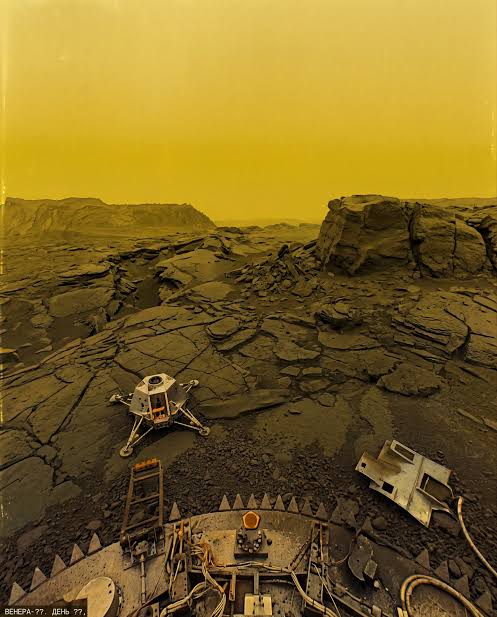
I use Mariner 2 and 4 as demarcations that divide science fiction. I call the time before Pre-NASA Science Fiction. After Mariner 2, science fiction writers had to deal with the reality of Venus as described by Wikipedia:
The atmosphere is composed mostly of carbon dioxide and has a thick cloud layer of sulfuric acid that spans the whole planet. At the mean surface level, the atmosphere reaches a temperature of 737 K (464 °C; 867 °F), making it the hottest planet in the solar system and also a pressure 92 times greater than Earth’s at sea level, turning the lowest layer of the atmosphere into a supercritical fluid.
In Pre-NASA SF, Mars was always the favorite planet. When the average citizen thought of aliens from space, they mostly thought of Martians. But Venusians were fairly popular with science fiction writers. According to Wikipedia, it’s been a popular fictional destination since the Civil War.
The reality of Venus didn’t stop some writers from using the planet in their planetary romances. Roger Zelazny’s “The Doors of His Face, the Lamps of His Mouth” (1965) is a great early example. In 2015, Gardner Dozois published an anthology of such stories, Old Venus.
If science fiction is science-based, shouldn’t stories about Venus work with what we know about Venus? If that’s the case, then imagining any kind of human settlement on Venus is insane. Even imagining a manned mission to Venus is crazy. Sure, some writers have tried to avoid the hell of the surface by imagining floating cities, or even terraforming Venus. Those writers worked to stay scientific. Other writers, hoping to come up with a believable mission to Venus invented massive tank-like suits.
What if science fiction isn’t science-based? I have friends who believe SF has never been about science. If that’s the case, Venus can be any kind of fantasyland you want. When I was growing up, the rationale for reading science fiction over fantasy is science fiction used science. If that’s not the case, what’s the point?
Of course, if we were completely scientific, and realistic, we’d accept that space isn’t for humans. For some people, it’s important to some people that humans explore space. Science fiction provides the sacred texts the promote that philosophy. If science fiction rationalizes the final frontier, shouldn’t it be as realistic as possible? If it isn’t, isn’t space no more realistic than Heaven or Valhalla?
In Pre-NASA SF, all the planets, moons, and asteroids of the Solar System were considered as possible destinations for human exploration. In Post-NASA SF, science fiction has mostly considered the Moon, Mars, asteroids, and maybe Titan. Venus is off the table. Yet, writers still consider it.
I have to wonder if we’re moving into an anti-science age. A large segment of the public is anti-science. Scientific research is losing funding. And science fiction has become far less about science. It feels like many people want reality to be belief-based rather than fact-based. Many people advocate for returning to a pre-scientific age. Of course, that mostly comes from religious folks, but not entirely. There’s a hankering to repeal The Enlightenment and Liberal philosophy.
If that trend continues, those thinkers will see Venus and the rest of the Solar System portrayed in stories that resemble Pre-NASA SF. I already feel Elon Musk and Jeff Bezos are spending their billions to build a 1950s vision of science fiction.
We need to ask if science fiction hasn’t brainwashed several generations. Venus is a kind of sanity test. Any contemplation of visiting Venus, whether fictional or explorational, should stress our scientific awareness. That’s also true of the Moon and Mars. Currently, both scientists and science fiction writers think we know enough to utilize both locations.
I believe both of those off-Earth prime locations will be impractical. But we won’t know that until we spend trillions and explore both thoroughly. I believe space probes in the 1960s significantly changed science fiction. But I also believe SpaceX will eventually become another shaper of science fiction. Just not the way people picture it now.
If science fiction is just another flavor of fantasy, everything I’ve said doesn’t matter. But if science fiction is an art form that speculates about the possibilities of science, then it does.
What’s funny is I can still read and enjoy science fiction published before Mariner 2, when Venus is a romantic jungle world. I can even read modern science fiction that attempts to recapture Pre-NASA in a kind of retro-SF. But it disappoints me if serious modern science fiction ignores the real Venus.
James Wallace Harris, 10/22/26

