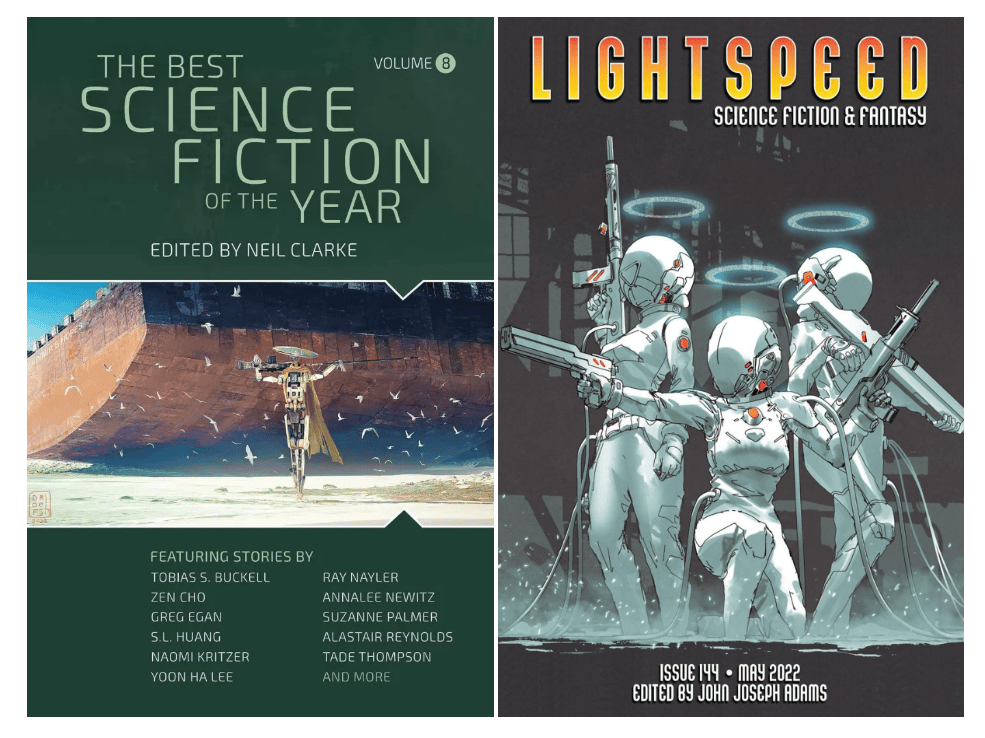
Story #2 of 31: The Best Science Fiction of the Year 8, ed. by Neil Clarke
Part of a series: Reading Science Fiction at 75. The first essay.
“Nobody Ever Goes Home to Zhenzhu” by Grace Chan was first published in Lightspeed (May 2002). You can read or listen to it online here.
Calam sneaks away from Orin to handle unfinished business on the planet Zhenzhu. In this very short space opera noir, the plot features one action scene, with gory results. The story wraps up with a discussion about freeing personal information from political thugs who control public information. That part is relevant to our times, but it wasn’t explored.
Treating this story like a wine tasting, I detect a strong flavor of George Lucas, with hints of Samuel R. Delany, William Gibson, and Richard K. Morgan.
Not to be critical, this story could have been Luke sneaking away from Han to conduct some unfinished business on Tatooine, but Han follows Luke and saves the day. My point is that writers need to tune into archetypes that appeal to readers. Of course, Chan uses specific details to make her story different; for example, Zhenzhu is in ecological collapse. Or why Calam is fighting the bad guys.
Old science fiction reader me keeps spotting these appeals to our belief systems, and I’m not responding like I did when I was younger.
“Nobody Ever Goes Home to Zhenzhu” is a well-told action story that could be part of a novel. I first read the story in the Clarke anthology, and then listened to Stefan Rudnicki read it on Lightspeed. I felt I got the best impression from listening. Rudnicki does a fantastic job of presenting the drama of Chan’s story.
“Nobody Ever Goes Home to Zhenzhu” appeals to three beliefs in readers. An analogy of what I’m saying is that Christianity succeeded by converting billions of souls over the last two thousand years by selling two major beliefs. The first is heaven; the second is eternal life. Science fiction succeeds primarily by selling the belief that humans have an infinity of worlds to explore and colonize. This is the first buy-in for Chan’s story.
Pulp and action fiction has always sold the belief that one person with a sword, gun, or blaster could take on a roomful of well-armed attackers and win. Chan’s story also sells this belief. Another common belief in certain genres of fiction is that a few people can overthrow a powerful ruling organization. I call this belief “blows against the empire.” Chan’s story kind of promises this too. Quite a few science fiction fans love to believe this; for example, just remember how popular The Hunger Games was.
My next comments shouldn’t be taken as a criticism of this story either. My point is why science fiction is failing me at 75. When I was young, I believed in the future where humanity would colonize the galaxy. That belief was a kind of faith. Looking back, I see my beliefs in science fiction were much like people who believe they will die and go to heaven. It’s a kind of unrealistic hope. Now I’m an atheist to those tenets of science fiction.
At 75, it’s hard to read stories about concepts I no longer believe in. I try to tell myself to just sit back and enjoy space opera as a specialized form of fantasy. Consider the Milky Way a setting like Tolkien’s Middle Earth. I could for many years, but I’ve reached an age where I can’t make believe anymore. Well, except for old favorite science fiction stories. If I have enough nostalgia for a story, even if I no longer buy into the beliefs it asks me to believe, I can still enjoy it.
I’ve always separated science fiction from fantasy by believing science fiction speculated about possible futures. I wanted to believe that after I died, humanity would go on to colonize the solar system and then the galaxy. I’ve reached an age where I no longer believe that, and it’s affecting my enjoyment of reading new science fiction. This is a problem for me because I have a lifelong addiction to science fiction that I can’t seem to break. I need a fix.
In his introduction, Neil Clarke describes how the demand for short science fiction has dwindled to almost nothing. Does that mean even young people have given up such beliefs? The demand for fantasy and romantasy has dwarfed the SF genre. Even as escapism, science fiction isn’t selling.
But there might be another factor. Maybe science fiction movie franchises have burned out the appeal of certain science fiction themes. I have to admit that I’m reading this anthology hoping to find something new and different. But has science fiction produced anything novel in decades? My bet regarding how well people like “Nobody Ever Goes Home to Zhenzhu” depends on how much science fiction they’ve consumed.
The market for best-of-the-year science fiction anthologies has dried up. Volume 8, covering 2022, ran a year late. Volume 9, due next month, covers 2023, is also late. This series used to have audiobook editions, but they are no longer published.
Have I gotten too old for science fiction, or has science fiction gotten old for everyone?
Like I said, my desire to read science fiction now is mostly nostalgic. I rarely enjoy reading new science fiction. However, I did get a big kick out of Andy Weir’s Project Hail Mary. Mostly, I seek the science fiction high I crave by reading old science fiction.
You know how many Baby Boomers only listen to music they discovered before 1975? The movie The Big Chill even jokes about it. I wonder if that’s happening with me and science fiction. I can reread a Heinlein juvenile and dig the shit out of it. However, I worry that someday even my old favorites won’t produce a good sci-fi high.
In reading this anthology, I hope to discover some stories that are seeds of new science fiction beliefs. One that writers can work with for a couple of decades.
James Wallace Harris, 10/1/26


I actually like SFFH stories from well before I was born. Something has changed in the market. And to be clear, the market is not the readers. It’s the editors. The editors select both the stories and the readers.
I am not the sort of reader today’s editors want.
LikeLike
That’s an interesting take. I should study the editors to see I can find one closer to my tastes. I always felt Gardner Dozois like too many high tech stories.
LikeLike