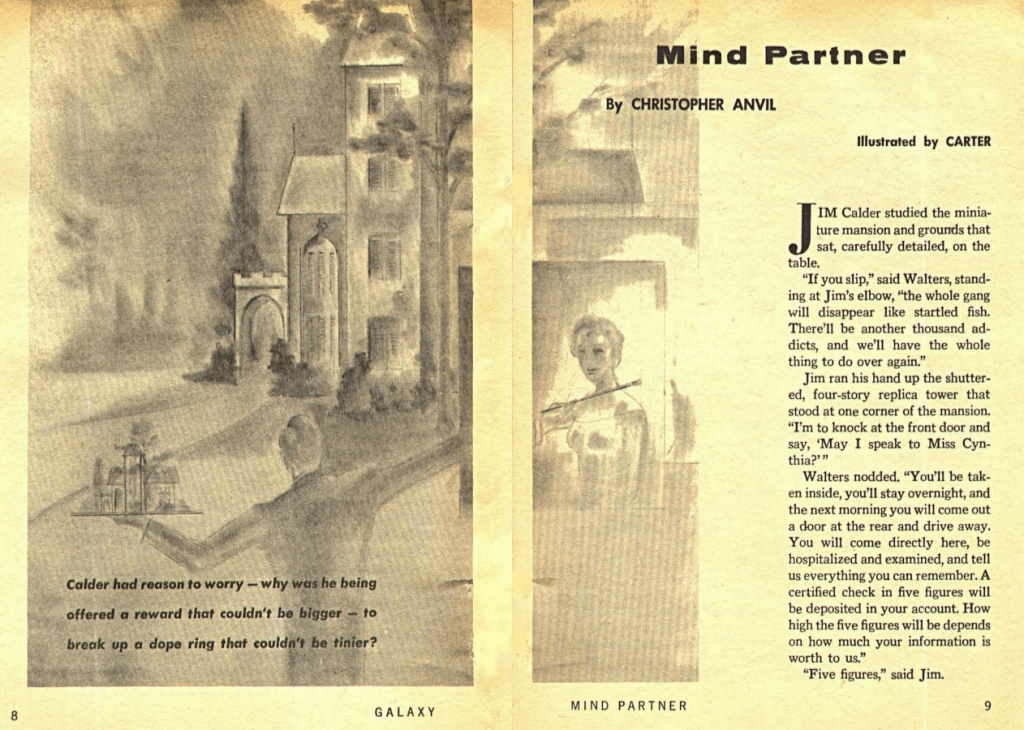
I’m trying to take a vacation from science fiction, but I can never escape its gravity. The pull of science fiction is as powerful as the “addictive drug” in “Mind Partner”. As much as I want to read something besides science fiction, I can’t stay away for long. However, to tempt me off the wagon, I need a science fiction story that’s different. Anvil blends a film noir detective encountering a cosmic horror invader. Unfortunately, Anvil is no Raymond Chandler or H. P. Lovecraft.
Finding a different kind of science fiction story is mighty hard for me, especially after reading thousands of science fiction stories. The other night, I pulled out a handful of Galaxy Magazines and started reading the August 1960 issue. (Follow that link and read the story before I spoil my analysis.)
“Mind Partner” was the first story I tried, and I hit pay dirt right away. It’s not a great story, but it is different. I checked ISFDB.org to see its reprint history and discovered “Mind Partner” achieved modest recognition. It was published in four editions of Galaxy, in four different countries, and it was selected for The Great SF Stories #22 (1960) edited by Isaac Asimov and Martin H. Greenberg. Greenberg also included “Mind Partner” in the anthology Neglected Visions (1979) that he edited with Barry Malzberg and Joseph Orlander. Their goal was to rescue forgotten stories they thought should be remembered.
Imagine you are a science fiction writer in 1960 and you want to sell a story to H. L. Gold, the editor of Galaxy Magazine. You know his slush pile is full of crappy science fiction that’s recycling ideas that have been around for decades. Could you come up with a new idea?
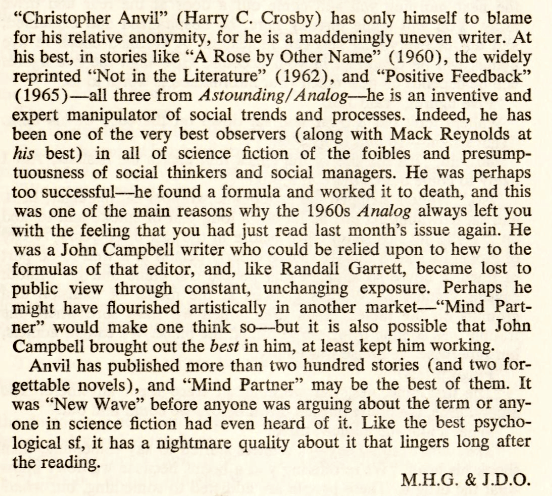
Here is what Greenberg and Orlander say about Christopher Anvil in the introduction to “Mind Partner” in Neglected Visions. At best, I feel they are condemning him with faint praise. But this is also one of the reasons why this story intrigues me. If you’re a mediocre writer who cranks out formulaic work, how do you break out?
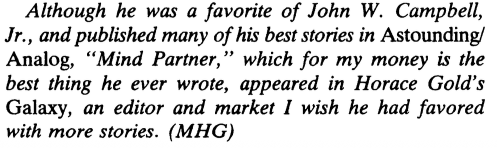
Years later, Greenberg was more emphatic about “Mind Partner” in The Great SF Stories 22 (1960):
Although Christopher Anvil is a mostly forgotten science fiction writer, Baen Books has been reprinting his work in ebook and audiobook editions, which are sometimes labeled “Complete Christopher Anvil” on Audible.com. Seven volumes are listed, and “Mind Partner” is included in Book 4, The Trouble with Aliens. (That audiobook is included in my Spotify subscription, so I might give it a try.)
I didn’t know all this on my first reading. I found “Mind Partner” intriguing but confusing. The story reminded me vaguely of The Three Stigmata of Palmer Eldritch by Philip K. Dick.
Jim Calder is offered $10,000 to $99,999 if he can pull off an undercover police operation. We don’t know if Jim is a detective or a cop. Details later in the story suggest he might be a detective, but he could be a volunteer from the police force.
A new drug is in town. People go in the front door of a mansion, and the next day, they leave by the back door addicted to a mysterious substance. The police have raided two previous buildings and locations, but have never caught the dealers. However, between 800 and 1,200 addicts are left behind living near those two locations. The police learn nothing directly from the addicts. All they know is they go in the front and out the back door the next day. Then they all rent a room near the drug house.
The police investigator, Walters, asks Calder to visit the mansion once and then come back to him.
So far, not that unique, at least to readers of mystery magazines. It sounds like something Philip Marlowe would investigate. And like Marlowe and Sam Spade in early film noir movies, the investigator gets knocked out and wakes up mentally altered.
As a writer, what can this drug do that’s completely different? At this point in the story, I asked myself, “What would Philip K. Dick do?” As I got into the story, I wondered if Christopher Anvil had been reading about LSD in 1960.
Then, as I read a little more, I realized that “Mind Partner” could be considered one of the earliest examples of a time-loop story. A day didn’t repeat like in Groundhog Day (1993), but Jim Calder lives his life over and over like in Replay by Ken Grimwood. We also see something similar in the episode of Star Trek: The Next Generation titled “The Inner Light.”
I consider the history of science fiction to be like one giant LLM (large language model). Writers consume science fiction and regenerate ideas. Did Anvil read about a character in a time loop before he wrote this story?
At this point in my reading, I remembered an intense experience I had over fifty years ago. I fell asleep in the afternoon after smoking some pot. I woke up and went into the kitchen. When I came back to the bedroom, I saw a monkey sitting in the window. I was hit by instant blackness. I woke up and thought, “What a weird dream.” I again went into the kitchen to get a Coke, and when I returned to the living room, I saw a chair I’d never seen before. Blam! I was hit with blackness again. I did this several more times. Each time I’d get up and walk around my apartment. It felt absolutely real. I felt absolutely awake. I started struggling during the blackouts. Somehow, I knew I wanted to wake up.
Then I woke up one more time. I went downstairs to sit outside on the steps. I kept waiting for the blackness. It never came.
Here’s where I explored in detail what happened. You really should go read it. I wonder if you have the reading skills to figure out what happened in one reading. I didn’t. I’m also curious how many SF readers are familiar with the obscure story?
The story got complicated, and I lost track of what Anvil was doing. I finished it and had several vague ideas about what Anvil might have intended. I even asked Gemini, Google’s AI, if it knew the story. It did. By the way, I was surprised by this. Months ago, I was asking AIs if they knew specific science fiction stories, and they’d say yes. But when questioned, I realized they had gotten what they knew from Wikipedia or blog reviews. This time, Gemini knew the story in detail and was quizzing me about it.
I decided I need to reread the story. Gemini asked if I saw the ambiguity of the ending, and I said I did. Then it asked what I thought about several scenes. The plot is more complicated than The Big Sleep. Unfortunately, Anvil lacks Chandler’s way with words.
Jim Calder goes to the drug house and talks with a mysterious, dark-haired lady named Cynthia. She tells him the first three visits will cost $1,000 each. The next three will be double that price. The price will double again after every three visits. Jim is drugged the first time.
When he awakens the next day, he reports back to Walters. Walters is so impressed with his intel that he pays Calder the full $99,999. Calder uses that money to start his own detective agency. The agency eventually grows to twenty-seven hired men. Jim also marries and has three children. His youngest son even goes into the detective business with him. Finally, he dies an old man.
Jim wakes up back in the drug house. He leaves, goes to Walters, and again gets paid the full amount. This time, he becomes a painter. Lives to be an old man. Dies.
Jim Calder lives six complete lives. Sometimes, he’s paid the minimum, $10,000, and doesn’t do well afterwards. He remembers each life in detail. The memories become painful. A burden.
After the sixth life, he complains to Cynthia that he wants to forget. She admits that’s why the price of the drug keeps doubling. What they’ve really hooked him on is the drug to forget.
Jim again goes back to Walters. They make an elaborate plan for him to break into the mansion. And they go into the details of the various lives, looking for clues. One clue is that sometimes shutters at the mansion are broken, and sometimes they aren’t.
Jim and Walters discuss the nature of the hallucinations and come up with various theories. Two of which deal with the distortion of time and how humans have learned to overcome their physical limitations. We can’t run as fast as cheetahs or fly like birds, but we can build cars and jet planes.
And what is time? A hummingbird thinks people are standing still. A powerful AI thinks a trillion times faster than we do. Jim and Walters wonder if they are dealing with a being from another dimension, one where time is much different. What if dreams and hallucinations happen at speeds far faster than reality?
Here’s the thing. Jim breaks into the mansion and finds an alien creature. The alien explains how all of the apparent events are happening. It has evolved the power to create detailed delusions in other beings. Its delusions alter humans’ awareness of time. Like humans using technology to extend their abilities, the alien uses mental abilities to overcome its limitations.
The range of the alien’s power is about four hundred feet. That’s why the drug addicts choose to live nearby; they need to stay close to the alien to tune into its power to forget. It’s also why the shutters appear broken sometimes, and other times are intact. Jim and Walters use remote TV cameras to check the alien’s power.
The alien agrees to be captured in exchange for its needs being met.
The end.
But really? Did Jim ever get back to Walters?
If he did, and the ending we are told is real, should we still believe everything? Could the alien have manipulated the police into providing a better living arrangement for its survival?
Christopher Anvil could have stretched this story into a novel. Just imagine what experiments humans would ask of the alien, and what the alien could trick us into giving it.
If Jim never got back to Walters, that could be another interesting novel.
James Wallace Harris, 4/23/26


I remember that story. In the final part, he duplicated his paintings — and the paintings were hung in museums. Each “life” left him with all the memories and abilities achieved in those lifetimes. The alien said the civilization he came from, used his ability to entertain and to help grow. (Or maybe not that 2nd phrase. I was young, but could see the advantage to living real life after having lived “real” lives. So much better than merely reading tons of books and listening to filtered and sanitized stories from my elders!)
Although a child of the sixties, I was never tempted by drugs and found being drunk boring, so lacked your life experience to compare . I found the alien explanation satisfying as the true end — and grieved with the hero over the loss of his “families.”
If I were the character, I could live with histories of confusing career differences, and in fact see where such disparate knowledge could have a synergistic effect. In fact, it would be fun to explore alternate lives in which a neglected talent could become fully developed — like in Ground Hog Day.
But the tragedy of fully knowing loved ones, raising children, having them be as real as the dirt in your hands — that would become a burden too deep to bear. A need to forget.
Plus, I suffer from mild facial-confusion (I blame an erratic childhood). Such a creature would make identifying a daily torment…but when I read the story, I thought the chance to experiment with so many life paths would be worth the risk.
Still do.
But then, I envied the hero of Ground Hog Day for the same reason. So much to learn, discover, experience… Will eternity be long enough?
LikeLiked by 1 person
I’ve always been drawn to time-loop stories, especially Replay by Ken Grimwood. Its character repeated their whole life over and over, each time trying to do something different.
You remember the details of “Mind Partner” quite well. Not perfect. I can never remember that much detail unless I read a story several time. But you do remember the pain of having to remember all those lifetimes.
LikeLike
I only read it once, back when the magazine was new.
Few realize all scientists (Including 98% of working scientists.) choose their preferred theories for an emotional component as well as intellectual/evidence reasons. I think the Many Worlds Theory gained so many adherents, and serious consideration even by those who opposed it, is that there is the universal desire for do-overs — and the conviction “If only I had —-, then things would now be perfect.” It’s nice to think sometime/somewhere you got it right the first time.
And egotistical to think that in the grand scheme of things, we have a clue what “right” is.
LikeLike
That’s an impressive memory you have.
One of my favorite fantasies is living my life over. Over the years, I’ve even decided exactly when I’d wanted to start over.
LikeLiked by 1 person
Hmmm .. I tried to leave a new comment (as opposed to this reply) and got a “comments are closed” message. 24 hours is an awfully small window to keep comments open. Wonder what’s going on?
LikeLiked by 1 person
I don’t close comments. I need to check into this.
LikeLike
Anyway – since this worked. I really like your LLM analogy. Authors do seem to repurpose and transform ideas in a way that sometimes seems like evolution. The science fiction kettle keeps boiling and churning throwing off transformed hints of characters, plots, themes, technologies that condense into new stories. And authors have to learn how to interact with this phenomenon in the same way that any programmer, who hopes to survive this unsettling era, has to learn how to successfully interact with LLMs.
LikeLike
Jim, I’m sorry your vacation from SF was interrupted.
Thanks for a great essay. I own both that issue of Galaxy and “Mind Partner and 8 Other Novelets from Galaxy. When I was a younger man and bought these in the 1970s, I read everything you gat came my way.
I have to assume I read “Mind Partner”, but I remembered nothing.
I have read quite a bit of Christopher Anvil, but I am not in a hurry to reread all of it. Looking at the stories of his I have read lately, including “Not In The Literature”, “Gadget versus Trend”, “The Captive Djinn”, and others, none of it gets to great.
“Mind Partner” is a great story, and I appreciate your calling it to my attention. Right now, it’s the best work by Anvil I have read lately.
Thanks.
LikeLike