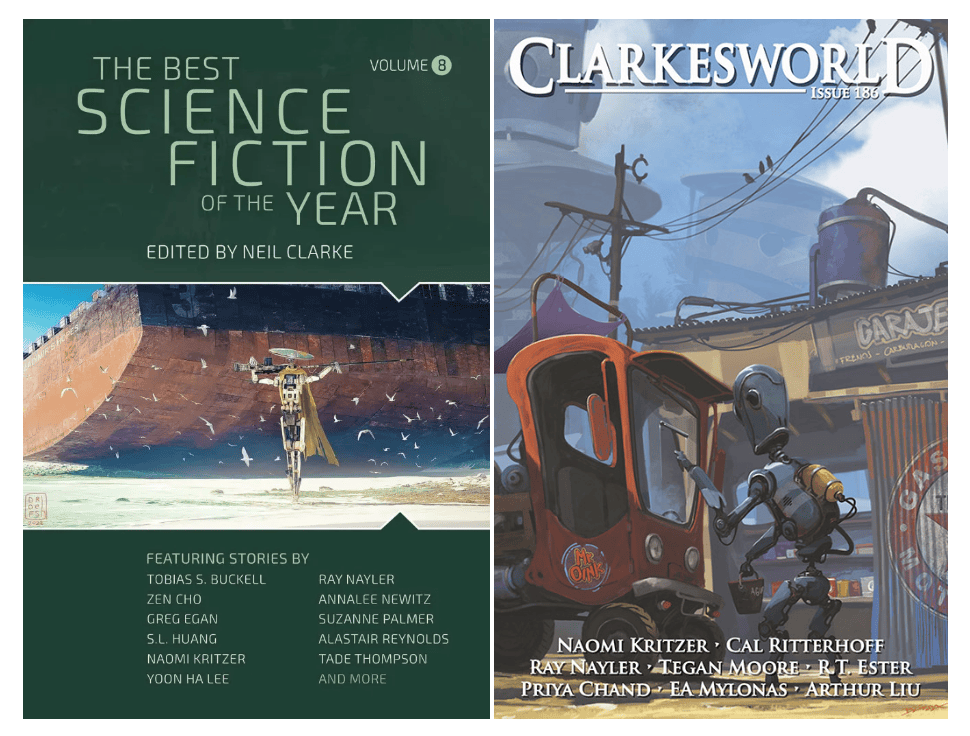
Story #1 of 31: The Best Science Fiction of the Year, Volume 8, edited by Neil Clarke
I’ll be turning 75 soon, and looking back, science fiction has given me much enjoyment, insight, and even inspiration. However, over the last couple of years, science fiction’s magic has ceased working. The state of the world has made me cynical. But then, it might be what I call the Williamson Effect. I had a friend, John Williamson, who slowly lost interest in everything he once loved before he died. I saw the same thing happen to Samuel Clemens in the many biographies I read of Mark Twain.
I’m struggling to cure this symptom of my aging, or at least put it into remission for a few more years. To look for my lost hope in science fiction, I’ve decided to join two discussions on the Facebook group, Best Science Fiction and Fantasy Short Fiction. The first covers Volume 8 of The Best Science Fiction of the Year, edited by Neil Clarke. That anthology collects the best science fiction short stories published in 2022. The group discussions are on Mondays and Fridays.
The second group discussion, if it happens, will read The Year’s Best Science Fiction, Fourth Annual, edited by Gardner Dozois. It covers the best short SF from 1986. I hope this group does make. I worry that I’ve lost interest in science fiction because it’s changed. Reading stories from forty years ago will test this theory.
“The Dragon Project” is the first story in Volume 8 of The Best Science Fiction of the Year. It was originally published in issue 186 of Clarkesworld. This suggests that Neil Clarke really loved this story. You can read or listen to it online here.
I found “The Dragon Project” mildly entertaining. A pleasant little read, but kind of bland. It imagines a future where new types of animals can be created with 3D biological printers. Vivian and her business partner, Jed, get a customer who wants them to create a dragon for the Chinese New Year parade. At first, Vivian creates a tiny dragon the size of a cat that disappoints the customer. Then she creates a bigger creature, but still only the size of a dog. They lose their client. Then Vivian and Jed hear about a horse-sized creature on the loose that some people describe as a hippogriff. They figure their client found another designer.
“The Dragon Project” is amusingly told. It’s light. Unfortunately, this story didn’t enchant me like Kritzer’s 2015 award-winning “Cat Pictures Please.” That little fantasy at least resonated with reality. However, I can understand the appeal of tiny dragons. I loved when Heinlein and Andre Norton included strange creatures in their young adult fiction. At 12, I would have loved to live on Mars with a creature like Willis from The Red Planet.
This might sound weird, but I might be prejudiced against 3D-printed creatures. I don’t think that will ever happen, but more importantly, I feel the future has gotten too riddled with technology. In the 1960s, a Jetsons future sounded wonderful. But after SpaceX and ChatGPT, technology is depressing. Young me loved high tech, but old me is becoming a Luddite.
Science fiction always made me excited about the future. “The Dragon Project” is a well-told, light-hearted story, but I don’t want to live in a future where rich people can become gods. My old mind wonders about all the millions of 3D-printed creatures that will be abandoned.
Of course, this isn’t a criticism of Kritzer’s story. But I must ask: has science fiction become Pandora’s Box? What happens if everything science fiction imagines becomes real? HAL was very entertaining in 1968, but not so much fun in 2026. “The Man Who Sold the Moon” was wonderful once, but Elon Musk is a drag.
I hope I haven’t bummed you out. Sorry if I have. But I thought I’d let you know that science fiction mutates into something different in old age. At least, it has for me.
The last two novels I loved were Whistler by Ann Patchett and The Things We Never Say by Elizabeth Strout. If I could have read those 2026 novels in 1964 when I was 12, I would have thought the future boring. But both of those books gave me hope and inspiration this year.
I’m not sure science fiction can do that anymore, at least for me. However, I’m going to keep reading this anthology. Maybe I’ll find another kind of science fiction that works for a 75-year-old science fiction fan.
James Wallace Harris, 9/30/26


2 thoughts on ““The Dragon Project” by Naomi Kritzer”