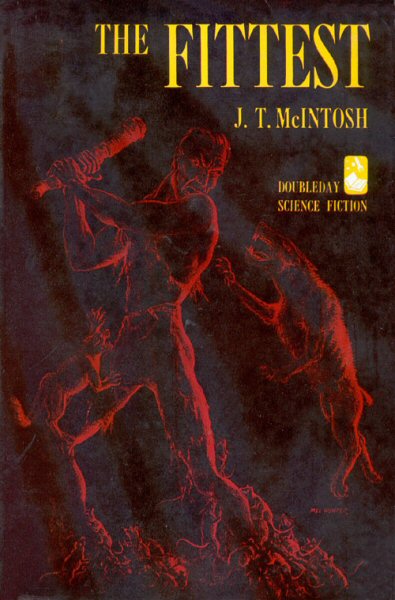
After being thoroughly disappointed with Ruler of the World, one of J. T. McIntosh’s later works, I decided to try one of his earliest novels. One from his prime. I chose The Fittest when I read that it was about animals with enhanced intelligence. It was his fourth published novel, from 1955. I love science fiction tales set just as civilization is collapsing. I have a strong affinity with Robinsonades, which are closely related to post-apocalyptic fiction. I especially love the cozy ones, about a small group of people struggling to survive.
My gold standard for judging such stories is Earth Abides by George R. Stewart and the television series Survivors (BBC 1975-1977). If these are 5-star efforts, then The Fittest is only a 3-star work; however, I thoroughly enjoyed reading it. It was a quick page-turner that I finished in less than 24 hours. The Fittest touched upon many of the essential elements of both Earth Abides and Survivors, but not as deeply.
The setup for The Fittest also puts it into another sub-genre of science fiction, one about uplifted animals. The story begins with a young woman being killed by mice and a cat. Over time, we learned that the intelligence of mice, rats, cats, dogs, and horses was increased in scientific experiments. Not enough for them to talk or think like humans, but enough to give them a greater ability to thrive and compete. Eventually, they could breed true, escape the laboratory, and spread across the world. For some reason, these uplifted animals saw humans as competition, with each species working to kill humans when they could. The uplifted horses were quickly eliminated because of their long gestation period, but the smaller animals bred faster than we could exterminate them. Over time, mice, rats, cats, and dogs found savvy ways to destroy our crops, infrastructure, and technology. They were simple methods, like chewing through wires, hoses, wooden structures, and so on, but effective in bringing down our civilization.
I have to assume that J. T. McIntosh was inspired by Sirius (1944) by Olaf Stapledon, Earth Abides (1949), The Day of the Triffids (1951) by John Wyndham, and Brain Wave (1954) by Poul Anderson. Sirius was an uplifted dog, but it could talk. Triffids were plants with more intelligence. And Brain Wave imagined all life on Earth with increased intelligence. Earth Abides and The Day of the Triffids dealt with small communities forming after civilization collapses.
Stories about humanity recovering from apocalyptic events were common in the 1950s and 1960s. Often they were inspired by the Cold War, pandemics, or environmental catastrophes. In 1956, John Christopher imagined a virus killing variously related grasses in The Death of Grass. I thought Wyndham was quite creative when he invented triffids. I give McIntosh credit for speculating about how increased intelligence in animals might threaten our apex position.
However, for me, how individuals cope in an apocalypse is the key rubric to score post-apocalyptic novels. I’m afraid Don Paget from The Fittest is no Isherwood Williams from Earth Abides. However, the characterization in The Fittest is closer to the characterization in the television series Survivors. Both stories are set in rural England, so that wins points with me.
Read my essay, “What Would You Do If You Were Among the Last Humans on Earth?” I think books about survivors of an apocalypse challenge readers to imagine themselves in a similar situation. Most post-apocalyptic novels deal with human vs. human conflicts, and The Fittest does cover this. But McIntosh creates a unique kind of horror when he pictures us fighting intelligent mice, rats, cats, and dogs. It’s not as scary as The Quiet Place, but if you think about what McIntosh imagines, it’s pretty scary.
Mice are particularly threatening to women. At the beginning of the book, three mice terrorize Gloria simply by stalking her. McIntosh points out that women hate the thought of mice touching them. While Gloria is terrorized by the mice, a cat attacks her. It’s not strong enough to kill her, but its vicious scratches scare Gloria into trying to flee out a window, and she dies from a fall.
Rats attack in waves of hundreds. Dogs attack in packs of dozens. Their movements suggest they have developed intelligent cooperative strategies. Not that they can talk or communicate ideas, but that they learn together. All four species learn that humans depend on technology to survive, so they begin sabotaging us in crude but effective ways. These modest increases in intelligence make The Fittest far more realistic.
The real story here is how humans react. Paralleling this story is Don’s relationship with Ginette and other women. It’s hard to choose a life partner during an apocalypse. Don is still swayed by good looks, but he realizes that having a personality with survival traits is the new measure of hotness.
I’m torn between rating this book 3 or 4 stars on Goodreads. My desire to keep reading was definitely 4 stars, but because of memories of more famous books, I think I should only give it 3 stars. My main criterion for rating a book 4 stars is having the feeling I’ll eventually want to reread it. I don’t think I will. I’ve read Earth Abides three times, and will probably read it again someday. That’s because the characters have depth, and the book puts me into philosophical contemplations. Earth Abides is almost twice as long as The Fittest.
It’s a shame McIntosh didn’t put more into The Fittest. Science fiction writers have always cranked out books to get quick paychecks. Earth Abides has always stayed in print. That’s not true for The Fittest. Still, I’m fascinated by the forgotten Scottish science fiction writer. I’ve now read three novels by him, two of which I liked.
Countless books have been published about survivors of apocalypses. Few stay in print. Earth Abides abides. That’s also a kind of survival of the fittest.
James Wallace Harris, 7/2/26


I only have one book by him, “The Suiciders”. It’s a weird book combining space war and witchcraft. I bought it as a teenager for something to read at the beach because it had a cool cover with rockets on it. I didn’t like it enough to ever get anything else of his.
Here’s a link to the isfdb page for the book https://www.isfdb.org/cgi-bin/pl.cgi?265900
LikeLiked by 1 person