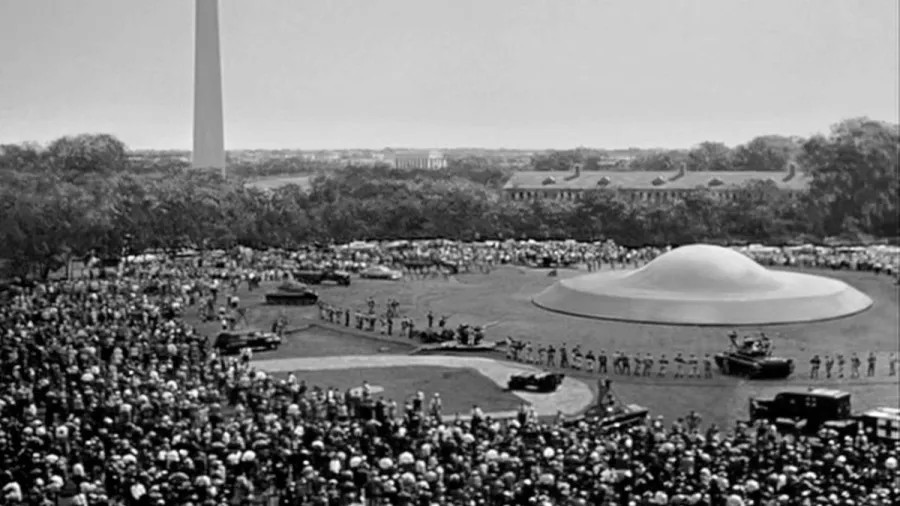
Why Do We Read Science Fiction?

by James Wallace Harris, 5/2/26

Why did so many Baby Boomers embrace science fiction back in the 1950s and 1960s? We were all playing Cowboys and Indians, wearing cowboy hats and shooting our cap pistols at each other, and watching westerns all the time on TV. Then we switched to space helmets and ray guns, and changed the channel to watch old 50s Sci-Fi flicks, The Jetsons, My Favorite Martian, and Lost in Space.

I can’t remember a time when I didn’t know about space and space travel. Nor can I remember my first exposure to rockets. My guess is it was from television. I remember my 4th-grade class listening to Alan Shepard’s 15-minute Mercury flight on Freedom 7 over the classroom’s PA system. That was May 5, 1961 (65 years ago). I assume I had seen movies or television shows with spaceships before that, but I have no memory. I watched The Twilight Zone before then, so it might have been on that show.

It seems like dinosaurs, spaceships, and robots have always been part of my conscious mind. Maybe Carl Jung was right about the collective unconscious. I knew about space travel before I learned about astronomy. And that doesn’t make sense, does it? How could I know about traveling in space before I knew what space was?

I do know that by 1962, I was reading Tom Swift, Jr. books. But I was also reading nonfiction books about NASA. We lived on base at Homestead Air Force Base, and I used the base library. The Moon and Mars were frequently mentioned in NASA’s goals, but this was before I started reading astronomy books. My young mind must have been told about the solar system in elementary school.

Concurrent with my discovery of science fiction in the mid-sixties were the flights of Project Mercury and Project Gemini. I slowly came to believe that science fiction was preparing me for the future. That was my rationale for reading science fiction. In reality, science fiction was my coping mechanism for a stressful childhood. By the time I learned what the term “science fiction” meant in 1964, I had attended at least seven different schools in four different states. The constant moving, as well as my parents’ marital problems and alcoholism, should have made my life miserable. But I loved those years because I loved science fiction.

During childhood and teen years, even into college, I really believed reading science fiction prepared readers for the future. Then, around 1975, I realized the futures I expected weren’t going to unfold, and reading science fiction was only entertainment. I gave up science fiction, got a real job, got married, and finished college. Then, in 1985, I returned to science fiction. I then treated it like an English major studying literary history. It was no longer about the future, but storytelling.

Any well-told story about any time or place, real or imaginary, can capture a reader’s attention. So the question becomes: Why do we read science fiction? It gets weird when you think about it. Why did we want to leave Earth? No sane person would want to live on the Moon or Mars, and you have to be tripping if you think Titan is a wonderful destination. Anything further is no more realistic than Oz or Narnia.

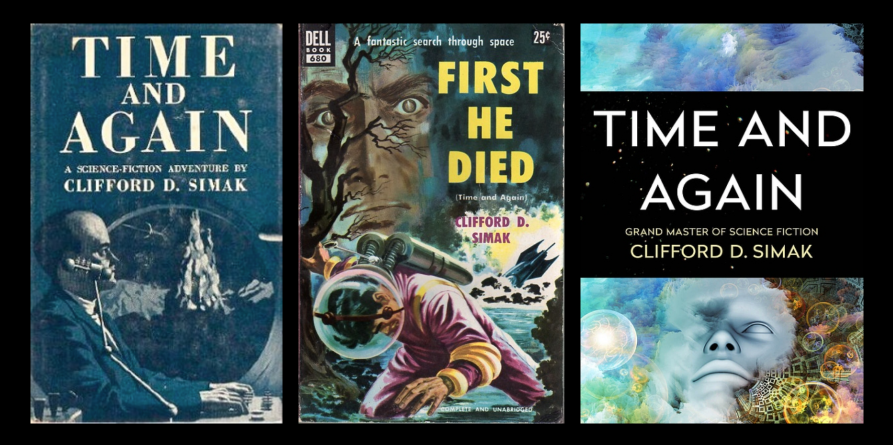
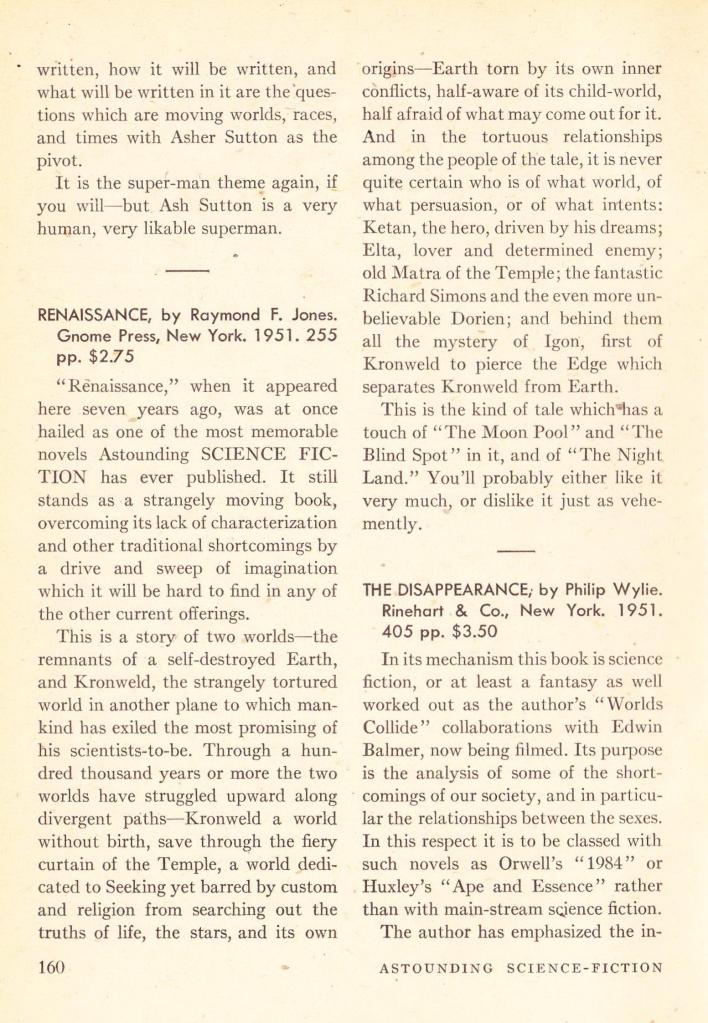
The question “Why am I reading science fiction?” struck me particularly hard recently, while reading stories by Christopher Anvil in The Trouble With Aliens. Christopher Anvil is a mostly forgotten science fiction writer who regularly sold short science fiction to John W. Campbell, Jr. for Astounding and Analog.

I’m enjoying the stories, but just barely. They just pass muster. I do enjoy them, but I’m enjoying them at the level of watching anything on television when you’re bored, and the show is just good enough not to change the channel. Anvil’s stories feel like I’m resonating with the archetypes of science fiction in my unconscious mind.

I keep asking myself: why don’t I read something better, something more rewarding, something that is cutting-edge? The stories are military science fiction, a sub-genre that I normally find boring. Reviewers don’t have much positive to say about Anvil, but they often praise him for his satire. Satire implies a target. Is the military Anvil’s target, or military science fiction? Anvil’s stories remind me a bit of Eric Frank Russell and Harry Harrison.

But are these stories really satire? Satire is usually driven by absurdity, and I don’t think Anvil believes his science fiction situations are absurd. I get the feeling Anvil is just trying to keep up with the other Astounding/Analog writers churning out what Campbell wants to buy and readers want to read.

Anvil’s stories epitomize how I once saw science fiction.

Anvil’s stories are entertaining enough that I look forward to returning to my audiobook. His stories aren’t great, but they are pleasant. I wonder if I’m using them to cope with getting old, like how I used science fiction to cope with adolescence?

I feel his stories touch what’s very basic about science fiction. If I could understand that, maybe I could understand why I started reading science fiction as a kid.

Anvil’s stories also remind me of Project Hail Mary, the bestselling novel by Andy Weir, which is also currently a hit movie. Weir’s appeal is that his stories are about solving problems, and that’s what Anvil focuses on too. However, Anvil’s prose is functional, but far from Weir’s level of entertaining.

I have to wonder if such escapist science fiction doesn’t function like dreaming at night. They might be a diversion for our consciousness when we want to turn off reality, and maybe symbolically play out some kind of existential purpose.

Baen Books has collected Anvil’s stories in several volumes, which they sometimes label the Complete Christopher Anvil. They are available in audiobook, which is my preferred format for consuming old science fiction.

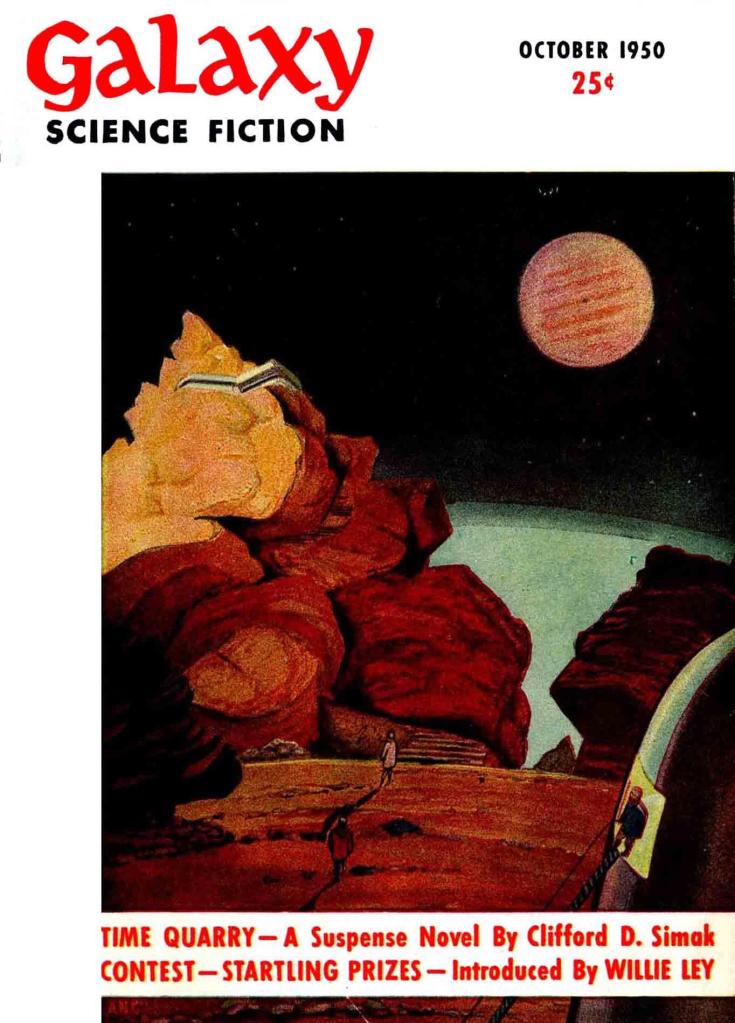
John W. Campbell, Jr. frequently published Anvil stories, but he seldom made them the cover story. Anvil published two novels, according to ISFDB.org, although many of his short stories were republished as a few fix-up paperback novels. Overall, Anvil appears to have published over a hundred stories, and much of that work has been collected in eight volumes by Baen Books.

Back in the 1950s, science fiction imprinted on my mind, and I’ve been following it around like a little duckling ever since.

JWH

“Mind Partner” by Christopher Anvil

I’m trying to take a vacation from science fiction, but I can never escape its gravity. The pull of science fiction is as powerful as the “addictive drug” in “Mind Partner”. As much as I want to read something besides science fiction, I can’t stay away for long. However, to tempt me off the wagon, I need a science fiction story that’s different. Anvil blends a film noir detective encountering a cosmic horror invader. Unfortunately, Anvil is no Raymond Chandler or H. P. Lovecraft.

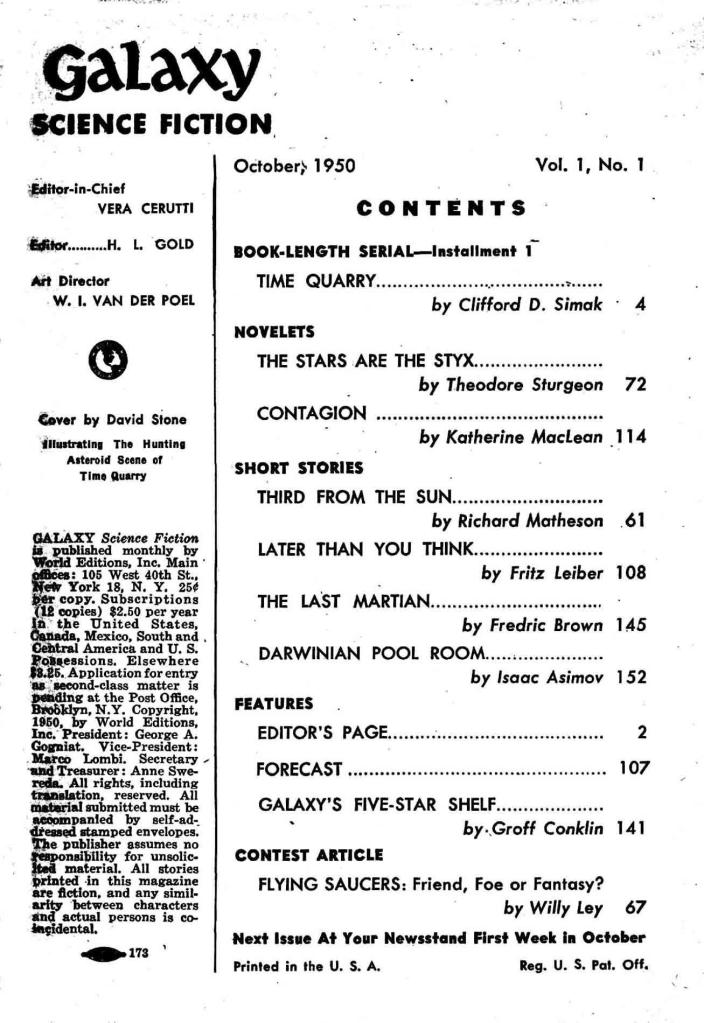
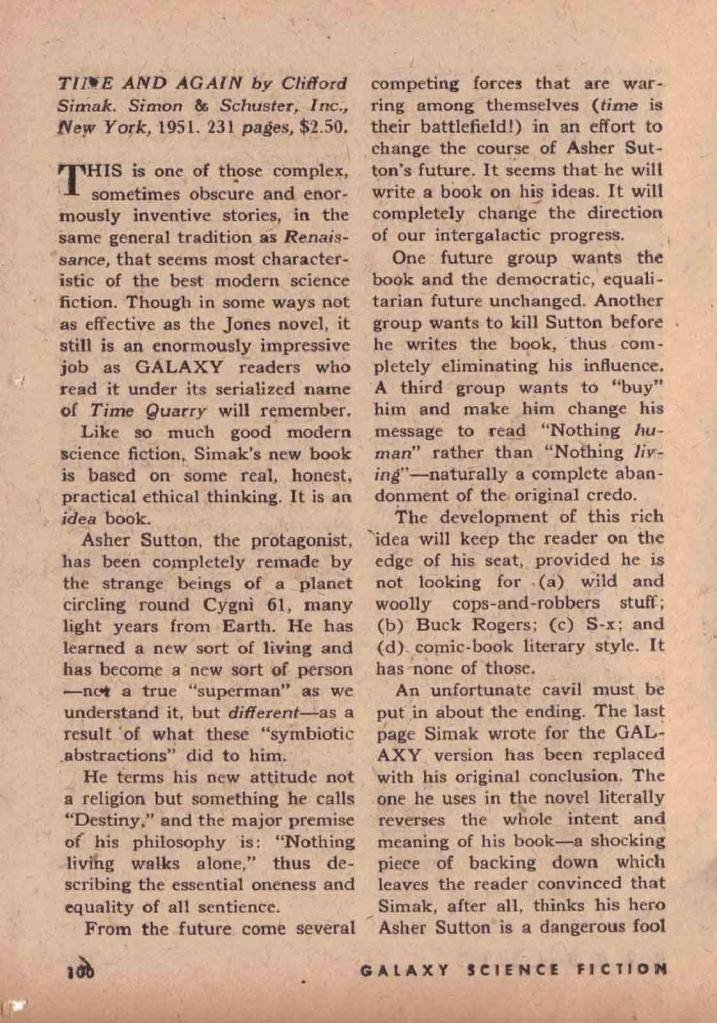
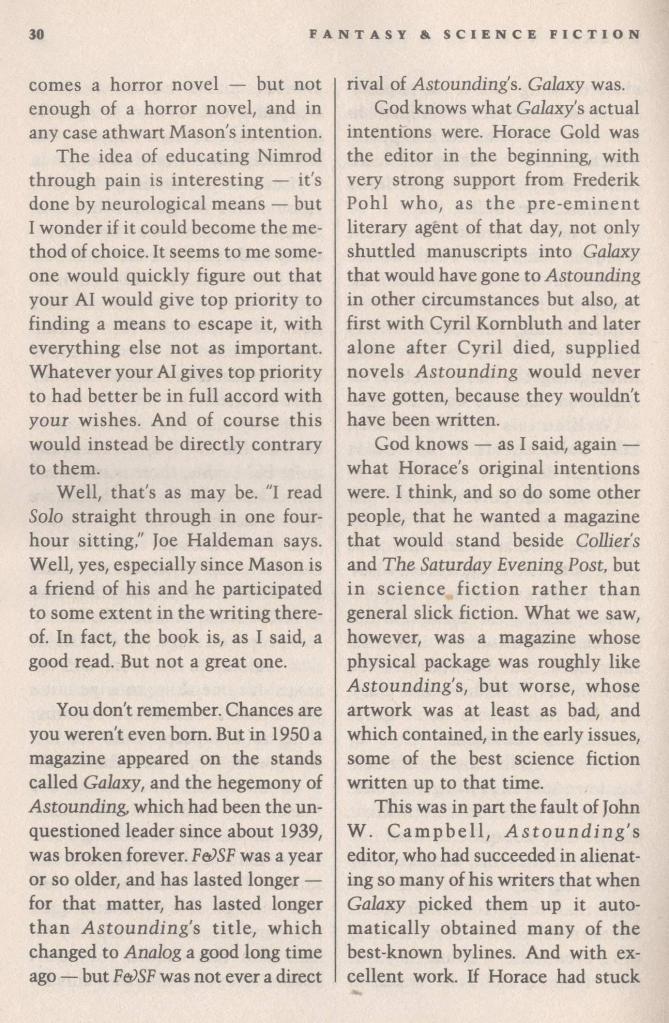
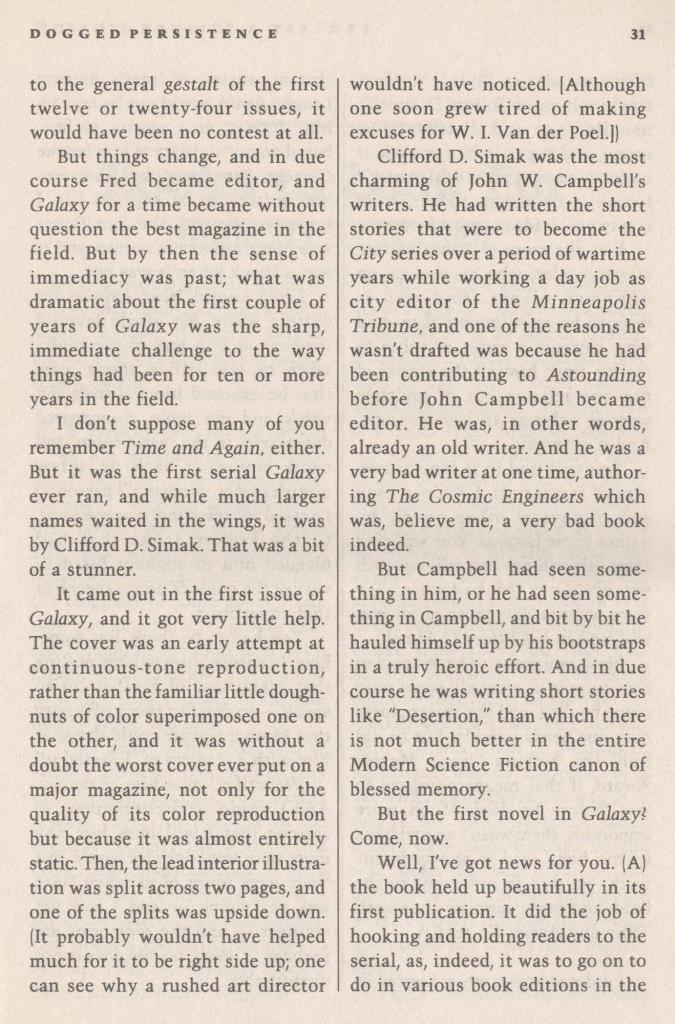
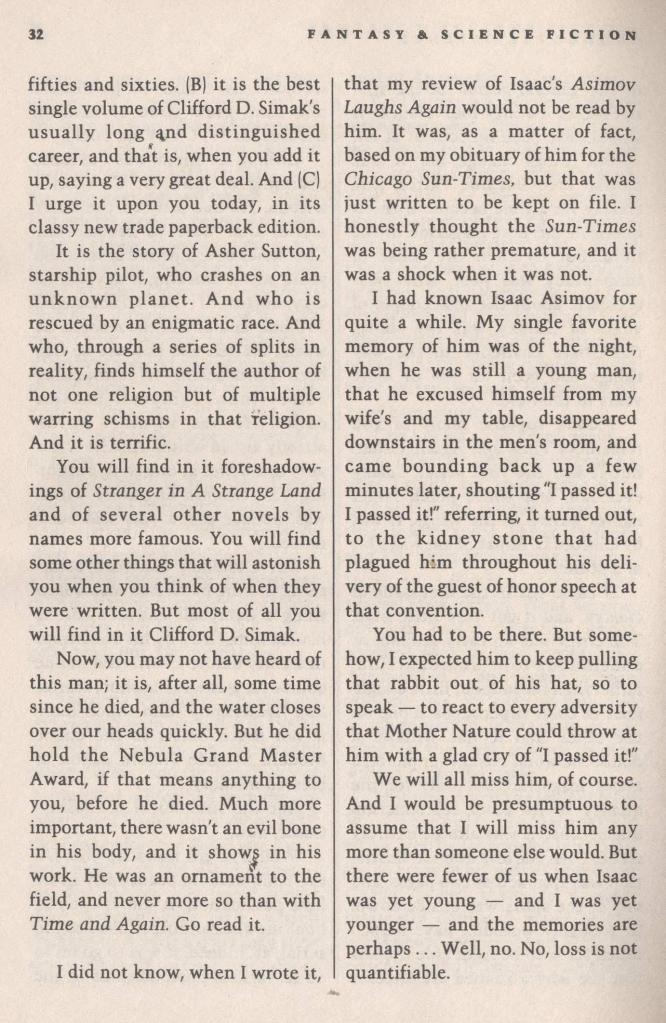
Finding a different kind of science fiction story is mighty hard for me, especially after reading thousands of science fiction stories. The other night, I pulled out a handful of Galaxy Magazines and started reading the August 1960 issue. (Follow that link and read the story before I spoil my analysis.)

“Mind Partner” was the first story I tried, and I hit pay dirt right away. It’s not a great story, but it is different. I checked ISFDB.org to see its reprint history and discovered “Mind Partner” achieved modest recognition. It was published in four editions of Galaxy, in four different countries, and it was selected for The Great SF Stories #22 (1960) edited by Isaac Asimov and Martin H. Greenberg. Greenberg also included “Mind Partner” in the anthology Neglected Visions (1979) that he edited with Barry Malzberg and Joseph Orlander. Their goal was to rescue forgotten stories they thought should be remembered.

Imagine you are a science fiction writer in 1960 and you want to sell a story to H. L. Gold, the editor of Galaxy Magazine. You know his slush pile is full of crappy science fiction that’s recycling ideas that have been around for decades. Could you come up with a new idea?

Here is what Greenberg and Orlander say about Christopher Anvil in the introduction to “Mind Partner” in Neglected Visions. At best, I feel they are condemning him with faint praise. But this is also one of the reasons why this story intrigues me. If you’re a mediocre writer who cranks out formulaic work, how do you break out?

Years later, Greenberg was more emphatic about “Mind Partner” in The Great SF Stories 22 (1960):

Although Christopher Anvil is a mostly forgotten science fiction writer, Baen Books has been reprinting his work in ebook and audiobook editions, which are sometimes labeled “Complete Christopher Anvil” on Audible.com. Seven volumes are listed, and “Mind Partner” is included in Book 4, The Trouble with Aliens. (That audiobook is included in my Spotify subscription, so I might give it a try.)

I didn’t know all this on my first reading. I found “Mind Partner” intriguing but confusing. The story reminded me vaguely of The Three Stigmata of Palmer Eldritch by Philip K. Dick.

Jim Calder is offered $10,000 to $99,999 if he can pull off an undercover police operation. We don’t know if Jim is a detective or a cop. Details later in the story suggest he might be a detective, but he could be a volunteer from the police force.

A new drug is in town. People go in the front door of a mansion, and the next day, they leave by the back door addicted to a mysterious substance. The police have raided two previous buildings and locations, but have never caught the dealers. However, between 800 and 1,200 addicts are left behind living near those two locations. The police learn nothing directly from the addicts. All they know is they go in the front and out the back door the next day. Then they all rent a room near the drug house.

The police investigator, Walters, asks Calder to visit the mansion once and then come back to him.

So far, not that unique, at least to readers of mystery magazines. It sounds like something Philip Marlowe would investigate. And like Marlowe and Sam Spade in early film noir movies, the investigator gets knocked out and wakes up mentally altered.

As a writer, what can this drug do that’s completely different? At this point in the story, I asked myself, “What would Philip K. Dick do?” As I got into the story, I wondered if Christopher Anvil had been reading about LSD in 1960.

Then, as I read a little more, I realized that “Mind Partner” could be considered one of the earliest examples of a time-loop story. A day didn’t repeat like in Groundhog Day (1993), but Jim Calder lives his life over and over like in Replay by Ken Grimwood. We also see something similar in the episode of Star Trek: The Next Generation titled “The Inner Light.”

I consider the history of science fiction to be like one giant LLM (large language model). Writers consume science fiction and regenerate ideas. Did Anvil read about a character in a time loop before he wrote this story?

At this point in my reading, I remembered an intense experience I had over fifty years ago. I fell asleep in the afternoon after smoking some pot. I woke up and went into the kitchen. When I came back to the bedroom, I saw a monkey sitting in the window. I was hit by instant blackness. I woke up and thought, “What a weird dream.” I again went into the kitchen to get a Coke, and when I returned to the living room, I saw a chair I’d never seen before. Blam! I was hit with blackness again. I did this several more times. Each time I’d get up and walk around my apartment. It felt absolutely real. I felt absolutely awake. I started struggling during the blackouts. Somehow, I knew I wanted to wake up.

Then I woke up one more time. I went downstairs to sit outside on the steps. I kept waiting for the blackness. It never came.

Here’s where I explored in detail what happened. You really should go read it. I wonder if you have the reading skills to figure out what happened in one reading. I didn’t. I’m also curious how many SF readers are familiar with the obscure story?

The story got complicated, and I lost track of what Anvil was doing. I finished it and had several vague ideas about what Anvil might have intended. I even asked Gemini, Google’s AI, if it knew the story. It did. By the way, I was surprised by this. Months ago, I was asking AIs if they knew specific science fiction stories, and they’d say yes. But when questioned, I realized they had gotten what they knew from Wikipedia or blog reviews. This time, Gemini knew the story in detail and was quizzing me about it.

I decided I need to reread the story. Gemini asked if I saw the ambiguity of the ending, and I said I did. Then it asked what I thought about several scenes. The plot is more complicated than The Big Sleep. Unfortunately, Anvil lacks Chandler’s way with words.

Jim Calder goes to the drug house and talks with a mysterious, dark-haired lady named Cynthia. She tells him the first three visits will cost $1,000 each. The next three will be double that price. The price will double again after every three visits. Jim is drugged the first time.

When he awakens the next day, he reports back to Walters. Walters is so impressed with his intel that he pays Calder the full $99,999. Calder uses that money to start his own detective agency. The agency eventually grows to twenty-seven hired men. Jim also marries and has three children. His youngest son even goes into the detective business with him. Finally, he dies an old man.

Jim wakes up back in the drug house. He leaves, goes to Walters, and again gets paid the full amount. This time, he becomes a painter. Lives to be an old man. Dies.

Jim Calder lives six complete lives. Sometimes, he’s paid the minimum, $10,000, and doesn’t do well afterwards. He remembers each life in detail. The memories become painful. A burden.

After the sixth life, he complains to Cynthia that he wants to forget. She admits that’s why the price of the drug keeps doubling. What they’ve really hooked him on is the drug to forget.

Jim again goes back to Walters. They make an elaborate plan for him to break into the mansion. And they go into the details of the various lives, looking for clues. One clue is that sometimes shutters at the mansion are broken, and sometimes they aren’t.

Jim and Walters discuss the nature of the hallucinations and come up with various theories. Two of which deal with the distortion of time and how humans have learned to overcome their physical limitations. We can’t run as fast as cheetahs or fly like birds, but we can build cars and jet planes.

And what is time? A hummingbird thinks people are standing still. A powerful AI thinks a trillion times faster than we do. Jim and Walters wonder if they are dealing with a being from another dimension, one where time is much different. What if dreams and hallucinations happen at speeds far faster than reality?

Here’s the thing. Jim breaks into the mansion and finds an alien creature. The alien explains how all of the apparent events are happening. It has evolved the power to create detailed delusions in other beings. Its delusions alter humans’ awareness of time. Like humans using technology to extend their abilities, the alien uses mental abilities to overcome its limitations.

The range of the alien’s power is about four hundred feet. That’s why the drug addicts choose to live nearby; they need to stay close to the alien to tune into its power to forget. It’s also why the shutters appear broken sometimes, and other times are intact. Jim and Walters use remote TV cameras to check the alien’s power.

The alien agrees to be captured in exchange for its needs being met.

The end.

But really? Did Jim ever get back to Walters?

If he did, and the ending we are told is real, should we still believe everything? Could the alien have manipulated the police into providing a better living arrangement for its survival?

Christopher Anvil could have stretched this story into a novel. Just imagine what experiments humans would ask of the alien, and what the alien could trick us into giving it.

If Jim never got back to Walters, that could be another interesting novel.

James Wallace Harris, 4/23/26

Taking A Vacation From Reading Science Fiction

After gorging on science fiction short stories for several years, I’ve finally got my fill of science fiction. At 74, aging is catching up with me. I was reading 52 books a year, and regularly posting on two blogs: Auxiliary Memory and this one, Classics of Science Fiction. My reading has slowed to about a fourth of what it was, and so has my blogging.

I’ve decided to post all my essays to Auxiliary Memory and put Classics of Science Fiction on hold. If I happen to write about science fiction, I’ll post it there. I’d rather look somewhat productive on one blog, rather than unproductive on two.

Also, I hunger for different kinds of reading. We’re now living science fiction. Reading about what’s going on now seems further out than speculation about the future. With AI, robots, space travel, climate change, astronomy, renewable energy, and so many other fields, it feels like we’re approaching a perfect storm of change.

One video I recently watched suggested that the amount of change humanity experienced in the 250-year history of the United States is enough to kill a person from future shock. If George Washington time-traveled to 2026, they speculated he would die of future shock. The guy also speculated that to generate that much future shock by bringing someone from before 1776 to 1776 would require going back 13,000 years. I have no idea how they calculated that, but it sounds right from all my history book reading. I believe society is breaking down now because the amount of future shock one person experiences in a lifetime is approaching what Washington would have felt.

I’m switching from science fiction to nonfiction to comprehend that future shock. Here are the books I’ve bought and plan to review at Auxiliary Memory. It will take me some time. Like I said, I’m slowing down.

  • I Am A Strange Loop by Douglas Hofstadter
  • Abundance by Ezra Klein and Derek Thompson
  • Worldviews: An Introduction to the History of Philosophy of Science by Richard DeWitt
  • Why the World Doesn’t Make Sense by Steven Hagen
  • Self Comes to Mind: Constructing the Conscious Brain by Antonio Damasio
  • A World Appears: A Journey Into Consciousness by Michael Pollan
  • Improbable Destinies: Fate, Chance, and the Future of Evolution by Jonathan B. Losos
  • Emergence: The Connected Lives of Ants, Brains, Cities, and Software by Steven Johnson
  • Being You: A New Science of Consciousness by Anil Seth
  • Maps of Meaning: The Architecture of Belief by Jordan B. Peterson
  • The Molecule of More: How a Single Chemical in Your Brain Drives Love, Sex, and Creativity–And Will Determine the Fate of the Human Race by Daniel Z. Lieberman and Michael E. Long
  • Sensation: The New Science of Physical Intelligence by Thalma Lobel
  • An Immense World by Ed Yong (reread)
  • Incognito: The Secret Lives of the Brain by David Eagleman
  • Ways of Seeing by John Berger
  • Think Again: The Power of Knowing What You Don’t Know by Adam Grant
  • The Adapted Mind: Evolutionary Psychology and the Generation of Culture by Jerome H. Barlow, Leda Cosmides, and John Tooby
  • Thinking, Fast and Slow by Daniel Kahneman (reread)
  • Zen and the Art of Motorcycle Maintenance by Robert M. Pirsig (3rd reading)
  • The Gang of Three: Socrates, Plato, and Aristotle by Neel Burton
  • The Idea Machine by Joel J. Miller
  • Thinking in Systems: A Primer by Donella H. Meadows
  • Your Brain Is a Time Machine: The Neuroscience and Physics of Time by Dean Buonomano

This is far more ambitious than I’m capable of right now, but I’m going to try.

James Wallace Harris, 4/13/26

What If Humanity Continues to Evolve for a Million Years?

In yesterday’s post, I claimed humans will never colonize the solar system or explore the galaxy. Whenever I express this doubt, I often get one excellent counterargument. This time, it came from P. F. Nel on my Facebook page.

I’d still read science fiction, but if I knew for an absolute fact that space exploration is going nowhere further than Mars and Venus, I’d probably prefer earthbound SF, where there is still enormous potential for imaginative futures.

But how are we ever going to know that “for an absolute fact”? The human race is only 300,000 years old. If we survive, what will the world look like a million years in the future? What about two million? I don’t think we can predict our technological future. Just look at those amusing predictions for the 21st century, made a hundred or more years ago. They’re nothing like the world of today.

So I can’t see how we can ever rule out interplanetary settlements or even interstellar trips. We still have millions of people who believe that nobody ever landed on the moon. We may be far wrong about how long things might take, but never say never.

This is a good argument, one I can’t counter. This argument is similar to those for God, Heaven, and the afterlife. Yes, these things are possible, but are they likely? It doesn’t hurt to believe in them as long as you don’t sacrifice anything in the here and now, in this existence.

We can never say anything for sure. Science is never 100% definite. We might invent some gizmo that takes us to the stars, but my main point yesterday was whether we’ll want to go if we could.

I can’t believe anyone who carefully considers the conditions on the planets and moons in our solar system would choose to live anywhere other than the Earth. But what if we discover Earth-like worlds orbiting distant stars? Would you really go if the trip lasted five to ten years? Would you go knowing that only your descendants would arrive? If you say yes, I think you need to psychoanalyze your motives. I would say science fiction has brainwashed you, and you need to think long and hard about your desires.

Let’s say we discover an FTL drive that can take us anywhere in the galaxy as fast as a plane trip from New York to Los Angeles. And you could pick destinations that are very Earth-like. Before you go, I suggest reading Aurora by Kim Stanley Robinson. Our bodies are ecologies of bacteria, fungi, and viruses. It took our species millions of years of evolution to coexist with those tiny creatures. If you step onto a planet where the air is breathable and the temperature is comfortable, do you think your microbiome will survive the onslaught of your destination’s biome?

There is something else to consider. Why do you want to leave Earth? It’s a world that took billions of years of customization just for your body. Why would you risk your only body to a world that wasn’t designed for it?

Furthermore, what motivates you? Adventure? Boredom? Oppression? Dislike of people? Political freedom? If you’re dreaming of traveling to other planets, isn’t it because of reading or watching science fiction? Has it given us a truly good reason to leave Earth?

Up till now, I’ve only been questioning our desire to colonize the galaxy. Let’s explore the real question: can we do it, given enough time? Like Piet said, what is possible in a million years?

The potential of technology seems infinite. Is it? What if Einstein is flat out right, and nothing can travel faster than light? That won’t stop us. If we could travel at near light speeds, we could eventually go anywhere in the galaxy. Hopping from star to star, in five to ten-year jaunts, people could endure that. But we’re back to my first argument. Is there anywhere we want to go? 

Ethically, we shouldn’t visit any planet that has evolved life. Why steal someone else’s existential potential? We’re not very ethical, are we? Humanity has consumed the planet Earth like a cancer. Shouldn’t we evolve spiritually before we start spreading across the galaxy? Remember The Day the Earth Stood Still? If aliens exist, they would do well to stop us. If we were truly moral beings, we’d do well to stop ourselves.

After the Soviet Union collapsed, we had a couple of decades where it looked like we might finally get our act together and become a peaceful species. Globalization and cooperation grew. We even realized we were destroying our environment by using fossil fuels. Humanity could have done something. We didn’t. We went back to nationalism and strong men rule. We’re deevolving.

Yes, there are people rich enough now to build their own space programs. But doesn’t that say something when the richest among us choose to use their wealth to feed their egos rather than help the species?

Taxpayers and politicians stopped supporting the space program after Apollo 11 because they thought the money could be better spent elsewhere. Did we? We’ve spent trillions on weapons and war that could have colonized the Moon and Mars. But we didn’t. Why? The driving force of our species is greed. We compete with each other to consume more.

We can’t even stop ourselves from turning the paradise of planet Earth into the hell of planet Venus. Can we really survive another million years?

Poul Anderson often claimed in his science fiction stories that the human race was best suited to handle feudalism. In a recent article in The Atlantic, “Rod Dreher Thinks the Enlightenment was a Mistake,” a radical-right philosopher makes a similar case. Dreher believes humanity was better off before science, when religion and faith dominated. Ignoring the fact that before the Enlightenment, the vast majority of people were ignorant peasants, serfs, and slaves, is feudalism the highest level of order humanity can handle? That doesn’t say much about our species.

Let’s face it, if the Singularity produces AI minds greater than ours, maybe there’s a reason. Maybe Homo Sapiens have evolved as far as they can. That doesn’t mean AIs have to wipe us out. Here’s the thing: intelligent machines are perfectly suited for living everywhere in the solar system and beyond. They can “live” long enough to travel to the stars.

What about Fermi’s Paradox? Maybe it’s logical that we haven’t heard from anyone else if biology is the limitation. So, why haven’t we heard from intelligent machines? Maybe they are ethical enough not interfere with biological beings? Maybe they only talk to other intelligent machines. If the singularity occurs in the next few years, it should only take another decade or two for machines to evolve into space-faring beings. Maybe our AI minds will be contacted by alien AI minds.

As an old man, my doubt about humans colonizing Mars and the galaxy comes from two reasons. First, I don’t think anyone will want to live on Mars, and second, I believe our current global civilization is doomed. And I doubt we’ll leave enough natural resources for a future global civilization to prosper as we did.

We can only guess what AI minds will do. Who knows, maybe they will help us achieve a Star Trek future. Or maybe they will convince us to take care of Earth. But if we couldn’t do right on our own, could we become better with them? Or will humanity become a cargo cult waiting for the flying saucers to save us? 

James Wallace Harris

How Would You Feel If You Knew Humans Will Never Colonize the Solar System or Galaxy?

A family sitting on a grassy Earth cliffside, looking at a glowing holographic bubble of Mars and the stars.

Science fiction writers can’t predict the future, but they love to imagine possibilities. For the most part, readers know they are just reading stories, but science fiction has given them certain concepts that they want to believe will come true. Three of the most popular memes that have been passed down over centuries are space travel, aliens, and robots.  

 Science fiction has also warned us about futures we want to avoid. The genre offers a spectrum of visions ranging from horror to hope. We don’t want War of the Worlds by H. G. Wells to come true, but many would find Carl Sagan’s vision in Contact to be wonderful.

Most science fiction fans know they read to escape ordinary lives, but a few hoped some of the things imagined by science fiction would come to be, even hoping in their lifetimes. Things like space travel, colonizing the Moon and Mars, first contact, robots, artificial minds, and life extension.

The robots and artificial minds of 2026 are almost like what we read about, and in the next few years, might catch up with science fiction. Many real robots surpass the abilities of the robots we saw in Forbidden Planet and Lost in Space. And real robots are way beyond the clunky robots we saw in The Twilight Zone. I’d even say modern robotics has evolved past most of the robots in early Asimov stories. We haven’t gotten Data or R. Daneel Olivaw yet. But I’d say they are within the realm of possibility.

For some reason, humans have long wanted to create intelligent companions. You can trace these desires back to folk tales and myths. But now that this dream is about to come true, will it make us happy?

Science fiction also dwells on aliens, alien invasion, and first contact. Again, this says something about our sense of aloneness in the universe. However, meeting aliens depends on science fiction’s prime hope, space travel.

With NASA and SpaceX, you’d think I’d give space travel an A+ too, but I don’t. I’m afraid I’m going to give science fiction a fail. It’s almost certain we won’t go to the stars. We might make it to Mars, but I doubt that we will stay there. My bet is we’ll screw around on the Moon for several years, maybe send a few crewed missions to Mars, and then decide space exploration isn’t very desirable at all. That is, at least for humans. 

All the nearby real estate outside of Earth is only suitable for robots. Robots don’t breathe or eat, and they don’t mind the extreme cold and heat of space, or even the radiation. Since they don’t need to carry a biosphere with them, it makes it much easier for them travel in space. More than that, they can handle voyages of years or even centuries. You have to wonder if evolution is working here. That robots are our evolutionary descendants.

Science fiction has glamorized outer space. Years ago, I was talking with a young woman who told me she was a science fiction fan. I asked her if she wanted to be an astronaut. She said, “No way!” But she went on to say she’d love to travel in space like Captain Picard and crew. I told her a spaceship like the Enterprise will probably never exist. She replied, “That’s depressing, so I don’t want to go, then.”

I’m pretty sure space travel, even the limited travel within the solar system that we see in The Expanse, is nearly impossible. The millions of would-be Mars colonists who put their faith in Elon Musk will beg to go home not long after they land on the Red planet.

I had Notebook LM collect a bunch of articles and videos about colonizing Mars and traveling to distant stars. Strangely, it found one of my blog posts that I had forgotten I had written. See “What If Science Fiction Is Wrong About Space Travel?” I often forget what I write, and the same inspiration often returns. I end up writing a new version of my thoughts. This post is one example.

I was inspired to start this research when several YouTube videos showed up in my feed. (See some of them below.)  

These videos made me contemplate why I didn’t want to believe them. A lifetime of reading science fiction made me assume sooner or later we’d colonize the solar system and then the galaxy. I thought that gave humanity an existential purpose. I justified this need by believing humanity needed to back up our species on other worlds.

For decades, I’ve known these hopes were naive and unscientific. They were my narrative fallacy. I always wanted to maintain these beliefs first acquired in childhood, using confirmation bias by finding supporting evidence.

A lifetime of reading science fiction has made me ignore the reality that Earth is our only home. I again come to the same final thought as I did in my first essay, and one Notebook LM latched onto: “Yet, reality suggests we’ll eventually bang into the glass walls of our aquarium. I wonder what science fiction will speculate on then.”

Can science fiction imagine possible futures where we stay home for millions of years and develop a healthy relationship with Earth and nature? Will such stories be as exciting and inspiring as current science fiction? Solarpunk and Hopepunk aim to offer hope, but they still see us as space-faring creatures. Is that real hope, or false hope? Should genuine hope be realistic?

Resources:

Notebook LM created a podcast from all the research articles it collected for me. It’s quite impressive, especially when you think an AI created it. It’s actually very science fictional.

Here are the three videos Notebook LM used.

James Wallace Harris, 2/27/26

Did Science Fiction Brainwash You in Early Childhood?

Can you remember when you first encountered concepts such as aliens, space travel, robots, time machines, and the end of the world? If you read science fiction, you might think of specific books that introduced those ideas. Think hard for a moment. Didn’t you encounter all those ideas before you could read? It’s my theory that all the iconic themes of science fiction were well integrated into society by the 1950s. Anyone under 80 probably heard about space travel, robots, and aliens in early childhood and can’t remember when these concepts first entered their minds. 

I didn’t understand there was a genre called science fiction until the fall of 1964, just before I turned 13. That’s when I discovered the science fiction section at the Homestead Air Force Base Library. Before that, I just stumbled onto science fiction books in the Young Adult section of the base library or at my school library. They weren’t labeled science fiction.

From ages 0-5 (1951-56), I don’t remember television, books, or magazines. My cognitive awareness was limited to my parents, sister, and grandmother. I can only recall a few conversations, and I was struggling with some very limited ideas. My vocabulary was small, and I comprehended few abstractions. However, if I had perfect recall, I bet I heard people talk about rockets, space travel, aliens from outer space, and robots. I’m not sure about time travel.

From 1956 until the fall of 1964, I was exposed to science fiction on television. I didn’t know these shows about space travel, aliens, and robots were science fiction; I was just drawn to those ideas. However, if I study my memories of sitting in front of a television set, I don’t think I comprehended much before third grade (1959/1960).  

I turned five on 11/25/56. I have only a few dozen memories of that year. My view of the world was quite minimal. Unlike some kids today, I didn’t know my alphabet, I couldn’t count, or tell time. I didn’t learn those things until first grade, which began in September 1957, the month before Sputnik. I attended Kindergarten in the 1956/57 school year, but they didn’t teach us those things back then.

The first show I remember liking was Topper. All I can remember are the names George and Marion Kirby, the dog Neal. They were ghosts. I don’t remember any scenes or plots, other than the ghosts had to hide from everyone but Topper. I had no idea this show was a fantasy. I’m quite sure I didn’t even know the word fantasy.

The earliest TV show I can remember a specific scene from is Gunsmoke in 1957. Matt Dillon killed a guy in a gunfight. I remember thinking that guy was only pretending to be dead, and I started thinking what being really dead meant. It blew my little mind. As far as I can remember now, that’s the first time my mind got philosophical.

The first movie I remember seeing at the theater was in 1958. It was called Snowfire, about a white wild stallion that a little girl loved. That same year, I remember seeing my first movie on television, High Barbaree. There was a scene about a little boy and a girl. The girl’s family was moving away, and the boy was crying. I had already experienced that several times since we moved a lot. That might be the first time I identified with a fictional character.

The next TV show I can remember was Clutch Cargo in 1959. This show may have had plot elements and may have proto-science fiction. I don’t remember any plots or stories, just the visuals.

My first real introduction to science fiction was probably The Twilight Zone during the first season, 1959/1960. I was in the third grade. There were many science fiction shows on television before The Twilight Zone, but I don’t remember ever watching them. 

The only specific episode I can remember is “The Eye of the Beholder” (November 11, 1960). It was so creepy. I remember watching it with my mother and sister. I had started the fourth grade, and we were living in Marks, Mississippi. That September, I also remember going to a friend’s house to see the last showing of Howdy Doody.  

That first season of The Twilight Zone introduced me to robots, aliens, rockets, and Martians. I didn’t really comprehend what all of those concepts meant. I was eight years old when the season started.

Writing this essay has helped me understand the limits of the childhood mind. It is a time when we are quite impressionable and especially gullible. If you meditate very hard on this, you’ll discover that many of your beliefs go back to these early years. There is no other way to say it, but we are brainwashed as kids by popular culture.  

My earliest memories of going to church and hearing about God and Jesus were when we lived in Marks, Mississippi. My mother’s oldest sister lived in Marks, so I think we lived there because my father was stationed in Texas. He was training as a mechanic for the F-106. My mother’s family, as well as the people from Mississippi in general in 1960, were big on going to church. I didn’t like Sunday School or going to church. It wasn’t because I wasn’t religious; hell, I didn’t know what religion was when I was eight. I just thought being stuck in Sunday School class or sitting in a pew during church services was boring. But I do remember they taught us this little song, “Jesus Loves the Little Children,” which had these lyrics:

Jesus loves the little children

All the children of the world

Red and yellow, black and white

They are precious in His sight

Jesus loves the little children of the world

I didn’t know what racism was, but I felt it in Marks, in 1960. I have this distinct memory of being at the Piggly Wiggly getting a drink of water, when this giant of a man runs up, grabs me by the arm, puts his face right up next to mine, and starts screaming something at me. I was terrified. I don’t think I ever understood his words, but later my mother explained I had been drinking from the fountain for black people. 

This was the beginning of my doubt about Christians. They had me sing one thing, but they lived another. I didn’t know the word hypocrite then, but I felt it. Not consciously. I bring this incident up to illustrate how my mind was being shaped.

Here’s the thing: around this time, I was being told a lot of fantastic things. God and Jesus came along the same time as Santa Claus and the Easter Bunny. And then there was science fiction, with aliens, robots, rockets, and flying saucers. In the second grade, a girl humiliated me in class when I told the class that Santa had brought me a certain toy. She sat in front of me, our row was next to the left wall. My desk was third in line. She said very snotily, “What a baby, there ain’t no Santa, it’s your daddy.” I think that was the first time I realized that people could lie to me.

So in the third grade, I was disturbed that adults were talking about believing in God and Jesus, beings I couldn’t see. If they hadn’t tricked me with Santa Claus, I might have been more receptive. I didn’t challenge them. And I didn’t completely doubt them. I just thought maybe they could see things I couldn’t.

I admit I was a weird little kid. After hearing about robots, I wondered if adults were robots. Kids were real. I could relate to them. But adults didn’t tell me what they were thinking. They just ordered me around. I didn’t know about the Peanuts comic strip at this time, but my world was like Charlie Brown’s. I hardly saw adults. I was in school, playing with my friends, or watching television. Adults only gave orders: get up, take a bath, go to school, go outside and play, clean up your room, etc.

And I wasn’t too impressed with school. My friends were real. Television was real. School was boring. It was painful to have to sit at my desk all day. I wanted to be out playing in the dirt with my cars and trucks. I loved climbing trees. I loved walking around the neighborhood looking for treasures. I loved playing Cowboys and Indians. By the way, TV back then was dominated by westerns. The Twilight Zone shook up my world.

Looking back, since I turned fifty, I realized that during this period, instead of accepting what people told me about God, I chose to believe in what science fiction was telling me. Most kids were sucking down theological beliefs. I didn’t want to go to Heaven, I wanted to go to the stars. I wasn’t interested in God; I wanted to hear about aliens. Of course, kids didn’t talk theology or science fiction.

In 1960, I had no idea about geography, much less astronomy. Outer space was just up. I could see the Moon. Mars and Venus were just words like Heaven and Hell. My absorption of concepts from science fiction came at a murky time in my mind. I wasn’t really self-aware and conscious. 

There were certain Bible stories I was drawn to. Adam and Eve, and the Garden of Eden, Noah and the Flood, and the Tower of Babel. But think about it, those stories are very much like science fiction. In recent decades, I imagine they were written by guys who had minds like science fiction writers.

My theory is that we acquire fantastic beliefs in early childhood. That’s why ancient people embraced myths and religions. It’s why we embrace science fiction today. Our personalities meld with ideas we love, and we spend the rest of our lives believing in them. 

But there’s a problem. A huge problem. At that age, we have little cognitive ability to evaluate those beliefs. And once ingrained, they are almost impossible to reprogram.

By the eighth grade (1964/65), I decided I was an atheist. I didn’t know it at the time, but I believe now it’s because I had accepted science fiction instead. 

Why has it taken until I was in my sixties, retired, and collecting Social Security to challenge my belief in science fiction? Science fiction helped me challenge my faith in religion as a child, but why did I wait so long to challenge my faith in science fiction?

I am reminded of something Eric Hoffer said in his book The True Believer. He said to get a true believer to give up their beliefs, you have to give them something else to believe. That’s what I did with religion and science fiction. But for me to challenge my faith in science fiction, I would have to believe in something else.

In old age, I’m looking for something else. I’ve concluded that all the political turmoil since 2016 is caused by people having too much faith in their beliefs and not enough understanding of reality. I’ve decided everyone is delusional, and we need to give up faith in our beliefs. I’ve decided faith in anything is bad.

I’m reminded of a science fiction novel I discovered in my teens, Empire Star by Samuel R. Delany. In the story, a wise character tells a naive character that there are three modes of perceiving reality: simplex, complex, and multiplex. The beliefs we acquire in youth are a simplex view of reality. As we learn that our beliefs are only fantasies, perceiving the world becomes complex. It’s only when we can act on the multiple complexities of reality that our thinking becomes multiplex. 

When Science Fiction Goes Too Far

The Facebook group, Best Science Fiction and Fantasy Short Fiction, was discussing “A Walk in the Sun” by Geoffrey A. Landis. The group had read the story before, and my previous comment was: “Good sole survivor story that reminded me of Kip’s journey across the Moon in Have Spacesuit-Will Travel. Unfortunately, it’s way too unrealistic. I did catch the magnificent desolation reference.”

This time, when I read “A Walk in the Sun,” I found it harder to get into the story. Landis asks us to believe that an astronaut stranded on the Moon, waiting 30 days for a rescue mission, could walk entirely around the Moon. It’s certainly a sense-of-wonder idea, but on this reading, I spent too much time thinking about the realistic problems Patricia Jay Mulligan faced. The story is moving because of Patricia’s will to live, and her imagined conversation with her sister, Karen. Patricia only has a spacesuit and enough extra equipment to keep it going for 30 days. Landis tries to address all our objections to realism, but this time the story was just too unbelievable.

“A Walk in the Sun” is well-liked. The story first appeared in Asimov’s Science Fiction (October, 1991). It won a Hugo and came in first in a Locus annual Readers’ poll. It’s often reprinted. I don’t mean to pick on it, but it does serve as a useful example of when science fiction goes too far.

Now, going too far is relative. Science fiction explores a limited number of themes, and new writers often take an old theme and push it a bit further. While reading “A Walk in the Sun,” I thought of Have Spacesuit-Will Travel, where Kip and Peewee make a dash across the Moon’s surface only in spacesuits. It’s quite dramatic and realistic. At least, it’s always been realistic to me. Heinlein worked with a team designing pressure suits during WWII, and he wrote two books in which spacesuits were a significant part of the story. The other being Starship Troopers.

Have Spacesuit-Will Travel was first serialized in the August 1958 issue of The Magazine of Fantasy & Science Fiction. By 1958, real spacesuits were being designed and tested. I feel the science fiction from the 1950s tried much harder to stick to realistic speculation because writers knew manned rocket travel was just a few years off, and travel to the Moon wasn’t much farther.

However, Heinlein took science fiction too far in Have Spacesuit-Will Travel. By the end of the story, Kip and Peewee traveled to the Lesser Magellanic Clouds. Even though I dearly love Have Spacesuit-Will Travel and have reread it more than any other book, I do know that Heinlein was satirizing science fiction in it.

In one of the comments on this discussion of “A Walk in the Sun,” Frank Policastro mentioned H. B. Fyfe’s “Moonwalk” as a more realistic story. (Space Science Fiction, November 1952.)

I loaded that issue on my iPad and read it. “Moonwalk” was indeed a much more realistic story about an astronaut walking across the lunar surface. I wondered if Heinlein had read it. Here was a case of science fiction not going too far. The story is about the first major scientific base on the Moon near the crater Archimedes. The base houses fifty people. It has two tractors that explore the surrounding area. They lose contact with Tractor Two, which was heading towards the crater Plato, and aren’t sure what to do. Radio is limited to line-of-sight. They figured something bad could have happened, or the tractor had gone behind the wall of a crater. They decide to wait.

However, Tractor Two has been destroyed in a landslide, but one astronaut, Hansen, has been thrown free. He has the air tanks of his suit, and one large oxygen tank from the tractor. Hansen decides to start walking back towards base, hundreds of miles away, figuring base will eventually assume something is wrong and send out Tractor One to rescue him.

It’s interesting to compare the descriptions of walking across the Moon by Fyfe, Heinlein, and Landis. Two writers were speculating, and one had the accounts of twelve American astronauts who walked on the Moon.

When I was younger, I enjoyed science fiction stories that went too far. In fact, the further out the better. Now that I’m older, I prefer science fiction that stays close to what might be real. This time around, I preferred “Moonwalk.” It was a basic adventure story, but I enjoyed how Fyfe imagined what it would be like working on the Moon. While researching “Moonwalk” on ISFDB.org, I came across an Ace Double.

“Moonwalk” was anthologized in Men on the Moon. I’m looking forward to reading it, but I started reading City on the Moon by Murray Leinster first. I haven’t been in the mood to read science fiction for months. I just got burned out. However, I’m enjoying all these 1950s stories about early explorers of the Moon. I’m enjoying them because they don’t go too far.

Except for odd alternative-history stories, we don’t get science fiction about early exploration of the Moon. We get a fair amount of science fiction about established lunar colonies, but for the most part, I think they gone too far. I believe establishing bases on the Moon will be extremely difficult, so there’s plenty of room for speculative fiction. Establishing self-sufficient lunar colonies will be next to impossible. Science fiction has seldom explored that territory. Most science fiction today about the Moon leaps too far ahead. I want to read the nitty-gritty of building the first bases and what it would take to make permanent colonies.

I think I’ll dig into the past and see how science fiction writers handled the subject who stayed close to reality. If you know of any, please let me know.

JWH

FUTURES PAST 1930 – A Science Fiction Yearbook

Jim Emerson has finally reached the nineteen thirties.

Futures Past 1930 is now available.

Back in the 1990s, I subscribed to a fanzine called Futures Past, written and published by Jim Emerson. Each issue covered one year of science fiction history, beginning with 1926. Unfortunately, the fanzine died after 1929. Then, a few years ago, as Emerson approached retirement, he decided to resurrect his project. Instead of publishing another issue of the fanzine covering 1930, he went back to 1926 and expanded it into a book (available in softbound, hardbound, and PDF formats). He has since expanded and republished 1927, 1928, and 1929 as books, too. See my reviews of 1926 & 1927, 1928, and 1929. (You can get 1926 as a free PDF as a sample of the series. However, it’s the shortest of the volumes, and doesn’t fully convey the potential of the series that we now see in volume 5, 1930. See the end of this essay for a comparison of all the table of contents.)

In other words, I’ve been waiting three decades for Jim Emerson to get to 1930.

If you study the table of contents above, you’ll see how the first 119 pages are devoted to 1930. For each story published in those magazines listed, Jim gives a brief description of the plot. He does the same for the books published that year. I’ve got to say, I hope in a hundred years, the science fiction of our day won’t sound as ridiculous. Although it’s big fun to laugh at these plot synopses, they also reveal something more serious: the mindset of readers. This is how science fiction people thought in 1930.

Reading these plot summaries is also a brilliant way to understand the evolution of science fiction. Here’s a sample covering stories from the October and November issues of Amazing Stories.

Since Astounding emerged as a competitor to Amazing, I thought I’d let you read a sample of what its stories were about.

1930 is the largest volume of Futures Past yet, at 236 pages. That’s about a hundred pages more than he devoted to 1926. 1930 was a pivotal year in the history of science fiction. Astounding Stories of Super-Science began publication with the January 1930 issue. Jim devotes 47 pages to the legacy of Astounding/Analog.

Beginning in the “Other Worlds” section of the book, Emerson strays away from 1930, both before and after. Not only does he chronicle the backstory of pulp publications and publishers that lead up to Astounding, but Emerson tracks the magazine’s history into the Analog days. I assume this means each volume of Futures Past will provide us with the complete history of every new SF magazine as they emerge.

Jim Emerson follows the footsteps of Sam Moskowitz and Mike Ashley, becoming another historian of the genre. I hope he lives long enough to cover the 1940s, 1950s, and 1960s, my favorite decades of the genre. Now that Jim is retired, he has promised to produce new volumes more quickly.

The unexpected bonus of this issue is Emerson’s history of dime novels and boys’ books titled “The Edisonade: Dynamo of American Imagination.” It chronicles how technology inspired proto-science fiction in the 19th century, and follows it into the 20th and 21st centuries, covering the Tom Swift books. I have read brief histories of all the publications that Emerson covers before, but this is the most detailed account I’ve read. This section, at 134 pages, could be a book itself.

I’m sure I’ve seen the term Edisonade before, but I don’t recall it now. I assume it has the same implication as Robinsonade for Robinson Crusoe, but was inspired by Thomas Edison. The Science Fiction Encyclopedia has an extensive entry for Edisonade. Wikipedia has a much shorter entry. Google Scholar offers several tempting citations, but they aren’t available to read. As far as I can tell, Emerson’s essay is the most extensive on the subject.

There’s a tremendous amount of reading in this volume. I can’t imagine how Jim could be so organized to research and write it. I’m sure it wouldn’t be possible without the internet.

I’ve always wanted to know what kids in the 19th and early 20th century thought about reading these books and magazines. Jim does have a section on fanzines, but 1930 was their starting year. Reading this section on Edisonades helps me to imagine what growing up back then might have been like. I wonder if I could find copies of these publications to see if they had letters from readers.

Have you ever read a novel or biography from the 19th century that mentions dime novels or boys’ books?

If you love science fiction, there’s much to contemplate in Futures Past 1930. Nowadays, young science fiction readers find SF from the 1950s as weird and antiquated. When I discovered science fiction in the 1960s, I thought stories from the 1920s and 1930s were painfully dated. These Edisonade stories are decades older. The DNA of SF concepts is a strange genealogy to track. It’s very psychologically revealing to us lovers of the genre.

Jim, I can’t wait for your take on 1931.

Table of Contents Comparison 1926-1930

James Wallace Harris, 1/17/26

How Much Science Fiction Should I Collect and Read Before I Die?

I accomplished a task last night that I’ve been hoping to finish for months. It made me exceedingly happy. My goal was to create a digital library of all my scanned pulp and digest science fiction magazines so they could be accessed from any of my computer devices. I have three computers (Windows, Mac, Linux), four tablets (two iOS, two Android), and an iPhone.

Last year, I bought a UGreen DXP2800 NAS. NAS stands for network-attached storage. Think of it as a big hard drive that all your computers can access. Over the years, I’ve collected scanned copies of nearly every science fiction magazine published in the 20th century. The Pulp Magazine Archive at the Internet Archive is a great place to search for them, but there are many others on the net. When I was young, I wanted to collect pulp magazines, but it’s not very practical unless you want to fill every room of your house with old magazines. I’ve known people who have. Even collecting digital copies is a pain because collecting them eventually overwhelms the latest big disk you’ve bought.

I have a librarian gene. I worked for six years in the periodicals department of a university library in my twenties. Pictured above is just the top portion of my magazine directory on the NAS. Here’s how I see the same directory with the YACReader Library:

Here’s what it looks like when I select a year.

YACReader is by far the best CBR/CBZ/PDF reader I’ve found. And combining it with the YACReader Library is by far the easiest way to get pulp magazines on my tablets.

I can sit at any of my computers and, within seconds, look up any magazine. My previous ease-of-use success was putting all my magazines on a microSD card and loading it onto my Android tablet.

This new method is great when I’m researching an essay for this blog. I often use ISFDB.org or Wikipedia to look up a detail about an old story, and it will mention a magazine. Or I can be in my La-Z-Boy using a tablet and find a story to read. I can even be on my phone and look up a detail. YACReader runs on all my devices. YACReader users can access files via several networking methods or from several major cloud providers. However, there is also the YACReader Library. On a single-user machine, it’s just a nice graphical interface for looking at magazine covers. However, it offers a port for remote clients.

I wanted to put the YACReaderLibrary Server on my UGreen NAS, but after weeks of agonizing over how to set it up with Docker, I gave up. (I don’t know Docker or Linux well enough.) YACReader and the YACReader Library were a breeze to install on a Mac. Since I leave my Mac on all the time, I decided it was just simpler to install YACReaderLibrary on my Mac. Everything worked perfectly. I quickly went through all my devices, making sure they could access my magazine library — and I could.

You know that old saying, “Be careful what you wish for?” I woke up this morning anxious to play with my new system, and a revelation came to me. I had created the perfect system for reading, researching, and writing about 20th-century science fiction, but at 74, do I still need all that science fiction?

I could just pig out on sci-fi. The best analogy I can think of is to picture yourself in a beautiful bakery, looking at all the cases of cookies, cakes, and pies. You’d want to eat everything. And you might be willing to spend every bill in your wallet. But how many sweets should you actually take home? How many should you eat each day? I know my younger self could have spent 24/7 inside my new library.

This morning, I feel like Henry Bemis, when he was organizing piles of books he planned to read for each month of the rest of his life. I have enough science fiction for every minute I have left to live.

However, if we labeled reading science fiction on a pyramid diagram of healthy reading, where would it sit? Would it be an essential life-affirming activity shown as a large solid base, ot would it be an occasional sweet, illustrated as a tiny tip at the top of the pyramid?

When I watch the news, it makes me feel like withdrawing from the world to read science fiction and watch the old TV shows I’ve collected on my Jellyfin server. I confess, I’ve spent most of my life escaping into fiction — either by reading or watching. That troubles me. In old age, I wish I had been more active in my youth, when I had the energy. I wish I had created things, rather than consuming them. It’s too late to change my spots now.

Science fiction was my artificial reality.

Science fiction, as a genre, began one hundred years ago when Hugo Gernsback published the April 1926 issue of Amazing Stories. There is an alternate reality in these magazines that I prefer over actual reality. I get a big kick out of having this reality at my fingertips. My computers are like a time machine; I can jump to any location in its space and time.

I’ve collected enough. Now that I’m old, and real reality presses in, I mostly read about here and now. My fiction addiction is wearing off. But I can’t give it up completely. It’s strange, but there are moments during the day when I just dip into an old science fiction magazine for a few minutes, and my science fiction craving is satiated.

James Wallace Harris, 1/11/26

How Unique A Reader Are You?

This morning, I read an email from a discussion group that mentioned Fitz-James O’Brien (1826-1862). You can sample his fiction at Project Gutenberg.

One member posted a link to a review of a new three-volume collection of his stories at The New York Review of Books. The review implied that O’Brien is little known, but several folks in the group quickly claimed they knew who he was. But that’s logical, our group is devoted to fiction in old magazines. I’ve even read some of O’Brien’s stories because they show up in science fiction anthologies, and I collect those. (See my post on 19th Century Science Fiction Short Stories.)

But this got me to thinking. How many people would know who Fitz-James O’Brien and read any of his stories? Then I asked myself, how many people read short stories? And of those, how many read old short stories? It’s one thing to read the short story in the latest issue of The New Yorker, and it’s another thing to read short stories originally published in the 19th century. Yes, some people still read Edgar Allan Poe, but how many outside of school?

I’ve always been a fan of science fiction magazines. When I was young, some of the top titles had over 100,000 subscribers. Over my lifetime, I’ve watched their subscriber base dwindle to well below 10,000.

It appears the three-volume Collective Speculative Works by Fitz-James O’Brien will be limited to 300 copies. Does that mean the publisher thinks fewer than 300 people in the world are interested in reading O’Brien’s stories? Or that some kind of marketable ploy? I don’t know. 300 is 0.0000036% of the world’s population. That’s one tiny subculture!

But all of this does make me curious about statistics on reading. I found “US Book Reading Statistics (National Survey 2025)“. It summarized its key findings:

  • Almost half of the respondents haven’t read any books in over a year: 48.5%
  • Print books were the most read books: 35.4%
  • The 65+ age group recorded the highest population of print book readers: 45.1%
  • The 45-54 age group contains the highest population of non-readers: 60.9%
  • Males recorded a slightly higher population of non-readers compared to females: 51.4%

The article reported that the Pew Research Center found that 64% of Americans read at least one book in the previous year. That’s a lot more than I expected, and it disagrees with their own poll.

This suggests there are many kinds of readers, and that made me speculate about possible names to give different types of readers. I’m not very good at creating fun labels, but here’s my lame attempt.

  • Non-readers (0 books per year)
  • Casual readers (1-11 books per year)
  • Steady readers (read a book a month)
  • Bookworms (read a book a week)
  • Super Bookworms (read two or more books a week)

This doesn’t say anything about the kinds of books they read. Someone who reads over a hundred books a year might never encounter the name Fitz-James O’Brien. In one of my older essays, I speculated that the average reader could not list more than one hundred titles from novels from the 19th century. And I listed the hundred I thought would be the most common. I doubt most people would come even close to recalling one hundred titles from the 19th century.

Outside of people I know in my discussion groups that specialize in old fiction, I doubt I have ever met anyone in my life who has read a story by Fitz-James O’Brien.

What possible name could we give to people who do? Bookworm is the tag that most people give to obsessive readers. But for every 1,000 bookworms, is there even one who reads old short stories from the 19th century? I know a fair number of people like me who love science fiction short stories from the 20th century, and I also know a smaller group who love short stories published in pulp magazines (mainly from 1900 to 1950). But how many people are we talking about? I asked CoPilot, and it estimates that the number is below 20,000 for people who read and collect old pulp fiction. That’s .0059% of the current U.S. population.

Would the word aficionado apply here? Here are some other words that CoPilot helped me find. Maybe we could use each for a different type of reader.

  • Aficionado
  • Enthusiast
  • Devotee
  • Connoisseur
  • Curator
  • Archivist
  • Bibliophile
  • Esotericist
  • Antiquarian
  • Obscurist
  • Archaeologist

We could use all these words to describe someone who would buy Collective Speculative Works by Fitz-James O’Brien.

At one time, I would have ordered this set. However, I’ve now reached an age where I’m trying to get rid of books rather than collect. But that set does call to me. Actually, what I would really like is digital scans of the periodicals where his stories were first published. I’ve collected scans of most science fiction magazines from the 20th century, but have next to nothing from the 19th century on my hard drive.

How many people are like me who love reading old magazines?

I’m sure it’s less than .006% of the population. What nickname would you give to such people? My wife would probably say, “A nut.”

James Wallace Harris, 12/31/25