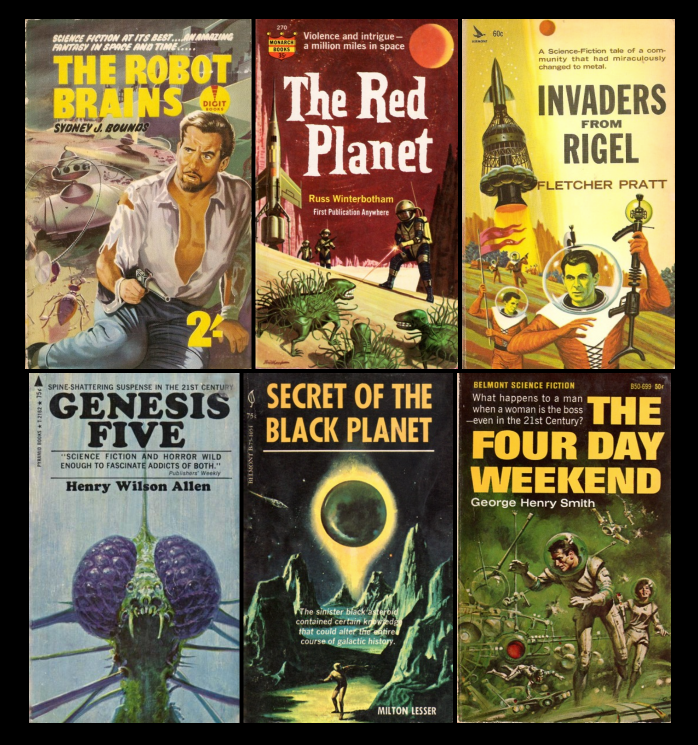
Recently, on the YouTube channel Pulpmortem, I viewed Jake’s video “9 So Bad, they’re Good Science Fiction Books you’ve probably never heard of.” Jake, evidently, is a connoisseur of bad science fiction, and the nine novels he reviewed indeed sound dreadful. Since Jake claims that bad books still can be fun to read, I gave The Red Planet by Russ Winterbotham a try. It was a quick, fun read that wasn’t badly written, but was essentially a minor, forgotten work.
I picked The Red Planet because it was free to Kindle Unlimited subscribers. It’s only $1.99 if you’re not a subscriber. This novel is also available for free on Project Gutenberg.
There are hundreds of better science fiction novels for $1.99 on Amazon, so why should anyone read it? Shouldn’t we always seek out the best possible novel to read? Why read a crappy book when you could be reading something great?
Well, readers don’t think that way. Even though we’re warned never to judge a book by its cover, how often have you bought one just because the cover was so cool looking? How many people have a secret fondness for watching old episodes of Perry Mason instead of streaming the trendiest show on Apple TV? People tend to develop a fondness for a particular type of story and storytelling. They don’t prejudge its quality.
But the question is: Should we seek out books (and movies and TV shows) that popular culture has forgotten? Regarding science fiction, I can think of a few reasons.
- We’re searching for forgotten gems.
- We like the author.
- We like the period.
- We like studying the evolution of the genre.
- We enjoy playing genre historian.
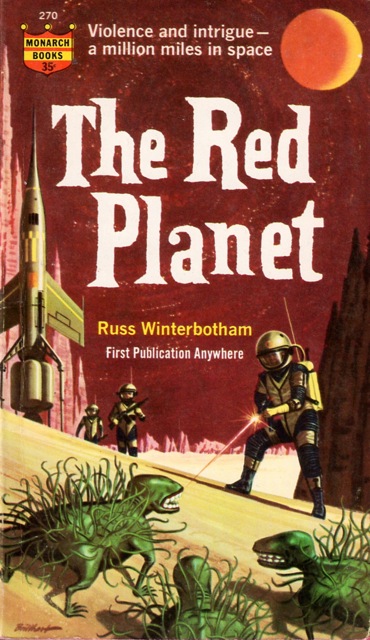
The Red Planet is about the first manned mission to Mars. The crew consists of five men and one woman. The driving conflict of the plot is that all five men want the woman sexually, and the woman, Gail Loring, wants to be left alone and treated as an equal, an astronaut, not a woman. This is quite progressive for 1962, since The Feminine Mystique wasn’t published until 1963.
Concurrent with the plot conflict is mutiny and murder. Dr. Sparten, the crew commander and rocket scientist, wants all the fame for being the first man on Mars. He also plans to be the man who ends up with Gail Loring. Sparten is Machiavellian and psychopathic. The other four men are dedicated astronauts, but they can’t stop thinking about Gail. After reading The Red Planet, I couldn’t help but wonder about the Artemis 2 mission and the sexual tensions on the International and Chinese space stations.
Even though The Red Planet was probably written in 1961 and published in August 1962, it’s not completely dated. Although it is dated regarding Mars, because the third conflict in the story regards Martians.
Russell Robert Winterbotham (August 1, 1904 – June 9, 1971) published books in several genres, comics, comic strips, and big little books, all the while working at a newspaper. Sixteen of his stories are reprinted at Project Gutenberg. Winterbotham was reasonably prolific and mostly forgotten.
Whenever I stumble upon an old science fiction story by a forgotten writer, I get curious about them. I snoop the internet for any clues about what they were like. I found this short biographical piece written by Russ in 1956, for the apazine Pooka #2. He ended the piece with:
I have no idea now much I’ve written. I expect I hold rights on about 50 to 100 short stories, but there were many many more that I sold outright and reserved nothing and I have no record of these. During my peak, I remember one year in thich I produced two million words. Usually I wrote about a million words a
year, counting my newspaper and comic strip work, Now I write less than a quarter of a million and very little of it, except comics, is fiction, I’m pecking away at a novel which should be finished before 1960. Then I hope to die with my boots on. Later, if I can help it, than 1960.
I authored some historical strips last fall, dealing with frontier characters, “Daniel Boone,” “Kit Carson,” and “Wild Bill Hickok,” These brought more fan mail, including letters from descendants of Boone and Carson, than anything I ever wrote.
My family never reads my stories because they share the opinion of a vast number of others, that they are not literature. But I like my work, I’m my greatest fan. And I’ll keep writing them, by God, as long as I live,
Fanencylopedia 3 quotes Winterbotham just before he died: “The science fiction market doesn’t seem to demand my talents, whatever they are, and I need the rest.”
The old cliche is that writers write for immortality. Sadly, most are quickly forgotten. One reason I like reading old forgotten novels is to wonder about why and how they were written. For a guy born in 1904, The Red Planet is an interesting read.
Winterbotham was around 58 when he was writing that novel. He’s obviously keeping up with science and science fiction. His story features NASA. His astronauts use a Saturn rocket to get to orbit, where the Mars rocket waits. Unfortunately, he has his astronauts get onto the Saturn with a cherry picker. A cherry picker was on hand for Alan Shepard in case of an emergency exit. The Saturn 1 rocket made its maiden flight in October 1961, and it was unmanned, so Winterbotham probably didn’t know the Saturn was too big for that method.
I have a thing for Pre-NASA science fiction, and have written about it several times. The Red Planet is on the cusp of this era. Winterbotham uses NASA in his story, but imagines Mars inhabited by intelligent beings. Even though we know this isn’t true, I’m still fond of stories that feature Martians.
Science fiction changed after the Space Race began. Robert A. Heinlein, who was the leading science fiction writer of the 1950s, made an abrupt change in direction in 1961 with Stranger in a Strange Land. Before that, Heinlein was a head cheerleader for space exploration. Once NASA got going, Heinlein began thinking about new territory for the genre. I don’t know why science fiction historians don’t consider Stranger in a Strange Land as early New Wave. Cause it’s certainly not Old Wave. Heinlein was Old Wave politically, but Stranger was definitely an experiment in fiction on many levels. There are many reasons why Stranger has lost popularity, and one of them is that fans quickly turned against New Wave SF.
Frank Herbert took science fiction on a new wave, too, with Dune, around the same time. Herbert anticipated the long SF novel, with many sequels that explored complex world development, characters, and plotlines. The kind that is popular today.
Winterbotham was trying to be new, too, with feminism. Gail Loring is an interesting character in 1962 science fiction. But then, so were Heinlein’s female characters. Just because Heinlein wasn’t enlightened by 21st-century attitudes didn’t mean he wasn’t changing, too.
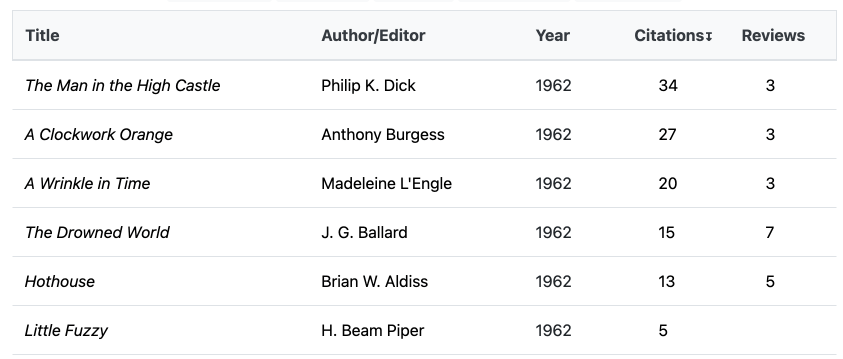
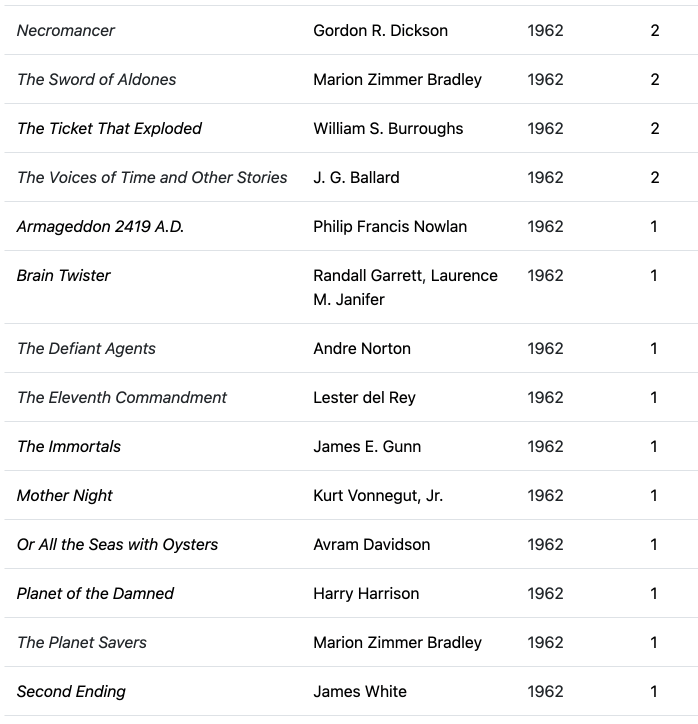
Look at the other top novels from 1962. I’d certainly recommend reading these better SF novels before The Red Planet.
But I’m not sure if The Red Planet is a significantly lesser read than these other SF novels from 1962.
I haven’t read Jake’s other eight SF books that he reviews. They are much harder to find. I’d probably have to spend $5-20 to acquire copies used, and I’m not going to do that right now. It’s a shame all old science fiction isn’t available as cheap ebooks or put into the public domain.
James Wallace Harris, 5/22/26


Interesting read. As a lover of sci-fi film & TV and fantasy books, I wonder if the disconnect is because sci-fi books were primarily targeted towards male readers when I was growing up. As an adult, maybe i should read some old ones for research
LikeLike
I would be interested to hear your reaction.
Most people didn’t read science fiction when I was growing up. You were nerdy if you did. I didn’t meet another science fiction reader until I was in the 10th grade (1967). I didn’t meet a woman who read science fiction until college (1970).
LikeLiked by 1 person
Sure, I’ll share thoughts when I get a chance to read. I guess I was (am) nerdy. I read non-fiction for my science fix, beyond classics. I could never find relatable characters in sci-fi books for it to be truly interesting or maybe I just didn’t find the right books.
LikeLiked by 1 person
Anything written totally entertain can be enjoyed.
Thanks for the review — I missed that one.
LikeLike
Mother Night is the best of all the books on that list. Better than Stranger, better thatn A Clockwork Orange, even better than A Wrinkle in Time. Yeah, I’m willing to die on that hill.
However, it is not by any stretch of the imagination SF. It doesn’t even have a guest appearance by Kilgore Trout.
LikeLiked by 1 person
Our citations come from a variety of sources. That citation was based on science fiction reprinted by The Library of America. And you’re right that
not SF. I should probably remove it. But you were seeing the raw data. We depend on our method to weed out bad citations. It takes a minimum of 12 citations to get on our Classics of Science Fiction list. Thus
will never make it. I sometimes ignore items on a citation list when they are obvious not science fiction. I have read
and thought it had one jab a science fiction, the main character, Howard W. Campbell, Jr. I can’t help but connect that name to John W. Campbell, Jr.
LikeLike
Oh, sure, the name “Howard W. Campbell, Jr.” is unquestionably a slam at JWC; Vonnegut seems to have been among the first to publicly acknowledge that Campbell was somewhat of a cryptofascist. (I believe the “HWC” character also appears in Slaughterhouse Five, attempting to recruit POWs in Dresden to fight for a “Freedom Brigade” or some such — though it’s been some years since I last read it, so I’m not 100% certain of that.)
LikeLike
I’m a bit of a snob when it comes to fiction. Last year I read Hamnet and The Seventh Function of Language and loved them. I also love reading bad science fiction. It’s fun to try to guess how bad it’s gong to get, how big the plot holes are going to get or laugh at the stilted dialogue. There’s bad science fiction that’s fun to read and then bad science fiction that’s a chore because it’s boring or badly written in a way that is not entertaining. Some of this may have to do with the fact that I mostly read pre-1970 science fiction. I also love Mystery Science Theater 3000, so I like laughing at bad art in general. I’m to the political left of 75% of Americans and a lot of contemporary science fiction is full of clunky and poorly executed political messaging that is far to my left. If I wanted to be lectured on why capitalism is the most evil force in human history, I’d log onto Facebook and read the posts of some of my old high school friends.
One thing I’ll say is that I’ve read bad literary fiction and it’s rarely as entertaining as bad science fiction. There’s a limit to the plot twists you can do with literary fiction and that makes more boring when it’s done badly. At least with science fiction there’s usually something like aliens, mutants, space exploration or some new technology
LikeLiked by 2 people
That’s true. Bad science fiction often has enough fun ideas to make them readable.
LikeLike
If the ‘awesome garbage’ is short, then I’d give it a try. I remember finding The Dirdir on a free little library rack and I think I had heard the name Jack Vance, but I hadn’t read any of his work. At ~180 pages I wouldn’t have picked it up unless it was that length.
LikeLiked by 1 person