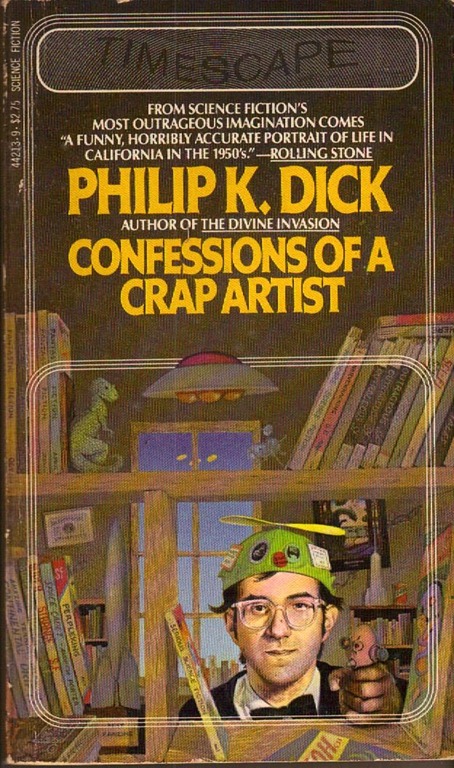
Trigger Warning: If you love reading science fiction, this essay might infect your mind with whatever I’ve caught. Then again, you might already be infected.
When I was 13, I loved watching Gilligan’s Island. However, whenever I see an episode today, I have to assume I was intellectually challenged as a child. Unfortunately, that’s how I feel whenever I read science fiction today. What’s happened to me? Science fiction has gone from significant to insignificant.
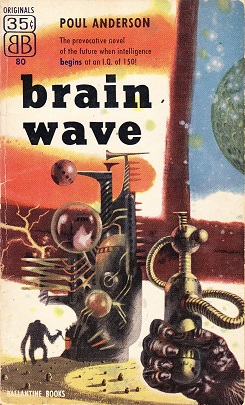
It makes me recall Poul Anderson’s novel Brain Wave. That story is about all life on Earth having an intellectual spurt when the Solar System moved out of a cosmic cloud that impeded mental development. How has my world changed in the last year?
The obvious suspect is age. But why did it take me three-quarters of a century to recognize that science fiction is silly? We know humans reach their physical and mental peak before age 30. I should have recognized the genre’s faults long ago.
My next suspect comes from an old saying: “Love is blind.” Until recently, I found great delight and joy reading science fiction. I always tell people I replaced religion with science fiction at age 12 because it was more useful to me in my everyday life. Science fiction made the chaotic 1960s meaningful. And it made me look forward to the future. Yet, was that an illusion?
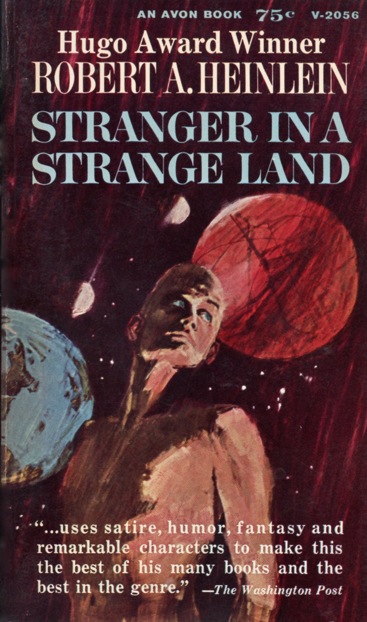
For most people, science fiction is just stories. And in the future, maybe I can read science fiction occasionally as a story. But for me, science fiction was always speculative fiction. I wanted science fiction writers to theorize about what might be possible in the future. That’s why I never really liked fantasy. A good story wasn’t enough. I considered science fiction a literary thought experiment. The best science fiction writers were those authors who at least made their ideas plausible. I knew Timescape wasn’t realistic, but Gregory Benford made his story believable.
I mainly admire science fiction for two areas of speculation. The primary one was the final frontier. Robots with artificial intelligence came a close second. But something has happened to me in recent years. I’ve completely given up on humans colonizing space, and real artificial intelligence has made me lose interest in intelligent robots.
I’ve concluded that humans don’t belong in space. That spoils most science fiction. I’ve also decided the Final Frontier belongs to AI robots. I’m not even sure if we should allow AI on Earth. We’ll never comprehend how AI perceives reality, and it might not be healthy for us to spend much time with it.
I strongly dislike speculating about brain uploading and artificial reality. Young science fiction writers love writing stories about those concepts, but to me, it’s all fantasy.
I’m currently reading Flowers for Algernon by Daniel Keyes because I’m looking for science fiction I can still believe in. Can humans be made smarter? I’m willing to concede that’s a possibility, and it’s an acceptable area of speculation for science fiction. However, my old-guy cynicism tells me humans aren’t quite smart enough to advance into the next stage of evolution. Evidently, intelligent machines will be our successors.
Would I think this if I were 25? That’s a very challenging question for me. My guess is that the 2020s are what changed me. For all my life, the future has been Schrödinger’s cat, and we’ve finally peeked into the box. Reality has become so science-fictional that it’s killed science fiction for me.
Books, movies, and TV shows about interplanetary and interstellar travel are like watching Bob Denver play Gilligan. At least for me. That’s painful.
I still try to find science fiction that meets my new vision of the future, but it’s hard.
James Wallace Harris, 11/26/26


James:
For SFF that fits your more narrow’d view of the future, look, perhaps, to the late ’60s/early ’70s “USA Trilogy” of John Brunner: The Jagged Orbit, The Sheep Look Up, and especially Stand on Zanzibar. Many add The Shockwave Rider to this group, though it doesn’t use the same techniques. There’s actually a lot of near-future SF from that period that might scratch the itch, but Brunner came first to my mind.
While I still enjoy the less-likely forms of SFF, I admit to sharing a somewhat jaundiced view of the possible future of humanity. I do allow myself a “bright-side” view, which assumes that (a) A.I. does not revolt against us (perhaps because the tech bros actually manage to implement some form of Asimov’s Three Laws); (b) it therefore actually helps us solve some of the existential problems facing us; and (c) having done that, it collaborates with us in getting past [some of] our limitations, either through “transhumance” or straightforward technological solutions.
There is of course a dark-side version of this light-side, and it is best summed up in David Bunch’s brilliant (and sardonically funny) 1971 fix-up Moderan; but I can also see a positive version where it lets us actually get our physical selves into space (though of course allowing no FTL travel).
A.I. is a technology. All technologies carry their promises and their risks. It is up to us to reach for the promises, moderate the risks, and ameloriate what gets past our attmpts at moderation. People foretold the end of the world with the coming of the Web, nuclear power, the automobile, and for all I know fire and the wheel. Until and unless God comes to roll up the sky like a scroll, I think we’ll muddle through.
(Actually, Fred Pohl, in the ’70s and ’80s, was a master of muddling-through science fiction. Man Plus, The Cool War, Jem, The Years of the City, and such…)
LikeLike
No longer like sci fi — or impatient for promises unlikely to be kept in your lifetime? AI will do for our brains what bulldozers did for aching back when a hole needed to be dug. Like Fire, it will be an awesome servant and a dangerous enemy. Flowers for Algernon is one of the few stories that made me cry when I first read it and still makes me think new thoughts. Sci fi inspires thought in a way no other literature format can — just don’t expect it to have the same impact today as when you were young and your own thoughts were few.
Fran
LikeLike