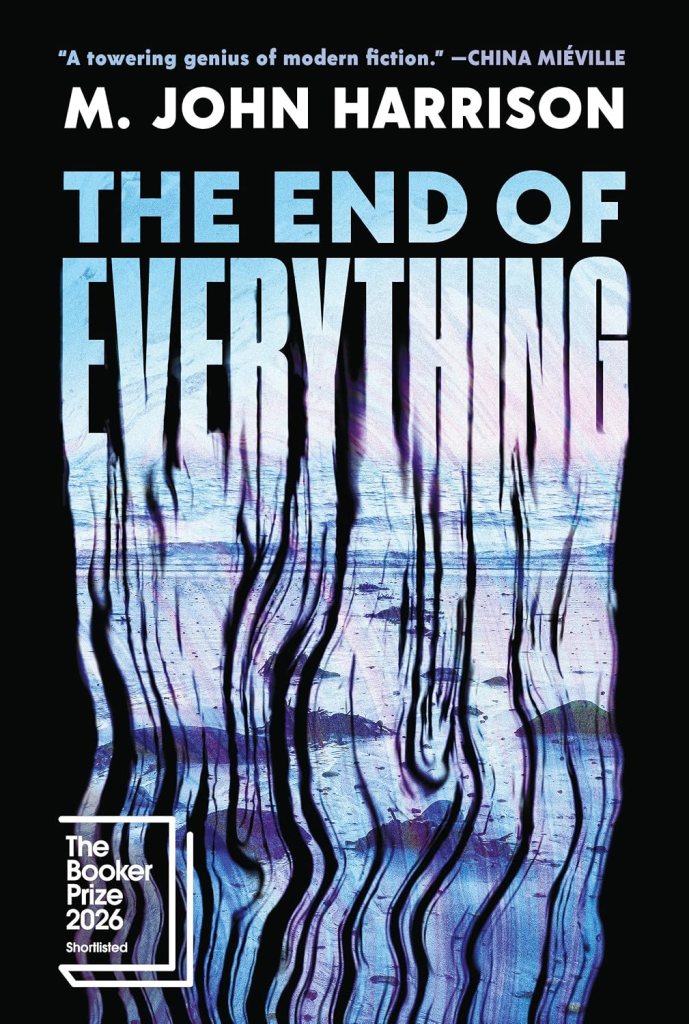
The End of Everything by M. John Harrison is a hard book to describe. Many people will want to read it because it’s a finalist for the 2026 Booker Prize. At around 200 pages, it’s a quick read in print, and just under four hours on audio. However, before buying, I highly recommend reading the sample offered by Amazon. I also recommend reading the reviews in Locus Magazine and The New York Times. The writing is clear and excellent, but the story is surreal, metaphorical, and ambiguous.
The End of Everything might be a science fiction novel about an alien invasion, but I’m not sure if science fiction fans will like it. The End of Everything might be an allegorical literary novel about our decaying society, but literary types might think it’s too science-fictional.
While listening to this novel, I was often reminded of The War of the Worlds by H. G. Wells. The settings are similar, and readers learn about the alien invasion from the personal perspective of the two main protagonists. Philip, 38, finds an alien artifact on the beach while staying with his aunt, Marnie, 70. Readers follow them separately and together, absorbing details about the aliens and the invasion along the way.
The aliens aren’t from outer space. They might be from Earth. At first, they are blobs of protoplasm. Eventually, grow larger, begin to resemble people, and even speak English. People wonder if they are from another dimension, the astral plane, a manifestation of spirits, etc.
Readers struggle to decide if they are actual invaders or metaphors for the problems of our times.
My initial reaction was to think about writing science fiction. The genre has a long history of alien invasion stories. Science fiction writers are hard-pressed to come up with new ways for Earth to be invaded. As a long-time science fiction reader, I felt Harrison found inspiration from The War of the Worlds, Invasion of the Body Snatchers, and Roadside Picnic.
If you’re a science fiction reader, you can take The End of Everything literally. However, if you’re the kind of reader who reads Booker Prize novels, The End of Everything can be deliciously ambiguous.
While reading The End of Everything, I was constantly reminded of books by J. G. Ballard and Brian Aldiss, especially the New Wave SF of the 1960s. I’m pretty sure Michael Moorcock would have proudly published The End of Everything in New Worlds back then.
The End of Everything has given M. John Harrison far more recognition than he ever got from science fiction readers. But this is at a time when many literary writers are selling lots of books by using science fiction themes. Turnabout is fair play, I guess.
I have a hard time reading modern science fiction. It’s just not that good. Young science fiction writers should study Harrison. I’ll use the hybrid SACD disc as an analogy. It can play standard-definition music on a CD player, but high-definition music on a SACD player. Harrison has written a hybrid novel, half science fiction, half literary. It will work with a science fiction reader or a literary reader.
My recommendation to would-be science fiction writers is to stop reading science fiction magazines and webzines and look for inspiration in novels like The End of Everything, What We Can Know by Ian McEwan, Annie Bot by Sierra Greer, Exit Party by Emily St. John Mandel, and other literary works.
Modern science fiction seems inspired by movies, television shows, comics, and video games. Great science fiction shouldn’t be inspired by older science fiction. It makes everything feel recycled. Find writing inspiration in literary bestsellers and the annual volume of The Best American Short Stories. But study everything going on in the real world today for inspiration for new science fiction themes.
Science fiction needs a new New Wave to stir things up.
If you love modern science fiction, you might find The End of Everything to be a downer. But then, back in the 1960s and 1970s, many SF readers found New Wave fiction a bummer. I’m not advocating writing dreary stories. Both Station Eleven and Annie Bot end up positive. And as bleak as The Handmaid’s Tale gets, it still has a powerful positive message.
Sadly, I didn’t walk away from The End of Everything feeling upbeat. I can’t tell if I missed Harrison’s hint of optimism in the end or if it’s just not there. The book might be saying we’re going down the tubes and we just have to learn to survive, and maybe something better will come along. Is he suggesting that AI might do a better job on Earth than we have? Assuming AI is one of the possible metaphors for the artifacts.
Story #4 of 31: The Best Science Fiction of the Year 8, ed. by Neil Clarke
Part of a series: Reading Science Fiction at 75. The first essay.
“Give Me English,” by Ai Jiang, is a metaphor for understanding languages and what it means to become an immigrant. The story feels like science fiction because everyone in this future has a language database (Langbase) in their head, and words are the universal monetary unit. Poor people have to sell their words to pay rent, and some eventually become mute because they run out of words in their langbase.
Gillian lives in New York. She is an immigrant from China. Gillian came to America because she couldn’t compete in the Chinese education system. That’s a real practice today. Because Gillian needs to learn English, she sells off her Chinese words to buy English words. But to survive in expensive New York, she eventually needed to sell her newly acquired English words too. Her friend Jorry is well off because he gambles with words and wins. Jorry offers to help Gillian, but she doesn’t want his help.
For a deeper appreciation of why Ai Jiang wrote this story, read Ray Naylor’s interview with her. Naylor, a science fiction writer who works in the Foreign Service and has taught English abroad. Naylor admired Jiang’s story, and the interview is very insightful. I highly recommend reading it.
“Give Me English” is a fine story. It was nominated for the Nebula and a finalist for the Locus Award.
However, I want to use this story to discuss something else. It’s not really about “Give Me English,” but about me being 75 and trying to find the kind of science fiction I grew up reading. I feel the stories in volume 8 of Clarke’s anthology take a different approach to science fiction. However, “Give Me English” could have been published in Galaxy or F&SF in the 1950s, and maybe even New Worlds in the 1970s. Even back then, science fiction was never consistently one thing.
Is “Give Me English” really science fiction? If it were published in The New Yorker or a literary magazine, would readers call it science fiction? Humans will never use words for money or have a language database in their heads, so it can seriously be considered speculation or extrapolation.
The story is a metaphor or allegory about language. It’s not realistic, but it uses a “what if…” thought experiment to place Gillian and Jorry in a fictional setting. “Give Me English” is included in a science fiction anthology because the genre has become a catch-all for oddball stories. Mostly, this is true because science fiction and fantasy periodicals are venues open to new writers. Would-be writers think that if they write stories with weird elements, they are writing science fiction. But is that the real essence of science fiction?
I’m not saying “Give Me English” is a bad story; it’s not. It’s a good story. But it’s not the kind of fiction I want to read when I’m in the mood for science fiction. Of course, my definition of science fiction is now in the minority. I’m not sure if my definition of science fiction was ever in the majority.
When I was growing up, science fiction was a type of writing challenge: explore possible futures. Generally, it was: if we can build this kind of technology, it will allow this kind of future. Even when the technology is scientifically impossible today, we hope future discoveries will make such technology possible.
Most science fiction writers, even in the past, didn’t try very hard to play this game. They often used recycled ideas as settings for their stories. Many classic science fiction concepts are recycled for endless fictional possibilities. To me, bad science fiction was stories that had comic book-level science. You know, radiation makes mutants with superpowers.
So far, the first four stories in The Best Science Fiction of the Year: Volume 8 don’t seem to believe in the future. They are set in the future, but not believable futures. Have writers and readers given up on the future? Science fiction has become this fantasy world where any kind of make-believe goes.
I want science fiction to seriously imagine possible futures. When 21st-century science fiction imagines the future, it most often utilizes old futures science fiction imagined in the past. I want SF in the 2020s to use the reality of the 2020s to speculate about the future.
I didn’t write about story #3, “The Ship Cat of the Suzaku Maru” by S. L. Huang. It’s obviously set in the future. It’s set in a traditional science fiction setting – a spaceship. John W. Campbell would have published that story in 1941, in Astounding Science Fiction. It would have done well in AnLab. But as nostalgic as I am for old pulp science fiction, that setting is now the past. Star Trek in 1966 is 1939 science fiction. Star Wars in 1977 is 1941 Astounding.
I want science fiction to speculate about the future, but I don’t want it to be recycled futures. In 1966, the year Star Trek came out, Samuel R. Delany published Babel-17. It redefined science fiction. Peter Watts did it in 2006 with Blindsight. Kim Stanley Robinson did it in 2015 with Aurora.
Take Mars, for example. We’ve learned a tremendous amount about Mars in recent decades. Plus, we have Elon Musk and SpaceX. And we have the reality of AI. Even in 2011, Andy Weir’s The Martian isn’t up to date. Mark Watney couldn’t have survived with what we knew even then.
Back in the 1960s, when I was in high school, my buddies and I would discuss science fiction stories. We’d argue over whether or not they could possibly happen. Even the silly stuff. We knew science fiction was far from scientific, but stories needed a certain amount of believability.
We wanted to grow up and see far-out speculation come true. Has science fiction become a kind of fantasy playground in our minds because we no longer have any hope for reality in the future?
Even if we think the future sucks, shouldn’t we still speculate about it?
Of course, I’m being naive here. Science fiction has seldom pursued the ideal I hope to find. Maybe I can’t find the kind of science fiction I want to read because I’ve changed.
Story #2 of 31: The Best Science Fiction of the Year 8, ed. by Neil Clarke
Part of a series: Reading Science Fiction at 75. The first essay.
“Nobody Ever Goes Home to Zhenzhu” by Grace Chan was first published in Lightspeed (May 2002). You can read or listen to it online here.
Calam sneaks away from Orin to handle unfinished business on the planet Zhenzhu. In this very short space opera noir, the plot features one action scene, with gory results. The story wraps up with a discussion about freeing personal information from political thugs who control public information. That part is relevant to our times, but it wasn’t explored.
Treating this story like a wine tasting, I detect a strong flavor of George Lucas, with hints of Samuel R. Delany, William Gibson, and Richard K. Morgan.
Not to be critical, this story could have been Luke sneaking away from Han to conduct some unfinished business on Tatooine, but Han follows Luke and saves the day. My point is that writers need to tune into archetypes that appeal to readers. Of course, Chan uses specific details to make her story different; for example, Zhenzhu is in ecological collapse. Or why Calam is fighting the bad guys.
Old science fiction reader me keeps spotting these appeals to our belief systems, and I’m not responding like I did when I was younger.
“Nobody Ever Goes Home to Zhenzhu” is a well-told action story that could be part of a novel. I first read the story in the Clarke anthology, and then listened to Stefan Rudnicki read it on Lightspeed. I felt I got the best impression from listening. Rudnicki does a fantastic job of presenting the drama of Chan’s story.
“Nobody Ever Goes Home to Zhenzhu” appeals to three beliefs in readers. An analogy of what I’m saying is that Christianity succeeded by converting billions of souls over the last two thousand years by selling two major beliefs. The first is heaven; the second is eternal life. Science fiction succeeds primarily by selling the belief that humans have an infinity of worlds to explore and colonize. This is the first buy-in for Chan’s story.
Pulp and action fiction has always sold the belief that one person with a sword, gun, or blaster could take on a roomful of well-armed attackers and win. Chan’s story also sells this belief. Another common belief in certain genres of fiction is that a few people can overthrow a powerful ruling organization. I call this belief “blows against the empire.” Chan’s story kind of promises this too. Quite a few science fiction fans love to believe this; for example, just remember how popular The Hunger Games was.
My next comments shouldn’t be taken as a criticism of this story either. My point is why science fiction is failing me at 75. When I was young, I believed in the future where humanity would colonize the galaxy. That belief was a kind of faith. Looking back, I see my beliefs in science fiction were much like people who believe they will die and go to heaven. It’s a kind of unrealistic hope. Now I’m an atheist to those tenets of science fiction.
At 75, it’s hard to read stories about concepts I no longer believe in. I try to tell myself to just sit back and enjoy space opera as a specialized form of fantasy. Consider the Milky Way a setting like Tolkien’s Middle Earth. I could for many years, but I’ve reached an age where I can’t make believe anymore. Well, except for old favorite science fiction stories. If I have enough nostalgia for a story, even if I no longer buy into the beliefs it asks me to believe, I can still enjoy it.
I’ve always separated science fiction from fantasy by believing science fiction speculated about possible futures. I wanted to believe that after I died, humanity would go on to colonize the solar system and then the galaxy. I’ve reached an age where I no longer believe that, and it’s affecting my enjoyment of reading new science fiction. This is a problem for me because I have a lifelong addiction to science fiction that I can’t seem to break. I need a fix.
In his introduction, Neil Clarke describes how the demand for short science fiction has dwindled to almost nothing. Does that mean even young people have given up such beliefs? The demand for fantasy and romantasy has dwarfed the SF genre. Even as escapism, science fiction isn’t selling.
But there might be another factor. Maybe science fiction movie franchises have burned out the appeal of certain science fiction themes. I have to admit that I’m reading this anthology hoping to find something new and different. But has science fiction produced anything novel in decades? My bet regarding how well people like “Nobody Ever Goes Home to Zhenzhu” depends on how much science fiction they’ve consumed.
The market for best-of-the-year science fiction anthologies has dried up. Volume 8, covering 2022, ran a year late. Volume 9, due next month, covers 2023, is also late. This series used to have audiobook editions, but they are no longer published.
Have I gotten too old for science fiction, or has science fiction gotten old for everyone?
Like I said, my desire to read science fiction now is mostly nostalgic. I rarely enjoy reading new science fiction. However, I did get a big kick out of Andy Weir’s Project Hail Mary. Mostly, I seek the science fiction high I crave by reading old science fiction.
You know how many Baby Boomers only listen to music they discovered before 1975? The movie The Big Chill even jokes about it. I wonder if that’s happening with me and science fiction. I can reread a Heinlein juvenile and dig the shit out of it. However, I worry that someday even my old favorites won’t produce a good sci-fi high.
In reading this anthology, I hope to discover some stories that are seeds of new science fiction beliefs. One that writers can work with for a couple of decades.
Story #1 of 31: The Best Science Fiction of the Year, Volume 8, edited by Neil Clarke
I’ll be turning 75 soon, and looking back, science fiction has given me much enjoyment, insight, and even inspiration. However, over the last couple of years, science fiction’s magic has ceased working. The state of the world has made me cynical. But then, it might be what I call the Williamson Effect. I had a friend, John Williamson, who slowly lost interest in everything he once loved before he died. I saw the same thing happen to Samuel Clemens in the many biographies I read of Mark Twain.
I’m struggling to cure this symptom of my aging, or at least put it into remission for a few more years. To look for my lost hope in science fiction, I’ve decided to join two discussions on the Facebook group, Best Science Fiction and Fantasy Short Fiction. The first covers Volume 8 of The Best Science Fiction of the Year, edited by Neil Clarke. That anthology collects the best science fiction short stories published in 2022. The group discussions are on Mondays and Fridays.
The second group discussion, if it happens, will read The Year’s Best Science Fiction, Fourth Annual, edited by Gardner Dozois. It covers the best short SF from 1986. I hope this group does make. I worry that I’ve lost interest in science fiction because it’s changed. Reading stories from forty years ago will test this theory.
“The Dragon Project” is the first story in Volume 8 of The Best Science Fiction of the Year. It was originally published in issue 186 of Clarkesworld. This suggests that Neil Clarke really loved this story. You can read or listen to it online here.
I found “The Dragon Project” mildly entertaining. A pleasant little read, but kind of bland. It imagines a future where new types of animals can be created with 3D biological printers. Vivian and her business partner, Jed, get a customer who wants them to create a dragon for the Chinese New Year parade. At first, Vivian creates a tiny dragon the size of a cat that disappoints the customer. Then she creates a bigger creature, but still only the size of a dog. They lose their client. Then Vivian and Jed hear about a horse-sized creature on the loose that some people describe as a hippogriff. They figure their client found another designer.
“The Dragon Project” is amusingly told. It’s light. Unfortunately, this story didn’t enchant me like Kritzer’s 2015 award-winning “Cat Pictures Please.” That little fantasy at least resonated with reality. However, I can understand the appeal of tiny dragons. I loved when Heinlein and Andre Norton included strange creatures in their young adult fiction. At 12, I would have loved to live on Mars with a creature like Willis from The Red Planet.
This might sound weird, but I might be prejudiced against 3D-printed creatures. I don’t think that will ever happen, but more importantly, I feel the future has gotten too riddled with technology. In the 1960s, a Jetsons future sounded wonderful. But after SpaceX and ChatGPT, technology is depressing. Young me loved high tech, but old me is becoming a Luddite.
Science fiction always made me excited about the future. “The Dragon Project” is a well-told, light-hearted story, but I don’t want to live in a future where rich people can become gods. My old mind wonders about all the millions of 3D-printed creatures that will be abandoned.
Of course, this isn’t a criticism of Kritzer’s story. But I must ask: has science fiction become Pandora’s Box? What happens if everything science fiction imagines becomes real? HAL was very entertaining in 1968, but not so much fun in 2026. “The Man Who Sold the Moon” was wonderful once, but Elon Musk is a drag.
I hope I haven’t bummed you out. Sorry if I have. But I thought I’d let you know that science fiction mutates into something different in old age. At least, it has for me.
The last two novels I loved were Whistler by Ann Patchett and The Things We Never Say by Elizabeth Strout. If I could have read those 2026 novels in 1964 when I was 12, I would have thought the future boring. But both of those books gave me hope and inspiration this year.
I’m not sure science fiction can do that anymore, at least for me. However, I’m going to keep reading this anthology. Maybe I’ll find another kind of science fiction that works for a 75-year-old science fiction fan.
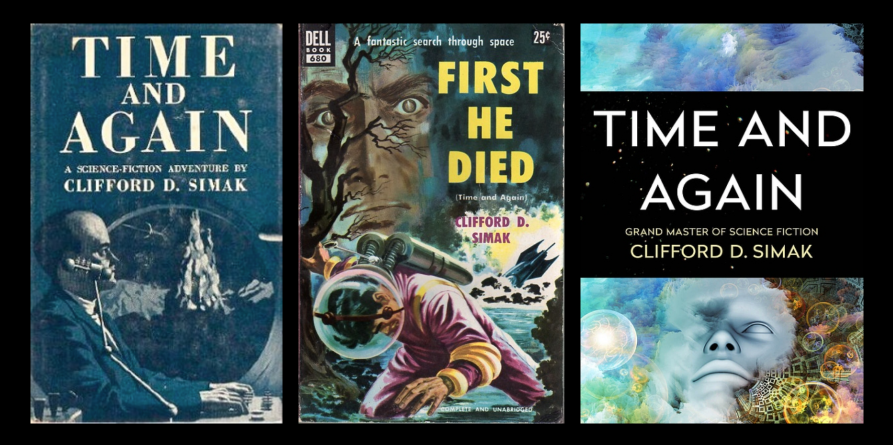
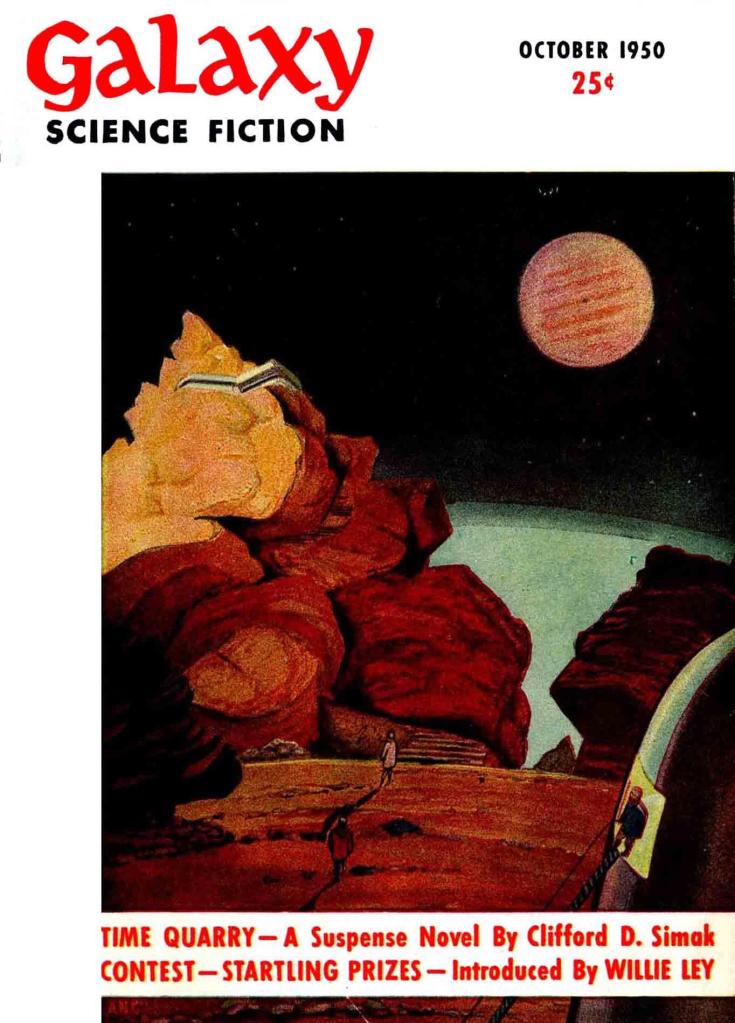
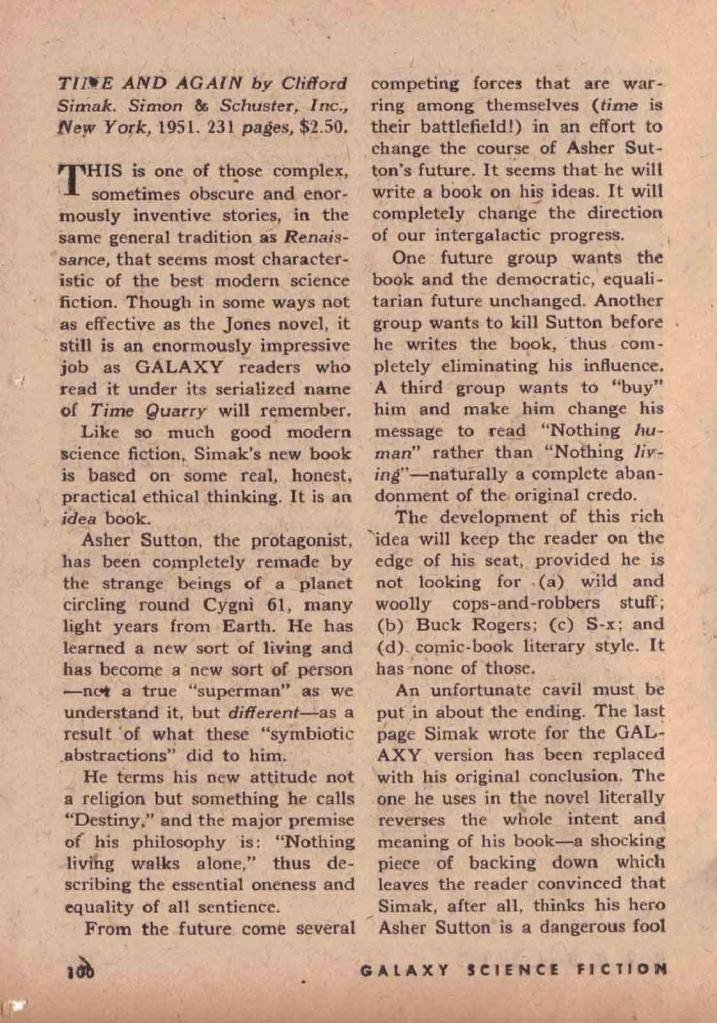
Time and Again by Clifford D. Simak has the distinction of being the first story in the first issue of Galaxy Magazine back in October 1950. It was serialized in three parts as Time Quarry. (All three issues can be found here.) It’s currently in print as a paperback, Kindle edition, and audiobook on Amazon.
I started reading Time and Again when I decided to read the first issue of Galaxy. I had the silly urge to try and read Galaxy from the very beginning. But I didn’t feel like reading a serial before the short stories, so I switched to an audiobook. Now that I’m finished, I can return to the magazine to begin reading “Third From the Sun” by Richard Matheson. The first issue of Galaxy has quite a lineup.
When I opened that issue of Galaxy, I tried to imagine myself as a reader back in 1950. Since I was born in November of 1951, that’s a little hard to do. On the other hand, I loved old movies my whole life, so I can picture 1950 from watching them.
What’s kind of fascinating is that outside of science fiction movies, movies about real people in 1950 never mention science fiction. This always makes me ask: What was the first character in a movie who was a science fiction fan?
Offhand, I thought of George McFly in Back to the Future (1985) might be the first. Gemini AI suggested young David MacLean from Invaders from Mars (1953) or Eugene Fullstack from Artists and Models (1955). But also mentioned Eliot Rosewater from Slaughterhouse-Five (1972).
In other words, I can safely say that science fiction in 1950 had a poor reputation (if any). Eugene Fullstack was played by Jerry Lewis – so you can imagine how they saw us. By the way, I highly recommend the vividly colorful Artists and Models because it is a fun look at pulp and comic book fans.
But back to Time and Again. If I had read it without knowing the author or even when it was published, I might have guessed very early Philip K. Dick. The story is out there. Way out. Time and Again begins six thousand years into our future with Christopher Adams. Adams has a visitor from five hundred years in his future warning Adams that Archer Sutton is returning from a long-lost space mission, and it’s important to humanity that he be killed.
Would Simak and science fiction fans in 1950 be shocked that it wouldn’t take six thousand years to develop intelligent robots? I’d love to time travel back to 1950 and show people YouTube from 2026. How many citizens back then would want to ban science fiction and computer technology?
Clifford Simak has always had a sentimental take on robots and dogs. However, I wonder if his view isn’t really an overly kindly view of faithful servants, like we see in Upstairs Downstairs and Downton Abbey? In Time and Again, at least Simak is wise enough to know they will one day want emancipation.
Returning to the story, Sutton does arrive, but in a wrecked spaceship that can’t hold air, has no fuel or food, or working engines. Sutton is barefoot and is wearing rags. He went to 61 Cygni twenty years previously to a world that had always shunned any outside contact. Something radical happens to Sutton on 61 Cygni, something like what happens to David Bowman in 2001: A Space Odyssey. Like Clarke would do in Childhood’s End in 1953. Simak imagines aliens uplifting humans.
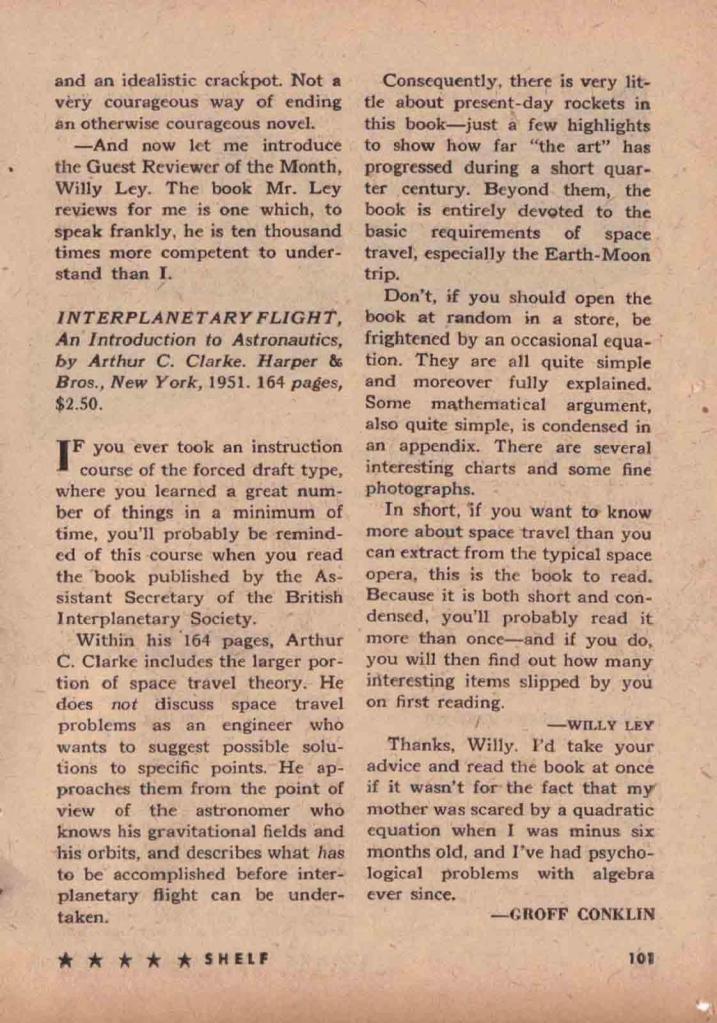
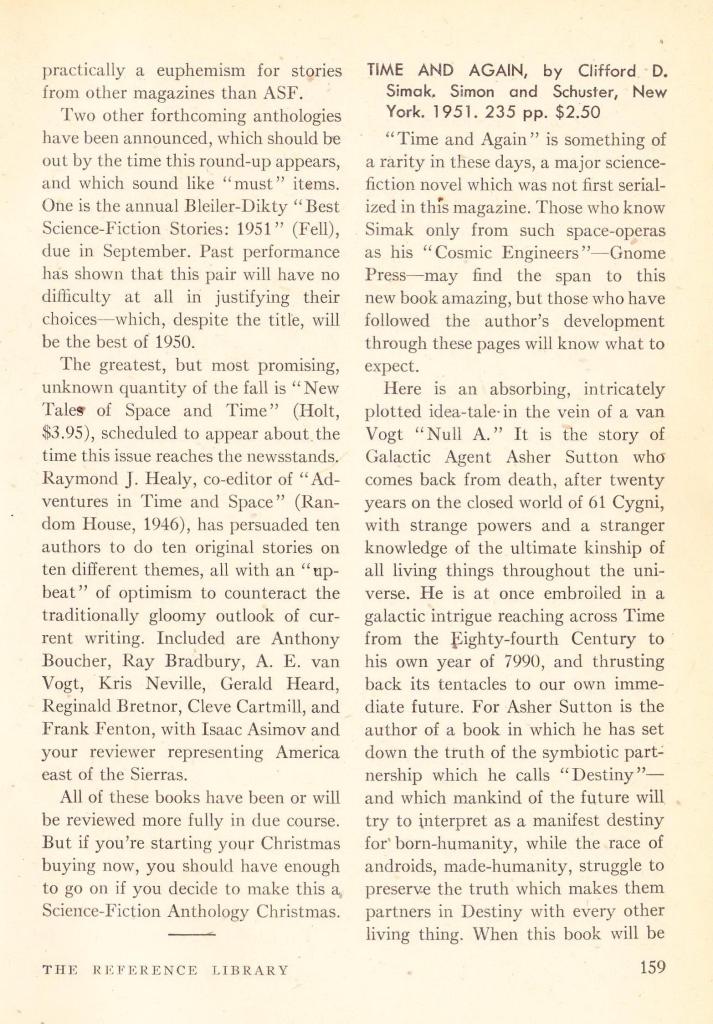
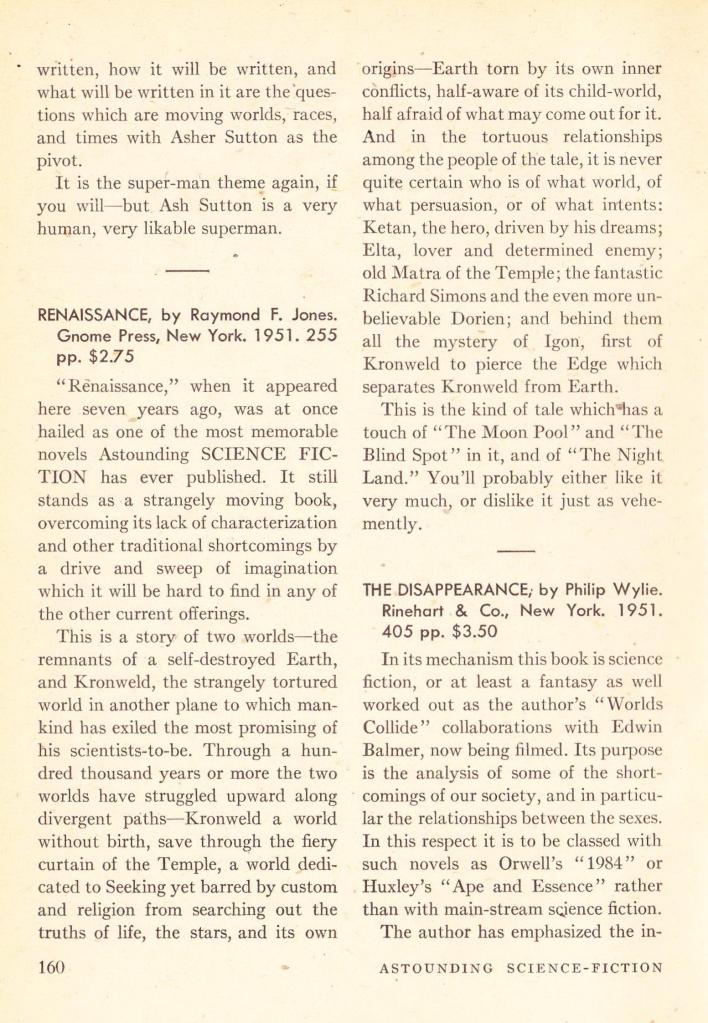
Most of the reviews of the 1951 hardback edition of Time and Again were quite positive. See attached reviews below.
However, I’m not sure I can recommend the novel. I don’t know if it holds up for modern readers. Yet, I remember seeing a YouTuber reviewer claim Time and Again was his favorite Simak novel. Two 1951 reviewers claim Time and Again is a mature work of science fiction, that is carefully plotted, and deals with serious ethical issues. Archer Sutton does come across as something between Christ and Abe Lincoln in advocating equality for robots, androids, and all animal life.
As Groff Conklin points out in his August 1951 book review in Galaxy Magazine, the hardback’s ending is not the ending in the serialized magazine version. I’m not sure that either ending is philosophically different from the other. But both endings are troubling and ambiguous. It’s the kind of ending Philip K. Dick would have liked.
I recently read A World Appears by Michael Pollan about consciousness. Pollan claims, with support from cited scientists, that all life, even non-living things, might have a degree of consciousness. I don’t think many people in 1950 thought like this, so, surprisingly, Simak made it a focus of a science fiction novel. Nor could people in 1950 have imagined the AIs we live with in 2026. I wonder how 1950 science fiction readers took Simak’s mysticism?
Not only is Simak advocating for equality for all conscious beings, but he appears to be protesting science fiction’s true believers who think it’s humanity’s manifest destiny to spread across the universe. Years ago, I read a story whose title or author I can’t remember that suggested two kinds of intelligent species emerge in the galaxy. The first wants to spread across the galaxy as the dominant species. And the second, and I’m less sure of my memory here, wants to study the galaxy to understand the nature of reality. Most science fiction writers suggest humans will be of the first type. I think Simak, in this novel, is advocating we be of the second type.
In Time and Again, agents from the future fight a war across time. They want to make sure humans are the superior species for a million years, time enough to spread across the entire universe. Archer Sutton is the Jesus of the opposition movement. Like in The Terminator, humans from the future come back in time to snuff him out.
All of this might sound terrific, but I should warn possible book buyers: Time and Again is a rather talky novel. On the other hand, it’s full of ideas.
ISFDB.org lists many reprint editions and nineteen reviews for Time and Again. Most of the reprint reviews were too short to bother reprinting. However, in 1992 Algis Budrys writes fond memories of Galaxy’s first issue, and Simak’s novel.
Galaxy Magazine (August 1951) – Groff Conklin
Astounding Science Fiction (December 1951) P. Schuler Miller
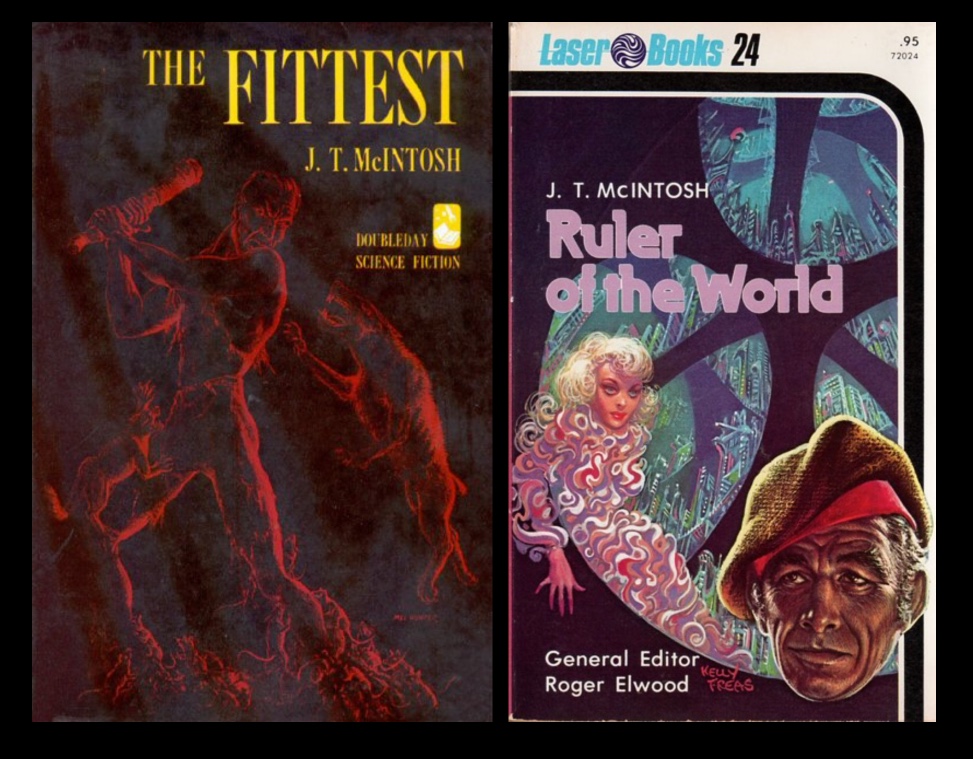
I thought it would be fun to look at old book reviews of the two books I just read and reviewed. I’ll start with The Fittest, which I liked, and then go to Ruler of the World, which I didn’t. Follow the links if you want to read my reviews.
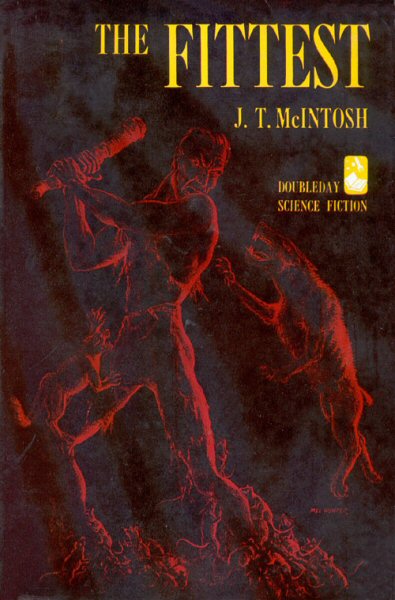
The Fittest
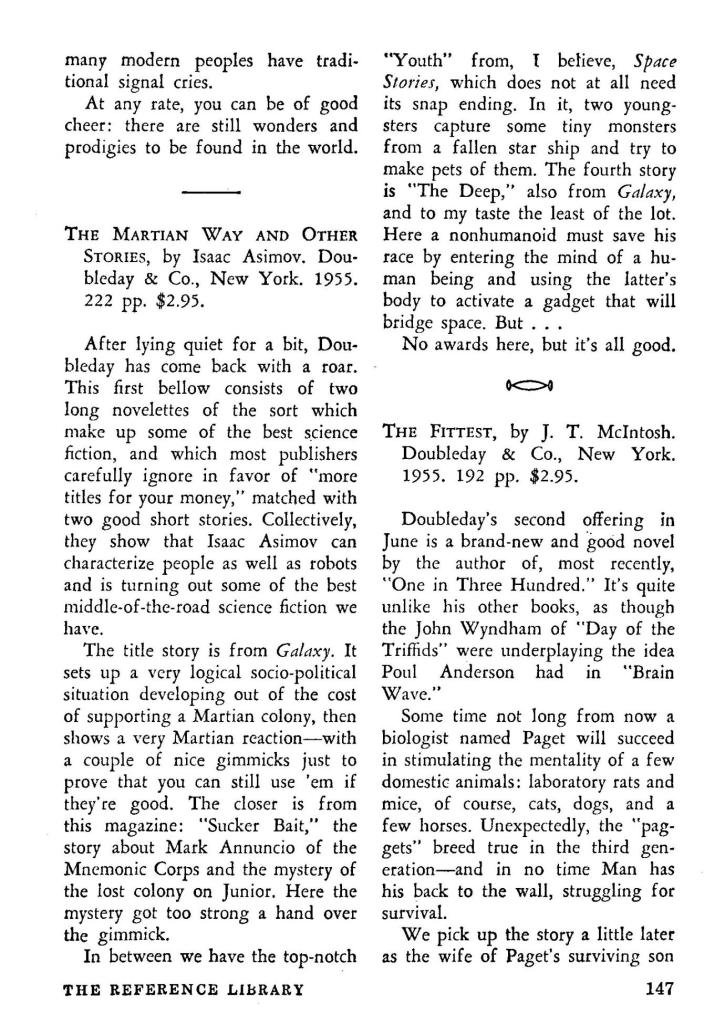
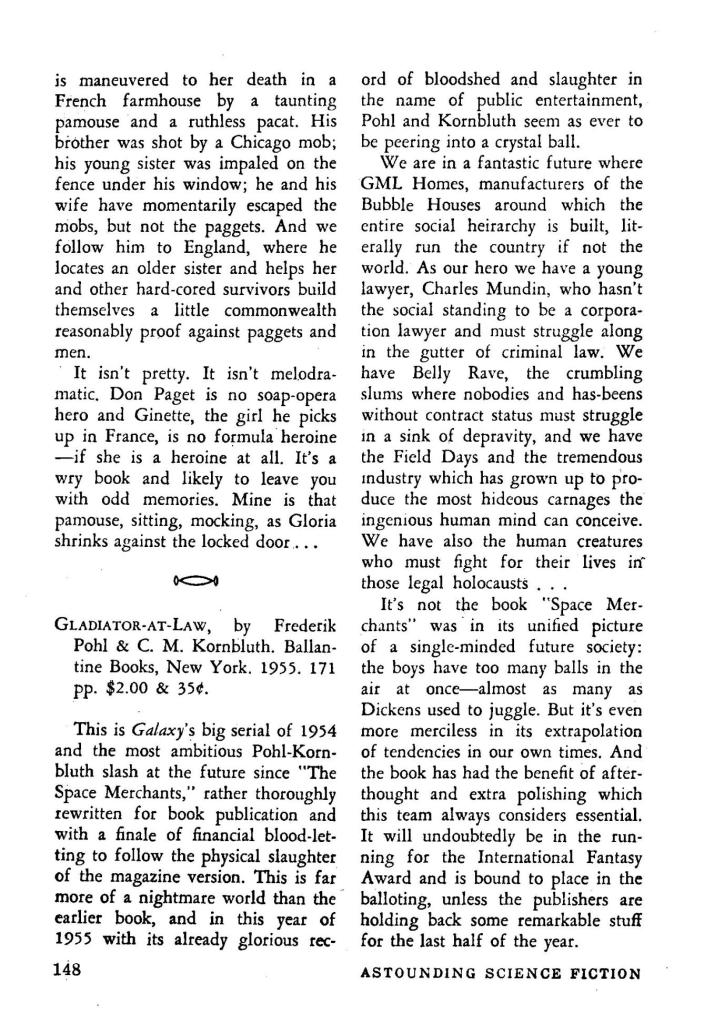
Astounding Science Fiction (December 1955)
by P. Schuyler Miller
Miller made the same connections I did to The Day of the Triffids and Brain Wave. However, Miller tells too much of what happens. The scenes of when Don’s brother and sister are killed are quite shocking, and they come late in the novel. Plus, a good portion of the story is Don trying to get to his older sister’s place in England, and Don doesn’t even know if she’s still alive. This destroys a lot of the mystery in the middle of the book. The book does leave you with odd memories, and the scene where the mice are terrorizing Gloria stayed with me, too. However, it’s at the very beginning of the story.
Miller likes the book, but he’s not very specific about how much. He merely says it’s a good book. If I were reading this review in 1955, I probably would have ignored this book. In the same review, Miller covers an Ace paperback reprint of McIntosh’s One in 300. He’s more telling about this book, saying, “It’s a very good book and I’m beginning to wish I had rated it higher in the International Award poll.” That kind of tidbit makes me take notice.
How much of the story should a reviewer reveal to get a potential book buyer to buy? Miller doesn’t really explain the core threat. Animals with increased intelligence are killing humans and destroying civilization.
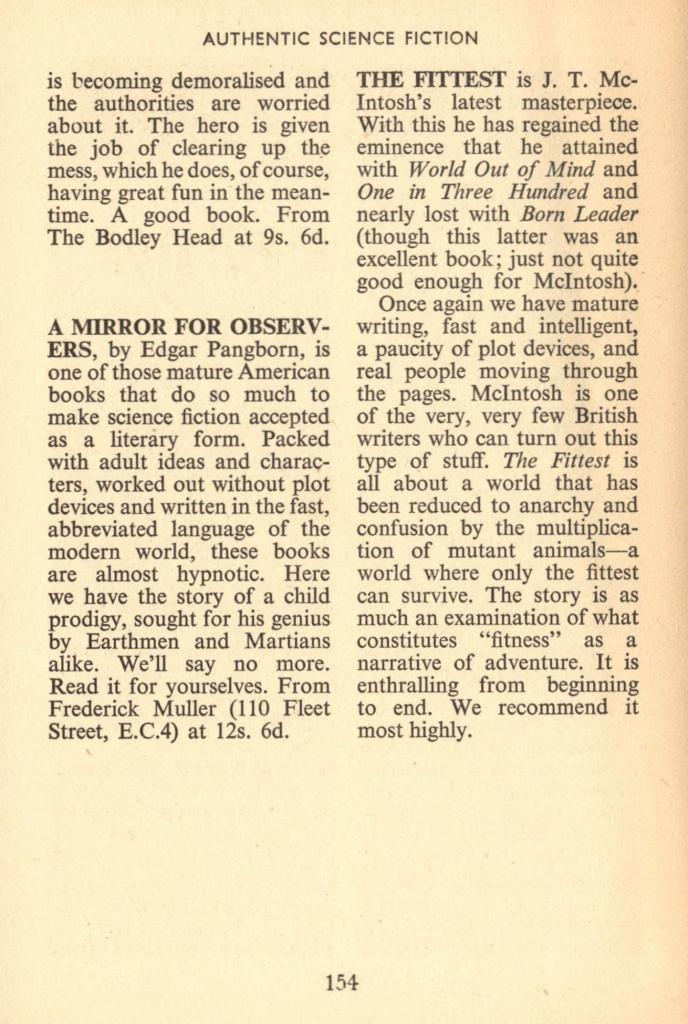
Authentic Science Fiction (August 1955)
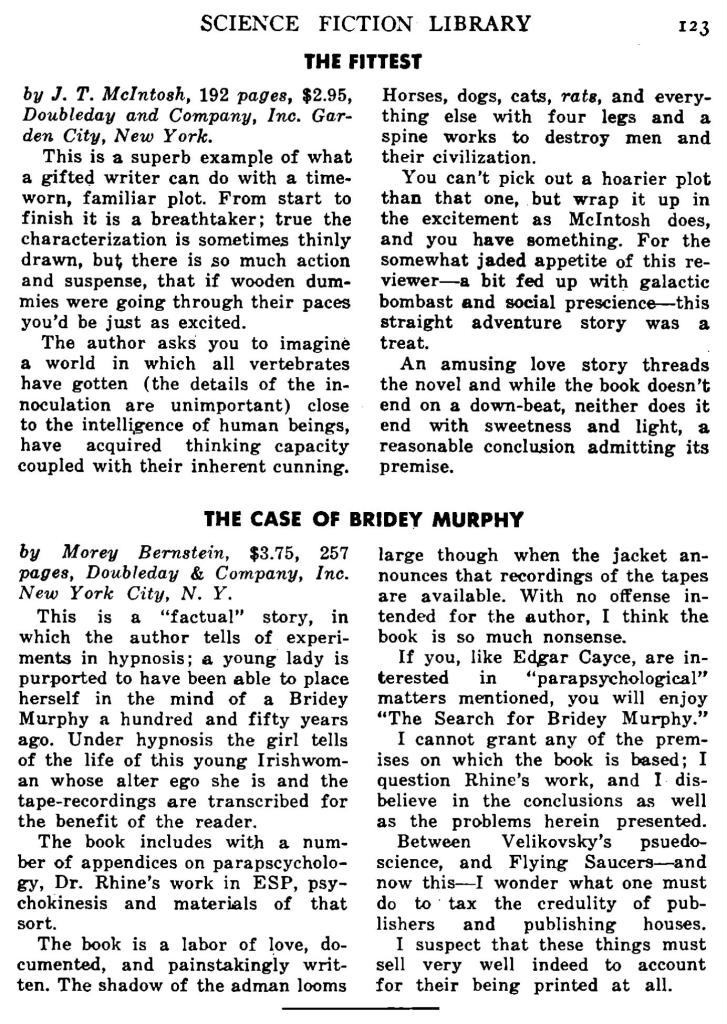
This unnamed review calls The Fittest a masterpiece and recommends it most highly. Authentic was a British publication, and McIntosh was Scottish. This reviewer doesn’t give many details about the story, but does cite the core conflict.
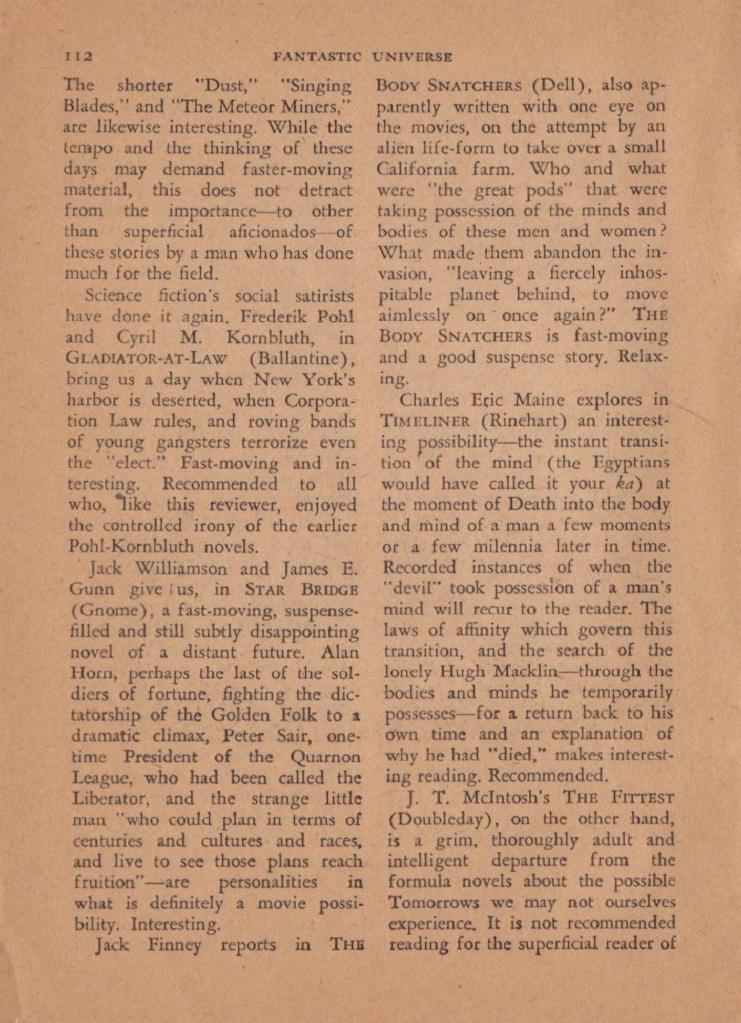
Fantastic Universe (October 1955)
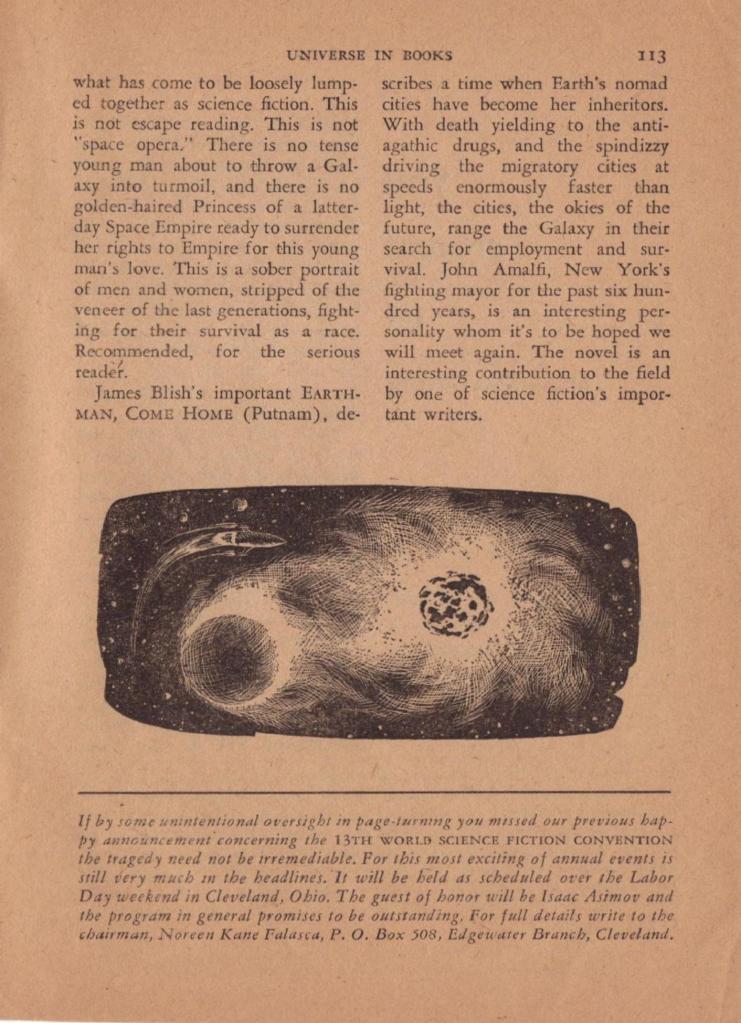
by Hans Stefan Santesson
Santesson is rather emphatic in warning readers that this is an adult novel, that it’s serious, and not like most gosh-wow science fiction. I would agree with that, especially for 1955. British science fiction from the 1950s and 1960s seemed more like literary novels than American science fiction.
However, Santesson gives no details about the story. Do book review readers need them? Or does just saying: “This is a sober portrait of men and women, stripped of the veneer of the last generations, fighting for their survival as a race.” is good enough of a recommendation?
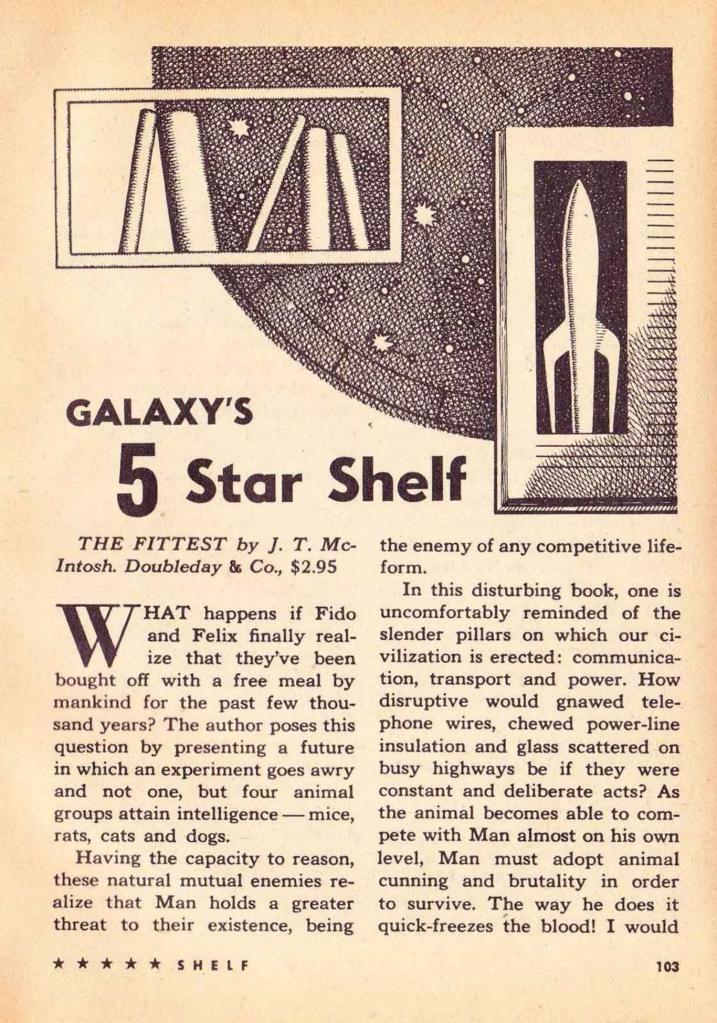
Galaxy (November 1955)
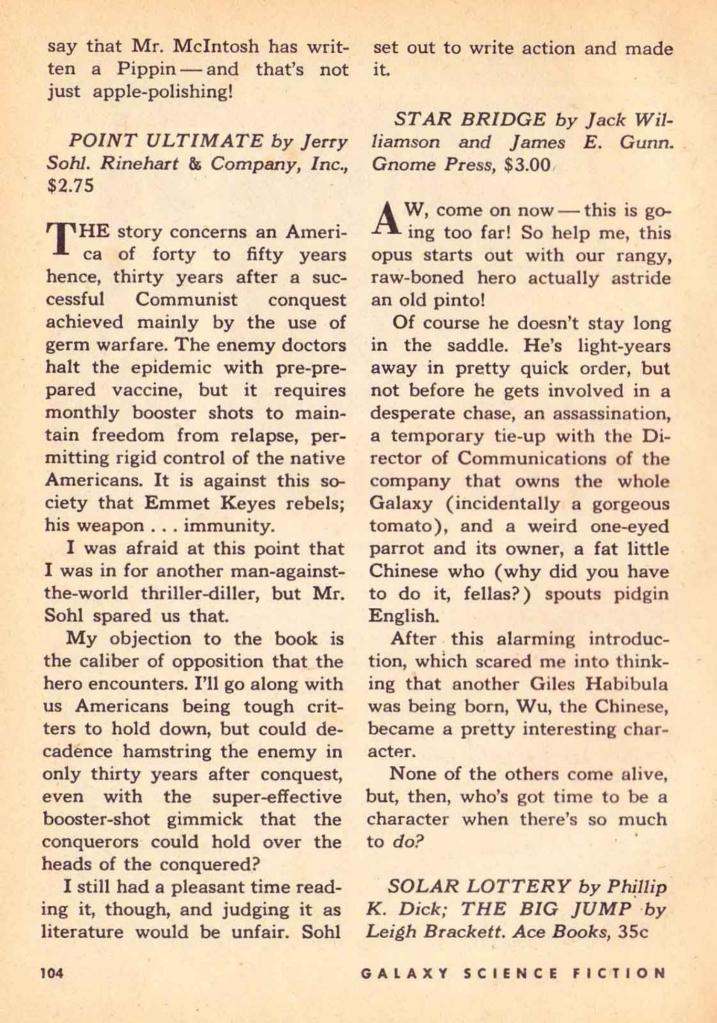
by Floyd C. Gale
So far, Gale has written the most concise and enticing summary of the core conflict that we’ve read yet. Gale is selling the book right up front. For a review, the size of a long cover blurb, Gale does a great job. He reviews eight books in six pages; we can’t expect too many details.
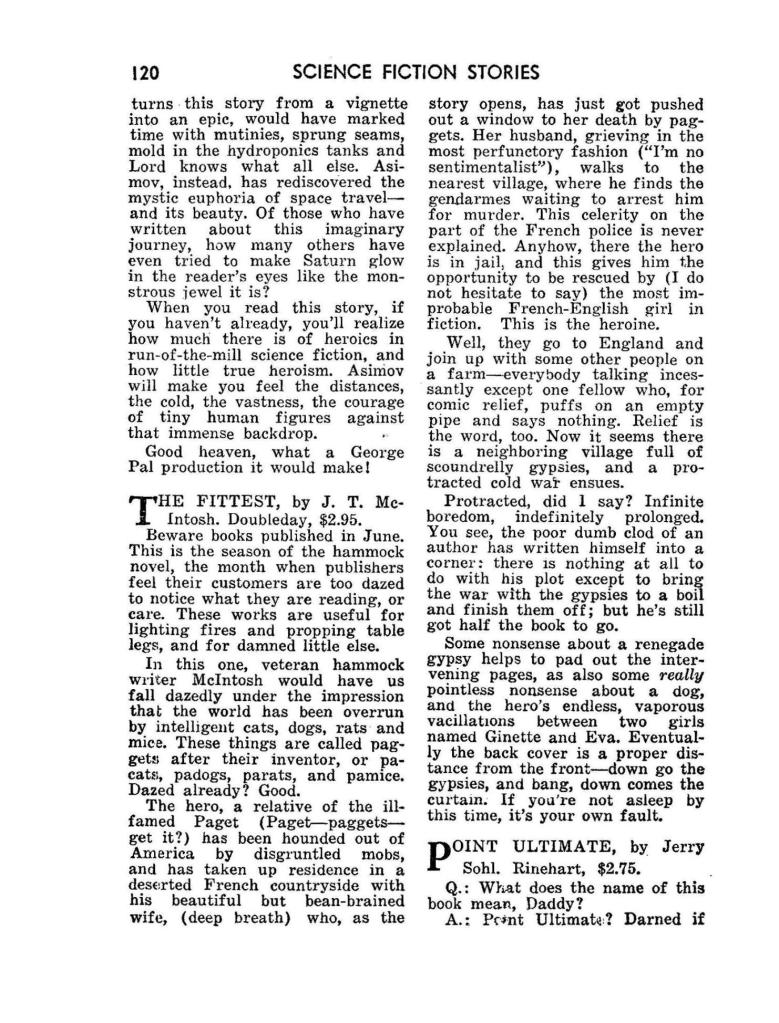
Science Fiction Stories (January 1956)
by Damon Knight
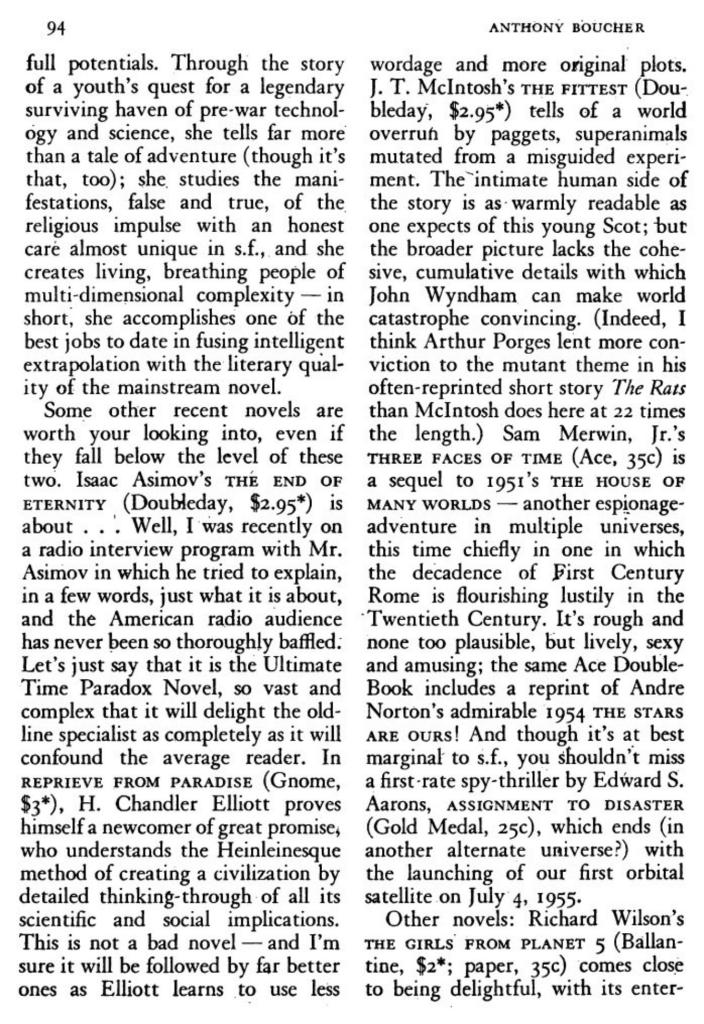
Damon Knight, in both fanzines, genzines, and books, was notorious for slicing and dicing books in his reviews. Knight is particularly nasty here. If I had read only this review, I would not have read the book. Luckily, I didn’t, because I liked this novel. I think Knight is completely unfair. I wonder if he hated it because it wasn’t like the kind of science fiction published in Galaxy. Knight is out of step with the other reviewers.
The Magazine of Fantasy & Science Fiction (January 1956)
by Anthony Boucher
Boucher’s review is quite succinct, and one I agree with. The story is warmly readable and intimate, but it’s not as good as The Day of the Triffids. Triffids is still in print, still widely read and recommended, and The Fittest and J. T. McIntosh are forgotten.
Imagination (June 1956)
by Henry Bott
Bott is quite positive about The Fittest, but he gets the core conflict wrong. Not all animals are uplifted, just mice, rats, cats, dogs, and horses.
None of these reviewers comment on the details of civilization’s collapse and what the characters do to survive. The Fittest isn’t as thought-out as Earth Abides, but it covers many of the issues that post-apocalyptic novels need to cover. The core conflict is with the animals. However, a good deal of the novel is about dealing with death and grief, and forming new relationships. Don Paget’s wife dies at the very beginning of the novel, and for the rest of the story, Don is concerned with picking a new mate. Because life is now different, making relationships is different. That’s a strong thread of the novel, and one that reviewers missed.
Ruler of the World
The next book is the one I found disappointing. I should have stopped reading it.
It’s telling that I could find no prozine reviews of Ruler of the World. ISFDB.org lists reviews in three fanzines. I could only track down one.
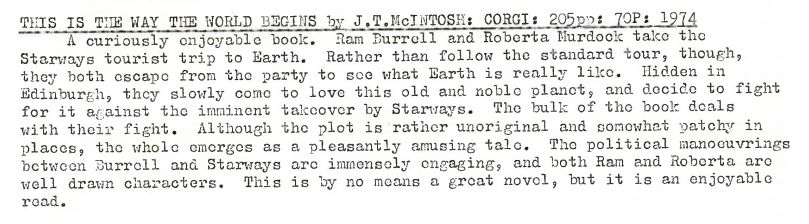
Paperback Parlour #3
by Philip Stephensen-Payne
This review uses the English title for Ruler of the World, published by Corgi.
Stephensen-Payne liked it way more than I did, using phrases like “pleasantly amusing tale” and “immensely engaging.” And the few details he gives about the story are misleading.
Just because I didn’t like the story doesn’t mean that other people will dislike it too. We now have two opinions. I guess there’s a chance that more people could have liked it. But without other reviews I won’t know.
After being thoroughly disappointed with Ruler of the World, one of J. T. McIntosh’s later works, I decided to try one of his earliest novels. One from his prime. I chose The Fittest when I read that it was about animals with enhanced intelligence. It was his fourth published novel, from 1955. I love science fiction tales set just as civilization is collapsing. I have a strong affinity with Robinsonades, which are closely related to post-apocalyptic fiction. I especially love the cozy ones, about a small group of people struggling to survive.
My gold standard for judging such stories is Earth Abides by George R. Stewart and the television series Survivors (BBC 1975-1977). If these are 5-star efforts, then The Fittest is only a 3-star work; however, I thoroughly enjoyed reading it. It was a quick page-turner that I finished in less than 24 hours. The Fittest touched upon many of the essential elements of both Earth Abides and Survivors, but not as deeply.
The setup for The Fittest also puts it into another sub-genre of science fiction, one about uplifted animals. The story begins with a young woman being killed by mice and a cat. Over time, we learned that the intelligence of mice, rats, cats, dogs, and horses was increased in scientific experiments. Not enough for them to talk or think like humans, but enough to give them a greater ability to thrive and compete. Eventually, they could breed true, escape the laboratory, and spread across the world. For some reason, these uplifted animals saw humans as competition, with each species working to kill humans when they could. The uplifted horses were quickly eliminated because of their long gestation period, but the smaller animals bred faster than we could exterminate them. Over time, mice, rats, cats, and dogs found savvy ways to destroy our crops, infrastructure, and technology. They were simple methods, like chewing through wires, hoses, wooden structures, and so on, but effective in bringing down our civilization.
I have to assume that J. T. McIntosh was inspired by Sirius (1944) by Olaf Stapledon, Earth Abides (1949), The Day of the Triffids (1951) by John Wyndham, and Brain Wave (1954) by Poul Anderson. Sirius was an uplifted dog, but it could talk. Triffids were plants with more intelligence. And Brain Wave imagined all life on Earth with increased intelligence. Earth Abides and The Day of the Triffids dealt with small communities forming after civilization collapses.
Stories about humanity recovering from apocalyptic events were common in the 1950s and 1960s. Often they were inspired by the Cold War, pandemics, or environmental catastrophes. In 1956, John Christopher imagined a virus killing variously related grasses in The Death of Grass. I thought Wyndham was quite creative when he invented triffids. I give McIntosh credit for speculating about how increased intelligence in animals might threaten our apex position.
However, for me, how individuals cope in an apocalypse is the key rubric to score post-apocalyptic novels. I’m afraid Don Paget from The Fittest is no Isherwood Williams from Earth Abides. However, the characterization in The Fittest is closer to the characterization in the television series Survivors. Both stories are set in rural England, so that wins points with me.
Read my essay, “What Would You Do If You Were Among the Last Humans on Earth?” I think books about survivors of an apocalypse challenge readers to imagine themselves in a similar situation. Most post-apocalyptic novels deal with human vs. human conflicts, and The Fittest does cover this. But McIntosh creates a unique kind of horror when he pictures us fighting intelligent mice, rats, cats, and dogs. It’s not as scary as The Quiet Place, but if you think about what McIntosh imagines, it’s pretty scary.
Mice are particularly threatening to women. At the beginning of the book, three mice terrorize Gloria simply by stalking her. McIntosh points out that women hate the thought of mice touching them. While Gloria is terrorized by the mice, a cat attacks her. It’s not strong enough to kill her, but its vicious scratches scare Gloria into trying to flee out a window, and she dies from a fall.
Rats attack in waves of hundreds. Dogs attack in packs of dozens. Their movements suggest they have developed intelligent cooperative strategies. Not that they can talk or communicate ideas, but that they learn together. All four species learn that humans depend on technology to survive, so they begin sabotaging us in crude but effective ways. These modest increases in intelligence make The Fittest far more realistic.
The real story here is how humans react. Paralleling this story is Don’s relationship with Ginette and other women. It’s hard to choose a life partner during an apocalypse. Don is still swayed by good looks, but he realizes that having a personality with survival traits is the new measure of hotness.
I’m torn between rating this book 3 or 4 stars on Goodreads. My desire to keep reading was definitely 4 stars, but because of memories of more famous books, I think I should only give it 3 stars. My main criterion for rating a book 4 stars is having the feeling I’ll eventually want to reread it. I don’t think I will. I’ve read Earth Abides three times, and will probably read it again someday. That’s because the characters have depth, and the book puts me into philosophical contemplations. Earth Abides is almost twice as long as The Fittest.
It’s a shame McIntosh didn’t put more into The Fittest. Science fiction writers have always cranked out books to get quick paychecks. Earth Abides has always stayed in print. That’s not true for The Fittest. Still, I’m fascinated by the forgotten Scottish science fiction writer. I’ve now read three novels by him, two of which I liked.
Countless books have been published about survivors of apocalypses. Few stay in print. Earth Abides abides. That’s also a kind of survival of the fittest.
I’m ashamed to admit that I wasted my time reading this book. Let’s hope I can find something insightful to say about the experience. I confess I have a lifelong addiction to fiction. Even though years of studying consciousness, philosophy, and spirituality have shown me wiser pursuits for my time on Earth, I still prefer to escape into fiction. I should at least read the highest quality fiction, books I could justify in some way, but I seldom do. Why?
When I say I’m addicted to fiction, I mainly mean novels, movies, and television. At 74, I regret spending so much time mass-consuming fiction. Sometimes I wish I could give up fiction completely. Other times, I dream of becoming disciplined and only reading and watching the very best fiction. Despite my best efforts, my reading habits are like a pinball machine, where I careen around the board, bouncing off great books and bad books with little control.
Unfortunately, I’m fascinated by all aspects of literary science fiction. Oddly, I’m somewhat indifferent to movie and TV science fiction. I justify reading crappy science fiction by rationalizing that I’m researching the genre’s history. I have a theory about that. Everyone specializes. I’ve got 65 years of experience reading science fiction, and I can’t walk away from that. I’m too old to become a newbie in another area.
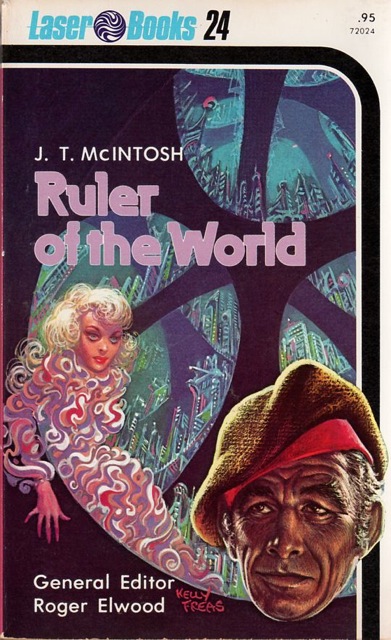
Laser Books was Harlequin Books’ foray into publishing science fiction from 1975 to 1977. Harlequin used its famous formula for publishing crappy romance novels to sell science fiction. They churned out 57 titles, all with similarly styled Kelly Freas covers. The books were short, and they published mostly first or second novels by new authors, and in the case of J. T. McIntosh, a work from his decline years. A bunch of these Laser Books showed up at my Friends of the Library bookstore. I bought Ruler of the World by J. T. McIntosh to try one out. I picked it because I had read McIntosh’s One in Three Hundred, and liked it.
I’m going to write a lot of words about a book I don’t recommend you read, and it’s doubtful you’ll ever see it at a used bookstore. Although if you’re willing to waste $9, you can pick up a used copy online. Many of his novels are available for the Kindle, and many of those you can read for free if you’re a Kindle Unlimited subscriber. However, Ruler of the World isn’t one of them.
I must admit, I’m intrigued by Scottish writer J. T. McIntosh. He had three hardback SF novels published in the early 1950s by Doubleday. Personally, I consider the 1950s to be the true Golden Age of Science Fiction. Wikipedia lists 24 novels by McIntosh, many from the 1950s, but it also says his later work is mediocre and was published by third-rate paperback publishers.
I have several ways to rationalize reading mediocre books, but are they valid? Of course, we’re living in a time when people lament that young people don’t read books, as if reading books were a virtue, but I worry that I read so much that I’ve made it a vice.
Just before I read Ruler of the World, I read Whistler by Ann Patchett. That novel is excellent. It’s quite compelling and beautiful. As soon as I started the McIntosh novel, I knew it was crap. So, why did I keep reading? I can give you two conscious reasons. One, I’ve been having fun looking for good science fiction among forgotten books. Since I had tremendous success with Dark World by Daniel F. Galouye, I was trying another.
And second, McIntosh offered a mystery. In his story, humans have colonized the galaxy, and Earth is a mostly forgotten planet. Ram Burrell, a thief and rogue, hears about Earth and decides to go there. Even more intriguing is that Earth limits galactic visitors to 500 at a time. And those visitors are restricted to seven tourist destinations: Malta, Cuba, Shetland, Hawaii, the Sahara, Russia, and Tibet. Weirdly, when tourists arrive at the Sahara, they are given the choice to visit Bagdad, Babylon, Lake Chad, and Timbuktu, all within easy driving distance. We know that’s impossible. Tourists are also told that they are forbidden to interact with normal Earth people. That’s a mildly intriguing setup.
Ram Burrell is a repellent protagonist. He punches innocent people, throws waiters out of windows, and expects every woman he desires to have sex with him. McIntosh implies that Burrell is so alluring to women that they comply even when they really don’t want to. He partners with the one woman able to refuse his advances, Roberta Murdock. Ram is 44, and Roberta is 22. That’s kind of skeezy too. At one point, Ram and Roberta are on the run, Roberta has been knocked unconscious, and two married women offer to help. When Ram gets one of the women alone, he makes a pass at her; she initially refuses, but then gives in. Later, when her husband goes to get the police, Roberta asks Ram why he risked their escape to have sex with a woman who was sheltering them. Ram says he hadn’t had sex in a while and needed it.
To give McIntosh another chance, I’m reading The Fittest from 1953. The novel parallels Ruler of the World, where the protagonist is an alpha male who partners with a 22-year-old girl. This time the guy is under 30. I think McIntosh was 28 when the novel was published, and 50 when Ruler was published. Is his protagonist a stand-in for himself? And the girl character, his idealized woman?
I wondered what McIntosh was intending for his character. Did he want Ram Burrell to be like James Bond? Later, when I read that Laser Books was owned by Harlequin, I wondered if they demanded a certain amount of sex. I’ve read that some forms of romance novels feature sex where women are “taken.” But then I read Harlequin’s rules for science fiction, which included a ban on explicit sex. Whenever Burrell stops to have sex, we’re told, not shown. And what’s the point of having so many scenes where Roberta avoids Ram’s advances? Is that another romance trope?
I bring all this up to explain possible justifications for reading old, forgotten books. What is this one saying about the gender roles of 1975? Or the fantasy expectations of men? Even though McIntosh portrays future men and women as unfettered by 1975 morality, his heroine, Roberta, seems to be holding out for marriage. Isn’t that weird? I assume modern female readers will despise this novel.
Wikipedia’s report on Laser Books isn’t flattering. Evidently, they were written to specification, and the editors often rewrote them or hired other writers to rewrite them. Piers Anthony even had a co-writer forced on him who got shared credit. Also, readers and reviewers disliked these books. So why am I reading one? I sort of feel like one of those women Burrell seduces – I really didn’t want to read this book, but I read it, anyway.
I’m also reminded of another book, A World Appears by Michael Pollan. I finished it just before Whistler. In the last chapter, Pollan describes meditating for days while living in a kind of cave. The whole point of this exercise is to experience quiet, abandon the mental chatter, and reach a state of pure existence where he sweeps the floor and chops wood. To a Zen Buddhist, our thoughts keep us from honestly interacting with reality. I’m afraid I feed my internal chatter books like shoveling coal into an old steam engine.
Ever since ChatGPT came out, I’ve realized that part of my brain works like a large language model (LLM). I continuously consume text to train my inner LLM. But as we’ve seen with AI, many produce poor output because they were trained on unreliable text.
If a subset of our minds is like LLMs, unconsciously generating thoughts, then we should do everything we can to control what it trains on. Or, if we allow it to train on bad content, we should annotate and explain it, so it won’t spew out later.
Consuming fiction, whether great or crappy, only adds to our mental chatter. Most of us are addicted to fiction. Now we can come up with reasons, even good reasons, why we substitute reality with fiction. Can we ever justify consuming bad fiction? After Whistler, which was extremely high-quality fiction, consuming Ruler of the World provided a revealing contrast. Like Burrell needing sex, I believe our minds crave fiction because we don’t want to face reality.
Many advocates of reading want young people to read books to become more empathetic. As we’ve learned from AI training on the internet, they become racist, mean-spirited, and hateful. Young men reading Ruler of the World are not going to develop any empathy for women. I know Republicans are hell-bent on removing DEI initiatives from society. How are readers training their internal LLMs going to know what is good and bad about characters if society doesn’t give them guidelines? I’m not sure just reading modern woke novels will do the trick.
There is no indication within Ruler of the World that Ram Burrell is a complete asshole. Ram is a grab them by the pussy kind of guy, who believes making money any way you can get away with is the goal. I think this is a terrible novel, but I’m not sure it wouldn’t be popular with today’s young men on the radical right.
This morning I watched an interesting YouTube video. It’s titled “The Book That Predicted the Destruction of Society – Analyzing The Catcher in the Rye.”
Hilary Layne, the channel’s host, divides her discussion into “observing books” and “dystopian books.” I like that distinction.
Observing books differ from dystopian stories. Books like 1984 and Brave New World are offering warnings about what current society could become if left uncorrected. Observing books offer no warnings; they are the bare-faced truth about what was happening in their times, and to a like-minded reader, they come across like keenly prescient insights into the specific ills plaguing their times and future times. A lot of the time, a very well-written observing book will accidentally stumble upon precisely the issues that could go on to create the broken society of the future that its writer could not have foreseen.
As an aside, this is why observation is the most powerful tool of any writer. The way I look at it, observing books are kind of the first wave. Society begins to fall ill, and then these sharp-eyed souls, these keenly observant creative types, can’t help but write stories in which their characters are also observing these hairline fractures in the weight-bearing beams of civilization and culture. Later, and sometimes even concurrently, other novelists who have made similar observations—sometimes even bolstered by those of the observing books—will write their dystopian warnings.
Of course, there are always the other books, and then there are even the escapist books like fantasy or romance. But certain points in history produce the right circumstances to give us exactly the right authors to write that era’s observing books. Observing books and the dystopian books of a given era work together to help a society both observe its own ills and also metabolize and adjust to the new normal, for good or ill. For this reason, the very best of these types of books become a source of profound comfort, contrary to what might seem logical, largely because they allow an isolated reader to feel that he or she isn’t insane or alone. Moments in history when massive changes occur in society are often met with very quiet waves of profound pain by people who can see what the world is becoming. These books become lifelines to these types of people.
Ruler of the World neither observes nor warns. It does speculate, one of the virtues of science fiction, but it does so poorly. Harlequin intended these books for male readers. Anyone under forty will not remember how many books and magazines were specifically aimed at men. Here’s another YouTube video I watched yesterday, “Did Men Stop Reading Fiction or Did Fiction Change Too Much for Men?”
This is a fascinating video. The host makes his case by comparing bestsellers from 1986 to 2026. He says anecdotal evidence suggests men have stopped reading fiction. Of course, I hear that young people have stopped reading. The host suggests several reasons why men have stopped reading, but I don’t think he covered all the possibilities. And I think people, both men and women, began giving up on reading much earlier than 1986.
Before the 1950s, hundreds of fiction-only magazines were sold on newsstands. Nearly every general-purpose magazine, either aimed at women or men, ran a couple of short stories. Television was the beginning of the shift. The internet, video games, social media, and all the rest came later. Every grocery store, drug store, and even convenience store had one or two twirling racks of paperbacks.
We can think of all of that reading as merely entertainment or training for the reader’s internal LLMs.
Where I go to mine for forgotten classics is this era. Laser Books came in at the tail end. Americans used to have an insatiable habit for reading. And a lot of it was gender specific. I don’t see the kinds of books and magazines I used to see aimed at men. And sure, a lot of that reading was bad fiction. Not just poorly written, but sexist, unwoke, and politically incorrect by today’s standards. Popular fiction today is different. And it’s mostly suitable for women. But does that mean men shouldn’t read it?
I have to wonder if I read a lot of old bad science fiction because it was designed for the males of my generation. However, I don’t crave old science fiction for its sexist outlook. Old science fiction had a different attitude about the future than what current science fiction writers have now.
Another Bibliophile Reads seems to suggest that we should bring back books for men. But what if those books men liked in the past were too much like Ruler of the World? Is that what conservatives want? If reading trains our internal LLMs, is that what we want young readers to consume?
To properly criticize a book, don’t we need to consider the book’s impact on the reader’s LLM? Isn’t that why conservatives want to ban books? Isn’t wokeness the liberals’ approach to banning books? And aren’t literary criticism and book-banning methods efforts to control human LLM training? Once you accept our thoughts come from the content our minds are trained on, then literary criticism takes on a new dimension.
I know I’ve brought up too many topics for one essay, but I’ve given myself several insights to think about. I believe I made reading a bad book worthwhile.
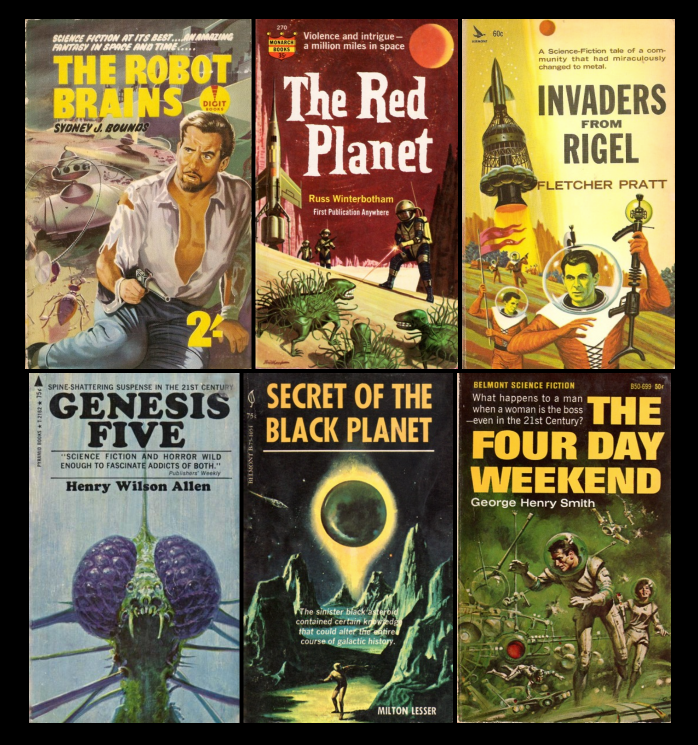
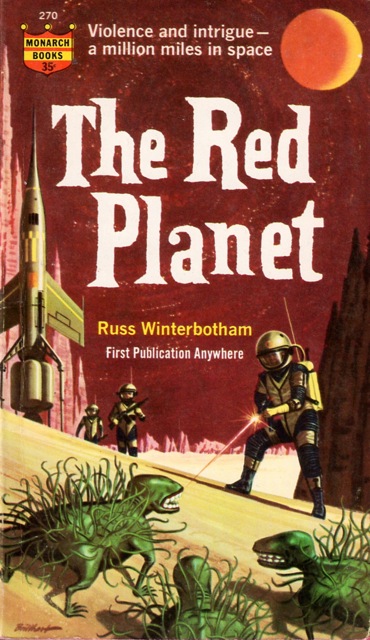
Recently, on the YouTube channel Pulpmortem, I viewed Jake’s video “9 So Bad, they’re Good Science Fiction Books you’ve probably never heard of.” Jake, evidently, is a connoisseur of bad science fiction, and the nine novels he reviewed indeed sound dreadful. Since Jake claims that bad books still can be fun to read, I gave The Red Planet by Russ Winterbotham a try. It was a quick, fun read that wasn’t badly written, but was essentially a minor, forgotten work.
I picked The Red Planet because it was free to Kindle Unlimited subscribers. It’s only $1.99 if you’re not a subscriber. This novel is also available for free on Project Gutenberg.
There are hundreds of better science fiction novels for $1.99 on Amazon, so why should anyone read it? Shouldn’t we always seek out the best possible novel to read? Why read a crappy book when you could be reading something great?
Well, readers don’t think that way. Even though we’re warned never to judge a book by its cover, how often have you bought one just because the cover was so cool looking? How many people have a secret fondness for watching old episodes of Perry Mason instead of streaming the trendiest show on Apple TV? People tend to develop a fondness for a particular type of story and storytelling. They don’t prejudge its quality.
But the question is: Should we seek out books (and movies and TV shows) that popular culture has forgotten? Regarding science fiction, I can think of a few reasons.
We’re searching for forgotten gems.
We like the author.
We like the period.
We like studying the evolution of the genre.
We enjoy playing genre historian.
The Red Planet is about the first manned mission to Mars. The crew consists of five men and one woman. The driving conflict of the plot is that all five men want the woman sexually, and the woman, Gail Loring, wants to be left alone and treated as an equal, an astronaut, not a woman. This is quite progressive for 1962, since The Feminine Mystique wasn’t published until 1963.
Concurrent with the plot conflict is mutiny and murder. Dr. Sparten, the crew commander and rocket scientist, wants all the fame for being the first man on Mars. He also plans to be the man who ends up with Gail Loring. Sparten is Machiavellian and psychopathic. The other four men are dedicated astronauts, but they can’t stop thinking about Gail. After reading The Red Planet, I couldn’t help but wonder about the Artemis 2 mission and the sexual tensions on the International and Chinese space stations.
Even though The Red Planet was probably written in 1961 and published in August 1962, it’s not completely dated. Although it is dated regarding Mars, because the third conflict in the story regards Martians.
Russell Robert Winterbotham (August 1, 1904 – June 9, 1971) published books in several genres, comics, comic strips, and big little books, all the while working at a newspaper. Sixteen of his stories are reprinted at Project Gutenberg. Winterbotham was reasonably prolific and mostly forgotten.
Whenever I stumble upon an old science fiction story by a forgotten writer, I get curious about them. I snoop the internet for any clues about what they were like. I found this short biographical piece written by Russ in 1956, for the apazine Pooka #2. He ended the piece with:
I have no idea now much I’ve written. I expect I hold rights on about 50 to 100 short stories, but there were many many more that I sold outright and reserved nothing and I have no record of these. During my peak, I remember one year in thich I produced two million words. Usually I wrote about a million words a year, counting my newspaper and comic strip work, Now I write less than a quarter of a million and very little of it, except comics, is fiction, I’m pecking away at a novel which should be finished before 1960. Then I hope to die with my boots on. Later, if I can help it, than 1960.
I authored some historical strips last fall, dealing with frontier characters, “Daniel Boone,” “Kit Carson,” and “Wild Bill Hickok,” These brought more fan mail, including letters from descendants of Boone and Carson, than anything I ever wrote.
My family never reads my stories because they share the opinion of a vast number of others, that they are not literature. But I like my work, I’m my greatest fan. And I’ll keep writing them, by God, as long as I live,
Fanencylopedia 3 quotes Winterbotham just before he died: “The science fiction market doesn’t seem to demand my talents, whatever they are, and I need the rest.”
The old cliche is that writers write for immortality. Sadly, most are quickly forgotten. One reason I like reading old forgotten novels is to wonder about why and how they were written. For a guy born in 1904, The Red Planet is an interesting read.
Winterbotham was around 58 when he was writing that novel. He’s obviously keeping up with science and science fiction. His story features NASA. His astronauts use a Saturn rocket to get to orbit, where the Mars rocket waits. Unfortunately, he has his astronauts get onto the Saturn with a cherry picker. A cherry picker was on hand for Alan Shepard in case of an emergency exit. The Saturn 1 rocket made its maiden flight in October 1961, and it was unmanned, so Winterbotham probably didn’t know the Saturn was too big for that method.
I have a thing for Pre-NASA science fiction, and have written about it several times. The Red Planet is on the cusp of this era. Winterbotham uses NASA in his story, but imagines Mars inhabited by intelligent beings. Even though we know this isn’t true, I’m still fond of stories that feature Martians.
Science fiction changed after the Space Race began. Robert A. Heinlein, who was the leading science fiction writer of the 1950s, made an abrupt change in direction in 1961 with Stranger in a Strange Land. Before that, Heinlein was a head cheerleader for space exploration. Once NASA got going, Heinlein began thinking about new territory for the genre. I don’t know why science fiction historians don’t consider Stranger in a Strange Land as early New Wave. Cause it’s certainly not Old Wave. Heinlein was Old Wave politically, but Stranger was definitely an experiment in fiction on many levels. There are many reasons why Stranger has lost popularity, and one of them is that fans quickly turned against New Wave SF.
Frank Herbert took science fiction on a new wave, too, with Dune, around the same time. Herbert anticipated the long SF novel, with many sequels that explored complex world development, characters, and plotlines. The kind that is popular today.
Winterbotham was trying to be new, too, with feminism. Gail Loring is an interesting character in 1962 science fiction. But then, so were Heinlein’s female characters. Just because Heinlein wasn’t enlightened by 21st-century attitudes didn’t mean he wasn’t changing, too.
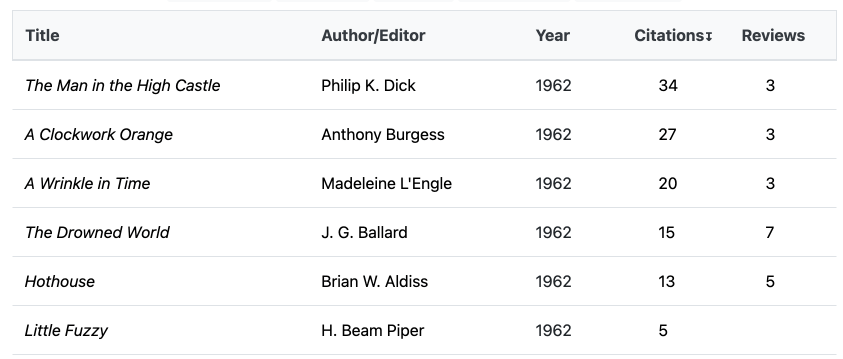
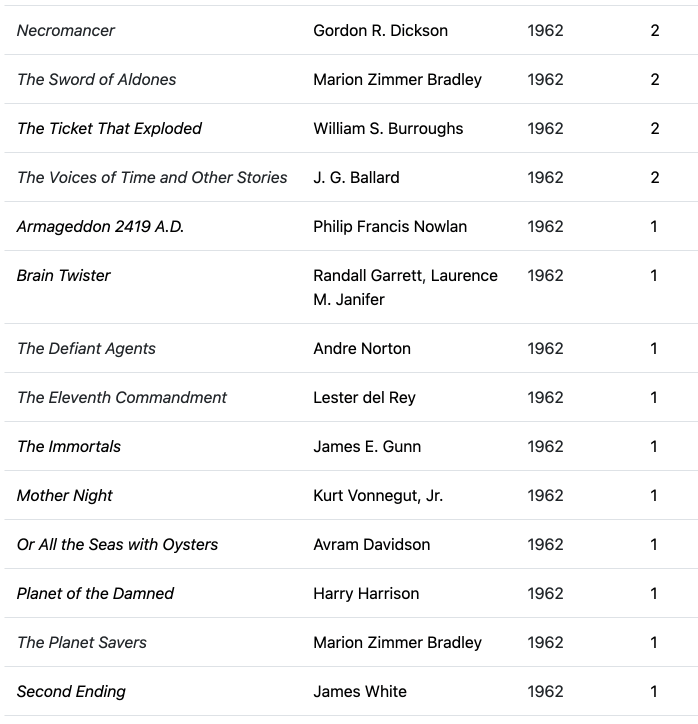
Look at the other top novels from 1962. I’d certainly recommend reading these better SF novels before The Red Planet.
But I’m not sure if The Red Planet is a significantly lesser read than these other SF novels from 1962.
I haven’t read Jake’s other eight SF books that he reviews. They are much harder to find. I’d probably have to spend $5-20 to acquire copies used, and I’m not going to do that right now. It’s a shame all old science fiction isn’t available as cheap ebooks or put into the public domain.
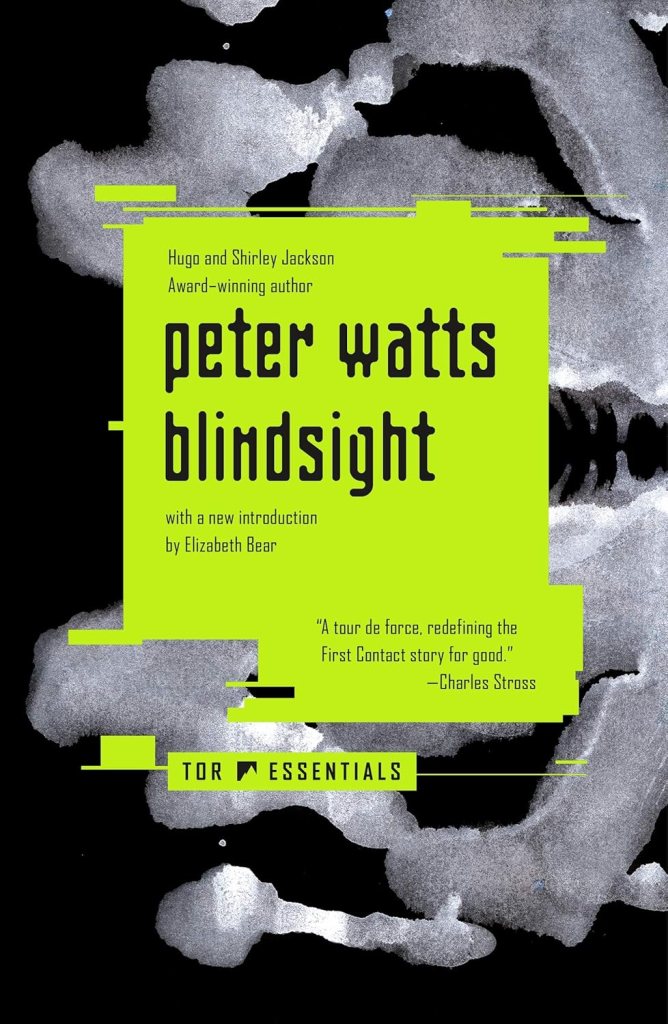
On the surface, Peter Watts’ novel Blindsight is a space adventure about first contact, but it’s mostly a series of lectures on the nature of consciousness. Watts works to convince the reader that space-faring intelligent aliens can exist without conscious self-awareness. The aliens in Blindsight are far scarier than the xenomorph creatures in the Alien movie franchise. Blindsight is science fiction horror.
It’s much easier to accept Watts’ main premise in 2026 than in 2006 when Blindsight was first published. Billions of people now converse with intelligent chatbots that have no conscious self-awareness. At least we hope they don’t. Reading Blindsight in the 2020s should make us more paranoid about AI.
Peter Watts is known for writing hard science fiction. He received a Ph.D. from the University of British Columbia, from the Department of Zoology and Resource Ecology. Writers of hard science fiction have an opportunity to present a hypothesis and test it in a novel. How seriously we should take these hypotheses depends on many factors. It’s not real science, but in some cases, both the writer and readers want to accept the fictional hypothesis as being provable scientifically in the future.
Watts makes a case that self-aware consciousness is a fluke of evolution. That intelligence could evolve more efficiently without it. Watts presents a convincing case in Blindsight, but should we believe him? With all hard science fiction, we must ask ourselves: Is this plausible or just good storytelling? Most science fiction writers don’t try as hard as Peter Watts in Blindsight, so it’s easy to just say, “Wow, that’s cool,” and let their work go unexamined. Watts presents so much interesting evidence (infodumps) that I feel demands evaluation.
I’ve tried several times over the years to read Blindsight. I never could stick with it. Blindsight just didn’t grab me, and learning that it featured a vampire completely turned me off. Recently, a reader left a comment on my post “Why Do We Read Science Fiction?” recommending Blindsight because it featured “creatures with very advanced intelligence but no self-awareness.” I’ve been doing a lot of reading on consciousness, so this did grab me.
Again, I struggled to get into the story. Several times, I considered quitting. The novel often presented ideas that got me thinking, but Watt’s style just wasn’t working. It’s probably a case of that old breakup line, “It’s not you, it’s me.”
Since we’re going to talk about the nature of consciousness, I should admit that I’m 74, and I often struggle with 21st-century science fiction. The SF books my mind was trained on came from the 1950s. They were often fewer than 200 pages, told in a linear plot, and had likable characters whom I could identify with. Blindsight is 384 pages, told in a convoluted plot, and there isn’t a single likeable character in the whole story. Fantasizing about being on the crew of the Theseus would be like wanting to be on the crew of the Nostromo? The entire time I was reading Blindsight, I thought about Alien. There are many similarities and parallels between the two stories, and their endings have much in common.
More than that, 1950s science fiction portrayed an overall positive philosophy regarding space exploration. Blindsight is a horror novel about the possible dangers we might find in outer space. Back in the 1940s, John W. Campbell, Jr., allowed Robert A. Heinlein and a few other writers to present stories with aliens so overwhelmingly terrifying that they put humanity on the level of a cargo cult. Heinlein even had Lazarus Long and companions run home to Earth after encountering one alien species. In the 1950s, Campbell and Heinlein switched gears and promoted humans as the badasses of the galaxy. Reading Blindsight makes me think humans need to stay on Earth and hide.
I accept that Blindsight is a masterpiece of 21st-century science fiction, and I even admire the story. I’m already thinking I should reread it because I’m sure I missed quite a bit of what Watts was trying to accomplish. However, there are many ideas raised in this novel that I want to discuss and even argue over. So this isn’t a review. If you haven’t read it, you might want to go read it before continuing. Blindsight has inspired many positive reviews on YouTube.
I should also mention that I almost didn’t finish Blindsight this time either. I was about a third of the way into the story and found the characters and plot confusing. So I read its Wikipedia entry. Even though it gave away the entire plot, it helped me enjoy the rest of the novel. I believe my problems were due to another difference between 20th-century SF and 21st-century SF. Science fiction has become more baroque in its complexity and storytelling techniques.
This YouTube video by the Feral Historian gives away the entire story. It’s not a review, but a synopsis of the story’s philosophical speculation. It’s strikingly eloquent, and I’m envious of his writing and speaking style. (By the way, the Feral Historian uses video clips from a short film based on Blindsight.)
I believe Peter Watts wants his readers to take his science-fiction speculations seriously because of his infodumps and Socratic dialogues. The infodumps cover a wide range of studies and theories about consciousness. I often wondered why Watts just didn’t skip the story and present his ideas as a collection of popular science essays.
There are two hierarchies for disseminating scientific ideas.
Genuine Science
Science (peer reviewed)
Mentors
Popular Science Books
School Science
Science Documentaries
Popular Science Articles
Science Fiction?
Pretend to Plausible Science
Science Fiction
Pseudoscience
Social Media
Crackpots
Comic Books
Watts bases his main hypothesis on the Chinese Room thought experiment first proposed by John Searle in 1980. The link is to a Wikipedia entry that I highly recommend reading to fully understand Blindsight. Searle proposed the Chinese Room thought experiment to refute the idea that if a computer could do everything a human could, it would also be self-aware and conscious.
When the crew of Theseus finally tracks down the alien spaceship, they are surprised by this message:
RORSCHACH TO VESSEL APPROACHING 116°AZ–23°DEC REL. HELLO THESEUS. RORSCHACH TO VESSEL APPROACHING 116°AZ–23°DEC REL. HELLO THESEUS. RORSCHACH TO VESSEL APPROACHI …
She’d decoded the damn thing. Already. She was even answering it:
Theseus to Rorschach. Hello Rorschach.
HELLO THESEUS. WELCOME TO THE NEIGHBORHOOD.
After quite a bit of back-and-forth communication between the two ships, Szpindel suggests that the aliens don’t actually understand English, but are using the technique suggested in the Chinese room thought experiment. If Watts had written Blindsight in 2026, would he have suggested the aliens understood English because they were a large language model (LLM)? Anyone with much experience communicating with ChatGPT would make the assumption.
Many current AI researchers are hellbent on creating a conscious, self-aware AI. If humans are biological machines that evolved to have self-awareness, then AI researchers believe it’s possible to build self-aware machines. Searle proposed the Chinese room thought experiment as proof that it’s possible to create a machine that appears self-aware but isn’t. Philosophers and computer scientists eventually concluded that the Chinese room thought experiment wasn’t conclusive.
Anyone who meditates or studies the science of the mind knows that intelligence and awareness are two separate aspects of our being. Throughout his novel, Watts hammers home to his readers that humans are not what we think we are. Just consider the title of the novel, Blindsight. Read the Wikipedia entry. Throughout the novel, Watts chronicles conditions where our senses fool us. At times, I wonder if Watts had been reading too many Oliver Sacks essays.
Watts suggests that conscious self-awareness may be an illusion, and suggests that many humans are no more than zombies.
At some point in the story, I believe readers should be asking: Is Watts wrong? If we combine LLMs with robots and those mechanical beings learn to interact with reality, will conscious self-awareness spring up? Will robotic consciousness be just as soulful as human consciousness? The scientific study of minds doesn’t leave room for the soul, although many religious researchers would like to find it. Christians will have to decide if robots and aliens have souls. Watts suggests that nobody has souls, that immensely intelligent beings could exist without consciousness, and that even those who do claim to have conscious self-awareness might be delusional.
Blindsight is an incredibly bleak book. But then it’s a horror novel. Several factors in Blindsight make me distrust any idea Watts proposes. The main one is resurrecting vampires. In the fictional world of Blindsight, vampires did exist, but became extinct. They are resurrected to learn about their longevity and ability to hibernate. The crew of the Theseus is enhanced by these genetic discoveries, allowing them to survive the long voyage to the edge of the solar system. I’m sorry, but this is comic book-level science.
The crew is supposed to be transhuman, or posthumans. Science fiction often imagines posthumans with longevity, immortality, and psychic abilities. I find such speculation to be weak, boring, and trite. Those ideas seem to have been swiped from Greek mythology. I thought the film Gattaca did a good job of imagining posthumans being humans with genetic modifications. Many science fiction writers like to imagine posthumans with all kinds of body modifications. That also seems rather comic-booky to me.
Watts offers several possibilities, but none of them were developed with much conviction or detail. The main one is Jukka Sarasti, a vampire. Vampires are genetically resurrected from their extinction in the Pleistocene. Probably inspired by Jurassic Park, but much like how current-day Colossal Biosciences wants to bring back the Woolly Mammoth.
The whole time I was reading Blindsight, I thought of that old saw: if a gun is introduced in the first act, it must be used by the final act. In my mind, I kept thinking: if a vampire is introduced at the beginning of a story, it’s got to kill before the story is over. That anticipating messed up Blindsight for me. Watts, in the very end, does fire off his vampire. However, it undermines the seriousness of his original hypothesis. I must admit I have a great prejudice against vampires. I thought vampires were perfect in Dracula, Bram Stoker’s famous novel, and their continued use has been all downhill since then.
The Gang of Four is merely a body with multiple personalities. I saw no advantage to this. I’ve had enough of this idea after seeing The Three Faces of Eve and reading the book.
Siri Keeton is our protagonist. He had had half his brain removed in childhood, which created a unique perspective for studying consciousness. Watts portrays him as the ship’s “synthesist.” I never felt Siri had any significant insights. Watts seems to use Siri to think out ideas to help move the story along.
However, I’m not going to ding Watts for these criticisms. Many modern science fiction stories try to jam in as many ideas as possible. It makes for an epic science fiction impact. For an old fart like me, it’s just tiring, but I do understand that younger, more energetic minds feed on this kind of science fiction speed.
We still need to decide on the novel’s main hypothesis. Can advanced intelligence exist without self-aware consciousness? The internet is full of stories about the initiative that Openclaw agents are taking. Watts didn’t know about LLMs and agentic AI, but both are convincing evidence for his case.
We only know of one species in the universe that we consider conscious and self-aware. The concept of the soul has existed for thousands of years, complicating this discussion. We have to assume there might be an infinite number of kinds of consciousness. It’s almost impossible to imagine anything that’s not like us. But then Einstein imagined relativity, proving the human mind can conceive of something vastly different.
Humanity is now spending hundreds of billions of dollars developing AI. Far more than we spent on the space race of the 1960s. More than likely, we can create robots that can function independently in this reality and become far more intelligent than we are. But will we ever know if they have self-aware consciousness like ours? Throughout Blindsight, Watts asks if we’re as self-aware as we think we are.
I’m not sure if Peter Watts ever asks if vastly intelligent beings without conscious self-awareness feel they do have it? Maybe the creatures on Rorschach experience existence no different than us. Maybe both the concept of the soul and conscious self-awareness are illusions.
Personally, I think my sense of awareness is one thing, and my fast and slow thinking abilities are two other mechanisms in my brain. That my sense of umwelt comes from an integration of sensory inputs, a sensorium. And that my thoughts come from another biological mechanism that works much like an LLM. Why shouldn’t it? LLMs are based on neural networks.
Because of a TIA, I know my awareness can exist without my thoughts. I also know that my awareness can disappear, and my biological LLM can generate dreams with all kinds of weird logic and intelligence. Watts mentions in the novel that sleepwalkers can drive cars or pursue various other activities without waking up.
The reason Blindsight makes such an impact on readers is not because of scary aliens but because it makes us think about our own minds, and that can be very scary.
By the way, the part of my being that watched me write this can’t explain how the part of my being thought it up.