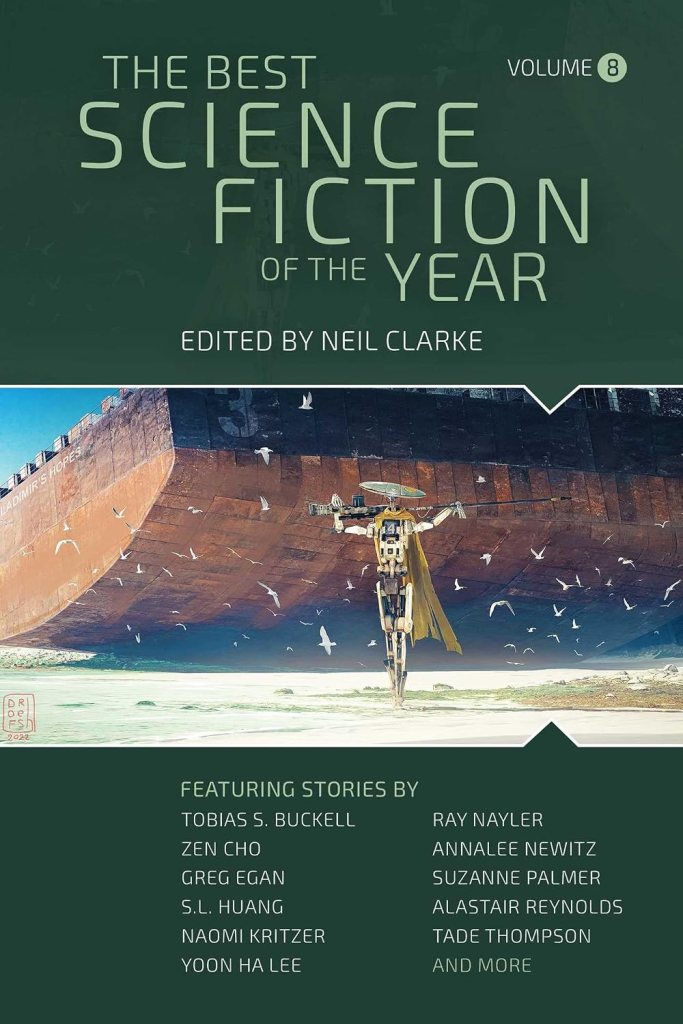
Starting on September 28th, our short story reading group will read The Best Science Fiction of the Year: Volume 8, edited by Neil Clarke. We’ll discuss a story every Monday and Friday. I haven’t been participating in the group for about a year because I got burned out on reading SF short stories. But I’m hoping to participate again. I miss reading science fiction.
I’ve read the first three stories to get back into the swing of things. My reaction was the same to all three. I felt these science fiction stories were written for young people. Have I gotten too old to read science fiction? I’m 74.
I’m not saying the stories are childish, but they do have a childlike quality. This is partly because of a “make-believe” feel, but also because of a kind of optimism. I can’t tell if it’s optimism for the future or optimism for science fiction. Unfortunately, I’ve lost all hope for humanity and concluded that science fiction’s hopes and fears for the future are wild speculations.
Such pessimism makes it hard to enjoy science fiction. I’m reminded of biographies I’ve read about Mark Twain and how gloomy his thoughts got in old age. Do we wear rose colored glasses in youth that we take off in old age, or do we put on dark glasses when we get old?
But I do have other theories. Every new science fiction story I read competes with the best science fiction stories I remember. And with over sixty years of discovering great science fiction stories, it’s very hard for any new story to measure up. Have I reached an age where the odds are against me finding new science fiction short stories that I love?
Another theory, based on years of reading, has suggested that only a handful of stories published each year are exceptional. If you look at The Classics of Short Science Fiction v. 2 sorted by year, the number of stories ranges from 0 (1957) to 5 (1966). A story needed at least 8 recommendations to get on that list. Some had as many as 18. That statistical system implies that, of the 31 stories in The Best Science Fiction of the Year: Volume 8, I’ll find five or fewer stories that I really admire.
Of course, different stories appeal to different readers, so if Neil Clarke collects 31 stories from 2022, the odds are most readers will find a handful they would recommend. I won’t know how many I’ll love until I finish the group read. If I do find a few, I’ll consider myself not too old to read science fiction. If I don’t, maybe I am too jaded for the genre. I do think being in my seventies has made me less tolerant of the average story.
Readers who are well-read in science fiction might look at my list of favorite short stories and notice some common elements. Many of the stories are dark and edgy. Many of them are innovative. Most of them are unique in some way. Young writers in the 21st century probably have a hard time coming up with any new science fiction concepts, themes, or plots.
One reason I think modern science fiction feels childlike is that it comes across as what Disney, Pixar, HBO, DC, or Marvel would produce. Have movies and comics completely reshaped how people think about science fiction? I grew up reading science fiction written by pulp writers, or inspired by pulp fiction.
I just don’t see edgy stories like “Fondly Fahrenheit” by Alfred Bester or “Coming Attraction” by Fritz Leiber today, much less innovative stories like “The Light of Other Days” by Bob Shaw, “Appearance of Life” by Brian W. Aldiss, or “The Star Pit” by Samuel R. Delany. Of course, even back in the 1960s and 1970s, science fiction writers struggled to come up with anything original in the genre.
But then I remember Ted Chiang and Sarah Pinsker.
The odds are that if I pick any random issue from my collection of science fiction magazines, I won’t find an outstanding story. Just read reviews of several magazine issues at Galactic Journey. Two- and three-star reviews are painfully common; five-star reviews are especially rare.
When I was young, a three-star story could still delight me. A Robert F. Young or Raymond Jones story could make an issue a satisfying purchase.
Hopefully, I’ve psyched myself up to finish The Best Science Fiction of the Year: Volume 8. I don’t want to give up on science fiction. But it’s getting hard to find anything I like. Let’s hope it’s not aging, but a matter of statistics.
James Wallace Harris, 9/13/26


My immediate thought — as a not-quite-as-old-as-you alter kocker myself — that when we are young, we haven’t read a lot of SFF (or whatever our chosen genre may be) yet, so we don’t have a lot of basis for comparison. Everything in the latest issue of Stupefying Stories (or whatever) is new to us. Only after we’ve read a certain number of stories — say, a couple of hundred — do we begin to have a sufficient “database” for judgement, a way to say, “hey, that was really outstanding,” or “well, that was boring and derivative” or “I guess that was kind of okay.” With further reading we find ourselves able to make more detailed comparisons and more coherent, meaningful comments on a new story.
This comes at a cost: the, shall we say, less-good stories just don’t work for us anymore. We really can’t enjoy the thirteenth story in the “Snotgurgles from Saturn” series the way we would have when we were new to SFF. Not only does the science make no sense, which we had always kind of known, we realize that the fairly limited possibilities of the series concept have been used up and the author is driving on an empty tank.
This only becomes more so as we enter the Golden Years. We have read so much great stuff, that the merely good stuff doesn’t entertain us. It takes something actually great to make us sit up and pay attention … and even that won’t necessarily do it, because we’ve frozen a little, we can’t always see what’s so great about some of the great new stuff. It isn’t so much that we can’t understand it; it’s that we can’t see it. Our eyesight, our hearing, all our senses are beginning to fail us; and this includes our sense of wonder, our imaginarium, and the other internal senses that made us love SFF in the first place.
For me, I struggle against this very hard. I have to; it’s inherent in the “Sturgeon’s Lawyer” identity: I’m supposed to be seeking and pointing out that all-important 5%.
So I deliberately seek out the best of the new stuff. But I don’t rely on “Best of the Year” anthologies anymore. I recently realized that buying WSFS memberships (what we used to call “supporting” memberships, remember that?) for every Worldcon is the way to go, partly so I can be part of the voting base for the Hugos. I’m not up enough on the new stuff to nominate, but by God and St. George, I am going to read the nominees.
And for about US$50, the price of the WSFS membership I’m getting half a dozen novels, half a dozen novellas, novelettes, and short stories, from the previous year, not chosen by one or two editors, but curated by a sort of statistical consense of a couple of hundred people who love SFF enough to buy a membership in Worldcon themselves. (Actually, a full dozen novels, half of them YA/juveniles. We mustn’t forget the Lodestars.) A new novel on Kindle typically runs, what, US$12-17? Those alone make the WSFS membership an insane bargain, then throw in the other fiction categories — and the fan categories, and the artist stuff, and … well, it’s an eddication, is what it is. (Of course, this comes with an implied responsibility to get through as much of it as possible in a timely manner, so that I can actually vote on the Hugo ballot, in an informed manner, in as many categories as possible. It’s rough, but somebody’s got to do it.)
And it works. For me, this year’s nominated novels were one three out of five, one four, and four fives, including one second-in-a-series that I liked so much that I bought the first in hardcopy, am seriously considering buying a hardcopy of the one I’ve already read, and will certainly buy any future installments in the series. (For what it’s worth, this is the “Shadow of the Leviathan” series by Robert Jackson Bennett, starting with The Tainted Cup: mysteries vaguely resembling the Nero Wolfe and Archie Goodwin novels of Rex Stout, only set in a wildly alternate reality that Bennett is wisely revealing a bit at a time. It’s probably fantasy, not science fiction — by my count there were only two real science fiction books on the ballot this year — but it’s that good. Another, Adrian Tchaikovsky’s Shroud, is something that I think would have blown Hal Clement’s mind.
To reiterate and sum up, I’m five years younger than you; at our age, that isn’t that much of a difference, I think: and I find it’s worth the effort, perhaps not to keep up with the genre, but to keep not too far behind it.
LikeLiked by 1 person
In the 50’s I read letters to the editor in Superman comic books, demanding to know why Clark Kent’s use of infrared beams didn’t melt his glasses and other topics that taught me more about science than I ever learned in my grade school classrooms.
Fantasy is wonderful – love Lord of the Rings – but fantasy doesn’t limit the impossible, it only requires internal consistency. Andy Weir knew Mars’ thin atmosphere makes debilitating, hero-stranding storms nigh impossible, but, like superman, we accepted the impossible as long as the rest is justifiable. Not enough science nerds are writing modern sci fi.
LikeLike
True. Great storytelling can overcome reality. Mediocre storytelling makes it harder to suspend rationality.
LikeLiked by 1 person
Wondering at 74 whether modern SF shorts still feel written for younger readers is a honest way back into Neil Clarke’s Year’s Best Volume 8, especially after a year away from the reading group. Calling the stories childlike without calling them childish captures a real tonal gap. I run Colony Flow, a guide site for a small ant colony puzzle game, and I likewise notice when a design assumes a player who still has endless energy for novelty.
LikeLike