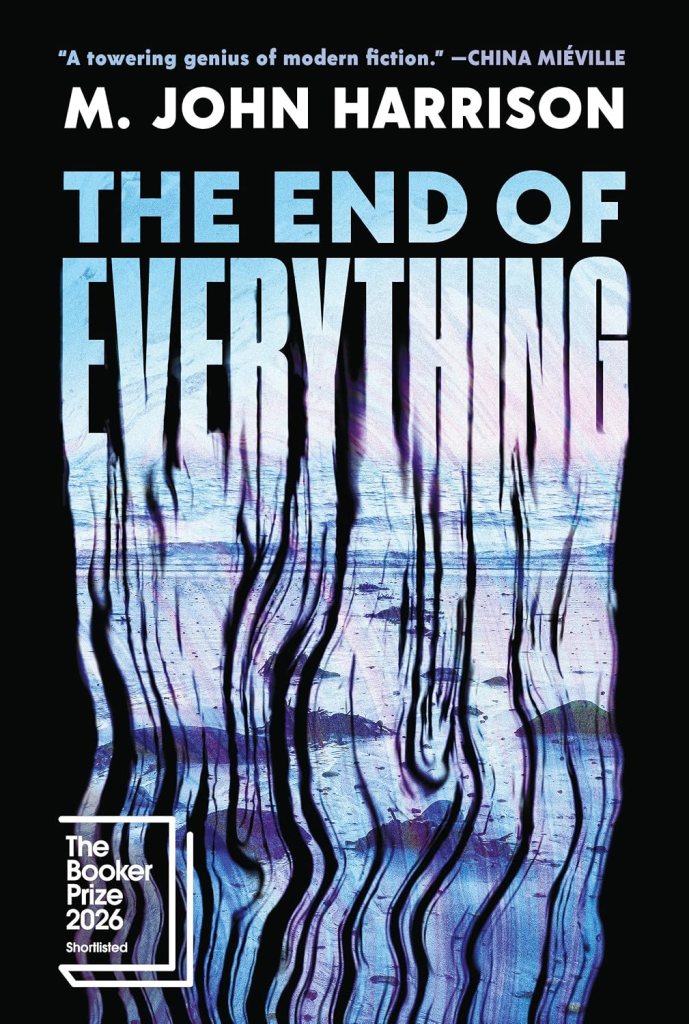
The End of Everything by M. John Harrison is a hard book to describe. Many people will want to read it because it’s a finalist for the 2026 Booker Prize. At around 200 pages, it’s a quick read in print, and just under four hours on audio. However, before buying, I highly recommend reading the sample offered by Amazon. I also recommend reading the reviews in Locus Magazine and The New York Times. The writing is clear and excellent, but the story is surreal, metaphorical, and ambiguous.
The End of Everything might be a science fiction novel about an alien invasion, but I’m not sure if science fiction fans will like it. The End of Everything might be an allegorical literary novel about our decaying society, but literary types might think it’s too science-fictional.
While listening to this novel, I was often reminded of The War of the Worlds by H. G. Wells. The settings are similar, and readers learn about the alien invasion from the personal perspective of the two main protagonists. Philip, 38, finds an alien artifact on the beach while staying with his aunt, Marnie, 70. Readers follow them separately and together, absorbing details about the aliens and the invasion along the way.
The aliens aren’t from outer space. They might be from Earth. At first, they are blobs of protoplasm. Eventually, grow larger, begin to resemble people, and even speak English. People wonder if they are from another dimension, the astral plane, a manifestation of spirits, etc.
Readers struggle to decide if they are actual invaders or metaphors for the problems of our times.
My initial reaction was to think about writing science fiction. The genre has a long history of alien invasion stories. Science fiction writers are hard-pressed to come up with new ways for Earth to be invaded. As a long-time science fiction reader, I felt Harrison found inspiration from The War of the Worlds, Invasion of the Body Snatchers, and Roadside Picnic.
If you’re a science fiction reader, you can take The End of Everything literally. However, if you’re the kind of reader who reads Booker Prize novels, The End of Everything can be deliciously ambiguous.
While reading The End of Everything, I was constantly reminded of books by J. G. Ballard and Brian Aldiss, especially the New Wave SF of the 1960s. I’m pretty sure Michael Moorcock would have proudly published The End of Everything in New Worlds back then.
The End of Everything has given M. John Harrison far more recognition than he ever got from science fiction readers. But this is at a time when many literary writers are selling lots of books by using science fiction themes. Turnabout is fair play, I guess.
I have a hard time reading modern science fiction. It’s just not that good. Young science fiction writers should study Harrison. I’ll use the hybrid SACD disc as an analogy. It can play standard-definition music on a CD player, but high-definition music on a SACD player. Harrison has written a hybrid novel, half science fiction, half literary. It will work with a science fiction reader or a literary reader.
My recommendation to would-be science fiction writers is to stop reading science fiction magazines and webzines and look for inspiration in novels like The End of Everything, What We Can Know by Ian McEwan, Annie Bot by Sierra Greer, Exit Party by Emily St. John Mandel, and other literary works.
Modern science fiction seems inspired by movies, television shows, comics, and video games. Great science fiction shouldn’t be inspired by older science fiction. It makes everything feel recycled. Find writing inspiration in literary bestsellers and the annual volume of The Best American Short Stories. But study everything going on in the real world today for inspiration for new science fiction themes.
Science fiction needs a new New Wave to stir things up.
If you love modern science fiction, you might find The End of Everything to be a downer. But then, back in the 1960s and 1970s, many SF readers found New Wave fiction a bummer. I’m not advocating writing dreary stories. Both Station Eleven and Annie Bot end up positive. And as bleak as The Handmaid’s Tale gets, it still has a powerful positive message.
Sadly, I didn’t walk away from The End of Everything feeling upbeat. I can’t tell if I missed Harrison’s hint of optimism in the end or if it’s just not there. The book might be saying we’re going down the tubes and we just have to learn to survive, and maybe something better will come along. Is he suggesting that AI might do a better job on Earth than we have? Assuming AI is one of the possible metaphors for the artifacts.
James Wallace Harris, 10/18/26


I was going to skip this book. I thought “Wish I Was Here” was just kind of nasty. But now I think I’ll give it a try.
LikeLike
Let me know what you think. It does have some nasty moments too.
LikeLike