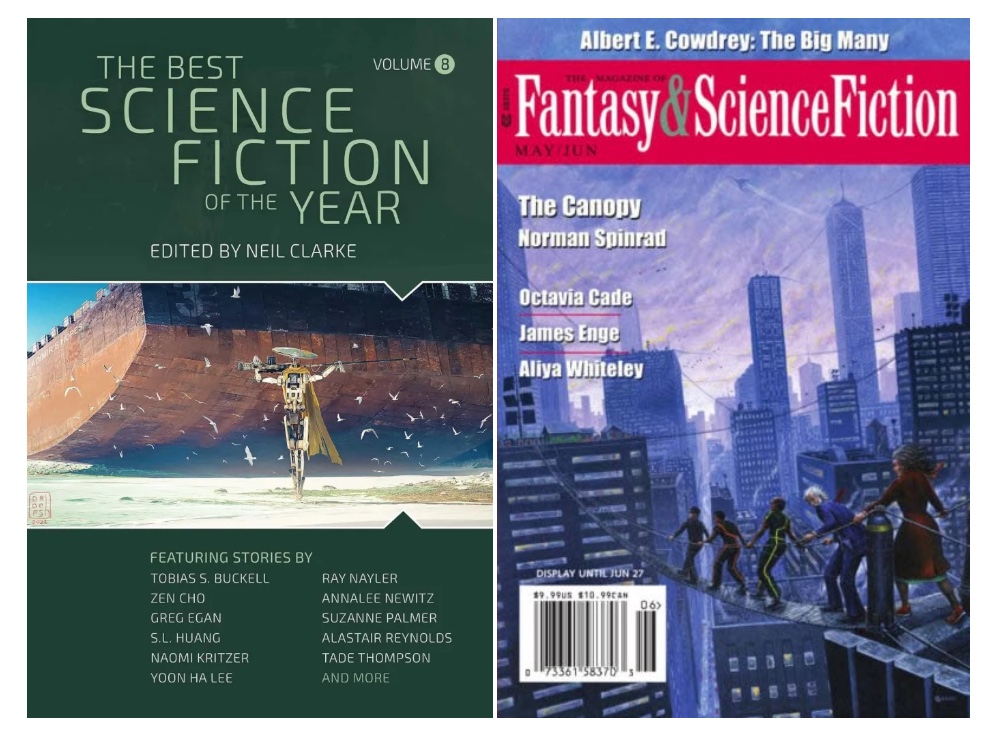
Story #4 of 31: The Best Science Fiction of the Year 8, ed. by Neil Clarke
Part of a series: Reading Science Fiction at 75. The first essay.
“Give Me English,” by Ai Jiang, is a metaphor for understanding languages and what it means to become an immigrant. The story feels like science fiction because everyone in this future has a language database (Langbase) in their head, and words are the universal monetary unit. Poor people have to sell their words to pay rent, and some eventually become mute because they run out of words in their langbase.
Gillian lives in New York. She is an immigrant from China. Gillian came to America because she couldn’t compete in the Chinese education system. That’s a real practice today. Because Gillian needs to learn English, she sells off her Chinese words to buy English words. But to survive in expensive New York, she eventually needed to sell her newly acquired English words too. Her friend Jorry is well off because he gambles with words and wins. Jorry offers to help Gillian, but she doesn’t want his help.
For a deeper appreciation of why Ai Jiang wrote this story, read Ray Naylor’s interview with her. Naylor, a science fiction writer who works in the Foreign Service and has taught English abroad. Naylor admired Jiang’s story, and the interview is very insightful. I highly recommend reading it.
“Give Me English” is a fine story. It was nominated for the Nebula and a finalist for the Locus Award.
However, I want to use this story to discuss something else. It’s not really about “Give Me English,” but about me being 75 and trying to find the kind of science fiction I grew up reading. I feel the stories in volume 8 of Clarke’s anthology take a different approach to science fiction. However, “Give Me English” could have been published in Galaxy or F&SF in the 1950s, and maybe even New Worlds in the 1970s. Even back then, science fiction was never consistently one thing.
Is “Give Me English” really science fiction? If it were published in The New Yorker or a literary magazine, would readers call it science fiction? Humans will never use words for money or have a language database in their heads, so it can seriously be considered speculation or extrapolation.
The story is a metaphor or allegory about language. It’s not realistic, but it uses a “what if…” thought experiment to place Gillian and Jorry in a fictional setting. “Give Me English” is included in a science fiction anthology because the genre has become a catch-all for oddball stories. Mostly, this is true because science fiction and fantasy periodicals are venues open to new writers. Would-be writers think that if they write stories with weird elements, they are writing science fiction. But is that the real essence of science fiction?
I’m not saying “Give Me English” is a bad story; it’s not. It’s a good story. But it’s not the kind of fiction I want to read when I’m in the mood for science fiction. Of course, my definition of science fiction is now in the minority. I’m not sure if my definition of science fiction was ever in the majority.
When I was growing up, science fiction was a type of writing challenge: explore possible futures. Generally, it was: if we can build this kind of technology, it will allow this kind of future. Even when the technology is scientifically impossible today, we hope future discoveries will make such technology possible.
Most science fiction writers, even in the past, didn’t try very hard to play this game. They often used recycled ideas as settings for their stories. Many classic science fiction concepts are recycled for endless fictional possibilities. To me, bad science fiction was stories that had comic book-level science. You know, radiation makes mutants with superpowers.
So far, the first four stories in The Best Science Fiction of the Year: Volume 8 don’t seem to believe in the future. They are set in the future, but not believable futures. Have writers and readers given up on the future? Science fiction has become this fantasy world where any kind of make-believe goes.
I want science fiction to seriously imagine possible futures. When 21st-century science fiction imagines the future, it most often utilizes old futures science fiction imagined in the past. I want SF in the 2020s to use the reality of the 2020s to speculate about the future.
I didn’t write about story #3, “The Ship Cat of the Suzaku Maru” by S. L. Huang. It’s obviously set in the future. It’s set in a traditional science fiction setting – a spaceship. John W. Campbell would have published that story in 1941, in Astounding Science Fiction. It would have done well in AnLab. But as nostalgic as I am for old pulp science fiction, that setting is now the past. Star Trek in 1966 is 1939 science fiction. Star Wars in 1977 is 1941 Astounding.
I want science fiction to speculate about the future, but I don’t want it to be recycled futures. In 1966, the year Star Trek came out, Samuel R. Delany published Babel-17. It redefined science fiction. Peter Watts did it in 2006 with Blindsight. Kim Stanley Robinson did it in 2015 with Aurora.
Take Mars, for example. We’ve learned a tremendous amount about Mars in recent decades. Plus, we have Elon Musk and SpaceX. And we have the reality of AI. Even in 2011, Andy Weir’s The Martian isn’t up to date. Mark Watney couldn’t have survived with what we knew even then.
Back in the 1960s, when I was in high school, my buddies and I would discuss science fiction stories. We’d argue over whether or not they could possibly happen. Even the silly stuff. We knew science fiction was far from scientific, but stories needed a certain amount of believability.
We wanted to grow up and see far-out speculation come true. Has science fiction become a kind of fantasy playground in our minds because we no longer have any hope for reality in the future?
Even if we think the future sucks, shouldn’t we still speculate about it?
Of course, I’m being naive here. Science fiction has seldom pursued the ideal I hope to find. Maybe I can’t find the kind of science fiction I want to read because I’ve changed.
JWH


In the 1960s most schools had advanced classes available and the emphasis was on math, scientific literacy and even — even in English class — logical thought. In the 1960s articles about colleges more concerned political correctness then teaching appeared. The great dumbing down of America had truly begun.
No wonder the college sit-ins received an insane amount of attention and most colleges capitulated to weirdly illiterate demands.
Today a market for logic-driven, scientifically knowledgeable sci fi and rule-bound fantasy exists, but traditional publishers do not perceive it to be the majority. Since at least the 1990s, the majority of traditional publishers and liberal arts educated editors genuinely equate feelings with knowing. They do demand story consistency, but lack scientific training.
(Biggest failing of scientific illiteracy: When told “Most believe —-“, will say “That’s not true, because I know someone who does not believe –“. Too many cannot comprehend “most” does not equal “all” .)
Old fashion Sci Fi assumes a scientifically literate audience. If a leap of ‘understanding’ is required, it will be done knowingly (like in the storm in The Martian or warping in Star Trek ) but otherwise (mostly) rely on factual knowledge. We are — and were — willing to ignore a little story-setup leap.
Today, are there enough knowledgeable young people who can enjoy great stories that make us ask, “Can a life form exist on the surface of a neutron star?” “Does the steepness of a black hole’s gravity well create dangerous tides from one end of an astronaut’s body to the other?’ “How much does the biological history of an organism influence its civilization?” “Will there come a time humans have settled the whole galaxy for so long, they forget which planet they originated from, and some scholars believe parallel evolution caused humans to form on many planets?”
There are enough people of all ages with sufficient savvy and who believe the future hold promise and unimaginable surprises, who enjoy old fashion sci fi, to justify printing such books — but too few among the primary gate keepers have the personality, education and optimism to appreciate even the original Star Trek vision. That is the primary driving force behind the fact that in many genres, the subsections called “male literature’ (books like Starship Troopers and Hail Mary), independently published, self-published, micro-small press published is enormously outselling traditionally published.
Back in the 1960s and 1970s more student took STEM type college majors because of Star Trek and Heinlein than because of school classes. Let us hope that as young people discover independently produced old fashion sci fi, we get more young people who enter STEM because they want to be part of an amazing future.
Side note: Hail Mary “spends too much time explaining” and would never have been approved without the success of The Martian; which would never have been noticed if it hadn’t sold so many as a self published book. If Weir had sent it to any publishing house or to a developmental editor, he would have have been told to cut the science talk 90% and up the feelings, perhaps make his character a minority so he wonders if that’s why he was left?
LikeLike
The feeling that “no one is writing the stories I want to read” is why writers write. Why not try your hand at it?
LikeLike
I wish I could. I try. But my old mind can’t handle writing fiction.
LikeLike
It seems to me that the science fiction you crave is a unique product of its time, and its time is fifty years past. Of course those works still exist, if you care to seek them out. But, as a reader of science fiction you can hardly expect the future to look and feel like the past. Nor can you expect the science fiction of that future to reflect the tastes of that past. It too, is of its time. Hang around long enough and we become strangers in a strange land.
LikeLike
This is what I use AI for. If I want a story about the Addams family as a drama about their challenging social norms written in the style of Robert Sheckley, I can ask for it. and get something at least close to desired.
LikeLike
Huh? That’s interesting. I’ll give it a try.
How long of a story will your AI write?
I can think of some fun projects. For example, have “ Fondly Fahrenheit” written by Robert A. Heinlein as one of his juveniles.
LikeLike
I ran it in Claude, Grok, ChatGPT. Chatgpt general gives me the longest responses at approx 5,000 words, Grok – 1600 words, Claude – 2700 words. And my personal ranking of best to worst is longer to shorter. In the last few months I’ve developed a strong preference for Chatgpt but it’s interesting to see what the others produce. I’ll definitely have to try the Fondly Fahrenheit reimagining.
LikeLike
I just tried “Who Goes There” as written by Stephen King – I really liked that. Grok’s version was I thought the best. Dropped the setting description opening of the original , tighter, briefer prose.
LikeLike
I tried Fondly fahrenheit as a Heinlein Juvenile. They rejected it as the original is still under copyright and incompatible with the Heinlein juvenile style. They did give me an original story in the Heinlein juvenile style with many of the same story elements.
LikeLike
I, too, am 75 and still reading science fiction and finding most of what I read on Project Gutenberg or in used bookstores.
We read and watched SF in the late 50’s thru the early 70’s until we mostly moved, got married or just drifted on to other things. To me those years also were wrapped up with the jet age, the space race and the Cold War. Science was bright and sharp and happening every day. I remember watching “Voyage to the Bottom of the Sea” and one of the scientists on the Seaview stating that the “Van Allen radiation belts are burning!” when there was an unexpected light display in the night sky. We laughed our heads off. We knew those belts were well outside of the atmosphere and could not catch fire.
Neal Stephenson had his ‘book talk’ about his new book “D: Heavy Water” a few nights ago. We attended and got the book. A very funny story so far!
Cheers!
LikeLike
Of course it would also be true to say that Mark Watney would never have been marooned on Mars in the first place, in the situation proposed at the beginning of The Martian .(and why did it do that in all caps….? And why is this center-justifying?) The atmosphere of Mars is so thin that even the most violent storms that have been detected there would not have done much damage, would not have forced the crew to evacuate, and certainly woudl not have caused the dish to break free and fall on Watney…
But aside from all that, this sounds like the sort of story I like, possibly in dialog with Octavia Butler’s “Speech Sounds” (but probably not).
LikeLike