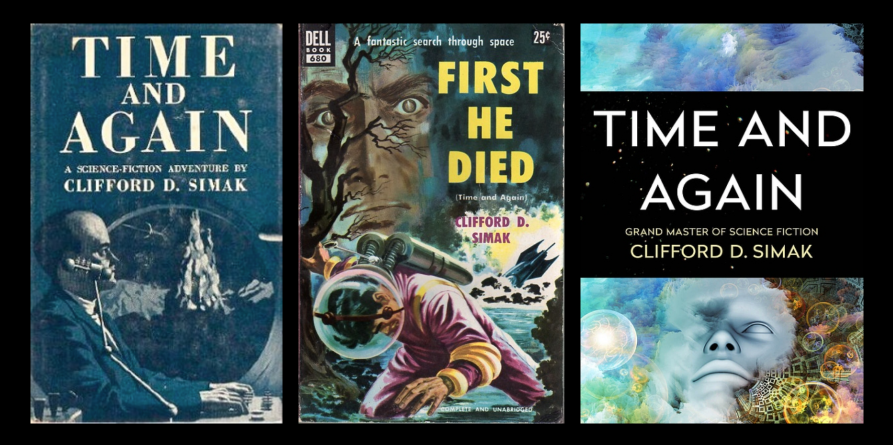
Time and Again by Clifford D. Simak has the distinction of being the first story in the first issue of Galaxy Magazine back in October 1950. It was serialized in three parts as Time Quarry. (All three issues can be found here.) It’s currently in print as a paperback, Kindle edition, and audiobook on Amazon.
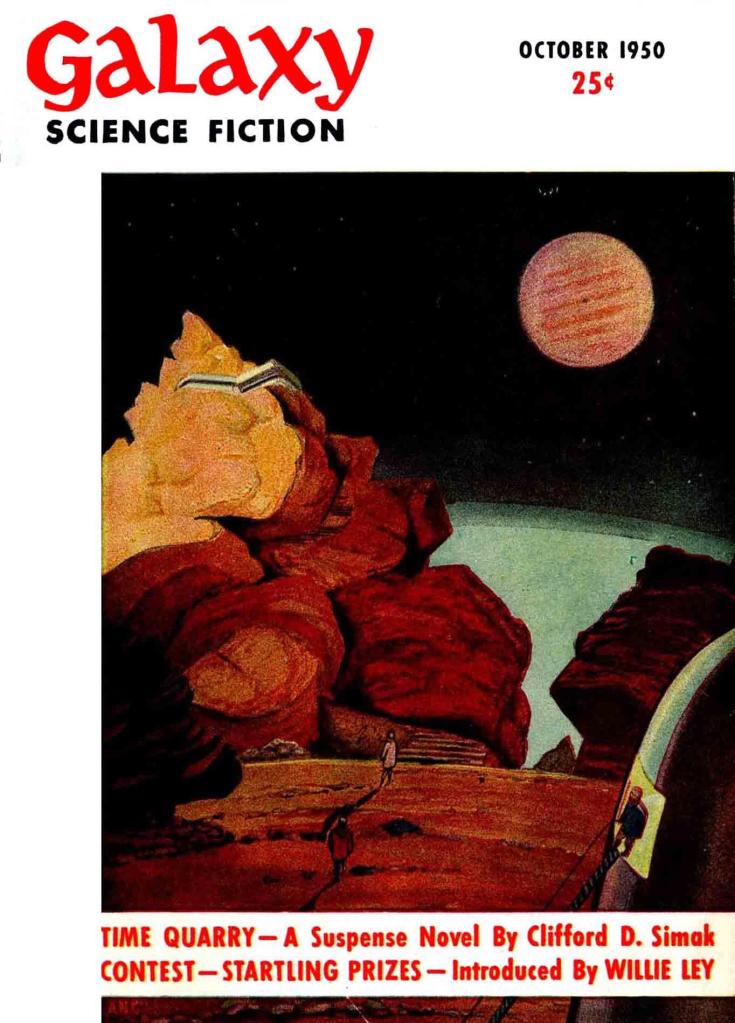
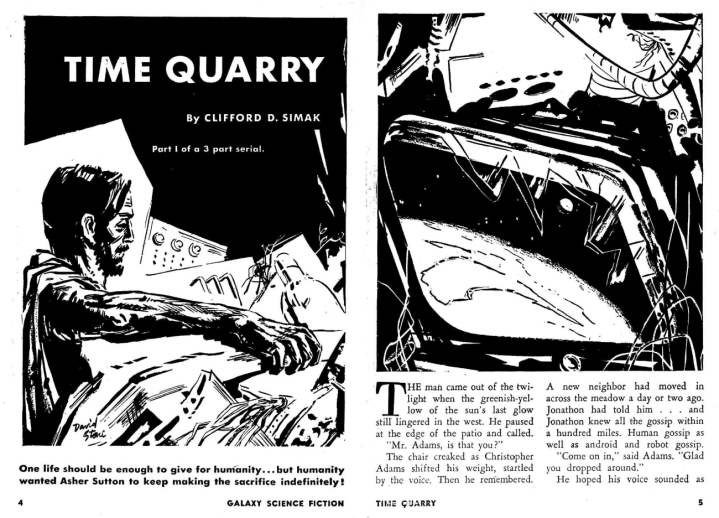
I started reading Time and Again when I decided to read the first issue of Galaxy. I had the silly urge to try and read Galaxy from the very beginning. But I didn’t feel like reading a serial before the short stories, so I switched to an audiobook. Now that I’m finished, I can return to the magazine to begin reading “Third From the Sun” by Richard Matheson. The first issue of Galaxy has quite a lineup.
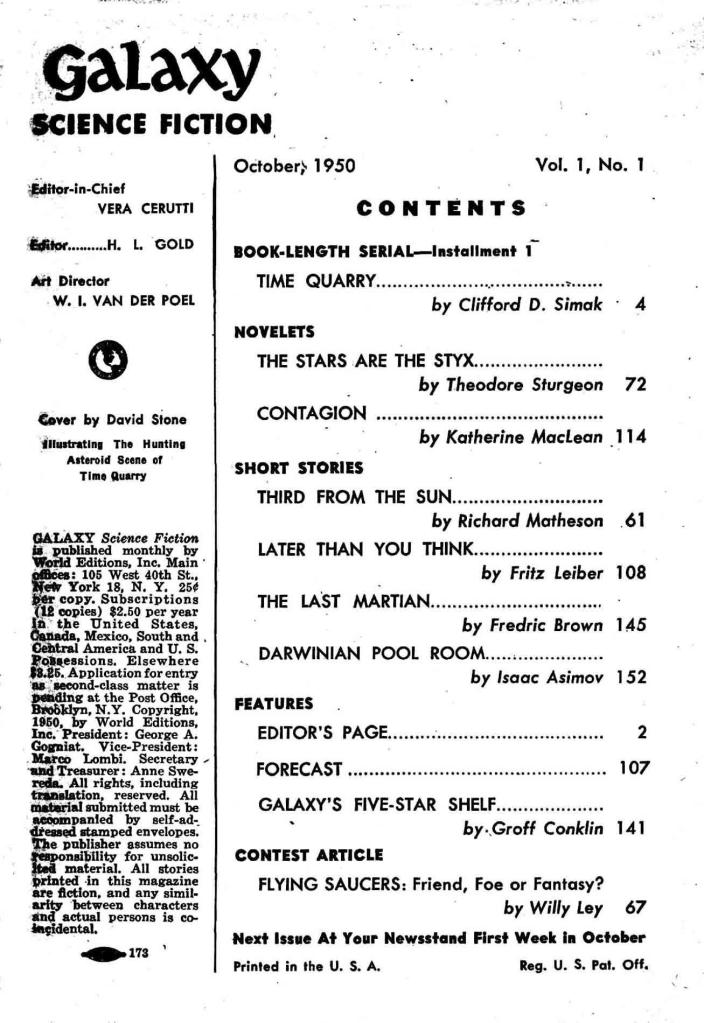
When I opened that issue of Galaxy, I tried to imagine myself as a reader back in 1950. Since I was born in November of 1951, that’s a little hard to do. On the other hand, I loved old movies my whole life, so I can picture 1950 from watching them.
What’s kind of fascinating is that outside of science fiction movies, movies about real people in 1950 never mention science fiction. This always makes me ask: What was the first character in a movie who was a science fiction fan?
Offhand, I thought of George McFly in Back to the Future (1985) might be the first. Gemini AI suggested young David MacLean from Invaders from Mars (1953) or Eugene Fullstack from Artists and Models (1955). But also mentioned Eliot Rosewater from Slaughterhouse-Five (1972).
In other words, I can safely say that science fiction in 1950 had a poor reputation (if any). Eugene Fullstack was played by Jerry Lewis – so you can imagine how they saw us. By the way, I highly recommend the vividly colorful Artists and Models because it is a fun look at pulp and comic book fans.
But back to Time and Again. If I had read it without knowing the author or even when it was published, I might have guessed very early Philip K. Dick. The story is out there. Way out. Time and Again begins six thousand years into our future with Christopher Adams. Adams has a visitor from five hundred years in his future warning Adams that Archer Sutton is returning from a long-lost space mission, and it’s important to humanity that he be killed.
Would Simak and science fiction fans in 1950 be shocked that it wouldn’t take six thousand years to develop intelligent robots? I’d love to time travel back to 1950 and show people YouTube from 2026. How many citizens back then would want to ban science fiction and computer technology?
Clifford Simak has always had a sentimental take on robots and dogs. However, I wonder if his view isn’t really an overly kindly view of faithful servants, like we see in Upstairs Downstairs and Downton Abbey? In Time and Again, at least Simak is wise enough to know they will one day want emancipation.
Returning to the story, Sutton does arrive, but in a wrecked spaceship that can’t hold air, has no fuel or food, or working engines. Sutton is barefoot and is wearing rags. He went to 61 Cygni twenty years previously to a world that had always shunned any outside contact. Something radical happens to Sutton on 61 Cygni, something like what happens to David Bowman in 2001: A Space Odyssey. Like Clarke would do in Childhood’s End in 1953. Simak imagines aliens uplifting humans.
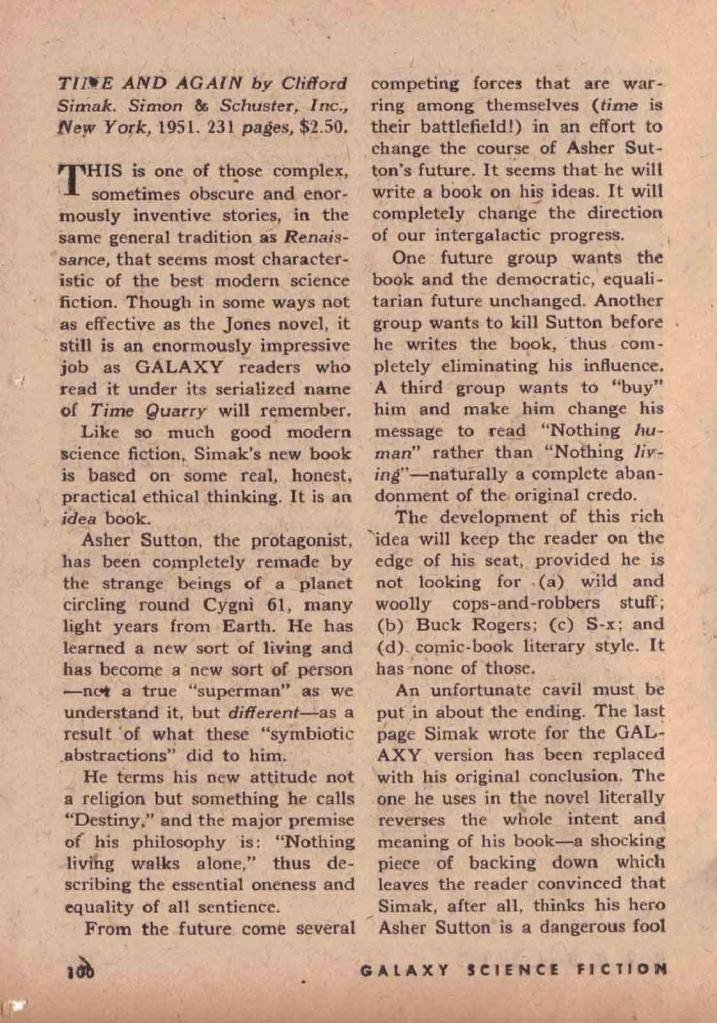
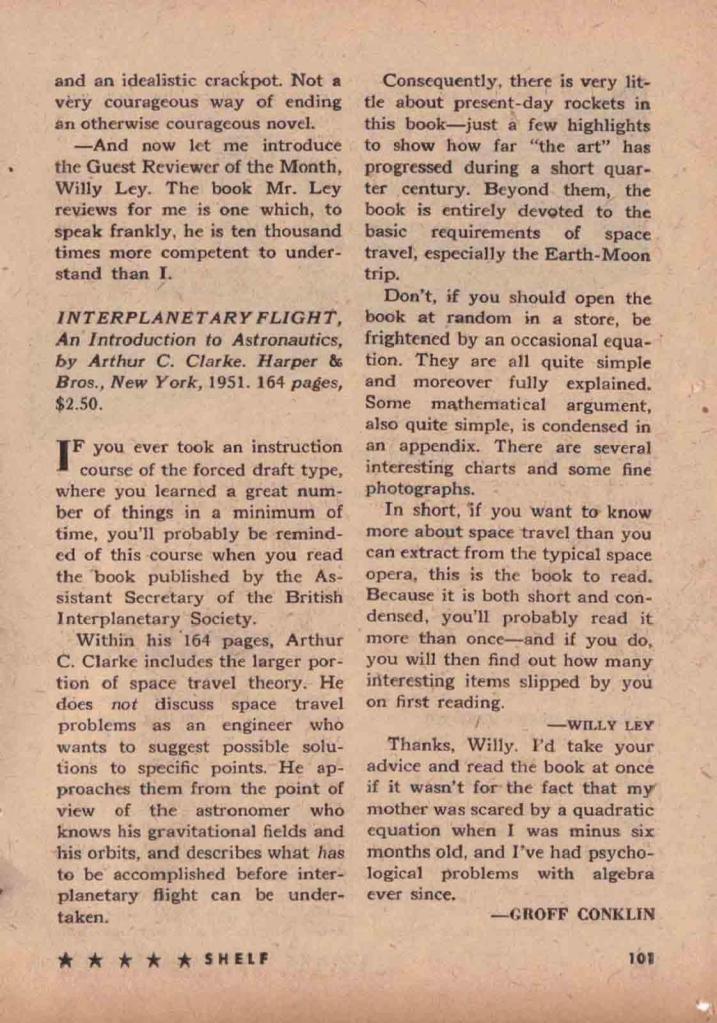
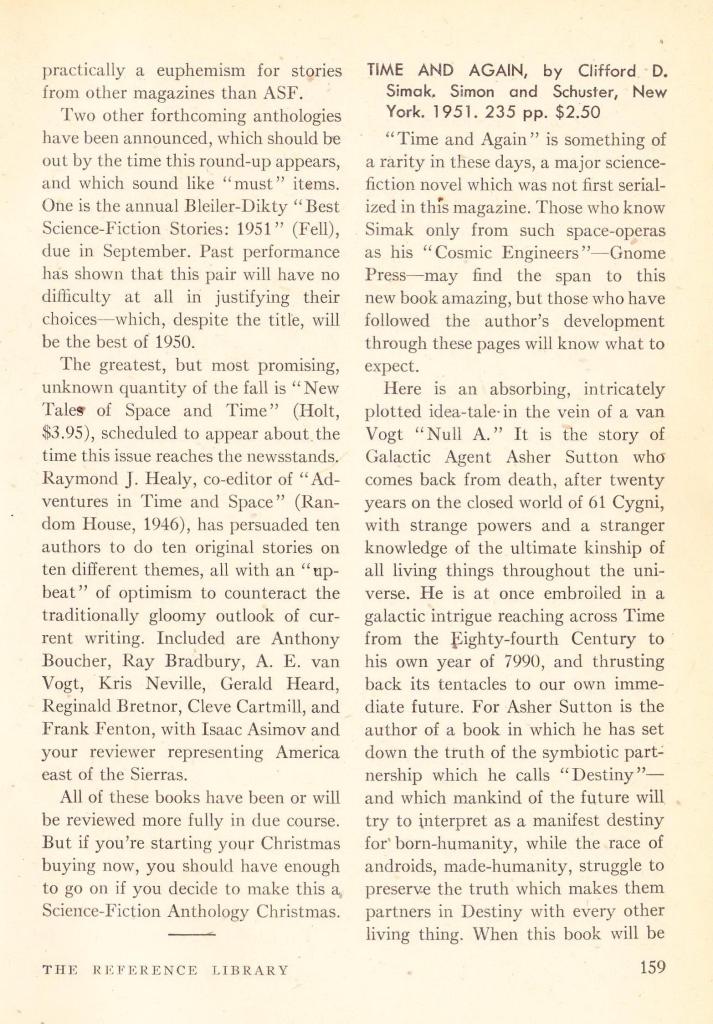
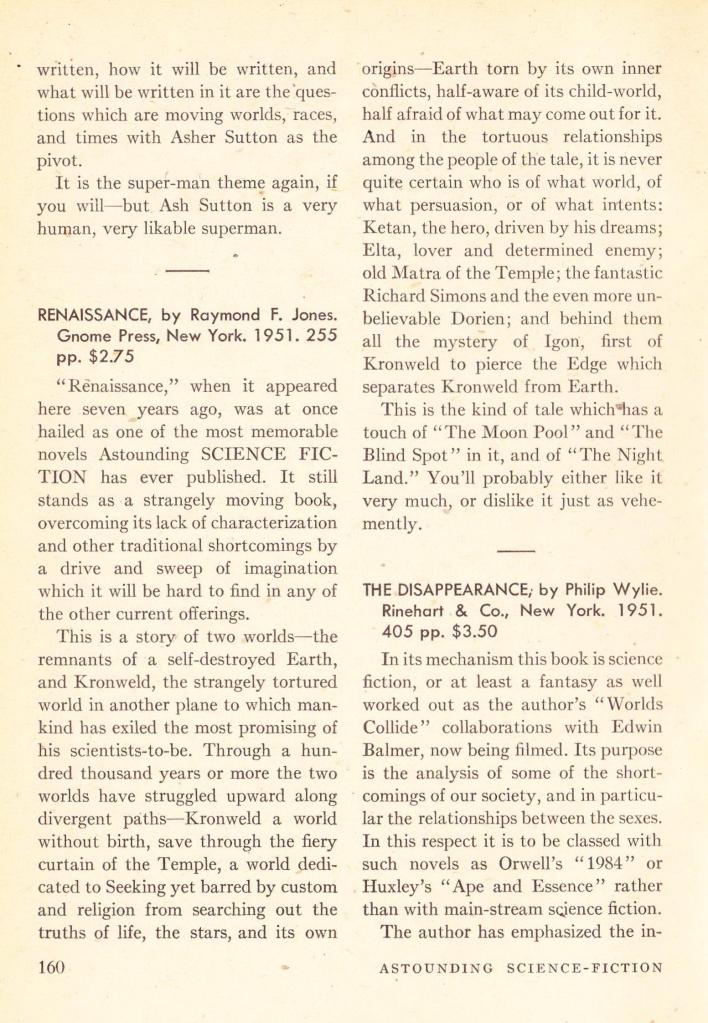
Most of the reviews of the 1951 hardback edition of Time and Again were quite positive. See attached reviews below.
However, I’m not sure I can recommend the novel. I don’t know if it holds up for modern readers. Yet, I remember seeing a YouTuber reviewer claim Time and Again was his favorite Simak novel. Two 1951 reviewers claim Time and Again is a mature work of science fiction, that is carefully plotted, and deals with serious ethical issues. Archer Sutton does come across as something between Christ and Abe Lincoln in advocating equality for robots, androids, and all animal life.
As Groff Conklin points out in his August 1951 book review in Galaxy Magazine, the hardback’s ending is not the ending in the serialized magazine version. I’m not sure that either ending is philosophically different from the other. But both endings are troubling and ambiguous. It’s the kind of ending Philip K. Dick would have liked.
I recently read A World Appears by Michael Pollan about consciousness. Pollan claims, with support from cited scientists, that all life, even non-living things, might have a degree of consciousness. I don’t think many people in 1950 thought like this, so, surprisingly, Simak made it a focus of a science fiction novel. Nor could people in 1950 have imagined the AIs we live with in 2026. I wonder how 1950 science fiction readers took Simak’s mysticism?
Not only is Simak advocating for equality for all conscious beings, but he appears to be protesting science fiction’s true believers who think it’s humanity’s manifest destiny to spread across the universe. Years ago, I read a story whose title or author I can’t remember that suggested two kinds of intelligent species emerge in the galaxy. The first wants to spread across the galaxy as the dominant species. And the second, and I’m less sure of my memory here, wants to study the galaxy to understand the nature of reality. Most science fiction writers suggest humans will be of the first type. I think Simak, in this novel, is advocating we be of the second type.
In Time and Again, agents from the future fight a war across time. They want to make sure humans are the superior species for a million years, time enough to spread across the entire universe. Archer Sutton is the Jesus of the opposition movement. Like in The Terminator, humans from the future come back in time to snuff him out.
All of this might sound terrific, but I should warn possible book buyers: Time and Again is a rather talky novel. On the other hand, it’s full of ideas.
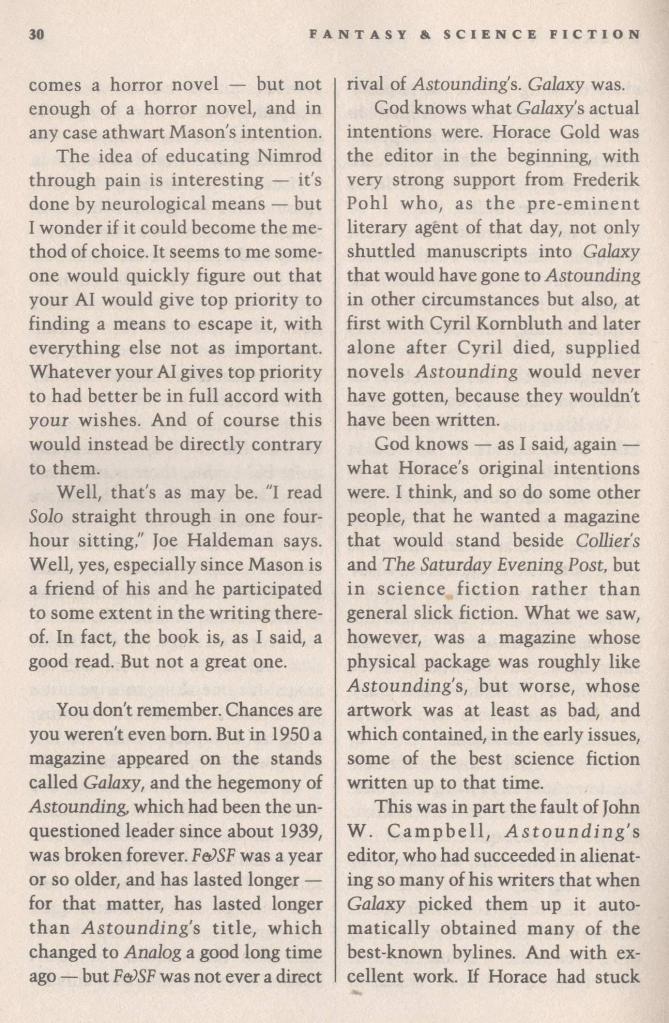
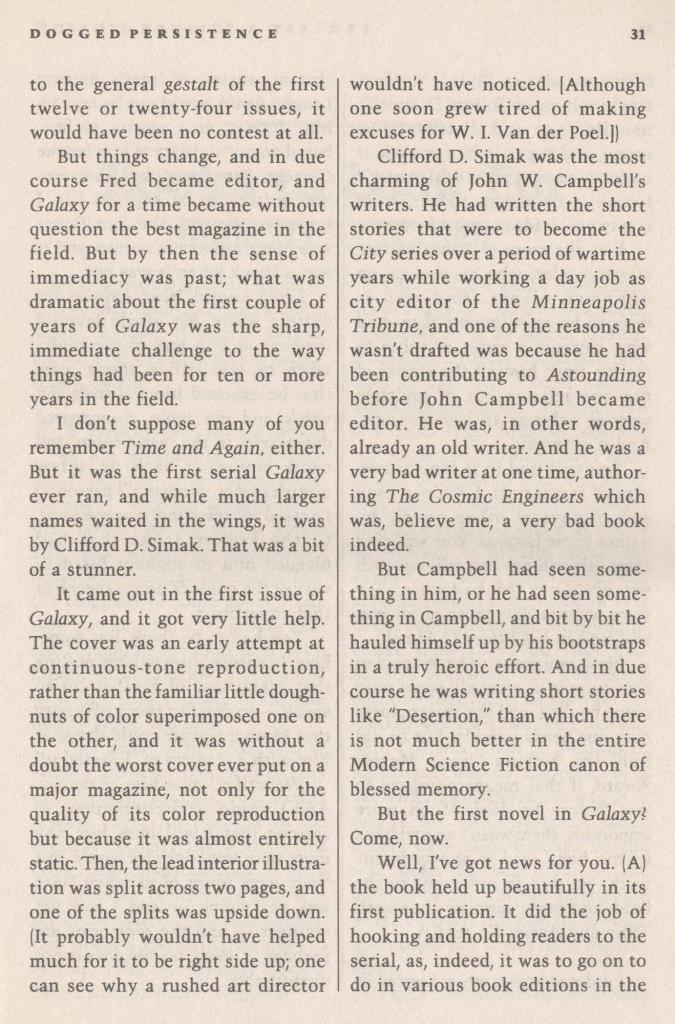
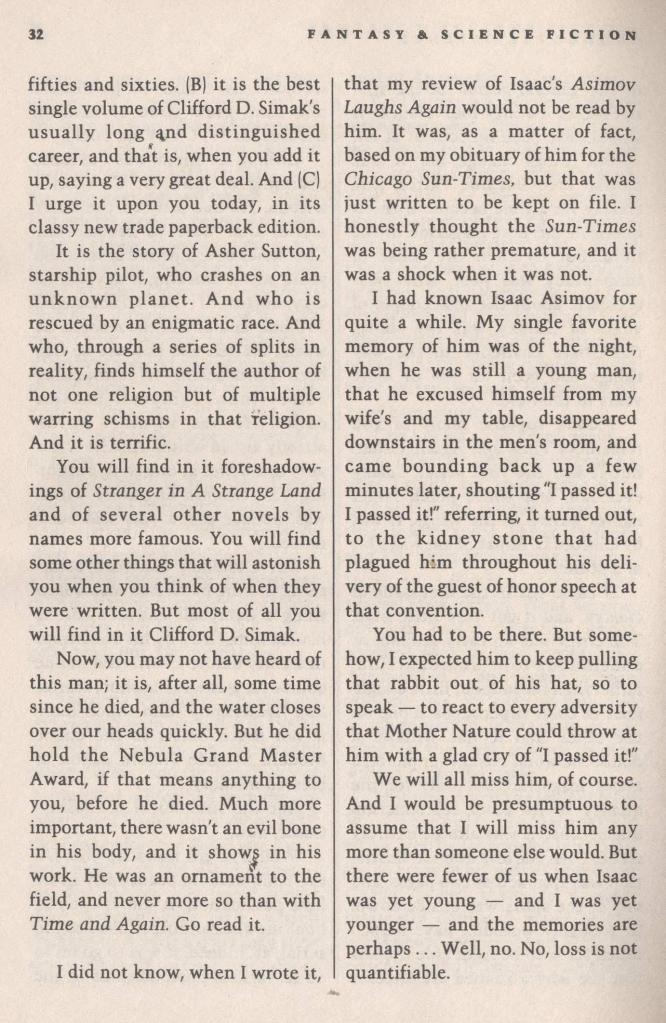
ISFDB.org lists many reprint editions and nineteen reviews for Time and Again. Most of the reprint reviews were too short to bother reprinting. However, in 1992 Algis Budrys writes fond memories of Galaxy’s first issue, and Simak’s novel.
Galaxy Magazine (August 1951) – Groff Conklin
Astounding Science Fiction (December 1951) P. Schuler Miller
F&SF (Sept. 1992) – Algis Budrys
James Wallace Harris, 7/25/26


Few in Hollywood understood or understand true science fiction because few consider the BIG QUESTIONS in life. Simak’s work was entertaining, frequently fun and always thought provoking. Perhaps it’s only logical that the same Hollywood icon who gave us Citizen Cain was associated with the famous radio production of War of the Worlds.
I hope you’ve inspired a new generation to read Simak.
LikeLike