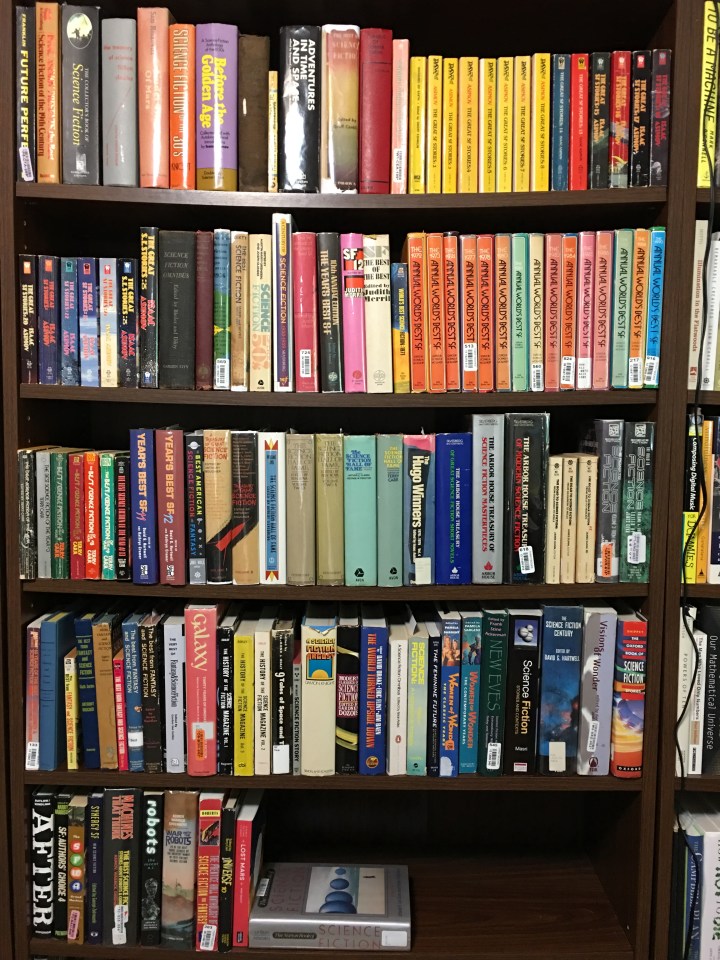
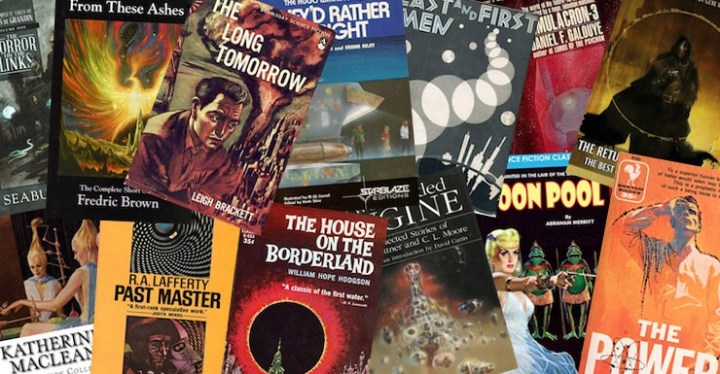
For several years now (2017, 2016, 2015), I’ve created wish-lists of wanted audiobook editions of classic science fiction stories. My hope is publishers would see my lists and produce those titles on audio. I doubt they ever have, but every year a few more classic science fiction books show up at Audible.com. They have done a fantastic job. Almost any title I read as a kid is now available to read with my ears. Nearly every book on The Classics of Science Fiction and Worlds Without End Top-Listed Books of All-Time lists are available on audio. And I think that validates those stories.
Starting in 2002 when I joined Audible.com I’d scan the new releases daily always hoping to find my favorite science fiction stories from my Golden Age years, the books Baby Boomers now consider the classic of the genre. Each year it gets harder to find titles that haven’t gotten the audiobook treatment. Here are some of the older science fiction titles that have shown up at Audible this past year:
- Armageddon 2419 A.D. by Philip Francis Nowlan
- Sleeping Planet (1965) by William R. Burkett, Jr.
- The Troublemakers by George O. Smith
- The Snail on the Slope by Arkady & Boris Strugatsky
- Triplanetary (1934) by Edward E. Smith (magazine version)
- This World is Taboo by Murray Leinster
- The Sensitive Man by Poul Anderson
- Masters of Space by Edward E. Smith & E. Everett Evans
- The Silent Invaders by Robert Silverberg
- Mercenary by Mack Reynolds
- Catseye by Andre Norton
- Storm by George R. Stewart
- The Land of Always Night (Doc Savage) by Kenneth Robeson
- The Golden Man (Doc Savage) by Kenneth Robeson
- Planet Stories – March 1953 (magazine)
- Planet Stories – Fall 1941 (magazine)
- “Rappaccini’s Daughter“ by Nathaniel Hawthorne
- “The Scarlett Plague“ by Jack London
- “With the Night Mail“ by Rudyard Kipling
- “As Easy as ABC“ by Rudyard Kipling
- “2 B R 0 2 B“ by Kurt Vonnegut, Jr.
- Sci-Fi Shorts volumes 1-6 (public domain)
- Future Eves: Classic Science Fiction About Women by Women edited by Jean Marie Stine
- Pink Winds, Green Cats, Radiant Rocks & Other Classics by the Forgotten Woman of Science Fiction’s Golden Age by Frances Deegan
As any diehard mid-century Sci-Fi fan knows, Audible is scraping the bottom of the barrel. They did (accidentally I’m sure) grant a few of my wishes from last year:
- The Demolished Man by Alfred Bester
- The Stars My Destination by Alfred Bester
- Rogue Moon By Algis Budrys
- The Einstein Intersection by Samuel R. Delany
- Grass by Sherri Tepper
Not very many, but they were heavy hitters that were overlooked. I realize now that many of my wishes were unrealistic because reprinting old anthologies on audio probably involve significant copyright problems. And I’m starting to doubt there’s a market for short fiction SF on audio anyway, but even then, I got to listen to the three-volume The Science Fiction Hall of Fame. That made 2018 a great year for science fiction on audio. The first volume is probably the most popular science fiction anthology of all-time.

I’ve decided to make this the last year for wishing for old science fiction on audio. I’m going to make one last roundup of what I’d love to hear and then go off to listen to all the great SF books already sitting in my Audible library. I’ve purchased more than I can listen to in my expected remaining lifetime. This year I’m going to mostly aim for books that publishers should have an easier time acquiring the rights, either novels or single author collections.
I love hearing science fiction read to me by great narrators. And because I study the history of science fiction, there are many rare titles on I want to hear. But I doubt many others do. Sure, there a bunch of us old SF fans rereading our favorite science fiction from our formative years by listening to their audiobook editions, but I don’t know how big that market is, and in any case, we’re a dying audience. I believe Audible and its allied publishers have found pretty much all the old science fiction that was once popular before the year 2000.
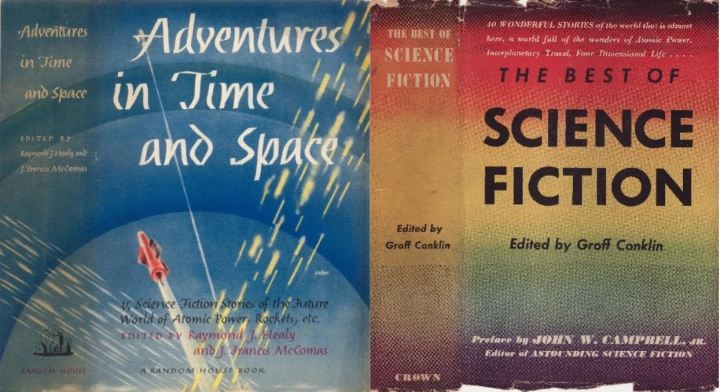
Still, there are books I want to hear, and there are science fiction authors from the past that never had anything reprinted in audio, such as Zenna Henderson or William Tenn, or other writers that have had little of their work represented. I still yearn to hear classic science fiction short stories, but I know copyright issues probably make them difficult to reprint. However, I still love to hear three SF anthologies that I believe would significantly cover the history of the science fiction short story if they were produced for audio: Adventures in Time and Space (1946) edited by Raymond J. Healy & J. Francis McComas, Dangerous Visions (1967) edited by Harlan Ellison, and The Big Book of Science Fiction (2016) edited by Jeff and Ann VanderMeer. Links are to ISFDB.org to show their table of contents. But I doubt they will ever get an audio production now.
67 Books I Want to Hear In My 67th Year
- A Voyage to Arcturus (1920) by David Lindsay
- The World of Null-A (1948) by A. E. Van Vogt
- The Voyage of the Space Beagle (1950) by A. E. Van Vogt
- The Legion of Time (1952) by Jack Williamson
- The Long Loud Silence (1952) by Wilson Tucker
- Marooned on Mars (1952) by Lester del Rey
- Bring the Jubilee (1953) by Ward Moore
- Children of the Atom (1953) Wilma H. Shiras
- A Mirror for Observers (1954) by Edgar Pangborn
- Mission of Gravity (1954) by Hal Clement
- Cities in Flight (1955) by James Blish
- Citizen in Space (1955) by Robert Sheckley
- Rocket to Limbo (1957) by Alan E. Nourse
- Wasp (1957) by Eric Frank Russell
- The Enemy Stars (1958) Poul Anderson
- The Lincoln Hunters (1958) by Wilson Tucker
- The Fourth “R” (1959) by George O. Smith
- The High Crusade (1960) by Poul Anderson
- Hothouse (1962) by Brian W. Aldiss
- Second Ending (1962) by James White
- Davy (1964) by Edgar Pangborn
- Simulacron-3 (1964) by Daniel Galouye
- Earthblood (1966) by Keith Laumer and Rosel George Brown
- Empire Star (1966)
- The Witches of Karres (1966) by James H. Schmitz
- Lords of the Starship (1967) by Mark S. Geston
- Camp Concentration (1968) by Thomas Disch
- Of Men and Monsters (1968) William Tenn
- Omnivore (1968) Piers Anthony
- Past Master (1968) by R. A. Lafferty
- Space Chanty (1968) by R. A. Lafferty
- The Last Starship from Earth (1968) by John Boyd
- The Still, Small Voice of Trumpets (1968) by Lloyd Biggle, Jr.
- Behold the Man (1969) by Michael Moorcock
- Bug Jack Barron (1969) by Norman Spinrad
- Macroscope (1969) by Piers Anthony
- And Chaos Died (1970) by Joanna Russ
- The Year of the Quiet Sun (1970) by Wilson Tucker
- The Doors of His Face, The Lamps of His Mouth (1971) by Roger Zelazny
- The Fifth Head of Cerberus (1972) by Gene Wolfe
- The Listeners (1972) by James Gunn
- The Continuous Katherine Mortenhoe (The Unsleeping Eye) (1973) by D. G. Compton
- The Centauri Device (1974) by M. John Harrison
- Orbitsville (1975) by Bob Shaw
- The Female Man (1975) by Joanna Russ
- The Shockwave Rider (1975) by John Brunner
- Trouble on Triton (1976) by Samuel R. Delany
- On Wings of a Song (1979) by Thomas M. Disch
- Ridley Walker (1980) by Russell Hoban
- No Enemy But Time (1982) by Michael Bishop
- Native Tongue (1984) by Suzette Haden Elgin
- Ancient of Days (1985) by Michael Bishop
- The Falling Woman (1986) by Pat Murphy
- Mindplayers (1988) by Pat Cadigan
- Her Smoke Rose Up Forever (1990) by James Tiptree, Jr.
- A Woman of the Iron People (1991) by Eleanor Arnason
- Sarah Canary (1991) – Karen Joy Fowler
- Synners (1991) by Pat Cadigan
- China Mountain Zhang (1992) by Maureen F. McHugh
- Ammonite (1993) by Nicola Griffith
- Galatea 2.2 (1995) by Richard Powers
- Ingathering: The Complete People Stories of Zenna Henderson (1995)
- Holy Fire (1996) by Bruce Sterling
- The Book of the Long Sun (1993-96) by Gene Wolfe
- Aye, and Gomorrah (2003) by Samuel R. Delany
- Store of the Worlds (2012) by Robert Sheckley
- The Future is Female (2018) edited by Lisa Yaszek

— James Wallace Harris 11/15/18