Untying a Knotted Plot

Yali on the Bosporus

I hope you have read “The Ocean Between the Leaves” by Ray Nayler from the July-August issue of Asimov’s Science Fiction. I’ve read this story four times trying to follow all the plot twists so I’ll be giving away spoilers describing my thoughts from each reading. If you’ve read the story, it will be more fun to follow my bumbling efforts to figure things out. “The Ocean Between the Leaves” is not free to read online, but it was made into a free podcast read by the author. The story is about a young woman who works at a yali on the Bosphorus, maybe like the one pictured above. Ray Nayler has lived all over the world, so this tale is full of exotic details.

I hope Nayler doesn’t mind that I dissect his story. I’m doing it for several reasons. First, my friend Piet asked me to read the story to see what I thought about the plot. He was confused but got some help from Greg Hullender’s review at Rocket Stack Rank. Piet wondered if I would get the story in one reading. I didn’t. I also looked at Greg’s review, and then read it again. After two readings, I thought I got it. But there were many lingering plot questions that kept popping into my head. I then found the audio version and listened to it. Okay, I thought when I finished it this time, I’d gotten everything for sure now and laid down to take a nap. I woke up with more questions. (That pesky subconscious.) That’s when I thought about writing down my convoluted journey through this story.

I’m going to explain all my reading reactions to the story while I still remember them. I hope I don’t hurt Ray Nayler’s feelings. I’m trying not to criticize his story because I don’t know if the problems are with me the reader or with him the writer. The plot of the story is both simple and complicated. It’s simple in that not a whole lot happens, but it’s complicated by how the story is told. It’s intended as a mystery, one meant to make the reader keep guessing. By the way, the story is full of colorful details that make the story enjoyable on other levels, but ones I won’t comment on.

First Reading

Read it the first time on my iPhone 6s Plus while lying on a couch. To be honest, I read it somewhat fast and I just missed the whole issue of mindswapping. That’s a huge plot point to pass over. In my defense though, it wasn’t ever explicit. It was hidden to create a mystery.

I liked how “The Ocean Between the Leaves” started out about a young woman gardener, Feride, on a rich person’s estate. She pricks her finger and it gets infected. Three months later she’s still in intensive care. Nayler describes the infection in gruesome detail.

We’re now introduced to the doctor Melek and Feride’s brother Fahri. Fahri visits his sister every day and flirts with the doctor each time with a 5-minute date. On this day Fahri has a cut that the doctor fixes. Then he goes out to work. We learn that he isn’t rich and his sister’s bills are high. We learn that he makes money tagging skips. I assume this is attaching some kind of signaling device to people who are skipping out on something. His boss Tarik is shady and wears VR glasses. We also learn that Tarik is shaking Fahri down for a lot of money.

Fahri tries to catch three slips in one day to get ahead on the bills but is knocked out by the third slip.

Then the story jumps back in time. Feride is told she is going to die, but the state is going to transfer her mind to another body so she can wrap up her life and say goodbyes. I thought that was rather odd. She/we are told she will be an experiment. At the time, I thought it was an uncommon procedure.

Feride goes back to the yali where she worked but tells people she is her brother. The first time I read this I didn’t realize we had jumped back in time and didn’t realize this Fahri was the same as the Fahri we had already met. Feride/Fahri hears a story from the old head gardener Suat about fighting the system. The first time I read this, I didn’t understand how the story changed Feride into Fahri. I was confused by the pronouns of describing her in his body. I focused on Fahri’s effort to make money and the action surrounding him. I wondered if Feride had died and had been transferred to another becoming Fahri. I was totally confused by the plot. The two similar names Feride and Fahri kept tripping me up, and I didn’t understand why they were the same person. At first, they seemed to be two separate people, and then they were the same person. Probably all of this confusion was due to me reading too fast. But I think some of the confusion was due to information behind withheld from the reader. But I also considered I’m getting old and I’m not sure if I can keep enough of the story in my head to make all the puzzle pieces reveal the overall picture.

Second Reading

This time I read the story on my iPad mini while in my reading chair. I was more determined to read slowly, understand the story, and concentrate on the details. This time around I noticed several references to Fahri being a prince. I also admired the rich background details more in the story.

On my second reading, I paid more attention to the first line, “It began just like a fairy tale; an orphaned young woman pricked her finger on the thorn of a rose, and fell asleep.” With this reading, I only figured this line linked Feride pricking her finger and getting infected. I didn’t try to imagine what it might mean for the whole story.

I also noticed this time we’re told Feride means “the only one.” Now that’s an obvious clue, but only in hindsight. But we’re also told Feride believes it means “the lonely one.”

I had read Greg Hullender’s review with spoilers. The keyword he gave was androids. I remembered from the first reading there had been androids, but I assumed they looked artificial and were just slave workers on the docks. I didn’t realize that androids could look just like people. I realized I was reading a story much like Mindswap by Robert Sheckley where technology allowed people to easily swap minds between bodies. In the first reading, I thought Feride was being put into a clone body. Nor did I realize that the skippers Fahri chased were minds in rented bodies trying to run away with them.

In the second reading, I realized that Feride was given a three-day rental body to wrap up her life, and she decided to keep it and work to pay her medical bills to save herself. I still didn’t understand some things. Did she skip out with the three-day body, or got a third body on the black market.

However, the story simplified into one of a person saving themselves. That’s a pretty neat idea of paying for your own medical bills by working in another body while your sick body remained in a coma. Pretty cool. Happy ending.

However, more questions kept popping into my mind.

Third Reading

This time I listened to the podcast version. I love listening to science fiction stories. I would have made my second reading a listen if I had known about the podcast. This time I just “read” the story to enjoy it. I thought I had all the plot twists down. However, after the podcast was over, I put the story out of my mind. But once again new questions started bubbling up.

When we see Dr. Melek talking to Fahri in a man’s body the first time we don’t know that Feride is inside, but she would — wouldn’t she? The reader thinks the brother and doctor are flirting with each other. Doesn’t the doctor know that it’s her patient? But did she talk to Fahri like Feride was inside? Was this the same three-day body the Institute bought for Feride? If Fahri had been working for Tarik for a third of a year as a skip chaser, was Feride in a different rented body, or had she skipped out with the three-day body, or had she merely taken up the payments on the three-day body?

Why was Feride given a male body to close out her life? That seemed rather insensitive. And why didn’t Feride tell Suat that it was her? Why did she make up the story about her brother? Obviously, swapping bodies was common in this time period, so Suat shouldn’t have been shocked. Feride was given a chance to say goodbye to the only people she knew and loved. But she didn’t, why? Obviously, Nayler liked the idea of a sister and brother because it diverts the reader’s attention so they will think they are two different people in the story. But that confused me and almost ruined the story.

What happened to Fahri, or his body?

We are told it’s three months later when Melek and Fahri agree to go on daily 5-minute dates. But we also know Fahri has been using the body for a while as a skip tracer. We are told later he’s been doing it for months. Is it the same three months? When did Feride almost die and Melek buy her three days to wrap up her affairs? At the beginning of the three months. Why would a doctor spend so much money on a patient she didn’t know? Or had she gotten to know Feride well enough to fall in love with her? And like Greg Hullender asked, how did the hospital keep a nearly dead woman without her mind in stasis for months?

Fourth Reading

This time I read my physical copy of Asimov’s Science Fiction. I’m currently buying both the Kindle and paper copies. I’m trying to decide which I prefer. I still don’t know, each has their pluses and minuses. However, I’m annoyed as hell that the Kindle version doesn’t display on my Kindle for the PC. That sure would make reviewing stories so much easier. There are times when I’m tempted to buy an OCR program so I can grab quotes without retyping.

With this fourth reading, I’m starting to feel like Phil Conners from Groundhog Day. Opening line: “It began just like a fairy tale; an orphaned young woman pricked her finger on the thorn of a rose, and fell asleep.” This time around I remember the fairy tales Sleeping Beauty and Snow White and read about them at Wikipedia. But both involved pricked fingers and women who sleep in a spell. However, in Snow White, it’s the evil witch that pricks her finger, so I guess we’re talking Sleeping Beauty here. That means Fahri is going to be her own Prince or is it, Dr. Melek? Melek saves her from permanent sleep but only intending it to be for three days. Feride saves her own life, so is Feride her own Prince Charming? If Melek is in love with Feride and not Fahri, is she the rescuing Prince of this story?

Here’s the thing, Ray Nayler knew what he wanted to do with this story and then contrived to make it happen. Readers don’t know that intention, so they read the story guessing as they go what might be happening. I now wonder at the sequence of inspirations Nayler got for this story. Did he first intend for it to be about a woman who gets a three-day chance to close out her life with a mindswap and then gets the idea of Feride saving herself? Or was that the plan all along? Was the love story an afterthought, and the three-day mindswap added in to make a better ending?

Ah-ha! When we’re first told about Fahri and Dr. Melek, Melek asks, “How is your sister?” The POV is following closely to Fahri and it says, “They had met the first night Fahri came in to see his sister. Melek had sat across from him the same way, nearly three months ago now, when they first met.” This is all very definite, and probably why I was so confused in the first reading. At the beginning of the story, we were told that Feride had a brother she never had met. It’s three months after she falls ill. But Fahri has been visiting her for three months. This leads the reader to believe that Fahri is a real person, found out right away about Feride’s illness and came to see his sister.

In the first scene with Fahri and Melek, there is no foreshadowing of things to come. And there’s an indication that Fahri has been a skip chaser for some time because he’s worn out. Knowing what we know from previous readings for this story to work Feride nearly died immediately after entering the hospital and Dr. Melek bought her a three-day rental on a body right after she arrived. We are told that the Institute did this as an experiment, but the very ending of the story suggests that Melek spent her own money. Why?

This also suggests that Melek never saw the rental body, or Feride got a third body. But this now brings up another interesting question. Did Melek ever know that Fahri was really Feride? The last two paragraphs are:

     "But the expense. It must have been ... I remember struggling to pay ... it's thousands of lire a day ... you can't possibly afford ..."

     "Hush." Melek presses a finger to Feride's lips. "It's my choice to make, Fahri. And where else would I find such a hero? And who would I go on my five-minute dates with? Are you trying to make me drink my coffee alone?"

Notice Melek touches Feride but addresses her as Fahri. I assume, and that’s dangerous with this story, that Feride survives and Feride/Fahri is back in her original body. But when did Melek realize that Fahri was Feride? If Feride had stolen the three-day body, didn’t Melek know? When Feride is visiting Suat she’s already thinking of the body as Fahri. Wouldn’t Melek have seen this rental body? Feride in her new body awakes with Dr. Solmaz Haznader explaining things. But there’s another clue on page 105. Feride/Fahri asks Tarik about the Institute who rented the three-day body when Tarik offered him a job chasing skips. (I don’t know why it says Tahir in this paragraph and not Tarik. Is it another person, or a name change not corrected?)

"I'll deal with the institute," Tahir said, "That's what you'll be paying me for. That' and your nice new body not full of poisonous bacteria. And your other body, drifting on the edge of death. And the price for all three together is going to be very, very high."

He’s paying off the Institute, the rental on the new body, and the medical care of the original body. But we don’t know if he keeps the three-day rental or gets a new body.

Because of Tarik/Tahir conversation with Dr. Haznader I think the Institute story is real, and wonder about Melek’s involvement. Then why does Feride think at the end of the story that Melek paid for everything? But the lengthy discussion of the Institute’s research suggests that they planned all along for Feride to use the rental body for an extended period. So Feride/Fahri stayed in the same body.

But now I have a whole new theory. Feride thanks Melek for the three additional days. Maybe Melek didn’t pay for mindswap, but just three more days of healthcare. And that all the story about mindswapping was in Feride’s feverous mind. Oh no, do I need to read this story again? But wait, Melek thinks about Fahri and mentions their 5-minute dates, so that can’t be right either.

This could go on forever, but it stops here.

(I hope.)

Asimovs Science Fiction July-August 2019

James Wallace Harris, 9/1/19

p.s. – To further explain how hard it was to read this story and write this essay I wrote: “Quantifying My Cognitive Decline.” I believe aging is affecting my reading ability.


“Finnegan, Bring the Pain” by Joe M. McDermott

Analog Jul-Aug 2019

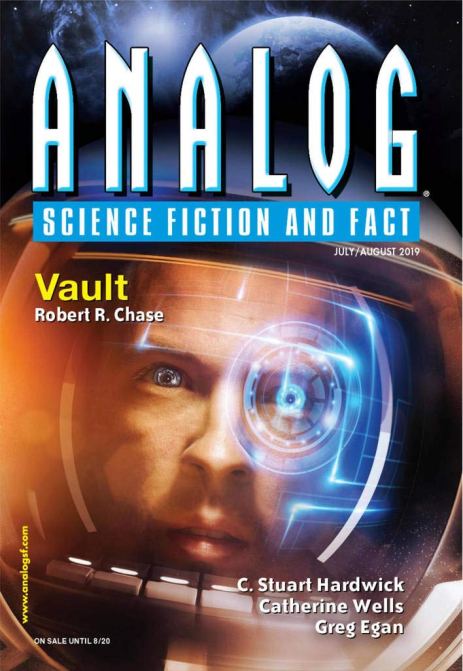
I read “Finnegan, Bring the Pain” by Joe M. McDermott because Greg Hullender gave it 5-stars at Rocket Stack Rank, saying it was “Hard-Hitting Tale of Different Kinds of Loss.” The story is in the latest issue of Analog (Jul-Aug 2019).

I believe a powerful short story often succeeds because it identifies a specific emotional insight. James Joyce called such storytelling moments epiphanies. I’m not sure I like Joyce’s label. I wish each literary emotion had its own identifiable noun. It would certainly help with reviewing fiction. Maybe if I thoroughly read The Dictionary of Obscure Sorrows I could find it.

In “Finnegan, Bring the Pain” the emotion is what one feels when being left behind while someone you know, someone often much like yourself, gets away. In “Finnegan, Bring the Pain” Finnegan is a teenager who is a loser in school, who knows he’s going to have a shitty life, but his friend Wind, a girl who keeps his unrequited love at arm’s length, is leaving for Alpha Centauri.

Joe M. McDermott is aiming point-blank at science fiction fans who want to go into space but feel left behind. As a kid, I wanted to go to Mars. I’m sure most SF fans dream of traveling somewhere beyond Earth, so “Finnegan, Bring the Pain” should resonate well with its readers. My all-time favorite short work of science fiction is “The Star Pit” by Samuel R. Delany, a novella that farms this emotion perfectly. (This emotion might also explain why my favorite science fiction movie is Gattaca.)

However, the essence of the “left behind” emotion applies in endless ways. I’ve read literary stories with characters who knew they could never escape their small-town life and make it in the big city, or with a low-level ball player watching a friend move up to the majors, or a poor soul desperately wanting to be rich, or an assistant professor realizing they’re never going to achieve their version of The Origin of Species or a would-be novelist who’d never write the great American novel.

After I realized I’d never go into space, I dreamed of writing science fiction, but the older I get the more I knew that dream has passed me by too. I read stories today like this one to inspire me to write. The dream isn’t completely dead, and I do feel left behind by young writers succeeding with ideas I wanted to explore.

Generally, science fiction is about people who achieve escape velocity. We want to live vicariously through characters who reach the stars. McDermott and Delany remind us that we don’t have the right stuff. That’s painful, but also cathartic.

I’ve always wanted to write a science fiction novel set in the future where all humans experience the “left behind” emotion when we discover that space travel isn’t practical for humans, but is perfect for robots. In this case, I want to be Wind, but I’m still Finnegan.

Finnegan resigns himself to mundane life, even one that has little successes. There is a secondary insight into the “left behind” emotion, and that is we do have a life that is ours, one that we have to accept and enjoy. My acceptance is by promoting SF stories I like and wish I had written.

Getting 5-stars at RSR doesn’t guarantee I’ll love a story, but it does inspire me to track them down. And to be balanced in my reporting, I have loved stories that Greg gave only 1-star. The real take-away of ratings and reviews: subscribe to the science fiction magazine, you won’t know what you’ll find until you read them. Don’t worry about all the stories you don’t like, find the ones you do. Analog has a great of variety among its stories. And if you do subscribe, as you read the stories, think about what each offers in terms of emotional insights. I believe the stories that deserve the most stars are the ones that resonate with your own deep emotions.

James Wallace Harris


“Contagion” by Katherine MacLean

Contagion by Katherine MacLean

“Contagion” by Katherine MacLean appeared in the very first issue of Galaxy Science Fiction in October of 1950. MacLean was in great company because the first issue also contained stories by Clifford Simak, Richard Matheson, Theodore Sturgeon, Fritz Leiber, Fredric Brown, and Isaac Asimov. If you follow the link above you can read “Contagion” online, as well as the whole first issue of Galaxy. You can also listen to “Contagion” on YouTube from a LibriVox.org recording.

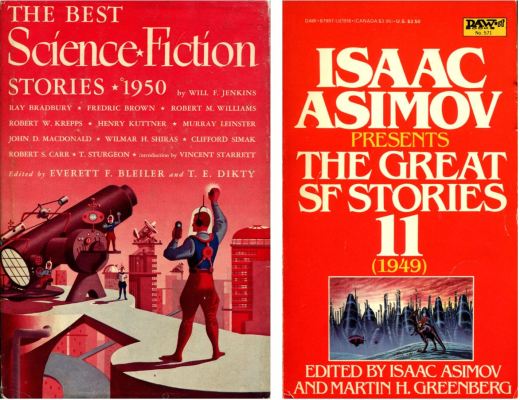
“Contagion” has been reprinted often, most notably in The Best Science Fiction Stories: 1951 edited by Bleiler and Dikty, Women of Wonder (1975) and the expanded Women of Wonder: The Classic Years: Science Fiction by Women from the 1940s to the 1970s (1995) both edited by Pamela Sargent, and most recently in The Future is Female! edited by Lisa Yaszek and published by the prestigious Library of America.

I just read “Contagion” in the Bleiler/Dikty volume as part of my project to read all the best-SF-of-the-year annuals in order starting with 1939. The story was not in The Great SF Stories 12 (1950) edited by Asimov and Greenberg. I wondered why. “Contagion” is not a great story, but it is a lot of fun, and is notable for a number of reasons. Back in 1950, there were damn few women SF writers, so Katherine MacLean stands out. But more importantly, MacLean deals with an idea that I’ve seldom seen other SF writers concern themselves with – can humans landing on other worlds survive their microscopic infections?

Kim Stanley Robinson dealt with this idea in Aurora just a few years ago. but at the moment these two examples are the only ones I can recall. Most SF yarns have their characters worry if they can breathe the air, drink the water, or eat the plants and animals.  However, most humans on Earth, if they were transported to a jungle in South America or Africa, would be at great risk of getting an infection. Why assume other planets are any less dangerous? KSM suggested it might be impossible to colonize any other world with an evolved biology, and I think he’s right. Visiting any other world with life might risk countless forms of dangerous infections like Ebola.

Little is known about Katherine MacLean. She seems to have been into hard science fiction and mostly wrote for Astounding/Analog, but that does include a lot of Psi-stories. I haven’t been able to find out much about her. She only produced three novels and three collections.

The Diploids by Katherine MacLeanThere are many benefits to my reading project. Not only do I get to watch science fiction evolve year by year, but I get to read a huge variety of stories by many authors I’ve never read before or even know about. There was an interview with Katherine MacLean in the July 2013 issue of The New York Review of Books I’d love to read. If anyone has a copy and could send me a scan it would be appreciated. I’m guessing that interview did help Andrew Liptak write “The Fantastic Foresight of Katherine MacLean” at Kirkus Review. That piece has the most information about MacLean I can currently find.
Joachim Boaz reviews her most famous book, Missing Man published in 1975 but based on her Nebula Award-winning 1971 story of the same name. Boaz rated it 5/5 (Near Masterpiece) which I’ve seldom seen him do. He says it’s one of the best sci-fi novels about telepathy ever. (Makes me want to buy a copy.)

<SPOILERS>

What makes “Contagion” so much fun to me is MacLean’s female perspective. The story is told in the third-person but follows June Walton closely. She is part of a team of human explorers landing on Minos that discover it had already been settled by human colonists when they come across a man named Patrick Mead in the jungle. Mead is a head taller than all the space explorers, is red-headed, wears only a loincloth, and has tremendous sexual magnetism. It’s fun as a male reader follow June as she observes Patrick’s impact on her fellow crew members, especially the women. June’s husband Max pales in comparison to Patrick and June feels bad she’s so attracted to the redheaded stranger.

Eventually, Patrick infects all the male space travelers even though they have been extremely careful to avoid infections. They wear spacesuits and use many decontamination methods. Patrick gives the men the “melting disease.” The women eventually save most of the men with antibodies from Patrick, but all the men go through a transformation and end up looking like Patrick – tall, muscular, and redheaded. The women in the crew are freaked out at first but quickly decided that their husbands and boyfriends easily reveal their personalities even though they all look the same. (I don’t know why but many SF writers have a thing for redheads.)  But here’s the kicker. Patrick’s sister shows up and the space explorers realize she will infect the women in the spaceship and they will all end up looking like her. Patrick’s sister is quite a beauty, but all the Earth women refuse to lose their individual looks. Several say they’d rather die. But do they have a choice?

I wondered if MacLean was having fun with all the male science fiction readers of 1950. I’m sure they were just as geeky then as they are today. MacLean has her spacewomen claiming they love their brainy guys, but they go nuts over Patrick. But what is she saying about women in general by having the spacewomen preferring death to all looking alike?

Is MacLean satirizing women’s vanity, or is it another dig at men? Maybe, MacLean is saying women don’t all want to be redheaded sex goddesses, which like I said, is a common ideal in science fiction magazine stories written by men.

</SPOILERS>

I’m not sure it’s politically correct to say female writers have a uniquely different perspective than male writers, but it seems like MacLean does so here, and is specifically targetting that belief in her story. Most older Sci-Fi tales avoided sex and gender issues and usually presented the most common stereotypes. Science fiction writers sometimes would have a hot woman in the spaceship that all the guys went nuts over, but I can’t remember them ever writing a story with a spaceship where the women crew members all going nuts over a hot guy. First of all, very few stories had spaceships where half the crew were women.

In “Contagion” Katherine MacLean anticipates a future in 1950 that’s more like what’s hinted at in Star Trek of 1966, although half the U.S.S. Enterprise’s command crew was not female. In her story, there is great equality males and females, and everyone is a scientist.

Maybe I should reconsider my assessment of “Contagion” being just a light-weight fun story. Now that I think about it, maybe MacLean was saying a lot more than I thought on my first reading. That’s another thing I’m learning from this reading project. Most great stories need 2-4 readings before I can discern all their great attributes.

James Wallace Harris

The Year’s Best Short Science Fiction: 1949


Years Best Short Science Fiction 1949

In 1950 Everett F. Bleiler and T. E. Dikty picked the following 1949 science fiction short stories for their second annual anthology The Best Science Fiction Stories – 1950:

  • “Private Eye” by Henry Kuttner (Astounding, January 1949)
  • “Doomsday Deferred” by Will F. Jenkins (Saturday Evening Post, 9/24/49)
  • “The Hurkle is a Happy Beast” by Theodore Sturgeon (The Magazine of Fantasy, Fall 1949)
  • “Eternity Lost” by Clifford Simak (Astounding, July 1949)
  • “Easter Eggs” by Robert Spencer Carr (Saturday Evening Post, 9/24/49)
  • “Opening Doors” by Wilmar H. Shiras (Astounding, March 1949)
  • “Five Years in the Marmalade” by Robert W. Krepps (Fantastic Adventures, July 1949)
  • “Dwellers in Silence” by Ray Bradbury (Planet Stories, Spring 1949)
  • “Mouse” by Fredric Brown (Wonder Stories, June 1949)
  • “Refuge for Tonight” by Robert Moore Williams (Blue Book Magazine, March 1949)
  • “The Life-Work of Professor Muntz” by Murray Leinster (Thrilling Wonder Stories, Jun 1949)
  • “Flaw” by John D. MacDonald (Startling Stories,  January 1949)
  • “The Man” by Ray Bradbury (Thrilling Wonder Stories, February 1949)

Astounding Science Fiction is no longer dominating. Why no stories from the Big 3 (Heinlein/Asimov/Clarke)? Robert A. Heinlein, probably the most popular science fiction writer at the time had five stories published in 1949 – “Our Fair City,” “Gulf,” “The Long Watch,” “Nothing Ever Happens on the Moon,” and “Delilah and the Space Rigger.” I’ve read the Heinlein wanted too much money to reprint his stories, or maybe Bleiler and Dikty just didn’t like Heinlein or felt he didn’t need the exposure.

If Heinlein wasn’t the most popular science fiction writer in 1949, then Ray Bradbury might have been because two of his stories were selected, and in 1984, Isaac Asimov and Martin H. Greenberg picked another for their anthology The Great SF Stories 11 (1949):

  • “The Red Queen’s Race” by Isaac Asimov (Astounding, January 1949)
  • “Flaw” by John D. MacDonald (Startling Stories, January 1949)
  • “Private Eye” by Henry Kuttner and C. L. Moore (Astounding, January 1949)
  • “Manna” by Peter Phillips (Astounding, February 1949)
  • “The Prisoner in the Skull” by Henry Kuttner and C. L. Moore (Astounding, February 1949)
  • “Alien Earth” by Edmond Hamilton (Thrilling Wonder Stories, April 1949)
  • “History Lesson” by Arthur C. Clarke (Startling Stories, May 1949)
  • “Eternity Lost” by Clifford D. Simak (Astounding, July 1949)
  • “The Only Thing We Learn” by C. M. Kornbluth (Startling Stories, July 1949)
  • “Private – Keep Out!” by Philip MacDonald (The Magazine of Fantasy, Fall 1949)
  • “The Hurkle is a Happy Beast” by Theodore Sturgeon (The Magazine of Fantasy, Fall 1949)
  • “Kaleidoscope” by Ray Bradbury (Thrilling Wonder Stories, October 1949)
  • “Defense Mechanism” by Katherine MacLean (Astounding, October 1949)
  • “Cold War” by Henry Kuttner and C. L. Moore (Thrilling Wonder Stories, October 1949)
  • “The Witches of Karres” by James H. Schmitz (Astounding, December 1949)

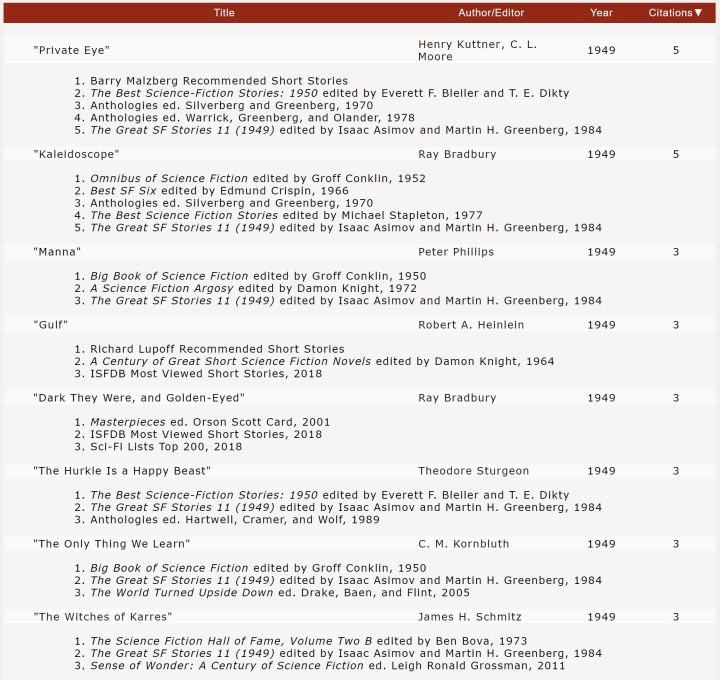
I’ve bolded the four stories that both collections picked. Asimov/Greenberg did add an Asimov and Clarke, but no Heinlein. And our system found even another Ray Bradbury story and picked a Heinlein:

CSFSS-1949.

If you look close, only four stories have had citations from the 21st-century, and only two, “Gulf” by Heinlein, and “Dark They Were, and Golden-Eyed” by Bradbury are remembered by fans recently. Our Classics of Science Fiction project shows how stories are slowly forgotten.

But what about how I felt reading these 1949 stories in 2019? To be honest, I’m struggling to retain them in memory. Most were just okay, even time-wasters. The story that really stuck out for me was “Alien Earth” by Edmond Hamilton, which I’ve already written about. Plus, Hamilton was writing about trees in 1949 that foresees such books as The Hidden Life of Trees (2015) by Peter Wohlleben and The Overstory (2019) by Richard Powers that just won the Pulitzer Prize.

The Ray Bradbury stories still work after all these years. In fact, my admiration for Bradbury is growing. His 1940s stories say so much about that decade and still, they seem relevant in the 2010s.

Most of the 1949 science fiction short stories were fun or clever but will probably offer little to modern readers.

One story, “Private Eye” by Kuttner and Moore, was very impressive but didn’t move me. Paul Fraser at SF Magazines really admired “Private Eye.” I want to reread it in the future because I think it will impress me more with a second reading. I wished someone would do an audiobook of Kuttner/Moore’s collected stories because they dominated the 1940s SF, yet I seldom enjoy their stories like I think I should. I’ve always loved “Vintage Season” but most of their stories seem to be more intellect than heart.

I thoroughly enjoyed “Opening Doors” by Wilmar Shiras, her sequel to “In Hiding” an all-time favorite of mine, but it didn’t have the impact of the first story and doesn’t stand on its own very well.

Nothing-Ever-Happens-on-the-Moon---Robert-A.-Heinlein

What Heinlein stories would I include. “Gulf” is a major story, but it’s subject major is something I find distasteful. I also found the novel Friday, which is a sequel to “Gulf” to be even more distasteful. I guess my favorite Heinlein for 1949 would be “Nothing Ever Happens on the Moon” – a two-part story from Boys Life. (Part 1, Part 2).

Bleiler and Dikty seem to have more stories from the first half of 1949, and Asimov and Greenberg more from the second half. Both looked at several magazines, getting away from Astounding is everything feeling. I’m not sure if I could find other stories worth anthologizing. Nor do I think I could pick enough 1949 SF stories to fill a whole book that’s I’d recommend to modern readers.

Starting last year I began reading the annual best-of-the-year SF anthologies in order. I began with the year 1939. Now that I’ve just finished 1949, it means I’ve covered the whole decade of the 1940s. I’m developing a sense that science fiction is evolving. But I will have to write about that at another time. I’ve started on the 1950 volumes, and the first four stories are already more exciting than any in 1949. My hunch is the 1950s will be the most exciting decade for science fiction.

James Wallace Harris, 6/12/19

“In Hiding” by Wilmar H. Shiras

[This is reprinted from Worlds Without End – originally published 5/11/18]

“In Hiding” originally appeared in the November 1948 issue of Astounding Science-Fiction. You can read it online at the Internet Archive. You can also find this story in these books, which include:

Warning: This column contains mild spoilers

I just finished listening to the new audiobook edition of The Science Fiction Hall of Fame Volume 2B. “In Hiding” turned out to be my favorite story in the collection. I don’t think I’ve read it before, although it feels vaguely familiar. And I had no memory of ever encountering the author, Wilmar H. Shiras, before. It turns out Wilmar was a woman, making her only the third woman writer in the first three volumes of The Science Fiction Hall of Fame.

“In Hiding” is a quiet story about a boy who is so smart that he has to hide his intelligence from other kids and grown-ups. I thought it a remarkable story, and so did the readers of Astounding Science-Fiction back in November 1948. “In Hiding” scored first place in “The Analytical Laboratory,” with an average score of 1.54, meaning most readers put it at the top of their list. That doesn’t happen often. John W. Campbell, the editor had this to say:

Wilmar H. Shiras sent in her first science fiction story, “In Hiding.” I liked it and bought it at once. Evidently, I was not alone in liking it: it has made an exceptional showing in the Lab here—the sort of showing, in fact, that Bob Heinlein, A. E. van Vogt, and Lewis Padgett made with their first yarns. I have reason to believe we’ve found a new front-rank author. Incidentally, there’s a sequel to “In Hiding” coming up in the March issue.

Shiras wrote two more stories for Campbell, “Opening Doors” (March 1949) and “New Foundations” (March 1950). In 1953 Shiras came out with Children of the Atom from Gnome Press by including the three Astounding stories and writing two more to create a collection. Although this book has been reprinted many times over the years, it’s not well-known, and Wilmar H. Shiras only wrote a handful of other stories, including three for Ted White’s Fantastic in the early 1970s. It’s a shame that Campbell was wrong about her, and she didn’t become a major science fiction writer. Wikipedia has damn little about Shiras. She got married at 18, had two boys and three girls. Children of the Atom is the main reason she is remembered, and only by a few old fans.

In Hiding

I found “In Hiding” to be a philosophically insightful science fiction story because of how Shiras dealt with the human mutant theme. There are some who claim (without documentation) that Children of the Atom inspired Stan Lee and Jack Kirby to create X-men comics. After the atomic bomb in 1945, radiation was used for all kinds of miracle mutations in comics, pulps, books, television shows, and movies. Radiation caused insects to grow as big as dinosaurs and for people to develop superpowers. Shiras took a quieter approach. Parents working at an atomic plant conceived mutant children with very high IQs. Normal looking, but very smart. I found that much more appealing than silly stories of oddities with superpowers.

I don’t know why, but science fiction has a long history of imagining Humans 2.0, and they invariably give our replacements telepathy and other psychic powers. I just don’t see that happening. Psi-powers are obviously borrowed from stories of gods, angels, and other magical beings in myths. Isn’t prayer telepathy with God? Don’t angels and demons teleport? Aren’t god-like beings always using telekinesis to act powerfully? I find it psychologically lame that SF writers assume evolution will lead to such talents. Superpowers appeal to the child in us. We want reality to be magical — it’s not.

Shiras takes a different approach, one I feel is more adult. Radiation can cause mutations. Sadly, most would be unwanted physical changes. But, Shiras suggests just a bump in smarts. Not god-like super-knowledge, but children smarter than average. In her stories, it’s implied the orphan children of the atomic plant workers have IQs greater than 150. They are orphans because the plant blows up.

“In Hiding” is about Tim, a boy a school psychologist discovers is a lot smarter than his B average grades imply. Over time the psychologist gains the confidence of the boy and learns Tim pretends to be a normal kid because he discovered at a very early age that other people, young or old, resents intelligence greater than theirs. Tim hides. He is raised by his grandparents who expect him to be well-behaved and quiet, and when he is, allows Tim to have privacy and a workshop in an old barn. By using the mail, and pseudonyms, Tim creates secret personalities that pursue various hobbies, conducts science experiments, breeds cats, completes college correspondence courses, sells stories to magazines, and writes articles for journals.

Science fiction has speculated about Homo superior or superior aliens since the 19th century. Almost always they imagine big heads and ESP. I think evolution is obviously working towards increased intelligence and self-awareness. I believe AI machines will be the next rung on the evolutionary ladder, but I also assume it is possible humans could undergo mutations that will lead to a new and improved biological species. But what is better? Marvel Comics mutants appeal to the child in us. What improvements would rational adults hope for? What new species of humans would have better adaptations for our current reality?

I’d say a species that is smart enough to live in cooperation with nature, one that doesn’t cause endless wars, mass extinctions and poisons the ecosystem. Science fiction and comic books can’t seem to conceive of that. If Wilmar H. Shiras had continued with her series, she might have. Science fiction shines at imagining dystopias but fails at speculating about utopias. Billions plan to go to heaven, but the most complete description of heaven in The Bible sounds like hell to me.

It’s sadly ironic, but Wilmar H. Shiras has been in hiding all these years.

James Wallace Harris

p.s. I found the picture of Children of the Atom on Google. Later I ordered the book from ABEbooks.com – and ended up with that exact copy.

“Living Fossil” by L. Sprague de Camp


Reprinted from Worlds Without End.

Read it now: Astounding Science-Fiction February 1939

You might own “Living Fossil” already in one these anthologies:

Warning: This column contains spoilers.

Let’s imagine we’re a science fiction writer back in the late 1930s. We don’t make much money, so we probably live in a cheap tenement house. There’s no air conditioning, so the windows are open, and the street sounds are pouring in. We have no computer or smartphone, no internet or television. We carefully read the morning and afternoon newspapers, listen to the radio and subscribe to Astounding Science Fiction, Thrilling Wonder Stories, Popular Science, and Scientific American. We often walk to the library in the evening. This is our world of information in 1939.

We’re sitting at the typewriter, smoking a cigarette, planning a story we hope to sell to Astounding Science-Fiction. We want an idea that will wow them and get us the cover. We want to produce the thought variant story. We have a solid knowledge of science fiction published in the pulps back to 1926, and we know the classics like Verne and Wells. Plus, we like to think we’re scientific and visionary.

If you’ve read science fiction short stories from this era you know the variety of wild ideas pitched to science fiction editors. Coming up with something different was essential. Science fiction was mostly idea driven until after the New Wave of the 1960s. Science fiction writers were expected to be as original as research scientists testing a new hypothesis.

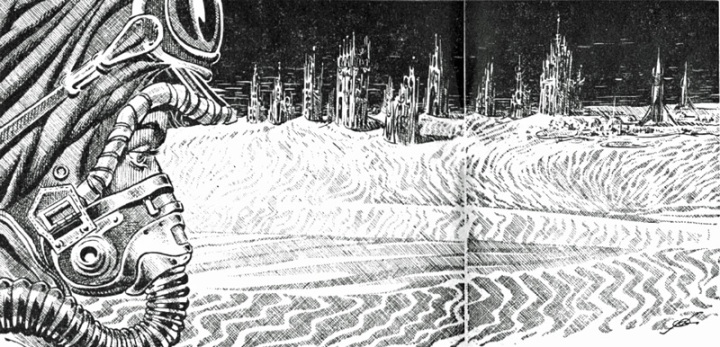
“Living Fossil” by L. Sprague de Camp has not been reprinted very often, and I find that surprising. Anyone seeing the interior illustration above will exclaim, “Oh my god, that’s Planet of the Apes!” But it’s 1939, not 1963 when Pierre Boulle’s Planet of the Apes first appeared in English. How did de Camp get that idea? Was it astoundingly original in 1939, or are there older versions of the same idea in pulps I haven’t read?

Anyone who has read The Time Machine (1995) by H. G. Wells already knows about possible evolutionary descendants of Homo Sapiens. That novella also gave us the meme that death will one day come to both to our species and the Earth. And if you’ve read the brilliant Last and First Men (1930) by Olaf Stapledon then you’ve already entertained that 17 possible future species of humans could exist after us.

Is it so hard to imagine that L. Sprague de Camp asked himself, “What if humans became extinct, how long before another species would become intelligent?” This is one of my favorite science fiction themes: Who comes after us? Clifford Simak imagined intelligent dogs and robots in his lovely fix-up novel, City. Today we assume AI machines will replace us. But have you read the wonderful The World Without Us by Alan Weisman, or seen the television documentaries that were inspired by it? I wrote about them back in 2012. What if self-aware intelligence doesn’t rise up again?

Who comes after humans? “Living Fossil” speculates they could be capuchin monkeys from South America after 10 million years. The story opens with Nawputta, a zoologist and his guide Chujee riding their agoutis exploring northeast North America near Pittsburgh. Ten million years have made a lot of smaller species much larger in their world, and now the agoutis are as large as mules.

This is a pleasing idea, at least to me. I love to think if humans go extinct life on Earth will go on. De Camp even has his Jmu (the capuchin word equal to human) complain that humans used up all the metals and other resources. As Nawputta and Chujee cross the country looking for new specimens for their museum back home, they speculate about the dead civilization of man. After finding what remains of a large stone with a partial inscription on it, they start speculating:

Notice the part where they wish they could meet a live human? Well, that comes true, but not for a couple days. First, they meet another one of their kind by a campfire, Nguchoy tus Chaw, and he’s none too friendly. This part of the story reminds me of James Fenimore Cooper and his tales about the French and English using the Native Americas. Like Cooper’s stories, there’s all kind of dishonest shenanigans going on by ambitious colonists wanting to exploit the wilderness.

Nguchoy is a timber scout who is doing something shady. Our guys get suspicious of him. After he leaves they head further into the unknown country. Eventually, they find three dead humans, not fossils, with bullet holes in them. They figured Nguchoy shot them. For some reason, the zoologist decides he wants to find and kill a fresh human for a specimen. My friend Mike thought this ruined the story because earlier they had been wishing to find a human to talk to. I assumed they meant city dwelling humans, not humans who had to devolve back to living in caves. Here’s what happens:

This is where de Camp differs from Pierre Boulle. For the rest of the story, which is mainly an adventure narrative about Nawputta and Chujee fleeing for their lives in a territory of hostiles humans who weren’t afraid of their guns. Our sympathy is with the Capuchins. De Camp portrays humans like Native Americans in old westerns. They are fearless, ferocious, and treacherous. I don’t know if this is ironic or straight. I don’t know if de Camp was being satirical by having monkeys colonize the new world and then treat humans the same way Europeans treated the Native Americans. Or, if the story was to parallel how Cro Magnon killed off the Neanderthal. Or both. In either case, it’s accepted within this story for the monkeys to kill the humans.

In the Planet of the Apes, our perspective is on the side of the humans, and we want them to fight their way back to the top of the evolutionary heap. Boulle plays to our vanity so we want his humans to outwit the evolved apes. In “Living Fossil” de Camp doesn’t take sides but assumes a kind of naturalism where an intellectually advanced species will overcome a less advanced species.

But I have yet another theory. Maybe de Camp wanted to say humans aren’t the divinely chosen, the crown of God’s creation. Science, evolution, and the Enlightenment offer a view of reality where God isn’t needed or wanted. Readers who feel humans are special will object to this story. In fact, the faithful shouldn’t like this story at all, because it says humans aren’t the center of existence, won’t live forever, and are no different from the other animal species. In that sense, I think de Camp is sticking it to our collective egos.

That’s what I love about these old pulp magazine stories. An ordinary writer could have big ideas and get paid a 1/2 cent a word by the top science fiction magazine of the day. Science fiction allows anyone the chance to defy the common belief, the accepted orthodoxy, or even speculate beyond proven scientific knowledge.

Science fiction allowed every writer to become a Darwin, explaining reality in fiction by using their own observations, speculations, and extrapolations. Sure, most science fiction writers came up with craptastic ideas, but so what, some of them were brilliantly imaginative, and often inspired a sense of wonder, at least in adolescent geeky boys of the times.

How would you answer this question today: “Who comes after humans?” Has science fiction already explored all the obvious possibilities? Already, science fiction has suggested endless variations on Superman and mutations. We’ve imagined countless evolved animals and machines taking over. We’ve imagined aliens moving in and kicking us out. But I’m positive, if I keep reading these old pulp magazines, I will find stories that will surprise me.

[I’m surprised “Living Fossil” didn’t get the cover for February 1939.]

James Wallace Harris

Vultures of the Void by Philip Harbottle

Vultures-of-the-Void

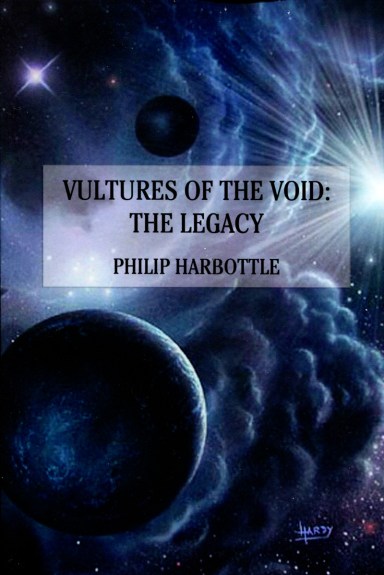
I came across Vultures of the Void: The Legacy by Philip Harbottle by accident. Paul Fraser chided me in an earlier post being too American-centric when talking about science fiction history, so I went looking for more information on British science fiction history. I found a mention of an earlier edition of Vultures of the Void in Mike Ashley’s Transformations: The Story of Science Fiction Magazines From 1950 to 1970 (itself out-of-print.)

Vultures of the Void is a print-on-demand (POD) book, which can be ordered from a number of sources. Here’s how Amazon describes it:

An earlier, very much shorter version of this book was published as VULTURES OF THE VOID in 1992 by Borgo Press, along with a companion bibliographic volume, BRITISH SCIENCE FICTION PAPERBACKS AND MAGAZINES 1949-1956. Now the compiler and editor of those books, Philip Harbottle, here presents the result of his further and ongoing researches into British science fiction publishing history. This greatly expanded version includes entirely new coverage of the generic hardcover titles that briefly and paradoxically flourished alongside the indigenous British paperbacks of the early 1950's, spearheaded by an influx of outstanding American science fiction by such authors as Isaac Asimov, Fredric Brown, Edmond Hamilton, Robert Heinlein, Jack Williamson, and A. E. van Vogt. VULTURES OF THE VOID: THE LEGACY also deals in fascinating detail with related shaping events both before and after the notorious postwar 'mushroom' decade. In particular, it describes how many of the original founders of the pre-war British Interplanetary Society - including fledgling young science fiction writers such as Arthur C. Clarke and Eric Frank Russell - were to become giants and shapers of their field after the war. And how pioneer editors such as Walter Gillings and John Carnell struggled against overwhelming odds to establish British science fiction magazines both before and after the Second World War. In this new book, Harbottle also reveals the astonishing latter-day legacy of the turbulent postwar decade for himself and some of the most prolific authors such as John Russell Fearn, E. C. Tubb, and others, whose work he has been instrumental in returning to print.

The book is almost four hundred pages of fairly small print spiced with black-and-white photos of covers from old British science fiction books, paperbacks, and magazines. While flipping through it I realized Paul was right, I do have an American-centric view of science fiction. Vultures of the Void shows an alternate history of science fiction that I know little about.

This is an obscure book, not because it’s unavailable, but because so little is written about it. There are only three reviews at Goodreads. I was able to find one review by science fiction writer  David Redd.

If you collect old science fiction magazines and books, you might want to buy this one.

James Wallace Harris

The Year’s Best Short Science Fiction: 1959

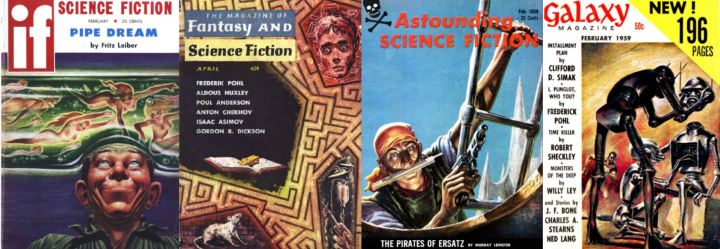
1959-SF-Magazines

Few people think about 1959 today – at least not consciously. Yet, 1959 hangs around. If you hear “So What” by Miles Davis or “Take Five” by The Dave Brubeck Quartet, that year creeps back into your mind. And if you play “Moanin’” by Art Blakey – now that’s 1959 down and dirty! 59′ also returns if you throw on the Blu-ray of Some Like it Hot, Ben-Hur, Anatomy of a Murder, or catch a rerun of The Twilight Zone, Rawhide, Bonanza, or The Untouchables. Three novels dominated The New York Times bestsellers list in 1959 were Doctor Zhivago, Exodus, and Advise and Consent, although it might be more common to be reading A Separate Peace, A Canticle for Leibowitz, or Starship Troopers today.

I’ve become an aficionado of short science fiction, a particularly minor aspect of pop culture, but even here 1959 still matters. I’ve always wanted to pick a year and read all the science fiction magazines that came out that year. But I’m lazy. However, back in 2014, Gideon Marcus did just that for his blog Galactic Journey. This week I read all his columns covering 1959.

I’ve always wondered if anthologists have missed great stories. Are there a few classics still to be unearthed? In 1960 Judith Merril told us which stories she liked from 1959. Bold ones are the titles Marcus also liked.

  • “No Fire Burns” by Avram Davidson (Playboy)
  • “No, No, Not Rogov!” by Cordwainer Smith (If)
  • “The Shoreline at Sunset” by Ray Bradbury (F&SF)
  • “The Dreamsman” by Gordon R. Dickson (Star Science Fiction No. 6)
  • “Multum in Parvo” by Jack Sharkey (The Gent)
  • “Flowers for Algernon” by Daniel Keyes (F&SF)
  • “A Death in the House” by Clifford D. Simak (Galaxy)
  • “Mariana” by Fritz Leiber (Fantastic)
  • “Day at the Beach” by Carol Emshwiller (F&SF)
  • “Plenitude” by Will Mohler (F&SF)
  • “The Man Who Lost the Sea” by Theodore Sturgeon (F&SF)
  • “Make a Prison” by Lawrence Block (Science Fiction Stories)
  • “What Now, Little Man?” by Mark Clifton (F&SF)

Why did Merril miss “All You Zombies—” by Robert A. Heinlein that year? It was on her honorable mention list. I’ve read in later years Heinlein wanted too much to reprint his stories so it might have been true in 1960 too. Gideon Marcus didn’t read Fantastic, the 1959 men’s magazines, or original anthologies, so he gave no opinion on those stories.

Also, in 1960, fans voted the Hugo award for Best Short Fiction:

Winner:

  • “Flowers for Algernon” by Daniel Keyes (F&SF)

Runner-ups:

  • “The Alley Man” by Philip José Farmer (F&SF)
  • “The Pi Man” by Alfred Bester (F&SF)
  • “The Man Who Lost the Sea” by Theodore Sturgeon (F&SF)
  • “Cat and Mouse” by Ralph Williams (Astounding)

Why wasn’t “All You Zombies—” among the top stories nominated for a Hugo? Fans loved three stories that Merril overlooked – “The Alley Man,” “The Pi Man” and “Cat and Mouse.” All three were on her honorable mention list, but it included over a hundred stories. Those three weren’t popular with Gideon Marcus either.

We never know if the stories anthologists published as the best of the year are their exact best of the year, or the stories they could get the rights to publish.

In 1990 Isaac Asimov and Martin H. Greenberg told us their favorite in The Great SF Stories 21 (1959). Stories in bold are those that Merril didn’t pick in 1960.

  • “Make a Prison” by Lawrence Block (Science Fiction Stories)
  • “The Wind People” by Marion Zimmer Bradley (If)
  • “No, No, Not Rogov!” by Cordwainer Smith (If)
  • “What Rough Beast?” by Damon Knight (F&SF)
  • “The Alley Man” by Philip José Farmer (F&SF)
  • “Day at the Beach” by Carol Emshwiller (F&SF)
  • “The Malted Milk Monster” by William Tenn (Galaxy)
  • “The World of Heart’s Desire” by Robert Sheckley (Playboy)
  • “The Man Who Lost the Sea” by Theodore Sturgeon (F&SF)
  • “A Death in the House” by Clifford D. Simak (Galaxy)
  • “The Pi Man” by Alfred Bester (F&SF)
  • “Multum in Parvo” by Jack Sharkey (The Gent)
  • “What Now, Little Man?” by Mark Clifton (F&SF)
  • “Adrift on the Policy Level” by Chan Davis (The Expert Dreamers)

Asimov and Greenberg added 8 stories that Merril didn’t anthologize, while still ignoring “Cat and Mouse” but remembered “The Pi Man.” In the early years of their series, Asimov and Greenberg would give the Heinlein stories they wanted to include a placeholder page in their anthologies. It told readers they couldn’t get the rights to publish Heinlein’s story, but they would have included it as one of the best of the year stories. They stopped even that recognition after a while. I assumed “didn’t get the rights” meant they didn’t want to pay Heinlein’s price.

In 2014 Gideon Marcus identified his favorites at Galactic Journey. His is a longer list than the others. The stories below are Gideon’s 5-stars or highly recommended, or his Galactic Stars Awards recommendations. I’ve cobbled this list together from my reading notes, and they are in no order. I’ve bolded stories the others didn’t recognize.

  • “Flowers for Algernon” by Daniel Keyes (F&SF)
  • “The Man Who Lost the Sea” by Theodore Sturgeon (F&SF)
  • “What Rough Beast” by Damon Knight (F&SF)
  • “This Earth of Hours” by James Blish (F&SF)
  • “To Fell a Tree” by Robert F. Young (F&SF)
  • “The Good Work” by Theodore L. Thomas (If)
  • “The City of Force” by Daniel Galouye (Galaxy)
  • “The Sky People” by Poul Anderson (F&SF)
  • “Cat and Mouse” by Ralph Williams (Astounding)
  • “Seeling” by Katherine MacLean (Astounding)
  • “Whatever Counts” by Frederik Pohl (Galaxy)
  • “Return to Prodigal” by J. T. McIntosh (If)
  • “Death in the House” by Clifford D. Simak (Galaxy)
  • “The Aliens” by Murray Leinster (Astounding)
  • “Someone to Watch Over Me” by Christopher Grimm (Galaxy)
  • “Operation Incubus” by Poul Anderson (F&SF)
  • “What Now, Little Man?” by Mark Clifton (F&SF)

Marcus finally confirms the Hugo nominated “Cat and Mouse.” Most of the previously unremembered stories that Marcus rediscovered were not on anybody else’s list. “The Aliens” was reprinted in The World Turned Upside Down, ed. Drake, Baen, and Flint, 2004, and “The Sky People” were on a list of all-time favorite stories by Gardner Dozois. My guess is these stories need to be reread and reevaluated, but they might be like Pohl’s “Whatever Counts” – just standout stories for the issue, and not all-time classics. I thought “Whatever Counts” was quite innovative – it opens with a dramatic scene of parents trying to burp a baby in freefall and eventually explores different states of consciousness. If I was doing an anthology of Forgotten 1950s SF Stories, I’d include it. But I can’t say it’s a classic like “So What” or “Take Five” are for 1959 jazz. SF’s version of those jazz classics would be “Flowers for Algernon” and “All You Zombies—”

Marcus didn’t say much about “All You Zombies—” but he did rate the March F&SF issue at 4 to 4.5 stars, meaning there must have been some 5-star stories in that issue. He never said which ones, and he did say that F&SF had eleven 5-star stories for 1959. I can only identify eight by reading the columns. Maybe “All You Zombies—” was one. Because Marcus didn’t gush over the obvious classics, maybe he was specifically trying to promote overlooked stories.

In 2018 we created The Classics of Short Science Fiction that identified just four stories from 1959. They each had five or more citations – the requirement to make the list. They were:

  • “Flowers for Algernon” by Daniel Keyes (12)
  • “All You Zombies—” by Robert A. Heinlein (11)
  • “The Man Who Lost the Sea by Theodore Sturgeon (7)
  • “The Pi Man” by Alfred Bester (5)

If Merril and Asimov/Greenberg anthologies had included “All You Zombies—” it would have gotten 14 citations, making it the most remembered SF story of 1959. It’s interesting that both “All You Zombies—” and “Flowers for Algernon” have been made into movies.

If you add in stories that got at least three citations the list would expand to:

  • “The Wind People” by Marion Zimmer Bradley (4)
  • “The Store of the Worlds” by Robert Sheckley (3)
  • “No, No, Not Rogov!” by Cordwainer Smith (3)
  • “The Alley Man” by Philip José Farmer (3)

When we do version 2.0 of The Classics of Short Science Fiction these four stories might get more citations, especially if I use Gideon’s picks as a citation source – that would at least put “The Wind People” on The Classics of Short Fiction list (unless I up the minimum citation requirement – now at 5).

If someone in 2019 created a new anthology series for the best short SF of the year, what should it contain? After 60 years have the classic short SF finally been identified? And if an anthologist in 2059 collected The Best Short SF of 1959 would they see the same classics we do today? Are there still SF stories from 1959 that haven’t revealed their genius yet?

And as Paul Fraser pointed out the stories above are mostly American and that Marcus didn’t read the British SF magazines New Worlds, Science Fantasy or Science Fiction Adventures. And the above lists ignore the rest of the world. We know Merril knew about Russian science fiction because she edited an anthology of Russian SF. Hopefully, by 2059 we’ll know more about the best 1959 SF short stories from around the world.

You can play with our database to create lists of best stories of the year lists.

James Wallace Harris, May 4, 2019

Reading Old Science Fiction Magazines

Old-Science-Fiction-Magazines

This year Galactic Journey is up for the Hugo Award for Best Fanzine.  The website is subtitled: “55 Years Ago: Science Fact and Fiction” which explains the clever idea on which the site is based. Founder, Gideon Marcus, traveled fifty-five years back in time when he began his blog and reviews the science fiction of that era. Mostly he reviews science fiction magazines as they come out, but also discusses SF movies, TV shows, and some books, along with science news of interest to science fiction readers. His journey began in 2013 when he jumped back to 1958, just a year after Sputnik was launched, but he’s now up to reporting on 1964, which includes a review of the latest issue of New Worlds.

Over the years I’ve read Galactic Journey erratically. I subscribe via RSS feed, and when a new post shows up I would read it if I had time. However, during this past year, I’ve slowly switched to old science fiction magazines as my favorite SF reading. It’s become my favorite form of escapism. I’ve even customized my iPad to read Galactic Journey. Weeks ago I jumped back to the beginning of Galactic Journey and began to read forward. I always keep the site open in my Chrome browser. I also keep my CBR reader active, so when I read a positive review of a story, I download the magazine in my CBR app and read the story right away. I used to keep a list of stories I wanted to read someday. Reading the story immediately has made a big difference in enjoying Galactic Journey.

You see, I have a vast collection of old science fiction magazines in digital format making this possible. In recent years fans of old magazines began scanning them to preserve and share. This began as a somewhat secret activity because it violates copyright law, but it’s now pretty much out in the open. I’m not sure if anyone really cares about old magazines to worry about their copyright. There are probably a few dozen scanners who want to preserve the decaying pulps for digital libraries, and maybe two or three hundred old readers who fondly remember these magazines. This is an exceedingly small subculture who love an incredibly tiny aspect of past pop culture.

The Internet Archive which is backed by a California library system has become the leading special collections library of old pulps and digests. See their Pulp Magazine Archive. Other sites around the net offer digital scans of old SF magazines for downloading too. Each issue is about 75-150mb on average in CBR format and 10-20mb in pdf format, so they are time-consuming to download and take up a lot of space on your hard drive.  On eBay, you can buy complete runs of a classic SF magazine on DVD for a few dollars which can save a lot of tedious downloading work. Internet Archive has an online viewer that makes casual reading easy. PulpLibrary.com also has an online viewer that is very visually appealing, but they far fewer issues.

Because these old magazines have become available, whole magazine issues are being reviewed like at Galactic Journey. Other reviewers include Rich Horton at Black Gate, Paul Fraser at SF Magazines, and a few other sites with less regularity. Paul Fraser has a handy Reviews Index by magazine title with links to reviews of individual issues from almost four dozen SF/F magazine titles.

I subscribe and read many of the current SF magazines, while also systematically reading through all the annual best-SF-of-the-year collections, as well as anthologies that cover the complete history of science fiction. What I’m discovering while gorging on all this short fiction is I tend to like science fiction best from the 1950s and 1960s. Galactic Journey has pulled me back into the past, and it has reached a point in time so that it’s now reviewing the SF magazines I read when I was growing up.

And I’m not sure if my preference for old science fiction is pure nostalgia. I just finished reading The Very Best of the Best edited by Gardner Dozois that claimed to be the 38 finest short science fiction stories published from 2002-2017. On average, I’d say these modern stories were more sophisticated and better written than SF stories from the 1950s, but I wouldn’t say they were more fun to read. The modern stories were more scientific and politically correct, but they offer far fewer settings in which I’d want to vicariously dwell.

Sadly, the future has changed during my lifetime. Maybe its a bit pathetic to jump back in time to read old science fiction magazines. Maybe it even reveals a psychological problem. But I find a distinct pleasure in reading these old science fiction mags at this stage in my life. I’m now reliving the 1960s in my sixties, and soon I’ll be reliving the 1970s in my seventies. A philosopher once said an unexamined life isn’t worth living. I think we also need to reexamine our futures too.

p.s.

I hope Galactic Journey wins the Hugo.

James Wallace Harris, May 2, 2019

“Omnilingual” by H. Beam Piper

Omnilingual-web

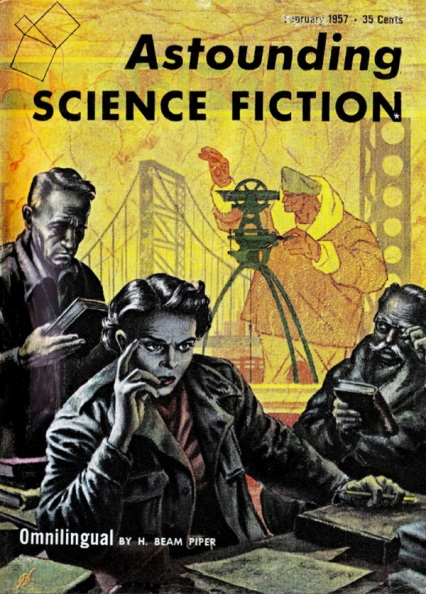
The Science Fiction Book Club on Facebook is discussing “Omnilingual” by H. Beam Piper this week. I had never read this classic novelette before and enjoyed it immensely. It’s my kind of science fiction. “Omnilingual” was first published in the February 1957 issue of Astounding Science Fiction but has often been reprinted. You can read it online or listen to it here.

“Omnilingual” is what I now call Pre-NASA Science Fiction because it’s about anthropologists on Mars excavating the ruins of a Martian civilization that had died out 50,000 years ago. In the 1940s and 1950s, science fiction often assumed we weren’t the only intelligent beings in the solar system, usually imagining jungle civilizations on Venus, and cold desert civilizations on Mars. Of course, NASA space probes in the 1960s destroyed those assumptions. “Omnilingual” fits in nicely between Ray Bradbury’s Martian stories of the 1940s, and Roger Zelazny’s dazzling “A Rose for Ecclesiastes” from 1963. I’ve always felt Zelazny’s story was an ode to Pre-NASA Science Fiction.

“Omnilingual” is impressive for several reasons. First, the main character is female, and the explorers from Earth includes women scientists in their crew. That wasn’t common back then. Remember the all-male crew in the 1956 film Forbidden Planet? That how most science fiction imagined space exploration before Star Trek.

Piper presents the problems of translating unknown ancient Earth languages to give his science fiction story the feel of scientific authenticity. One of my favorite themes in science fiction is the archeology of dead alien civilizations. And, there’s one aspect to this story I can’t reveal because it would be a major spoiler, but I think Piper makes an original observation about how to translate dead alien languages without a Rosetta Stone. I’d really like to know if Piper’s idea was original with him.

Every science fiction story that explores ideas about alien civilizations speculates how other intelligent beings would be like us and could be different. Piper assumes the Martians were a whole lot like us. Would that be true? For example, the researchers find what they think is a scientific journal. Is a periodical that publishes scientific research a logical feature for any advanced civilization? I’m not sure if that’s true, but it’s hard to imagine how scientific knowledge could be collected, stored, and transmitted in another way.

It’s really sad that Mars and Venus didn’t have intelligent life on them. Can you imagine what our world would be like if they did? Not science fiction imagining, but really what it would be like? Picture modern television with the extra diversity of Martians and Venusians. I think the popularity of Star Wars shows there’s a deep desire for living in a reality filled with many intelligent life forms and robots. We don’t want to be alone. This could also explain why many SF fans prefer classic mid-century science fiction stories.

I believe Piper’s goal in writing this story was to present his idea for finding a Rosetta Stone for translating alien languages. “Omnilingual” was written just before modern SETI began with the 1959 paper by Philip Morrison and Giuseppe Cocconi suggested frequencies for listening to alien signals and Frank Drake’s 1960 Project Ozma. I feel Piper had been reading histories of the pioneers who translating Earth’s dead languages and got the inspiration to think about dead alien languages. He also threw in some observations about rivalries between scientists and their academic ambitions.

Omnilingual-illo-1

Ultimately, the appeal of “Omnilingual” today is for modern science fiction readers to find nostalgic solace in a disappearing era of science fiction. That desire is reflected in two recent anthologies edited by George R. R. Martin and Gardner Dozois, Old Mars and Old Venus.

When I was a kid I would have given anything to grow up and been a part of the scientific crew in “Omnilingual.” I guess its a kind of psychological ailment I suffer as an older person wishing I had lived an alternate life history.

JWH