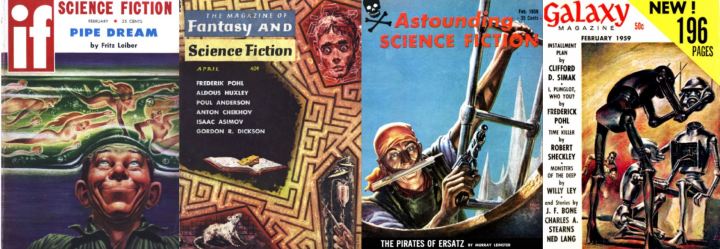
Few people think about 1959 today – at least not consciously. Yet, 1959 hangs around. If you hear “So What” by Miles Davis or “Take Five” by The Dave Brubeck Quartet, that year creeps back into your mind. And if you play “Moanin’” by Art Blakey – now that’s 1959 down and dirty! 59′ also returns if you throw on the Blu-ray of Some Like it Hot, Ben-Hur, Anatomy of a Murder, or catch a rerun of The Twilight Zone, Rawhide, Bonanza, or The Untouchables. Three novels dominated The New York Times bestsellers list in 1959 were Doctor Zhivago, Exodus, and Advise and Consent, although it might be more common to be reading A Separate Peace, A Canticle for Leibowitz, or Starship Troopers today.
I’ve become an aficionado of short science fiction, a particularly minor aspect of pop culture, but even here 1959 still matters. I’ve always wanted to pick a year and read all the science fiction magazines that came out that year. But I’m lazy. However, back in 2014, Gideon Marcus did just that for his blog Galactic Journey. This week I read all his columns covering 1959.
I’ve always wondered if anthologists have missed great stories. Are there a few classics still to be unearthed? In 1960 Judith Merril told us which stories she liked from 1959. Bold ones are the titles Marcus also liked.
- “No Fire Burns” by Avram Davidson (Playboy)
- “No, No, Not Rogov!” by Cordwainer Smith (If)
- “The Shoreline at Sunset” by Ray Bradbury (F&SF)
- “The Dreamsman” by Gordon R. Dickson (Star Science Fiction No. 6)
- “Multum in Parvo” by Jack Sharkey (The Gent)
- “Flowers for Algernon” by Daniel Keyes (F&SF)
- “A Death in the House” by Clifford D. Simak (Galaxy)
- “Mariana” by Fritz Leiber (Fantastic)
- “Day at the Beach” by Carol Emshwiller (F&SF)
- “Plenitude” by Will Mohler (F&SF)
- “The Man Who Lost the Sea” by Theodore Sturgeon (F&SF)
- “Make a Prison” by Lawrence Block (Science Fiction Stories)
- “What Now, Little Man?” by Mark Clifton (F&SF)
Why did Merril miss “All You Zombies—” by Robert A. Heinlein that year? It was on her honorable mention list. I’ve read in later years Heinlein wanted too much to reprint his stories so it might have been true in 1960 too. Gideon Marcus didn’t read Fantastic, the 1959 men’s magazines, or original anthologies, so he gave no opinion on those stories.
Also, in 1960, fans voted the Hugo award for Best Short Fiction:
Winner:
- “Flowers for Algernon” by Daniel Keyes (F&SF)
Runner-ups:
- “The Alley Man” by Philip José Farmer (F&SF)
- “The Pi Man” by Alfred Bester (F&SF)
- “The Man Who Lost the Sea” by Theodore Sturgeon (F&SF)
- “Cat and Mouse” by Ralph Williams (Astounding)
Why wasn’t “All You Zombies—” among the top stories nominated for a Hugo? Fans loved three stories that Merril overlooked – “The Alley Man,” “The Pi Man” and “Cat and Mouse.” All three were on her honorable mention list, but it included over a hundred stories. Those three weren’t popular with Gideon Marcus either.
We never know if the stories anthologists published as the best of the year are their exact best of the year, or the stories they could get the rights to publish.
In 1990 Isaac Asimov and Martin H. Greenberg told us their favorite in The Great SF Stories 21 (1959). Stories in bold are those that Merril didn’t pick in 1960.
- “Make a Prison” by Lawrence Block (Science Fiction Stories)
- “The Wind People” by Marion Zimmer Bradley (If)
- “No, No, Not Rogov!” by Cordwainer Smith (If)
- “What Rough Beast?” by Damon Knight (F&SF)
- “The Alley Man” by Philip José Farmer (F&SF)
- “Day at the Beach” by Carol Emshwiller (F&SF)
- “The Malted Milk Monster” by William Tenn (Galaxy)
- “The World of Heart’s Desire” by Robert Sheckley (Playboy)
- “The Man Who Lost the Sea” by Theodore Sturgeon (F&SF)
- “A Death in the House” by Clifford D. Simak (Galaxy)
- “The Pi Man” by Alfred Bester (F&SF)
- “Multum in Parvo” by Jack Sharkey (The Gent)
- “What Now, Little Man?” by Mark Clifton (F&SF)
- “Adrift on the Policy Level” by Chan Davis (The Expert Dreamers)
Asimov and Greenberg added 8 stories that Merril didn’t anthologize, while still ignoring “Cat and Mouse” but remembered “The Pi Man.” In the early years of their series, Asimov and Greenberg would give the Heinlein stories they wanted to include a placeholder page in their anthologies. It told readers they couldn’t get the rights to publish Heinlein’s story, but they would have included it as one of the best of the year stories. They stopped even that recognition after a while. I assumed “didn’t get the rights” meant they didn’t want to pay Heinlein’s price.
In 2014 Gideon Marcus identified his favorites at Galactic Journey. His is a longer list than the others. The stories below are Gideon’s 5-stars or highly recommended, or his Galactic Stars Awards recommendations. I’ve cobbled this list together from my reading notes, and they are in no order. I’ve bolded stories the others didn’t recognize.
- “Flowers for Algernon” by Daniel Keyes (F&SF)
- “The Man Who Lost the Sea” by Theodore Sturgeon (F&SF)
- “What Rough Beast” by Damon Knight (F&SF)
- “This Earth of Hours” by James Blish (F&SF)
- “To Fell a Tree” by Robert F. Young (F&SF)
- “The Good Work” by Theodore L. Thomas (If)
- “The City of Force” by Daniel Galouye (Galaxy)
- “The Sky People” by Poul Anderson (F&SF)
- “Cat and Mouse” by Ralph Williams (Astounding)
- “Seeling” by Katherine MacLean (Astounding)
- “Whatever Counts” by Frederik Pohl (Galaxy)
- “Return to Prodigal” by J. T. McIntosh (If)
- “Death in the House” by Clifford D. Simak (Galaxy)
- “The Aliens” by Murray Leinster (Astounding)
- “Someone to Watch Over Me” by Christopher Grimm (Galaxy)
- “Operation Incubus” by Poul Anderson (F&SF)
- “What Now, Little Man?” by Mark Clifton (F&SF)
Marcus finally confirms the Hugo nominated “Cat and Mouse.” Most of the previously unremembered stories that Marcus rediscovered were not on anybody else’s list. “The Aliens” was reprinted in The World Turned Upside Down, ed. Drake, Baen, and Flint, 2004, and “The Sky People” were on a list of all-time favorite stories by Gardner Dozois. My guess is these stories need to be reread and reevaluated, but they might be like Pohl’s “Whatever Counts” – just standout stories for the issue, and not all-time classics. I thought “Whatever Counts” was quite innovative – it opens with a dramatic scene of parents trying to burp a baby in freefall and eventually explores different states of consciousness. If I was doing an anthology of Forgotten 1950s SF Stories, I’d include it. But I can’t say it’s a classic like “So What” or “Take Five” are for 1959 jazz. SF’s version of those jazz classics would be “Flowers for Algernon” and “All You Zombies—”
Marcus didn’t say much about “All You Zombies—” but he did rate the March F&SF issue at 4 to 4.5 stars, meaning there must have been some 5-star stories in that issue. He never said which ones, and he did say that F&SF had eleven 5-star stories for 1959. I can only identify eight by reading the columns. Maybe “All You Zombies—” was one. Because Marcus didn’t gush over the obvious classics, maybe he was specifically trying to promote overlooked stories.
In 2018 we created The Classics of Short Science Fiction that identified just four stories from 1959. They each had five or more citations – the requirement to make the list. They were:
- “Flowers for Algernon” by Daniel Keyes (12)
- “All You Zombies—” by Robert A. Heinlein (11)
- “The Man Who Lost the Sea by Theodore Sturgeon (7)
- “The Pi Man” by Alfred Bester (5)
If Merril and Asimov/Greenberg anthologies had included “All You Zombies—” it would have gotten 14 citations, making it the most remembered SF story of 1959. It’s interesting that both “All You Zombies—” and “Flowers for Algernon” have been made into movies.
If you add in stories that got at least three citations the list would expand to:
- “The Wind People” by Marion Zimmer Bradley (4)
- “The Store of the Worlds” by Robert Sheckley (3)
- “No, No, Not Rogov!” by Cordwainer Smith (3)
- “The Alley Man” by Philip José Farmer (3)
When we do version 2.0 of The Classics of Short Science Fiction these four stories might get more citations, especially if I use Gideon’s picks as a citation source – that would at least put “The Wind People” on The Classics of Short Fiction list (unless I up the minimum citation requirement – now at 5).
If someone in 2019 created a new anthology series for the best short SF of the year, what should it contain? After 60 years have the classic short SF finally been identified? And if an anthologist in 2059 collected The Best Short SF of 1959 would they see the same classics we do today? Are there still SF stories from 1959 that haven’t revealed their genius yet?
And as Paul Fraser pointed out the stories above are mostly American and that Marcus didn’t read the British SF magazines New Worlds, Science Fantasy or Science Fiction Adventures. And the above lists ignore the rest of the world. We know Merril knew about Russian science fiction because she edited an anthology of Russian SF. Hopefully, by 2059 we’ll know more about the best 1959 SF short stories from around the world.
You can play with our database to create lists of best stories of the year lists.
James Wallace Harris, May 4, 2019