End-of-the-World Anthologies

Our reading group on Facebook is considering reading a science fiction theme anthology and I thought I’d look up all the end-of-the-world anthologies devoted the apocalyptic science fiction.


1956: The End of the World edited by Donald A. Wollheim

  • The Year of the Jackpot • (1952) • novelette by Robert A. Heinlein
  • Last Night of Summer • (1954) • short story by Alfred Coppel
  • Impostor • (1953) • short story by Philip K. Dick
  • Rescue Party • (1946) • novelette by Arthur C. Clarke
  • Omega • (1932) • short story by Amelia Reynolds Long
  • In the World’s Dusk • (1936) • short story by Edmond Hamilton

This old 1956 paperback is kind of expensive to buy, so not really practical for a group read. We need books that are readily available in libraries or are cheap to buy new or used.


1982: The Last Man on Earth edited by Isaac Asimov, Martin H. Greenberg, and Charles G. Waugh

  • Introduction (The Last Man on Earth) • (1982) • essay by Isaac Asimov
  • The Underdweller • (1974) • short story by William F. Nolan (a variant of Small World 1957)
  • Flight to Forever • (1950) • novella by Poul Anderson
  • Trouble with Ants • [City] • (1951) • novelette by Clifford D. Simak (a variant of The Simple Way)
  • The Coming of the Ice • (1926) • short story by G. Peyton Wertenbaker
  • The Most Sentimental Man • (1957) • short story by Evelyn E. Smith
  • Eddie for Short • (1953) • short story by Wallace West
  • Knock • (1948) • short story by Fredric Brown
  • Original Sin • (1946) • short story by S. Fowler Wright
  • A Man Spekith • (1969) • novelette by Richard Wilson
  • In the World’s Dusk • (1936) • short story by Edmond Hamilton
  • Kindness • (1944) • short story by Lester del Rey
  • Lucifer • (1964) • short story by Roger Zelazny
  • Resurrection • (1949) • short story by A. E. van Vogt (variant of The Monster 1948)
  • The Second-Class Citizen • (1963) • short story by Damon Knight
  • Day of Judgment • (1946) • short story by Edmond Hamilton
  • Continuous Performance • (1974) • short story by Gordon Eklund
  • The New Reality • (1950) • novelette by Charles L. Harness

I’d love it if we voted this one in, but again, it’s out-of-print and too expensive to buy used.


1985: Beyond Armageddon edited by Walter M. Miller Jr. and Martin H. Greenberg

  • Case 101: Ch’iu-Ch’iu’s Firestorm • poem by uncredited
  • Alibi • poem by Walter M. Miller, Jr.
  • Forewarning (an Introduction) • essay by Walter M. Miller, Jr.
  • Salvador • (1984) • short story by Lucius Shepard
  • The Store of the Worlds • (1959) • short story by Robert Sheckley
  • The Big Flash • (1969) • novelette by Norman Spinrad
  • Lot • [David Jimmon] • (1953) • novelette by Ward Moore
  • Day at the Beach • (1959) • short story by Carol Emshwiller
  • The Wheel • (1952) • short story by John Wyndham
  • Jody After the War • (1972) • short story by Edward Bryant
  • The Terminal Beach • (1964) • novelette by J. G. Ballard
  • Tomorrow’s Children • (1947) • novelette by Poul Anderson and F. N. Waldrop
  • Heirs Apparent • (1954) • novelette by Robert Abernathy
  • A Master of Babylon • (1966) • novelette by Edgar Pangborn
  • Game Preserve • (1957) • short story by Rog Phillips
  • By the Waters of Babylon • (1937) • short story by Stephen Vincent Benét
  • There Will Come Soft Rains • (1950) • short story by Ray Bradbury
  • To the Chicago Abyss • (1963) • short story by Ray Bradbury
  • Lucifer • (1964) • short story by Roger Zelazny
  • Eastward Ho! • (1958) • short story by William Tenn
  • The Feast of Saint Janis • (1980) • novelette by Michael Swanwick
  • “If I Forget Thee, Oh Earth …” • (1951) • short story by Arthur C. Clarke
  • Case 113: Ch’iu-Ch’iu’s Wow • poem by uncredited
  • A Boy and His Dog • [Vic and Blood • 2] • (1969) • novella by Harlan Ellison
  • My Life in the Jungle • (1985) • short story by Jim Aikin

This looks wonderful. Again, out of print. I wonder if I could convince several people to track down a used copy? That’s the weakness of the group. Even though we have hundreds of members, very few members join in the reading and discussion. Participating is depended on the availability of the anthology and I think the age of the stories. I feel most of our members prefer newer stories, while I prefer older ones. There are quite a few copies at ABEbooks for under $10 including shipping.


2010: The End of the World edited by Michael Kelahan

  • Introduction • essay by Michael Kelahan
  • Darkness • (2001) • poem by Lord George Gordon Byron [as by Lord Byron]
  • The Last Man • (1826) • short story by Anonymous
  • The Comet • (1839) • short story by S. Austin, Jr.
  • The Conversation of Eiros and Charmion • (1839) • short story by Edgar Allan Poe
  • Earth’s Holocaust • (1844) • short story by Nathaniel Hawthorne
  • Into the Sun • [Into the Sun • 1] • (1882) • short story by Robert Duncan Milne
  • Plucked from the Burning • [Into the Sun • 2] • (1882) • short story by Robert Duncan Milne
  • For the Ahkoond • (1909) • short story by Ambrose Bierce
  • The Crack of Doom • (1895) • novel by Robert Cromie
  • The Star • (1897) • short story by H. G. Wells
  • The Thames Valley Catastrophe • (1897) • short story by Grant Allen
  • A Corner in Lightning • (1898) • short story by George Griffith
  • Within an Ace of the End of the World • (1900) • short story by Robert Barr
  • The Last Days of Earth • (1901) • short story by Geo. C. Wallis
  • The End of the World • (1903) • short story by Simon Newcomb
  • Finis • (1906) • short story by Frank Lillie Pollock
  • The Scarlet Plague • (1912) • novella by Jack London
  • The Last Sunset • (1907) • short story by Edwin A. Start
  • The Machine Stops • (1909) • novelette by E. M. Forster
  • The Poison Belt • [Professor Challenger • 2] • (1913) • novel by Arthur Conan Doyle
  • Nyarlathotep • [Dream Cycle] • (1920) • short fiction by H. P. Lovecraft

If the group was more scholarly I think this would be a good choice because it goes further back in time, which is interesting to me.


2016: This Way to the End Times edited by Robert Silverberg
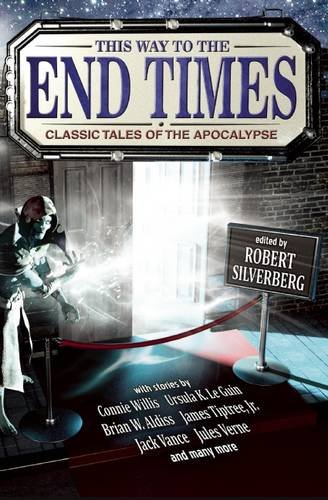
  • Editor’s Introduction (The Eternal Adam) • essay by Robert Silverberg
  • The Eternal Adam • (1957) • novelette by Jules Verne and Michel Verne
  • Editor’s Introduction (The Last Generation) • essay by Robert Silverberg
  • The Last Generation: A Story of the Future • (1908) • novelette by James Elroy Flecker
  • Editor’s Introduction (Finis) • essay by Robert Silverberg
  • Finis • (1906) • short story by Frank Lillie Pollock
  • Editor’s Introduction (The Coming of the Ice) • essay by Robert Silverberg
  • The Coming of the Ice • (1926) • short story by G. Peyton Wertenbaker
  • Editor’s Introduction (N Day) • essay by Robert Silverberg
  • N Day • (1946) • short story by R. S. Richardson [as by Philip Latham]
  • Editor’s Introduction (Guyal of Sfere) • essay by Robert Silverberg
  • Guyal of Sfere • [Dying Earth] • (1950) • novella by Jack Vance
  • Editor’s Introduction (A Pail of Air) • essay by Robert Silverberg
  • A Pail of Air • (1951) • short story by Fritz Leiber
  • Editor’s Introduction (Who Can Replace a Man?) • essay by Robert Silverberg
  • Who Can Replace a Man? • (1958) • short story by Brian W. Aldiss
  • Editor’s Introduction (Heresies of the Huge God) • essay by Robert Silverberg
  • Heresies of the Huge God • (1966) • short story by Brian W. Aldiss
  • Editor’s Introduction (The New Atlantis) • essay by Robert Silverberg
  • The New Atlantis • (1975) • novelette by Ursula K. Le Guin
  • Editor’s Introduction (When We Went to See the End of the World) • essay by Robert Silverberg
  • When We Went to See the End of the World • (1972) • short story by Robert Silverberg
  • Editor’s Introduction (The Wind and the Rain) • essay by Robert Silverberg
  • The Wind and the Rain • (1973) • short story by Robert Silverberg
  • Editor’s Introduction (The Screwfly Solution) • essay by Robert Silverberg
  • The Screwfly Solution • (1977) • novelette by James Tiptree, Jr.
  • Editor’s Introduction (After-Images) • essay by Robert Silverberg
  • After-Images • (1983) • short story by Malcolm Edwards
  • Editor’s Introduction (Daisy, in the Sun) • essay by Robert Silverberg
  • Daisy, in the Sun • (1979) • short story by Connie Willis
  • Editor’s Introduction (Three Days After) • essay by Robert Silverberg
  • Three Days After • (2014) • short story by Karen Haber
  • Editor’s Introduction (The Rain at the End of the World) • essay by Robert Silverberg
  • The Rain at the End of the World • (1999) • short story by Dale Bailey
  • Editor’s Introduction (The End of the World as We Know It) • essay by Robert Silverberg
  • The End of the World as We Know It • (2004) • short story by Dale Bailey
  • Editor’s Introduction (Final Exam) • essay by Robert Silverberg
  • Final Exam • (2012) • short story by Megan Arkenberg
  • Editor’s Introduction (Prayers to the Sun by a Dying Person) • essay by Robert Silverberg
  • Prayers to the Sun by a Dying Person • short story by Alvaro Zinos-Amaro
  • Editor’s Introduction (Last and First Men) • essay by Robert Silverberg
  • Last and First Men (excerpt) • [Last and First Men] • (1966) • short fiction by Olaf Stapledon

This one is in print, $10 for the Kindle edition and $20 for the paperback. Plus it has introductions by Silverberg which are always worth reading.


2010: The End of the World edited by Martin H. Greenberg
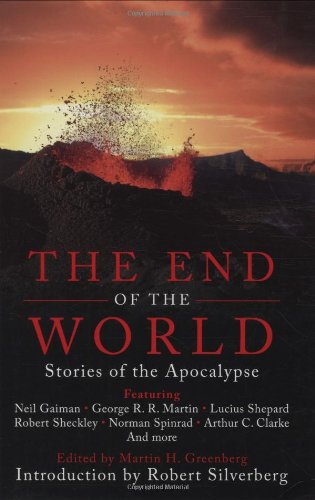
  • Dancing Through the Apocalypse • essay by Robert Silverberg
  • The Hum • (2007) • short story by Rick Hautala
  • Salvador • (1984) • short story by Lucius Shepard
  • We Can Get Them for You Wholesale • (1984) • short story by Neil Gaiman
  • The Big Flash • (1969) • novelette by Norman Spinrad
  • Kindness • (1944) • short story by Lester del Rey
  • The Underdweller • (1974) • short story by William F. Nolan
  • Lucifer • (1964) • short story by Roger Zelazny
  • To the Storming Gulf • (1985) • novella by Gregory Benford
  • The Feast of Saint Janis • (1980) • novelette by Michael Swanwick
  • The Wheel • (1952) • short story by John Wyndham
  • Jody After the War • (1972) • short story by Edward Bryant
  • Salvage • [The Mormon Sea] • (1986) • novelette by Orson Scott Card
  • By Fools Like Me • (2007) • short story by Nancy Kress
  • The Store of the Worlds • (1959) • short story by Robert Sheckley
  • Dark, Dark Were the Tunnels • (1973) • short story by George R. R. Martin
  • If I Forget Thee, Oh Earth … • (1951) • short story by Arthur C. Clarke
  • Afterward • (2006) • short story by John Helfers
  • When We Went to See the End of the World • (1972) • short story by Robert Silverberg
  • Flight to Forever • (1950) • novella by Poul Anderson

Another anthology that’s available to buy. It even has an audiobook edition. That’s a big plus for me.


2010: The Mammoth Book of the End of the World edited by Mike Ashley

  • The End of All Things • (2010) • essay by Mike Ashley
  • When We Went to See the End of the World • (1972) • short story by Robert Silverberg
  • The End of the World • (2002) • short story by Sushma Joshi
  • The Clockwork Atom Bomb • (2005) • short story by Dominic Green
  • Bloodletting • (1994) • short story by Kate Wilhelm
  • When Sysadmins Ruled the Earth • (2006) • novelette by Cory Doctorow
  • The Rain at the End of the World • (1999) • short story by Dale Bailey
  • The Flood • (1998) • short story by Linda Nagata
  • The End of the World Show • (2006) • short story by David Barnett
  • Fermi and Frost • (1985) • short story by Frederik Pohl
  • Sleepover • (2010) • novelette by Alastair Reynolds
  • The Last Sunset • (1996) • short story by Geoffrey A. Landis
  • Moments of Inertia • (2004) • novelette by William Barton
  • The Books • (2010) • short story by Kage Baker
  • Pallbearer • (2010) • novella by Robert Reed
  • And the Deep Blue Sea • (2005) • short story by Elizabeth Bear
  • The Meek • (2004) • short story by Damien Broderick
  • The Man Who Walked Home • (1972) • short story by James Tiptree, Jr.
  • A Pail of Air • (1951) • short story by Fritz Leiber
  • Guardians of the Phoenix • (2010) • novelette by Eric Brown
  • Life in the Anthropocene • (2010) • short story by Paul Di Filippo
  • Terraforming Terra • (1998) • novelette by Jack Williamson
  • World Without End • (2010) • short story by F. Gwynplaine MacIntyre
  • The Children of Time • (2005) • short story by Stephen Baxter
  • The Star Called Wormwood • (2004) • short story by Elizabeth Counihan

Again, out of print, but it is available at ABEbooks.

2019: The End of the World and Other Catastrophes edited by Mike Ashley
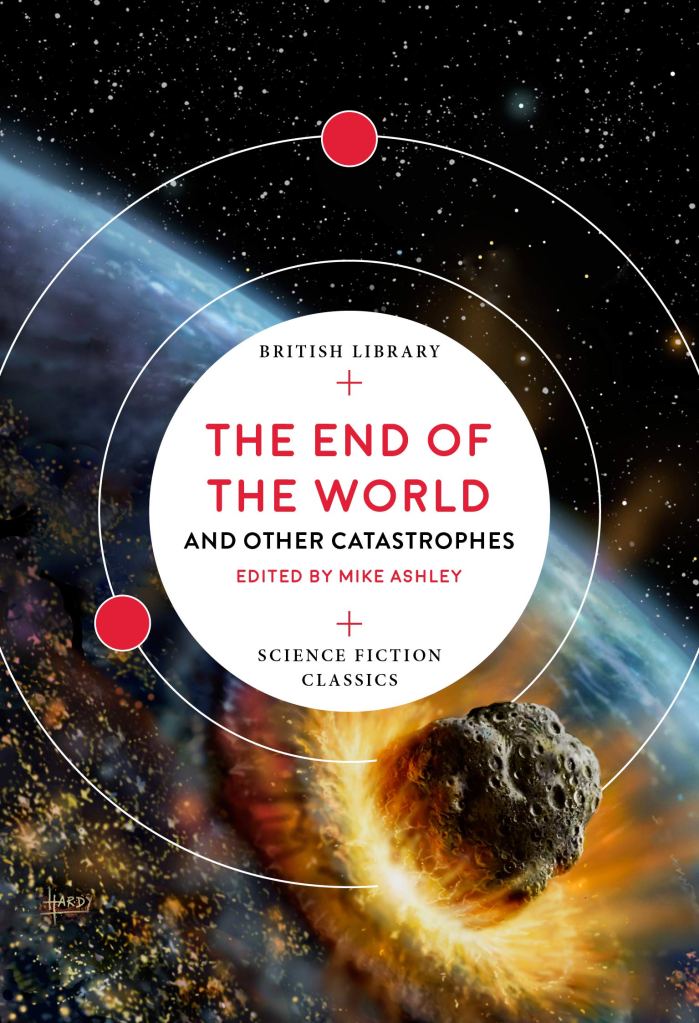
For some reason, ISFDB.org doesn’t have a table of contents for Mike Ashley’s latest end-of-the-world anthology. But you can read about the stories in The BSFA Review. This is another anthology with older stories. That’s great for seeing how the theme evolved.


2010: The Last Man Anthology edited by Hunter Liguore
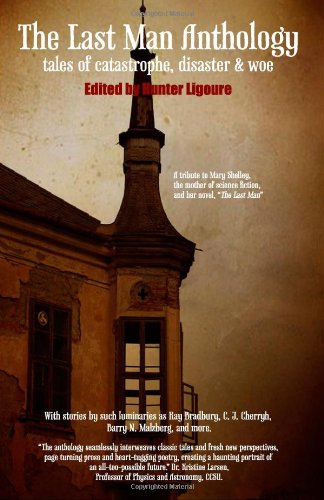
  • Timeline of Catastrophe, 2000-2010 • essay by uncredited
  • Snowmelt • short story by Lane Ashfeldt
  • Teddy and the Last Girl of Brighton Street • short story by William Wood
  • The End of the Beginning • poem by George Moore (I)
  • The Paperless Doctrine of 2152 • short story by Aaron M. Wilson
  • Origins • short story by Liz R. F. Coley
  • Ozymandias • (1818) • poem by Percy Bysshe Shelley
  • Omega Museum • short story by Jaleta Clegg
  • Turning In • poem by Caitlin Kenzie Scott
  • Fire and Ice • (1920) • poem by Robert Frost
  • Under Erasure • short story by Murray Leder
  • The Star • (1897) • short story by H. G. Wells
  • Depletion • poem by Mark Brandon Allen
  • Old Gods at the Armageddon • short story by Jeffery Ryan Long
  • Helen of Troy • (1911) • poem by Sara Teasdale
  • Suicide of the World • short fiction by Andre Saglio
  • Nuclear Winter • poem by Nicolas Samaras
  • Gip • short story by Mark Taylor (I)
  • There Will Come Soft Rains • [The Martian Chronicles] • (1950) • short story by Ray Bradbury
  • The Last Man on Earth • short story by Big Jim Williams
  • Eclipse • poem by Alicia A. Curtis [as by Alicia Curtis]
  • The Last Day of Sanity • short story by Darryll B. Snyder
  • Immutable • poem by Janelle Schwartz
  • The Last Unicorn • short story by H. L. Liguore
  • The Last Hours • (1919) • poem by D. H. Lawrence
  • Cassandra • (1978) • short story by C. J. Cherryh
  • Cee-Cee was My Dog • poem by John Dudek
  • 水 (mi)? • short story by Jack Frey
  • My Blue Ribbon Pies • short story by Jacquelyn Fedyk
  • The Masque of the Red Death • (1845) • short story by Edgar Allan Poe
  • Finley’s Last Chapter • short fiction by Alexandra Wolfe
  • Life of a Child • short story by Samantha Boyette
  • The End of the World • (1911) • essay by Hilaire Belloc
  • Arturo • short story by M. Sullivan
  • Going Home • short story by Kodilynn Calhoun
  • Life Gaped Open • poem by Alan Gann
  • The Scarlet Plague • (1912) • novella by Jack London
  • The Last of Everything • poem by Cassandra Consiglio
  • Corridors • (1982) • short story by Barry N. Malzberg
  • The Last of the Great Coffee Shop Philosophers • short story by Koos Kombuis
  • Last Call • short story by Mark Edwards

This anthology seems to be more historical and covers territory outside of the science fiction genre. It’s not something the group would read but I think I’ll track down a copy.


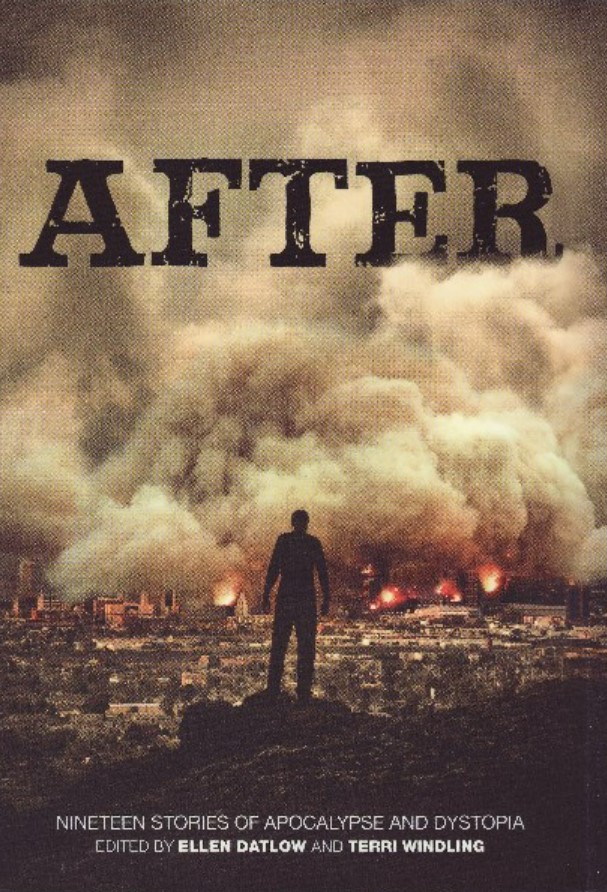
2012: After edited by Ellen Datlow and Terri Windling
  • The Segment • short story by Genevieve Valentine
  • After the Cure • novelette by Carrie Ryan
  • Valedictorian • [The Trojan Girl • 2] • short story by N. K. Jemisin
  • Visiting Nelson • novelette by Katherine Langrish
  • All I Know of Freedom • short story by Carol Emshwiller
  • The Other Elder • juvenile • [Across the Universe] • short story by Beth Revis
  • The Great Game at the End of the World • novelette by Matthew Kressel
  • Reunion • short story by Susan Beth Pfeffer
  • Blood Drive • short story by Jeffrey Ford
  • Reality Girl • novelette by Richard Bowes
  • How Th’irth Wint Rong by Hapless Joey @ homeskool.gov • short story by Gregory Maguire
  • Rust with Wings • [7th Sigma • 0.5] • short story by Steven Gould
  • Faint Heart • novelette by Sarah Rees Brennan
  • The Easthound • (2012) • short story by Nalo Hopkinson
  • Gray • poem by Jane Yolen
  • Before • short story by Carolyn Dunn
  • Fake Plastic Trees • novelette by Caitlín R. Kiernan?
  • You Won’t Feel a Thing • [Shade’s Children milieu] • short story by Garth Nix
  • The Marker • short story by Cecil Castellucci

This is an original anthology that focuses on the post-apocalypse. I’m not sure if the group has ever read an original anthology.


2008: Wastelands: Stories of the Apocalypse edited by John Joseph Adams

  • The End of the Whole Mess • (1986) • novelette by Stephen King
  • Salvage • [The Mormon Sea] • (1986) • novelette by Orson Scott Card
  • The People of Sand and Slag • (2004) • novelette by Paolo Bacigalupi
  • Bread and Bombs • (2003) • short story by M. Rickert
  • How We Got in Town and Out Again • (1996) • novelette by Jonathan Lethem
  • Dark, Dark Were the Tunnels • (1973) • short story by George R. R. Martin
  • Waiting for the Zephyr • (2002) • short story by Tobias S. Buckell
  • Never Despair • (1997) • short story by Jack McDevitt
  • When Sysadmins Ruled the Earth • (2006) • novelette by Cory Doctorow
  • The Last of the O-Forms • (2002) • short story by James Van Pelt
  • Still Life with Apocalypse • (2002) • short story by Richard Kadrey
  • Artie’s Angels • (2001) • short story by Catherine Wells
  • Judgment Passed • novelette by Jerry Oltion
  • Mute • (2002) • short story by Gene Wolfe
  • Inertia • (1990) • novelette by Nancy Kress
  • And the Deep Blue Sea • (2005) • short story by Elizabeth Bear
  • Speech Sounds • (1983) • short story by Octavia E. Butler
  • Killers • (2006) • short story by Carol Emshwiller
  • Ginny Sweethips’ Flying Circus • (1988) • novelette by Neal Barrett, Jr.
  • The End of the World as We Know It • (2004) • short story by Dale Bailey
  • A Song Before Sunset • (1976) • short story by David Grigg
  • Episode Seven: Last Stand Against the Pack in the Kingdom of Purple Flowers • (2007) • novelette by John Langan

Another title that’s in print and available on ebook and audio.


2015: Wastelands 2: More Stories of the Apocalypse edited by John Joseph Adams

  • The Tamarisk Hunter • (2006) • short story by Paolo Bacigalupi
  • Deep Blood Kettle • (2013) • short story by Hugh Howey
  • Animal Husbandry • (2009) • short fiction by Seanan McGuire
  • “… For a Single Yesterday” • (1975) • novelette by George R. R. Martin
  • Chislehurst Messiah • (2011) • short story by Lauren Beukes
  • Colliding Branes • (2009) • short story by Rudy Rucker and Bruce Sterling
  • Ellie • (1995) • novelette by Jack McDevitt
  • Foundation • [Razorland • 0.5] • (2012) • short story by Ann Aguirre
  • Beat Me Daddy (Eight to the Bar) • (2002) • short story by Cory Doctorow
  • A Beginner’s Guide to Survival Before, During, and After the Apocalypse • (2013) • short story by Christopher Barzak
  • Wondrous Days • (2009) • short story by Genevieve Valentine
  • Dreams in Dust • (2012) • short story by D. Thomas Minton
  • By Fools Like Me • (2007) • short story by Nancy Kress
  • Jimmy’s Roadside Cafe • (2008) • short story by Ramsey Shehadeh
  • The Elephants of Poznan • (2000) • novelette by Orson Scott Card
  • The Postman • [The Postman] • (1982) • novella by David Brin
  • When We Went to See the End of the World • (1972) • short story by Robert Silverberg
  • The Revelation of Morgan Stern • (2013) • short story by Christie Yant
  • Final Exam • (2012) • short story by Megan Arkenberg
  • A Flock of Birds • (2002) • short story by James Van Pelt
  • Patient Zero • (2000) • short story by Tananarive Due
  • Soulless in His Sight • (2012) • short fiction by Milo James Fowler
  • Outer Rims • (2011) • short story by Toiya Kristen Finley
  • Advertising at the End of the World • (2009) • short story by Keffy R. M. Kehrli
  • How the World Became Quiet: A Post-Human Creation Myth • (2007) • short story by Rachel Swirsky
  • Tight Little Stitches in a Dead Man’s Back • (1986) • short story by Joe R. Lansdale
  • After the Apocalypse • (2011) • short story by Maureen F. McHugh
  • The Traditional • (2013) • short story by Maria Dahvana Headley
  • Monstro • (2012) • short story by Junot Díaz
  • Biographical Fragments of the Life of Julian Prince • (2013) • short story by Jake Kerr

Also, still in print including ebook and audio.


2019: Wastelands: The New Apocalypse edited by John Joseph Adams

  • Bullet Point • short fiction by Elizabeth Bear
  • The Red Thread • (2016) • short story by Sofia Samatar
  • Expedition 83 • short fiction by Wendy N. Wagner
  • The Last to Matter • (2018) • novelette by Adam-Troy Castro
  • Not This War, Not This World • short story by Jonathan Maberry
  • Where Would You Be Now • [The Bannerless Saga] • novelette by Carrie Vaughn (variant of Where Would You Be Now? 2018)
  • The Elephants’ Crematorium • (2018) • short story by Timothy Mudie
  • Bones of Gossamer • short fiction by Hugh Howey
  • As Good As New • (2014) • short story by Charlie Jane Anders
  • One Day Only • short fiction by Tananarive Due
  • Black, Their Regalia • (2016) • short story by Darcie Little Badger
  • The Plague • (2013) • short story by Ken Liu
  • Four Kittens • short fiction by Jeremiah Tolbert
  • Eyes of the Flood • short fiction by Susan Jane Bigelow
  • The Last Garden • (2017) • novelette by Jack Skillingstead
  • Through Sparks in Morning’s Dawn • short fiction by Tobias S. Buckell
  • Cannibal Acts • (2017) • short story by Maureen F. McHugh
  • Echo • short fiction by Veronica Roth
  • Shooting the Apocalypse • (2014) • novelette by Paolo Bacigalupi
  • The Hungry Earth • (2013) • short story by Carmen Maria Machado
  • Last Chance • (2017) • novelette by Nicole Kornher-Stace
  • A Series of Images from a Ruined City at the End of The World • short fiction by Joseph Allen Hill [as by Violet Allen]
  • Come on Down • short fiction by Meg Elison
  • Don’t Pack Hope • (2018) • short story by Emma Osborne
  • Polly Wanna Cracker? • short fiction by Greg van Eekhout
  • Otherwise • (2012) • novelette by Nisi Shawl
  • And the Rest of Us Wait • (2016) • novelette by Corinne Duyvis
  • The Last Child • short fiction by Scott Sigler
  • So Sharp, So Bright, So Final • short fiction by Seanan McGuire
  • Burn 3 • (2013) • novelette by Kami Garcia
  • Snow • (2015) • short story by Dale Bailey
  • The Air Is Chalk • short fiction by Richard Kadrey
  • The Future Is Blue • [Garbagetown • 1] • (2016) • novelette by Catherynne M. Valente
  • Francisca Montoya’s Almanac of Things That Can Kill You • (2014) • short story by Shaenon K. Garrity

Again, in print, including ebook and audiobook editions.


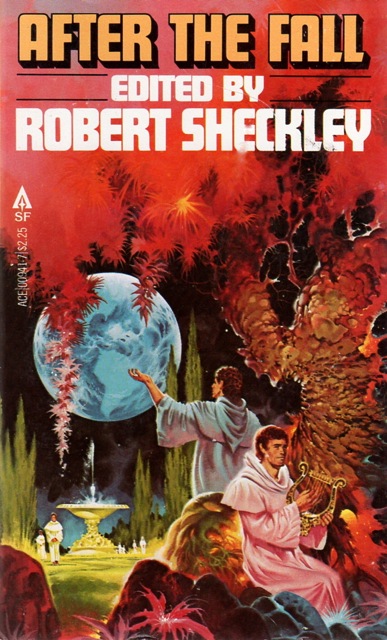
1980: After the Fall edited by Robert Sheckley
  • The Last Days of (Parallel?) Earth • short story by Robert Sheckley
  • The Day After the End of the World • short story by Harry Harrison
  • A Very Good Year … • (1979) • short story by Roger Zelazny
  • Fire and/or Ice • short story by Roger Zelazny
  • Exeunt Omnes • short story by Roger Zelazny
  • Sungrab • [Sam Space] • novelette by William F. Nolan
  • Where Are You Now, Erik Scorbic? • short story by K. Copeland Shea
  • Bud • short story by Ian Watson
  • The Making of Revelation, Part I • novelette by Philip José Farmer?
  • Rebecca Rubinstein’s Seventeenth Birthday • short story by Simon Gandolfi
  • The Revelation • short story by Thomas M. Disch
  • Nirvana Is a Nowhere Place • short story by Joel Schulman
  • Heir • short story by J. A. Lawrence
  • Afterword (Heir) • essay by J. A. Lawrence
  • The Kingdom of O’Ryan • novelette by Bob Shaw
  • Just Another End of the World • short story by Maxim Jakubowski

I imagine this collection by Sheckley is about finding humor at the end of the world. I think I would need it if I read all the other anthologies.


I think my pick would be Beyond Armaggedon edited by Walter M. Miller, Jr. and Martin H. Greenberg.

I can’t believe I’ve found 14 anthologies about the end of the world or the post-apocalypse.

James Wallace Harris, 1/26/23
Baby Boomer Science Fiction

Science fiction stories are fairytales for teenagers that fuel their imaginations about the future. Science fiction creates myths about tomorrow for each new generation. And science fiction offers both hopes and fears about what’s to come. Readers from each new generation embrace their own flavor of science fiction.

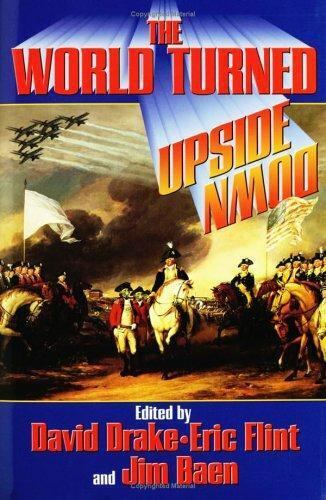
The World Turned Upside Down is an anthology where the editors picked science fiction stories that wowed them when they were teens. Currently available in print for the Kindle for $8.99 or free online for misers and the poor. And for collectors, the hardback is readily available used. I dearly wish there were an audiobook edition because I’d love to hear these stories read by a professional reader.

David Drake (b. 1945) and Jim Baen (b. 1943) are from the Silent Generation (1925-1945). Eric Flint (b. 1947) is from the second year of the Baby Boomers (1946-1964). I was born in 1951, the fifth year. All three editors started reading science fiction in the 1950s and I started in 1962. I believe science fiction fans that discovered the genre in the 1950s and 1960s during the Baby Boomer era imprinted on a certain type of science fiction that’s distinctly different from later generations’ science fiction. I believe the stories in The World Turned Upside Down will appeal the most to Baby Boomers.

One significant extra to this anthology is the personal recollections from the three editors. The introductions and follow-ups are bite-size memoirs. The editorial comments added extra enjoyment to reading this anthology. And I felt on the same wavelength as the editors.

Picture a graph with a bell curve stretched out on the trailing edge. Each year hundreds (thousands?) of science fiction stories are published, but only a small number become popular and are embraced as favorites by a generation. The newest stories are the leading edge of the curve. Then the long stretched-out trailing edge is where stories are remembered as they fade away in pop culture memory. Growing up I mostly read science fiction short stories that were at the peak of the curve. They were mostly 5-20 years old. Now those stories are 55-70 years old.

As I’ve gotten older, that bulge has diminished. In The World Turned Upside Down 5 stories are from the 1930s, 5 from the 1940s, 15 from the 1950s, and 4 from the 1960s. You should be able to visualize the curve just from that tiny bit of data. Readers today from the current generations will like or know very few of these stories. They are now far away from the leading bulge of popular stories. In 20 years, that bulge in the 1950s will thin away in future anthologies. Anthologists whose teen years were during the 1980s or 2010s will seldom pick stories that old.

For the past couple of months, our Facebook group has been reading and discussing the 29 stories from The World Turned Upside Down. I thought the age of the group member had an impact on which stories they liked. Current with reading these old stories on Tuesdays, Thursdays, and Saturdays, we read newer stories from The Good New Stuff edited by Gardner Dozois on Mondays, Wednesdays, and Fridays. I also thought the contrast to it in the comments was age-related. Austin Beeman reviewed The World Turned Upside Down on his blog and overall liked most of the stories, but the stories he responded to best were a bit different from my favorites. And I thought he liked stories in The Good New Stuff a lot more than I did. I believe he’s 25-30 years younger than I am. Jeppe Larsen reviewed the anthology on his blog and liked fewer stories. My hunch is he is younger. But it’s also possible, he’s not young, and like many people, just likes to keep up with the times. I actually prefer the older stuff, even if it feels old. And to also skew my impression, most of the active members are hardcore SF fans that love a wide range of science fiction.

Generally, a great story is usually liked by any age group, but less famous stories seem to have a generational appeal. My guess is writers write under the assumption they are speaking to the current generation but some of them end up speaking across the ages.

The stories in The World Turned Upside Down were first published from 1933 through 1967, but the most common decade represented was the 1950s. Here are the stories with my ratings (1-5 stars).

1930s

  • Shambleau • (1933) • novelette by C. L. Moore (*****)
  • Who Goes There? • (1938) • novella by John W. Campbell, Jr. (*****)
  • Black Destroyer • (1939) • novelette by A. E. van Vogt (*****)
  • Heavy Planet • (1939) • short story by Milton A. Rothman (***+)
  • Spawn • (1939) • novelette by P. Schuyler Miller (****+)

My father (b. 1920) would have been a teen when these stories came out. He was from the Greatest Generation (1901-1924). These are also stories that appeared with the generation of First Fandom. Those were the old guys of science fiction when I was a teen. I’m not sure if any of them are around anymore. The star of that era was E. E. “Doc” Smith. Most of the fiction from then felt dated in the 1960s and even more so in the 2020s, even to me, a guy who loves to read old science fiction.

1940s

  • Quietus • (1940) • short story by Ross Rocklynne (****)
  • Environment • (1944) • short story by Chester S. Geier (***+)
  • Rescue Party • (1946) • novelette by Arthur C. Clarke (*****)
  • Thunder and Roses • (1947) • novelette by Theodore Sturgeon (*****)
  • The Only Thing We Learn • (1949) • short story by C. M. Kornbluth (***+)

These stories came out during the teen years of the Silent Generation. This has been called The Golden Age of Science Fiction, but people who felt that are mainly dead. Stories collected in anthologies stay around for a few decades, and I was reading these stories as a teen in the 1960s. I thought 1940s SF was science fiction from the good old days. They felt somewhat dated when I read them in the 1960s, but they were still fun. Today, even to me, they feel quite quaint.

1950s

  • Liane the Wayfarer • (1950) • short story by Jack Vance (****)
  • Trigger Tide • (1950) • short story by Wyman Guin (***+)
  • A Pail of Air • (1951) • short story by Fritz Leiber (****+)
  • All the Way Back • (1952) • short story by Michael Shaara (***+)
  • Thy Rocks and Rills • (1953) • novelette by Robert E. Gilbert (****+)
  • Answer • (1954) • short story by Fredric Brown (*****)
  • The Cold Equations • (1954) • novelette by Tom Godwin (*****)
  • Hunting Problem • (1955) • short story by Robert Sheckley (****)
  • A Gun for Dinosaur • (1956) • novelette by L. Sprague de Camp (****)
  • The Last Question • (1956) • short story by Isaac Asimov (****+)
  • The Gentle Earth • (1957) • novella by Christopher Anvil (***+)
  • The Menace from Earth • (1957) • novelette by Robert A. Heinlein (*****)
  • Omnilingual • (1957) • novelette by H. Beam Piper (*****)
  • St. Dragon and the George • (1957) • novelette by Gordon R. Dickson (****)
  • The Aliens • (1959) • novelette by Murray Leinster (****)

Now, these were stories that were often anthologized in the 1960s when I was a teen and a number of them are considered classics. They seem just a little bit old to me when I was a teen. Like 1950s Rock and Rollers, who were in their twenties when I was a teen in the 1960s, but they were still so cool!

1960s

  • Code Three • (1963) • novella by Rick Raphael (***+)
  • Turning Point • (1963) • short story by Poul Anderson (***+)
  • Goblin Night • (1965) • novelette by James H. Schmitz (****)
  • The Last Command • (1967) • short story by Keith Laumer (****)

It’s interesting that these stories did come out when I was a teen, but they were some of my least favorites in the anthology, although still a lot of fun to read. I’m surprised Flint, Drake, and Baen picked them because none of them became classics. These kinds of stories were the salt of the Earth content of the SF magazines in the 1960s, but not the stories I thought defined the generation. At the time, Samuel R. Delany, Roger Zelazny, J. G. Ballard, and Ursula K. Le Guin were the bright stars in the sky.

Even though fiction being called science fiction was around in the 1920s, 1930s, and 1940s, it wasn’t until the 1950s that the general public recognized it. The 1950s was a boom time for science fiction when it regularly began appearing in book form – both paperback and hardback. Plus, it became popular in the movies and in the early days of television. In 1953 there were three dozen science fiction magazine titles being published. When I grew up stories from the 1950s boom felt like they defined the genre.

I felt the most famous SF from the 1950s would be the classics all my life and into the future. However, I’ve now lived long enough to see those stories age and fade away. It sometimes hurts me to see my favorite science fiction novels and short stories being forgotten, rejected or even vilified. This is why it’s difficult to recommend The World Turned Upside Down to younger readers. But I feel its stories capture an era so nicely. The stories aren’t the most famous Baby Boomer science fiction stories, but then the most famous stories are often over-anthologized while so many other good stories need to be remembered. I’m guessing Drake, Flint, and Baen wanted to preserve a picture of our era taken from a different angle. Of the stories I hadn’t read before, I was very glad to be introduced to them.

I would love to review each story one by one and natter about how they each aged and guess how each appealed to their generation. But this post is already longer than what 99% of internet readers read. I know, I’m way too verbose.

JWH

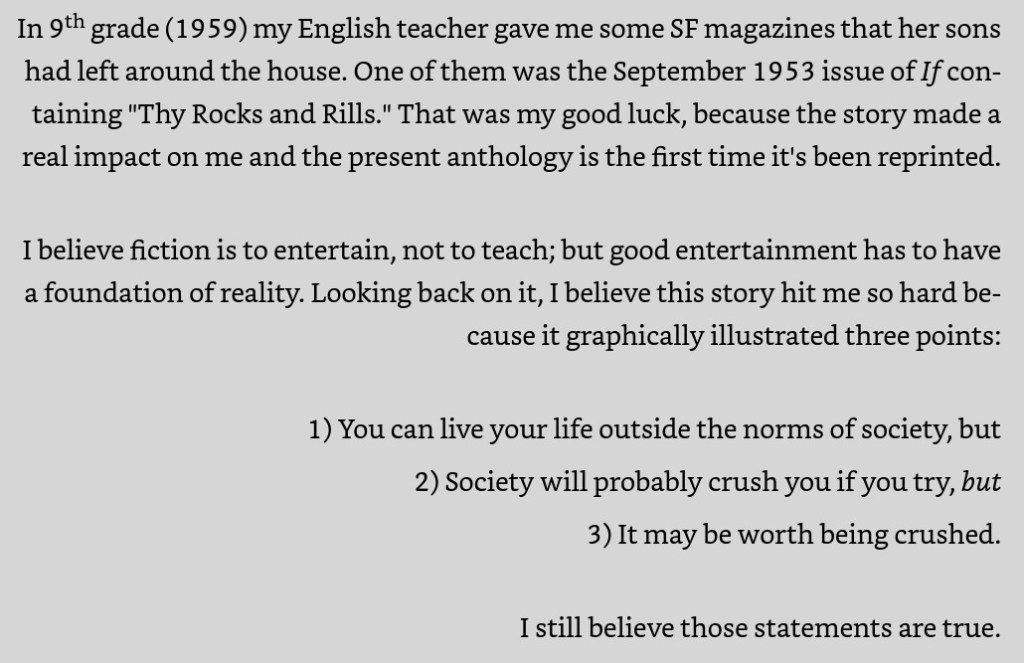
“Thy Rocks and Rills” by Robert Ernest Gilbert

How is it possible that I can rate a short story five stars out of five when it took 52 years to be anthologized for the first time? If countless editors passed it over for decades while looking for good SF stories to reprint, how can it possibly be any good? The story I’m talking about is “Thy Rocks and Rills” by Robert Ernest Gilbert. Ever heard of it? Ever heard of Gilbert? I haven’t on both counts.

“Thy Rocks and Rills” was originally published in the September 1953 issue of If. The first time it was reprinted was in 2005 in The World Turned Upside Down edited by Jim Baen, David Drake, and Eric Flint. You can also read the story on Project Gutenberg.

The goal of that anthology was to collect the stories that got the three editors excited about science fiction when they were teens. David Drake gave “Thy Rocks and Rills” this introduction:

I can understand why Drake responded to “Thy Rocks and Rills” that way, but it wasn’t how I reacted.

I’ve owned The World Turned Upside Down for years but I’m just now getting around to reading it because the Facebook group Best Science Fiction and Fantasy Short Fiction is discussing its stories every Tuesday, Thursday, and Saturday.

When I read “Thy Rocks and Rills” yesterday I just thought, “Wow, oh wow!” However, others in the group have not been so enthusiastic. And I can understand that.

I don’t believe fiction can be rated on absolute terms. In fact, my subjective ratings will change every time I reread a story. There are elements in “Thy Rocks and Rills” that would have made me dislike this story on other days, especially the talking bull and calves. Yeah, it has talking farm animals and mules with Appaloosa coloring. If you read the descriptions closely, the male fashions in this future are as gaudy as any Elton John or Prince wore on stage.

“Thy Rocks and Rills” is over-the-top. And it’s from 1953. But it’s also weirdly prophetic. Gilbert predicts a painfully hot future. One where toxic masculinity dominates and everyone is gun crazy. In Gilbert’s future, people are quick-tempered and ready to duel. And most women are condemned to conform to male expectations, making their bodies tiny and slender, staying in their place, and sticking to chirpy women’s talk. Although, some women are different and get into duels with men. The hero of this story is Stonecypher, and this is how Gilbert describes his wife Catriona:

The villain of the story is Dan who makes a legal proposition to Catriona that enrages Stoncypher:

Oh, but the way, the story has ornithopters. I did say it was colorful. The reason we have talking farm animals is because of mutations from radiation. Gilbert is protesting bomb testing. He’s also protesting bullfighting or any kind of arranged animal fights. “Thy Rocks and Rills” is quite woke for 1953. The world-building in this novelette is quite impressive. The basic plot involves Stonecypher getting in a dual and not knowing how to use a gun, and his talking bull wanting to go into the bullfighting ring.

The results were not what I anticipated but they were very satisfying. However, the ending is brutal, but David Drake has already warned us about that. I’m afraid most readers won’t like the ending, but I think it’s realistic. I overcame my dislike of talking animals because this story is gritty and dark, and we’re living in a gritty and dark age, but then so was 1953.

I’m quite fond of science fiction short stories from 1953, especially the grim ones:

  • “Lot” by Ward Moore
  • “Deadly City” by Paul W. Fairman
  • “The Last Day” by Richard Matheson
  • “One in Three Hundred” by J. T. McIntosh
  • “A Saucer of Loneliness” by Theodore Sturgeon
  • “A Case of Consciousness” by James Blish
  • “Four in One” by Damon Knight
  • “DP!” by Jack Vance
  • “Imposter” by Philip K. Dick
  • “The Liberation of Earth” by William Tenn
  • “The Model of a Judge” by William Morrison

If you know these stories, you’ll understand why I now list “Thy Rocks and Rills” among my favorites of 1953. I linked to the two that are available on Project Gutenberg. Six of them are in The Great SF Stories 15 (1953).

After reading science fiction for sixty years I’m having trouble finding new science fiction that wows me. Reading “Thy Rocks and Rills” Saturday morning gave me the kind of surprises I keep hoping to find in science fiction but seldom do anymore. “Thy Rocks and Rills” is perfect for an anthology called The World Turned Upside Down.

However, I can completely understand if it doesn’t work for you. The success of a story depends largely on what the reader brings to the story. I believe I’m just as cynical now as Gilbert was in 1953 and that made the story work for me. I was tuned into where Gilbert was coming from when he wrote it.

James Wallace Harris, 10/30/22

“The Hemingway Hoax” by Joe Haldeman

The Facebook group Best Science Fiction and Fantasy Short Fiction is reading The Best of the Best, Volume 2: 20 Years of the Best Short Science Fiction Novels edited by Gardner Dozois. This week’s discussion story is “The Hemingway Hoax” by Joe Haldeman which first appeared in Asimov’s Science Fiction (April 1990). I remember reading the story when it came out. I was around forty then, and I’m seventy now. I thought it might be interesting to explore how my attitudes toward “The Hemingway Hoax” have changed since I got old.

I was an English major in college and had read A Farewell to Arms (1929) and The Sun Also Rises (1926) and a handful of Hemingway’s short stories. Other than classroom discussion I knew little about Hemingway. I’ve read several biographies since then, and more of his fiction, but at the time I didn’t know about the central inspiration of “The Hemingway Hoax,” that Hadley, Hemingway’s first wife, had lost all his early manuscripts. At the time I thought that fascinating and probably encouraged me to go read about Hemingway.

“The Hemingway Hoax” focuses on John Baird, a Boston University professor specializing in Hemingway. Baird is a vet, wounded in Vietnam, who identifies with Hemingway’s war wounds, and eventually makes a list of all the things they share. He’s married to a much younger woman, Lena. They are vacationing in the Florida Keys, but are worried about their future. Baird’s trust fund is about to run out and they are used to living a rich lifestyle. Baird is afraid of how Lena will react to living within an academic’s salary. Then Baird meets Castle, a con man who suggests a scheme for Baird to forge a lost manuscript of Ernest Hemingway. Baird is not really interested, but think’s it is an amusing idea. Lena who married Baird for his money connives with Castle to force Baird into the caper. Along the way, Castle cons a woman named Pansy into the scheme too.

The magazine version of “The Hemingway Hoax” is a long novella, which Haldeman later expanded into a short 155-page novel. (Or did he cut it down for magazine publication?) The novella won both the Hugo and Nebula awards. See Mark R. Kelly’s blog for a comparison of the novella and novel. This long story follows three main plot threads:

  • The Hemingway Hoax – how to forge a Hemingway unpublished manuscript. I thought this was an A+ idea for a plot both at forty and seventy. Unfortunately, Haldeman doesn’t stick with this plot. A few years ago PBS had an episode of Secrets of the Dead that told of an effort to forge a book by Galileo. It was tremendously fascinating. Baird does do a bit of work on this plot, finding typewriters and paper Hemingway would have used and starting a couple of drafts that were interesting. The old me was quite disappointed when Haldeman didn’t finish this plot, but the younger me was more than happy when Haldeman introduced the science fiction.
  • The Baird Con – as a counterplot, when Lena and Castle plan to con Baird into doing something illegal it could have taken the story into noir territory. The older me loves film noir and was excited by that direction. This also could have been an A+ idea too, but it was mainly used for sex and violent scenes. When I was younger I liked sex and violent scenes, but the old me hates excessive violence, and graphic sex scenes only seem suitable for hot romance novels and porn. I could understand taking the noir route with the cheating wife, skipping the science fiction, and selling it to Alfred Hitchcock’s Mystery Magazine or Ellery Queen’s Mystery Magazine. Better yet, I would have been even more impressed if Haldeman had skipped both the noir and the SF and gone the straight literary route like Possession by A. S. Byatt, another story about a literary mystery.
  • The Hemingway Demon – the story has one other character, a supernatural character that physically looks like Hemingway from different times in his life. I call it a demon because like Maxwell’s Demon, it guards the flow actualities between universes in a multiverse Haldeman calls the Omniverse. When I was young this was exciting stuff, but the old crotchety me considers multiverse plots much like time travel plots, easy to abuse. When anything can happen it spoils the story for me. I like my fictional universes to have limitations that reign in the plots. Haldeman goes wild with the universe hopping. That was fun at forty but tedious at seventy. It would have been mindblowing to me at thirteen if the story had been available for me to read in 1964.

You can’t expect a writer to write what you want. That’s completely unfair. But as a reader, every story creates anticipation. Stories are great when they fulfill that initial anticipation. In this reading, Haldeman got me excited about forging Hemingway and then didn’t complete the mission. I have to wonder if he felt compelled to add the science fiction thread because he’s a science fiction writer, and knows where to sell science fiction. I wonder if he would have even liked writing the story as mainstream fiction. When I was young I wanted everything to be science fiction, but as I’ve gotten older, my interests have widened. Not only do I not need everything to be science fiction, but when it is science fiction it needs to be reasonably realistic and down to Earth.

Getting old has done something to my reading tastes. My time in this life is dwindling, and my physical health also limits how much I can read. I now hate when stories are padded with extra scenes. I generally prefer science fiction at the short story or novelette length. Most novellas stretch out ideas too much. The older, impatient me, felt Haldeman was too ambitious with this story. What I really love is a story that has lots of realistic details, good characterization, a tight plot, and a compelling narrative style. But I want it focused. I don’t want any wasted words or scenes.

I’m afraid when reading “The Hemingway Hoax” Haldeman hooked me on the writing of a forged Hemingway manuscript and then distracted me with all the omniverse mumbo-jumbo. It allowed him to come up with a clever idea of what happened to the lost manuscripts, and it gave Haldeman a chance to write from Hemingway’s point of view as he lived his life backward. All that was interesting, but wasn’t part of the story that hooked me this time.

When I was young I found stories and novels that used real people as fictional characters to be neat and fun. But over a lifetime of reading biographies, I now see such a practice as exploitation – an easy way to get readers’ attention. Reading such books as The Paris Wife by Paula McLain produced a false idea of what Hadley and Hemingway were like. I wrote about this in my essay, “Why Did Ernest Hemingway Leave Hadley Out of The Sun Also Rises?“

In recent years, we’ve seen more and more best sellers and movie blockbusters that fictionalize historical people, and I’ve realized that I don’t like this trend. That has tainted my rereading of “The Hemingway Hoax.” I thought John Baird was a great idea for a character, a wounded vet who identified with Hemingway in so many ways, including his war wounds. And I thought a fictional character who is a Hemingway scholar trying to forge a lost Hemingway manuscript was a legitimate use of Hemingway’s name in fiction. Creating a supernatural demon that monitors the influence of Hemingway across the multiverse is a fun science fictional idea, but not really significant or meaningful to me at 70.

When we’re young any far-out idea is fun. But now that I’m old, I like my speculation within the realm of realism. “The Hemingway Hoax” is a case where the story was five stars when I was young, but only three stars when I’m old.

James Wallace Harris, 8/15/22

Old and New Science Fiction

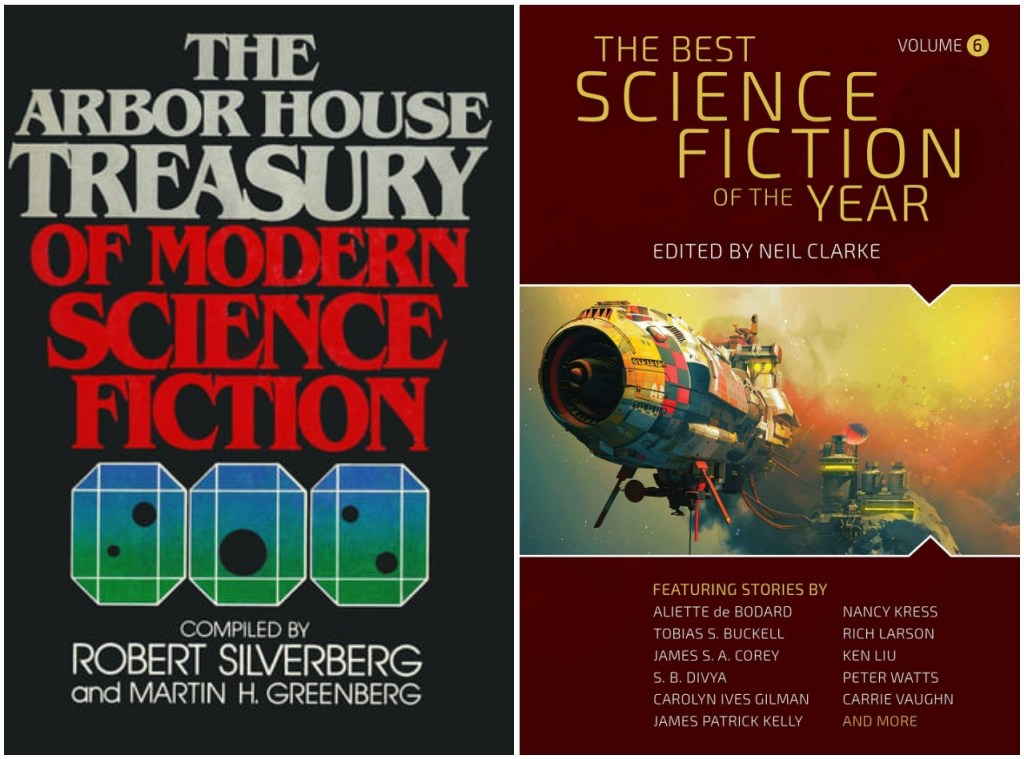
The Facebook group Best Science Fiction and Fantasy Short Fiction will begin discussing The Best Science Fiction of the Year v. 6 edited by Neil Clarke on April 24th for Group Read 38, and The Arbor House Treasury of Modern Science Fiction edited by Robert Silverberg and Martin H. Greenberg for Group Reading 39 on April 29th. That means during May, June and some of July will be alternating between old and new science fiction short stories each day.

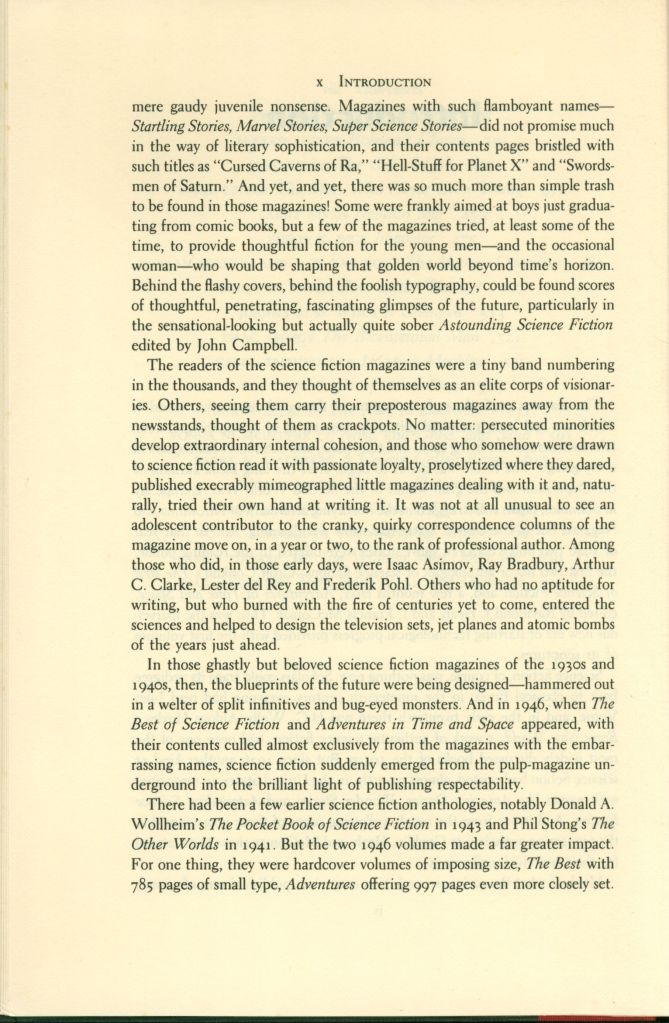
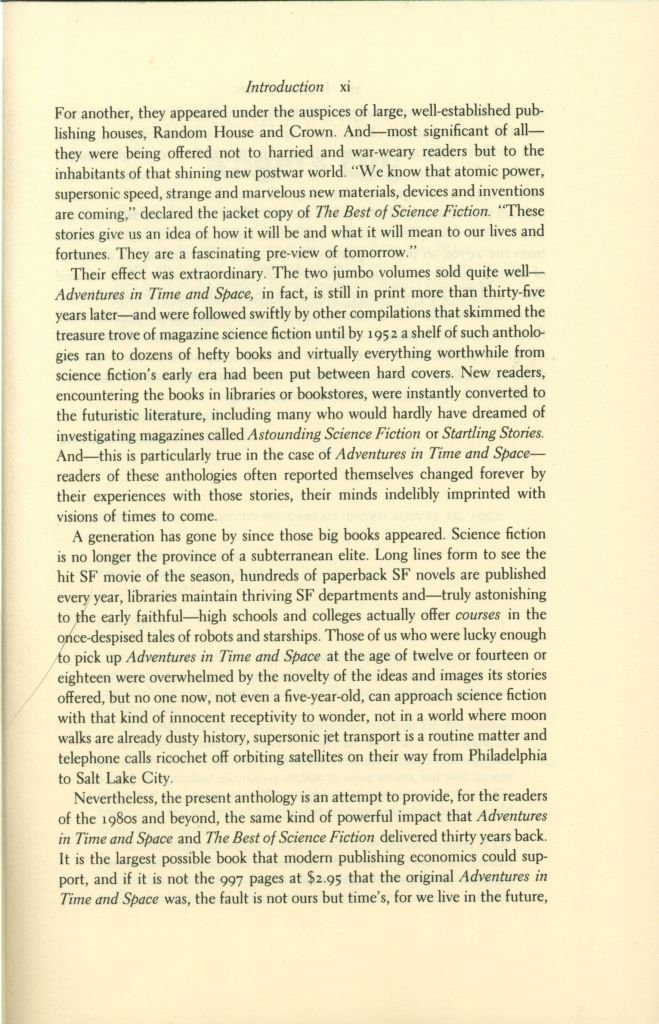
Silverberg and Greenberg compared their anthology to the two classic SF anthologies from 1946: The Best of Science Fiction edited by Groff Conklin, and Adventures in Time and Space edited by Raymond J. Healy and J. Francis McComas. For decades, readers found those two anthologies in their libraries and were standards for introducing readers to short science fiction. They hoped The Arbor House Treasury of Modern Science Fiction would cover 1946-1979 like those two classic anthologies did for science fiction before 1946.

The Neil Clarke volume is his pick of the best short science fiction of 2020. Group Read 38 schedule. Group Read 39 schedule.

Now that I’m regularly reading old and new science fiction short stories I’m learning how both science fiction and writing science fiction are evolving. Part of my daily routine is reading the next day’s story, and then thinking about it when I’m going to sleep at night so that in the morning I can type up a short review for the group when I start my day. Belonging to this Facebook group has been a real education, kind of a graduate course in science fiction literature. More than that, it’s been a meditation on my lifelong relationship with science fiction. I’ll try to write longer reviews for this blog for those stories that really inspire me.

I hope Silverberg and Greenberg won’t mind me reprinting their short introduction because it says so much about remembering science fiction short stories. 75 years later, the CSFSS list only recalls one story from the Conklin anthology and four from the Healy/McComas book. 42 years later, the list remembers 10 from the stories Silverberg and Greenberg picked out. But how many of those 10 will remain in another 33 years?

James Wallace Harris, 4/23/22 – updated 4/27/22

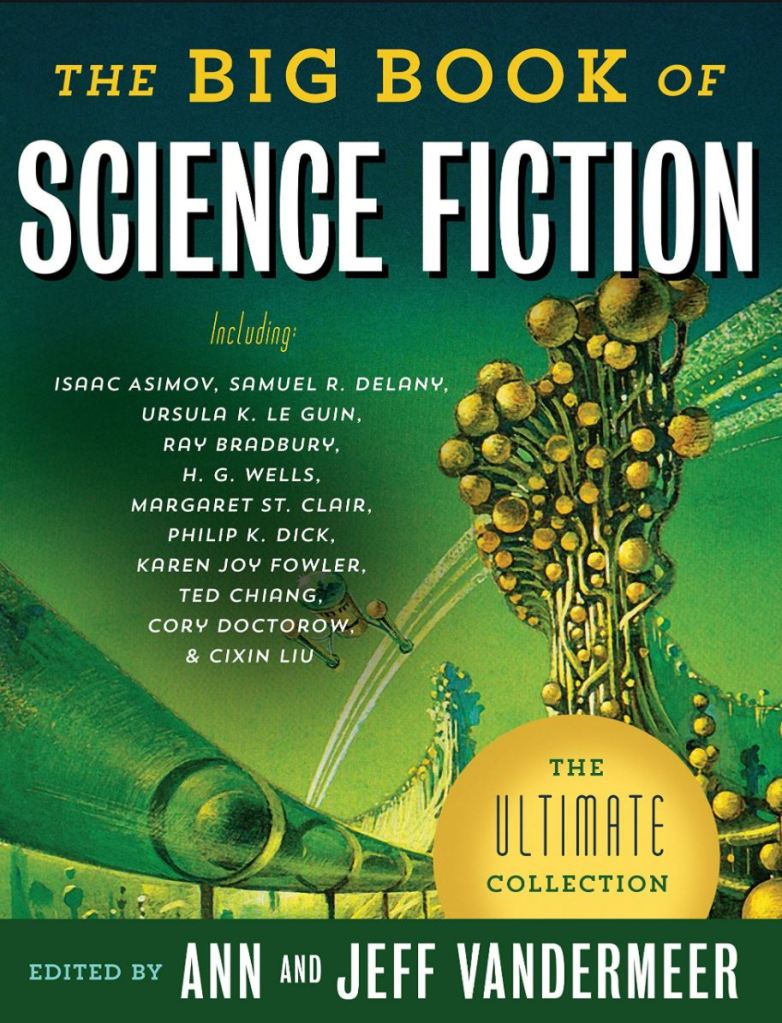
Finishing The Big Book of Science Fiction

After finishing “Craphound,” I decided to go ahead and read “The Slynx” by Tatyana Tolstaya and “Baby Doll” by Johanna Sinisalo and finish The Big Book of Science Fiction. That gave me a real sense of accomplishment because The Big Book of Science Fiction is probably the largest book I’ve ever read, and I’ve read War and Peace. I’m guessing TBBofSF is even longer than The Bible.

I don’t have any final assessment on this anthology. It’s just too damn big to judge as a whole. I did complain about many of the stories, but on the other hand, it has a massive amount of great science fiction too. The other day it was on sale for $2.99 for the Kindle edition at Amazon, and I thought what a wonderful bargain. I wished I hadn’t owned it already so I could get in on such a deal.

“The Slynx” was a good science fiction story, about Moscow in the far future after an atomic war where people only remember “The Blast.” The story is about civilization being thrown back into the Dark Ages. People live by myths and superstitions. Mutations are common. This kind of story was very popular in the 1950s, and Wikipedia refers to them as nuclear holocaust fiction. Among my favorites are A Canticle for Leibowitz by Walter M. Miller, Jr., and The Long Tomorrow by Leigh Brackett. What struck me most was how Tolstaya portrayed people’s thinking in this future much like how I imagined people thinking in prehistory.

I’ve read “Baby Doll” before, but I’m not sure where. I might have read it years ago when I first bought The Big Book of Science Fiction and tried a few stories from it. At the time, I never imagined I would read it from cover to cover. “Baby Doll” is a disturbing story about the near future where the main character is an eight-year-old girl who tries to be as sexualized as possible from the clues she gets from society and her peers. It came out in 2002 and imagined a near future where grade school children would emulate the dress styles, language, and behaviors they got from watching porn and adult reality shows. I can’t help but wonder how much of that is true today? Imagine if the MTV Awards show could be sent back in time to the people in the 1950s. What would they think?

My sister recently told me she tried to get her very young granddaughter to wear something less provocative to school and the kid got upset claiming her granny was slut shaming her. I doubt “Baby Doll” could be taught in a 7th grade English class, but I sure would love to hear what the students would say about it.

On the same day finishing The Big Book of Science Fiction, I also finished Star Science Fiction Stories, the first in a series edited by Frederik Pohl from 1953. That means Group Read 27 and 35 are finishing for our Facebook group Best Science Fiction and Fantasy Short Fiction. It also means Group Read 36, Asimov’s SF Magazine Poll Finalists for 2021 starts 21st March, and Group Read 37, Hugo and Nebula Award Winners from Asimov’s Science Fiction edited by Sheila Williams will start a few days after that. It’s a coincidence that our 36th group read will be the 36th annual readers’ awards for Asimov’s Science Fiction.

So for the next several weeks, the Facebook group will be reading and discussing SF stories from the 1980s and 1990s, and 2021. If you’re interested and use Facebook drop by. I won’t be reviewing every one of these stories here, but I’ll probably write about the ones that impress me most.

James Wallace Harris, 3/15/22

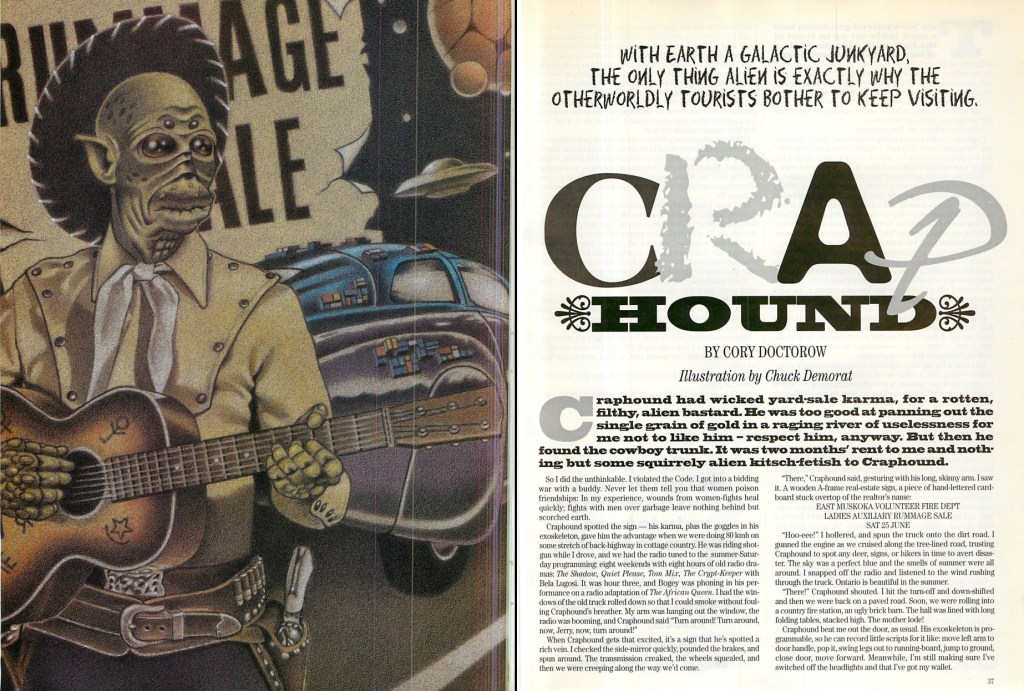
“Craphound” by Cory Doctorow

Group Read 27: The Big Book of Science Fiction

Story #105 of 107: “Craphound” by Cory Doctorow

“Craphound” by Cory Doctorow belongs to that wonderful sub-sub-sub-genre, nostalgia stories by science fiction writers. Other classics of that theme are “Jeffty is Five” by Harlan Ellison, “Travels With My Cats” by Mike Resnick, and “A Scent of Sarsaparilla” by Ray Bradbury. I belong to several online groups where old science fiction fans dwell on old science fiction, and many of them collect all kinds of crap from when they grew up. The novel Ready Player One by Ernest Cline resonates so well with certain readers because of its nostalgia for the 1980s.

Over my lifetime I’ve known many collectors of science fiction and their collections usually included memorabilia crap from the past. Forrest J. Ackerman, Ray Bradbury, and Harlan Ellison were known for their huge nostalgic collections (much of it toys). Just pay attention to Harlan Ellison’s house in the documentary Dreams With Sharp Teeth. A few glimpses can be had in this preview from YouTube.

All during my school and college years, I thought science fiction was about the future, but ever since then, science fiction has been about the nostalgic past. There’s an article at The Economist, “If you think sci-fi is about the future, think again” that I’d love to read but it’s behind a paywall. It’s subtitled “An exhibition in London shows how much of science fiction is fuelled by nostalgia.” If anyone is a subscriber and is willing, send me a copy.

Cory Doctorow has tuned into these nostalgic readers with a story about Jerry and his best friend known as Craphound, an alien from outer space. Both are professional hunters of old crap that they resell for big dollars to the addicts of nostalgia. Sadly, their friendship is shattered one day when they get into a bidding war over an old suitcase of cowboy clothes and toys at the East Muskoka Volunteer Fire Department Ladies’ Auxiliary sale.

Why would aliens want our old crap? Well, without Craphound (which Doctorow uses for his domain name) the story wouldn’t be science fiction, and Doctorow couldn’t have sold it to a science fiction market. Without Craphound the story would just be about a loser with arrested development making a living by going to garage sales and Goodwill stores. Without Craphound, the story would be about people like us. Just imagine if you’re yard sale copilot was an ET.

Nostalgic SF is closely related to Recursive SF. If I could remember better, I could cite a long list of stories where science fiction stories longingly look back to the past.

In recent years I’ve been collecting old science fiction anthologies and a fair amount of old science fiction magazines and fanzines. I was just looking at my wall of bookshelves and thinking about all the people that once held those books and magazines. There must have been thousands of folks like me. Mike Resnick was one since I bought some fanzines on eBay with mailing labels addressed to him. When I die my wife will liquidate my collection and it will go to new collectors. Some of my things would make garage sale craphounds very happy. Who knows, maybe one of them will be an alien.

Main Page of Group Read

James Wallace Harris, 3/15/22

“Story of Your Life” by Ted Chiang

Group Read 27: The Big Book of Science Fiction

Story #104 of 107: “Story of Your Life” by Ted Chiang

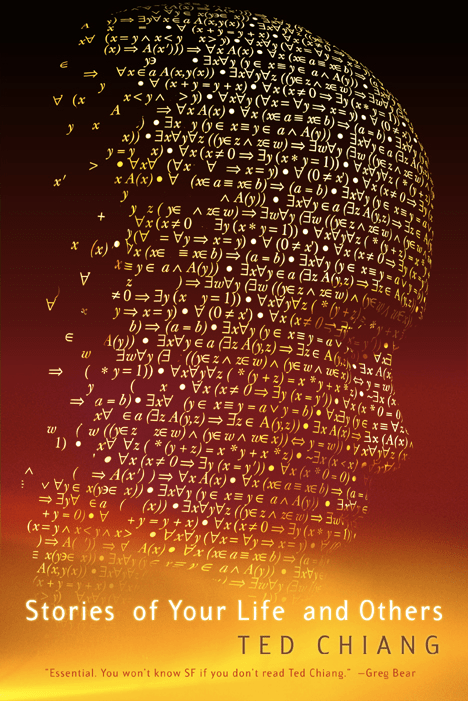
Warning: Don’t read this essay if you haven’t read “Story of Your Life,” or at least seen Arrival. I want to explore how and why this story works and that means spoilers, and “Story of Your Life” is much too lovely to spoil for anyone. There are copies on the internet and it can be found in many anthologies, but it’s best to own a copy of Stories of Your Life and Others.

Today I read “Story of Your Life” for the third time, and watched Arrival for the second time. “Story of Your Life” by Ted Chiang is the epitome of what science fiction strives to achieve. There were many stories in The Big Book of Science Fiction that I don’t believe deserve that label, but this story does. Science fiction is notoriously hard to define because everyone wants to define it differently, but I’d like to think “Story of Your Life” fits within everyone’s definition of science fiction.

For me, the best science fiction does two things, and the greatest does three. The best science fiction stories combine wonderful storytelling with a sense of wonder. Sense of wonder emerges when readers are taken from the edge of current science to the forefront of tomorrow’s science. What elevates a 4-star story into a 5-star story is when it emotionally, spiritually, and philosophically transcends. Ted Chiang is transcendent in “Story of Your Life.”

Chiang asks, what if we meet aliens that perceive reality differently from us? What if we see reality linearly, and they see it holistically — could we communicate? Science fiction, for the most part, has always assumed we’ll bridge the language divide with aliens quickly. Chiang’s story asks, “Wait, what if that’s not true?” It’s one thing to question the possibility, it’s another thing altogether to show how the difficulties could unfold. It’s even greater when the writer takes us through the process so we see why too.

Time and again, Chiang presents us with an idea and the evidence to support the idea. For example when Louise Banks, the linguist in the story, realizes that the Heptapods’ written language was not patterned on its spoken language. That’s kind of mindblowing until Chiang reminds us that there have been written languages in human cultures that didn’t follow the structure of their spoken languages. Would we have ever deciphered ancient Eygptian hieroglyphics without the Rosetta Stone?

According to Wikipedia, Chiang spent five years studying linguistics before writing this story.

“Story of Your Life” is actually twin narratives, two stories. The first is a third-person narrative relating Louise’s and Gary Donnelly’s work with the Heptapods to learn their language. The other story is a second-person narrative of Louise talking to her daughter.

The twin narratives represent a linear story and a holistic story. One is how humans think, and the other is how Heptapods perceive. From our perspective, they know the future. When Louise begins to understand that this might be possible she struggles to understand how and what are its implications. Louise imagines someone having the Book of Ages where everything that’s ever happened is written down. Humans perceive reality as if reading such a book word by word, sentence by sentence, page by page, but the Heptapods know it all at once.

This is the great leap forward that science fiction makes to inspire a sense of wonder. This explains how the second-person narrative of the story works.

“Story of Your Life” also presents science facts too. Unfortunately, these are often perceived as infodumps by science fiction readers. Infodumps can burden a tale. In this story, I was quite entertained by them, especially Fermat’s Principle. It’s very hard to teach science within a science fiction story. I took many science courses in high school and college and read hundreds of popular science books, but my science knowledge is rather flimsy and fading. This is the first time I’ve encountered Fermat’s Principle, even even though it wasn’t entirely mind-blowing, it hurt my head to contemplate. Who sticks things like this into science fiction and gets away with it? Not many writers. Ted Chiang does.

Ted Chiang is basically performing a magic trick upon his readers. He uses real science several times as a diversion so we will believe in the science fiction illusion he creates. I do not believe there is any being that comprehends reality holistically like the Heptapods. Theists claim God can but I’m an atheist. But for the sake of this story, I suspend my disbelief and let it be true. Science fiction doesn’t have to be realistic, it just has to feel within the realm of reality.

Louise learns just enough of the Heptapod’s written language to start thinking in it, and that affects her dreams. She can’t consciously perceive holistically like they do, but her unconscious mind can, its perceptions leaking out in dreams and visions creating the second-person story.

My mind aches while trying to imagine how Ted Chiang constructed this intricate story. There are certain stories I consider writing models that new science fiction writers need to beat. “Story of Your Life” set the pace in 1998. It’s definitely a 5-star story, but it’s more than that. A few great science fiction stories are also philosophical, and they go beyond great storytelling.

In the end, we know that Louise has been talking to her daughter in dream sequences. The daughter was born after the Heptapods left after the story ends. She died young. On first reading or first viewing of Arrival, we assumed her daughter died before the story starts. Louise learns during the story, and before we do, that she is seeing the future. Sadly, she also knows her daughter’s life will be brief, and when and how she will die. For us who live linear lives, we know what a tremendous burden such knowledge would be. Yet, Louise fully embraces her tragic future. She accepts the ecstasy and the agony.

As far as I can find, Chiang never gives the daughter a name, but in the movie, they make a special point to let us know it’s Hannah. I wonder why for each case. The screenwriters also change the name of the aliens from Flapper and Raspberry to Abbott and Costello. In this case, I prefer the screenwriters’ choice.

What Chiang tells us if we perceived reality holistically, if we’re omniscient, we’d still choose to follow our paths. This questions the whole idea of free will. It’s Buddhism versus Christianity. But we don’t get so technical when we experience this story, it evokes an epiphany in Louise, but one that we should resonate with emotionally.

Many will ask, why did Louise agree to have a baby when she knew her daughter would die from a horrible disease? With the Heptapod’s way of perceiving choice isn’t a factor. Acceptance is a path in Eastern philosophy.

I should mention that Arrival tacks on some extra storylines. It often appears that moviemakers believe that science fiction audiences want their heroes to save the world. “Story of Your Life” is quiet and personal. Arrival ramps up the politics and adds in a save the world plot. I have to wonder if the general population would have admired the film just as much without it?

James Wallace Harris, 3/12/22

p.s. I’ve been reading but not reviewing some of the last stories in The Big Book of Science Fiction. If I don’t have anything new to say after I’ve already oversaid everything, I decided just not to say anything.

“Remnants of the Virago Crypto-System” by Geoffrey Maloney

Group Read 27: The Big Book of Science Fiction

Story #101 of 107: “Remnants of the Virago Crypto-System” by Geoffrey Maloney

“Remnants of the Virago Crypto-System” by Geoffrey Maloney is about aliens who have come to the Earth and leave. Their motives are mysterious. They leave behind crypto machines that look like large teletypes that print on ancient-looking paper. In the story, an unnamed narrator travels with his girlfriend who hopes to meet one of the last aliens before they leave. The narrator becomes petty and jealous for being ignored. Ultimately he finds out that his girlfriend has learned about what the aliens have said about us and it’s not very nice, but true.

The mood of this story reminds me of the Strugatsky brother’s novel, Roadside Picnic. The aliens in that story are completely unknowable. In Maloney’s story, we knew the aliens were here and got to know them some, but they and their mission were always a mystery. Back in the 1950s, there were two famous science fiction stories where aliens judged humanity, the film The Day the Earth Stood Still, and the novel Have Space Suit-Will Travel by Robert A. Heinlein. But the theme is reasonably common.

Quite often in science fiction, we hope aliens will save us from ourselves, a Christ-like role. But every so often, science fiction writes about aliens who judge us, an Old Testament God-like role. In this story, the aliens are more like Margaret Mead coming to live with us for a while. At the end of this short story, we learn one question that horrifies the aliens about us. The narrator worries that the aliens will be sending an executioner, but I get the feeling these aliens are more gentle, so they would probably only put up signs – Warning! Insane Creatures.

“Remnants of the Virago Crypto-System” is a nice science fiction story. Not great, but does the job and creates a neat mood. It’s part of a larger work called Tales from the Crypto-System. I’m slightly tempted to try the book, except that it’s too expensive at Amazon, and there is no Kindle edition. A $2.99 Kindle edition might rescue it from obscurity. Infinity Plus gave it a nice review back in 2005. Some of it can be read from Google Books, and I might try more of it when I have time.

Main Page of Group Read

James Wallace Harris, 3/6/22

“The Remoras” by Robert Reed

Group Read 27: The Big Book of Science Fiction

Story #99 of 107: “The Remoras” by Robert Reed

“The Remoras” by Robert Reed was first published in the May 1994 issue of The Magazine of Fantasy and Science Fiction and has been reprinted a number of times since then. “The Remoras” is set in the far future, on a spaceship as large as a planet, crewed by immortal humans and aliens, who are taking a grand tour around the Milky Way.

The story is part of Reed’s The Great Ship Universe series, but I’ve only read a few of its many entries. My favorite was “Good Mountain,” but it wasn’t set on the Great Ship. I’ve Googled around hoping to find an overview of the Great Ship stories but couldn’t find one. It includes the novels Marrow and The Well of Stars, as well as the collection The Great Ship, but there are other books in the series according to GoodReads.

“The Remoras” is a Quee Lee story, she is a passenger on the Great Ship that is on a 500,000-year voyage that will make one orbit of the Milky Way. This story imagines the far future, when posthumans live lives we can’t imagine.

We have to assume Reed’s goal with this story is to speculate about immortality and posthuman societies, yet the story starts off with a very contemporary-sounding situation. Quee Lee is lounging around in her luxury apartment when a person name Orleans comes to her door wanting 52,000 credits her husband Perri owes. That sounds like a 1940s film noir beginning. I have a pet peeve against plots that use cliche pulp fiction plot conflicts.

We are told we’re in a giant spaceship but we don’t feel it – yet. The person at the door is a man, but not like anyone now in existence. Orleans is a Remora, humans that have mutated themselves by exposure to radiation from working on the outside of the ship. They were tagged with the name Remoras after the fish that follow sharks and feed off their skin. The Remoras are also immortal, but to normal humans look grossly disfigured by cancers. For example, Orleans has an eye that looks like a sea anemone.

At first, Quee Lee mistrusts Orleans and tells him she will tell her husband and he will have to deal with his debt. All of this first part of the story disappointed me. I find the idea of a ship as big as a planet taking passengers on a half-million-year orbit of the Milky Way to be too unbelievable. I also find the idea of longevity extending to hundreds of thousands of years to be unbelievable. And I felt nothing Reed gave us helped me see the possibilities.

But in the second half of the story, when Quee Lee goes to visit Orleans and decides she wants to temporarily experience being a Remora, the story got good. For some reason, I could buy the idea that humans could mutate themselves by consciously directing cancers and genetic alterations. It’s not that I believe such actions are possible in our reality, but Reed made them believable in his story, and that’s what counts.

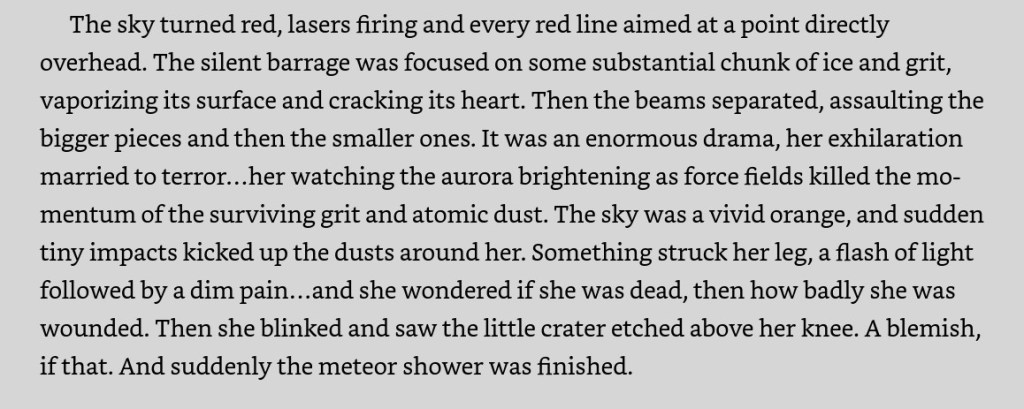
And to make his story even more fun, he takes us through several plot twists. There is a scene when Quee Lee is on the surface of the ship describing a tremendous light show of lasers destroying comets before they could hit the ship that reminded me of the “Tears in the Rain” speech by Roy Batty in Blade Runner. It goes like this: “I’ve seen things you people wouldn’t believe… Attack ships on fire off the shoulder of Orion… I watched C-beams glitter in the dark near the Tannhäuser Gate. All those moments will be lost in time, like tears in rain… Time to die.”

What Quee Lee saw wasn’t so eloquently and succinctly stated, but the imagery was just as impressive, like an experience Roy Batty would have seen in his short lifetime.

Reed’s story is super-science on a vast scale. Many writers of modern space opera try to imagine such far futures, but for me, they fail. I can imagine humans living for hundreds of years, but not hundreds of thousands of years. I can imagine humans traveling across the galaxy, but not in ships as big as planets. The Great Ship stories push the boundaries for what I consider credible science fiction. However, once this story zeroed in on one relationship that involves a very short period of time involving exact details I got into it.

Main Page of Group Read

James Wallace Harris, 3/6/22