I’ve read over a thousand science fiction short stories in the last three years and I’ve decided I have an anthology problem. This is different from the anthology problem Szymon Szott solved for me in “The SF Anthology Problem – Solved.” No, my current problem is finding anthologies with a higher percentage of great stories to read.
I and other members of our science fiction short story reading group never can find anthologies where we love all the stories. Of course, that’s asking too much from editors but we still crave 24k carat gold anthologies. Even the Gold Standard of science fiction anthologies, volume one of The Science Fiction Hall of Fame had stories I didn’t enjoy (“The Weapon Shop”) and it was created by polling science fiction writers for their all-time favorite stories.
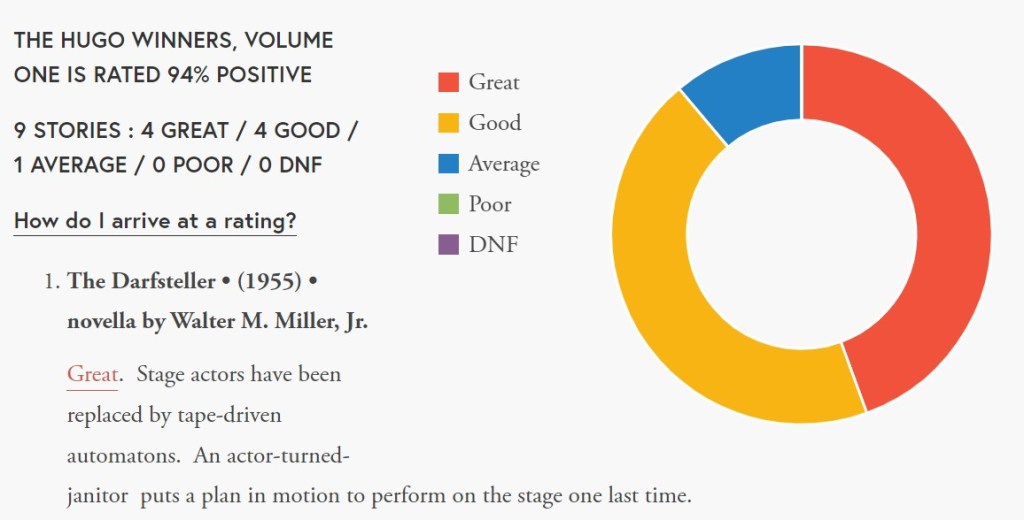
One of our members, Austin Beeman, has a useful website that reviews science fiction anthologies. He has a nifty infographic that measures the percentage of great/good/average/poor/DNF stories. Here’s his chart for The Hugo Winners: Volume One. Austin considers it has a 94% positive rating, but then that’s for a book of all award-winning stories. Austin tends to be generous by including stories he rates Good in that figure. I wouldn’t.
Most science fiction anthologies never get anywhere near that percentage of good and great stories. Why?
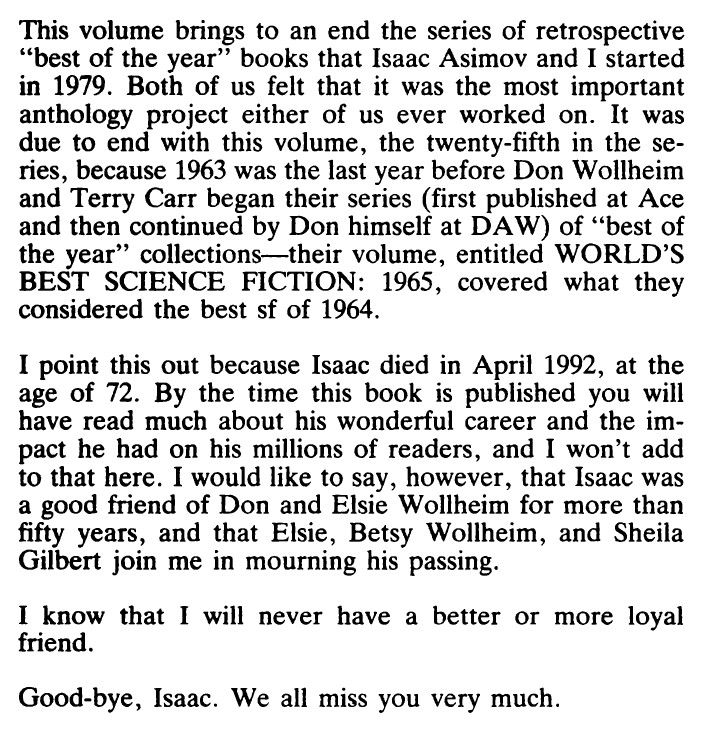
I just finished reading The Great SF Stories 25 (1963) edited by Isaac Asimov and Martin H. Greenberg. Even though I enjoyed most of the stories to varying degrees, I thought only 5 of the 13 were worth my time.
And isn’t time the essential yardstick here? I only have so much time for reading. I only have so many years left in life. And the number of books I want to read will take more time than I have left. From a different time perspective, many of these stories are supposed to be the best of one year, and often the anthologies I read are assumed to be the best of all time.
There is the problem that some stories are extremely time-worthy to some members of our group, while other members complain those same stories were a waste of their time. I’m realistic enough to know that no editor can ever satisfy every reader one hundred percent, but I believe there are stories that a good majority of readers will admire. Is it possible for editors to pick more of them?
I’ve known many people who say they don’t read science fiction magazines because they don’t find enough good stories in each issue. And I think that’s true. Magazines have the lowest hit rate. And now that most of the print magazines are bi-monthly, they are fat with stories, but instead of feeling I’m getting my money’s worth, it just makes me hesitant to start reading because I dread all the disappointing stories.
Many old-timers complain that the print magazines aren’t fairly represented at award time or in the best-of-the-year anthologies, but is that actually true? I tend to only read online stories when someone recommends a story, and that makes me avoid the filler stories. But also, if I was a writer, I think I’d prefer to have my stories online so they were easy to be read. I generally only read stories published online when they are anthologized by best-of-the-year volumes, so that makes me think online publishers have a higher hit rate. I don’t know if that’s true.
Original anthologies often do much better than magazines, probably because they pay more. You can tell their hit rate by how many of their stories get anthologized in the best-of-the-year volumes.
For the annual best-of-the-year volumes, our group has found that the success rate depends on the editor. But I also think size matters. Gardner Dozois’ giant yearly anthologies with over thirty stories often had more hits in them than his competitors with fewer pages. But his percentage of hits was probably lower.
To be honest, some of Dozois’ competitors mixed fantasy with science fiction, and for me, that automatically lowers the hit rate. Could the success rate of an anthology depend on the type of story?
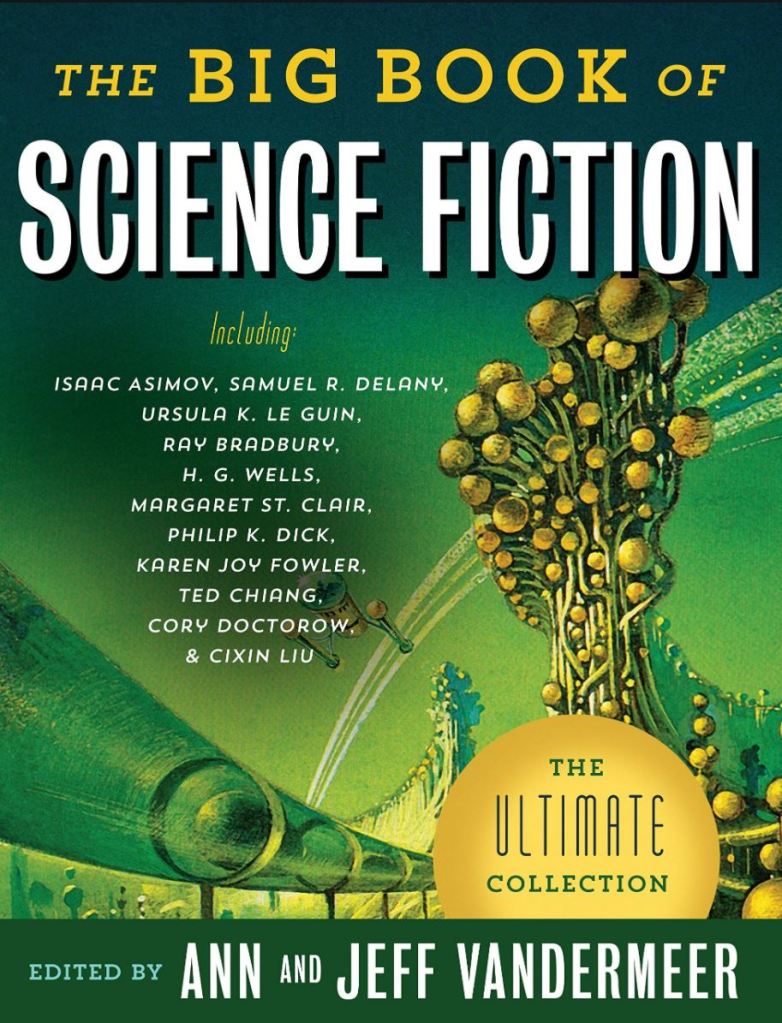
Our group is currently reading the gigantic anthology The Big Book of Science Fiction and it has many stories generally loved, as well as many stories generally disliked. We were considering four other giant 21st century SF anthologies that look back on the 20th century but I doubt we’ll vote to read them as a group. Some of our members have promised to read and review them on their own and let us all know.

Again, I think size is a factor. If these giant retrospective volumes had been smaller, they might have forced their editors to be pickier about what they anthologized. I have many giant science fiction anthologies on my shelves, and I’m becoming leery of reading them. I think somewhat smaller retrospective anthologies like The World Turned Upside Down edited by David Drake, Eric Flint, and Jim Baen, and Masterpieces edited by Orson Scott Card are much more solid with hits. I’m more likely to buy that size anthology in the future.
Theme anthologies are a bit different. I’m more forgiving. I still expect good stories, but I don’t expect great stories simply because I’m reading to be entertained by how an idea is used.
Giant anthologies are great for writers because more stories are preserved and given a chance to find readers. Yet, is such noble efforts fair to readers? Few readers want to be slush pile readers.
That suggests another possibility. I do think too many stories are being published each year, but what if it’s a theme distribution issue? Allan Kaster has switched from general best-of-the-year SF anthologies to best-of-the-year theme volumes. The Year’s Top Hard Science Fiction Stories and The Year’s Top Robot and AI Stories might be the solution. This opens up a whole new avenue for editors, and maybe readers.
I guess what I want is retrospective science fiction anthologies aimed at science fiction fans who came of age in the 1960s who don’t like fantasy and who are somewhat nostalgic for 1950s science fiction. However, I am willing to try new things. Rich Horton gave our group a list of stories he liked best among the two decades of stories he reviewed for Locus Magazine. I’d buy them as an anthology, even though many of them were fantasy stories. I don’t entirely live in the past, or focus exclusively on SF. And I hope our group finds more anthologies that cover contemporary SF/F to read. I just wished they weren’t too big and had mostly great stories.
The reality is no anthology is going to be perfect, except for the editor who assembled it. Subjective tastes vary. But as readers, I think we all love it when we can find an anthology that has a high percentage of stories that wow us. And I assume editors love it when they create an anthology that gets praise for having a lot of great stories. Perfect anthologies are impossible, but I think we all hope to find them.
James Wallace Harris, 1/21/22