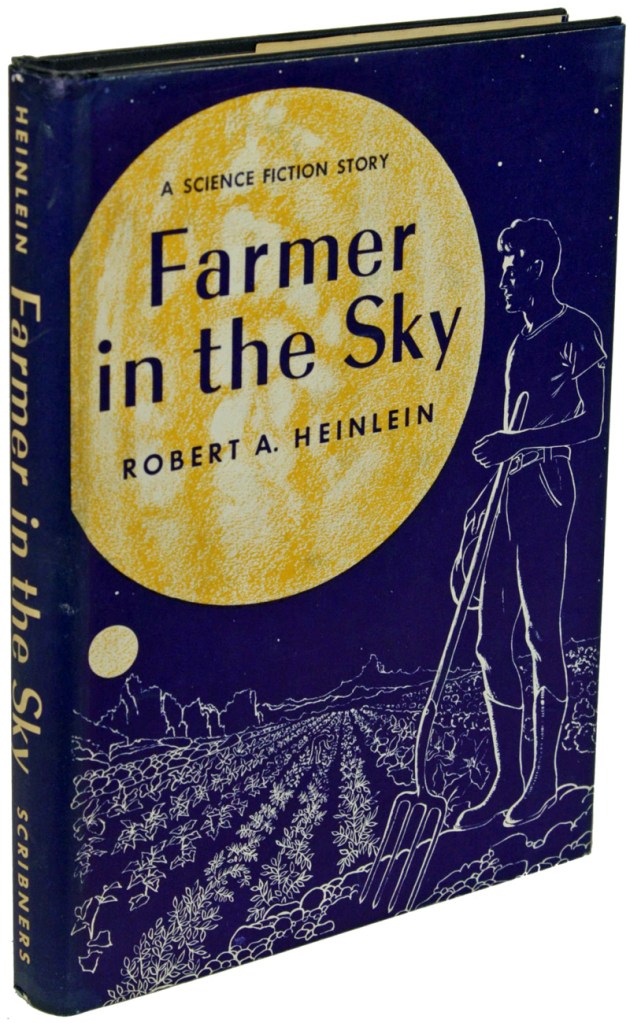
Robert A. Heinlein’s first young adult science fiction novel was published by Charles Scribner’s Sons in 1947. Heinlein imagined a realistic trip to the moon in Rocket Ship Galileo. For his 1948 novel, Space Cadet, Heinlein imagined a far more ambitious future, where humans had colonized Mars and Venus, and had explored all the way out to Pluto. In 1949, he focused on a Mars colony in his novel Red Planet. In 1950, Heinlein had humanity moving further out into the solar system, terraforming Ganymede, a moon of Jupiter, in Farmer in the Sky.
(For some reason, this title is out of print except for an audiobook edition. There isn’t even a Kindle edition. Does that imply it’s no longer popular?)
It’s worth reading the Wikipedia entry for terraforming. They claim Jack Williamson coined the term in 1942 for a story, “Collision Orbit,” published in Astounding Science-Fiction. However, they said the first scientific use of the concept was proposed in 1961 by Carl Sagan, who labeled the concept planetary engineering.
Heinlein uses Farmer in the Sky to significantly explore the idea of terraforming, way ahead of the science community. Of course, he’s turned out to be completely wrong about Ganymede, but then we didn’t know much about that moon in 1950. I don’t think any work of science fiction has dealt with terraforming again so head-on until The Mars Trilogy by Kim Stanley Robinson (1992-1996).
The novel begins on an overpopulated Earth. Bill Lermer and his father, George, decide to emigrate to Ganymede. Life on Earth isn’t bad, but food is carefully rationed. Bill is shocked when he discovers that George is marrying Molly at the last minute. One of the requirements of emigration is being part of a family. Molly has a daughter, Peggy.
When Bill’s new family arrives on Ganymede, they discover pioneering life is hard. The planet’s atmosphere has been undergoing a heating process for years. The air is barely breathable, and it’s cold. Peggy develops health problems because of the thin atmosphere and must stay in a pressurized room. Each new family is assigned land, but it’s just rock. To make it farmable, the rock must be crushed into powder, and then specifically cultured microorganisms, organic waste, and worms are added to convert that powder into soil.
A significant portion of the narrative is about farming. Heinlein emphasizes the hard work involved. He also dramatically illustrates the dangers of living in a geoengineered world. Like his later novel, Tunnel in the Sky, Heinlein puts the pioneer on a pedestal. One of Heinlein’s major themes has been the colonization of space. As a young teen in 1965, I embraced Heinlein’s science fiction stories as a personal philosophy. Heinlein made me believe in the final frontier like Baptists believe in heaven.
Today, millions want to colonize Mars, while others advocate colonizing Titan, a moon of Saturn. In 2025, I no longer see the point. Mars is colder than the pinnacle of Mt. Everest, and living on Titan would be like living in a flask of liquid nitrogen.
Heinlein’s books made horrible places sound appealing. Why? Heinlein transferred his love of the American Revolution and the American frontier to outer space. But it’s not the same. Elon Musk is spending billions to colonize Mars, and it might happen, but I’m not sure people will like Mars once they try to live there.
So, why did I love rereading Farmer in the Sky so much? It’s as realistic as John Carter living on Barsoom. And that might answer my question. Farmer in the Sky is a fun fantasy. But that’s not the answer either. Heinlein has a great deal of sentimentality in his juveniles. Heinlein is not a gripping plot writer. His stories are episodic. Nor is Heinlein a dramatic writer. His characters converse more than they conflict. Often they lecture. But Heinlein has a talent for creating likable characters and placing them into situations that evoke positive emotions.
I would say the Heinlein juveniles work on me in the same way old Frank Capra movies do. Capra was born in 1897, and Heinlein in 1907. They both expressed a sentimental love of America in their work, a kind that existed before World War II. I also see it in the stories of Ray Bradbury. Heinlein’s Ganymede is really Iowa in the 1920s.
I should have moved on from Heinlein after 1966. The world keeps changing, and I should have changed with it. Maybe after this rereading, I’ll move on. Or will I still be rereading these children’s stories in my nineties?
The future I dreamed of at 13 is much different from the one I find myself in at 73. If I had read realistic literary novels from 2025 in 1965, would I have been anxious to grow up and live in that reality? 2025 is more science-fictional than the science fiction I read back then.
James Wallace Harris, 9/27/25


I was born in 1948, when vision ruled. It was our vision that both launched rockets into space and killed Jim Crow here on earth. But somehow, the down-to-Earth practical types merged with the living-with-past-grievances types and decided their realistic pessimism was the road to twenty first century political power.
For the bulk of society, dreaming the impossible no longer inspired the possible. Dystopian visions ruled popular science fiction. Science Fiction is the harbinger of future attitudes.
The movie The Martian bucked the trend. It’s a modern version of the attitude that inspired Farmer in the Sky. Let us hope it inspires more to imagine the impossible and in doing so creates a world where every child dreams of bold adventure.
Thank you for reviewing classic Heinlein.
LikeLike