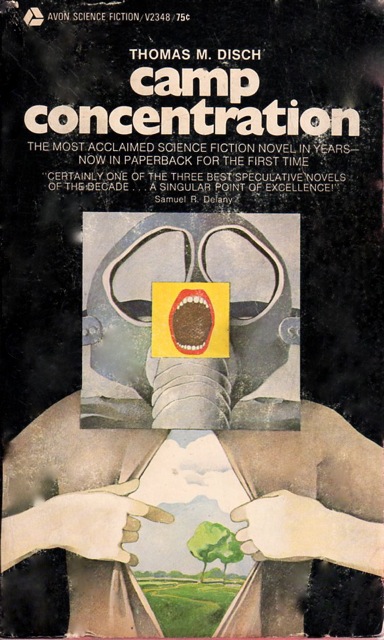
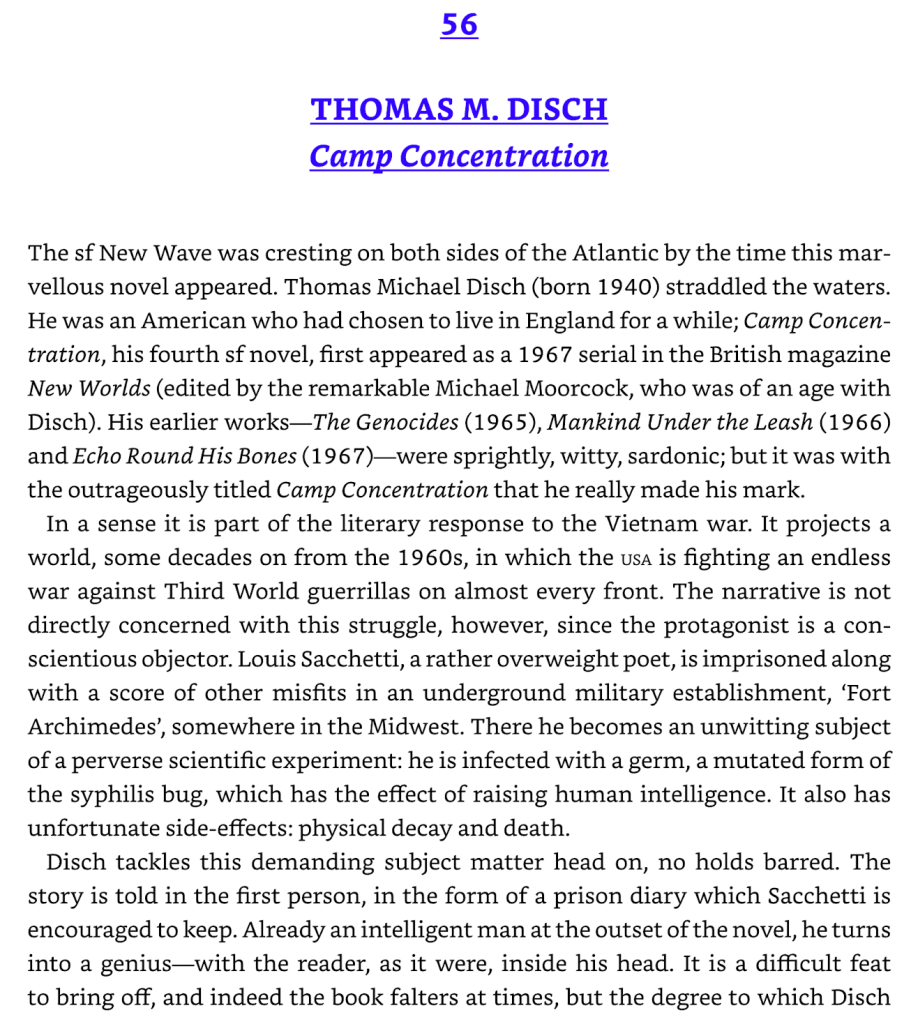
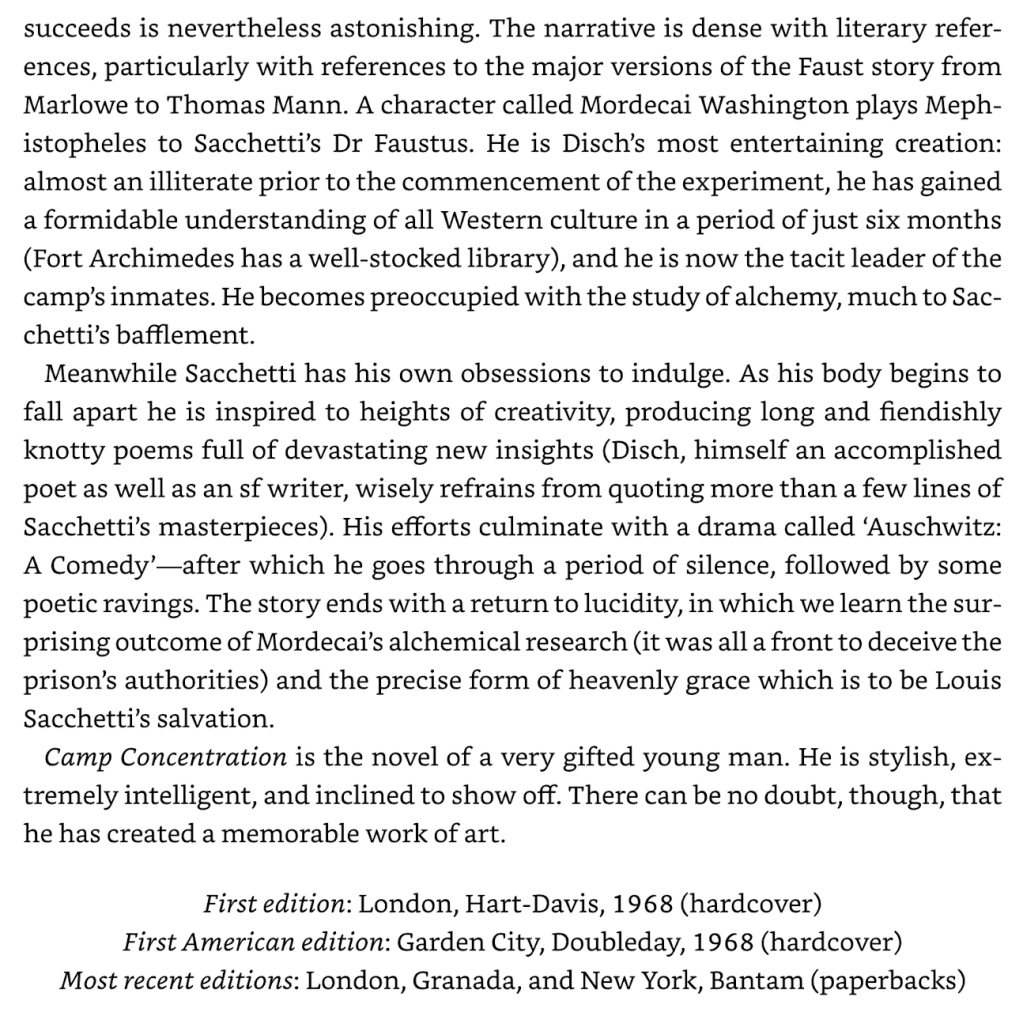
The first time I read Camp Concentration by Thomas M. Disch, I was around 20 and proud of myself for reading one of those New Wave science fiction novels I had been reading about in fanzines. It wasn’t much fun to read. It was overly intellectual – well beyond my level of comprehension. After reading thousands of other books over the last fifty-plus years, Camp Concentration made much more sense. I actually enjoyed the story. I enjoyed it a lot. But please, don’t buy a copy without carefully reading this review.
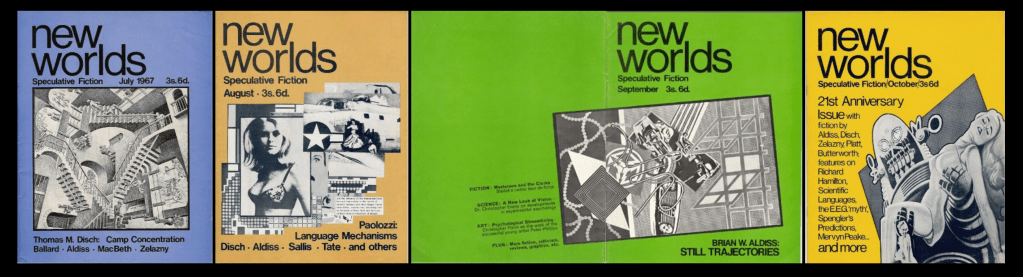
It’s important to know that Camp Concentration first appeared in the July, August, September, and October 1967 issues of New Worlds. It suggests it was written in 1966 or early 1967 and published first in England, in a magazine that promoted the New Wave. To fully appreciate this novel, you must remember when it was written and what happened in the United States in 1966 and 1967. The first hardback came out in England in 1968, and it wasn’t until 1969 when it was published in America. I didn’t read it until after the 1971 Avon paperback, cover shown above.
I’d love to hear an audiobook version of Camp Concentration. However, a highly skilled narrator would be needed to handle all the accents, poetry, foreign language quotes, and characterizations. It would also make a wonderful movie. Unfortunately, the audience for either the audiobook or film would be small.
Back in the 1970s Camp Concentration was greatly admired. Philip K. Dick loved the book so much he promoted to friends and suggested it be made into a movie to a producer interested in his own work. But there’s a bizarre story here. Dick, who was paranoid, started seeing things in Camp Concentration and wrote a letter to the FBI claiming it had secret intel. You can read that letter here. Eventually, Disch found out about this and didn’t take it kindly. Wikipedia describes what happened:
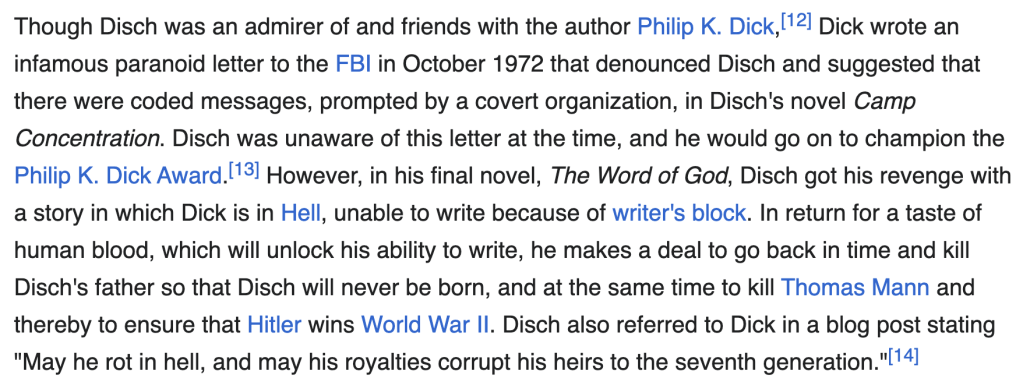
I mention this early in the review because it helps set up how strange Camp Concentration is as a novel. It’s quite readable, but it has so many references to literature, music, philosophy, poetry, etc., that you might feel it has some deeper message. Even though I just finished the novel, I’m already looking forward to rereading it again. However, before I can do that, I need to study first. At minimum I should read Christopher Marlowe’s play Doctor Faustus, and Thomas Mann’s novel Dr. Faustus. In fact, I need to go through Camp Concentration, make a list of all the works Disch mentions, and at least read their Wikipedia pages about them.
Louis Sacchetti is a conscientious objector, and Camp Concentration is the journal he writes while imprisoned in two locations. Disch wrote the novel while LBJ was president, and before Nixon. The story is set somewhat in the future, and Robert McNamara is President. McNamara was the Secretary of Defense under JFK and LBJ. McNamara played a major role in promoting the Vietnam War. To get the fullness of Camp Concentration, you need to read the Wikipedia link to McNamara. It also helps to see The Fog of War: Eleven Lessons from the Life of Robert S. McNamara, a 2003 Academy Award winning documentary.
Camp Concentration is a deeply cynical view of the United States in 1967. Louis is a war resister, at first imprisoned in an ordinary prison. He accepts that. But the novel is about when he is transferred to another prison, a military prison, where an experimental drug is used on the inmates by the U.S. Army. Most of the prisoners had committed crimes while in the Army, but Louis is a special civilian prisoner. The army believes it has synthesized a drug that will enhance intelligence. It was derived from a strain of syphilis.
The U.S. Army conducted experiments with LSD from 1955 to 1967. From 1932 to 1972, the U.S. government studied the effects of syphilis on black people after telling them they were being treated. These are just two examples of unethical experiments by our government. It’s not hard to believe the setup for Camp Concentration.
Camp Concentration reminds some readers of Flowers for Algernon because it’s about a treatment that makes people smarter. Over one hundred journal entries, we see Louis and the other prisoners change and become brilliant. I felt the characters did change, but my friend Mike, who got me to reread the novel, says he didn’t. Writers find it hard to describe humans with superintelligence. I’ve written about that recently. I thought Disch pulled it off, Mike didn’t.
Most of the novel is intellectual discussions about art, literature, poetry, theater, music, religion, philosophy, Alchemy, and other medieval beliefs. Mike thought all this discussion was boring, I was fascinated. I feel it helps to have a classical education to appreciate Camp Concentration. I don’t, but I’ve read enough to wish I had.
While reading Camp Concentration I was reminded of another book I read in the 1970s, Where the Wasteland Ends: Politics and Transcendence in Post Industrial Society by Theodore Roszak. I’m not saying the two books are about the same things, but as the characters evolve intellectually, they start sounding like Roszak.
Read Disch’s Wikipedia entry, you’ll see that Thomas M. Disch and Louis Sacchetti have much in common. Louis is a poet, and Disch wrote The Castle of Indolence: On Poetry, Poets, and Poetastes.
In the novel, the drug makes the test subject smarter, but it also kills them within months. As the characters grow more brilliant, they realize they have much more to live for and become bitter. Disch appears to equate higher IQ with depression and cynicism.
Disch does not suggest that superintelligence leads to super-powers. The test subjects only become more academic in their communication with each other. As they evolve mentally, their use of intellectual ideas to express themselves becomes more dense. This is subtle, and it may be hard to believe they are more intelligent. It seems that most of their references are to ideas covered in Classical studies or Medieval studies.
If you are prone to depression, I would not read this novel. If you are among the faithful, I would not read this novel. If you prefer tightly plotted stories, that are easy to read, and enjoy action, don’t buy this book.
On the other hand, if you’re into the history of science fiction, the New Wave, or the 1960s, Camp Concentration might be a good one to read. Science fiction changed in 1967-1968. I believe several young prodigies like Disch and Delany took the genre in new directions, and older writers like Silverberg, Brunner, and Ellison decided they were tired of where science fiction was going too.
Camp Concentration is available at Amazon.com (Kindle $5.99, Trade paper $15.00)
Reviews:
New Worlds (December 1968)
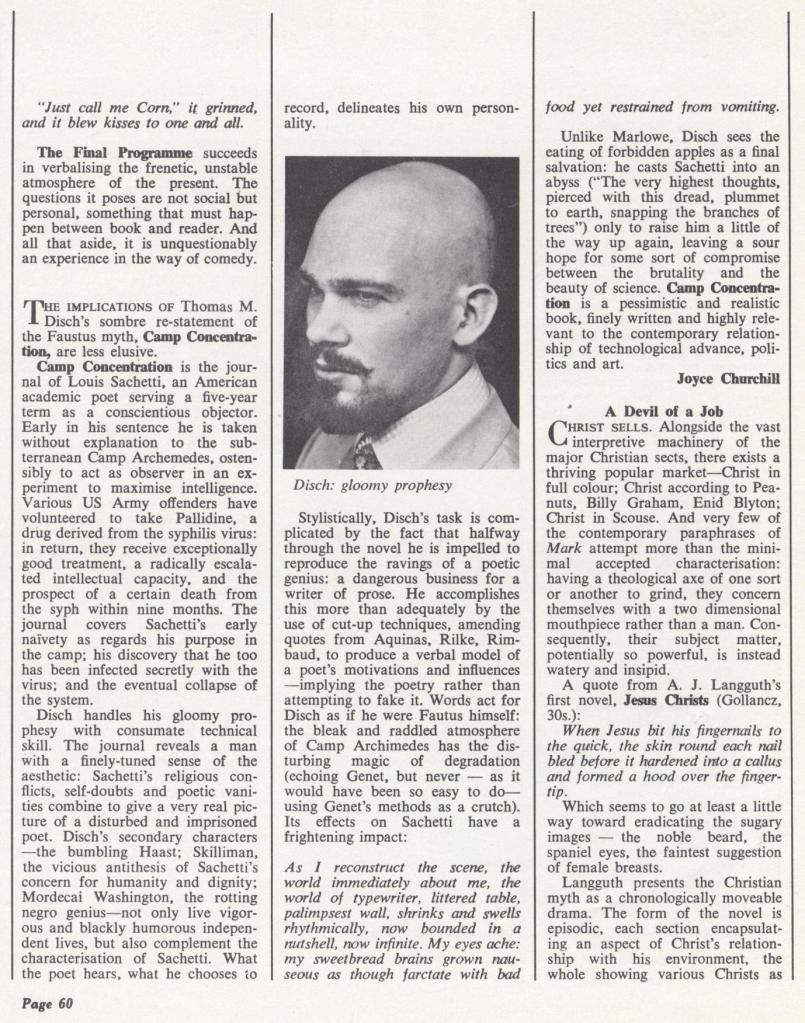
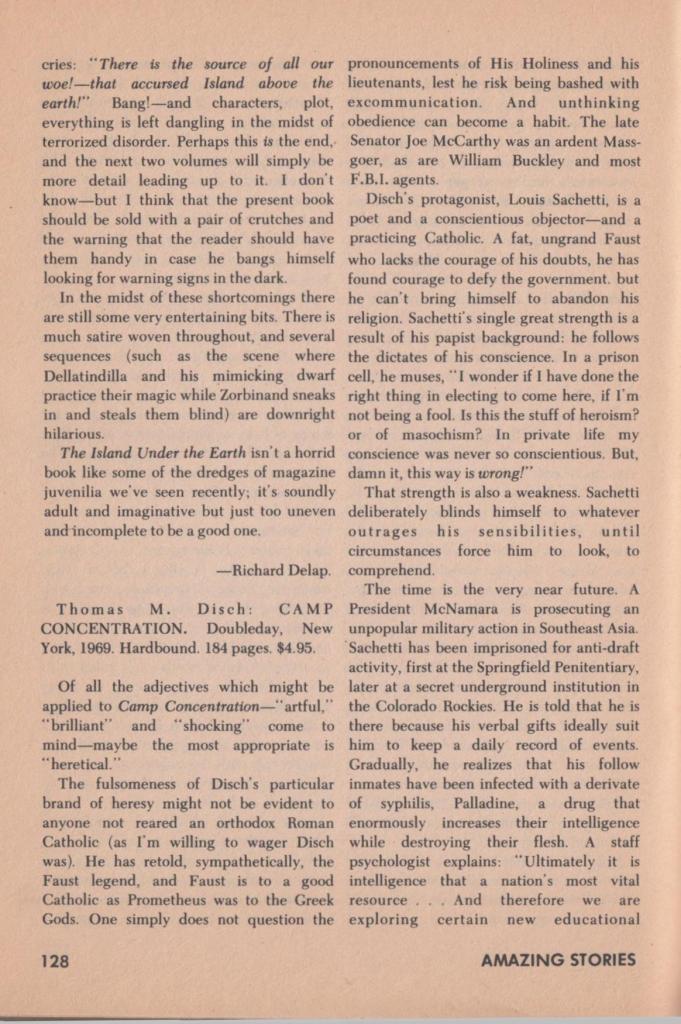
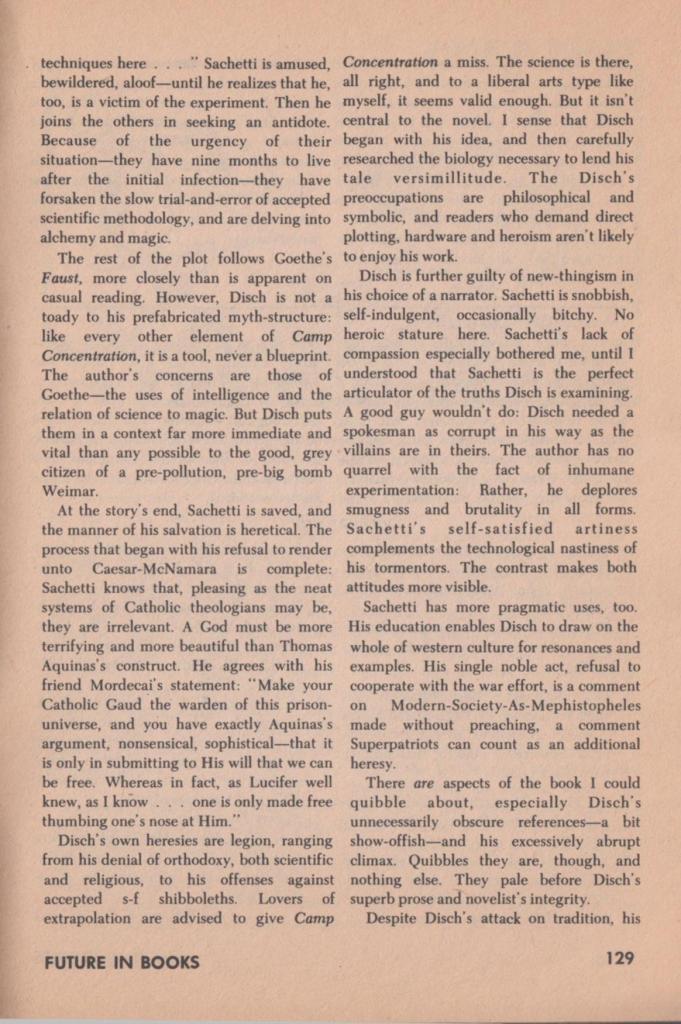
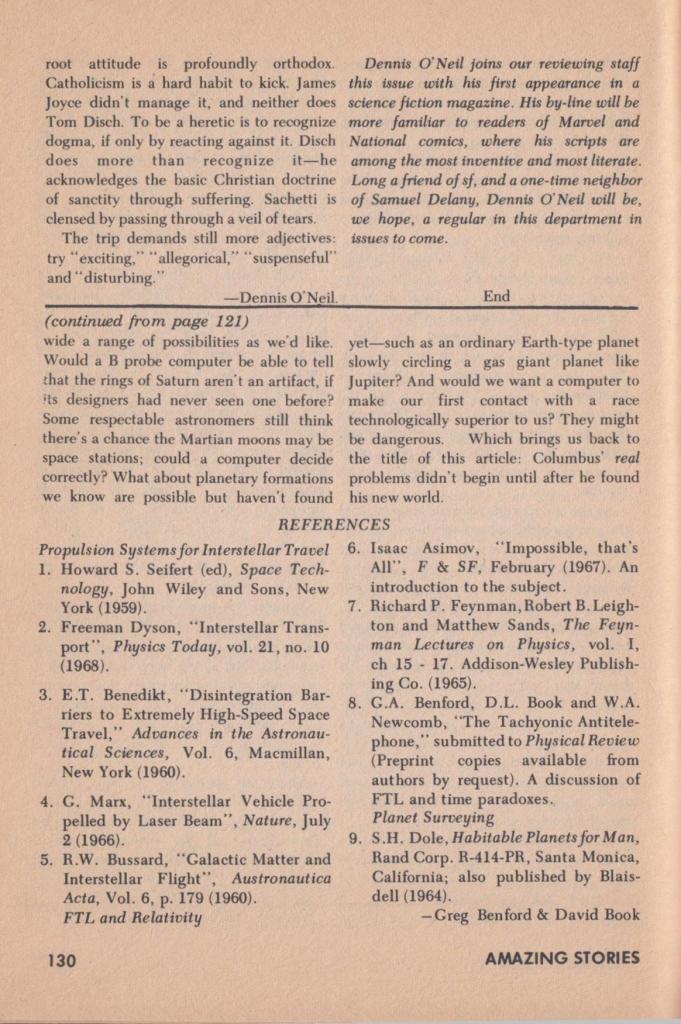
Amazing Stories (January 1970)
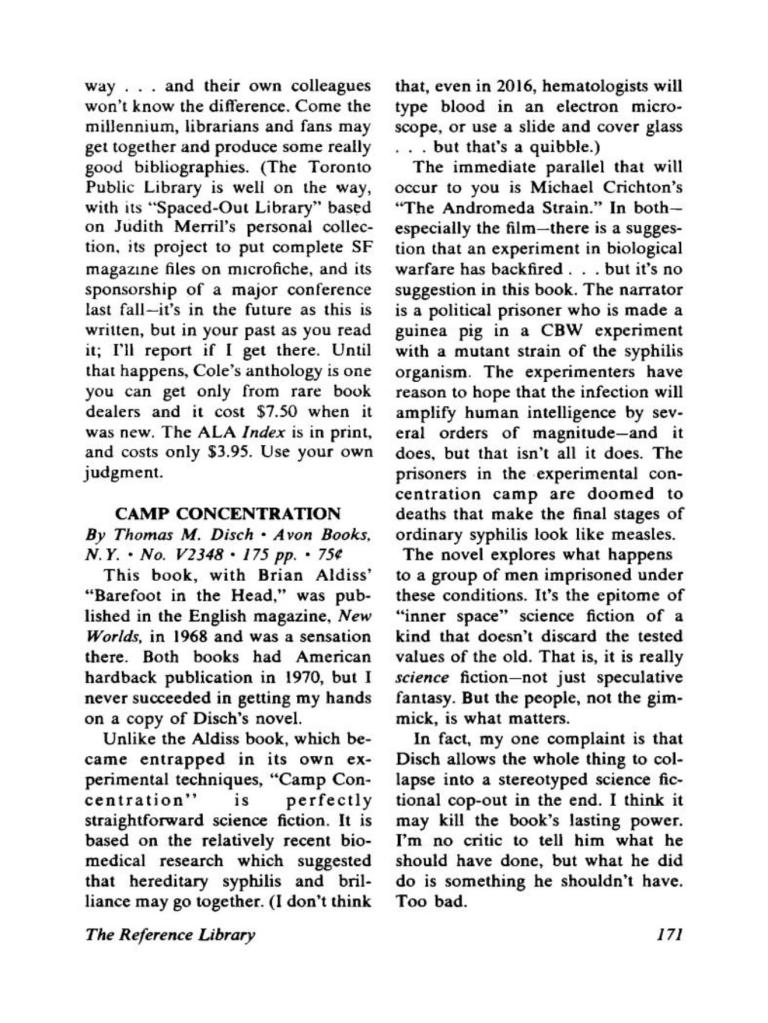
Analog (March 1972)
Science Fiction: The 100 Best Novels by David Pringle ($1.99 Kindle)
James Wallace Harris, 3/11/25
 Classics of Science Fiction
Here’s good run of annotations for Camp Concentration which ma help a reread:
http://www.errorbar.net/nits/Camp_Concentration
I was reading Warren Miller’s “Looking for the General” (1964) a fortnight ago and wondering whether it was an influence on the younger Disch and Sladek, but the only way to find out now would involve a ouija board.
LikeLike
Did you make these annotations? I wish I had the discipline to make such extensive notes. And what is that software? Some kind of personal wiki?
LikeLike
Thanks a lot Matthew for sharing these annotations. They are amazing and motivate me to reread this novel. I had the same experience as James, I read it when I was a teenager and it was not fun at all!
LikeLike
The annotations are by a chap called Eli Bishop.
My contribution to spreading the Word of Disch was this old-fashioned, all-encompassing attempt at a fan website of the kind that doesn’t seem to exist much any more (probably because micro-blogging platforms aren’t made for it, and website hosts want to preformat everything):
https://web.archive.org/web/20110510083630/http://www.ukjarry1.talktalk.net/tmd.htm
LikeLike