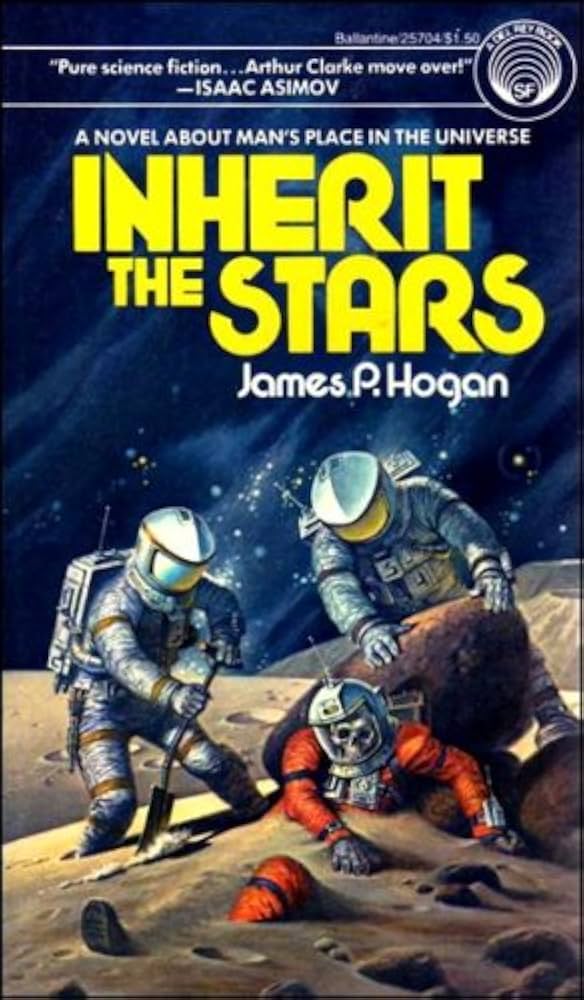
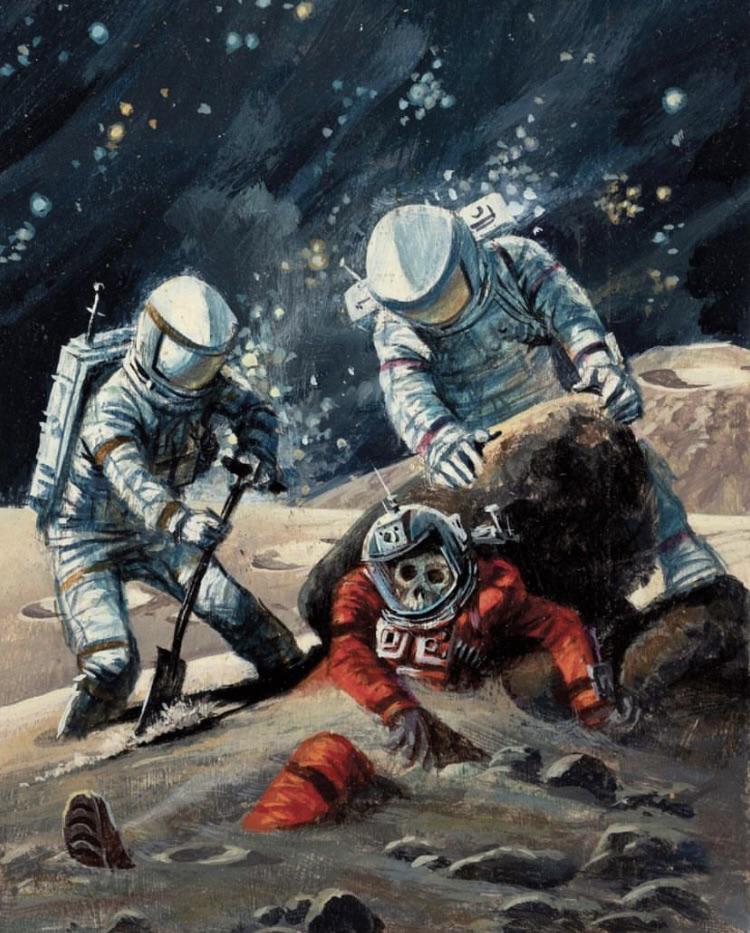
The original paperback, Inherit the Stars by British writer James P. Hogan (1941-2010), had a terrific cover – the kind that made you buy the book. The artwork appears to show astronauts on the Moon finding a dead astronaut, but that is deceptive. Hogan creates a scientific mystery because the dead astronaut has been there for 25,000 years.
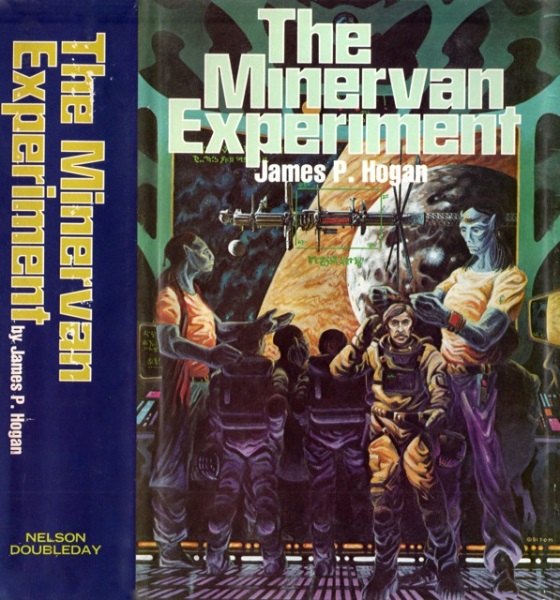
I first read Inherit the Stars in 1992 but after seeing Whitney’s review on YouTube, I wanted to reread the story. I went to Amazon but couldn’t find the book. Was it out of print? I did find it on Audible. Later, I discovered that Inherit the Stars and its sequel The Gentle Giants of Ganymede are now being sold together as The Two Moons for the Kindle. A bargain for $6.99, especially since Whitney also praised the second book. It turns out that there are five books in the series being sold as three Kindle editions. The series is called Giants. Only the first three novels are available on Audible. The Science Fiction Book Club once published the first three novels as The Mirnervan Experiment. Ballentine also published a paperback called The Giants Novels that contains all three.
Before anyone rushes out to buy Inherit the Stars, I need to describe it more, but not enough to give spoilers. Hogan’s story is the kind you want to figure out for yourself. It kept me guessing for the entire novel even though I had read it before. That worried me. Why wasn’t it more memorable? Was that an indication it was a bad book? I don’t think so. How the story is told isn’t very memorable, but the ideas are big-time fun. I did remember some of those, but not connected to the book.
Inherit the Stars is basically scientists talking about one mystery after another. There’s no real plot. A lot happens, but it’s not dramatic. With each discovery, there’s a new puzzle, which makes you think and try to guess what caused each mystery. Inherit the Stars is science fiction focused on ideas and not storytelling. I’ve told you the first mystery, but I don’t want to give away any others.
However, I will give you some fun clues. Inherit the Stars reminds me a lot of Rendezvous With Rama by Arthur C. Clarke. Hogan’s prose is similar to Clarke’s. At one point, the story reminded me of the classic short story “Omnilingual” by H. Beam Piper. The novel also triggered memories of Gateway by Frederik Pohl. At other times it reminded me of the Winston Science Fiction, a series of young adult SF that came out in the 1950s, especially the entries where the protagonists find relics of ancient alien technology. If you love alien archeology stories, you might like Inherit the Stars.
I call Inherit the Stars Pre-NASA Science Fiction, by which I usually mean science fiction written before Mariner 4 photographed Mars in July 1965. Until NASA started exploring the solar system with robotic probes, many people hoped that we would find life, even intelligent life somewhere on other planets in our solar system. For example, Heinlein’s Stranger in a Strange Land from 1961 imagines Mars being inhabited by a dying race. However, after Mariner 4, serious science fiction assumed we were alone in the solar system. (I must admit, that I still love Pre-NASA science fiction. Growing up in the 1950s and 1960s, I desperately wanted us to find Martians.)
I consider Hogan’s 1977 Inherit the Stars Pre-NASA Science Fiction because Hogan maintains the hope that we had neighbors. However, some readers might feel Hogan’s ideas might come across like those of Erich von Däniken, who wrote Chariot of the Gods? Another reviewer dismissed this book as unbelievable. Personally, I find Erich von Däniken’s theories to be insulting to humanity. But I consider Hogan’s speculation to be great science fictional fun.
James Wallace. Harris, 3/1/25
 Classics of Science Fiction
For many of us is the ultimate joy of exploring ideas and their consequences uninhibited by current limitations. It’s the ultimate brainstorming session where nothing is too crazy to consider…or to hope just might be true.
LikeLiked by 1 person
I read this novel not long ago. I love the premise (and the cover)–it’s one of the mind-blowing ideas I love in SF. However, although the story is well told, I found it disappointing. It lacks (for me) the poetic, even mystical, quality of Arthur C. Clarke’s writing. I found the lengthy expounding of the various theories and discoveries rather dry–an archaeological detective story.
My problem with Hogan’s writing may be indicated by his comments on the Clarke/Kubrick film 2001. He liked it until the final sequence, “Jupiter and Beyond the Infinite.” He felt that the film up to this point was a rigorous hard SF film, but during this sequence the film “collapsed into surrealism.” However, this sequence is by far my favourite part of the film (or any SF film).
LikeLike
I was hoping I conveyed that. The story is fun only for the ideas because it’s only scientists talking. That’s true of Clarke too. Both writers have no character development. Neither writer develops tension or plots.
Clarke does have a mystical streak but his writing isn’t mystical. He just adds mystical ideas. About his most poetic story is “The Nine Billion Names of God.” But that’s because of idea the ending. It’s not his prose.
Both writers are dry emotionally. But I agree with you that Clarke has a mystical streak. He also seems to be in psychic powers, at least in the idea that evolution is heading towards some kind of mind powered stage.
Modern readers aren’t fond of Heinlein nowadays but he was a great storyteller before 1960. He wasn’t good on plots. But he knew how to get readers to care for his characters. Clarke, Asimov, and Hogan lack that skill.
LikeLike
Nevertheless, even if Clarke doesn’t have three-dimensional characters, I don’t find his writing dry emotionally. His writing consists not just of ideas, but vivid images and visions. I find it evocative, even poetic.
LikeLiked by 1 person
I have that SFBC Minervan omnibus. The first book was so fun to read but each sequel got worse. And later Hogan went completely off the deep end. But wow, fond memories of the first one.
LikeLiked by 1 person
Hello, Mr Harris,
Thank you for your in-depth coverage of these gems (and sometimes stones) of classic science fiction. Husband and I are big science fiction fans from way back – how we met, actually. Anyway, we were having a discussion on things science fiction, and I had vague recollections of a short story, but couldn’t remember title or author. I was wondering if you’ve heard of it. These are the bits and bobs that I remember:
Part of a collection, maybe Isaac Asimov’s efforts Takes place on Earth, a bit in the future It centers around razor blade disposal, of all things There had been development of some type of portal that one could drop in the used blades and worry no more Until the portal started spewing out all the blades (over capacity of some kind) Those in the know tinkered with settings and the blade problem disappeared Meanwhile, on a distant planet, the last survivors of a dragon-like dying race were starving, resources all used up When suddenly, like manna from heaven, all the razor blades rained down Fortunately, the blade material was exactly what the doctor ordered and starvation was staved off … from shaved offs
The writing was okay and the plot a bit hokey. But it has been lodged in my neural net and won’t work free. Does this sound familiar?
Thank you for any effort you may expend.
Sincerely, Bob Pesavento
>
LikeLike
I vaguely remember the razor blade thing too. I posted your query on the Science Fiction Book Club on Facebook which has over 10,000 members. Maybe one of them will know. I’ll post an answer if I get one.
LikeLike