The Limits of Believability in Science Fiction

Skylark-Three

There are two kinds of believability in science fiction. The first is internal, does the story make sense in its own fictional reality? The second kind asks if the concepts in the story are believable in our reality? In this essay, I’m concerned with the second kind. I believe all science fiction readers have built-in bullshit detectors that vary in accuracy depending on the science they know. To complicate the problem, none of us know the real potential of science and technology.

Last year I started gorging on science fiction short stories. I’m reading stories from the last two hundred years, jumping around from decade to decade in no particular order. This is giving me a sense of what every generation feared and hoped for the future. What I discovered, and should have predicted but didn’t, is that every era has the same hopes and fears, they just apply their current science to their speculation. However, over time we accept the reality of what science teaches us while still wildly speculating about what science could still discover. It’s a form of neverending hope.

Those reading space operas today no longer expect futures where Dick Seaton hurls galaxies at his enemies, but they do believe our minds will be easily transferred between bodies (human, alien, artificial beings), virtual realities, machines, and spaceships. Every generation wants to go where no human has gone before, to escape the limits of mortality, and create what’s never been imagined.

When we’re young we’re willing to believe almost anything. However, the closer we get to knocking on heaven’s door the more we disbelieve. Aging means education and experience, lessons that define our boundaries of believability.

I’m almost finished reading The Very Best of the Best edited by Gardner Dozois that collects 38 science fiction short stories first published from 2002-2017. It’s giving me a great overview of what 21st-century writers think what might be possible in the future. The trouble is, I doubt most of what they dream will come true.

One of the most popular science fiction themes of our time is brain downloading. Essentially, it’s a psychological replacement for accepting Jesus and attaining everlasting life. Sure, getting downloaded into a robot, clone, or artificial body is as entertaining to read as magically getting turned into a dog or cat, but my bullshit detectors start clicking loudly when science fiction acts like Harry Potter.

Science fiction shouldn’t be let’s play make-believe. There’s a huge difference between what if and if this goes on. Just because we can imagine it doesn’t make it possible. In recent decades some science fiction writers have pulled away from faster-than-light travel. And time travel is a much less popular plot device in serious science fiction. Yet most science fiction readers and writers ache to zip around the galaxy at whatever magical warp factor makes the story work, or escape a plot conundrum with a bit of time travel.

I don’t know if it’s because I’m 67 or reading science fiction for sixty years, but I’m now craving bullshit free SF stories. I now consider most stories labeled science fiction to be fantasy. Some writers even claim that science fiction is merely a subgenre of fantasy. I believe, or want to believe, that real science fiction is separate from fantasy. That science fiction is a genuine cognitive tool for speculating about what might be possible.

Yesterday, The Guardian ran “‘It drives writers mad’: why are authors still sniffy about sci-fi?” by Sarah Ditum. It’s another report about how literary writers sneer at science fiction even when they use its storytelling techniques in their work. Every few years essays like this appear, and science fiction fans get in a snit. The reality is published science fiction is not a successful publishing category and ambitious writers don’t want to get pigeonholed into our genre. It’s perfectly understandable. However, the cognitive tool of writing science fiction is very successful, and literary writers want to use it from time to time. Ian McEwan has just published Machines Like Me that is obviously science fiction. He wants his science fictional speculation taken seriously, thus the reason why he’s avoiding being classified as a science fiction writer. It sounds like Catch-22, but then the Yossarian’s Catch-22 meant something real too.

What some science fiction fans don’t understand is the average person might have better SF bullshit detectors than we do. It’s somewhat analogous to religious true believers being angered by skeptics who reject their truth out of hand. Faith in anything tends to disable bullshit detectors.

What I’m saying is either my age or my study of science fiction has made me a skeptic in my faith in science fiction. In other words, I’m becoming the Bart D. Ehrman of my religion – science fiction – by studying its history.

James Wallace Harris, 4/19/19


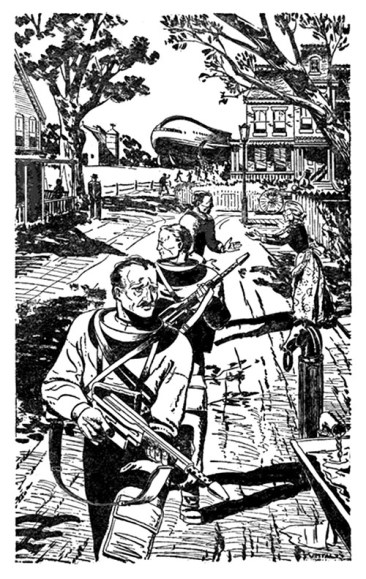
“Omnilingual” by H. Beam Piper

Omnilingual-web

The Science Fiction Book Club on Facebook is discussing “Omnilingual” by H. Beam Piper this week. I had never read this classic novelette before and enjoyed it immensely. It’s my kind of science fiction. “Omnilingual” was first published in the February 1957 issue of Astounding Science Fiction but has often been reprinted. You can read it online or listen to it here.

“Omnilingual” is what I now call Pre-NASA Science Fiction because it’s about anthropologists on Mars excavating the ruins of a Martian civilization that had died out 50,000 years ago. In the 1940s and 1950s, science fiction often assumed we weren’t the only intelligent beings in the solar system, usually imagining jungle civilizations on Venus, and cold desert civilizations on Mars. Of course, NASA space probes in the 1960s destroyed those assumptions. “Omnilingual” fits in nicely between Ray Bradbury’s Martian stories of the 1940s, and Roger Zelazny’s dazzling “A Rose for Ecclesiastes” from 1963. I’ve always felt Zelazny’s story was an ode to Pre-NASA Science Fiction.

“Omnilingual” is impressive for several reasons. First, the main character is female, and the explorers from Earth includes women scientists in their crew. That wasn’t common back then. Remember the all-male crew in the 1956 film Forbidden Planet? That how most science fiction imagined space exploration before Star Trek.

Piper presents the problems of translating unknown ancient Earth languages to give his science fiction story the feel of scientific authenticity. One of my favorite themes in science fiction is the archeology of dead alien civilizations. And, there’s one aspect to this story I can’t reveal because it would be a major spoiler, but I think Piper makes an original observation about how to translate dead alien languages without a Rosetta Stone. I’d really like to know if Piper’s idea was original with him.

Every science fiction story that explores ideas about alien civilizations speculates how other intelligent beings would be like us and could be different. Piper assumes the Martians were a whole lot like us. Would that be true? For example, the researchers find what they think is a scientific journal. Is a periodical that publishes scientific research a logical feature for any advanced civilization? I’m not sure if that’s true, but it’s hard to imagine how scientific knowledge could be collected, stored, and transmitted in another way.

It’s really sad that Mars and Venus didn’t have intelligent life on them. Can you imagine what our world would be like if they did? Not science fiction imagining, but really what it would be like? Picture modern television with the extra diversity of Martians and Venusians. I think the popularity of Star Wars shows there’s a deep desire for living in a reality filled with many intelligent life forms and robots. We don’t want to be alone. This could also explain why many SF fans prefer classic mid-century science fiction stories.

I believe Piper’s goal in writing this story was to present his idea for finding a Rosetta Stone for translating alien languages. “Omnilingual” was written just before modern SETI began with the 1959 paper by Philip Morrison and Giuseppe Cocconi suggested frequencies for listening to alien signals and Frank Drake’s 1960 Project Ozma. I feel Piper had been reading histories of the pioneers who translating Earth’s dead languages and got the inspiration to think about dead alien languages. He also threw in some observations about rivalries between scientists and their academic ambitions.

Omnilingual-illo-1

Ultimately, the appeal of “Omnilingual” today is for modern science fiction readers to find nostalgic solace in a disappearing era of science fiction. That desire is reflected in two recent anthologies edited by George R. R. Martin and Gardner Dozois, Old Mars and Old Venus.

When I was a kid I would have given anything to grow up and been a part of the scientific crew in “Omnilingual.” I guess its a kind of psychological ailment I suffer as an older person wishing I had lived an alternate life history.

JWH


Decoding Short Stories

the-misses-vickers-crop

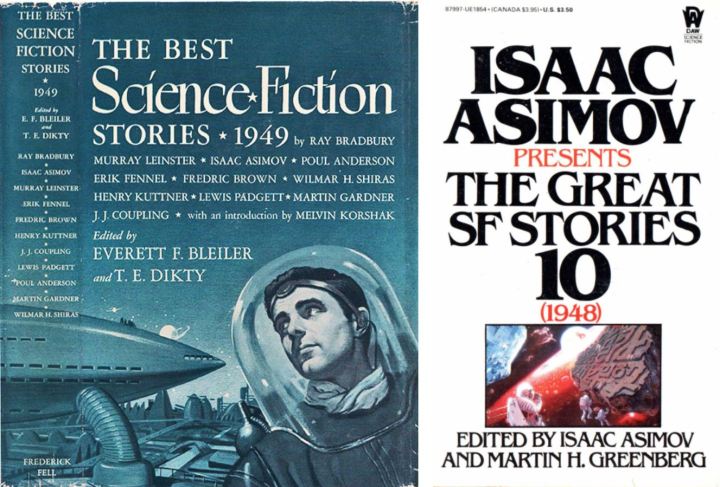
I read mainly science fiction short stories, but my theories about decoding short stories apply to any genre. Lately, I have been reading science fiction from a number of time periods. I’m systematically reviewing the stories in The Very Best of the Best edited by Gardner Dozois which covers stories 2002-2017. I’m also reading The Great SF Stories 9 (1947) edited by Asimov and Greenberg. I’ve started reading Science Fiction Rivals of H. G. Wells edited by Alan K. Russell that covers SF in the 1890s. I just bought Best SF: 1968 edited by Harry Harrison and Brian W. Aldiss because I want to study the science fiction of 1967.

Concurrently to reading science fiction, I’ve started reading short stories by D. H. Lawrence from the early 20th-century and bought an audiobook anthology of classic literary short stories that cover a century in scope. Because of all this short story reading, I’m beginning to notice patterns. I imagine whenever someone sits down to write a short story they have a goal in telling their story. The subtle variations of each are endless, but I think I see a taxonomy of writing targets. Many short stories begin with vague goals and then fill in with increasing details. Some of the target outlines include:

  • Biography
  • Autobiography
  • Fictional realism
  • Retelling/Reporting
  • Travelogue
  • Humor
  • History
  • Mystery
  • Fantasy
  • Science Fiction

Literary writers are like realistic painters. They want to capture all the details of their subjects, whether they are writing about themselves or people they know. Marcel Proust and Jack Kerouac wrote thinly disguised stories based on their own experiences (autobiography). Hemingway and Fitzgerald liked to observe the people around them (biography). If you read any annual edition of The Best American Short Stories, the most intense stories often feel like they are based on real-life events (fictional realism) but aren’t. MFA programs teach their students the writing skills to pull this off. Finally, some literary writers love to find a great true story and turn it into fiction (retelling/reporting).

Inbetween literary writers and genre writers are humor and travel writers. Sometimes their stories are based on the truth, but often they stretch it. There’s a difference between nonfiction humor and travel writers and the fictionalized kind, although if you could read the minds of writers of the nonfiction kind you’d find they often fudged the truth with a bit of fictionalizing.

Genre writers nearly always open Microsoft Word and begin their story purely from their imaginations. For example, I just read “The Tale of the Three Beautiful Raptor Sisters, and the Prince Who Was Made of Meat” by Brooke Bolander, one of the stories nominated for a Hugo award this year. Nothing in her story has ever existed in reality, it all came from Bolander’s ability to make stuff up. Bolander begins:

Once upon a time, long, long, long, long, long, long, ago, there were three raptor sisters, hatched beneath a lucky star. They lived in a wood together, they stole sheep and cattle together, and all in all, there was no tighter-knit hunting pride of matriarchal dromaeosauridae between the mountains and the sea.

Fantasy writers are bound by their Guild to create fantastic beasts. Using raptors was fun and clever. Melding a medieval fairytale about a Prince and Princess with Jurassic Park nasties is one of the reasons Bolander is up for an award, but not the only reason. Recasting Prince Charming as a doofus, creating an anti-princess Princess, while poking fun at traditional little girl fantasies, are some of the others.

My point in referencing Bollander’s story is to show the challenge of writing a fantasy short story. There’s no need for biographical or autobiographical characters, and the use of history barely exists and what is used is completely distorted.

When John Singer Sargent painted “The Misses Vickers” above he was creating a visual biography of Florence, Mabel, and Clara Vickers. When we read Henry James or Edith Wharton, we feel they are painting with words to capture 19th-century people they knew. Genre writers can base their characters, settings, and times on real people, places, and events, but they usually don’t. However, they can create characters, settings and times that feel like they were real or could be real. The reason why Game of Thrones and Harry Potter stories are so popular is they feel real.

When I read Thomas Hardy or D. H. Lawrence I feel they’re accurately describing village life in England. I expect their characters could be based on real people, and the scenes they describe could be real places. I don’t expect that from genre writers.

But here’s the thing, great writing is the accumulation of significant details. Writers can crib those details from reality, or they can make them up. It’s my theory that the best science fiction has a feeling of realness, such as Timescape by Gregory Benford, or Earth Abides by George R. Stewart, or Station Eleven Emily St. John Mandel.

On the other hand, the best fantasy is realistically painted with imagined details, like Tolkien or Rowling. There is an uncanny valley effect in fantasy too, like in computer animation. A fantasy that feels somewhat real, but not quite, is disturbing. Think of all those cheap fantasy films that feel campy today. Then think about why you love Game of Thrones on HBO.

When you read a short story you’re decoding both the writer’s goal and their coding. To fairly judge a story requires decoding that goal while reading the story. Sadly, all too often it’s to crank out 7,500 words to sell at 10 cents a word. Too many writers use seat-of-their-pants plotting and grab details out of the air as fast as they type. The end product of a work of realism or imagination should still feel realistic even if the physics of the genre world is much different from ours.

I believe when a writer sits down to write a short story they have a goal in mind. As readers, we need to decipher that goal to properly appreciate the story. To judge a story we need to decide if the goal is both worthy and met. I have a problem with reading some genres, such as fantasy stories, because it’s just not my thing. However, I should not judge those genres by my tastes but by figuring out the target of the story and deciding if it was hit.

When I read fantasy stories I often feel like I went to a rock concert and classical music was played. Sometimes the classical music wins me over, and sometimes it doesn’t. I feel the world of science fiction is being replaced by fantasy, even the stories with spaceships and robots. It’s a challenge for me to read modern SF/F because of my personal interests, but I’m trying to judge these works by their own goals. I’m using this site to explore the art and nature of short stories. I was going to ignore all fantasy fiction, but that’s becoming very hard to do.

My goal is to get away from judging fiction by my personal tastes and instead work to understand how a story works by decoding its own goal.

lawrence alma-tadema

JWH


“A Witch’s Guide to Escape: A Practical Compendium of Portal Fantasies” by Alix E. Harrow

the-witches-ride-mary-evans-picture-library

There are only two ways to escape this reality – death or fantasy.

Back in the 1950s, some librarians tried to discourage the reading of Oz books claiming they gave unrealistic expectations about life. They were absolutely right. But by the end of the 1960s, it was obvious that fantasy books and witches had won. In 1969 the Ballantine Adult Fantasy series began appearing, which turned out to be a tsunami warning of the overwhelming wave of fantasy books to come.

Alix Harrow’s “A Witch’s Guide to Escape: A Practical Compendium of Portal Fantasies” is a lovely story about the magic of libraries and books. It just won the Best Short Story category for the 2019 Hugo awards. I hadn’t read any of the fiction in the fiction categories this year until I read “A Witch’s Guide to Escape.” It made me cry. I think it should win awards. It’s a fantasy about fantasy stories, and I don’t even like fantasy stories, except when I love them. I’m a straight-ahead science fiction guy, but sometimes fantasies tales get to me, and this one did.

I’m not going to spoil this story by describing it, just follow the linked title above and read it. If you are like me, and shot up fiction as your drug of choice growing up, then this story will sting you in the eyes, clog up your sinuses and constrict your throat, but in a way that you’ll love.

I could go on and write 100,000 words about the siren calls of fantasy, but I don’t know if this is the proper time and place. But someday we should sit down and talk about our addiction. Go read the story and then leave a “My name is Bill” testimonial in the comments.

Harris-as-a-kid

JWH


“The Purple Death” by W. L. Alden

The Purple Death by W. L. Alden

“The Purple Death” by W. L. Auden first appeared in the January 1895 issue of Cassell’s Family Magazine. I read it in my copy of Science Fiction by the Rivals of H. G. Wells edited by Alan K. Russell, but I also own The Wordsworth Collection of Science Fiction edited by David Stuart Davies, the other anthology that ISFDB.org says contains the story. However, it is also available to read online.

In the last decade, I’ve come to admire science fiction from the 19th-century and collected a number of anthologies that mine that era for early tales of sense-of-wonder. I dip into these volumes now and then, often to discover ideas I thought original to the golden age of pulp SF magazines of the 1930s and 1940s. It makes me wonder if anthologists shouldn’t scout the 18th-century for even earlier examples of common science fiction themes.

“The Purple Death” is a quiet story about an Englishman vacationing in Italy who meets Professor Schwartz, a mad scientist from Germany living the cottage next door. Schwartz wants to help the poor and downtrodden by reducing their numbers. He believes overpopulation is the source of the planet’s problems. His has a solution, one we’d call terrorism today. In fact, the description of his bioweapons of mass destruction and how he would deploy them sounds exactly like possibilities we regularly hear on the nightly news.

Wikipedia has little to say about Alden, other than he was Consul General in Rome, Italy from 1885-1890, appointed by Grover Cleveland. He brought the sport of canoeing to the United States and was the founding member of the American Canoe Association. That I thought strange since I assumed native Americans invented the canoe.

The Encyclopedia of Science Fiction is a bit more revealing, with a concise rundown of his other SF/F tales. Their themes support my idea that many of the famous science fictional ideas of the 20th-century had earlier versions in the 19th. To quote SFE:

Alden's sf and fantasy seems to date only from around 1890 or so, his first title of genuine genre interest seeming to be A Lost Soul: Being the Confession and Defence of Charles Lindsay (1892), narrated by a physician who re-animates the frozen body of an Italian countess (see Sleeper Awakes), only to find that she has retained the amoral ways (see Sex) that caused her husband to immolate her in the first place. Most of the stories in Among the Freaks (coll of linked stories 1896) are tall tales, narrated by the owner of a freak show (but see Monsters); The Mystery of Elias G Roebuck and Other Stories (coll 1896) includes several fantasies and sf tales, including an interesting Apes as Human tale, "A Darwinian Schooner" (August 1893 Pall Mall Magazine) and several tales involving Inventions, a topic more intensely (and humorously) deployed in the stories assembled as Van Wagener's Ways (coll of linked stories 1898), in which the eponymous professor's inventions, all of which go wrong but which are not hoaxes, end with his death in something like a nuclear explosion. Drewitt's Dream (1902) is partially set on an Island Utopia. Alden was prolific and fluent, and further exploration of his works may uncover more material of interest.

I think I’d like to give A Lost Soul (1892) a try. In his bibliography, SFE also mentions A New Robinson Crusoe (1888), which also intrigues me.

By the way, I highly recommend Science Fiction Rivals of H. G. Wells if you can find a copy. They are getting expensive on the used market. I only snagged a copy of one without its dust jacket, so in some ways, I hate to make this recommendation, because I’d still like to find a cheap copy in its wrapper. However, it’s a cool volume, reprinting Victorian era SF from the magazines and including their original illustrations. It’s a shame there is no ebook or audiobook edition.

James Wallace Harris, April 2, 2019


“Utriusque Cosmi” by Robert Charles Wilson

Utriusque-Cosmi

“Utriusque Cosmi” by Robert Charles Wilson was first published in The New Space Opera 2 edited by Gardner Dozois and Jonathan Strahan in 2009. It’s been reprinted a number of times, including Clarkesworld where you can read and listened to it online. It is the 12th story I’ve reviewed from The Very Best of the Best edited by Gardner Dozois.

Utriusque Cosmi was a two-volume work by Robert Fludd published in 1617 and 1621. You can see a facsimile copy of this book at Archive.org. It is a work of occult philosophy.

“Utriusque Cosmi” by Robert Charles Wilson is a teleological science fiction story, or maybe a fantasy claiming a different intelligent designer other than God. Robert Charles Wilson thinks big when he writes science fiction, like his story Spin, a 2005 novel which won the Hugo award.

To say “Utriusque Cosmi” is epic in scope is an epic understatement. The story starts out simple, with a woman named Carlotta going back in time to haunt her sixteen-year-old self. I won’t tell you where it ends up. Let’s just say this is one of the most unique ghost stories ever written with a science fictional explanation that would impress Olaf Stapledon.

My goal of slowly reviewing the 38 stories in The Very Best of the Best is not to critique the stories, but to use them to contemplate the nature of science fiction. “Utriusque Cosmi” is a mixture of literary and science fictional writing. Young Carlotta’s narrative if separated from the science fiction feels like something I’d read in the annual Best American Short Stories. In fact, it could have been written as a traditional ghost story inside any other theological view of reality.

What Wilson has done is come up with a teleological argument using a science fictional intelligent design. That’s both clever and somewhat psychoanalytically revealing of our genre. Both theists and Sci-Fi fans want reality to be different from what it actually is. That’s why I often consider science fiction to be a substitute for religion. Science fiction keeps dreaming of ways to give humans everlasting life in heaven. Science fiction writers have just come up with far more complex explanations of how this might happen. Religion is really a belief in magical incantations. God creates with the power of the Word – but then so do science fiction writers. SF readers just believe that science and technology will one day make their words come true.

“Utriusque Cosmi” is a lovely story of faith.

JWH

Before there was Instagram, Twitter, and Facebook, before there was Blogs, Forums, and Listserv, there was the Fanzine!

The Science Fiction Fanzine Reader

I’m not sure people who grew up after the internet can comprehend living before the computer era. They are used to instant communication with anyone around the world. They are used to finding their peeps in a Facebook group just by typing in a search phrase or battling tempests in a teacup with digital acquaintances they’ve never met on Twitter. The internet lets everyone easily locate like-minded members of their subculture or the foes of their philosophy. Anyone can have a world-wide distribution of their writing. But in the days before networked computers, most people only knew other people from meeting face-to-face. Writing letters were about the extent of distant communication, and generally, they were to Mom and Dad when you were at camp.

However, Amazing Stories in the 1920s inspired science fiction fans to communicate with other unmet fans through the letter columns, which led them to invent their own magazines, the fanzine. That allowed SF fans to express themselves and find other fans to share and argue over the mighty topic of science fiction. Instead of HTML, they used letterpresses, ditto machines, and the mighty Gestetner mimeograph to publish text and graphics.

Luis Ortiz has just come out with a new anthology of fanzine essays and artwork called The Science Fiction Fanzine Reader: Focal Points 1930-1960. He ties 400 pages of reprints with commentary and history. Sure this is a big book about a tiny subculture. Only 200 people attended the first Worldcon in New York City in 1939. Most science fiction fans lived in isolation, hungry for contact with their fellow fen.

In my recent essay about Hugo award-winning fanzines, I provided links to sites where you can read these classic zines. What Ortiz has done is give those archives a coherent overview and history. I don’t think many people will be buying this $30 book. The old science fiction fandom is dying out. It’s been completely overshadowed by social media. But I want to let those who remember to know that it exists. And maybe let those who don’t remember a chance to see how the ideology of science fiction was spread before the world knew the term science fiction.

I joined Spectator Amateur Press Society (SAPS) in 1971 and my cousin-in-law let me use his church’s Gestetner to run off my first zine called The Blue Bomber (named after my car). SAPS was an amateur press association (APA) where I shared my zine with 36 other people around the world. In 1974, Greg Bridges and Dennis McHaney and I purchased a Gestetner together. I helped Greg publish a genzine called Diversity for our local science fiction club, but we traded it for other zines in other states, and I think England, Canada, and Australia. Dennis published a zine devoted to Robert E. Howard. I used our mimeograph for publishing my SAPS and SFPA zines.

Communicating with distant people I’ve never met in the 1970s via zines prepared me for the BBS boom in the 1980s. I joined Prodigy, AOL, Genie. I had a 2-line BBS system to discuss science fiction. When I got access to the internet in 1987 I contacted other SF fans via email, forums, mailing lists, and USENET. I created the first version of The Classics of Science Fiction for a fanzine Lan’s Lantern. I reprinted it on a gopher server in the early 1990s, and right after the web was created I set up the first web version. This site is version 4.

I feel all of this communicating across the planet was a natural progression from publishing my first fanzine.

James Wallace Harris, March 27, 2019


“The Illustrated Biography of Lord Grimm” by Daryl Gregory

Unpossible and Other Stories by Daryl Gregory

“The Illustrated Biography of Lord Grimm” by Daryl Gregory is the 11th story in The Very Best of the Best edited by Gardner Dozois. It originally appeared in Eclipse 2 but has been reprinted a number of times. You can read or listen to it online at Clarkesworld. Daryl Gregory has published seven novels, numerous short stories, and a handful of comic books/graphic novels. I believe this is the first story I’ve read by Gregory.

The setup of “The Illustrated Biography of Lord Grimm” is quite simple – a small country is attacked by a much larger country. Gregory said he was inspired by the U.S. attacking Iraq. Now picture the United States invading a small country not with stealth fighters but with superheroes. The story opens:

The 22nd Invasion of Trovenia began with a streak of scarlet against a gray sky fast as the flick of a paintbrush. The red blur zipped across the length of the island, moving west to east, and shot out to sea. The sonic boom a moment later scattered the birds that wheeled above the fish processing plant and sent them squealing and plummeting.

Elena said, “Was that—it was, wasn’t it?”

“You’ve never seen a U-Man, Elena?” Jürgo said.

“Not in person.” At nineteen, Elena Pendareva was the youngest of the crew by at least two decades, and the only female. She and the other five members of the heavy plate welding unit were perched 110 meters in the air, taking their lunch upon the great steel shoulder of the Slaybot Prime. The giant robot, latest in a long series of ultimate weapons, was unfinished, its unpainted skin speckled with bird shit, its chest turrets empty, the open dome of its head covered only by a tarp.

Elena is our point-of-view character from which we see her city destroyed and watch citizens struggles to survive the aftermath. It’s a clever anti-war story that makes me feel for these imaginary foreign people. Trovenia is characterized like a cold war era eastern bloc country. Its citizens parrot the standard propaganda against America yet distrust their own leaders. America uses its superhero power advantage to bully smaller nations, while Trovenia’s leader, Lord Grimm, brags of having equal superpowers to fight back.

This story is not my kind of story because I’m bored to blazes with superheroes and their superpowers, but I imagine fans who love the DC/Marvel universes will be entertained.

Science fiction and fantasy writers face a constant challenge of competing with the successes of movie franchises that make billions dominating the pop culture landscape. Our society has reached the science fiction saturation point decades ago, so it’s hard to come up with anything new that will dissolve into our Pop Culture Kool-Aid.

I feel sorry for struggling young writers. I’d like to think this story is also Gregory’s way of responding to superhero oppression. Even though “The Illustrated Biography of Lord Grimm” isn’t my kind of story, I still found it enjoyable, and maybe I did so because the superheroes are portrayed like V-1 and V-2 bombs rocketing over London during WWII – powerful caped menaces streaking across the skies terrifying ordinary people.

There are whole armies of talented writers out there hoping to get noticed. Their only weapon is typing out words, but those black pixels on white backlights must compete with 3D Imax blockbusters. Even though I have some problems with the stories in Love, Death + Robots, I’m still excited to see science fiction writers getting their short stories produced for the HDTV screen. “The Illustrated Biography of Lord Grimm” could make a visually stylish short film.

And that might be another reason why Gregory features superheroes in his story – he imagined it being filmed as he wrote it.

James Wallace Harris, March 26, 2019 (Happy Anniversary Susan)


“Finisterra” by David Moles

Cory and Catska Ench Finnisterra

“Finisterra” by David Moles was first published in the December 2007 issue of The Magazine of Fantasy and Science Fiction. It has been reprinted a number of times, including online at Clarkesworld where you can read and listen to the story. The cover painting (above) for the story is by Cory and Catska Ench. This is the 10th review in a series, following the stories in The Very Best of the Best edited by Gardner Dozois.

“Finisterra” is supposed to be science fiction, but it feels like a mini-epic fantasy. Storytellers always have to top previous stories of a similar kind, so this tale is about hunting for an animal bigger than city or county.

“Pictures don’t do them justice, do they?” he said.

Bianca went to the rail and follows the naturalist’s gaze. She did her best to maintain a certain stiff formality around Fry; from their first meeting aboard Transient Meridian she’d had the idea that it might not be good to let him get too familiar. But when she saw what Fry was looking at, the mask slipped for a moment, and she couldn’t help a sharp, quick intake of breath.

Fry chuckled. “To stand on the back of one,” he said, “to stand in a valley and look up at the hills and know that the ground under your feet is supported by the bones of a living creature—there’s nothing else like it.” He shook his head.

At this altitude they were above all but the highest-flying of the thousands of beasts that made up Septentrionalis Archipelago. Bianca’s eyes tried to make the herd (or flock, or school) of zaratanes into other things: a chain of islands, yes, if she concentrated on the colors, the greens and browns of forests and plains, the grays and whites of the snowy highlands; a fleet of ships, perhaps, if she instead focused on the individual shapes, the keel ridges, the long, translucent fins, ribbed like Chinese sails.

The zaratanes of the archipelago were more different from one another than the members of a flock of birds or a pod of whales, but still there was a symmetry, a regularity of form, the basic anatomical plan— equal parts fish and mountain—repeated throughout, in fractal detail from the great old shape of Zaratán Finisterra, a hundred kilometers along the dorsal ridge, down to the merely hill-sized bodies of the nameless younger beasts. When she took in the archipelago as a whole, it was impossible for Bianca not to see the zaratanes as living things.

“Nothing else like it,” Fry repeated.

It’s hard to imagine creatures this large and still be real. Look closer again at the cover illustration. There’s a larger creature there. And even it isn’t large enough to be the creature in the story.

“Finisterra” isn’t meant to be speculative science fiction. This is Planet Stories for the 21st-century. Oh sure, it has its moral compass with an anti-poaching message, but really it’s an adventure tale, the kind you wish you could see at an IMAX theater in 3D. David Moles has done some wonderful worldbuilding, as has the nine stories that came before it in The Very Best of the Best. If there’s one lesson for the would-be science fiction writer in this anthology, it’s to master the techniques of world-building.

It’s serendipitous that I read “Finisterra” just before I watched Love, Death + Robots on Netflix, a series of 18 mostly animated short SF/F stories. Many of its short films were based on original short stories by science fiction writers. Love, Death + Robots is a great proof of concept that short SF/F would be very successful on television, and “Finisterra” would make a beautifully animated film. Of course, Dust has been making such short films for years for internet viewers, and now they offer Dustx channel for Roku owners. I hope all these short SF films and anthology shows get more people to read science fiction short stories and subscribe to the magazines.

Even though I thoroughly enjoyed Love, Death + Robots, I felt the variety of science fiction themes in the 18 short films limited. Its stories mainly focused on sex and violence with a lot of profanity, the kind that would appeal to teenage boys. I hope the producers of this series mine more SF stories from current genre magazines and select stories like “Finisterra” or the others in The Very Best of the Best to film.

James Wallace Harris, March 23, 2019

How Many Hugo Award Winning Fanzines Can You Read Online?


Hugo winning fanzines

In the 1930s fans began publishing amateur magazines devoted to the science fiction genre. They were dubbed fanzines, as compared to prozines, where science fiction was published by professional writers and editors. Eventually, other pop culture fans created fanzines chronicling the subcultures of comics, horror movies, rock music, the counter-culture, etc.

In the 1950s when the Hugo awards began, a category for best fanzine was created. In recent years Retro Hugo voters looked back to the 1930s and 1940s, giving awards to now legendary titles that are almost impossible to find. Most fanzines had very small print runs. Reading them today reveals how readers of the past felt about science fiction, long before the genre became well known. Fanzines including gossip, feuds, nonfiction, fiction, poetry, art, letter columns, book reviews, and anything you’d read now on the web.

Since the advent of the internet, some fanzines have been digitized and put online. Fanac.org focuses on the fan history of the SF genre, especially fanzines from before 1980. eFanzines covers all kinds of zines, including current ones. The University of Iowa is digitizing 10,000 fanzines from Rusty Havelin’s collection. And ZineWiki is the encyclopedia of fanzine history. Fanzines chronicle the histories of subcultures. Fredric Wertham, M.D. who campaigned against comics in the 1950s as a negative influence on children, praised fanzines in the 1970s in his book The World of Fanzines, claiming they were a special form of creative communication.

Fanzines were the precursors to blogs and home pages. Fanzines allowed people to inter-network using postal services around the world. Access to a school ditto machine or an office Gestetner gave fans publishing power. The web, for the most part, killed off the fanzine because HTML serves the same purpose as the mimeograph, but cheaper and more efficiently.

A complete list of Hugo nominated fanzines and winners can be found at Wikipedia. Below are the fanzines that won the Hugo Awards. This is the smallest drop in the bucket compared to what was published. I’ve tried to find the best link possible to sample issues. In recent times the award for fanzines has gone to websites. The art of writing, editing, illustrating, and printing an amateur magazine is disappearing. Fanzines are still remembered by collectors who buy them on eBay and discussed on Facebook. However, they are disappearing quickly. Booksellers often refer to them as ephemera. I have been scanning a few issues of old zines and putting them on the Internet Archive, a library system that hopes to preserve everything that can be digitized. If you have old fanzines you might consider scanning them for IA. Especially if you believe your spouse will toss your collection in the recycle bin when you leave this world.

Retro Hugos

Hugos

  • 1955 – Fantasy Times (James V. Taurasi, Sr. and Ray Van Houten)
  • 1956 – Inside (Ron Smith), Science Fiction Advertiser (Ron Smith)
  • 1957 – Science-Fiction Times (James V. Taurasi, Sr., Ray Van Houten and Frank R. Prieto, Jr.)
  • 1959 – Fanac (Terry Carr, Ron Ellik)
  • 1960 – Cry of the Nameless (F. M. Busby, Elinor Busby, Burnett Toskey and Wally Weber)
  • 1961 – Who Killed Science Fiction? (Earl Kemp)
  • 1962 – Warhoon (Richard Bergeron)
  • 1963 – Xero (Richard and Pat Lupoff)
  • 1964 – Amra (George H. Scithers)
  • 1965 – Yandro (Robert and Juanita Coulson)
  • 1966 – ERB-dom (Camille Cazedessus, Jr.)
  • 1967 – Niekas (Edmund R. Meskys and Felice Rolfe)
  • 1968 – Amra (see 1965)
  • 1969 – Science Fiction Review (Richard E. Geis)
  • 1970 – Science Fiction Review (see 1968)
  • 1971 – Locus (Charles and Dena Brown)
  • 1972 – Locus (see 1971)
  • 1973 – Energumen (Michael Glicksohn and Susan Wood)
  • 1974 – The Alien Critic (Richard E. Geis)
  • 1975 – The Alien Critic (see 1974)
  • 1976 – Locus (see 1971)
  • 1977 – Science Fiction Review (see 1968)
  • 1978 – Locus (see 1971)
  • 1979 – Science Fiction Review (see 1968)
  • 1980 – Locus (see 1971)
  • 1981 – Locus (see 1971)
  • 1982 – Locus (see 1971)
  • 1983 – Locus (see 1971)
  • 1984 – File 770 (Mike Glyer)
  • 1985 – File 770 (see 1984)
  • 1986 – Lan’s Lantern (George “Lan” Laskowski)
  • 1987 – Ansible (David Langford)
  • 1988 – Texas SF Inquirer (Pat Mueller)
  • 1989 – File 770 (see 1984)
  • 1990 – The Mad 3 Party (Leslie Turek)
  • 1991 – Lan’s Lantern (see 1986)
  • 1992 – Mimosa (Richard Lynch and Nicki Lynch)
  • 1993 – Mimosa (see 1992)
  • 1994 – Mimosa (see 1992)
  • 1995 – Ansible (see 1987)
  • 1996 – Ansible (see 1987)
  • 1997 – Mimosa (see 1992)
  • 1998 – Mimosa (see 1992)
  • 1999 – Ansible (see 1987)
  • 2000 – File 770 (see 1984)
  • 2001 – File 770 (see 1984)
  • 2002 – Ansible (see 1987)
  • 2003 – Mimosa (see 1992)
  • 2004 – Emerald City (Cheryl Morgan)
  • 2005 – Plokta (Alison Scott, Steve Davies, and Mike Scott)
  • 2006 – Plokta (see 2005)
  • 2007 – Science-Fiction Five-Yearly (Lee Hoffman, Geri Sullivan, and Randy Byers)
  • 2008 – File 770 (see 1984)
  • 2009 – Electric Velocipede (John Klima)
  • 2010 – StarShipSofa (Tony C. Smith)
  • 2011 – The Drink Tank (Christopher Garcia and James Bacon)
  • 2012 – SF Signal (John DeNardo)
  • 2013 – SF Signal (John DeNardo, JP Frantz, and Patrick Hester)
  • 2014 – A Dribble of Ink (Aidan Moher)
  • 2015 – Journey Planet (James Bacon, Christopher J Garcia, Colin Harris, Alissa McKersie, and Helen J. Montgomery)
  • 2016 – File 770 (see 1984)
  • 2017 – Lady Business (Clare, Ira, Jodie, KJ, Renay, and Susan)
  • 2018 – File 770 (see 1984)

James Wallace Harris, March 22, 2019