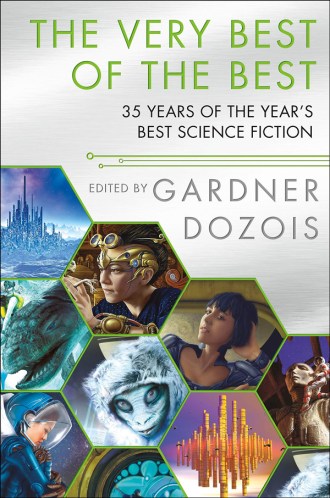
The Very Best of the Best: 35 Years of the Year’s Best Science Fiction edited by Gardner Dozois

The-Very-Best-of-the-Best-edited-by-Gardner-Dozois

Yesterday Santa Claus came to visit me in February. Since 2002 when I joined Audible.com, I’ve wished for an audiobook edition of one of Gardner Dozois giant Year’s Best Science Fiction annuals. Sadly, Dozois died last May and none of the 35 volumes were ever produced on audio. But before he died, he created The Very Best of the Best: 35 Years of the Year’s Best Science Fiction and it’s out in hardcover, ebook and audiobook editions.

Unfortunately, the subtitle to this volume is flat out wrong. It only collects the best stories from 2002-2017, but that’s because Dozois had already published The Best of the Best: 20 Years of the Year’s Best Science Fiction back in 2005 and The Best of the Best Volume 2: 20 Years of the Best Short Science Fiction Novels in 2007. I had hoped this new volume would have been Dozois legacy collection reflecting the full 35 years. But be that as it may, it’s still a giant collection of great science fiction and over 39 hours of science fiction short stories on audio, which is something I love. Vivienne Leheny and Will Damron do a fantastic job of narrating these stories, and my new wish is for someone to hire them to create audiobook editions of the earlier volumes.

Last year the three volumes of The Science Fiction Hall of Fame came out on audio. That means I can listen to some of the most remembered science fiction short stories from 1926-1964. This is why I had hoped this new audiobook would have given me the best short science fiction from 1984-2017 to listen to, but that hasn’t happened. I’m not complaining. This new book is great in both quality and quantity, and I’m quite appreciative of all the wonderful stories I’m getting to hear for the first time. I’m just greedy and want more. I want audiobook publishers to produce more anthologies of great short science fiction, and I’m now particularly anxious to hear the best short fiction from 1965-2001.

And, there’s even another problem for me, other readers, editors, and publishers. No one reader, no matter how experienced, can identify all the best stories for all readers. Tastes just vary too much. If you look at our Classics of Science Fiction Short Stories by Year list, which has the citations listed for each story, you can see which stories Gardner picked as his favorite, and which ones he didn’t. Or if you use our CSF Query program to look at stories for 2002-2017 you’ll see only one story Gardner picked for The Very Best of the Best on our list.

The 38 stories from The Very Best of the Best covering 2002-2017 with links to my reviews are:

  • The Potter of Bones by Eleanor Arnason
  • Rogue Farm by Charles Stross
  • The Little Goddess by Ian McDonald
  • Dead Men Walking by Paul McAuley
  • Tin Marsh by Michael Swanwick
  • Good Mountain by Robert Reed
  • Where the Golden Apples Grow by Kage Baker
  • The Sledge-Maker’s Daughter by Alastair Reynolds
  • Glory by Greg Egan
  • Finisterra by David Moles
  • The Illustrated Biography of Lord Grimm by Daryl Gregory
  • Utrinsque Cosmi by Robert Charles Wilson
  • Events Preceding the Helvetican Renaissance by John Kessel
  • Useless Things by Maureen McHugh
  • Mongoose by Elizabeth Bear and Sarah Monette
  • Hair by Adam Roberts
  • The Things by Peter Watts
  • The Emperor of Mars by Allen M. Steele
  • Flower, Mercy, Needle, Chain by Yoon Ha Lee
  • Martian Heart by John Barnes
  • The Invasion of Venus by Stephen Baxter
  • Weep For Day by Indrapramit Das
  • The Girl-Thing Who Went Out For Sushi by Pat Cadigan
  • The Memcordist by Lavie Tidhar
  • The Best We Can by Carrie Vaughn
  • The Discovered Country by Ian R. MacLeod
  • Pathways by Nancy Kress
  • The Hand Is Quicker… by Elizabeth Bear
  • Someday by James Patrick Kelly
  • The Long Haul, From the Annals of Transportation, The Pacific Monthly, May 2009 by Ken Liu
  • Three Cups of Grief, By Starlight by Aliette De Bodard
  • Calved by Sam J. Miller
  • Emergence by Gwyneth Jones
  • Rates of Change by James S.A. Corey
  • Jonas and the Fox by Rich Larson
  • KIT: Some Assembly Required by Kathe Koja and Carter Scholz
  • Winter Timeshare by Ray Nayler
  • My English Name by R.S. Benedict

Our meta-list system recognized 37 stories from the same period:

  • Breathmoss by Ian R. MacLeod
  • The Cookie Monster by Vernor Vinge
  • The Empire of Ice Cream by Jeffrey Ford
  • The Empress of Mars by Kage Baker
  • Singing My Sister Down by Margo Lanagan
  • The People of Sand and Slag by Paolo Bacigalupi
  • The Voluntary State by Christopher Rowe
  • Little Faces by Vonda N. McIntyre
  • Magic for Beginners by Kelly Link
  • The Calorie Man by Paolo Bacigalupi
  • The Little Goddess by Ian McDonald
  • The House Beyond Your Sky by Benjamin Rosenbaum
  • Yellow Card Man by Paolo Bacigalupi
  • The Merchant and the Alchemist’s Gate by Ted Chiang
  • 26 Monkeys, Also the Abyss by Kij Johnson
  • Exhalation by Ted Chiang
  • The Gambler by Paolo Bacigalupi
  • The Ray-Gun: A Love Story by James Alan Gardner
  • Eros, Philia, Agape by Rachel Swirsky
  • Spar by Kij Johnson
  • The Island by Peter Watts
  • The Lady Who Plucked Red Flowers Beneath the Queen’s Window by Rachel Swirsky
  • The Sultan of the Clouds by Geoffrey A. Landis
  • The Things by Peter Watts
  • Under the Moons of Venus by Damien Broderick
  • The Man Who Bridged the Mist by Kij Johnson
  • The Paper Menagerie by Ken Liu
  • Close Encounters by Andy Duncan
  • Botanica Veneris: Thirteen Papercuts by Ida Countess Rathangan by Ian McDonald
  • The Game of Smash and Recovery by Kelly Link
  • Seasons of Glass and Iron by Amal El-Mohtar
  • The Visitor from Taured by Ian R. MacLeod
  • Things with Beards by Sam J. Miller
  • Touring with the Alien by Carolyn Ives Gilman
  • A Series of Steaks by Vina Jie-Min Prasad
  • The Martian Obelisk by Linda Nagata
  • The Secret Life of Bots by Suzanne Palmer

Practically no overlap. Why? If The Very Best of the Best is actually what it says it is, why don’t we see more overlap with the stories our system identified by means of tracking popularity? An easy answer is there’s a lot of great SF short stories, more than enough for every editor to pick different favorites. But what if there are other motives besides claimed quality that go into selecting a story for a best-of anthology?

For example, the first story in The Very Best of the Best is “The Potter of Bones” by Eleanor Arnason. It’s a beautiful tale that was nominated for a Nebula but has only been reprinted in anthologies edited by Gardner Dozois or Arnason’s own collection. I don’t know if Gardner intentionally selected stories that hadn’t been reprinted often, or if Gardner has a very unique taste in science fiction. My guess, it’s a little of both. An honest title for this collection might be Gardner Dozois’ Favorite Science Fiction from 2002-2017 That He Believes Deserves More Attention.

On the other hand, the second story “Rogue Farm” by Charles Stross, has been included in at least seven anthologies. That seems to disqualify my theory, but I’m not sure.

A troublesome paradigm shift is going on in publishing short science fiction right now. The short stories that get the most attention, especially for awards, are those that are published online where people can read them for free. And it’s becoming more common for online publishers to include both a text and an audio edition. Free online stories compete for readers with stories that are published in magazines or original anthologies behind another kind of paywall. The old print magazines, Analog, Asimov’s and F&SF have dwindling readerships. The prestige of getting published used to be seeing your work in print. But I wonder if short story writers now prefer online publications because they get more readers.

I could speculate endlessly about what are the best SF short stories or how they are identified by editors and discovered by readers, but the bottom line is I’m very happy with The Very Best of the Best. I hope thousands of SF fans buy and listen to it because that should encourage audiobook publishers to produce more SF anthologies on audio. But if you don’t like audiobooks, there are print and ebook editions.

Finally, there are two tributes to Gardner by Robert Silverberg and James Patrick Kelly that I want to recommend. They just appeared in the new issues of Asimov’s Science Fiction but are available to read online. I got to study with Gardner when he spent a week as our resident instructor for the Clarion West workshop I took in 2002. He was a man I will remember and I’ll always be grateful for his encouragement and writing lessons.

James Wallace Harris, February 27, 2019
In Praise of Mediocre Science Fiction

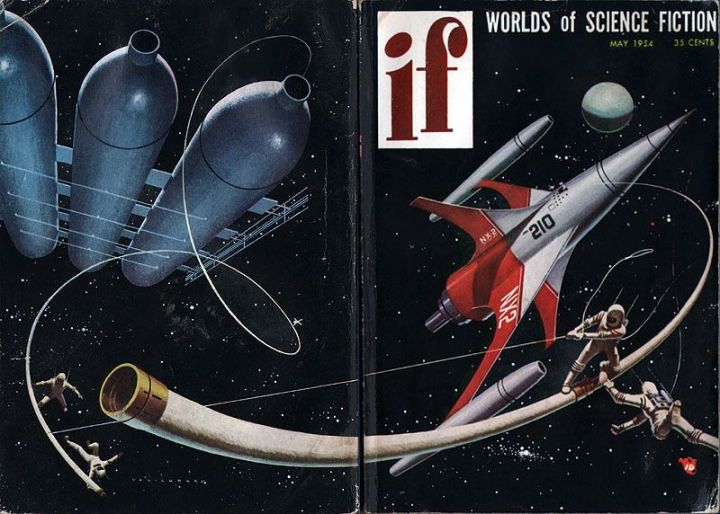
IF Magazine May 1954

The word “mediocre” usually presents a negative connotation. But the word can mean ordinary, average, middle-of-the-road which if you think about it, is true for most things in our lives. Not everything in life can be exceptional. Statistically, most aspects must be run-of-mill common. We don’t like to believe this, but most of us lead mediocre lives. We wish our time on Earth could be as important as a classic novel, but we’re goddamn lucky if we can say we’ve had a good average life.

This essay was originally going to be called “Favorite Science Fiction Stories Volumes 1-10 Table of Contents.” I love Audible.com, but it often annoys me by selling anthologies without listing their individual entries. I recently stumbled upon this series and thought I’d provide a public service by listing the contents of all ten volumes. I was hesitant to even try these audiobooks because the so few stories I saw listed were famous.

I couldn’t find much about the publisher, Jimcin. It’s web page merely states its products are for sale at Audible.com, although these anthologies are also listed at Amazon and iTunes. They appear to be collections of out-of-copyright stories, which means they are older than the 1920’s or the authors or author’s heirs never bothered to renew the original copyright. In other words, they might be the dregs of the genre. The ten volumes do contain a few big-name-authors, and a handful of classic science fiction stories like “The Machine Stops” by E. M. Forster, “The Martian Odyssey” by Stanley G. Weinbaum, and “Scanners Live in Vain” by Cordwainer Smith. Those three stories also appear in the legendary Science Fiction Hall of Fame anthology series which came out in audio this past year. But for the most part, these stories were the common, run-of-the-mill stories that filled the science fiction digests in the 1950’s and 1960’s.

There’s a certain fun quality to science fiction that doesn’t require literary greatness. In the middle of last century, hack writers churned out Sci-Fi tales to survive. Many of them could hammer out a story in a few days that could both excite geeky fans and pay the rent. All they had to do was come up with an idea that 12-year-old know-it-alls had never encountered. Hardcore science fiction lovers thought of themselves as Slans but often blowing their minds only took one hit on the science fiction bong.

I avoided buying these Jimcin anthologies for years because I thought they’d be crappy, but then four volumes went on sale and I took a chance. I’ve been pleasantly surprised. Yes, they are mediocre, but they also have a unique entertainment quality. Just my kind of fun. If you love episodes of the old Twilight Zone TV series, there’s a good chance you’ll enjoy these stories too.

I crave science fiction short stories on audio. Somehow, short stories come alive for me when I listen, especially when they’re read by a narrator who adds dramatic voices. Oh, I still love to read, but I admit I’m a poor reader compared to these hired guns. It’s the narrators who add the extra dimension. And these ten volumes are a time capsule of what it’s like to have been a kid back in the 1950’s and 1960’s who loved science fiction.

My goal here is to promote more audio productions of short science fiction. I need to get more people buying audiobook science fiction anthologies so publishers will feel the demand and publish more of them. Most of you will not rush out and buy one of these Favorite Science Fiction Stories anthologies, especially after I called them mediocre, but I wanted to be as honest as possible.

I’m going to list the table of contents to all ten volumes and provide links to some of the stories I’ve found on YouTube, so you can hear what I’m talking about. These are public domain stories you can find online for free, especially at places like Project Gutenberg and YouTube. I don’t think the audio versions below are the same as the ones in the anthologies, but I’ve only tested a handful of stories. I’m not trying to ruin Jimcin’s sales but promote them. It’s far more convenient to listen to them on your smartphone than to listen to them on YouTube. But try a few to see why you should buy a whole anthology.

There are many public domain science fiction stories in audio available on the web. Often, they are from LibriVox, which use volunteer readers. LibriVox readers are good and provide a great public service, but they don’t usually provide the kind of dramatic narration I’m talking about. The stories I link to below have at least a basic level of professionalism, and some of them are excellent. I don’t know if these recordings are from copyrighted productions or if they’re productions by would-be audiobook narrators hoping to prove they can be professional.

My goal is to promote audio productions of short science fiction by expanding the audience. I want to see more anthologies of older science fiction for sale. Try some of these audio short stories to see if you get hooked, and if you do, then try one of the anthologies. 1 credit or $7-$10 is not that much for 15-20 hours of entertainment.

If you want to know more about audio science fiction, check out SFFAudio.com. They track and review both print and audio productions of public domain genre stories, as well as review professional productions of new and old stories.

I’ve bought 5 of the 10 volumes so far – see *. I’m getting a big kick out of listening to these stories. Yes, they are mediocre, but they capture a certain science fictional flavor from mid-20th-century. Be sure and read “The History of Science Fiction, and Why it Matters” by Allen Steele in the Nov-Dec 2018 issue of Asimov’s Science Fiction which just came out. Steele wonderfully explains why it’s important to read old science fiction.

Prices listed are from Amazon. Audible members might get a discount. These Favorite Sci-Fi Stories have been around for a decade, but I don’t know if they get much attention. These anthologies are not listed in ISFDB.org as far as I can tell. I wish they were. I’ve published this list of contents because I had a hard time finding this information.

Favorite Science Fiction Stories

Volume 1 (2009)* – $10.95

  1. The Gifts of Asti“ by Andre Norton
  2. The Defenders” by Philip K. Dick
  3. “Earthmen Bearing Gifts” by Fredric Brown
  4. A Martian Odyssey” by Stanley G. Weinbaum
  5. This is Klon Calling” by Walter Sheldon
  6. Security” by Poul Anderson
  7. “The Perfectionists” by Arnold Castle
  8. “The Day Time Stopped Moving” by Bradner Buckner
  9. Image of the Gods” by Alan E. Nourse
  10. “Time and Time Again” by H. Beam Piper
  11. “The World Called Crimson” by Darius John Granger
  12. “Postmark Ganymede” by Robert Silverberg
  13. The Stars, My Brothers” by Edmond Hamilton
  14. 2 B R 0 2 B” by Kurt Vonnegut, Jr.
  15. “Belly Laugh” by Ivar Jorgensen
  16. Year of the Big Thaw” by Marion Zimmer Bradley
  17. The Machine Stops” by E. M. Forster
  18. “Pandemic” by J. F. Bone
  19. Bread Overhead” by Fritz Leiber
  20. “The Day of the Boomer Dukes” by Frederik Pohl
  21. Beyond Lies the Wub” by Philip K. Dick

Volume 2 (2010) – $10.95

  1. The Coffin Cure” by Alan Edward Nourse
  2. Cat and Mouse” by Ralph Williams
  3. The Blue Tower” by Evelyn E. Smith
  4. The Gift Bearer” by Charles Fontenay
  5. “History Repeats” by George Oliver Smith
  6. The Altar at Midnight” by C. M. Kornbluth
  7. Hall of Mirrors” by Fredric Brown
  8. The Answer” by H. Beam Piper
  9. “The Calm Man” by Frank Belknap Long
  10. The Next Logical Step” by Ben Bova
  11. Operation Haystack” by Frank Herbert
  12. Foundling on Venus” by John and Dorothy DeCourcy
  13. The Repairman” by Harry Harrison
  14. The Beast of Space” by F. E. Hardart
  15. The Big Trip Up Yonder” by Kurt Vonnegut, Jr.
  16. Where There’s Hope” by Jerome Bixby
  17. The Success Machine” by Henry Slesar
  18. Pythias” by Poul Anderson
  19. Two Plus Two Makes Crazy” by Walt Sheldon
  20. “Alien Offer” by Al Sevcik
  21. All Cats Are Gray” by Andre Norton
  22. Zen” by Jerome Bixby
  23. “The Unspecialist” by Murray Yaco
  24. The Sargasso of Space” by Edmond Hamilton
  25. “Flamedown” by H. B. Fyfe
  26. “Grove of the Unborn” by Lyn Vanable
  27. What Is He Doing in There?” by Fritz Leiber
  28. “The 4D Doodler” by Grapy Waldyte
  29. “Bad Medicine” by Robert Sheckley
  30. Dead Ringer” by Lester del Rey
  31. I’ll Kill You Tomorrow” by Helen Hubert

Volume 3 (2011) – $10.95

  1. “The Missing Link” by Frank Herbert
  2. Arm of the Law” by Harry Harrison
  3. No Moving Parts” by Murray F. Yaco
  4. The Hills of Home” by Alfred Coppell
  5. The Measure of a Man” by Gordon Randall Garrett
  6. The Hated” by Frederick Pohl
  7. “Salvage in Space” by Jack Williamson
  8. The Burning Bridge” by Poul Anderson
  9. The Crystal Crypt” by Philip K. Dick
  10. The Hour of Battle” by Robert Sheckley
  11. The Mathematicians” by Arthur Feldman
  12. Crossroads of Destiny” by H. Beam Piper
  13. Homesick” by Lynn Venable
  14. “The Eyes Have it” by James McKimmey, Jr.
  15. “They Twinkled Like Jewels” by Philip Jose Farmer
  16. Old Rambling House” by Frank Herbert
  17. Youth” by Isaac Asimov
  18. “Navy Day” by Harry Harrison
  19. “Service with a Smile” by Charles Louis Fontenay
  20. “The Cosmic Express” by John Stewart Williamson
  21. The Moon is Green” by Fritz Leiber
  22. “Stopover Planet” by Robert E. Gilbert
  23. “Watchbird” by Robert Sheckley
  24. “Probability” by Louis Trimble
  25. “The Doorway” by Evelyn E. Smith
  26. The Stroke of the Sun” by Arthur C. Clarke
  27. The Velvet Glove” by Harry Harrison
  28. “The House from Nowhere” by Arthur Stangland
  29. The Tunnel Under the World” – Frederik Pohl

Volume 4 (2012) – $10.95

  1. Arena” by Fredric Brown
  2. “Mate in Two Moves” by Winston Marks
  3. Love Story” by Irving E. Cox
  4. “The Golden Man” by Philip K. Dick
  5. Advanced Chemistry” by Jack G. Huekels
  6. The Dueling Machine” by Ben Bova
  7. Time Enough at Last” by Lyn Venable
  8. “Sorry, Wrong Dimension” by Ross Rocklynne
  9. Duel on Syrtis” by Poul Anderson
  10. “The Gostak and the Doshes” by Miles J. Breuer
  11. Keep Your Shape” by Robert Sheckley
  12. “Home Is Where You Left It” by Stephen Marlowe
  13. “Planet of Dreams” by James McKimmer, Jr.
  14. Blessed Are the Meek” by G. C. Edmonson
  15. Incident on Route 12” by James Schmitz
  16. The Invader” by Alfred Coppel
  17. “Monkey on His Back” by Charles DeVet
  18. “Robots of the World Arise” by Mari Wolf
  19. A Woman’s Place” by Mark Clifton
  20. The K-Factor” by Harry Harrison
  21. The Hanging Stranger” by Philip K. Dick.

Volume 5 (2012)* – $6.95

  1. The Skull” by Phlip K. Dick
  2. Sam, This Is You” by Murray Leinster
  3. “Manners of the Age” by Horace Brown Fyfe
  4. Omnilingual” by H. Beam Piper
  5. “Heist Job on Theiser” by Gordan Randall Jarrett
  6. The Yillian Way” by Keith Laumer
  7. “The Ultimate Vice” by A. Bertram Chandler
  8. “Backlash” by Winston Marks
  9. “Adolescents Only” by Irving Cox
  10. Project Mastodon” by Clifford Simak
  11. “Sargasso of Lost Starships” by Poul Anderson
  12. The Dictator” by Milton Lesser
  13. The Misplaced Battleship” by Harry Harrison
  14. A Pail of Air” by Fritz Leiber
  15. “The Vilbar Party” by Evelyn E. Smith
  16. “The Servant Problem” by Robert F. Young

Volume 6 (2012)* – $6.95

  1. Perchance to Dream” by Richard Stockham
  2. “Father Image” by Robert Silverberg
  3. Tree, Spare That Woodman” by Dave Dryfoos
  4. “Disaster Revisited” by Darius John Granger
  5. Subversive” by Mack Reynolds
  6. “The Stutterer” by R. R. Merliss
  7. Infinite Intruder” by Alan E. Nourse
  8. “A Bottle of Old Wine” by Richard O. Lewis
  9. “B12’s Moon Glow” by Charles A. Sterns
  10. A Logic Named Joe” by Murray Leinster
  11. No Strings Attached” by Lester del Rey
  12. The Street That Wasn’t There” by Clifford D. Simak
  13. “Regeneration” by Charley Dye
  14. “Wheels Within” by Charles V. Devett
  15. “The Lonely Ones”, by Edward W. Ludwig
  16. “The God in the Box” by Sewell Peaslee Wright
  17. “Scanners Live in Vain” by Cordwainer Smith
  18. “New Hire” by Dave Dryfoos
  19. “The Enormous Room” by H.L.Gold and Robert Kreps
  20. Turnover Point” by Alfred Coppel
  21. “Breeder Reaction” by Winston Marks

Volume 7 (2013)* – $5.95

  1. “The Ties That Bind” by Walter Miller, Jr.
  2. Toy Shop” by Harry Harrison
  3. Beyond the Walls of Sleep” by H. P. Lovecraft
  4. Victory” by Lester del Rey
  5. Accidental Death” by Peter Bailey
  6. The Color Out of Space” by H. P. Lovecraft
  7. “Cully” by Jack Eagan
  8. “The Statue” by Mari Wolf
  9. “Police Operation” by H. Beam Piper
  10. “See” by Edward G. Robles, Jr.
  11. “Thing of Beauty” by Damon Knight
  12. “A Scientist Rises” by Desmond Hall
  13. “The Small World of M-75” by Ed M. Clinton, Jr.
  14. “Two-Face” by Frank Belknap Long
  15. “Creature from Cleveland Depths” by Fritz Leiber

Volume 8 (2014)* – $6.95

  1. The Last Days of Earth” by George C. Wallis
  2. Contamination Crew” by Alan E. Nourse
  3. The Memory of Mars” by Raymond F. Jones
  4. A Traveler in Time” by August Derleth
  5. The Colonists” by Raymond F. Jones
  6. Doubletake” by Richard Wilson
  7. Stamped Caution” by Raymond Z. Gallon
  8. Success Story” by Robert Turner
  9. “Disqualified” by Charles L. Fauntenay
  10. Say Hello for Me” by Frank W. Coggins
  11. “Witch of the Demon Seas” by Poul Anderson
  12. “The Last Two Alive” by Alfred Coppell
  13. “The Old Die Rich” by H. L. Gold
  14. “Ministry of Disturbance” by H. Beam Piper

Volume 9 (2016) – $6.95

  1. The Concrete Mixer” by Ray Bradbury
  2. “Farewell to the Master” by Harry Bates
  3. “Bedside Manner” by William Morrison
  4. “The Inferiors” by Mari Wolf
  5. “The Aggravation of Elmer” by Robert Arthur
  6. Conquest Over Time” by Michael Shara
  7. The Virgin of Valkarion” by Poul Anderson
  8. “No Charge for Alterations” by H. L. Gold
  9. Greylorn” by Keith Laumer
  10. The Other Now” by Murray Leinster
  11. The Ambulance Made Two Trips” by Murray Leinster
  12. The Fun They Had” by Isaac Asimov
  13. “Fondly Fahrenheit” by Alfred Bester
  14. A Matter of Importance” by Murray Leinster

Volume 10 (2018) – $6.95

  1. Adjustment Team” by Philip K. Dick
  2. The Keeper” by H. Beam Piper
  3. The Amazing Mrs. Mimms” by David C. Knight
  4. The Girls from Earth” by Frank N. Robinson
  5. The Man the Martians Made” by Frank Long
  6. “Pet Farm” by Roger Dee
  7. “A World of Talent” by Philip K. Dick
  8. “Shock Treatment” by Stanley Mullen
  9. “The Variable Man” by Philip K. Dick
  10. “The Players” by Everett Cole
  11. “Common Denominator” by John D. MacDonald
  12. “Survey Team” by Philip K. Dick
  13. “Medal of Honor” by Dallas McCord Reynolds
  14. “The Highest Treason” by Randall Garrett

– – James Wallace Harris (11/8/18)

19th Century Science Fiction Short Stories


19th century science fiction

Over the years several anthologies have reprinted science fiction short stories from the 1800’s. These tales are fascinating to read on many levels. Way before the establishment of the science fiction genre, writers were telling science fictional stories. Even without modern technology, they explored the same SF possibilities we do today. Ideas I thought original with Golden Age science fiction writers turn out to be much older. Reading these stories reveals universals about human nature that you don’t get from history books.

The Anthologies

The Stories

Here are all the stories from the above anthologies. You can see the editors have done a good job of finding stories the other editors haven’t, although there are stories loved by more than one editor. Where I can, I’ve linked to an online version of the story. If one isn’t available, I’ll link to an essay about the story. For some stories, you’ll need to get the anthology. Actually, reading the anthologies are much more convenient.

Year Title Author Editor
1809 The Conquest of the Earth by the Moon Washington Irving Franklin
1833 The Mortal Immortal Mary Shelley Asimov, Moskowitz
1835 The Unparalleled Adventure of One Hans Phall Edgar Allan Poe Moskowitz
1835 The Great Moon Hoax Richard A. Locke Lester, Sims
1839 The Conversation of Eiros and Charmion Edgar Allan Poe Kuebler
1840 A Heavenward Voyage Samuel-Henry Berthoud Stableford
1844 A Tale of the Ragged Mountains Edgar Allan Poe Franklin
1844 Rappaccini’s Daughter Nathaniel Hawthorne Franklin, Asimov, Gunn
1844 The Artist of the Beautiful Nathaniel Hawthorne Franklin, Stableford
1844 The Sandman E. T. A. Hoffman Asimov
1845 The Facts in the Case of M. Valdemar Edgar Allan Poe Sims
1849 Mellonta Tauta Edgar Allan Poe Franklin, Gunn
1852 A Descent Into the Maelstrom Edgar Allan Poe Asimov
1854 The Birthmark Nathaniel Hawthorne Franklin
1855 The Bell-Tower Herman Melville Franklin
1858 The Diamond Lens Fitz-James O’Brien Franklin, Gunn, Lester
1859 The Wondersmith Fitz-James O’Brien Moskowitz
1859 What Was It? Fitz-James O’Brien Stableford
1860 The Atoms of Chladni J. D. Whelpley Franklin
1863 Darwin Among the Machines Samuel Butler Lester
1870 Annie Denton Cridge Franklin
1872 The Brick Moon Edward Everett Hale Moskowitz
1872 The End of the World Eugène Mouton Stableford
1873 The Automaton Ear Florence McLandburgh Sims
1874 The Tachypomp Edward Page Mitchell Davies
1875 The Soul Spectroscope Edward Page Mitchell Davies
1875 The Story of the Deluge Edward Page Mitchell Davies
1876 The Inside of the Earth Edward Page Mitchell Davies
1876 The Telescope Eye William Henry Rhodes Sims
1877 The Age of Science Frances Power Cobbe Lester
1877 The Man Without a Body Edward Page Mitchell Davies
1879 A Paradoxical Ode (After Shelley) James Clerk Maxwell Stableford
1879 A Psychological Shipwreck Ambrose Bierce Franklin
1879 The Ablest Man in the World Edward Page Mitchell Davies, Stableford
1879 The Facts in the Ratcliff Case Edward Page Mitchell Davies
1879 The Senator’s Daughter Edward Page Mitchell Davies, Sims
1880 From Mizora: A Prophecy Mary E. Bradley Lane Franklin
1880 The Professor’s Experiment Edward Page Mitchell Davies
1881 The Clock That Went Backwards Edward Page Mitchell Asimov, Davies, Sims
1881 The Crystal Man Edward Page Mitchell Davies
1882 Into the Sun Robert Duncan Milne Asimov, Davies
1882 Josuah Electricmann Ernest d’Hervilly Stableford
1884 A Tale of Negative Gravity Frank R. Stockton Asimov, Davies
1884 The Child of the Phalanstery Grant Allen Stableford
1885 Old Squids and Little Speller Edward Page Mitchell Davies
1885 The Great Keinplatz Experiment Arthur Conan Doyle Asimov, Davies
1886 The Blindman’s World Edward Bellamy Franklin
1886 The Monarch of Dreams Thomas Wentworth Higginson Franklin, Sims
1887 Christmas 200,000 B.C. Stanley Waterloo Franklin
1887 The Horla, or Modern Ghosts Guy de Maupassant Asimov
1887 The Shapes (Les Xipéhuz)  J. H. Rosny aîné Asimov
1888 An Express of the Future Jules Verne Moskowitz
1888 Tornadres J. H. Rosny aîné Stableford
1889 Our Second Voyage to Mars W. S. Lach-Szyrma Evans
1889 To Whom This May Come Edward Bellamy Asimov, Davies
1890 Dr. Materialismus Frederic Jesup Stimson Franklin
1890 In the Year Ten Thousand Edgar Fawcett Stableford
1890 Professor’s Bakermann’s Microbe Charles Epheyre Stableford
1891 Old Doctor Rutherford D. F. Hannigan Moskowitz
1891 The Revolt of the Machines Emile Goudeau Stableford
1891 The Salvation of Nature John Davidson Stableford
1892 In the Year Ten Thousand Will N. Harben Franklin
1892 The Doom of London Robert Barr Moskowitz
1892 The Los Amigos Fiasco Arthur Conan Doyle Moskowitz
1892 The Philosophy of Relative Existence Frank R. Stockton Stableford
1893 June, 1993 Julian Hawthorne Stableford
1893 Mysterious Disappearances Ambrose Bierce Sims
1893 The Damned Thing Ambrose Bierce Gunn, Kuebler
1895 A Wife Manufactured to Order Alice W. Fuller Sims
1895 Lost in a Comet’s Tale Luis P. Senarens Moskowitz
1895 The Purple Death W. L. Alden Davies, Russell
1896 Citizen 504 Charles H. Palmer Moskowitz
1896 In the Abyss H. G. Wells Asimov
1896 In the Deep of Time
George Parsons Lathrop, Thomas A. Edison
Locke
1896 London’s Danger
C. J. Cutcliffe Hyne
Evans, Russell
1897 The Aeriel Brickfield John Mills Evans
1897 The Crystal Egg H. G. Wells Knight
1897 The Microbe of Death Rudolph De Cordova Russell
1897 The Star H. G. Wells Kuebler, Stableford
1897 The Thames Valley Catastrophe Grant Allen
Asimov, Davies, Evans, Moskowitz, Russell, Sims
1898 A Corner in Lightning George Griffith Evans, Moskowitz, Stableford
1898 From the “London Times” of 1904 Mark Twain Franklin, Knight
1898 The Lizard C. J. Cutcliffe Hyne Asimov, Evans, Russell
1898 Where the Air Quivered L. T. Meade, Robert Eustace Moskowitz
1899 A Thousand Deaths Jack London Asimov, Davies, Franklin
1899 Moxon’s Master Ambrose Bierce Knight
1899 The Master of the Octopus Edward Olin Weeks Russell
1899 The Monster of Lake LaMetrie Wardon Allan Curtis Moskowitz, Russell, Sims
1899 The Purple Terror Fred M. White Davies, Evans, Moskowitz, Russell
1899 The Wheels of Dr. Ginochio Gyves Ellsworth Douglass, Edwin Pallander Locke, Russell

James Wallace Harris (9/20/18)

What Anthology First Recognized the Science Fiction Genre?

The Pocket Book of Science-Fiction edited by Donald Wollheim

While growing up in the 1960’s I loved a certain kind of story. I did not know the terms “science fiction” or “genre” but I knew what I liked. I believe readers before the label “science fiction” was used in the 1930s felt the same way. I’m not sure when the general public began referring to science fiction stories as “science fiction” or book publishers began to market to its fans.

When Amazing Stories first appeared in April 1926 editor Hugo Gernsback and his readers already knew the kinds of stories they wanted – they just didn’t have a universal identifier to define them. Gernsback had been using “scientifiction” since 1916 but luckily that ugly word didn’t stick. The term “science fiction” had been occasionally used before then, but only accidentally. Sometime between ads using the phrase “science fiction” in Air Wonder Stories in the late 1920s and March 1938 when Astounding Stories became Astounding Science-Fiction did the label began to stick – at least with hardcore fans. I don’t know if the world at large realized there was a new genre. Stories using science fiction themes have been around for thousands of years. Hell, Noah’s Ark is about a generation ship and a post-apocalyptic world.

Also, I’m not sure if all the credit should go to the pulp magazines for creating our genre. Newspapers ran Buck Rogers and Flash Gordan comic strips, and those stories then moved to radio and movie serials. Comic books back then were full of science fictional plots. The play R.U.R. gave us the word robots premiered in 1920, and Metropolis the silent film about robots came out in 1927. The novels Brave New World and When Worlds Collide appeared in 1932 and 1933.

Why hadn’t book publishers spotted this trend and aimed at that market sooner?

Had any anthology editor before the 1920’s collected science fiction stories for the unnamed science fiction fans of the 19th-century or early 20th-century? General interest magazines, newspapers, dime novels, and pulp magazines had been publishing science fiction long before Amazing Stories. Had anyone tried to categorize or name these kinds of stories before Gernsback? Anthologies are seldom reprinted, so they are rare and hard to track down. I have found a few 19th-century anthologies that focused on weird, horror, and fantasy, but then ghost stories were a staple in that century.

Edgar Allan Poe helped develop the short story as a unique art form and wrote fiction that would eventually be classified as mystery, horror, detective, and science fiction. Poe had many imitators. When did readers decide they preferred stories about life on other planets, travels in space, artificial life, mechanical beings, time travel, invaders from other worlds, flying machines, etc?

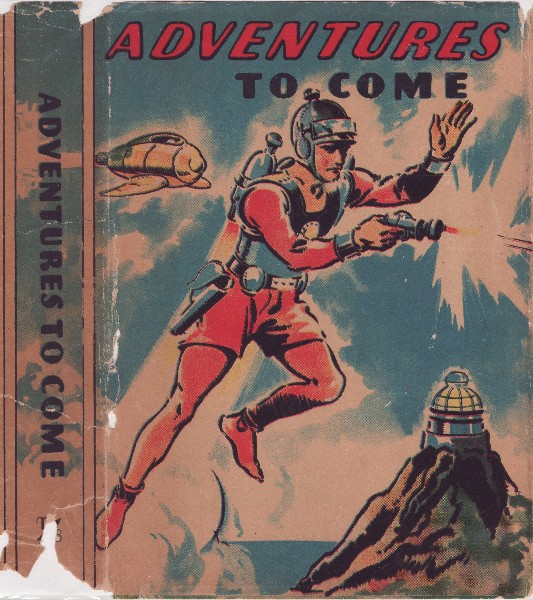
Adventures to Come

There is a concise history of the science fiction anthology at The Encyclopedia of Science Fiction. It suggests Adventures To Come (1937) edited by J. Berg Esenwein is the first science fiction anthology. It’s also the first SF original anthology, publishing stories written for that volume. But they were forgettable stories by unknown writers and that had no impact on the genre. The cover of Adventures To Come was obviously inspired by the 1929 Buck Rogers newspaper comic strip and the original Buck Rogers story from a 1928 issue of Amazing Stories.  We forget that daily comic strips were probably more popular than the pulp magazines. And Adventures to Come obviously looks like a children’s book. It may have been the first SF anthology aimed at young proto-SF fans, but it is so rare and so seldom remembered that I can’t think of it as important to the genre either. But it does show that publishers were seeing a new market.

The Other Worlds edited by Phil Stong

Next up is The Other Worlds (1941) edited by Phil Stong. I just got a copy of that one, and it collects stories from Weird Tales, Astounding Stories, Amazing Stories and Thrilling Wonder Stories beside Esquire and Westminister Magazine. It features fiction by Lester del Rey, Ralph Milne Farley, Theodore Sturgeon, Murray Leinster, Harry Bates, Henry Kuttner, and Otto Binder. Authors remembered today as being science fiction writers. There are twenty-four writers in all, many of which I don’t know, probably because they came out of the horror genre.

I’ve only had time to read Stong’s introductions so far, but he shows a disdain for much of pre-1941 science fiction. For instance, Stong knocks War of the Worlds and The Time Machine by H. G. Wells and favors “The Man Who Could Work Miracles” as being more sensible. Stong uses the term “scientifiction” which was already a decade out of date and sneers at E. E. “Doc” Smith, the most popular SF writer at the time. The book’s introduction begins with two “true” stories of psychic premonition. I doubt Stong was a science fiction fan because none of the stories he collected has come down to us as classics. I’m guessing he liked borderline science fiction/weird tales that supported his metaphysical/philosophical interests. I think Stong realized there was a science fiction genre, but he didn’t like how it was shaping up. He picked stories he considered good from the genre but dismissed the rest as juvenile or crude. The Other Worlds didn’t hit the mark for me.

However, The Other Worlds fits my theory that there were science fiction fans before the term science fiction was widely used. There were readers, even literary readers, who loved weird stories that one day would be called science fiction. The Science Fiction Encyclopedia reports there were several anthologies from the 1800’s that collected fantasy and weird fiction. Did any of them have true science fiction in them? This matches my own research.  SF Encylopedia claims Popular Romances (1812) edited by Henry William Weber could be the first SF anthology, but it’s really an omnibus rather than an anthology, reprinting several famous novels about fantastic voyages (including Gulliver’s Travels and Robinson Crusoe).

I want to believe there was at least one anthology published between 1800 and 1900 that included at least three stories we’d anthologize today as classics of the genre. Of course, this might be my Holy Grail that I shall never find. I’ve been using ISFDB.org with several anthologies published in recent decades that identify 19th-century science fiction hoping to spot an anthology from the 1800’s. Unfortunately, the Internet Science Fiction Database gets murky with data from that century.

I believe there were readers in the 1800’s that were drawn to themes we’ve come to attribute to science fiction. We know the novels of Mary Shelley, Jules Verne, and H. G. Wells were popular. We know many other science fiction novels came out in that century. We know many shorter works of science fiction appeared in newspapers and magazines. That leads me to assume that fans existed, and they might have written letters to friends, letters to editors, essays, diary entries, or newspaper articles about their fondness for such stories. It’s hard to believe some editor didn’t capitalize on that interest.

For now, I consider The Pocket Book of Science-Fiction (1943) edited by Donald Wollheim the first anthology to collect stories that modern readers still read and think of as classics of science fiction. Five of his ten stories are still admired today:

  • “By the Waters of Babylon” (1937) by Stephen Vincent Benet
  • “A Martian Odyssey” (1934) by Stanley G. Weinbaum
  • “Twilight” (1934) by John W. Campbell
  • “Microcosmic God” (1941) by Theodore Sturgeon
  • “–And He Built a Crooked House” (1941) by Robert A. Heinlein

The last four were included in The Science Fiction Hall of Fame Volume One (1970) edited by Robert Silverberg, which many still consider the best anthology of science fiction. Donald Wollheim was a super-fan in the 1930’s, began editing SF magazines in 1941, became a major editor for Ace Books in the 1950’s and eventually formed his own publishing company DAW Books. He was a major influence on the genre.

The Pocket Book of Science-Fiction was the first mass-market paperback of science fiction stories. It used the term science fiction in the title. It was sent overseas to the troops in WWII. I can’t help but believe that’s how the term science fiction really began to spread to readers outside of the pulp magazines.

1946-SF-Anthologies

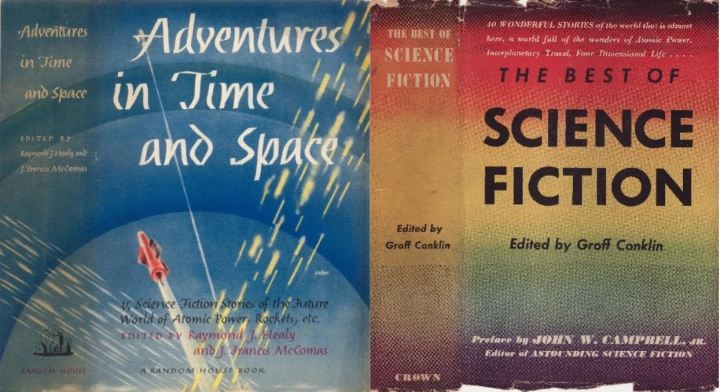
In 1946 two hardback anthologies appeared: Adventures in Time and Space edited by Raymond J. Healy and J. Francis McComas and the Big Book of Science Fiction edited by Groff Conklin. Conklin even removed the hyphen in “science fiction.” McComas would co-found The Magazine of Fantasy & Science Fiction in 1949. Conklin would go on to edit many science fiction anthologies in the 1940’s, 1950’s and 1960’s that introduced classic short SF from the pulp era to Baby Boomers.

By the 1950’s science fiction should have been a well-known genre and term, but I’m not sure. There was an explosion of magazines, comics, television shows, and movies devoted to the genre. So it’s odd, as a kid in 1962 that I didn’t know the term science fiction. I was only ten, and I had been loving science fiction movies and television shows since 1955. I’m sure I heard the phrase frequently, but it didn’t stick with me. And it just didn’t occur to me that it defined a type of story at the library. I’d go up and down the school library shelves looking for books that were science fiction.

I wonder when other people my age realized there was a genre called science fiction? I wish my parents were still alive so I could ask them when they first remember hearing the term. I wished I had asked them in 1964 if they knew the phrase science fiction and could they describe it. They were born in 1916 and 1920 and grew up with science fiction in the 1930’s. Had they encountered it?

It wasn’t until 1964 when I was allowed into the adult area of the Homestead Air Force Base Library where they had a science fiction section. That’s when I realized there was a book category for the stories I loved. In 1965 I discovered Conklin’s anthologies at the public library and learned there were magazines devoted to science fiction, and had been for almost 40 years. Then I found Sam Moskowitz’s histories of science fiction and realized stories with science fictional themes were very old, they just weren’t called science fiction.

It wasn’t until 2018 that I became fascinated with the history of science fiction anthologies. It boggles my mind that there was a time when people didn’t know science fiction existed even though it did. I eventually want to write about that, but my next essay will be about anthologies that collected short fiction from the 1800’s. It seems every new editor that works that century finds more science fiction to reprint. I want to find the first science fiction fans. The first popular film I can think of that has a character who loves science fiction is Back to the Future from 1985. I’m sure I’m wrong that George McFly is the first SF fan depicted in the movies. I keep hoping I’ll see one mentioned in an old MGM film from the 1930’s or 1940’s. But what I’d really love is to find an SF fan from the 1860’s who wrote about his favorite stories in a diary.

James Wallace Harris (9/19/18)

Why Anthologies Are Important to Science Fiction

1946-SF-Anthologies

If anthologies didn’t exist, the only science fiction short stories we’d read from the past are those by the most famous of writers. For example, from the 1940s we still read science fiction short stories by Ray Bradbury and Robert A. Heinlein because they gained enough readers over a lifetime to keep their short story collections in print.

Short story writing is the minor leagues where authors labor until they can break into the majors writing novels. There are fans of short stories, but most readers prefer novels. Short stories mostly appear in periodicals and online, although some lucky stories make their debut in an original hardback anthology.

Most short stories are never reprinted. Their original publication is their only publication. Since 1949, shorter works of science fiction got a second chance to find new readers when editors of annual best-of-the-year anthologies reprinted them. They got yet another chance to find new readers when they were reprinted in theme, retrospective, and textbook anthologies. Although, the best bet for a short story to stay in print is to be by a very famous author who stays in print.

Anthologies are books collecting short artistic works (short stories, poems, drawings, songs, essays) by a variety of authors. As far I can discover, they developed in the 19th-century when publishers wanted to promote artists who couldn’t sell a solo collection. I have searched hard to discover a 19-century anthology that collected science fiction. The best I could find were anthologies of horror and weird fiction that might have a single story we’d call science fiction today. I still believe an SF anthology from that century could exist, but it must be very rare, like El Dorado. I’d love to know if there were proto-science fiction fans in the 1800’s. Did cowboys riding the range discuss life on other planets while sitting around the campfire?

There are several anthologies published since the 1960’s that unearth 19th-century science fiction. I’m going to devote a future essay to them. My point is those stories wouldn’t be remembered without an anthology editor.

There were earlier science fiction anthologies, but in 1946 Adventures in Time and Space edited by Raymond J. Healy and J. Francis McComas was the Amazing Stories beginning of science fiction anthologies. It introduced hardback book buyers to the best pulp science fiction short stories of the 1930’s and 1940’s. However, it was Groff Conklin, in the same year, that began a career editing science fiction anthologies that rescued stories from the pulps for a generation of hardback and paperback readers.

I’ve met readers from my generation all over the internet who got their start reading science fiction by discovering Adventures in Time and Space and the Conklin anthologies at their public library in the 1950’s and 1960’s.

Sadly, anthologies seldom stay in print. Every decade or generation new editors emerge to anthologize the best short science fiction of the previous year or redefine the best short science fiction for the genre’s history or illustrate the evolution of a science fiction theme with a series of shorter works. They keep short science fiction in our memories. Of course, newer editors will drop some older stories and discover newer stories for their generation of readers.

My plan is to write a series of essays about this process. As I collected anthologies for our Classics of Science Fiction Short Story lists, I began to notice that anthologies had a collective history. Few people notice this. Histories of books, magazines, and newspapers are common if you know where to look, but I’ve had a very hard time finding histories that recognize the importance of anthologies. For science fiction, I did find Bud Webster’s Anthopology 101 columns which were collected in his book, Anthopology 101: Reflections, Inspects and Dissections of SF Anthologies. But even those 336 pages don’t begin to cover the topic.

For hundreds of science fiction writers, their only chance of literary immortality are the anthologies that remember them. A great example of this are the dozens of women science fiction writers being rediscovered in recent anthologies devoted to them. We need to give more credit to anthologists who mine the past for writers with a sense of wonder. Reading those old stories can give new insights into the evolution of the genre. It also makes us change how we think about our great-grandparents’ generation, and theirs before them.

James Wallace Harris (9/14/18)