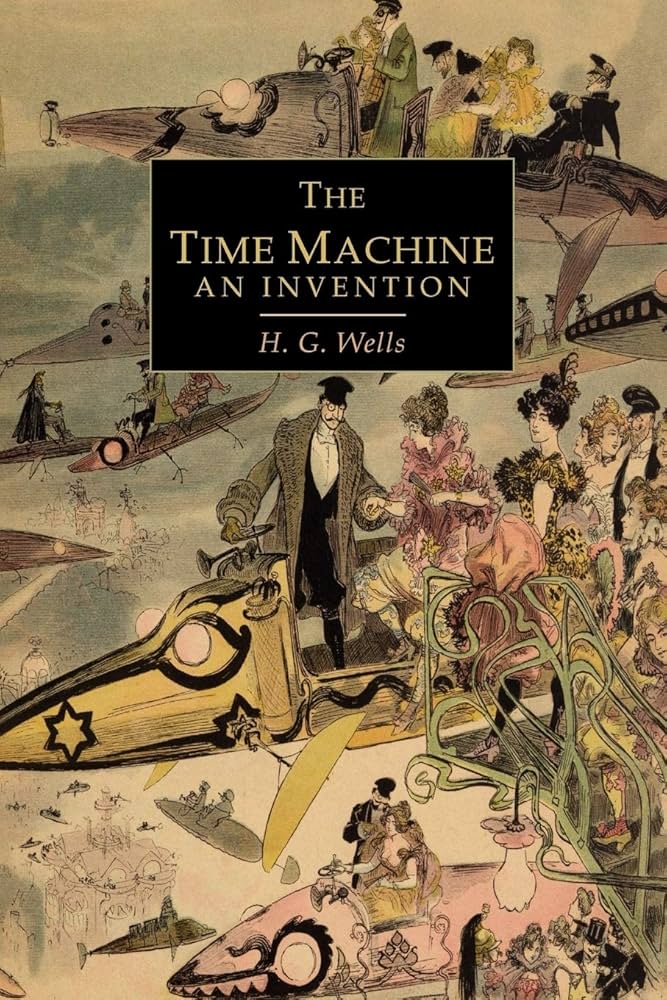
I didn’t discover the concept of time travel until September 25, 1965, when the 1960 film version of The Time Machine was shown on NBC Saturday Night at the Movies. That was two months before I turned 14. It blew my mind. The next day at Cutler Ridge Junior High, kids excitedly talked about the movie. Sometime after that, I read the H. G. Wells novella, but I’m not sure when.
I consider The Time Machine by H. G. Wells the most science fictional of all science fiction stories. Not only did it introduce me to the concept of a time machine, but it also introduced me to social evolution, Homo sapiens evolving into different species, the extinction of humankind, the end of the Earth, and the death of the Sun. That’s epic for a 13-year-old in 1965.
I’m pretty sure I’d never have imagined time travel on my own. I think if I had learned about astronomy before discovering science fiction, I could have thought, “Wouldn’t it be neat to go to the Moon or Mars?” on my own. But time travel was a much bigger conceptual breakthrough, one I don’t think I would have made.
Now, I had been a watcher of The Twilight Zone since 1959, when it premiered, and it often played with time. This video lists ten episodes involving some form of time travel.
The episode I remember best is from April 7, 1961, “A Hundred Yards Over the Rim,” where a man from a 19th-century wagon train walks over a hill into the 20th century. Most of the episodes were fantasies about people thrown through time. There was one episode where Buster Keaton had a helmet that let him time-travel, but I don’t remember seeing it as a kid. (Here’s another list that covers 13 episodes featuring some form of time travel.)
On January 13, 1964, I saw “Controlled Experiment” on The Outer Limits. It was the series sole comic episode about two Martians studying humans. They had a machine that could roll back time and replay it. That might be my first inkling of time travel. But I didn’t make the jump to using a machine to travel in time.
How often do we imagine original ideas? Harlan Ellison was famous for suing people for stealing his ideas, but did he really think up all the science fiction concepts before he read about them? Was a time machine original with H. G. Wells?
I believe that science fiction is a conceptual tool for generating ideas through literary evolution. For every far-out idea you encounter in science fiction, there’s a long history of previous stories that helped evolve that idea. I’d love to have a book, database, or website that creates taxonomic ranks of all science fiction concepts and shows how each evolved over time.
We like to think that science fiction has infinite possibilities, but I have a hunch that it’s finite. If we studied science fiction and developed a classification system for SF story ideas, we’d discover its limitations.
Take time travel. There’s only so much you can do with the concept. I’m currently rewatching the old TV series, The Time Tunnel, from the 1966/1967 television season. The same season that Star Trek premiered. The Time Tunnel, like Quantum Leap, allowed its protagonists to jump around in time. But in both treatments, you quickly realize how limiting time travel is as a plot device. Most time travel stories end up being about their destinations, not the concept itself. H. G. Wells milked the idea for most of its worth in The Time Machine.
Time travel stories generally produce historical or romance fiction.
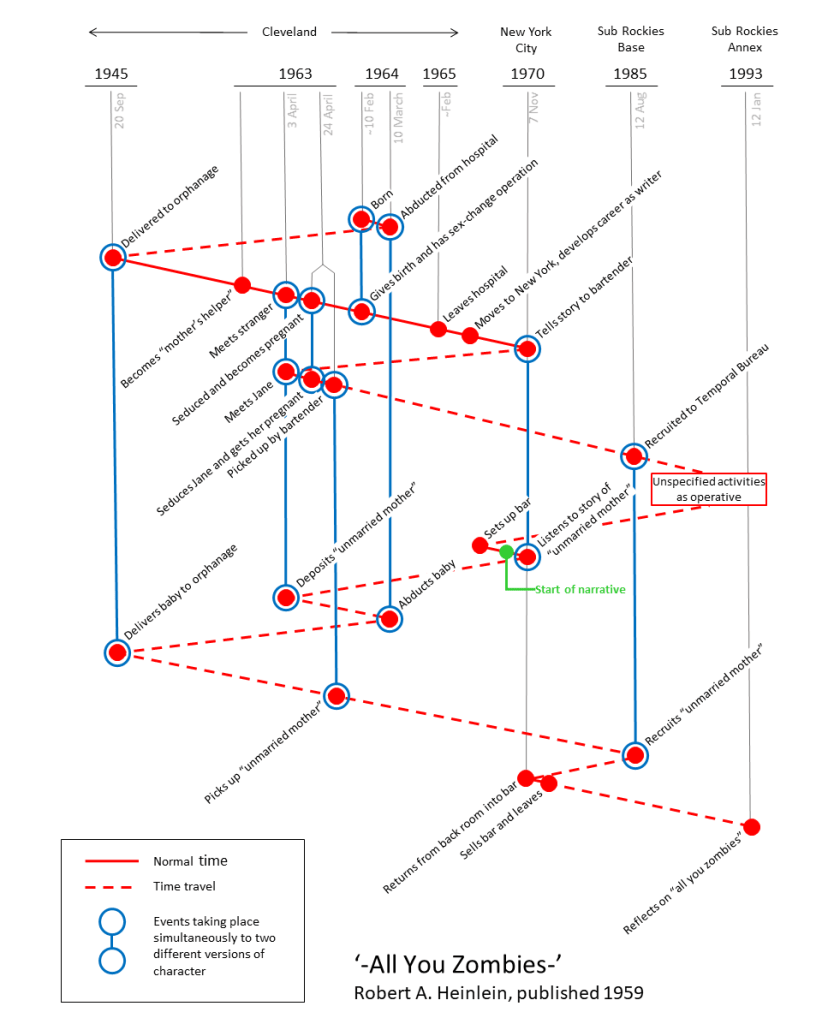
Robert A. Heinlein knew this, so he published “—All You Zombies—” in 1959, a fantastic satire on the concept. Heinlein pushed time travel to its limits. Just look at this plot diagram.
Most science fiction is set in the future. That makes most science fiction essentially a time travel story. History is a well-established academic pursuit. That’s why time travel to the past, like stories by Connie Willis, is really a kind of historical fiction. And stories about going to the future allow writers to speculate and extrapolate. But most writers do that by just setting their stories in the future.
Today, science fiction that uses time travel often uses the concept to play with entertaining plot ideas. Most of what I really admired about The Time Machine, Olaf Stapledon explored in Last and First Men and Star Maker. Wells invented the time machine as a gimmick, a plot gimmick. And if you think about it, a time machine is always a plot gimmick. Just watch all those episodes of The Twilight Zone.
The mind-blowing parts of Wells’ story explore the evolution of humanity, the fate of the Earth, the solar system, and the galaxy. This is the real meat and potatoes of science fiction.
James Wallace Harris, 5/11/26
 Classics of Science Fiction
Harlan Ellison was famous for suing people for stealing his ideas,
In fairness, to the best of my knowlege, Harlan actually filed exactly two plagiarism suits: once against the producers of The Terminator, claiming that it had plagiarized his Outer Limits script “Soldier”; and once, with Ben Bova, against Paramount, claiming that the Future Cop teevee series had lifted ideas from their story “Brillo.” He often threatened to sue others, for a variety of reasons; but rarely actually did.
It is worth noting that both these suits were successful: the “Soldier” suit was settled out of court; the “Brillo” suit won in court. So he was not recklessly litigious.
It is this sort of misinformed gossip that has unfairly tarnished Harlan’s reputation during and after his life.
LikeLike