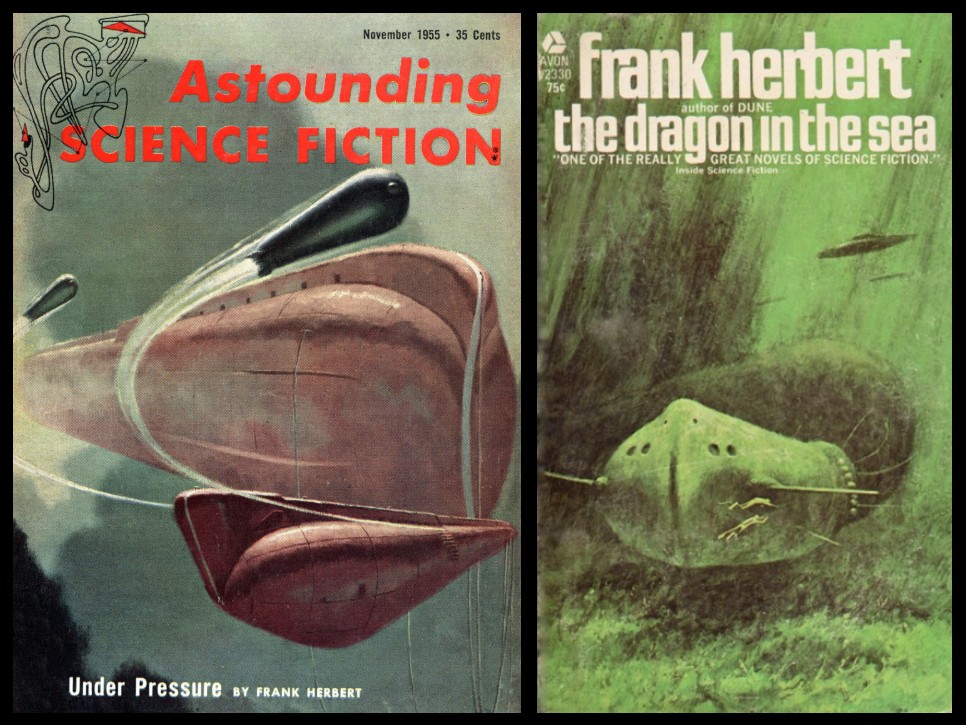
I’m not sure I can recommend The Dragon in the Sea by Frank Herbert, even though I enjoyed reading it. If Herbert had not become famous for Dune, I’m not sure it would be in print today. The story, written in the early days of the Cold War, portrays a future where the United States steals oil from the Soviets using submarine tugboats. Most of the novel takes place in one of these four-man subtugs. The plot feels more like an early political techno thriller than science fiction. It’s the kind of adventure story aimed at male readers that was usually published in men’s magazines in the 1950s. Those old nudie mags ran a lot of fiction.
The Dragon in the Sea is terribly dated on several levels. That’s ignoring the silliness of a submarine towing a giant plastic bag that holds millions of gallons of crude oil. However, the characterization was intriguing. The primary point-of-view character, John Ramsey, is an undercover psychologist studying the captain, who also knows there’s a Soviet sleeper agent aboard. Because the crew suspects the psychologist is the spy, the story is driven by paranoia.
I read The Dragon in the Sea because of a review at Science Fiction and Fantasy Remembrance (Part 1, Part 2, Part 3). Herbert’s novel was titled Under Pressure when it ran as a serial in Astounding Science Fiction (November & December 1955, January 1956). I didn’t want to read another science fiction novel at the time because I had several nonfiction books I was anxious to read. But Brian Collins’ review intrigued me. Collins is one of several bloggers who review old science fiction. His focus is on reviewing stories from science fiction magazines, something I also do. We’re part of an extremely tiny subculture that remembers a rather obscure art form.
The way Collins described the conflict between the four men in the submarine made me think of Rogue Moon by Algis Budrys. Rogue Moon is a compelling read because of the tense conflict between two ego-driven men. However, Rogue Moon is solid science fiction, dramatizing the bizarre consequences of using a matter transmitter to explore an alien artifact that killed every living thing that entered it. In other words, Rogue Moon had more than just the battle of alpha males; it had some heavy-duty sci-fi.
I can feel y’all asking, “Why are you even reviewing this book? You’re damning it with faint praise.” Well, that brings me to the theme of this essay. Why do we choose the science fiction books we read?
Most people buy The Dragon in the Sea because they loved Dune and want to see what else Frank Herbert wrote. That’s one of my main reasons. The Dragon in the Sea is Herbert’s first published novel, so it’s an interesting place to start. Dune was the breakthrough SF novel in the 1960s. How did Herbert get there? I liked The Dragon in the Sea well enough that I now want to read one of Herbert’s novels that he wrote after Dune.
I’m also the kind of science fiction reader who prefers older science fiction, even if it’s dated. It’s not that I dislike current science fiction. I just enjoy the science fiction I grew up with more. Especially, from the era when science fiction books were under 300 pages. I don’t like trilogies and series, or giant novels. I love a standalone story that paints a great science-fictional idea quickly. I read this sentiment fairly frequently online.
I have two other reasons for reading old forgotten science fiction that are less commonly expressed. I love reading old science fiction because I enjoy exploring the history of science fiction. And I love searching for old science fiction I missed in my youth, that might turn out to be a forgotten gem.
The Dragon in the Sea is no lost masterpiece. Brian Collins said he’s never seen a Frank Herbert novel for sale that wasn’t part of the Dune series. I have seen many over the decades, but have never tried reading one before. I’ve read Dune twice but not the sequels. It’s hard to imagine the man who wrote The Dragon in the Sea writing Dune. I will say that Herbert has a flair for drama and dialogue that was uncommon in science fiction in the 1950s. His first novel showed no talent for the kind of sense of wonder that made science fiction famous. To have an overabundance of that talent ten years later is amazing.
Interestingly, Herbert makes religion an essential aspect of his first novel. Religion made Dune epic. Herbert portrays Captain Sparrow in The Dragon in the Sea somewhat like Captain Ahab. The plot has the crew facing death time and again. They must kill or be killed. Captain Sparrow sees God as guiding and protecting them. The other two crewmen, Bonnett and Garcia, have become true believers because Captain Sparrow has always brought them home. Ramsey has a religious upbringing, but is not a believer. Yet, even though he’s a psychologist, Sparrow starts to get to him.
The story kept me reading because of the conflict between the characters and how Ramsey slowly became one with the crew. You end up liking all the men, even when they do unlikable things.
The men are under tremendous pressure. The previous twenty missions have failed. They expect to die unless they can uncover the secrets of the sleeper agent. But how can there be a spy among the three men who have worked together for years and are so dedicated to each other? They all profess to love their wives, but in reality, they love their job, their ship, their captain, and each other.
Now that I’m writing this, I realize how much more I liked this novel. It has many flaws, but I still found it entertaining to read. So did Brian Collins. Like Collins, I struggle to write reviews. He writes about his struggle in a post published after reviewing part 1 and before part 2, Under Pressure. (Remember, the links to all three parts of his review are above.) Collins does a much better job than I of describing the story.
It takes a lot of mental work to pinpoint why you like or dislike something. It’s easy to say, “I hate this” or “I love this,” but those statements are meaningless. You have to say why, and that’s hard, especially when you have to cite the context.
I could list a hundred novels and say, “If you haven’t read these yet, don’t waste your time on The Dragon and the Sea.” It’s not that good. But if you’re an old, jaded science fiction fan and are looking for something that might feel like good old-timey SF, then The Dragon and the Sea might be worth giving a try.
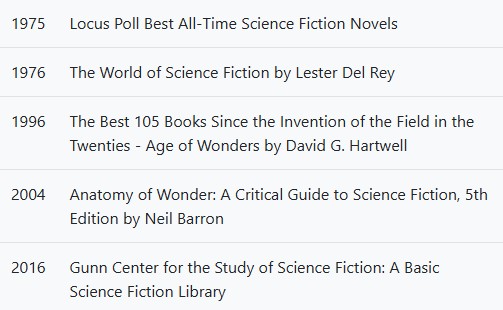
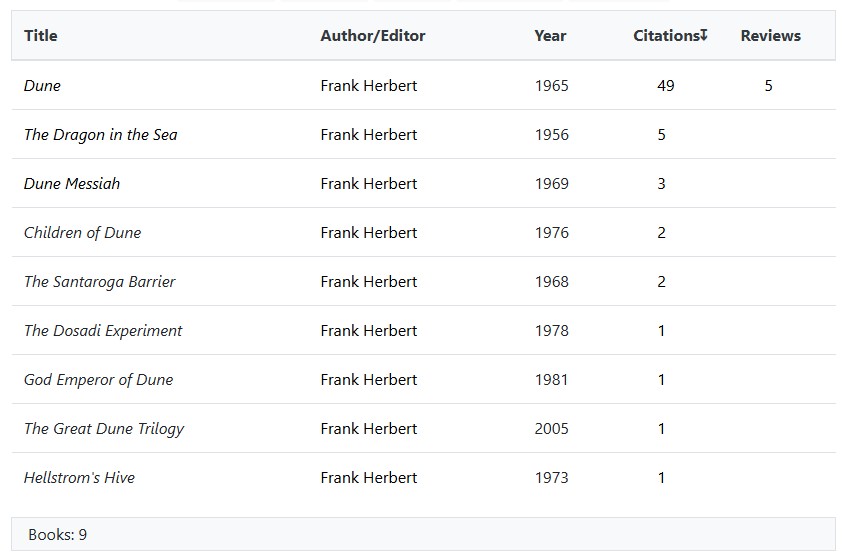
Checking our database, The Dragon in the Sea received five citations, the second most of Herbert’s novels. The citations were from:
James Wallace Harris, 10/6/25
 Classics of Science Fiction
If it wasn’t for Dune, I suspect Herbert would be a forgotten author today. Of all the non-Dune books of his I’ve read, I’d never want to reread them. Dune on the other hand is a permanent favorite to reread 🙂
LikeLiked by 1 person
So there’s not much hope of me finding a forgotten gem in his other books? Which nonDune book did you like best?
LikeLiked by 1 person
The White Plague was the one I read in high-school and then again 20 years later 🙂 it did not improve 😀
LikeLike
Hi James,
thanks for your thoughtful review. I’ve read quite a few of the Herbert novels and agree that most of them fall well short of what he delivered in Dune. The two I would recommend are Whipping Star and the Dosadai Experiment, which are a both set in the ConSentiency universe. We are literally dumped into this universe without explanation, and find our way with a similarly uninformed main protagonist as he works his way through to understanding and agency.
There’s some serious hand-wave reality-bending going on, but Herbert does that in Dune too (prescience, multiple potential timelines). Where these two novels excel is political intrigue and lateral solutions to the obstacles the key characters face. Dune does this in spades, as well as introducing us to Sandworms, an entire worked-out ecology and the societal consequences of living on a “waterless” world. The two novels mentioned don’t reach those heights, but would be my next two recommendations in the Herbert pantheon.
LikeLiked by 1 person
If you want to read a Herbert novel postdating DUNE, I’d recommend THE SANTAROGA BARRIER (1967) (a contrary take on a familiar theme–I have described it as the anti-MORE THAN HUMAN) or THE GREEN BRAIN (1966) (could be described as a non-contrary take on a familiar theme, but very weirdly done). I would strongly dis-recommend DESTINATION: VOID (1966, revised later) (turgid and nearly incomprehensible, though apparently there’s a posthumous revised edition which I haven’t seen).
LikeLike
Oops, correction: the revised DESTINATION VOID did not appear posthumously; it was published in 1978.
LikeLike