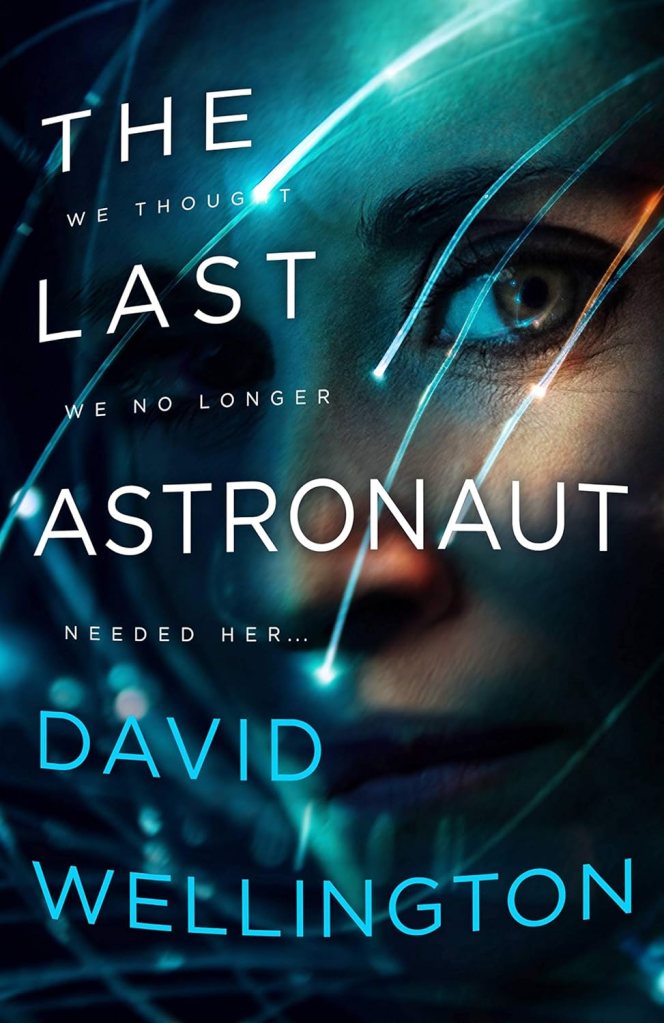
I don’t read many science fiction novels nowadays. I prefer SF short stories. I just don’t read as many books as I used to. However, after my friend Laurie told me about The Last Astronaut by David Wellington, I decided to give it a try. The Last Astronaut is the kind of science fiction thriller that Michael Crichton used to write — fast pace, lots of physical action, and basically fun. The Last Astronaut reminded me how entertaining reading a novel used to be. I wouldn’t call it great, but it does have that page-turning quality.
Now I do have some things to say about it, but what I have to say is full of spoilers. I recommend you go read the novel and then come back here, if you can remember. The Last Astronaut made me think about how science fiction novels change over the years, and how each generation retells old themes in new ways.
The Last Astronaut is about a Big Dumb Object. That’s the official name of a specific science fiction plot device. When I started reading The Last Astronaut, I immediately thought of Rendezvous with Rama. In 2020, The Last Astronaut was nominated for the Arthur C. Clarke Award. Wikipedia even says, “Edward Guimont and Horace A. Smith propose that the origins of the Big Dumb Object trope can be found in H. P. Lovecraft’s novellas At the Mountains of Madness and The Shadow Out of Time, both of which feature human expeditions to immense ancient alien cities in remote parts of our world, and both of which were early influences upon Arthur C. Clarke.”
Funny that they mention H. P. Lovecraft. Because I also thought of Lovecraft while reading The Last Astronaut. Wellington’s novel features horror. Horror like the film Alien, but also horror like Lovecraft’s monstrous alien gods.
The setting, inside the vast alien spacecraft, is dark. Having a story set almost completely in darkness reminded me of Jules Verne’s Journey to the Center of the Earth and The Night Land by William Hope Hodgson.
I’m finally reminded of another story/movie, Fantastic Voyage by Isaac Asimov, along with “Finisterra” by David Moles. This last reminder should give you one huge clue to what’s happening in The Last Astronaut. But I did warn you about spoilers.
My point in this essay is that science fiction is seldom original anymore. The Last Astronaut feels like David Wellington took several of his favorite science fiction themes and blended them into a new SF novel. It succeeds well. I had a lot of problems with the characters because I felt their psychological motivations were too contrived. However, Wellington does use those contrived motivations to wrap up his novel. The ending does make sense and is satisfying.
I was entertained by how Wellington told his story. Wellington places himself in the book as an author in the future, writing a historical novel, but a history that hasn’t happened yet. It’s amusing that one of his characters criticizes the future Wellington for getting his facts wrong. Since we know the story is based on history, there are clues as to who survives and who doesn’t. The audiobook is especially nice because they rig up the audio so that interviews of characters taken after events sound different.
In the 40s and 50s, science fiction writers aimed to create new ideas and themes, but their stories were told without sophistication. In the 60s and 70s, SF writers added literary techniques to their stories. In the 80s and 90s, SF writers upped the ante by going epic. Hyperion is a great example. In the 21st century, SF writers have had to constantly find new ways to tell stories that have already been told.
If you haven’t read old science fiction, new science fiction seems novel. If you have read old science fiction, new science fiction feels recycled. That’s not a bad thing, but it makes the stories feel baroque when you cram so many old ideas into one story. Wellington does streamline his novel, so it feels action-packed like old science fiction. In some ways, his storytelling is as speedy as Edgar Rice Burroughs’ stories or pulp fiction.
James Wallace Harris, 6/6/25
 Classics of Science Fiction