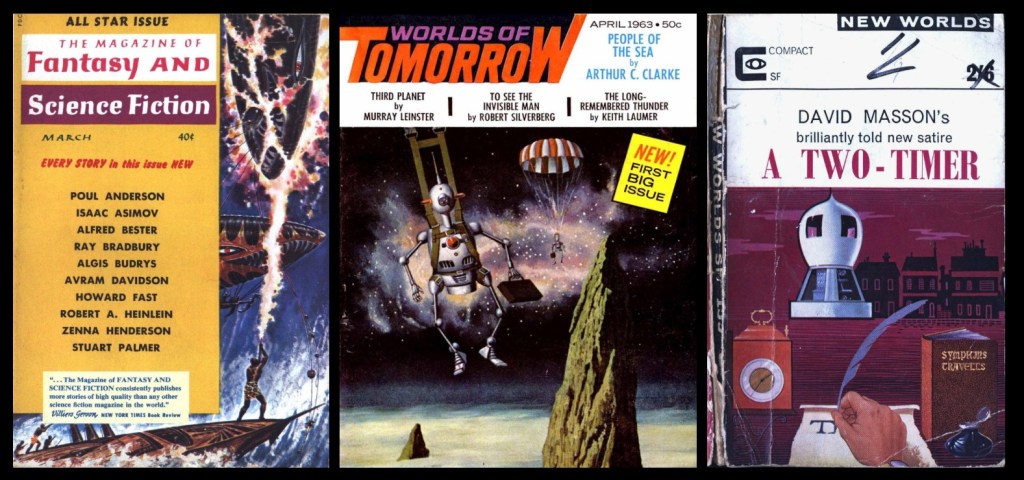
Group Read 92 (#06-08 of 25)
“The Certificate” by Avram Davidson (F&SF, March 1959)
“To See the Invisible Man” by Robert Silverberg (Worlds of Tomorrow, April 1963)
“A Two-Timer” by David I. Masson (New Worlds 159, February 1966) (Amazon)
Back in the sixties, in high school, my friends and I would argue endlessly over science fiction short stories. We didn’t remember them by their title or author, but by whatever neat idea they imagined. I still remember my friend George telling Connell and me about a humorous short story, where a human crewed military spaceship tries to get cooperation from a human colony world where the social norms and economy were wacky. The colonists kept telling the crew “myob” to everything asked. I didn’t learn until years later that this was a famous story by Eric Frank Russell called “… And Then There Were None.” Another story George told us was about an Earthman who fell in love with a girl, and she wanted him to tell him he loved her. But the guy didn’t want to use such a trite phrase, so he left Earth and went all over the galaxy to learn about the preciseness of language. Eventually, he returns to the girl and says, “My dear, I’m rather fond of you.” Of course, the girl was hugely disappointed and rejected the guy. When the guy told his language guru what happened, the guru said, “Lucky devil, vaguely enjoyable was the best I could ever find.” I didn’t discover until decades later that it was “The Language of Love” by Robert Sheckley.”
The point of all this was that we judged science fiction solely on the ideas in the stories, not the plot, characterization, or writing. George read the most and was the best at retelling a story. I think he mainly read anthologies. I read anthologies and magazines. I was more into neat inventions. For example, I told them about the ecologariums in “The Star Pit” by Samuel R. Delany. Connell and I loved Mindswap by Sheckley, and we told everyone about the Theory of Searches. We worked at the Kwik Chek in Coconut Grove, Florida. At the time, its park was a gathering place for would-be hippies. The odds of meeting someone you knew from all over Dade County were increased if you came to the park on Saturdays. That fit Sheckley’s idea that there were optimal places to go if you were searching for someone.
The last three stories we read for the Best Science Fiction and Fantasy Short Fiction Facebook group were all idea stories, the kind my buddies and I would have discussed at Connell’s house on Vista Ct.
“The Certificate” by Avram Davidson is a tight little story about alien invaders who take complete control over humanity, making us their slaves. The aliens create a vast bureaucracy that’s impossible to fight. The aliens also punish us severely if we don’t cooperate. To make matters worse, they have altered us so we heal immediately, so they can torture us over and over again.
The story’s protagonist is Dr. Roger Freeman, who desperately wants a new winter coat. To apply for one involves going through an obstacle course that takes years. But Freeman is finessing the system.
Back in high school, this story would have caused us to argue about how we’d overthrow those aliens. Being young guys, we’d probably claim to know how to start a rebellion, even though Davidson sets up the story to suggest no rebellion is possible. When I read this story this week, the idea didn’t appeal to me much. The story is well-written, with an O. Henry surprise ending. However, it doesn’t offer anything to me as an older reader.
“To See the Invisible Man” by Robert Silverberg seems like a reply to Damon Knight’s classic short story, “Country of the Kind.” Like the Knight story, Silverberg sets up a society with a unique liberal form of punishment. The unnamed first-person narrator is sentenced to a year of invisibility for being cold and detached. He’s not actually made invisible. He’s just branded on the forehead, so anyone who sees him should act like he doesn’t exist. The story is about the psychological changes this character undergoes during the year. The narrator learns that he can steal whatever he wants or visit women’s locker rooms and be completely ignored. But he gets lonely, even desperate for someone to talk to. Silverberg takes us to a different place in his story. His character rebels in a different way by being compassionate.
My buddies and I would have had a lot to say about this story, with each of us coming up with how to handle the punishment. We’d probably argued over whether or not we’d go into the women’s locker room. I would have said that my solution would have been to read science fiction for a year. We did know of “Country of the Kind,” so we would have compared the two, but only about what the two criminals did, not about the writing, plotting, or characterization. Science fiction was about setting up a situation that you could argue over.
“To See the Invisible Man” is a good story. It’s tightly told, immediate, and works. However, it is not nearly as dramatic as “Country of the Kind,” and thus won’t be as memorable.
There’s little likelihood we would have read “A Two-Timer” by David I. Masson in the 1960s because it came out in a British SF magazine. Also, the idea behind this story is probably too subtle for three teenage boys in the 1960s. Joe, the narrator, is a guy from 1683 who steals a time machine and visits 1964. Of course, he doesn’t know it’s a time machine when he discovers it, or comprehends the idea of time travel. He just sees a guy walk away from a weird enclosed chair. He gets in and sees all kinds of dials and buttons labeled with words he doesn’t understand. He pushes a button and goes to 1964. Eventually, Joe figures out how the machine travels in time and space, like the DeLorean in Back to the Future.
The real point of this story is Joe, with his Middle English mind, describing 1964 to the reader. That might have entertained us back in the sixties, but I’m not sure. Old man me, found it very creative. There’s little action in the story. The piece is Masson’s playground for showing off his knowledge about language and history. Present-day me was disappointed that Joe wasn’t inspired to explore time based on his 17th-century knowledge.
I’m getting old and jaded. I find it hard to discover science fiction that thrills me in the remaining years of my life. I’ve loved reading science fiction magazines my whole life, but most of the stories were aimed at readers like my younger self. Masson’s exploration of language is more ambitious and mature than the other two stories, but Masson built his story on a lame plot.
Even though I’ve been reading science fiction for over sixty years, I still want to find stories that thrill me to the same degree as I was at 13. I’m not sure that’s even possible. Breakthrough science fiction novels like Hyperion are rare. But it’s interesting to note that Hyperion would have been a novel that thrilled me and my high school science fiction buddies.
Obviously, many of the stories that wowed me as I grew older would have also thrilled the younger me. For example, “Think Like a Dinosaur” by James Patrick Kelly or “Beggars in Spain” by Nancy Kress.
On the other hand, would “Story of Your Life” by Ted Chiang have inspired our younger selves? We would have avidly talked about translating an alien language, but would we have appreciated the advanced plotting and exceptional writing?
And could we have appreciated “Loneliness Universe” by Eugenia Triantafyllou without having lived through the social media era? Or could my younger self appreciate “Two Truths and a Lie” by Sarah Pinsker, which moved my older self? Wasn’t I mainly moved by the writing? I’m not sure high school Jim could have.
What if we could have read “Press ENTER ■” by John Varley in 1966? Would it blow us kids away like it did me in 1984? Did we need to understand computers and know about the technological singularity first?
I have to assume certain stories in the 1960s were relevant because of my age and current events. That’s why Dangerous Visions was exciting in 1969 but painful to read last year.
I keep looking for old science fiction I missed back then that will thrill me as much now as it would have thrilled me back when — if I had discovered it when I was young. One such book was The Man Who Fell to Earth by Walter Tevis. The trouble is, I think George, Connell, and I would have all thought that story was dull. Isn’t that novel better for the old and jaded?
I need to find cutting-edge science fiction for today that would have thrilled me as a 13-year-old but also a 73-year-old.
By the way, my 1964 self expected a much different 2025 than the one I live in now. There are many nonfiction books about current affairs that, if I could send to my 1964 self, would read more like science fiction than science fiction.
James Wallace Harris, 5/9/25
 Classics of Science Fiction
I remember a story about a man who suffered tidal forces on his body because he flew dangerously close to a black hole. Turned out most of those in my college physics class and all of us wanted to skip the planned lecture to better understand tidal forces. I expected to learn from Sci fi — wish fantasy hadn’t over taken the market.
LikeLike
What was that story? It sounds familiar.
LikeLike
Don’t remember. It was in one of the Big Three sci fi magazines of the 1960’s. Might have been by Niven? I think the Puppeteers were in the story, but could be wrong.
LikeLike
No idea what story that is, but it wouldn’t surprise me if it was Larry Niven who wrote it. He wrote several stories featuring massive gravitational forces—”Neutron Star” and “The Hole Man”, to name but two.
LikeLiked by 1 person
Timothy Zahn filled this kind of niche for me and my friends in the 80’s and 90’s.
Makes me wonder who is filling that area for the kids of today.
LikeLiked by 1 person
The story is indeed Neutron Star by Niven.
Too bad the physics in it turned out to be wrong.
LikeLiked by 1 person
Do you judge the science fiction you read by the same standards you did when you were young, or has what you want from the genre changed as you’ve grown older?Short answer: No… and yes. (If we’re sticking to an ‘OR’ kind of logic.)
I started with Tom Swift, The White Mountains (The Tripods trilogy), and The Mushroom Planet — those were my gateway into science fiction. Then I leveled up with Star Trek — first the TV show, then the paperbacks that adapted all 70-something original episodes. (Lost those books somewhere along the way… still kind of mad about that.)
Later on, after taking a few sci-fi classes in high school and college, I really upped my game. These days, I’m drawn to the big, wondrous stuff: space opera, hard science fiction, stories that make me feel like the universe just got a little bigger.
But I’ll admit, some of the current trends wear me out. Too many robot stories, too much AI everything, or wave after wave of climate change fiction — after a while, it all starts to blur together and burn me out.
But give me space exploration, first contact, alternate histories set in the present or near future? That stuff? I eat it up. Still love it.
LikeLike
Many times when we re-visit stories we read when we were in both grade school and high school is often not as good as we remember it. However, since I always wanted to write, I tended to concentrate more as the plotting rather than many O. Henry endings. In the various volumes of the Histories of science fiction magazines, I read that it was not unusual for editors to buy work from other fans they knew, more often than not just barely into their twenties. Since we are older, when we re-read these older stories do not date very well, since we less naive. Robert A Heinlein does not hold up all that well as far as characterization goes. He had a tin ear for dialogue.
LikeLiked by 1 person
I think that’s true for Heinlein’s work after 1960, but some of his earlier work does have decent characterization. I was just rereading PODKAYNE OF MARS and thought Heinlein create a good voice for Poddy. I thought Hugh Farmham was his last good characterization, even though it’s in a bad book. Hugh was an asshole version of the Heinlein character. Now Heinlein probably thought Hugh was a competent man and justified in his actions but the way he was written also revealed that Hugh could be a total asshole.
LikeLike
You are right.
LikeLike