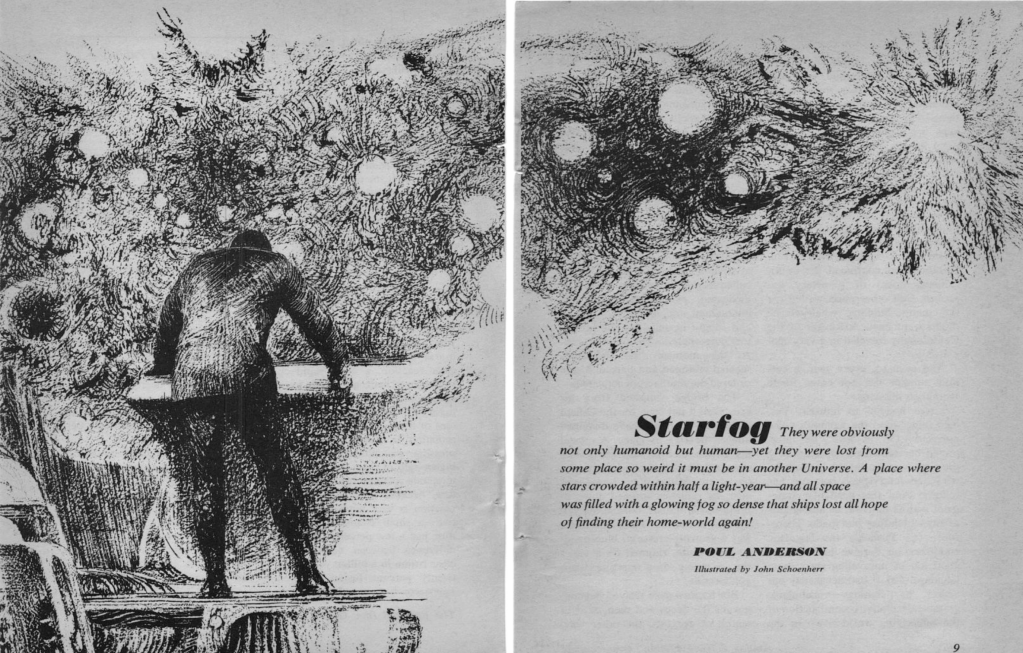
If I was pitching “Starfog” by Poul Anderson to a movie producer, I say “Two women are in love with Daven Laure, one is a spaceship computer and the other a mutant human who claims to be from another universe.” I also mention it’s a hard science fiction space opera dealing with a rare astronomical phenomenon reminiscence some episodes of Star Trek: The Next Generation on one hand with the scope and speculation of the Culture Novels of Iain M. Banks on the other.
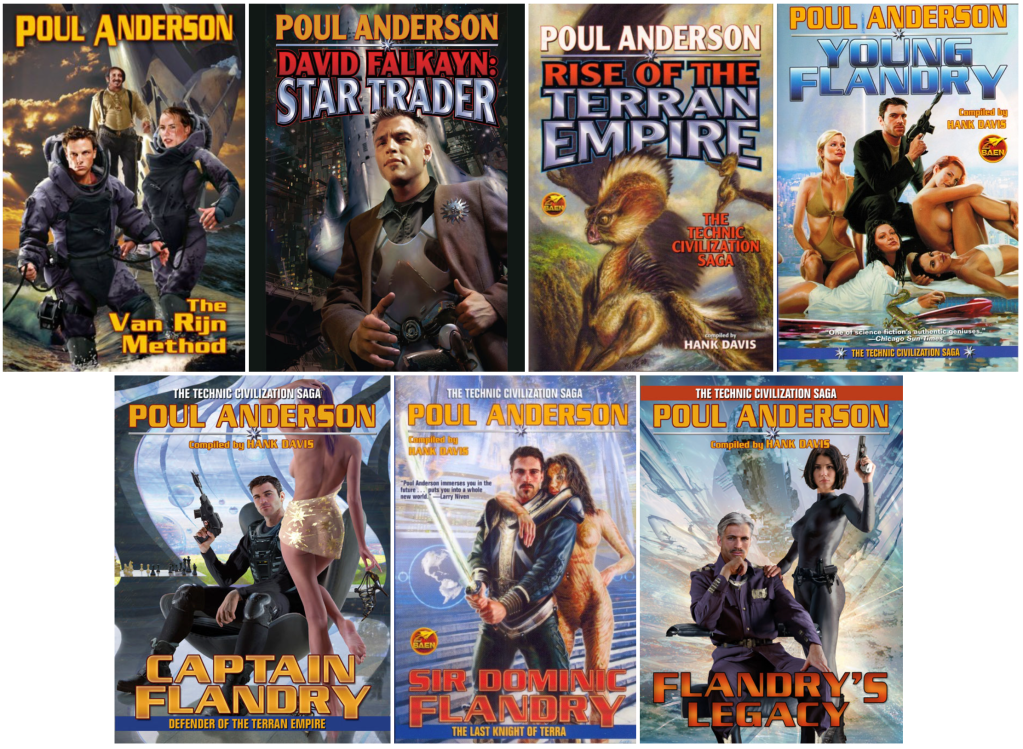
“Starfog” is the last story in the seventh and final volume of the Technic Civilization Saga, the one called Flandry’s Legacy. (Available in paper, ebook, and audiobook at Amazon.) See the ISFDB.org listing of all the Technic Civilization stories here.
Theoretically, “Starfog” might make a good science fiction adventure movie if they could drastically reduce Anderson’s talky dialog and somehow make the characters endearing. I confess that I’ve never felt any emotional attachment to any of Poul Anderson’s characters. His science ideas are often epic, but his political philosophizing gets crusty.
The setup for the story is a compelling mystery. A spaceship is discovered with a crew that appears human, and despite their strange language, seem to have cultural hints of Earth’s past. But they claim they come from a different universe where space is radically different.
“Starfog” is set five thousand years after Earth achieves space travel according to Sandra Miesel’s chronology of the Technics Civilization stories in Against Time’s Arrow: The High Crusade of Poul Anderson. (You can check it out at Archive.org.) Paul Shackley writes about Miesel’s timeline here and updates it. Baen includes the timeline in the books of the series.
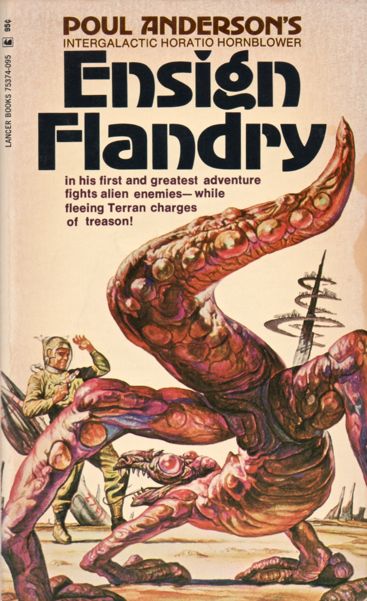
Daven Loure, and his intelligent spaceship Jaccavrie are explorers in a new galactic civilization of humanity called the Commonality. The other stories are about Van Rijn, David Falkayn, and Dominic Flandry written over four decades. I’m afraid the current covers of the books (see above) imply a different feel than the actual stories. However, older covers are just as cheesy.
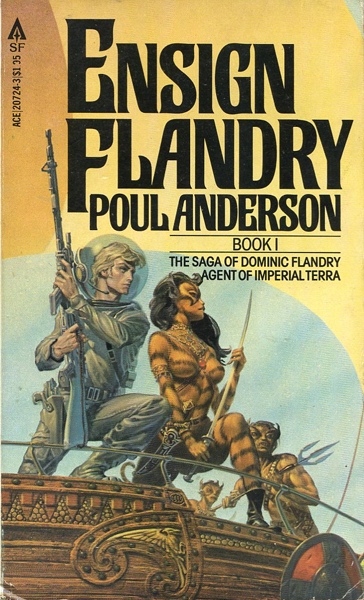
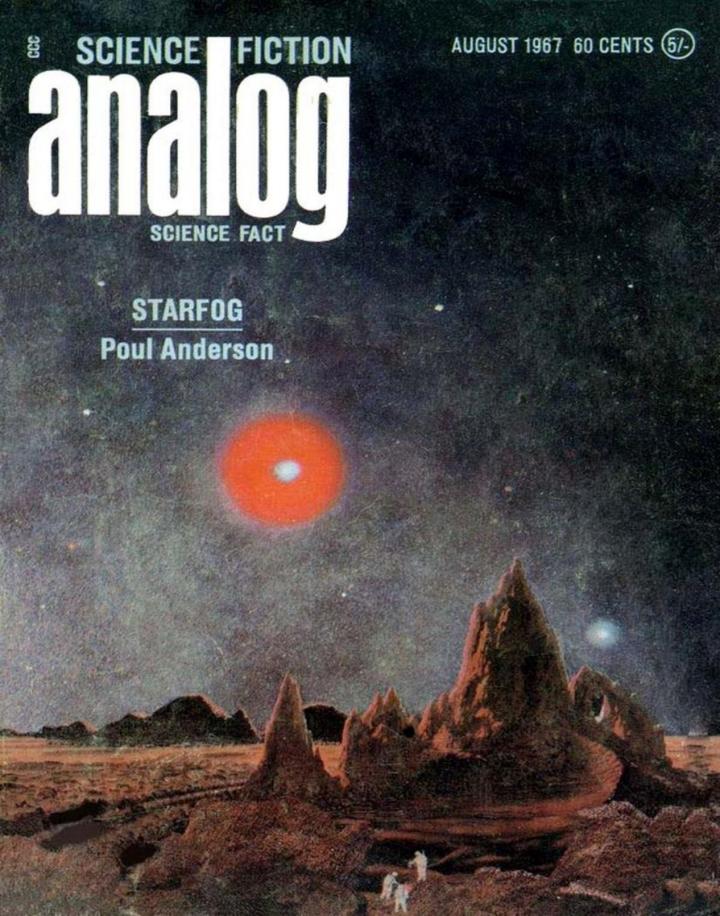
“Starfog” doesn’t come across like these covers. It’s just a little less dignfied than the Analog cover from when it was first published in August 1967.
Although I haven’t read the series but from reading about the various stories, I’m guessing the quality of storytelling is somewhat like Larry Niven’s Known Space stories. I might read more of Flandry’s Legacy, which includes three novels, two novellas, and one novelette in the series.
However, Anderson’s stories don’t fit my current craving for science fiction. Everyday life in 2025 is wilder than fiction, wilder than science fiction. Sadly, “Starfog” just seemed dull in comparison. Events of recent years is making me rethink about science fictional futures. Most science fiction just doesn’t have the cutting edge of our ever sharpening reality.
Most science fiction is perfect for escaping from reality. But I’m craving the kind of science fiction that plays off of reality. Nothing I’ve found lately says anything about our present and near future. We need the kind of vicious writers who can extrapolate and speculate about our exploding society. Sharp tongue writers like Mark Twain, Gore Vidal, Kurt Vonnegut, Barry Malzberg, Oscar Wilde, Aldous Huxley, Jerzy Kosinksi, Dorothy Parker, George Orwell, Joseph Heller, and Philip K. Dick.
We don’t need science fiction that gives us grownup fairytales about the far future. We need writers that cane us about our head and shoulders like a great Zen Master. We need to read books that pistol whip us until we accept reality and reject our delusions.
James Wallace Harris, 1/28/25
 Classics of Science Fiction
Have you read Octavia Butler? It’s become fashionable to describe PARABLE OF THE SOWER and PARABLE OF THE TALENTS as books that would fit your criteria. For once the fashion is pretty accurate.
LikeLike
I started listening to PARABLE OF THE SOWER this morning. I’ve read DAWN and come of Butler’s short stories. At Clarion West 2002, Octavia Butler spent an afternoon with us. I wish I had read her stuff before then.
LikeLike
Jim, your last paragraph is very well and eloquently said. I must admit, however (I’m somewhat abashed to say this), that when it comes to science fiction (and other forms of fantastic literature) I’m drawn to adult fairy tales more than to works that rub our noses in reality. I feel I get enough reality in all the news and commentary I follow about the climate catastrophe, the ongoing fascist coup in the U.S., etc. (I’m writing from Canada.)
LikeLike
Carl, I believe we need both kinds of science fiction. But when the going gets tough we need tough writers that tell it like it is. If SF writers extrapolated on the current path the U.S. is taking they might scare some people straight. We need a NINETEEN EIGHTY-FOUR right now.
LikeLike
What you describe is what the Mundane manifesto, by Geoff Ryman et al, calls for. Science fiction should be realistic and strictly bound by our understanding of the laws of science. You probably are familiar with the manifesto, but if not, check it out. As for me, I read mostly for entertainment, so I’m fine with hyperdrives and such if they allow for a good story. Some uncharitable soul described the Mundane manifesto as “they hate the idea that someone, somewhere, might be having fun”.
LikeLiked by 1 person
I think there is room for both types of science fiction. I love fun SF too. I didn’t say this directly but “Starfog” is somewhat fun. I wanted it to be more fun in fact.
I don’t remember reading the Mundane Manifesto but it sounds like something I’d like.
LikeLike
Do you mind reading science fiction that connecting heavily with politics like criticism of governments or social systems? For example, a virus blunted the president’s brain and people comically found they actually worked better with a stupid president.
LikeLike
What book was that?
I loved books like NINETEEN EIGHTY-FOUR and THE HANDMAID’S TALE.
LikeLike
I also find interesting some of the less well-known dystopias such as Jack London’s 1907 The Iron Heel, and Zevgeny Zamyatin’s We, written in the early twenties. There’s one I’d like to read called Swastika Night, published in 1937, by Katherine Burdekin (writing under the pseudonym Murray Constantine). She envisioned (even before WWII) a world dominated by Nazi Germany. I understand that she was especially concerned with the macho, misogynistic aspects of Nazi ideology.
LikeLike
I’ve read WE and read about THE IRON HILL and SWASTIKA NIGHT. Maybe I should get to them soon because of recent events.
LikeLike