“The Potter of Bones” by Eleanor Arnason

Asimovs-2002-09

The first story in The Very Best of the Best edited by Gardner Dozois is “The Potter of Bones” by Eleanor Arnason. It originally appeared in Asimov’s Science Fiction from 2002. This story is part of Arnason’s Hwarhath series of tales about a planet of intelligent fur-covered beings where homosexuality is the norm for relationships and heterosexuality is used for procreation. Eleanor Arnason stories explore the themes of art, anthropology, sociology, sexuality, and feminism by creating science fiction stories that feel like folk tales and allegories. The narrator of “The Potter of Bones” is from the planet’s present time, and she is telling stories that come down from early history, that could be closer to myths.

The heroine of this story is Tulwar Haik. Tulwar is a clan name, so her personal name is Haik. She has become a legendary figure on this alien planet. Haik was a potter who loved finding fossils and is known on her world for developing the theory of evolution. Haik’s story recapitulates Darwin’s discoveries on Earth. “The Potter of Bones” uses a richly drawn fantasy about aliens that sound human but look like furry animals to comment on human society, especially about gender and race.

Is this story science fiction? Eleanor Arnason’s stories often remind me of stories by Ursula K. Le Guin. They’re set on other worlds, which makes them science fiction, but they often feel like folk tales, which makes me think they’re fantasy. Their stories are intensely sociological and often come across as fables for grown-ups.

I am listening to The Very Best of the Best while thinking about the nature of science fiction and how it is written. Being the lead story in a collection of science fiction that claims to be the very best of the best, suggests that Gardner Dozois must have loved “The Potter of Bones” very much. He bought it for Asimov’s when he was the editor there, included it in his annual best-of collections for America and Great Britain and reprints it again here. I had read “The Potter of Bones” when it came out because I like Arnason’s stories about Hwarhath. I found it a compelling read, especially now that I got to listen to it, and thoroughly enjoyed the story, but to be honest, it’s not my kind of science fiction.

How can “The Potter of Bones” be science fiction that entertained me a great deal and not be my kind of science fiction? And how many kinds of science fiction are there? See, that’s why I want to review the stories in The Very Best of the Best. I’ve listened to the first three stories since yesterday (and two are novellas) and even though each is dazzling in their own way, none of them were my kind of science fiction.

I’ve always wanted to write science fiction. And I’ve tried. I’ve even attended Clarion West Writer’s Workshop, but my stories were never any good. I’m reading and listening to this anthology very closely to study what makes science fiction tick. “The Potter of Bones” stands out for its worldbuilding. Arnason has been writing Hwarhath stories since 1993. They were collected into Hwarhath Stories: Transgressive Tales by Aliens in 2016. I generally disliked science fiction series because my favorite aspect of science fiction is its ideas, so stories that constantly recycle its world-building ideas seem less impressive with each successive story.

However, I’m discovering why writers love writing stories in a series. It takes a tremendous mental effort to create new worlds for science fiction. The reason why the Harry Potter stories are the most successful on the planet today is that J. K. Rowling imagined such an incredibly detailed fictional world. Starting from scratch every time you sit down to write a story would give each story a costly overhead. If the writer can assume their readers already understand how the fictional world works they can get down to the storytelling quicker.

Reading the stories in The Very Best of the Best perfectly illustrates the importance of world-building to writing science fiction and fantasy. It often explains why stories get rated 5-stars at Rocket Stack Rank. It also tells me that if I want to write science fiction I’ve got to up the information density of my fiction to include an abundance of imagined details. Here’s the opening for “The Potter of Bones”:

The northeast coast of the Great Southern Continent is hilly and full of inlets. These make good harbors, their waters deep and protected from the wind by steep slopes and grey stone cliffs. Dark forests top the hills. Pebble beaches edge the harbors. There are many little towns. 

The climate would be tropical, except for a polar current which runs along the coast, bringing fish and rain. The local families prosper through fishing and the rich, semi-tropical forests that grow inland. Blackwood grows there, and iridescent greywood, as well as lovely ornamentals: night-blooming starflower, day-blooming skyflower and the matriarch of trees, crown-of-fire. The first two species are cut for lumber. The last three are gathered as saplings, potted and shipped to distant ports, where affluent families buy them for their courtyards. 

Nowadays, of course, it’s possible to raise the saplings in glass houses anywhere on the planet. But most folk still prefer trees gathered in their native forests. A plant grows better, if it’s been pollinated naturally by the fabulous flying bugs of the south, watered by the misty coastal rains and dug up by a forester who’s the heir to generations of diggers and potters. The most successful brands have names like “Coastal Rain” and emblems suggesting their authenticity: a forester holding a trowel, a night bug with broad furry wings floating over blossoms.

Can you even count every detail that Arnason thought up as she typed those sentences? And don’t confuse the technical term “world-building” used in science fiction to mean just describing how a fictionalized world works. In the next story in this anthology, Charles Stross describes Earth just a few decades into the future and it is overflowing with strangely different details, each of which had to be imagined by Stross. World-building can include any detail that paints the science fiction or fantasy of a story. Here’s how we learn that Haik got into fossils:

The young Tulwar, her playmates, found the topic boring. Who could possibly care about shells made of stone? “They don’t shimmer like living shells, and there’s nothing edible in them. Think about living shellfish, Haik! Or fish! Or trees like the ones that support our family!” 

If her kin could not answer her questions, she’d find answers herself. Haik continued her study. She was helped by the fact that the strata along the northeast coast had not buckled or been folded over. Top was new. Bottom was old. She could trace the history of the region’s life by climbing up. 

At first, she didn’t realize this. Instead, she got a hammer and began to break out fossils, taking them to one of the town’s many empty houses. There, through trial and error, she learned to clean the fossils and to open them. “Unfolding with a hammer,” she called the process. 

Nowadays we discourage this kind of ignorant experimentation, especially at important sites. Remember this story takes place in the distant past. There was no one on the planet able to teach Haik; and the fossils she destroyed would have been destroyed by erosion long before the science of paleontology came into existence. 

She began by collecting shells, laying them out on the tables left behind when the house was abandoned. Imagine her in a shadowy room, light slanting through the shutters. The floor is thick with dust. The paintings on the walls, fish and flowering trees, are peeling. Haik—a thin red adolescent in a tunic—bends over her shells, arranging them. She has discovered one of the great pleasures of intelligent life: organization or (as we call it now) taxonomy. 

This was not her invention. All people organize information. But most people organize information for which they can see an obvious use: varieties of fish and their habits, for example. Haik had discovered the pleasure of knowledge that has no evident use. Maybe, in the shadows, you should imagine an old woman with white fur, dressed in a roughly woven tunic. Her feet are bare and caked with dirt. She watches Haik with amusement. 

In time, Haik noticed there was a pattern to where she found her shells. The ones on the cliff tops were familiar. She could find similar or identical shells washed up on the Tulwar beaches. But as she descended, the creatures in the stone became increasingly strange. Also, and this puzzled her, certain strata were full of bones that obviously belonged to land animals. Had the ocean advanced, then retreated, then advanced again? How old were these objects? How much time had passed since they were alive, if they had ever been alive? Some of her senior kin believed they were mineral formations that bore an odd resemblance to the remains of animals. “The world is full of repetition and similarity,” they told Haik, “evidence the Goddess has little interest in originality.”

Now part of this world-building is character development. Notice how Arnason brings in human history to weave her story. Arnason needs to know geology and archeology to sculpt her theme. And taxonomy played a very important part in Darwin’s discovery of evolution.

“The Potter of Bones,” tells several stories about Haik. I won’t quote them all, but Haik has to become a potter. Eventually, she becomes a lover of a traveling actress, Dapple. Haik has children, which Arnason uses to explain mating customs. And Haik grows old. “The Potter of Bones” gathers the legends about Haik and Dapple that the narrator uses to understand their planet’s history, which lets Arnason comment on how we know what we know about our past. “The Potter of Bones” is also about the different forms of communicating history and story.

Eleanor Arnason uses her stories about furry aliens to analyze human society. Does that mean a good science fiction writer must also be a philosopher and cultural observer? If I just consider the three stories I’ve read so far in this anthology, then the answer is a definite yes.

I’ve always judged science fiction by the validity of its speculation about future technology or if extrapolated trends will actually unfold. With Arnason and writers like Le Guin, should I wonder if their imagined aliens and alien societies could possibly exist? Ultimately, isn’t the world-building in “The Potter of Bones” more akin to Mission of Gravity by Hal Clement or Dragon’s Egg by Robert L. Forward than to Kim Stanley Robinson’s Mars trilogy?

Or, is Arnason’s world-building more like Tolkien’s Middle Earth, not meant to be speculation at all, but a deeply adult fairy tale? Gardner Dozois calls “The Potter of Bones” science fiction. The story is about geology, fossils, evolution, classification, taxonomy, so there is a lot of science in it. Of course, it could be a fantasy that uses science rather than magic as its unifying theme.

My kind of science fiction are stories that speculate and extrapolate about the future. There are all kinds of science fiction, and I read all kinds. But the kind I love most is the science fiction that teaches me about the future in the same way history helps me model the past. “The Potter of Bones” is not that kind of science fiction. Of course, it might be science fiction that teaches us about who we are now.

Recommended Reading

James Wallace Harris, 2/28/19


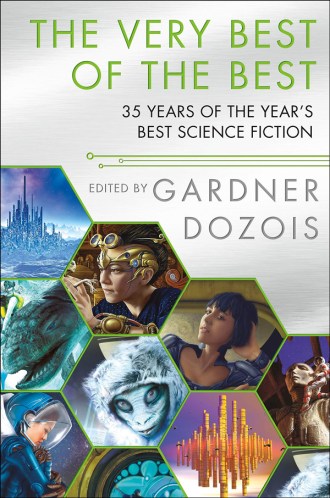
The Very Best of the Best: 35 Years of the Year’s Best Science Fiction edited by Gardner Dozois

The-Very-Best-of-the-Best-edited-by-Gardner-Dozois

Yesterday Santa Claus came to visit me in February. Since 2002 when I joined Audible.com, I’ve wished for an audiobook edition of one of Gardner Dozois giant Year’s Best Science Fiction annuals. Sadly, Dozois died last May and none of the 35 volumes were ever produced on audio. But before he died, he created The Very Best of the Best: 35 Years of the Year’s Best Science Fiction and it’s out in hardcover, ebook and audiobook editions.

Unfortunately, the subtitle to this volume is flat out wrong. It only collects the best stories from 2002-2017, but that’s because Dozois had already published The Best of the Best: 20 Years of the Year’s Best Science Fiction back in 2005 and The Best of the Best Volume 2: 20 Years of the Best Short Science Fiction Novels in 2007. I had hoped this new volume would have been Dozois legacy collection reflecting the full 35 years. But be that as it may, it’s still a giant collection of great science fiction and over 39 hours of science fiction short stories on audio, which is something I love. Vivienne Leheny and Will Damron do a fantastic job of narrating these stories, and my new wish is for someone to hire them to create audiobook editions of the earlier volumes.

Last year the three volumes of The Science Fiction Hall of Fame came out on audio. That means I can listen to some of the most remembered science fiction short stories from 1926-1964. This is why I had hoped this new audiobook would have given me the best short science fiction from 1984-2017 to listen to, but that hasn’t happened. I’m not complaining. This new book is great in both quality and quantity, and I’m quite appreciative of all the wonderful stories I’m getting to hear for the first time. I’m just greedy and want more. I want audiobook publishers to produce more anthologies of great short science fiction, and I’m now particularly anxious to hear the best short fiction from 1965-2001.

And, there’s even another problem for me, other readers, editors, and publishers. No one reader, no matter how experienced, can identify all the best stories for all readers. Tastes just vary too much. If you look at our Classics of Science Fiction Short Stories by Year list, which has the citations listed for each story, you can see which stories Gardner picked as his favorite, and which ones he didn’t. Or if you use our CSF Query program to look at stories for 2002-2017 you’ll see only one story Gardner picked for The Very Best of the Best on our list.

The 38 stories from The Very Best of the Best covering 2002-2017 with links to my reviews are:

  • The Potter of Bones by Eleanor Arnason
  • Rogue Farm by Charles Stross
  • The Little Goddess by Ian McDonald
  • Dead Men Walking by Paul McAuley
  • Tin Marsh by Michael Swanwick
  • Good Mountain by Robert Reed
  • Where the Golden Apples Grow by Kage Baker
  • The Sledge-Maker’s Daughter by Alastair Reynolds
  • Glory by Greg Egan
  • Finisterra by David Moles
  • The Illustrated Biography of Lord Grimm by Daryl Gregory
  • Utrinsque Cosmi by Robert Charles Wilson
  • Events Preceding the Helvetican Renaissance by John Kessel
  • Useless Things by Maureen McHugh
  • Mongoose by Elizabeth Bear and Sarah Monette
  • Hair by Adam Roberts
  • The Things by Peter Watts
  • The Emperor of Mars by Allen M. Steele
  • Flower, Mercy, Needle, Chain by Yoon Ha Lee
  • Martian Heart by John Barnes
  • The Invasion of Venus by Stephen Baxter
  • Weep For Day by Indrapramit Das
  • The Girl-Thing Who Went Out For Sushi by Pat Cadigan
  • The Memcordist by Lavie Tidhar
  • The Best We Can by Carrie Vaughn
  • The Discovered Country by Ian R. MacLeod
  • Pathways by Nancy Kress
  • The Hand Is Quicker… by Elizabeth Bear
  • Someday by James Patrick Kelly
  • The Long Haul, From the Annals of Transportation, The Pacific Monthly, May 2009 by Ken Liu
  • Three Cups of Grief, By Starlight by Aliette De Bodard
  • Calved by Sam J. Miller
  • Emergence by Gwyneth Jones
  • Rates of Change by James S.A. Corey
  • Jonas and the Fox by Rich Larson
  • KIT: Some Assembly Required by Kathe Koja and Carter Scholz
  • Winter Timeshare by Ray Nayler
  • My English Name by R.S. Benedict

Our meta-list system recognized 37 stories from the same period:

  • Breathmoss by Ian R. MacLeod
  • The Cookie Monster by Vernor Vinge
  • The Empire of Ice Cream by Jeffrey Ford
  • The Empress of Mars by Kage Baker
  • Singing My Sister Down by Margo Lanagan
  • The People of Sand and Slag by Paolo Bacigalupi
  • The Voluntary State by Christopher Rowe
  • Little Faces by Vonda N. McIntyre
  • Magic for Beginners by Kelly Link
  • The Calorie Man by Paolo Bacigalupi
  • The Little Goddess by Ian McDonald
  • The House Beyond Your Sky by Benjamin Rosenbaum
  • Yellow Card Man by Paolo Bacigalupi
  • The Merchant and the Alchemist’s Gate by Ted Chiang
  • 26 Monkeys, Also the Abyss by Kij Johnson
  • Exhalation by Ted Chiang
  • The Gambler by Paolo Bacigalupi
  • The Ray-Gun: A Love Story by James Alan Gardner
  • Eros, Philia, Agape by Rachel Swirsky
  • Spar by Kij Johnson
  • The Island by Peter Watts
  • The Lady Who Plucked Red Flowers Beneath the Queen’s Window by Rachel Swirsky
  • The Sultan of the Clouds by Geoffrey A. Landis
  • The Things by Peter Watts
  • Under the Moons of Venus by Damien Broderick
  • The Man Who Bridged the Mist by Kij Johnson
  • The Paper Menagerie by Ken Liu
  • Close Encounters by Andy Duncan
  • Botanica Veneris: Thirteen Papercuts by Ida Countess Rathangan by Ian McDonald
  • The Game of Smash and Recovery by Kelly Link
  • Seasons of Glass and Iron by Amal El-Mohtar
  • The Visitor from Taured by Ian R. MacLeod
  • Things with Beards by Sam J. Miller
  • Touring with the Alien by Carolyn Ives Gilman
  • A Series of Steaks by Vina Jie-Min Prasad
  • The Martian Obelisk by Linda Nagata
  • The Secret Life of Bots by Suzanne Palmer

Practically no overlap. Why? If The Very Best of the Best is actually what it says it is, why don’t we see more overlap with the stories our system identified by means of tracking popularity? An easy answer is there’s a lot of great SF short stories, more than enough for every editor to pick different favorites. But what if there are other motives besides claimed quality that go into selecting a story for a best-of anthology?

For example, the first story in The Very Best of the Best is “The Potter of Bones” by Eleanor Arnason. It’s a beautiful tale that was nominated for a Nebula but has only been reprinted in anthologies edited by Gardner Dozois or Arnason’s own collection. I don’t know if Gardner intentionally selected stories that hadn’t been reprinted often, or if Gardner has a very unique taste in science fiction. My guess, it’s a little of both. An honest title for this collection might be Gardner Dozois’ Favorite Science Fiction from 2002-2017 That He Believes Deserves More Attention.

On the other hand, the second story “Rogue Farm” by Charles Stross, has been included in at least seven anthologies. That seems to disqualify my theory, but I’m not sure.

A troublesome paradigm shift is going on in publishing short science fiction right now. The short stories that get the most attention, especially for awards, are those that are published online where people can read them for free. And it’s becoming more common for online publishers to include both a text and an audio edition. Free online stories compete for readers with stories that are published in magazines or original anthologies behind another kind of paywall. The old print magazines, Analog, Asimov’s and F&SF have dwindling readerships. The prestige of getting published used to be seeing your work in print. But I wonder if short story writers now prefer online publications because they get more readers.

I could speculate endlessly about what are the best SF short stories or how they are identified by editors and discovered by readers, but the bottom line is I’m very happy with The Very Best of the Best. I hope thousands of SF fans buy and listen to it because that should encourage audiobook publishers to produce more SF anthologies on audio. But if you don’t like audiobooks, there are print and ebook editions.

Finally, there are two tributes to Gardner by Robert Silverberg and James Patrick Kelly that I want to recommend. They just appeared in the new issues of Asimov’s Science Fiction but are available to read online. I got to study with Gardner when he spent a week as our resident instructor for the Clarion West workshop I took in 2002. He was a man I will remember and I’ll always be grateful for his encouragement and writing lessons.

James Wallace Harris, February 27, 2019

What Are The Magic Ingredients That Make Me Love a Short Story?

AFF_JanFeb2019_400x570

On Monday, my friend Mike told me to read “The Fading Pages of a Short Story” by Bud Sparhawk in the Jan-Feb 2019 issue of Analog. Three days later I’m still thinking about it. Mike warned me that Rocket Stack Rank (RSR) had not liked it. I read the story and found it moving. I assumed RSR had only given it 3-stars, but when I checked, “The Fading Pages of a Short Story” had just 1-star.

What were the magic ingredients in “The Fading Pages of a Short Story” that made Mike and I resonate with the story but were missed by Rocket Stack Rank? My routine way of selecting the latest short science fiction to read is to check RSR and go after the 5-star stories. This means I wouldn’t have read “The Fading Pages of a Short Story” on my own. I’m grateful to Mike recommended the story because the story worked on me and pushed my emotional buttons.

Several reviewers have dismissed this story as sentimental. Are Mike and I emotional saps who are suckers for stories that make our eyes water? I don’t know about Mike, but I am. Does that make “The Fading Pages of a Short Story” a 5-star story in my heart? Well, not quite.

I don’t want to rate stories, but I do want to promote them. Let’s face it, the short story is a dying art form, but one I admire. To be upfront and honest, I want you to buy science fiction magazines and read more short stories because I want the market to thrive and not go extinct. But what’s the best way to do this? Rocket Stack Rank has its system which I use and recommend, but it’s not perfect. If you learn their system I believe it’s reliable for rating stories by its standards.

However, if you don’t normally read science fiction short stories, you won’t become a fan if you try a couple and don’t like them. It helps to have a pusher to get you hooked. There are all kinds of stories for all kinds of readers. That makes it hard for us story pushers to get people to read a particular story.

If I review a story I have to carefully point out what works for me in a way that is understandable to you. If we can’t find a common wavelength to communicate on, there’s no reason for you to try the stories I push, or even read what I write.

So why exactly did I like “The Fading Pages of a Short Story” by Bud Sparhawk?

  1. The story is about an old man, David, losing his memory. I’m an old guy worried about losing my memory.
  2. The old guy is a science fiction writer who reads his own stories having forgotten he wrote them. I can already rewatch a Perry Mason I saw two months ago and not remember the plot.
  3. Sparhawk proposed a gadget he calls a memory-aid (think hearing aid) that helps with short-term and long-term memory. Great idea for SF short story.
  4. The story conflict deals with the old man’s children, Bill and Gwen, trying to decide if they should spend their own savings for a memory-aid for their aging father. Tough call.
  5. The story makes me wonder what would I do in the same situation, either for an older person or for myself.
  6. The story makes me fantasize how I would have told the same story differently.

Sparhawk’s story moved me, but I thought it had problems. Storytelling problems often make me stop reading. But sometimes they make me obsess over the story – like now. Often I like the idea but not the execution. I actually love stories I want to rewrite using my own personal insights because I believe the writer came up with a wonderful situation.

The main flaw of “The Fading Pages of a Short Story,” which could have been an editor’s tweaking, is making David 98. Who would consider spending the price of a house to get a memory-aid for a 98-year-old man? If he had been 68, then the decision would have been realistic and heartwrenching. It would have also fixed some secondary problems. If David is 98, Bill and Gwen should be in their 60s or 70s. They should be old enough to have their own memory problems. But in the story, Gwen still has kids at home. Clues suggest the story takes place in the 2030s, and David began writing at the beginning of the century, which would make him around 70. That doesn’t work. I can’t but wonder if 98 was a printing mistake.

But there were other little problems that made me pause my reading and think. David says he relies on speed-dialing. That’s an archaic phrase now and will be even more so in the 2030s. You just “call” people with smartphones, but we do rely on them to remember phone numbers. But this problem is an interesting writing problem to contemplate. I still call the refrigerator an “icebox” because that’s what my dad called it, and that was an old fashioned term when he learned it in the 1920s and 1930s. So an old man in the 2030s might still use the phrase “speed dial.” In other words, sometimes what I think of as flaws in the stories might be features.

There were a number of other aspects to the story that made me pause too, but they aren’t really important to why the story moved me. Being moved is the key ingredient. If I had not read the Rocket Stack Rank review I would never have thought about the flaws in this story. I would have finished it with a wonderful sense of existential suffering. A rewarding kind of pain that comes from good stories. Faulker said great fiction is about the heart in conflict with itself.

“The Fading Pages of a Short Story” is a slight story that made me feel something deeply in myself. That’s the magic ingredient to any short story. As someone who wants to write short stories, Sparhawk’s story gave me a lot to think about. But mostly, it made me fear for the future, tear up, and ache. My memories are slipping away and I know what that means, so I identified with David and I felt for him. When I was younger, this story would have meant nothing to me.

On The Astounding Analog Companion, Bud Sparhawk writes “The Bane and Pleasure of Writing” where he mentions having PSS (premature-submission-syndrome). I believe “The Fading Pages of a Short Story” would have gotten more stars with Rocket Stack Rank if he had baked it in the oven longer. Below that linked essay is a Q&A with Sparhawk where he talks about writing “The Fading Pages of a Short Story.” And below that is a bit of biography with his photo. Bud Sparhawk is 81, so he knows something about getting old. He’s also been a regular contributor to Analog for decades.

James Wallace Harris, February 20, 2019


The Winston Science Fiction Series

Winston-Science-Fiction-series

There are pleasures of the past you can buy — if you’re willing to pay the price. For some bookworms who got hooked on science fiction in the 1950s and 1960s, the Winston Science Fiction series aimed at children trigger an intense sense of nostalgia. However, I don’t believe it was the words in those 37 volumes that are burned into our memories, but the cover and endpaper art. Finding one of these stories reprinted without the art doesn’t set off those same intense emotions about the past, at least for me. I often wonder if nostalgia isn’t predominantly a visual thing. I’m in a number of Facebook groups where people are crazy about posting images of the past.

I never owned any of the Winston books as a kid, but got them from my school library, the Miami-Dade County Public Library, or from the Homestead Air Force Base library in the mid-1960s. There were three kinds of science fiction novels aimed at children that I remember from back then. The twelve Heinlein juveniles from Scribners, books by Andre Norton, and the Winston Science Fiction series. When I got my first job I ordered all the Heinlein books in hardback from the publisher. I wish I had ordered the Winston books at the time too. Those Winston books today in VG to Fine condition run hundreds of dollars each if they have the original dust jackets.

Mists of Dawn by Chad Oliver Another important visual bond with these books was the endpaper art that was part of most of the first editions by Alex Schomburg. In fact, this artwork can set off a flurry of comments on the Facebook groups Space Opera Pulp and Science Fiction Book Club. It seems to capture the essence of 1950s science fiction. And it’s a shame that all hardback books don’t all have endpaper art. The Heinlein juveniles did have beautiful endpapers, but just a star pattern, not like the sense-of-wonder artwork below.
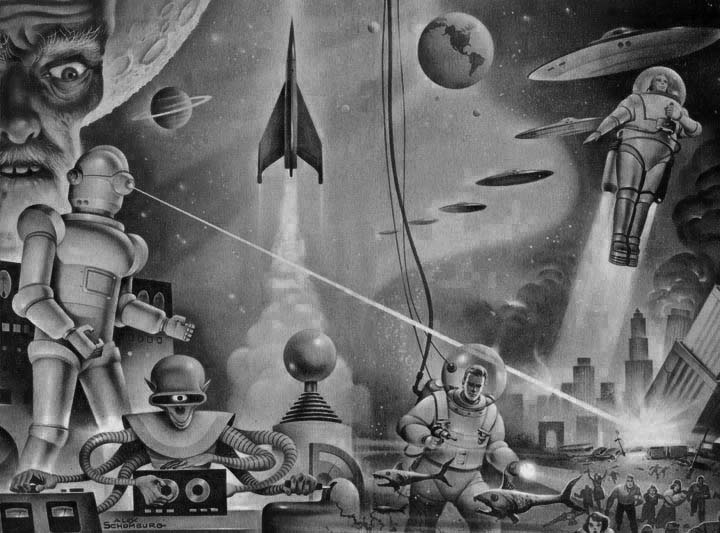
Winston_Endpaper For many years I’d keep an eye out for the Winston Science Fiction books when I shopped at used bookstores. I never saw any. I eventually assume they were all owned by collectors. A few years ago my friend Mike found The Ant Men by Eric North at a library book sale in good condition but without a dust jacket. I was envious of him for his luck. We then found WinstonSciFi that sells reproductions of the dust jackets at very reasonable prices. Now his copy of The Ant Men looks like this one:

The Ant Men by Eric North

The other day Mike and I were shopping at a used bookstore and found a Dover reprint of The Ant Men by Eric North. It had a stylised version of the cover that was okay, but what really shouted at me to buy the book was the original Schomburg endpaper art. I didn’t buy it because the book’s cover looked wrong. I’m still tempted to go back to get it because of the endpaper art.

Last year I discovered that many titles in the Winston Science Fiction series were being sold on Amazon as ebook and trade paperback reprints and they used the original cover art (but not the endpaper art). I ordered one just to check it out, Rockets to Nowhere by Lester del Rey. The publisher of these reprints is Dan Thompson of Thunderchild Publishing from Huntsville, Alabama. He also offers a reprint of The Ant Men with the original cover. You can read about how Dan got into reprinting vintage science fiction here. Like me, Dan also read the Heinlein and Andre Norton books growing up. He discovered that most of the Winston books were out-of-print and thought that was a shame, so he got into the publishing business. A few were in the public domain, but for most, he had to track down the copyright holders to arrange contracts for reprinting. He’s been able to reprint many but not all of the series in both ebook and trade paper editions.

Even though I’d love to own a mint condition original copy of Rockets to Nowhere, having Dan’s trade paperback reprint visually fulfills my nostalgic needs.

Rockets-to-Nowhere---both-editions

Of course, I would prefer to own the 1st-edition, but I don’t want to spend $200. $7.99 is a great compromise between my eyes and my bank account.

If you’d like to see what the other covers look like for the entire series, check out Worlds Without End. Publication history and other details can be found at ISFDB.org.

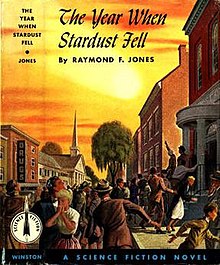
The-Year-When-Stardust-FellSome of these books have never been reprinted, and for some, Thunderchild is the first publisher since Winston to publish them. Which makes me wonder just how good are these stories? I decided to give one a read, but the one I picked wasn’t from Thunderchild. I’ve been wanting to read some Raymond F. Jones, but I now prefer to listen to books. The Year When Stardust Fell was the first one I could find on audio. I got it for $2.99 at Audible.com because I bought the 99 cent ebook edition at Amazon. Thunderchild also sells an ebook and trade paper of this title, and I might get it too because of the cover.

These stories were aimed at children, sometimes even targeted to elementary school kids, but mostly to junior and senior high. I found this story far more adult than I remembered. I don’t think I read The Year When Stardust Fell as a kid, but I had a couple of Deja vu experiences while listening to it. The story is about when Earth passes through a comet’s tail and its dust affects metals, so eventually, all machinery breaks down. Civilization slowly collapses. The story is told from the point of view of Ken Maddox who lives in Mayfield in an unspecified state. Ken’s father is a chemistry professor at a local university. Because of Mayfield being isolated, it’s citizens are able to survive with rationing while in larger cities millions die. As the story progresses the people of Mayfield must learn to live with less and less, and even deal with the moral problem of lifeboat ethics.

Ken and his science club buddies run a ham radio rig that stays in touch with other research sites who are trying to solve the problem of the dust affecting metals. Ken and his buddies also help his father in the lab. This allows the story to emphasize the workings of science. I found the tale thoroughly engaging. It’s not great, but it’s not bad either. To me, it holds up well with other 1950s science fiction stories. In fact, I was always anxious to get back to the story. But then, after-the-collapse stories are among my favorite kind of science fiction story.

Winston-Science-Fiction-at-eBay

To be honest, I can’t remember any of the details from the books I think I read. Of course, I read these stories 55 years ago. I’ll have to read several more to see if I think the series deserves to be remembered for its fiction. What I’m discovering is I want these books because of their physical artistic appeal that trigger my nostalgia. I saw a group of 8 of them on sale at eBay today for $300. The idea of holding those old books again is very tempting, even though $300 could probably get me “reading copies” of the entire series if I shopped carefully. A reading copy in used book terminology meaning its beat to hell but you can still read it. I could get most of them as ebooks for less than $100, and all of Thunderchild trade paper editions for under $300.

Dan says these books aren’t big sellers. It’s probably hard to market books for kids in the 1950s to kids or nostalgic adults in the 2010s. I wonder what will happen to these stories when the baby boomers all die off. I doubt any of them will ever be considered classics of the genre. It’s a shame that Thunderchild doesn’t have the right to publish the entire series again as one uniform set so they might have collector appeal.

Here the complete list of titles with cover artists. My favorites tend to be the ones with Alex Schomburg cover paintings. Links are to Thunderbird trade editions at Amazon.

  1. EarthboundMilton Lesser, cover by Peter Poulton (1952)
  2. Find the Feathered Serpent, Evan Hunter, cover Henry Sharp (1952)
  3. Five Against Venus, Philip Latham (Robert S. Richardson), cover Virgil Finlay (1952)
  4. Islands in the Sky, Arthur C. Clarke, cover Alex Schomburg (1952)
  5. Marooned on Mars, Lester del Rey, cover Paul Orban (1952)
  6. Mists of Dawn, Chad Oliver, cover Alex Schomburg (1952)
  7. Rocket Jockey, Philip St. John (Lester del Rey), cover Alex Schomburg (1952)
  8. Son of the Stars, Raymond F. Jones, cover Alex Schomburg (1952)
  9. Sons of the Ocean Deeps, Bryce Walton, cover Paul Orban (1952)
  10. Vault of the Ages, Poul Anderson, cover Paul Orban (1952)
  11. Attack from Atlantis, Lester del Rey, cover Kenneth S. Fagg (1953)
  12. Battle on Mercury, Erik Van Lhin (Lester del Rey), cover Kenneth S. Fagg (1953)
  13. Danger: Dinosaurs!, Richard Marsten (Evan Hunter), cover Alex Schomburg (1953)
  14. Missing Men of Saturn, Philip Latham, cover Alex Schomburg (1953)
  15. The Mysterious Planet, Kenneth Wright (Lester del Rey), cover Alex Schomburg (1953)
  16. Mystery of the Third Mine, Robert W. Lowndes, cover Kenneth S. Fagg (1953)
  17. Planet of Light, Raymond F. Jones, cover Alex Schomburg (1953)
  18. Rocket to Luna, Richard Marsten (Evan Hunter), cover by Alex Schomburg (1953)
  19. The Star Seekers, Milton Lesser, cover Paul Calle (1953)
  20. Vandals of the Void, Jack Vance, cover Alex Schomburg (1953)
  21. Rockets to Nowhere, Philip St. John (Lester Del Rey), cover Alex Schomburg (1954)
  22. The Secret of Saturn’s Rings, Donald A. Wollheim, cover Alex Schomburg (1954)
  23. Step to the Stars, Lester del Rey, cover Alex Schomburg (1954)
  24. Trouble on Titan, Alan E. Nourse, cover Alex Schomburg (1954)
  25. The World at Bay, Paul Capon, cover Alex Schomburg (1954)
  26. The Year After Tomorrow, eds. Lester del Rey, Cecile Matschat, and Carl Carmer cover and interior illus. Mel Hunter (1954) – an anthology of nine short stories
  27. The Ant Men, Eric North, cover Paul Blaisdell (1955)
  28. The Secret of the Martian Moons, Donald A. Wollheim, cover Alex Schomburg (1955)
  29. The Lost Planet, Paul Dallas, cover Alex Schomburg (1956)
  30. Mission to the Moon, Lester del Rey, cover Alex Schomburg (1956)
  31. Rockets Through Space, Lester del Rey, cover and interior illus. James Heugh (1957) – Special Companion Book (nonfiction)
  32. The Year When Stardust Fell, Raymond F. Jones, cover James Heugh (1958)
  33. The Secret of the Ninth Planet, Donald A. Wollheim, cover James Heugh (1959)
  34. The Star Conquerors, Ben Bova, cover Mel Hunter (1959)
  35. Stadium Beyond the Stars, Milton Lesser, cover Mel Hunter (1960)
  36. Moon of Mutiny, Lester del Rey, cover Ed Emshwiller (1961)
  37. Spacemen, Go Home, Milton Lesser, cover Ed Emshwiller (1961)

JWH

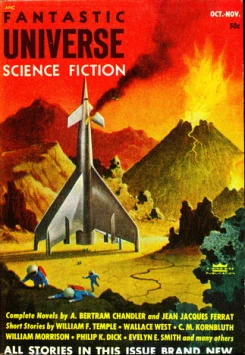
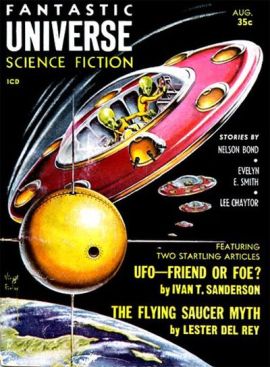
Fantastic Universe (1953-1960)

FANTUNIVAPR1955

I think it’s time we recognize some other science fiction magazines besides Astounding Science Fiction. So I’ve picked Fantastic Universe on a whim. Below, I’m going to list all the issues of Fantastic Universe available to read online at the Internet Archive, but before that, I thought I might explain why. If this column works out, I might do additional magazines.

I’ve recently read four books about Astounding Science Fiction and its editor John W. Campbell, Jr. (Requiem for Astounding by Alva Rogers, The World Beyond the Hill by Alexei and Cory Panshin, Astounding Days by Arthur C. Clarke, and Astounding by Alec Nevala-Lee). Quite often when I read the history of science fiction magazines Hugo Gernsback gets credit for starting Amazing Stories, and John W. Campbell seemingly gets credit for almost everything else. Of course, that’s not true. Time and time again, writers want to write about Campbell and Astounding. I’d like to know about the other editors and their magazines.

fantastic_universe_195310-11Most historians of the science fiction magazines do admit that Campbell’s influence waned in the 1950s as The Magazine of Fantasy and Science Fiction and Galaxy Science Fiction came on the scene. David L. Roshelm did write Galaxy Magazine: The Dark and the Light Years (1986), but as far as I know, no one has written a history of F&SF. There have been dozens of other science fiction magazines published in the 20th-century, and I have to wonder if their editors didn’t discover new writers, give new artists a gallery on their covers, provide letter columns for fans fighting their tempests in a teacup, and book reviewers a place to begin publishing.
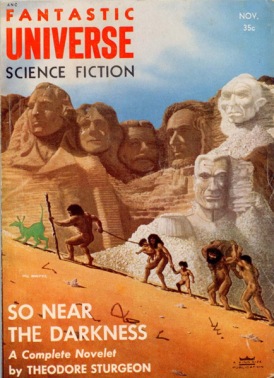
I collect anthologies of science fiction short stories. Most of the stories anthologized from the 1930s and 1940s have come from Astounding Science Fiction. And Astounding, F&SF, and Galaxy seem to dominate when looking at stories collected from the 1950s. Of course, these markets paid more, so their editors got the first look at work from the top writers. Yet, I’ve got to wonder about all those forgotten science fiction magazines, editors, and writers. Did their editors discover new writers? Have anthologists missed story gems from those forgotten magazines?

FANTUNIVNOV1955The four books about Astounding break into two kinds. Rogers and Clarke were fans from the start and go back and review old issues story-by-story they fondly remember. The Panshins and Nevala-Lee were too young to have read Astounding growing up. The Panshins focused on analyzing the impact of stories, while Nevala-Lee focused on the biographies Campbell and his famous writers: Heinlein, Asimov, and Hubbard.
Thus, historians of magazines can choose to write about the stories, writers, or editors, an sometimes about the cover artists, interior illustrators, and book reviewers. Alva Rogers had a collection of Astounding to work with, and Clarke was given a microfilm set of Astounding. Nevala-Lee had digital scans. Having access to old magazines makes writing about them easier.

Because of sites like the Internet Archive, researchers can now read many more old science fiction magazines. It’s a great time for genre scholars to pour through long forgotten issues looking for undiscovered discoveries regarding SF in the 1950s. Fantastic Universe got the reputation for supporting the UFO craze. Whether it’s editor and writers believed in flying saucers, or were trying to make a buck of the craze, is another issue.  Ray Palmer at Amazing Stories and John W. Campbell, Jr. at Astounding both have piles of embarrassing editorials to defend too. And if you lived through the 1950s you’ll know people believed a lot of crazy ideas back then. Just read Confessions of a Crap Artist by Philip K. Dick, which I think is PKD’s best novel.

FANTUNIVAUG1957I thought it would be fun to research a lesser known science fiction magazine and picked Fantastic Universe, which ran from 1953-1960. I did find Leo Margulies: Giant of the Pulps (2017) by Philip Sherman. Supposedly, in the 1930s Leo Margulies edited 46 different pulp titles, but he’s most famous among SF fans for editing Startling Stories and Thrilling Wonder Stories. Sam Merwin, Jr. also worked on those two pulps and others, but I could not find a biography devoted to him. Hans Stefan Santesson seems to have gotten his start with Fantastic Universe and then went on to edit The Saint Mystery Magazine from 1959-1967.
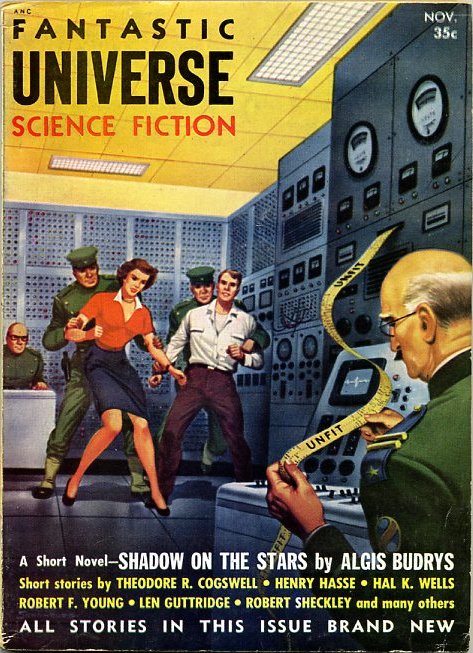
Issue Lists (69)

Volume/Number links to ISFDB to see table of contents.

[IA] links to Internet Archive to read a scanned copy

1953Sam Merwin, Jr.

1954 – editor Beatrice Jones

1954 – editor Leo Margulies

1955 – editor Leo Margulies

1956 – editor Leo Margulies

1956 – editor Hans Stefan Santesson

1957 – editor Hans Stefan Santesson

1958 – editor Hans Stefan Santesson

1959 – editor Hans Stefan Santesson

1960 – editor Hans Stefan Santesson

The Internet Archive is becoming the Library of Congress for the web. It’s only missing 12 of the 69 issues of Fantastic Universe, and I’m pretty sure those issues will show up soon. I used to work in a periodicals department at a university and one of my jobs was tracking down and ordering missing issues. This was back in the 1980s and I had to snail-mail publishers all over the world. As our library ran out of space, we sometimes discarded whole runs of magazines, including a complete bound run of F&SF. That really killed my soul. I wanted them, but state law forbade the library from giving them to people, so they were shipped off to state surplus.

Now that libraries routinely discard items that seldom get used, it’s great that the Internet Archive is collecting everything it can as digital scans. Old pulp and digest magazines are aging badly, disintegrating and disappearing. So, scanning saves them for the future. And by being on the internet, people from all over the world can use them to write about the history of science fiction.

In the future, I’m hoping to see more books like Astounding by Alec Nevala-Lee about other areas of science fiction history. I was surprised by how many prominent general interest magazines reviewed it. I assume there are many more old fans like me who want to read about the evolution of science in magazines.

Additional Reading:

James Wallace Harris, 2/1/19

FantUnivNov54