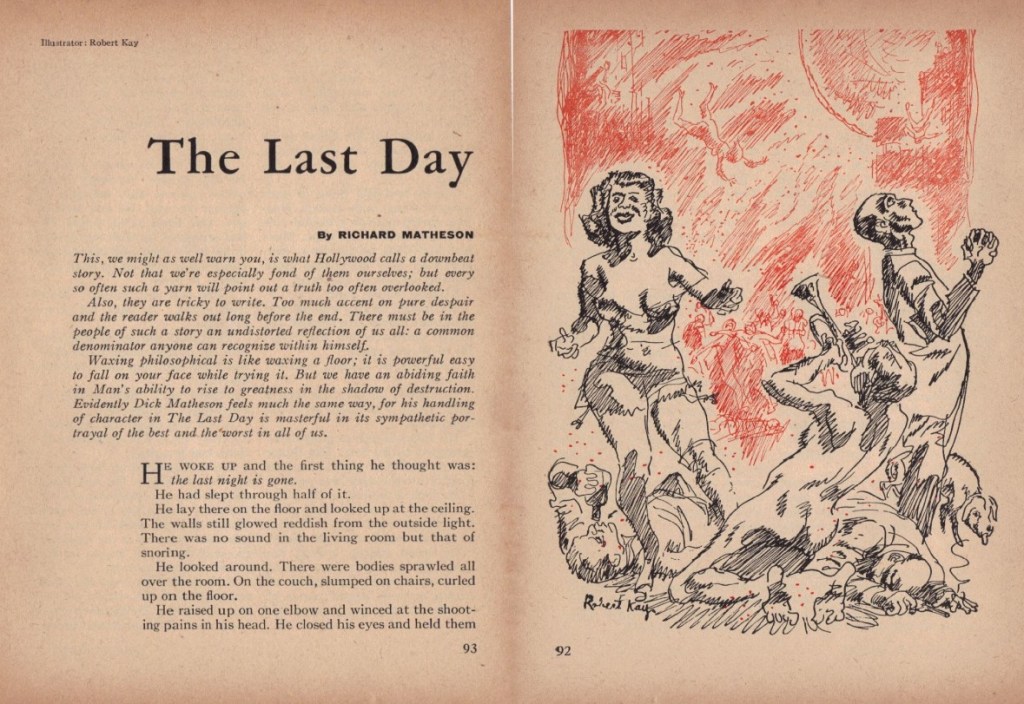
“The Last Day” by Richard Matheson was first published in the April-May 1953 issue of Amazing Stories. You can read it online here. Or you can buy The Best of Richard Matheson in various media editions here. Or look at its reprint history to see if you already own it in an anthology.
Our reading group is reading 25 short stories recommended by five group members. They are stories we haven’t read as a group, but ones the five people thought we shouldn’t miss. I didn’t submit this time, but “The Last Day” would have been one of the stories I would have submitted. Three of my favorite SF short stories from 1953 are “The Last Day,” “Lot” by Ward Moore, and “Deadly City” by Paul W. Fairman. I admire these stories because they were so gritty, even brutal.
Science fiction has often dealt with post-apocalyptic stories but “The Last Day” is about the end of the world. Some astronomical object is about to crash into the Earth. It’s not specified. The story begins in the morning of the last day and ends in the evening just before the end of everything on Earth.
I have often read and thought about surviving an apocalypse. I have often contemplated my own death. And I’ve always been fascinated by stories about people with a terminal illness and what they did with their remaining days.
But I haven’t thought about what I would do if everyone had just one day to live. It’s a neat concept to ponder. After reading “The Last Day” I’m not sure I’d need to read another story on the same idea. “The Last Day” gets the job done so nicely that I can’t imagine anyone topping it.
For this reading, I read the story with my eyes and then listened to it with my ears. I was impressed by its drama. Richard Matheson is famous for writing over a dozen episodes of The Twilight Zone. Many of Matheson’s stories and novels were adapted for television and the movies, and he wrote many screenplays. Matheson knows how to create drama.
“The Last Day” begins with Richard waking up in a room full of passed-out people. Several are naked, and it’s obvious that a drunken orgy had taken place the night before. When Richard goes into the bathroom to clean up a bit, he finds a dead man in the tub. Richard enters the kitchen where a friend, Spencer, is frying eggs. By now, we’ve realized that life on Earth is about to end.
Richard wishes he were with Mary, a woman he loved but didn’t commit to. His friend Norman comes into the kitchen and tells Richard he wants to go see his mother. Norman asks Richard if he wants to see his mother. Richard dreads the idea because he knows his mother will preach religion at him, and he doesn’t want to hear it.
After Spencer leaves to have more sex with a woman who wants everyone to watch, Norman begs Richard to drive him to his mother’s house. We learn that riots are going on all over the city. Many people have committed suicide, but others run wild, murdering each other.
All of this is amazingly adult for a science fiction story in 1953, especially published in a magazine mostly read by young adults. That issue seemed atypical for Amazing Stories. It also had stories by Robert A. Heinlein, Theodore Sturgeon, and Murray Leinster. It was edited by Howard Browne. I feel I need to reevaluate that era of the magazine. 1953 was a boom year for science fiction magazines. I’ve written about it before. I believe the Cold War had a significant impact on the genre that year. Just look at some of the other notable stories from 1953.
Richard eventually finds his mother at his sister’s house. There’s a poignant scene of his sister and her husband getting their daughter to take sleeping pills, and Richard watching all three commit suicide. And finally, Richard has a moving moment with his mother while they wait to die.
The story is cleanly told. Direct. It covers many bases without getting wordy. 5-stars.
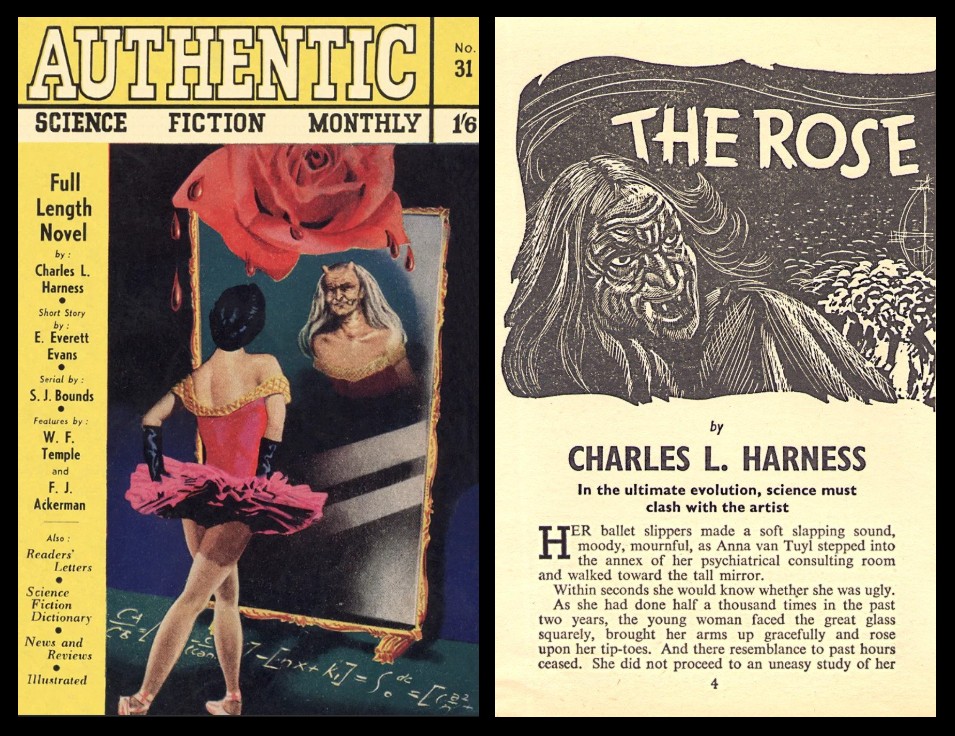
“The Rose” by Charles L. Harness was first published in Authentic Science Fiction Monthly (No. 31, March 1953). You can read it online here. Our Facebook group is discussing 25 stories suggested by five members that we haven’t discussed before. Paul Fraser has recommended “The Rose” in comments, but it’s never been up for a group discussion. I’ve tried to read “The Rose” twice before but got bogged down. The story is long, a novella, and it’s dense.
“The Rose” is one of the most ambitious science fiction novellas I’ve ever read. I’m glad that I finally finished it. This is exactly what I was hoping for from our member-recommended group read, a standout science fiction work I haven’t read. One good enough to merit rereading.
The story reminds me of what other writers explored in the years after 1953, works by Theodore Sturgeon, J. G. Ballard, Robert Silverberg, Jack Vance, and Roger Zelazny. “The Rose” has seldom been reprinted, but the most significant anthology to remember it is The Science Fiction Century, edited by David G. Hartwell.
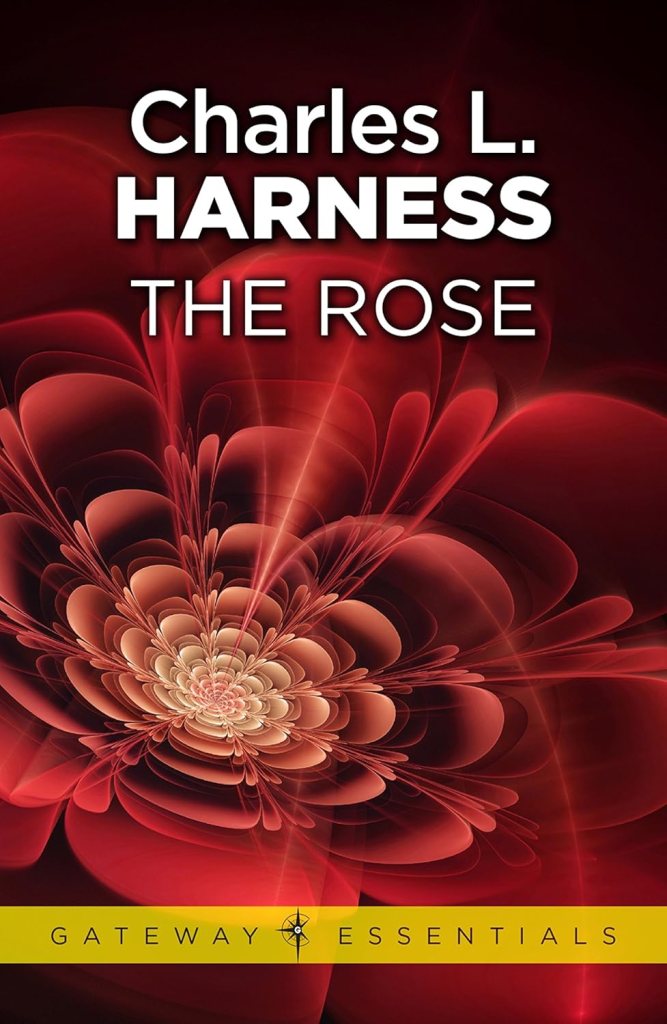
“The Rose” is available as The Rose, a standalone Kindle novel for 99 cents. They say it’s 192 pages, but I can’t tell if it’s expanded from the novella. The UK edition says it’s just 88 pages, so it’s probably the same as the novella.
But for $1 more, you can get the Kindle edition of The Ornament of His Profession for $1.99, which includes “The Rose” and several other stories by Harness. I just discovered I already own that edition in my Kindle Library. Probably, I bought it when Paul recommended “The Rose” the first time.
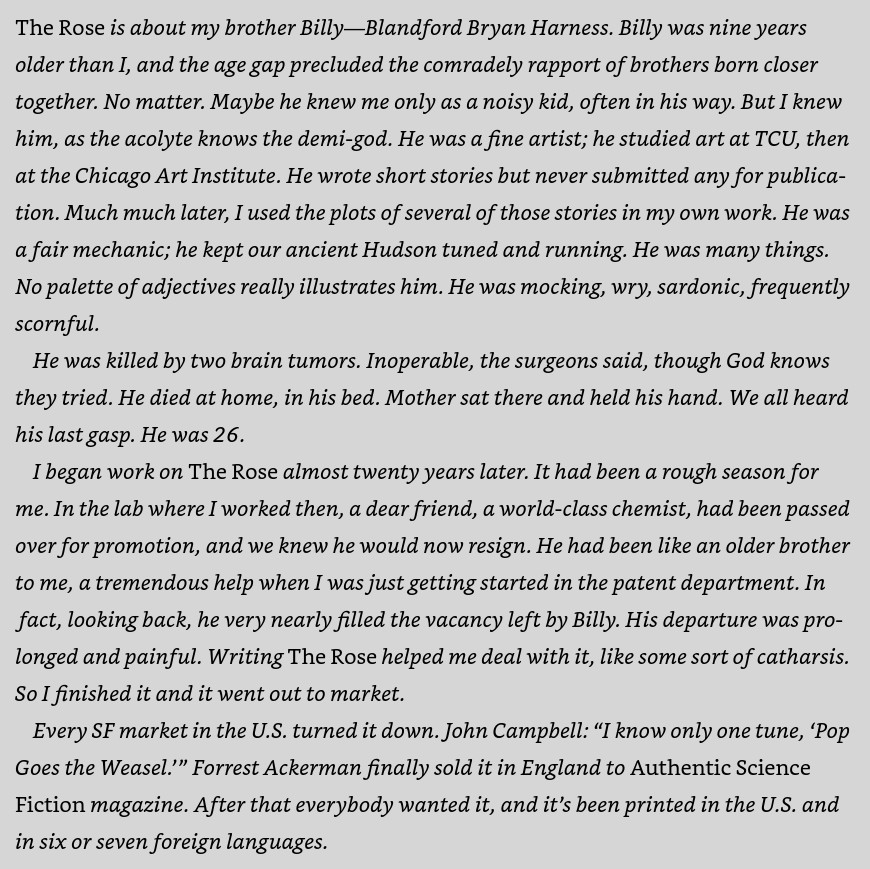
Both have the same introduction to “The Rose:”
Because “The Rose” appeared in Authentic Science Fiction Monthly, I thought Harness was British, but his Wikipedia page says he was American. I recommend taking the time to read his entry because it made me want to read more of what Charles L. Harness wrote. His science fiction sounds fascinating, but I’ve only read a couple of his shorter works. I may, or may not have read Flight Into Yesterday/Paradox Men. I also recommend reading “The Novels of Charles Harness” by Rich Horton.
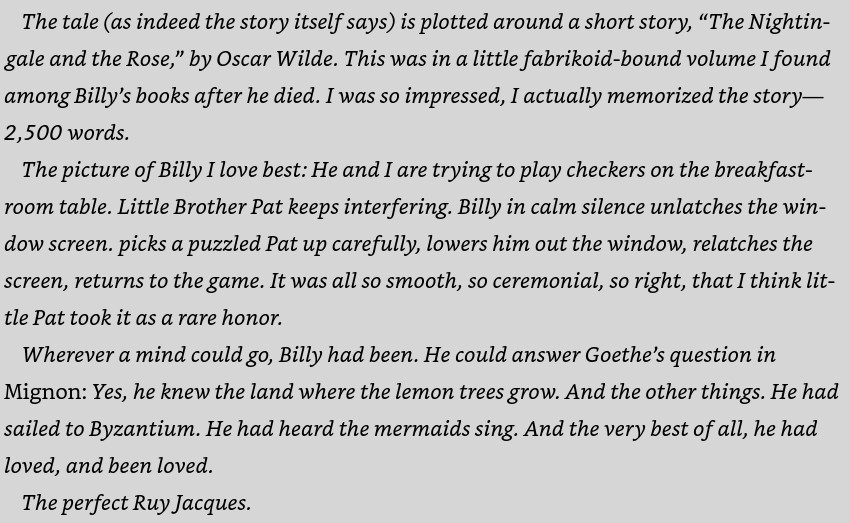
Describing “The Rose” is going to be difficult. Anna van Tuyl is a psychiatrist. She’s also a ballet dancer, composer, and choreographer. Anna was once beautiful, but now she is hunched back and has two horn-like structures growing from her forehead. The story is about Anna’s efforts to finish the score for a ballet called Nightingale and the Rose. As the introduction tells us, it’s plotted around a short story, “The Nightingale and the Rose” by Oscar Wilde. Anna is mentally blocked from composing the score’s climax.
Anna’s friend, Max Bell, a psychogeneticist, recommends Anna to Martha Jacques, wife of Ruy Jacques. Martha is a brilliant scientist working on an advanced weapon, and Ruy is an artist. Ruy has also become disfigured by a hump and horns, and recently lost the ability to read and write. Max Bell tricks Anna into meeting Ruy Jacques, where she falls in love with him. Ruy is an over-the-top, outrageous character — narcissistic, insane, and brilliant to the nth degree.
It turns out that Martha is obsessively jealous of Ruy and is hesitant to hire Anna. Throughout the story, Martha and Ruy have one never-ending argument about art versus science. This is one of the many reasons “The Rose” is so dense to read. Harness throws out all kinds of ideas and theories about art and science. Ruy believes artists have long known everything scientists eventually discover.
To complicate the story further, Ruy and Anna are emerging supermen, or examples of Homo superior. They are developing psychic powers, but these are strange powers. Harness has taken on the task of showing how advanced humans will think. Much of his speculation is psychobabble and pseudo-science, but there’s a kind of elegance to his thinking. Harness uses 1953 art theory, combined with a fair knowledge of classical music, ballet, and other arts, to contrast with scientific and mathematical ideas of the time. Reading Charles L. Harness suggests he was a cultured man, better educated than the average science fiction writer. But then, science fiction writers are often great autodidatics and bullshitters. Harness had degrees in chemistry and the law and worked as a patent attorney.
Harness also complicates his story by paralleling the plot of the novella with the plot of the fictional ballet. And Ruy and Anna work to live out their own artistic creation.
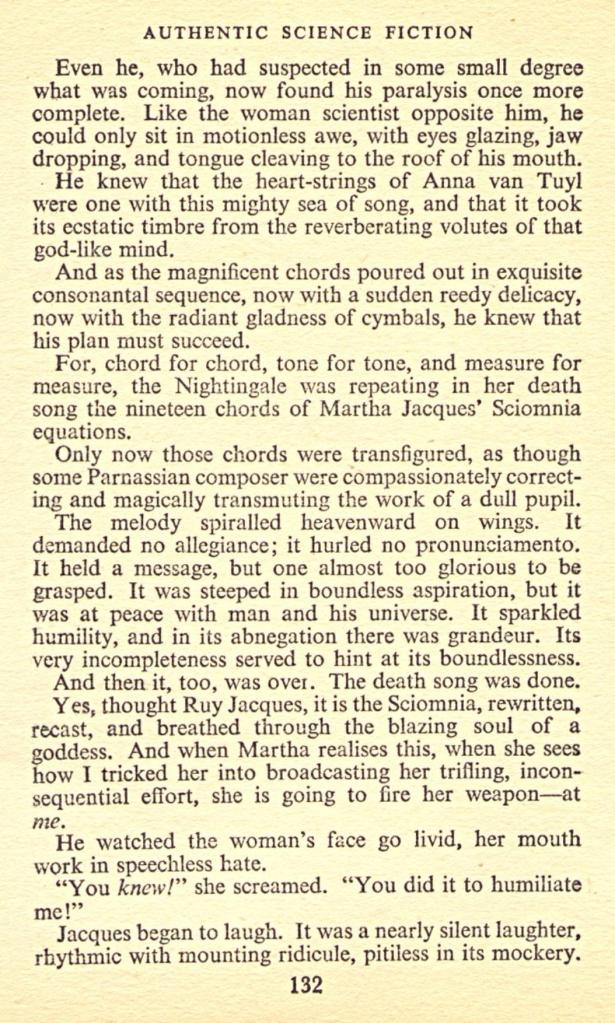
It took me a while to embrace Harness’s prose. You have to read it slowly because he intends so much with each sentence. Here’s one sample.
“The Rose” is definitely a story I look forward to rereading someday. I’d love to hear a professional narrator read it in an audiobook. “The Rose” doesn’t emotionally enchant me like “The Star Pit” by Samuel R. Delany or “A Rose for Ecclesiastes” by Roger Zelazny does. It’s about as intellectually impressive as “The Darfsteller” by Walter M. Miller, Jr., another long science fiction story about artists and performers I admire but don’t quite love.
My opinion might change with another reading of “The Rose.” Right now, it doesn’t quite make the five-star rating. I think the density of the prose keeps me from embracing the characters. I never liked Anna or Ruy, only admired them as interesting characters. This might be due to the story being too tightly plotted. Harness wanted his characters to act out a ballet they were creating, and you get the feeling that Anna and Ruy are acting for Harness, not themselves.
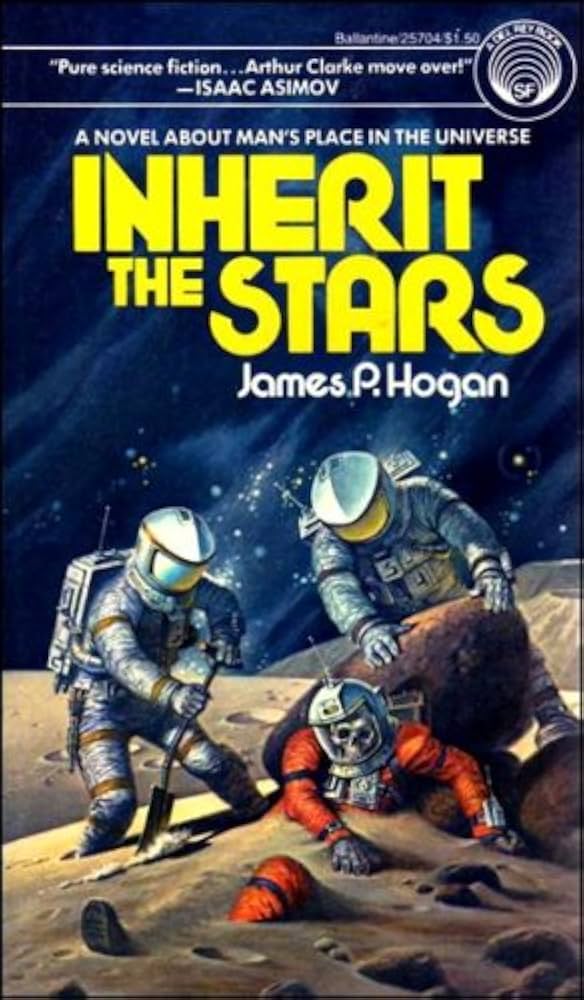
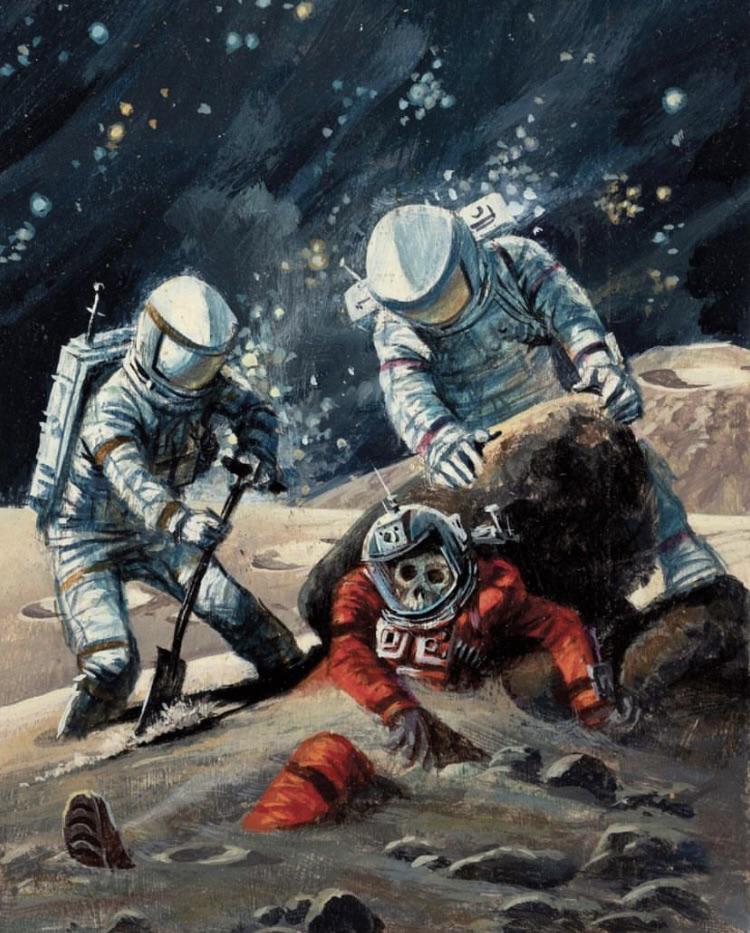
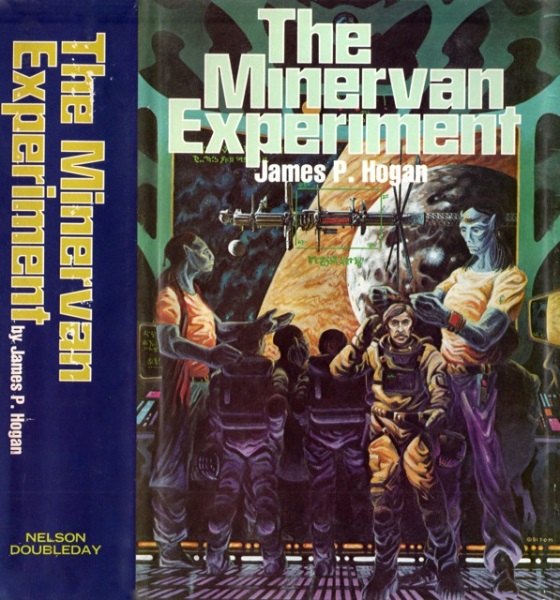
The original paperback, Inherit the Stars by British writer James P. Hogan (1941-2010), had a terrific cover – the kind that made you buy the book. The artwork appears to show astronauts on the Moon finding a dead astronaut, but that is deceptive. Hogan creates a scientific mystery because the dead astronaut has been there for 25,000 years.
I first read Inherit the Stars in 1992 but after seeing Whitney’s review on YouTube, I wanted to reread the story. I went to Amazon but couldn’t find the book. Was it out of print? I did find it on Audible. Later, I discovered that Inherit the Stars and its sequel The Gentle Giants of Ganymede are now being sold together as The Two Moons for the Kindle. A bargain for $6.99, especially since Whitney also praised the second book. It turns out that there are five books in the series being sold as three Kindle editions. The series is called Giants. Only the first three novels are available on Audible. The Science Fiction Book Club once published the first three novels as The Mirnervan Experiment. Ballentine also published a paperback called The Giants Novels that contains all three.
Before anyone rushes out to buy Inherit the Stars, I need to describe it more, but not enough to give spoilers. Hogan’s story is the kind you want to figure out for yourself. It kept me guessing for the entire novel even though I had read it before. That worried me. Why wasn’t it more memorable? Was that an indication it was a bad book? I don’t think so. How the story is told isn’t very memorable, but the ideas are big-time fun. I did remember some of those, but not connected to the book.
Inherit the Stars is basically scientists talking about one mystery after another. There’s no real plot. A lot happens, but it’s not dramatic. With each discovery, there’s a new puzzle, which makes you think and try to guess what caused each mystery. Inherit the Stars is science fiction focused on ideas and not storytelling. I’ve told you the first mystery, but I don’t want to give away any others.
However, I will give you some fun clues. Inherit the Stars reminds me a lot of Rendezvous With Rama by Arthur C. Clarke. Hogan’s prose is similar to Clarke’s. At one point, the story reminded me of the classic short story “Omnilingual” by H. Beam Piper. The novel also triggered memories of Gateway by Frederik Pohl. At other times it reminded me of the Winston Science Fiction, a series of young adult SF that came out in the 1950s, especially the entries where the protagonists find relics of ancient alien technology. If you love alien archeology stories, you might like Inherit the Stars.
I call Inherit the StarsPre-NASA Science Fiction, by which I usually mean science fiction written before Mariner 4 photographed Mars in July 1965. Until NASA started exploring the solar system with robotic probes, many people hoped that we would find life, even intelligent life somewhere on other planets in our solar system. For example, Heinlein’s Stranger in a Strange Land from 1961 imagines Mars being inhabited by a dying race. However, after Mariner 4, serious science fiction assumed we were alone in the solar system. (I must admit, that I still love Pre-NASA science fiction. Growing up in the 1950s and 1960s, I desperately wanted us to find Martians.)
I consider Hogan’s 1977 Inherit the Stars Pre-NASA Science Fiction because Hogan maintains the hope that we had neighbors. However, some readers might feel Hogan’s ideas might come across like those of Erich von Däniken, who wrote Chariot of the Gods? Another reviewer dismissed this book as unbelievable. Personally, I find Erich von Däniken’s theories to be insulting to humanity. But I consider Hogan’s speculation to be great science fictional fun.
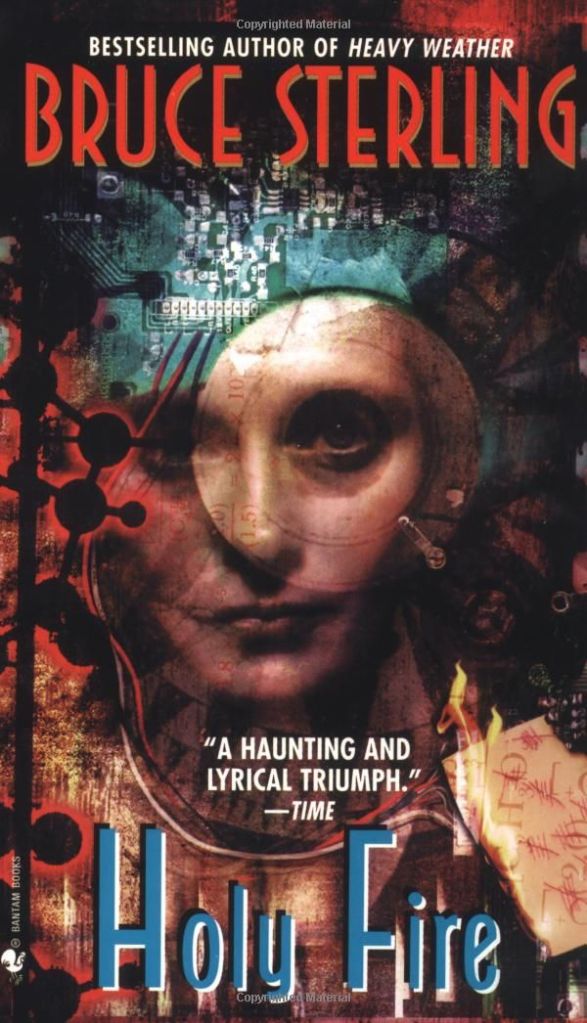
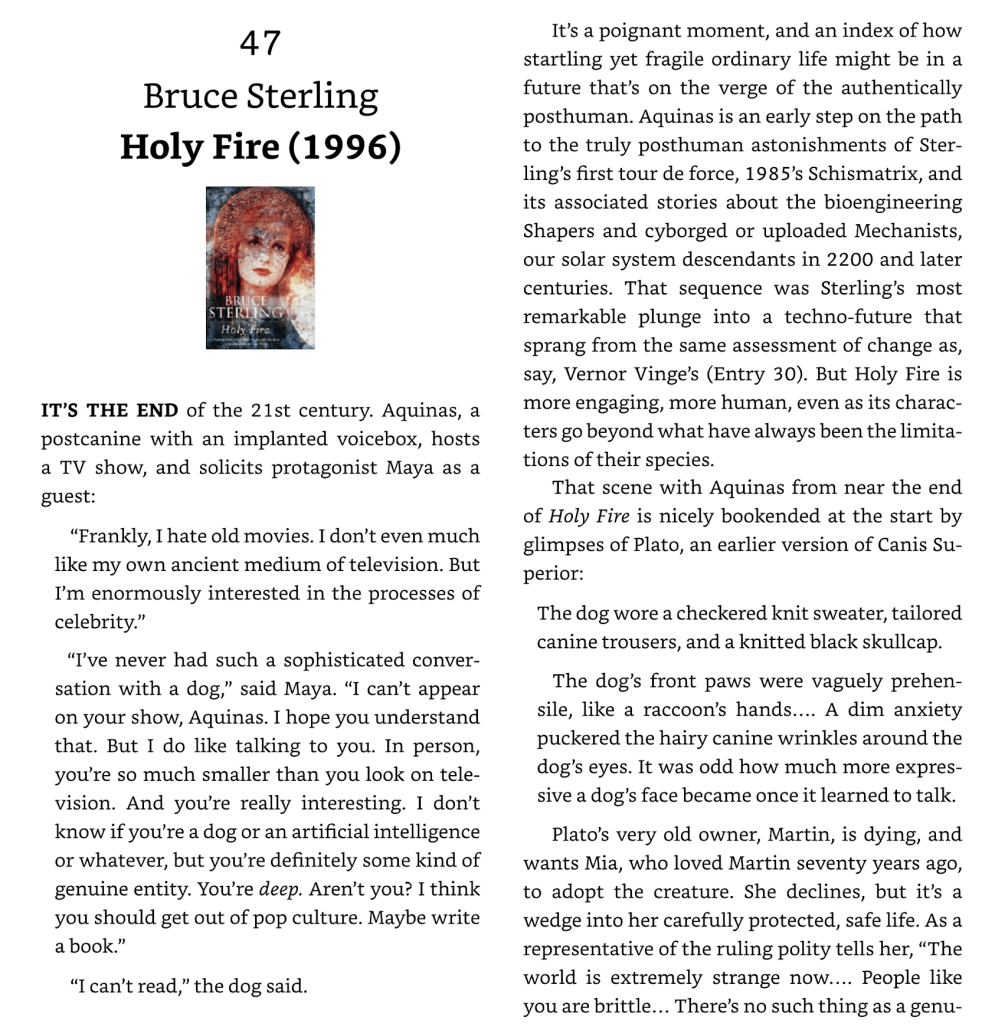
Science fiction writers can’t predict the future but some aim to speculate on times to come by extrapolating current trends. One of the most famous SF novels to do this was Stand on Zanzibar by John Brunner, his 1968 novel that anticipated the world of 2010. Bruce Sterling’s 1996 novel Holy Fire tries to imagine life in 2096 via speculation and extrapolation. Do I recommend it? That’s hard to say, even at the current Kindle price of $1.99.
How self-aware are you regarding the selection of the science fiction you read? Does your mind crave a tightly plotted story? If so, Holy Fire by Bruce Sterling might not be for you. Or do you love reading novels with characters you care about, even identify with, and want to vicariously live their fictional adventures? Again, Holy Fire might not be your cup of tea. If you are the kind of science fiction reader who resonates with dense science fiction speculation, reading Holy Fire should definitely be for you.
We judge such speculative fiction in two ways. Does it jive with our own efforts to imagine the future, and now that the novel is almost thirty years old, how well has it done so far? Evidently, back in 1996, Sterling saw that medical technology, changing trends in family size, and population demographics would lead to a world where there were far more old people than young people. The exact opposite of the Baby Boom generation I grew up with. All the current 2024 demographics point to such a future.
Sterling solved the overpopulation problem that many science fiction writers before him saw by having a great pandemic in the 2020s. And he imagined that networks, artificial reality, and artificial intelligence would reshape society. Instead of predicting gloom and doom like so many science fiction novels from the late 20th century, Sterling imagines a near-liberal utopia and a post-scarcity society. The problems faced by the characters in this novel divide between the old and young. The old strive to find purpose with an ever-lengthening lifespan, while the young feel crushed under the weight of a gerontocracy that advises the youth to learn from their experience and live longer.
Because humans have been trying out medical life-extension procedures for decades, a growing percentage of the population is old. These elders have the wealth and power and dominate politics with their gerontocracy. Mia Ziemann, Holy Fire’s protagonist, is 94 at the start. Because she has led such a cautious life and is in such good shape, the medical establishment offers her the latest life extension treatment, one that goes way beyond any previous effort. The procedure is so arduous, that it can be fatal. Mia comes through the process and now looks 20, although some of her memories are gone.
Mia’s doctors consider her an expensive experiment and legally bind her to them for years of research. Mia runs away to Europe and hides as an illegal alien, living among a youthful bohemian crowd of revolutionaries. She changes her name to Maya. On nearly every page of Holy Fire, Sterling speculates about the future evolution of society, technology, and politics. Strangely, climate change is never brought up. But then, Holy Fire came out a decade before An Inconvenient Truth.
Sterling doesn’t focus on space flight, but it happened. The focus of the story is finding meaning in everyday living on Earth. Dogs and other animals have been uplifted, and talk with computer-aided voices. Governments take care of the needy. People use public transportation. People engineer their minds with designer hormones and neural transmitters. And the net and virtual reality is everywhere. Holy Fire makes me think that Bruce Sterling had abundant optimism for the future in the 1990s. I used to have such liberal optimism but it was crushed in 2016.
Sterling’s future is not quite a utopia, because segments of the population are discontented, especially the young who are too brilliant for their own good. That’s the crowd Mia/Maya, embraces. They want the freedom to fail.
Sterling calls Mia/Maya and others in this book posthumans, and that’s where this story shines. His posthumans aren’t silly comic-book superheroes like in many 21st-century SF books. Virtual reality is toned down too from 21st-century SF stories of people downloading themselves into virtual realities. Sterling tries to stay reasonably realistic and scientific. Holy Fire reminds me of the dense speculation in John Brunner’s Stand on Zanzibar. Sterling doesn’t take it to narrative gonzo extremes like Brunner.
Holy Fire is a somewhat picaresque novel, with one reviewer comparing it to Candide. Of course, Candide is considered a broad satire, and I’m not sure that’s true of Holy Fire. I didn’t read it that way, but I could see how a filmmaker could present Holy Fire as a satire. The novel attempts to be transcendental, you might have guessed that from the title. The youth rebellion in Sterling’s 2090s is like the 1960s involving art, music, drugs, and mind-expansion — adding networking, AI, and AR.
The problem with picaresque novels is they are episodic. The hero is exposed to a series of people and subcultures, and that’s what happens to Mia/Maya. There are so many different characters it’s hard to keep up with them or even care about them. Most of the story is about how they impact Mia/Maya, whereas I believe a novel about a 94-year-old woman becoming 20 again should be about her inner transformations.
Mia is an uptight old lady who protects herself by hiding from life, and Maya is a free-spirit young woman giving everything a try and throwing all caution to the wind. We are told that Mia lost some of her memories, but would she lose all wisdom from living to 94?
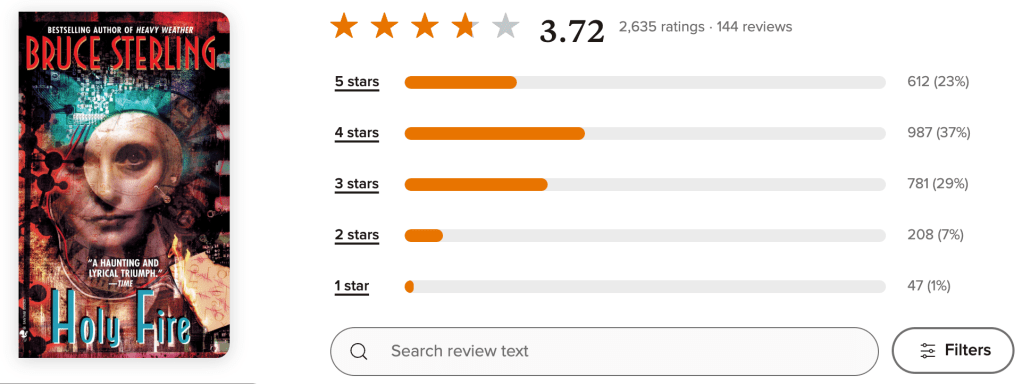
Response to Holy Fire is all over the place. Hundreds at Goodreads gave it five stars, a few more hundred gave it four stars, but plenty of folks just didn’t care for the story.
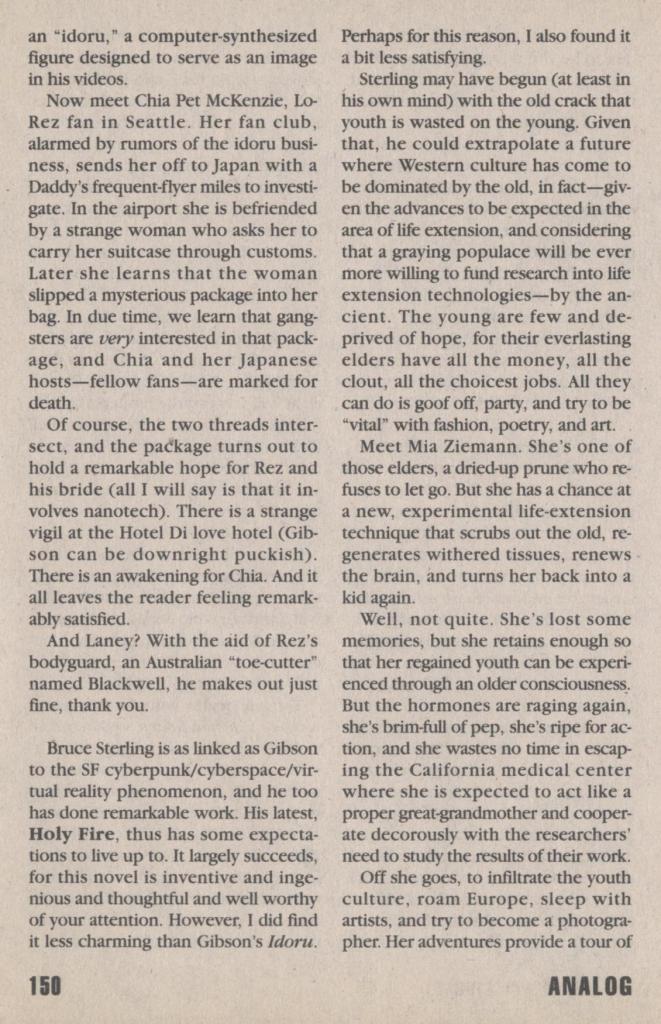
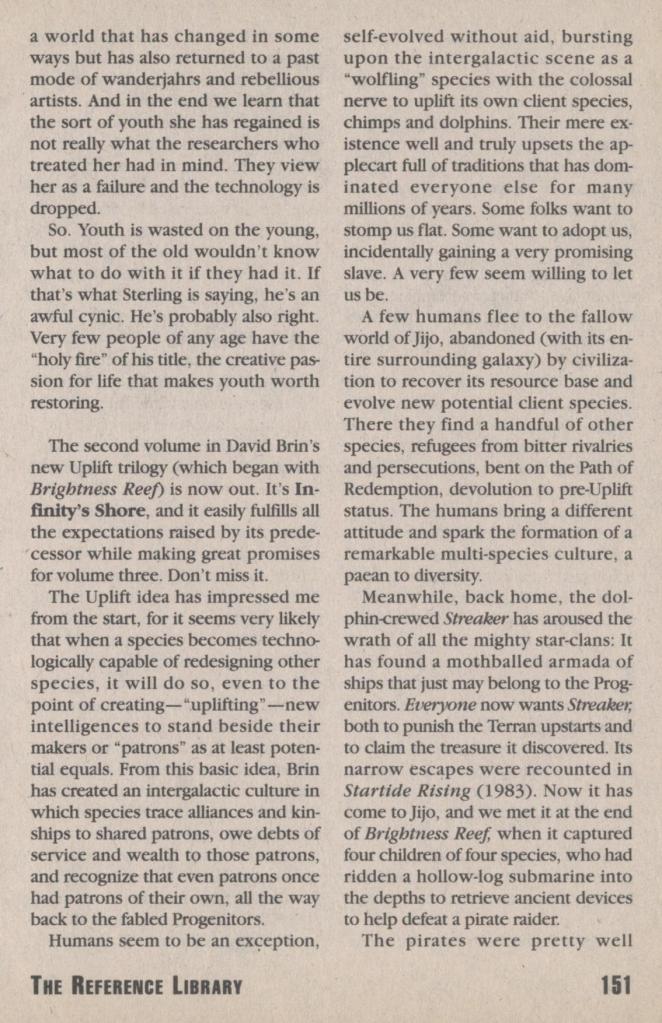
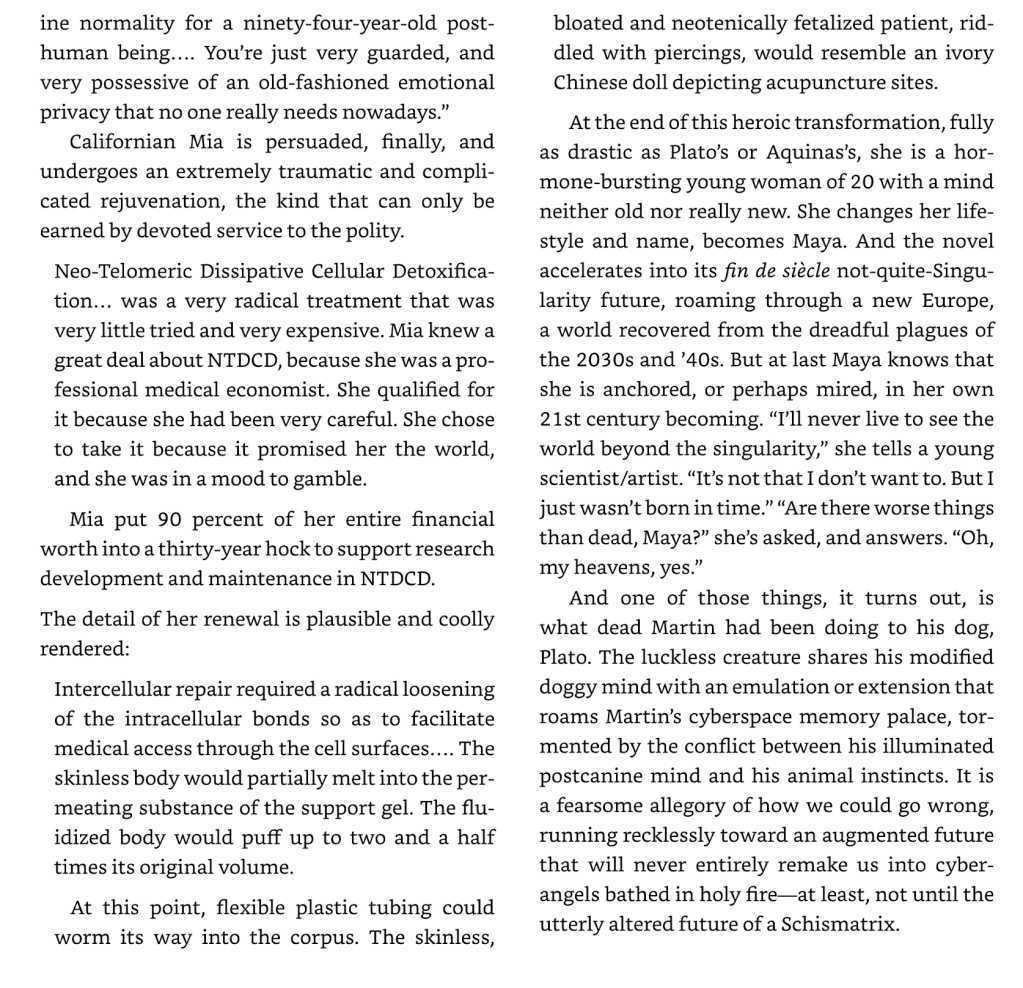
Reviews were also mixed. Tom Easton in “The Reference Library” for the March 1997 issue of Analog has this to say:
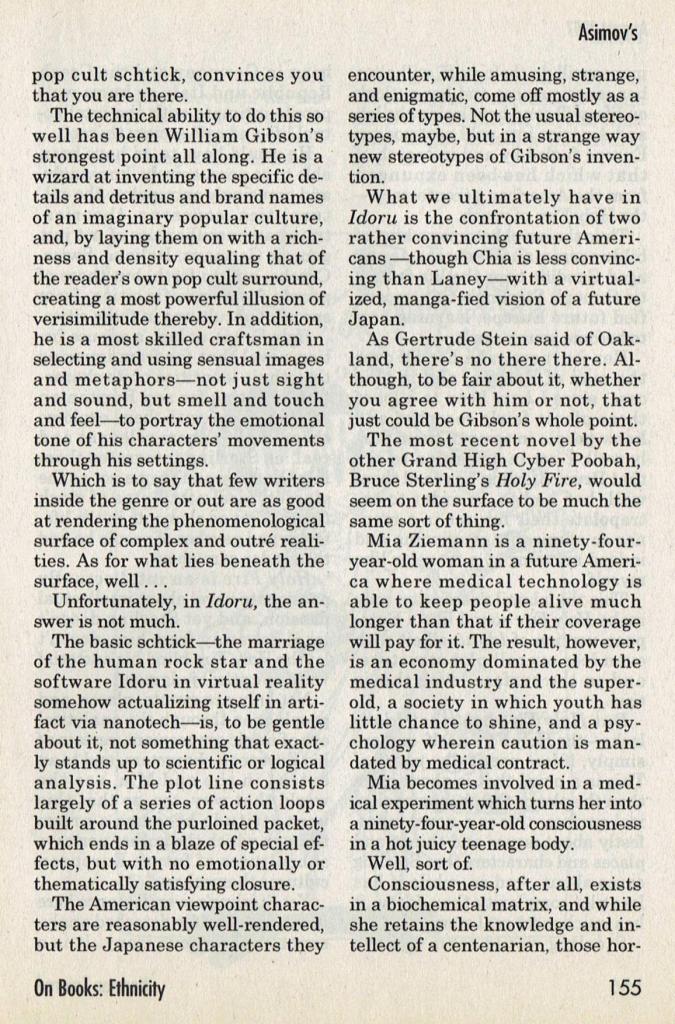
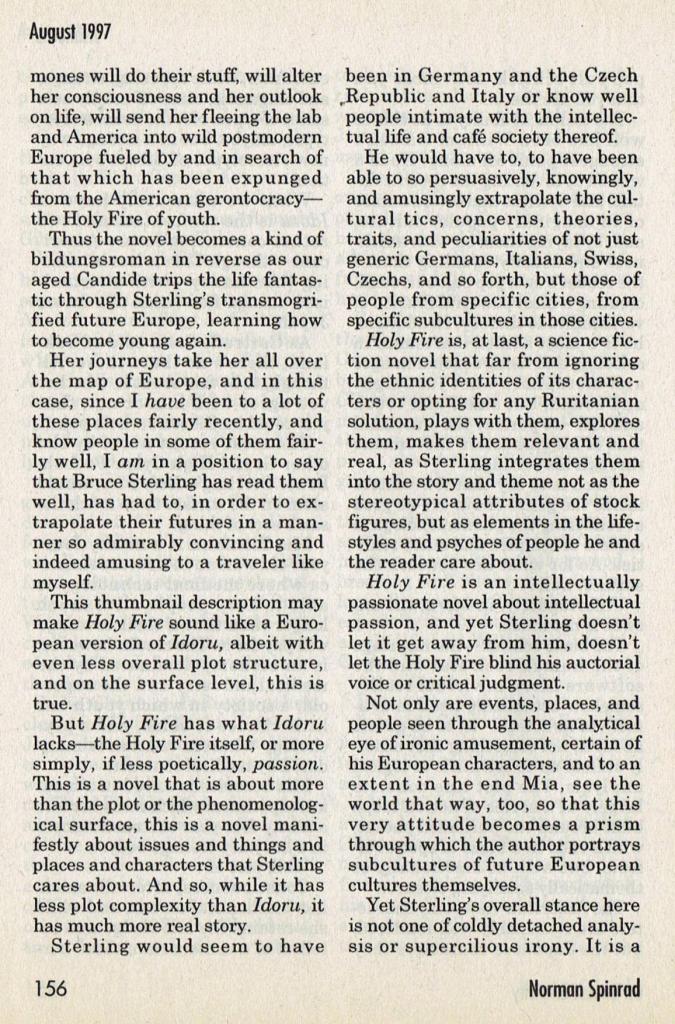
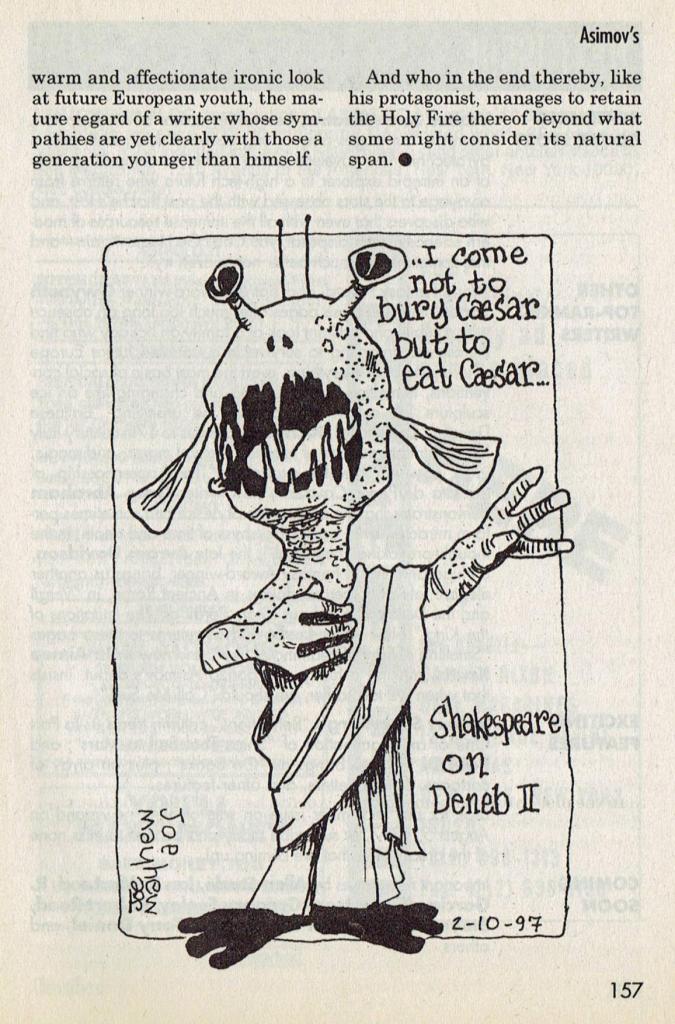
Norman Spinrad’s “On Books” from the August 1997 issue of Asimov’s Science Fiction also compares Holy Fire to William Gibson’s Idoru but comes to a different conclusion. Both novels are later cyberpunk works from the two leading founders of the cyberpunk movement, so it was logical to review them together. Spinrad is the more insightful of the two reviewers.
That Damien Broderick and Paul Di Filippo would recommend Holy Fire as one of the best SF novels from 1985-2010 is high praise. But why don’t I hear more about this novel after all these years? My assumption, is most science fiction readers don’t particularly care for serious speculation about the future and would prefer to read stories that compel you to turn the pages because of tight plots and characters they care about.
This is my second reading of Holy Fire. I first read it when it came out from the Science Fiction Book Club. I bought it then because its plot sounded similar to a 1926 novel I was trying to find, Phoenix by Lady Dorothy Mills. That book was also about an old woman undergoing a rejuvenation process and then running off to Europe to join a bohemian crowd. I finally found Phoenix several years ago and it’s more of a love story than science fiction. I need to reread it and compare the two.
For my second reading, I listened to it on audio. I’ve started rereading it again with my eyes. I never developed an emotional bond with Holy Fire like I have with the novels I consider my favorites. However, I admire it intellectually. It could have had the emotional impact of Flowers for Algernon because Mia/Maya goes through a similar arc of intellectual development. We just don’t see her experiences as tragic.
I think Sterling tried though. Throughout the novel, Mia/Maya experiences epiphanies that should have had a deep emotional impact. To me, they were just intellectually interesting. The ending should have been profoundly spiritual, like something from Hermann Hesse. Instead, it just seemed like a logical way to end the story. The choices Mia/Maya and her former husband, Daniel made in the end are vivid, even dramatic in concept. That just didn’t make an emotional impact on me. I assume Bruce Sterling wanted the ending to be an emotional epiphany. The ending does say a lot about how a posthuman would react to becoming posthuman.
Please leave a comment if you’ve read Holy Fire. I’m curious if you had an emotional response to the story. I found it intellectually exciting. I would recommend it on that level. However, it didn’t touch me, so I’m hesitant to say it’s good. I gave it four stars on Goodreads.
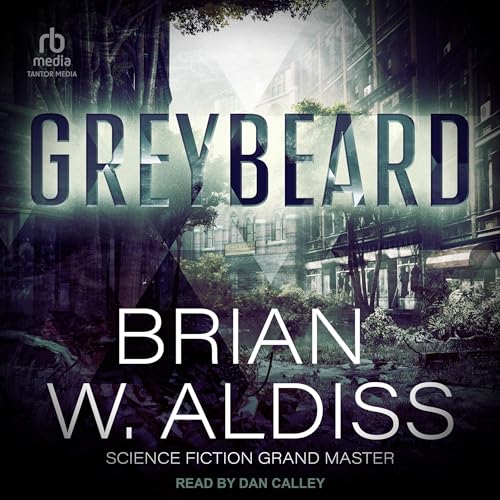
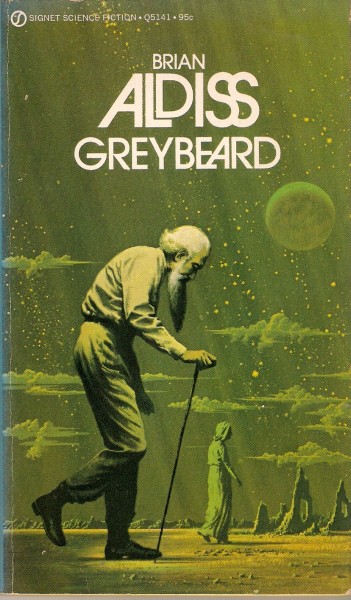
Greybeard is a 1964 post-apocalyptic novel by Brian W. Aldiss. It was reprinted as an audiobook by Trantor Media on October 15, 2024, read by Dan Calley. The ebook version is currently available for the Kindle for $1.99 in the U.S. Greybeard has an extensive reprint history. I heard about this novel back in the 1960s, but I’ve only become an Aldiss fan in the last few years, so I was excited when the audiobook edition showed up on Audible.com. Greybeard was one of the novels David Pringle admired in his Science Fiction: The 100 Best Novels (1985). That book is available for $1.99 for the Kindle too.
Greybeard is set in the 2020s, and is about the aftermath of atomic bomb testing in space in 1981, when the explosions altered the Van Allen radiation belt. Eventually, people learned “the accident” caused the human race to become sterile, along with certain other animals. In the story, everyone is old, waiting to die, and wondering what will happen after humanity is gone. This is a different premise for a post-apocalyptic novel, but Aldiss uses his tale mostly to toss out a ideas. The story lacks a compelling plot.
The characters are never developed to the point where you care about them. That’s a common problem of older science fiction, where characters were created mainly to present far-out science fictional thoughts.
The story’s main focus is on Algy and Martha Timberlane as they travel around England after the collapse, along with flashbacks of how they got together. Algy, short for Algernon, is called Greybeard because of his long beard. After the accident, during a period when kids were born with genetic defects, but before they stopped coming altogether, the world economies collapsed, which led to wars. As Aldiss points out, a lot of consumerism is targetted to babies, children, and young people, so certain businesses quickly went bust. But also, as people realized they had no future, many gave up on their ambitions, or even committed suicide.
The book is divided into seven chapter, each a different time and setting:
Chapter 1 – The River – Sparcot
Chapter 2 – Cowley (flashback)
Chapter 3 – The River Swifford Fair
Chapter 4 – Washington (flashback)
Chapter 5 – The River – Oxford
Chapter 6 – London (flashback)
Chapter 7 – The River – The End
The novel begins with rampaging stoats (ermine, short-tail weasel). This setting of England being taken over by nature reminded me of After London by Richard Jefferies, but Jefferies did a much better job describing how nature would overrun decaying cities, towns, and roads. After London is a superior post-apocalyptic novel, and one of the earliest
We first meet Greybeard and Martha who have been living for years in a tiny village, Sparcot, ecking out an existing through fishing and gardening. They live near a river surrounded by a barrier of brambles. When two boats arrive with refuges from another village, they hear about how the stoats are attacking everything including people. This reminded me of the stobors in Heinlein’s Tunnel in the Sky. Algy, Martha, and a few friends, flee in a boat Algy had hidden. They plan to float down the river to the sea.
The novel is about what they see along the way. It might be called a picaresque novel. Algy/Greybeard is a bit of a rogue, and we follow his episodic travels. At each stopping place along the river they meet folks living under different conditions. Swifford Fair seemed like something out of the Middle Ages. When they get to Oxford, they find a certain level of civilization has maintained itself around the old university. But in every location, there are wild beliefs about how things are, including lots of charlatans, thieves, and con artists preying on ignorant people. Rumors abound about children still being born, strange mutant beings living in the woods, or even fairy creatures of old returning.
Algy and crew meet a crazy old man on the river who tells them to find Bunny Jingadangelow in Swifford Fair because he can make them immortal. Bunny Jingadangelow shows up several times during this novel running different scams, including one as a messiah.
Greybeard isn’t a bad science fiction novel, but it’s not that great either. If I had read it back in 1968 when I first heard about it, I would have been impressed. But over the decades I’ve read a lot of post-apocalyptic fiction, and Greybeard just isn’t up to the standard of Earth Abides by George R. Stewart or The Road by Cormac McCarthy. I’d say The Hopkins Manuscript by R. C. Sherriff as one of the great post-apocalyptic novels about England to read first. In other words, there are a lot of post-apocalyptic novels you should read before spending time on Greybeard.
It’s a shame that Aldiss didn’t spend more time writing Greybeard because his premise is so good. I just finished the four-volume novel series by Elena Ferrante that begin with My Brilliant Friend. This is a true masterpiece, and future classic. Greybeard and most science fiction feel like starvation rations compared to that novel. Of course, Ferrante used 1,965 pages to tell her story, and Aldiss only used 237 on his story. Aldiss tried to develop the characters with flashbacks, but those flashbacks were mainly used to describe the world during the initial stages of collapse.
Ferrante created a compelling novel by showing how two girls evolve psychological and intellectually over a lifetime. That anchored the novel and gave it a page-turning plot. Aldiss never moors us in the story with anything we can anchor our attention. Richard Jefferies handled his post-apocalyptic London by using the first part of the book to explore ideas around the collapse, and then used the second half with a well-plotted adventure story. I enjoyed Greybeard enough to read it, but just barely.
I wish Aldiss had expanded his story to 400-500 pages and developed Algy and Martha, and found something to give the book a clear purpose. I can only recommend Greybeard to folks who read a lot of post-apocalyptic novels and enjoy studying them.
Aldiss imagines radiation causing a world of only old people. But we’re currently facing a depopulation crisis because most countries around the world aren’t producing enough babies. A country needs every woman to have 2.1 children to grow. Many women don’t want to have any, and one child is common. Theoretically, countries like South Korea can become like the world of Greybeard by the end of this centry. I wonder if any current writers are exploring that idea?
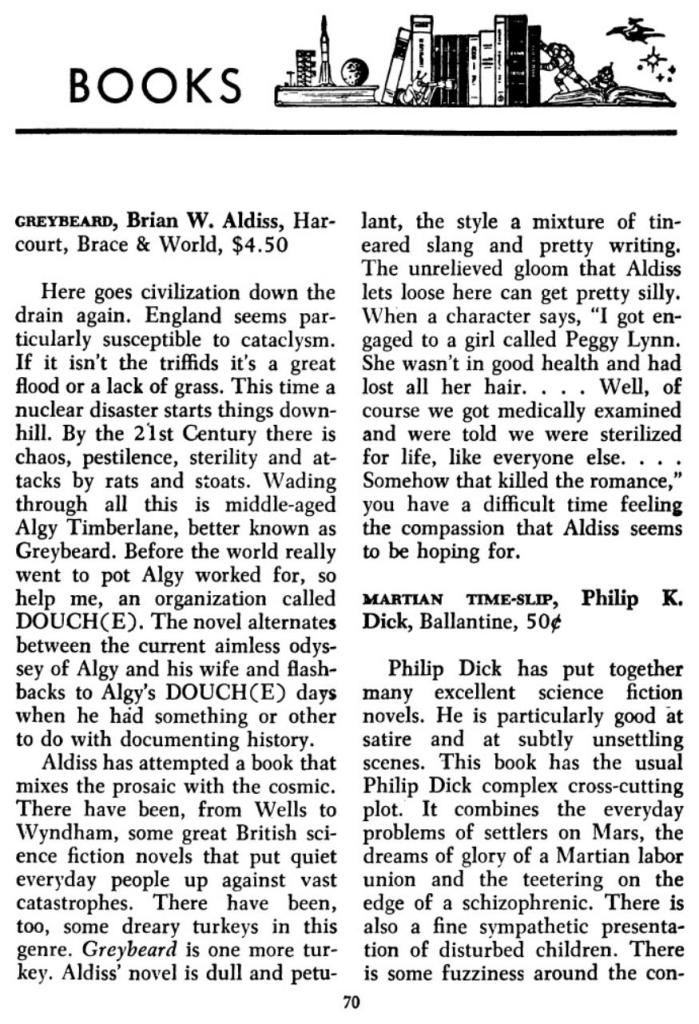
Ron Goulart didn’t like the story in his F&SF (Dec. 1964) review.
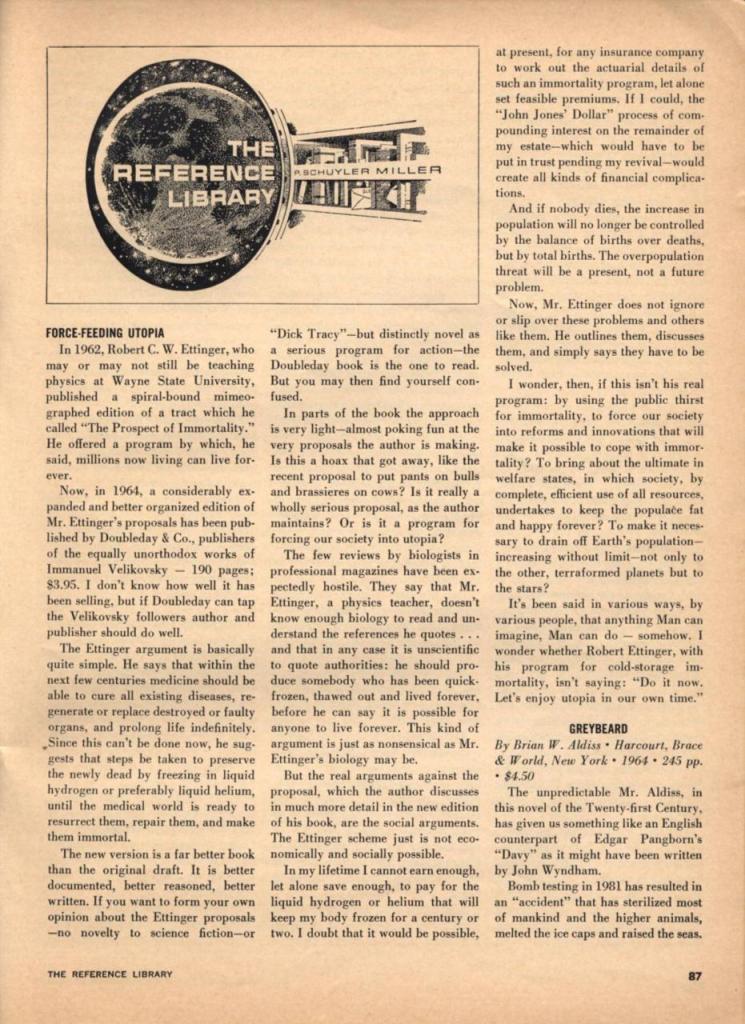
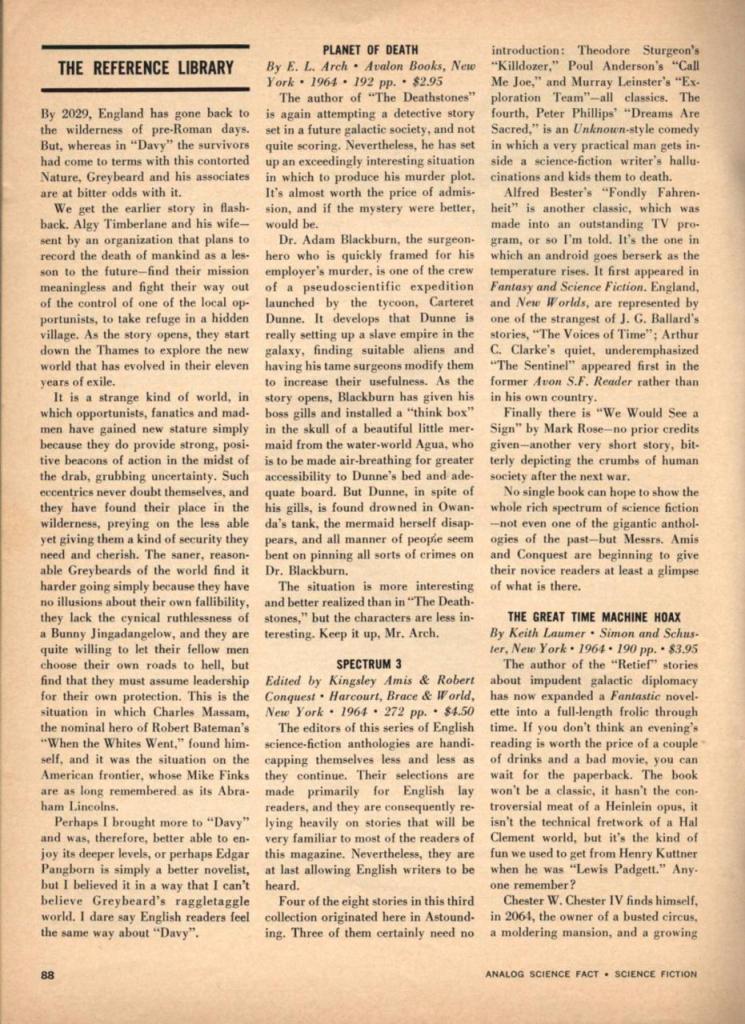
P. Schuyler Miller liked it a bit better, but not much, in his Analog (Feb. 1965) review.
Judith Merril in 1966, pointed out to F&SF readers that the original American hardback lacked some of the flashback scenes, and might like the story better in the Signet paperback, which included the full British edition.