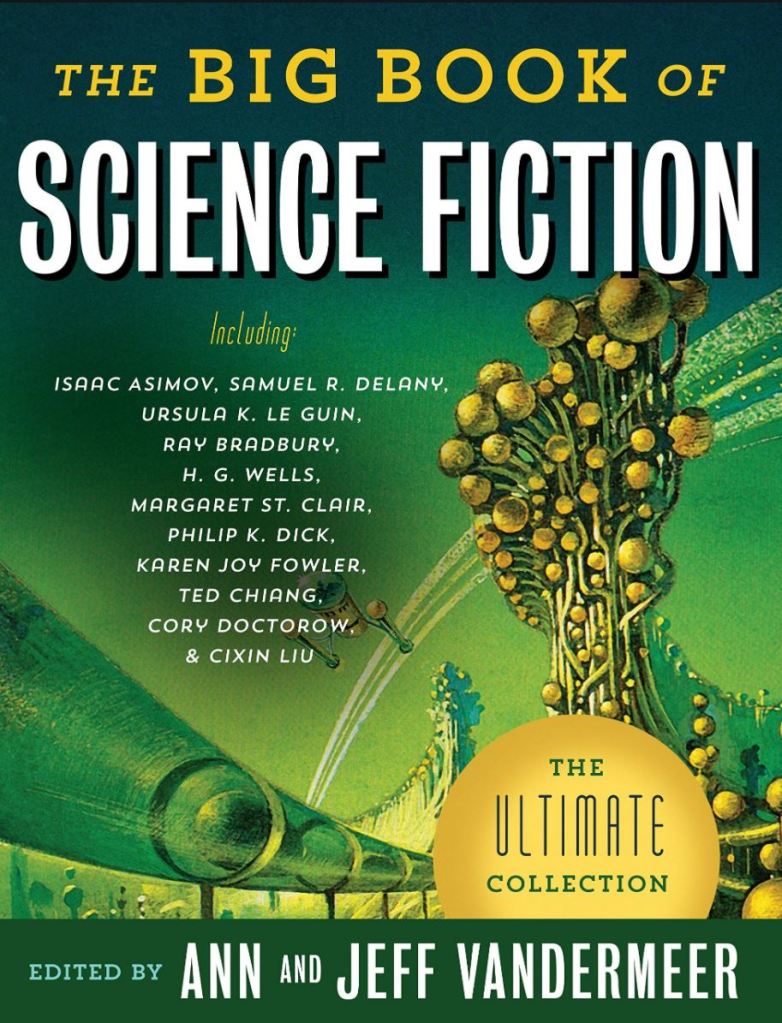
Group Read 27: The Big Book of Science Fiction
Story #33 of 107: “The Monster” by Gérard Klein
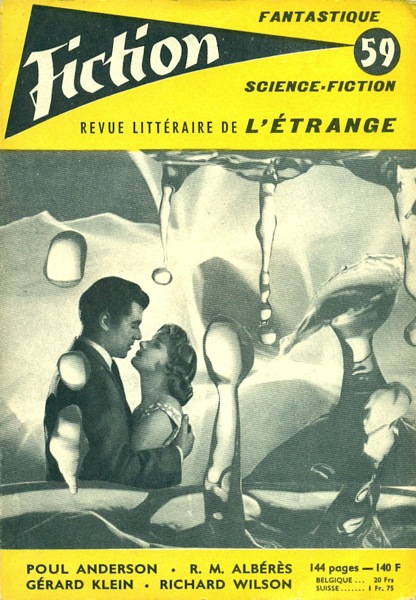
“The Monster” by French writer Gérard Klein was first published in October 1958 in Fiction #59, but later translated and reprinted in the September 1961 issue of The Magazine of Fantasy & Science Fiction. Later on it was collected in Thirteen French Science-Fiction Stories edited by Damon Knight. According to the VanderMeers in their introduction to the story in The Big Book of Science Fiction, Klein is quite a prolific science fiction writer in France. ISFDB lists five translations and a decent number of reprints for “The Monster.”

I found “The Monster” a compelling story until the ending. Marion, the stay-at-home wife of Bernard anxiously awaits her husband return from work. When she hears that an alien from space has been cornered in the park she begins to fret because she knows Bernard walks home through that park. The story tightens by Marion listening to radio broadcasts, and then by her efforts to get into the park which has been cordoned off by the police. The tension Klein builds is quite effective. We slowly learn that Bernard has been the one viction of the alien, and now the alien keeps calling out “Marion” in the voice Marion knows as Bernard’s.
The buildup for this story was quite nice, but the resolution was disappointing. We are shown how Marion has always been dependent on Bernard, but in the end we’re also told that too. The story isn’t about the alien, but Marion. I’m going to quote a significant part of the story from near the ending to explain my disappointment, and to discuss the nature of reading science fiction.
“I’m coming, Bernard,” said Marion, and she dropped the microphone and threw herself forward. She dodged the hands that tried to stop her and began running down the graveled path. She leaped over the copper-meshed web and passed between the gleaming tongues of the flamethrowers.

“It’s a trap,” called a deep voice behind her. “Come back. The creature has absorbed some of your husband’s knowledge—it’s using it as a lure. Come back. That isn’t human. It has no face.”

But no one followed her. When she turned her head, she saw the men standing up, grasping their lances and looking at her, horrified, their eyes and teeth gleaming with the same metallic light as the buttons of their uniforms.

She rounded the pond. Her feet struck the cement pavement with soft, dull sounds, then they felt the cool, caressing touch of the grass again.

She wondered even as she ran what was going to happen, what would become of her, but she told herself that Bernard would know for her, that he had always known, and that it was best that way. He was waiting for her beyond that black doorway through which his voice came with so much difficulty, and she was about to be with him.

A memory came suddenly into her mind. A sentence read or heard, an idea harvested and stored away, to be milled and tasted now. It was something like this: men are nothing but empty shells, sometimes cold and deserted like abandoned houses, and sometimes inhabited, haunted by the beings we call life, jealousy, joy, fear, hope, and so many others. Then there was no more loneliness.

And as she ran, exhaling a warm breath that condensed into a thin plume of vapor, looking back at the pale, contracted faces of the soldiers, dwindling at every step, she began to think that this creature had crossed space and searched for a new world because it felt itself desperately hollow and useless in its own, because none of those intangible beings would haunt it, and that she and Bernard would perhaps live in the center of its mind, just as confidence and anxiety, silence and boredom live in the hearts and minds of men. And she hoped that they would bring it peace, that they would be two quiet little lights, illuminating the honeycombed depths of its enormous, unknown brain.

She shuddered and laughed. “What does it feel like to be eaten?” she asked herself.

She tried to imagine a spoonful of ice cream melting between her lips, running cool down her throat, lying in the little dark warmth of her stomach.

“Bernard,” she cried. “I’ve come.” She heard the men shouting behind her. “Marion,” said the monster with Bernard’s voice, “you took so long.”

She closed her eyes and threw herself forward. She felt the cold slip down her skin and leave her like a discarded garment. She felt herself being transformed. Her body was dissolving, her fingers threading out, she was expanding inside that huge sphere, moist and warm, comfortable, and, she understood now, good and kind.

“Bernard,” she said, “they’re coming after us to kill us.”

“I know,” said the voice, very near now and reassuring.

“Can’t we do anything—run away?”

“It’s up to him,” he said. “I’m just beginning to know him. I told him to wait for you. I don’t know exactly what he’s going to do. Go back out into space, maybe? Listen.”
This is almost the end of the story, yet not the complete ending, but the part that’s worth discussing. The ending could be interpreted in several ways, but that’s true of most good stories. But I’m not particularly concerned about that at the moment. What I want to talk about is the difference between story and metaphor.
Story is the artificial world created by the writer. Metaphor is what the writer wants you to contemplate. I’m not against metaphor, but what I really love is story. As I read “The Monster” I got caught up in Marion’s worry for her husband, and wondering what kind of alien was trapped in the park. I assumed it was a real alien. At least a real story alien. What I got was a metaphor alien. And that disappointed me.
Klein had set up realistic situation and turned it into a page-turning story. But he didn’t give me a realistic story ending. This is the only story I’ve read by Gérard Klein. I have no idea what his work is like. But for my purposes I’m going to use “The Monster” as my example for science fiction in general.
Most science fiction writers are just storytellers. They might also include philosophical insights, metaphors, political messages, religious preaching, satire, etc., but their main goal is to tell a story. Think of it this way. We create all kinds of lies to convince children to believe that Santa Claus is real. That’s storytelling. But if we sat a kid down and said, Santa Claus is a metaphor to teach you about the goodness of giving I believe most kids will say, “Cut the crap. I knew you were lying to me. I loved the lies. Don’t spoil them now with some cheesy moral lesson.”
I wanted a real alien at the end of “The Monster.” Marion felt real. The story felt real up to the end. Why didn’t I get a real alien? All I got was some cheesy metaphor. I can accept Marion is dependent on Bernard. I can accept that people are hollow and lonely shells without other people. I can even accept that some belief, philosophy, religion will provide a shell to bind lonely people together. And I can even accept that Klein uses the alien to present his meaningful messages. I can even accept such messages don’t have to be true for the story to work. But where’s my fucking monster from space? How did it get here? What’s it like? How does it survive? What kind of environment does it need to live? What kind of technology does it use? Why would the police want to kill such a unique being? Where’s its spaceship? Why isn’t the alien as real as Marion?
In my old age I’ve come to love science fiction that immerses me into a fully-developed fictional world. Metaphors bridge fiction worlds with reality, and that’s fine if you like that kind of thing. But story comes first. And I want a whole story. Don’t lead me up to a point and yell, “Surprise!” Don’t break the goddamn fourth wall (unless it integrated into a much deeper story).
I know, I’m getting to be a grumpy all guy whining for his 100% science fiction stories.
James Wallace Harris, 10/22/21
arris 10/22/21