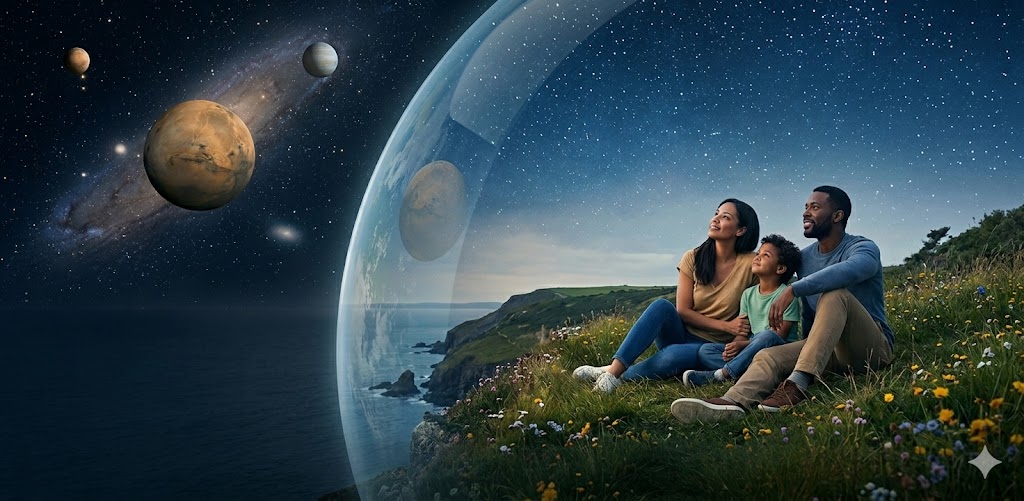
Science fiction writers can’t predict the future, but they love to imagine possibilities. For the most part, readers know they are just reading stories, but science fiction has given them certain concepts that they want to believe will come true. Three of the most popular memes that have been passed down over centuries are space travel, aliens, and robots.
Science fiction has also warned us about futures we want to avoid. The genre offers a spectrum of visions ranging from horror to hope. We don’t want War of the Worlds by H. G. Wells to come true, but many would find Carl Sagan’s vision in Contact to be wonderful.
Most science fiction fans know they read to escape ordinary lives, but a few hoped some of the things imagined by science fiction would come to be, even hoping in their lifetimes. Things like space travel, colonizing the Moon and Mars, first contact, robots, artificial minds, and life extension.
The robots and artificial minds of 2026 are almost like what we read about, and in the next few years, might catch up with science fiction. Many real robots surpass the abilities of the robots we saw in Forbidden Planet and Lost in Space. And real robots are way beyond the clunky robots we saw in The Twilight Zone. I’d even say modern robotics has evolved past most of the robots in early Asimov stories. We haven’t gotten Data or R. Daneel Olivaw yet. But I’d say they are within the realm of possibility.
For some reason, humans have long wanted to create intelligent companions. You can trace these desires back to folk tales and myths. But now that this dream is about to come true, will it make us happy?
Science fiction also dwells on aliens, alien invasion, and first contact. Again, this says something about our sense of aloneness in the universe. However, meeting aliens depends on science fiction’s prime hope, space travel.
With NASA and SpaceX, you’d think I’d give space travel an A+ too, but I don’t. I’m afraid I’m going to give science fiction a fail. It’s almost certain we won’t go to the stars. We might make it to Mars, but I doubt that we will stay there. My bet is we’ll screw around on the Moon for several years, maybe send a few crewed missions to Mars, and then decide space exploration isn’t very desirable at all. That is, at least for humans.
All the nearby real estate outside of Earth is only suitable for robots. Robots don’t breathe or eat, and they don’t mind the extreme cold and heat of space, or even the radiation. Since they don’t need to carry a biosphere with them, it makes it much easier for them travel in space. More than that, they can handle voyages of years or even centuries. You have to wonder if evolution is working here. That robots are our evolutionary descendants.
Science fiction has glamorized outer space. Years ago, I was talking with a young woman who told me she was a science fiction fan. I asked her if she wanted to be an astronaut. She said, “No way!” But she went on to say she’d love to travel in space like Captain Picard and crew. I told her a spaceship like the Enterprise will probably never exist. She replied, “That’s depressing, so I don’t want to go, then.”
I’m pretty sure space travel, even the limited travel within the solar system that we see in The Expanse, is nearly impossible. The millions of would-be Mars colonists who put their faith in Elon Musk will beg to go home not long after they land on the Red planet.
I had Notebook LM collect a bunch of articles and videos about colonizing Mars and traveling to distant stars. Strangely, it found one of my blog posts that I had forgotten I had written. See “What If Science Fiction Is Wrong About Space Travel?” I often forget what I write, and the same inspiration often returns. I end up writing a new version of my thoughts. This post is one example.
I was inspired to start this research when several YouTube videos showed up in my feed. (See some of them below.)
These videos made me contemplate why I didn’t want to believe them. A lifetime of reading science fiction made me assume sooner or later we’d colonize the solar system and then the galaxy. I thought that gave humanity an existential purpose. I justified this need by believing humanity needed to back up our species on other worlds.
For decades, I’ve known these hopes were naive and unscientific. They were my narrative fallacy. I always wanted to maintain these beliefs first acquired in childhood, using confirmation bias by finding supporting evidence.
A lifetime of reading science fiction has made me ignore the reality that Earth is our only home. I again come to the same final thought as I did in my first essay, and one Notebook LM latched onto: “Yet, reality suggests we’ll eventually bang into the glass walls of our aquarium. I wonder what science fiction will speculate on then.”
Can science fiction imagine possible futures where we stay home for millions of years and develop a healthy relationship with Earth and nature? Will such stories be as exciting and inspiring as current science fiction? Solarpunk and Hopepunk aim to offer hope, but they still see us as space-faring creatures. Is that real hope, or false hope? Should genuine hope be realistic?
Resources:
Notebook LM created a podcast from all the research articles it collected for me. It’s quite impressive, especially when you think an AI created it. It’s actually very science fictional.
Here are the three videos Notebook LM used.
James Wallace Harris, 2/27/26
 Classics of Science Fiction
Have you read Aurora by KSR? In that book he quite conclusively shows colonization outside the solar system is impossible for humans, and probably, as you say, even Expanse like stuff indeed is highly implausible.
LikeLike
Yes, I’ve read it. I think it was the beginning of my doubt.
LikeLike
I’m an old Robert Heinlein fan like you. When I read “Space Cadet”, I taught myself how to use a slide rule and wanted to go to the Air Force Academy and become an astronaut. I actually began the process of applying as I finished high school.
Now I think that sending organic beings into space is stupid and wasteful. It’s OK to send machines, robots or whatever that are custom designed for the environment.
I also think there is a subtext to the idea of expanding through the solar system, or through the galaxy. “It’s OK to strip mine this planet, the are plenty more.
I think we should devote resources into the long term cultivation of this planet. To me this means an end to radical expansion.
LikeLike
Doug, we are a lot alike. Maybe many of us who started out as disciples of Heinlein have undergone the same evolution.
Did you notice that Heinlein seems to give up on space exploration starting with Mistress? He had space travel in some of the later books but it was vague, lacking details. His later books were metafiction about his own fiction.
LikeLike
I worked in the US human spaceflight program for 30 years and I agree with you pretty much completely. I think there can be a use for a crewed Moon base but it will never be self sustaining.
Mars colonization is pretty much impossible unless there is a profit motive, and so far there is not.
The jury is still out on humans in Earth orbit. In the long term it will depend on if there is a way to make it profitable.
Interstellar travel is a fantasy, the only possibility is generation ships, and the question is why.
LikeLike