In the 1960s, we often thought about what life would be like in the 21st century. We’d speculated about fantastic inventions. One that frequently came up was having the Library of Congress in a device we could hold in our hands. In a way, a smartphone is that device. However, we didn’t anticipate networking. We just imagined all the works in the Library of Congress copied onto a small device.
We’re close to having that invention now. It’s not like how we imagined. We don’t think about the future as much today as we did back in the 1960s. Change is happening so fast that every day seems like the future. However, can we speculate what a fantastic invention we might have in another sixty years?
I did something fun the other day, something even science fictional. I put all my scanned science fiction magazines and books on a teeny-tiny 1 TB microSD card and loaded it into my old Amazon Fire 10 HD tablet. That tiny library contains 7,266 magazines and fanzines, as well as 3,570 fiction and nonfiction books. I’ve assembled this collection from the internet. Many items can be found on the Internet Archive or the Luminist Archives. Although some come from DVD-R disc collections I bought on eBay.
The Internet is a gigantically large library itself, but not one that’s always easy to use. When I was young, I worked in libraries. I always loved special collections. Special collections can contain material of any type, but they often house personal libraries donated by famous people. These donated libraries frequently focus on a single subject or type of work that’s been collected over a lifetime. I have a lifetime love for science fiction and science fiction magazines.
My microSD card is a special collection on a tiny chip that, back in the 1960s, we would have considered a marvel of the future. They are not so special today. I keep several in an old orange plastic pill bottle.
For fifteen years, I’ve collected digital copies of books and magazines on Dropbox. I had almost filled my two terabytes of cloud storage when I decided to buy a NAS. NAS stands for network-attached storage. I purchased a Ugreen DXP2800 and two Seagate 12 TB drives, which I mirrored. Now my digital library can expand to six times its previous size.
There is a major problem with leaving the cloud. If something bad happened to my DXP2800, such as the house burning down, my library and years of work would disappear. I have copies on external drives, but I need to find a way to keep regular copies off-site. My first thought was to take an external drive to a friend’s house, but then I remembered the microSD card.
Years ago, I bought a 128 GB card (pictured above) to test with my Amazon Fire 10 HD. That didn’t work out well because the card was too small, and larger capacity cards were too expensive.
Up till now, I have read my digital library with an iPad Mini, accessing my files from Dropbox. It didn’t matter that my old iPad only had 64 GB of storage. Each time I downloaded a magazine, it took about 30 seconds.
When I first considered backing up to a microSD, I checked current prices, and a 1 TB card was $67. That’s when I got the idea to see if I could copy my science fiction library onto a single 1 TB microSD. Copying just science fiction-related magazines, fanzines, and books, I used up just 650 GB.
I loaded that microSD into my Amazon Fire HD 10 and ran CDisplayEX. It saw the files. It even displayed them beautifully. And it was fast. Pulp magazines loaded instantly. Here’s the directory page for Astounding Science-Fiction 1942.
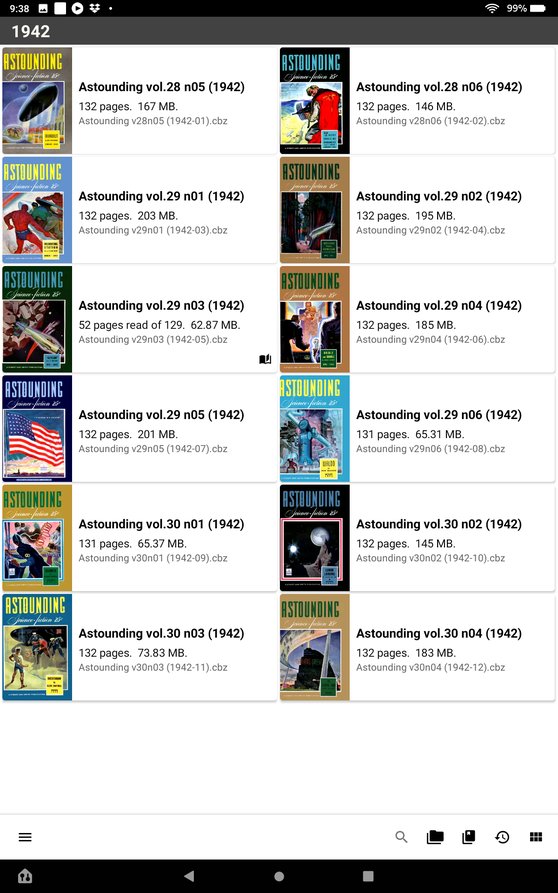
I realized I held in my hands what I had dreamed about sixty years ago. I had the ultimate pulp magazine reading machine. The tablet also allowed me access to thousands of Kindle books and Audible audiobooks. It wasn’t The Library of Congress in my hands, but it was amazing. I could kick back in my La-Z-Boy and browse through decades of magazines. That’s quite cool.
This got me thinking. How can I best use this resource? How can I integrate it into my work routines? Normally, as I create posts for this blog, I read and think in my La-Z-Boy, but I get up and write at my computer.
Being the lazy person that I am, I’ve long wanted to write anywhere and at any time. I spend a lot of time with my eyes closed, thinking. I compose essays in my head, but they are vaguely formed. After a point, the pressure of keeping all those ideas in my head gets too great, and I have to jump up and start writing.
I’ve always wanted to read, think, and write simultaneously. I’m now wondering if I can combine my new reading machine with a note-taking app and a word processor? Combining CDisplayEX with Obsidian and Jetpack goes a long way towards that idea. It occurs to me there’s more needed.
A large library isn’t useful without a card catalog. Before computers, this was called a card catalog because it was contained in drawers of index cards. However, special collections usually had their own index. Most people use Google and the Internet as their card catalog, but it is becoming more problematic every day.
I depend on two indexes to explore science fiction: Wikipedia and ISFDB.org. For example, here is the ISFDB.org page that indexes the history of the magazine Astounding/Analog. Here is the Wikipedia entry that describes the history of that magazine. And although ISFDB.org will eventually link you to the Internet Archive to read a particular issue, it would be cool if it linked to my copy of the magazine. It is possible to download copies of Wikipedia and ISFDB.org, but it’s not practical to integrate them into my tablet library of science fiction.
Certain things should stay in the cloud. Realistically, that should include the magazines and books. What we didn’t imagine back in the 1960s was a better version of The Library of Congress. Why should everyone own a NAS and build their own special collection?
The only advantage I have for messing with this tablet is speed. If my access to everything on the Internet were instant, would I need any storage at all? No, I wouldn’t. Currently, Internet speeds are fast, but not quite speedy enough. The real speed bump is how everything is organized. It’s finding what you want that’s really slow.
Here’s where AI comes in. I’ve discovered it’s quicker to ask CoPilot to find something than to ask Google. Unfortunately, when CoPilot can’t find what I want, it makes shit up.
You might be wondering by now where this essay is going. At first, I only wanted to describe the delight I found in my science fiction library on a tablet. But along the way, I began to imagine other science-fictional possibilities of taking the idea further.
Writing this essay has made me realize that what I really want to build is an annotated science fiction library. My blog is a disjointed attempt to write an annotated history of science fiction.
Here is my speculation for an awe-inspiring future device. Instead of having a Library of Congress we can hold in our hands, I’d like a handheld device that saves a copy of every artwork that inspires me, with a lifetime of my annotated thoughts about them. Wouldn’t it be wonderful if Shakespeare had such a gadget? I wish my parents had left me such memory cubes.
James Wallace Harris, 10/25/25


I would willingly pay for a well -indexed copy of your sci fi magazine & related records. Why? I remember short stories & novels I’ve read over the last 60+years, but almost never know about which author went with which story, and which well-written scene or thought provoking question went with which story.
When I write essays, first drafts often contain direct quotes & snippets from those stories. Naturally I want to give credit where it’s due — and encourage others to read those old stories.
What I usually end up doing if it’s part of work I hope to publish is distill the essence of the reference and rewrite until it’s totally mine. That’s OK and honest, but, I’m cheating the reader because there’s a reason certain phrases and peculiar points of view peculate up from my subconscious, and the original is almost always better than my remake.
Google use to help me research esoteric sources. I’d look up related topics and go through the pages. By page 25 I’d either find what I was looking for, or else discover a fun rabbit hole I never imagined existed.
Nowadays you go just a few pages in, and you’re getting either repeats, or people obviously just quoting the page 1 or 2 stuff. It’s like google is terrified you will learn the unexpected ways all knowledge is ultimately connected if you just dig deep enough. Or at the very least hates deep knowledge diggers.
LikeLike
Yes, we are part of a web of knowledge. I don’t know why people bitch at AIs for learning on books they haven’t written, which is exactly what all of us do.
I have this fantasy of building an AI and feeding all of science fiction into it. I’d hope it could connect everything to everything else.
As of now, I have no index to my library. They are adding OCR ability to AI, so it might be possible to build an index in the future.
LikeLike
What you need is a graduate student you could assign the task of indexing…. 🙂
Too bad that pool of free labor is not available to all of us!
LikeLike
I’ve fantasized that if I was rich I’d hire research assistants to work on all kinds of projects.
LikeLiked by 1 person