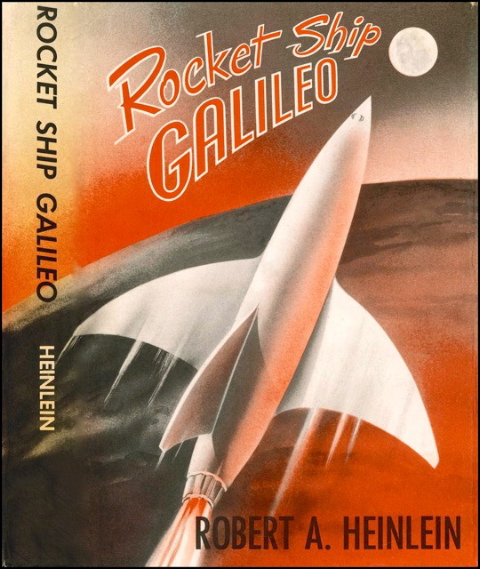
In The Outliers, Malcolm Gladwell claims that successful people often grew up with mentors. I never had one. Looking back, I could have used Robert A. Heinlein as my mentor, because his books for young people gave a great deal of advice. Unfortunately, I ignored his wisdom.
I’ve always been embarrassed to recommend Rocket Ship Galileo to science fiction fans because it’s so dated, unrealistic, and naive. Yet, I’ve enjoyed reading it several times over my lifetime. This 1947 novel for kids sets the stage for much of science fiction to come. Rocket Ship Galileo was Robert A. Heinlein’s first published novel. It was written in 1946, just a year after the war, and published by Charles Scribner’s Sons. That was quite a coup for Heinlein, since science fiction was just starting to be published by fan presses, and his first book was coming from the same publisher as Ernest Hemingway, F. Scott Fitzgerald, and Thomas Wolfe.
Heinlein’s writing is several steps up from most science fiction being written in 1947, but Rocket Ship Galileo is not much more than an updated Tom Swift novel. The story is set in the late 1950s, when Heinlein speculates that commercial rockets have been established for transporting freight and passengers. Military jets were being tested in 1947, but there were no commercial jets, so Heinlein expected rocket technology to be the winning technology.
Heinlein based his speculation on Werner von Braun’s rockets and our use of atomic bombs in 1945. However, I thought Heinlein was overly naive and incredibly unrealistic to suggest that three high school students and one Manhattan Project scientist could retrofit a commercial chemical rocket with an atomic drive and fly to the Moon. That’s why I find the book embarrassing to recommend to modern readers. Even more embarrassing are the Nazis found hiding on the Moon.
I first read Rocket Ship Galileo in 1964. This was just before the Project Gemini manned missions in 1965. It was obvious that three teenagers and an adult could never build a rocket in one summer capable of traveling to the Moon. I was in the 8th grade. That kind of belief was common in the Tom Swift and Tom Swift, Jr. books I read in the 5th grade. I should have been savvy enough in 1964, at age 13, to quit reading Rocket Ship Galileo after a few pages. Why didn’t I? And why have I read it another four times since then?
In the fall of 1964, I loved the new TV show Gilligan’s Island, but whenever I watch an episode of it today, I wonder if my brain was damaged as a teenager. Why wasn’t I more discerning about what I read and watched? However, I was a dumbass kid of twelve and thirteen when I first read Heinlein’s fourteen novels for young adults. (I’m adding in Starship Troopers and Podkayne of Mars to the twelve from Charles Scribner’s Sons.)
This is going to sound weird. I now consider embracing science fiction as a kid was psychologically similar to becoming religious. Accepting fantastic science fiction beliefs gave me the same comforts as accepting Jesus. I just wanted to travel to the heavens before I died.
Now Heinlein wasn’t trying to be irrational or promote silly ideas. Rocket Ship Galileo is full of scientific digressions, also called info dumps. I felt Heinlein was speculating as scientifically as possible with what people knew in 1947. He uses his own ideas about the possibilities of applied atomic power. But he doesn’t think things through. Heinlein understood that radioactivity could superheat fuel and create a more powerful exhaust than chemical combustion. However, to suggest liquid zinc or mercury as a rocket fuel is insane. Did they have no concept of pollution back in 1947?
Heinlein also understood that computers would be used to navigate to the Moon. He references ENIAC, built in 1945, the first general-purpose digital computer.
Because of rockets, computers, and atomic bombs in 1945, the guiding philosophy of science fiction became, if we can do this now, why can’t we do something like it in the future? Heinlein was leading the charge for science fiction to speculate and extrapolate. The twelve Heinlein juveniles, published from 1947 until 1958, became my gospels and epistles to a religion founded on science fiction. Heinlein became my guru, my substitute father, yet I missed all his advice that could have been considered mentoring.
All the Heinlein juveniles advocated studying science and mathematics, especially math. I read these books in the mid-1960s, believing I’d grow up and travel into space in the 1970s and 1980s. But I didn’t follow Heinlein’s guidance. In the 1920s, Heinlein had worked hard at school, making his way through the Naval Academy at Annapolis. Heinlein repeatedly emphasized studying.
Most Christians want easy Christianity. All they want to do to get to heaven and have everlasting life is to say, “I believe.” I was no better in my approach to science fiction. I have read several accounts from rocket scientists who claimed Heinlein inspired them to become who they were. There are millions like me, who aren’t rocket scientists, who also read Heinlein.
I’ve criticized some science fiction stories for using comic book science. You know the kind, exposure to Z-rays leads to superpowers. In the early years of science fiction, the public considered it moronic trash. And kids who loved it justified reading science fiction to their parents, claiming they learned science from science fiction. The frequency of science lecture infodumps in the Heinlein juveniles is high. They were respected by librarians and teachers. Ultimately, their appeal was adventure. They were crack for geeks. They preached that humanity’s manifest destiny was exploring space. Each book took readers further away from Earth. (Chart provided by CoPilot.)
| Year | Title | Primary Setting | Scope of Exploration |
|---|---|---|---|
| 1947 | Rocket Ship Galileo | Earth ↔ Moon | First lunar mission; atomic propulsion |
| 1948 | Space Cadet | Earth ↔ Solar System | Venus and outer planets via military service |
| 1949 | Red Planet | Mars | Colonial life and rebellion |
| 1950 | Farmer in the Sky | Ganymede (Jupiter moon) | Terraforming & settlement life |
| 1951 | Between Planets | Earth ↔ Venus | Interplanetary conflict and diplomacy |
| 1952 | The Rolling Stones | Earth ↔ Mars ↔ Jupiter system | Freewheeling space travel by a family |
| 1953 | Starman Jones | Earth ↔ Deep Space | Galactic navigation and far-flung trade routes |
| 1954 | The Star Beast | Earth ↔ Galactic Civilizations | Alien ambassador pet and interstellar law |
| 1955 | Tunnel in the Sky | Unknown planet | Survival and societal formation via teleportation |
| 1956 | Time for the Stars | Earth ↔ Deep Space | Relativistic travel and twin-linked telepathy |
| 1957 | Citizen of the Galaxy | Various worlds in Galactic Empire | Slavery, social caste, and galactic society |
| 1958 | Have Space Suit—Will Travel | Earth ↔ Pluto ↔ Intergalactic Tribunal | Kidnap into deep space; galactic ethics debate |
While rereading Rocket Ship Galileo this time, I noticed many of Heinlein’s lifelong pet ideas, which Heinlein elaborated on in his adult science fiction in the 1960s. Heinlein wanted to be a philosopher and teacher. The Heinlein philosophy is gentle in these books for young people. One of my pet theories is that Heinlein was influenced by Ayn Rand in her 1957 novel, Atlas Shrugged. After that, he switched to writing novels for adults, and the Heinlein philosophy became more pronounced.
Heinlein’s core philosophy in the twelve juveniles is that space exploration is humanity’s manifest destiny. In Rocket Ship Galileo, the first of the twelve, is about going to the Moon. In Have Space Suit-Will Travel, the twelfth and last, it’s about travel across the galaxy. Each new book goes further out into space, expanding on Heinlein’s pet ideas. Strangely, after the juveniles, Heinlein turns to politics in his adult science fiction novels. Space travel is part of these stories, but it’s no longer being promoted. It’s just accepted.
I first read the twelve Heinlein juveniles just after Project Mercury and just before Project Gemini. I had followed all the manned flights of Project Mercury. Was I a space enthusiast because of NASA or Heinlein? When Heinlein began his series for boys in 1946, few people thought about actual space travel. Science fiction was considered that Buck Rogers stuff, and if you’ve seen any of the Buck Rogers serials, you know that’s a put down.
Heinlein does contribute to a long line of books speculating about the first mission to the Moon. Verne imagined a giant gun. Wells imagined anti-gravity. Heinlein imagined rockets evolving from V-2s. Heinlein just didn’t imagine how difficult the task would be to send a human to the Moon but had anyone else. I asked CoPilot and got this answer:
| Era | Title & Author | Mode of Travel | Notable Themes |
|---|---|---|---|
| 2nd century CE | True History by Lucian of Samosata | Whirlwind | Satire of fantastical travel tales |
| 1634 | Somnium by Johannes Kepler | Lunar demons during eclipses | Early scientific speculation; heliocentrism |
| 1638 | The Man in the Moone by Francis Godwin | Migrating swans | Utopian society; weightlessness |
| 1657 | States and Empires of the Moon by Cyrano de Bergerac | Fireworks & dew bottles | Satirical science; proto-rocketry |
| 1705 | The Consolidator by Daniel Defoe | Winged chariot | Political satire; lunar governance |
| 1835 | The Unparalleled Adventure of One Hans Pfaall by Edgar Allan Poe | Balloon | Comic realism; early space travel logic |
| 1865 | From the Earth to the Moon by Jules Verne | Space cannon | Technological optimism; post-Civil War science |
| 1901 | The First Men in the Moon by H.G. Wells | Antigravity material (Cavorite) | Alien civilizations; imperialism |
| 1926 | The Moon Maid by Edgar Rice Burroughs | Spaceship | Hollow Moon; hidden civilizations |
| 1947 | Rocket Ship Galileo by Robert A. Heinlein | Atomic rocket | Youthful ingenuity; Cold War anxieties |
| 1950 | The Man Who Sold the Moon by Robert A. Heinlein | Corporate-funded rocket | Capitalism and space exploration |
| 1956 | Mission to the Moon by Lester del Rey | Rocket | Realistic Moon landing prep |
| 1977 | Inherit the Stars by James P. Hogan | Archaeological discovery | Human origins; Moon as historical site |
Rocket Ship Galileo will probably not appeal to modern science fiction readers. But for science fiction fans who study the evolution of the genre, is it worth reading? I was surprised by how many things I had forgotten about the novel. All I remembered was the Nazis on the Moon. I had forgotten all the details about creating an atomic rocket engine based on nuclear thermal propulsion, ballistics, space navigation, space suits, autopilots, airlocks, weightlessness, space sickness, computers, radio communication, and more.
After Apollo 11, reading books about the first landing on the Moon is problematic. However, Mary Robinette Kowal’s Lady Astronaut Universe series and Apple TV’s series For All Mankind have succeeded uniquely by creating retro histories. Because I grew up reading pre-NASA science fiction, I can still enjoy stories that are obviously dated because of nostalgia. I also love reading old science fiction because I love studying how the genre evolved.
But is Rocket Ship Galileo really worth reading five times over sixty-plus years? I imprinted on the Heinlein juveniles like baby ducks imprint on their mother. I loved these books so much that I ordered all twelve in hardback directly from Charles Scribner’s Sons with my first paycheck at age sixteen in 1967. I still have them.
At 73, I’m trying to understand how my personality was created. There are the genes I inherited from my parents. And my upbringing and education. I also believe a great deal of who I am came from pop culture – books, movies, TV shows, and music. One of the biggest factors was science fiction. When I reread old favorite books from childhood, I look for clues about how my personality formed.
I’m forced to ask myself: Did I really believe I would go into space someday? I thought I did, but was it a realistic belief? Do kids really believe they will grow up to be football players, or rock stars, or astronauts?
Here’s the thing. If I truly paid attention to Heinlein’s books, I should have modeled myself after his characters. I didn’t. I half-ass did. I read easy popular science books. I built Estes model rockets. I even tried to grind my own telescope mirror but failed. However, I mostly read science fiction. The Heinlein characters didn’t read science fiction.
Today, we have the Maker Culture. That’s what Heinlein was really promoting. Heinlein wanted his readers to become junior scientists. Reading his books made me fantasize about doing that. Instead, I just read more science fiction.
I’ve often pondered how many science fiction books anyone should read. Taking psychedelics back in the 1960s opened the doors of perception. Science fiction was like that. But like people asked back in the 1960s, how many times do you need to go through the doors of perception?
In retrospect, I feel I read too much science fiction and didn’t do enough of other things. I’ve often wondered what my life would have been like if I had stopped with Have Space Suit-Will Travel and gotten busy doing things. Rereading Rocket Ship Galileo reminds me of what I wanted to be as a kid, but reveals I took the wrong path.
James Wallace Harris, 8/5/25
 Classics of Science Fiction
Thanks for the article. I’m 75, so it’s contemporary for me. I had to look up “Thorium” when I read “Rocket Ship Galileo”. Our little library, in Glenview Illinois had all of Heinlein up in the adult section where I wasn’t allowed until I was thirteen. So I never really noticed a distinction between the juveniles and other books. IMO “Double Star”, “The Puppet Masters”, “The Door Into Summer”, etc. are on the same level. I also didn’t make much distinction between fantasy and SF. “The Unpleasant Profession of Jonathan Hoag” was on the same shelf.
I have no regrets about reading so much science fiction. I, too, read instead of acting. And I don’t regret reading as much Heinlein as I could get ahold of. I taught myself to use a slide rule after reading Heinlein.
I like the reference to psychedelics. In his book “Mother American Night”, which I recommend, John Perry Barlow said “You only trip once”. I think “Space Cadet” opened the door for me. I never wanted to be one of Heinlein’s characters, maybe because they didn’t read science fiction.
https://www.poetryfoundation.org/poems/44978/miniver-cheevy
LikeLiked by 1 person
I enjoy reading your thoughts on SF. I read a lot 40 years ago but it dropped off and I’ve lost many of my old books. I’m buying many again and re-reading. Plus reading many I missed. I’ve not read any Heinlein juveniles, only Starship Troopers, Moon is a Harsh Mistress and Stranger in a Strange Land. I re-read Starship Troopers a couple of years ago and thought it held up, better than Haldeman’s Forever War actually (re-read around the same time).
Cheers, Alastair
P.S. You have a typo in the post title (“galilio”).
LikeLike
It’s always more embarrassing misspelling a word in the title.
I also think Starship Troopers is better than Forever War.
LikeLike
I’ve never read this. Sounds like it’s right up my alley, though. I’ll have to check it out.
LikeLike
Let me know what you think of it. I’m curious how new readers will react.
LikeLiked by 1 person
I’m not a “rocket scientist” but I spent my career as an engineer in Space Shuttle training and operations.
Have Spacesuit Will Travel started me down that path; I read it in my elementary school library. I didn’t understand a lot of it, but I did get the part about Kip using math to solve his problems. My inborn talents were not mathematical – my SAT scores were lopsidedly towards the “Verbal” – but I recognized that learning the math was required for what I wanted to to do.
I just bought a Scribner’s “library binding” copy of HSSWT that is in fact a discard from a library; I don’t know how to tell what printing it is, but it looks exactly like the one I read back then.
I too have read Rocket Ship Galileo several times over the years, but for the reasons you list, it’s my least favorite of the juveniles.
LikeLike
Over the years, I’ve read several accounts like ours. Those Heinlein juveniles stuck with people, I wonder how many?
LikeLike
Acabo de descubrir este blog y me parece maravilloso. Doy gracias de que aún queden personas que se dedican a escribir blogs, las redes sociales limitaron la navegación de internet. Tus opiniones y recomendaciones son geniales. Leeré todas las entradas y espero seguir leyendo muchas más en el futuro. Saludos!
LikeLike