
Ray Bradbury published hundreds of short stories over and over again in various collections. Bradbury and his publishers often repackaged his stories into new collections or reprinted older collections with a slightly different lineup of stories. Ray Bradbury’s bibliography at ISFDB.org is so confusing that we’ve decided to select those collections that will provide the most stories by buying the fewest books.
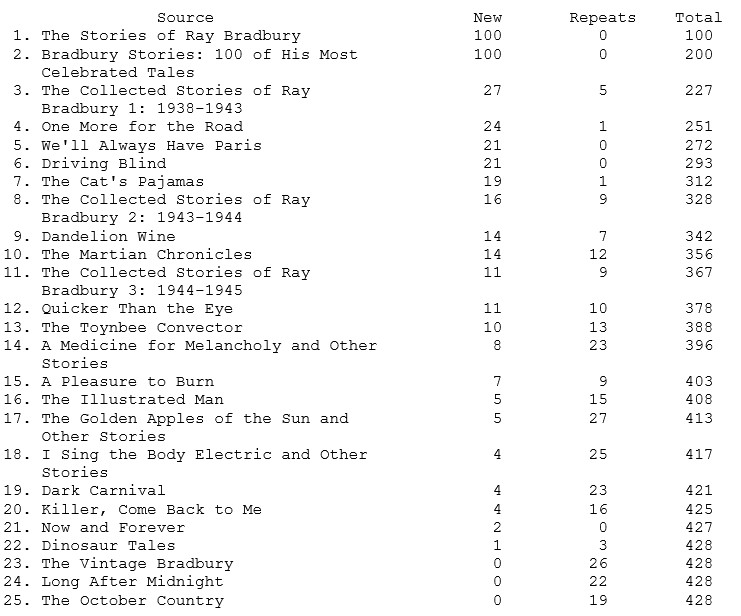
Mike, the programmer for the Classics of Science Fiction website, coded several programs to find the right combinations of Bradbury collections that would give the widest selection of stories to read. The permutations turned out to be excessively large, so we simplified the procedure.
Our solution was to pick the collection that provided the most Bradbury stories. Then add a second collection that provides the most additional stories not in the first collection. Then add the third collection that contributes the next most additional stories, not in the previous two. And so on. Study the table, and the technique will become obvious.
Here are the twenty-five collections we used. We only used collections that are in print, either in hardback, paperback, e-book, or audiobook. Hyperlinks are to Amazon affiliate links.
- 1947 – Dark Carnival
- 1950 – The Martian Chronicles
- 1951 – The Illustrated Man
- 1955 – The October Country
- 1957 – Dandelion Wine
- 1965 – Vintage Bradbury
- 1976 – Long After Midnight
- 1980 – The Stories of Ray Bradbury
- 1983 – Dinosaur Tales
- 1988 – The Toynbee Convecter
- 1996 – Quicker Than the Eye
- 1997 – Driving Blind
- 1997 – The Golden Apples of the Sun and Other Stories
- 1998 – A Medicine for Melancholy and Other Stories
- 1998 – I Sing the Body Electric and Other Stories
- 2002 – One More for the Road
- 2003 – Bradbury Stories
- 2004 – The Cat’s Pajamas
- 2007 – Now and Forever
- 2009 – We’ll Always Have Paris
- 2010 – A Pleasure to Burn
- 2010 – Killer, Come Back to Me
- 2011 – The Collected Stories of Ray Bradbury 1: 1938-1943
- 2014 – The Collected Stories of Ray Bradbury 2: 1943-1944
- 2017 – The Collected Stories of Ray Bradbury 3: 1944-1945
Here are Mike’s calculations.
James Wallace Harris, 3/30/25
 Classics of Science Fiction
Can of worms opened…!
The COLLECTED STORIES volumes often contains earlier versions of stories that you won’t find elsewhere. Example: “The Wind” is the original Weird Tales version, which RB totally revised for Dark Carnival.
You wouldn’t really want to READ the books in that order… For example, you wouldn’t want to experience MARTIAN CHRONICLES in the way implied there…
Nitpicking aside, what a neat thought-experiment!
LikeLike
What are the COLLECTED STORIES like? I’ve never seen a copy and they are too expensive for me to buy. Are they just the original versions of the story or do that contain editorial essays that explain the history of the stories? Are there letters or other supplementary content?
LikeLike
They’re for completions only, really. They have detailed intros explaining the creation of the stories, usually some appendices, and they always have line-by-line editorial notes at the back that comment on every little change and editorial decision. Where the Collected Stories editors have had to make a decision (e.g. on whether something was a typo or the author’s intent), they document it and rationalise it.
The average reader will never even look at these notes, but they’re important from a scholarly point of view.
Vol.1 is arguably more important than the other two volumes, because it brings back into print some very early compositions that you can’t easily get elsewhere. But the stories in that volume are mostly of historical interest only.
And yes, they’re quite expensive, because they’re aimed at university libraries rather than general readers.
LikeLike
I had a similar problem with Theodore Sturgeon and Keith Laumer. Tried to tackle it with spreadsheets.
Fortunately a complete edition of Sturgeon was published in many volumes so I got that and pitched all the collections. Laumer still is a mess.
LikeLike
Happily for us fans of Cordwainer Smith, there is the 1993 NESFA Press’s The Rediscovery of Man: The Complete Short Science Fiction of Cordwainer Smith. If you have that and Norstrillia, you have it all.
LikeLiked by 1 person
Well, almost all … there are novels under two other names Atomsk (as by Carmichael Smith), and Ria and Carola (both as by Felix C. Forrest); there are apparently three unpublished novels (General Death, Journey in Search of a Destination, and The Dead Can Bite (a/k/a Sarmantia). Then there is the non-fiction, notably Psychological Warfare, published in 1954 and still considered a seminal text in the field, plus The Political Doctrines of Sun Yat-Sen: An Exposition of the San Min Chu (1937); Government in Republican China (1938); The China of Chiang K’ai-Shek: A Political Study (1941); Foreign Milieux 1951); and a couple others with titles so long that I’m too lazy to type them but they can all be found on the “Cordwainer Smith” article on Wikipedia. The non-fiction is all under his real name, Paul Myron Anthony Linebarger, and the ones I listed, except for Foreign Milieux, are all available on gutenberg.org. Atomsk is available as, at least, a Kindle book, as is Psychological Warfare, though I would be more inclined to get the latter from gutenberg.org.
LikeLike
Jim and Mike, thanks for a fun thought experiment and essay. This reminds me a bit of your 2022 essay The SF Anthology Problem – Solved. I will admit I don’t have a goal to read all Ray Bradbury, but I enjoyed reading about this anyway. I do own the 2020 e-book version of “The Stories of Ray Bradbury”, which is fun reading but lacks individual story introductions/essays.
LikeLike