Group Read 92 (#05 of 25)
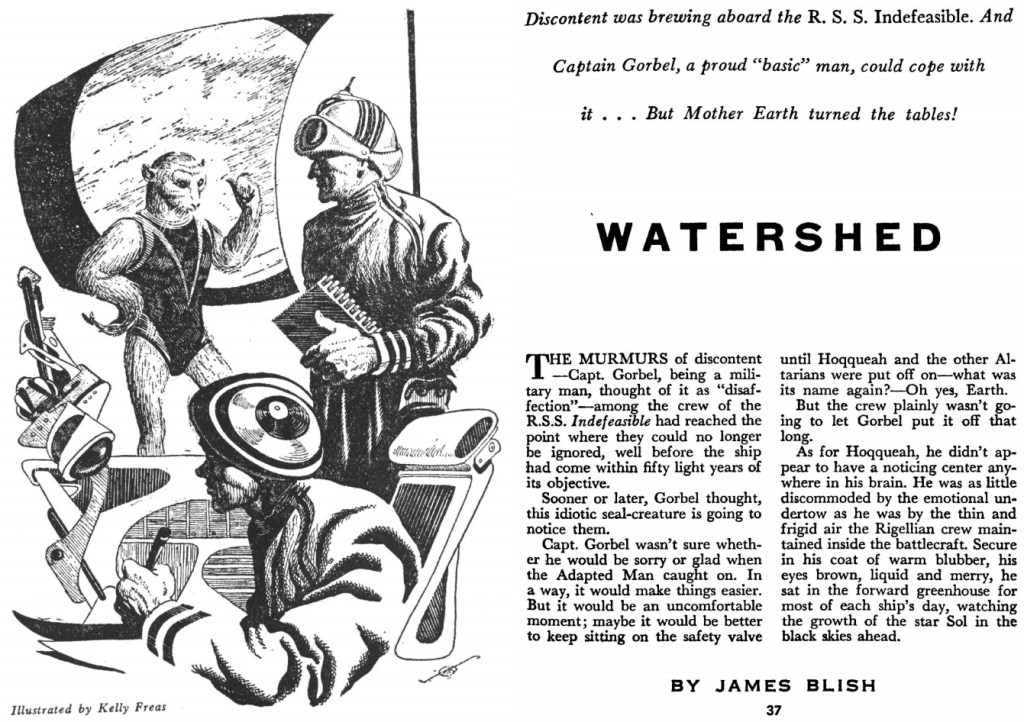
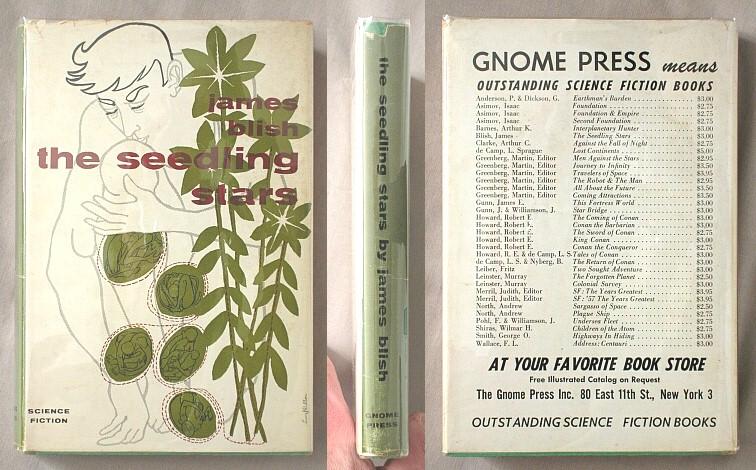
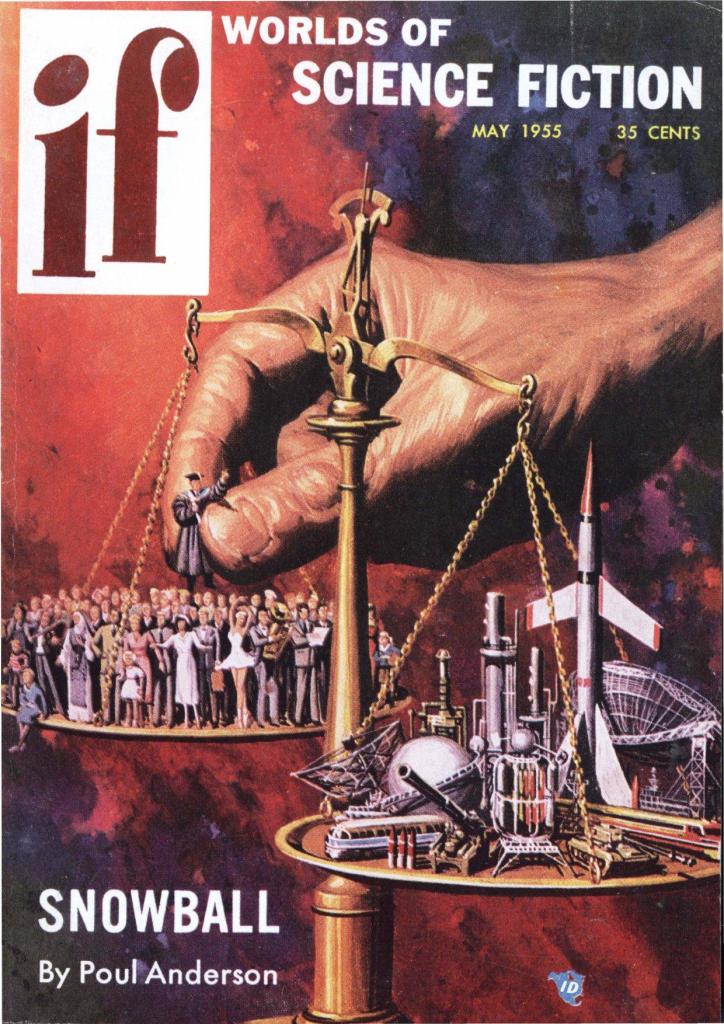
“Watershed” by James Blish was first published in IF Worlds of Science Fiction (May 1955). You can read it online here. “Watershed” became part of James Blish’s The Seedling Stars, a collection of short stories about adapting humans to new environments. The most famous story of the collection is the classic “Surface Tension.” Unfortunately, “Watershed” is not in print except for Supermen: Tales of a Posthuman Future, a 2002 anthology edited by Gardner Dozois.
“Watershed” is a rather preachy tale, not a thrillingly dramatic story like “Surface Tension.” Capt. Gorbel of the spaceship R.S.S. Indefeasible is traveling to Earth to deliver new colonists, but it’s not what you think. Humans have long colonized the galaxy, and the environment of Earth can no longer sustain “standard form” humans. Gorbel is going to Earth to deliver colonists that look like seals, but are considered just as human as we are, well, that’s by the standards of political correctness of their day.
The adapted human is Hoqqueah. He likes to sit in the forward greenhouse and stare into space as the ship approaches Earth. However, the standard form crew considers itself superior to the adapted humans. Averdor doesn’t like that Hoqqueah spends so much time in the greenhouse, and is annoyed by his constant talking. Averdor tries to convince Gorbel to forbid the adapted humans from using the greenhouse.
Hoqqueah knows of this prejudice, and he tells the Captain a story about Earth. He explains that Earth was the original home of all humans. He also tells how humans have found many planets that couldn’t support the standard human body, so they adapted humans to new forms. The concept is called pantropy. (That link gives several classic examples in SF.)
However, this is 1955, and we must ask ourselves if this story is about space exploration. The famous civil rights case, Brown v. Board of Education, happened in 1954. To be fair to James Blish, he had been exploring pantropy since 1942. But then Blish has Hoqqueah tell Captain Gorbel about prejudice against dark skin humans on old Earth.
The kicker to this story is that the standard form is now the minority.
“Watershed” has nice sentiments, but not much of a story. It’s told, not shown. It would have been far better if it had been dramatized. We don’t get to know Hoqqueah or what it’s like to be a seal person. And why, if standard form humans can’t handle Earth, how can the adapted men of his kind handle the spaceship with Gorbel and Averdor?
I recommend reading “Surface Tension” to understand what I mean by telling the story with drama. You can read it in the August 1952 issue of Galaxy Magazine.
James Wallace Harris, 4/30/25
 Classics of Science Fiction