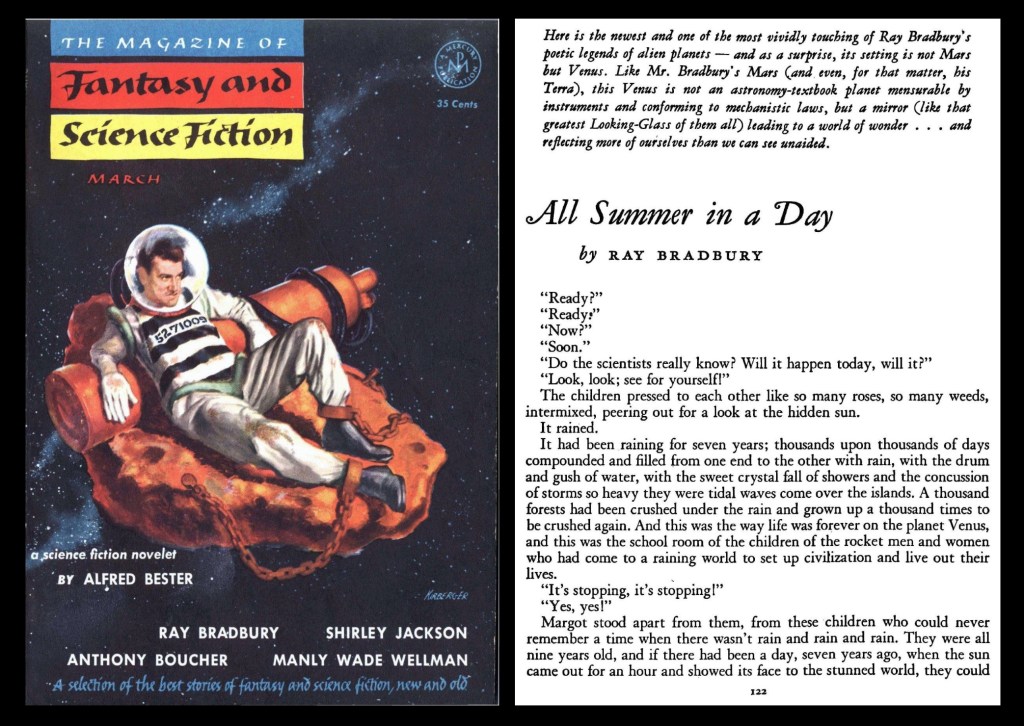
I’ve been rereading Ray Bradbury short stories, and I’m amazed at how well they hold up even when the science is beyond dated. Ray Bradbury is quite cruel to us readers in “All Summer in a Day.” In fact, I had to stop reading when I knew where the story was going, I just didn’t want to go there. I waited a couple of days to finish this fifteen-minute story on audio.
At first the kids in “All Summer in a Day” reminded me of Charles Schultz’s Peanuts characters, but then it was obvious they associated with bad kids from stories by Charles Beaumont or Shirley Jackson.
Remember when Lou Grant told Mary Richards she had spunk? And then Lou said, “I hate spunk.” Well, “All Summer in a Day” has a punch in the gut, and I should say “I hate a punch in the gut,” but when it comes to short stories, a punch in the gut is a good thing. Isn’t that weird. Why do we admire a great punch in the gut from a short story? Why is it so satisfying?
“All Summer in a Day” is set on Venus where it rains continuously except for a two-hour window of clear weather and sunshine every seven years. In a classroom the kids are talking about the impending summer. One girl, Margot, was born on Earth and didn’t come to Venus until she was four. She could remember sunshine and tried to describe it to her classmates who didn’t remember the sun because they were born on Venus. They were just two the previous summer day. They didn’t believe Margot. They resented that she knew something special. So, just before the sun was to come out, they locked Margot in a closet. All the other kids got to see the sun, and it was everything and more that Margot had tried to describe to them.
The children completely forgot about Margot while they cavorted through their brief summer day. When the rain and clouds returned, they remembered Margot and let her out.
This is a simple story about how children are cruel to each other. It’s about being the nail that sticks up. It’s about knowing the undescribable. Does the setting on Venus really matter? It makes the story science fiction so Ray Bradbury can sell it to a science fiction magazine, but does it really matter to the story? Charles Schultz could have done such a story about how the Peanuts gang mistreated Charlie Brown, and may have many times, I just can’t cite a specific panel.
I’m in the process of rereading my favorite science fiction stories and trying to understand why they are my favorites. Writing ability accounts for some of the reasons, but triggered emotions count for many too. I wish I could say I understood every cog in this story, but I don’t. What I do recognize is Ray Bradbury has a set of skills to tell a story in a way that makes it stand out. Not only that, but his stories also endure.
As I reread this story I didn’t remember the details, but either I guessed or remembered what was going to happen to Margot. That’s why I stopped listening to it. But when I returned to the story, I kept thinking to myself: “How is Margot going to react?” I was surprised that Bradbury didn’t give us Margot’s reaction. He left that up to us. That’s another tool in his writing toolbox. Writers don’t have to tell us everything. Bradbury does tell us this about Margot:
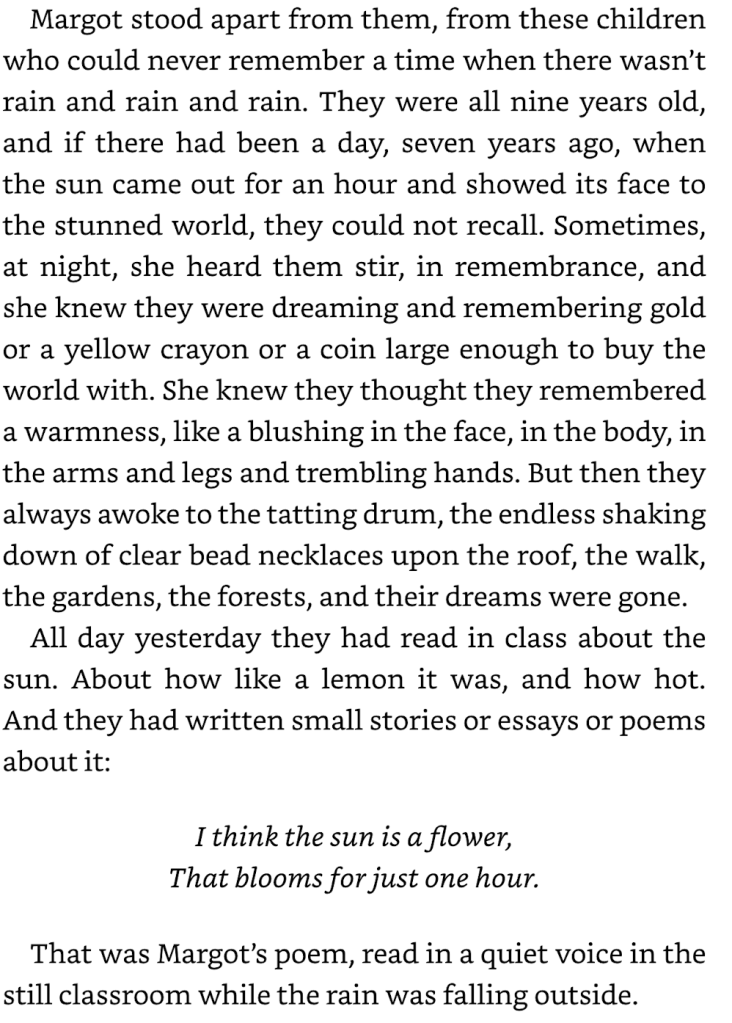
Because I just finished reading a biography of Ray Bradbury I know he was an odd child that stood out to his classmates. He also like to write poetry. Bradbury doesn’t have to tell us that this story is for us loners and oddballs, the ones other kids considered weird. When I was growing up, I didn’t know anyone else who read science fiction. Science fiction was like the sun appearing on Venus to me. I tried to explain its appeal to other kids, but they just thought I was a zero. I didn’t make a science fiction reading friend until the tenth grade when I met James Joseph Andrew Connell, III. The experience of meeting another science fiction fan is why Among Others by Jo Walton won the Hugo, Nebula, and British Fantasy Award. Zenna Henderson made a whole writing career out of telling stories about oddballs.

Even in the 1940s Ray Bradbury knew that being labeled a science fiction writer would hurt his career. Bradbury authored stories for all kinds of markets and genres, but when he wrote science fiction, he knew he had to be different. Back in the 1950s he might have been the best-known science fiction writer in America, but many science fiction readers didn’t consider his work science fiction. Bradbury wanted to be a writer like Sherwood Anderson, Ernest Hemingway, or Thomas Wolfe, someone who was just called a writer.
The reason “All Summer in a Day” is good is because of the parts that aren’t science fiction. The reasons why some science fiction fans dismissed him was for the science fiction parts. The obvious lesson here for would-be science fiction writers, is don’t worry about the science fictional aspects but focus on the universal human appeal.
James Wallace Harris, 4/11/25
 Classics of Science Fiction
I agree with your comments about “All Summer in a Day.” When I first read the story, I knew that was going to be a surprise sending since by 15 I was very familiar with his short stories. When I first read his work, I thought of “Twilight Zone”, the two Alfred Hitchcock shows, and other short lived anthology TV shows. His writing is so smooth, that many unsold short stories of mind were imitations of his work. The rejection slips are long gone.
LikeLiked by 1 person