
Parable of the Sowers by Octavia E. Butler is a classic post-apocalyptic science fiction novel from 1993. It’s one of the best stories to read if you want to contemplate America collapsing from economic inequality. Most post-apocalyptic novels begin during the collapse or a short time after and are about the characters struggling to survive. The Parable of the Sowers is different. It starts in the early stages of collapse, so it’s technically a pre-apocalyptic novel. The rich still have civilization, but chaos is moving up from the poor, into the middle class. It begins with the fear of the coming apocalypse.
The Parable of the Sowers should offer a great panel discussion topic at a preppers’s convention. Most preppers picture themselves surviving when others don’t. They imagine grabbing their bug-out bags and heading to the hills where they own a private redoubt to make their last stand. Many post-apocalyptic novels start with tens of millions dying, making more room for those struggling to survive. Octavia Butler’s book imagines a collapse without a huge population die-off. Her scenario has millions clogging the highways fleeing collapsing cities.
Owning an AR-15 and backpack stuffed with survival food and gear won’t get you far. In fact, anyone with anything will be a target. That was also true in Cormac McCarthy’s The Road. Reading Parable of the Sower is about as depressing as reading The Road. However, Butler adds one twist that’s different from other post-apocalyptic novels.

The Parable of the Sower is the journal of Lauren Olamina who wants a reason to survive when all around her are dying. She redefines God to explain the horrors she’s experiencing. In fact, she begins writing a book that will eventually be called Earthseed: The Books of the Living. Lauren quotes from Earthseed to head her journal entries. Lauren decides God is change and our purpose is to shape God. Don’t get turned off by the religious angle of the book, most of the story is about survival. There is a sequel called Parable of the Talents. The story was planned as a trilogy, with additional books, but Butler died before finishing it.
Parable of the Sower begins with Lauren a teenager living in a gated community. Her father is a black Baptist minister, and her mother is a deceased drug addict. Her father has remarried and Lauren has three step-brothers. The novel begins in 2024 when Lauren is 15 and ends in 2027 when she is 18. The first half of Parable of the Sowers is about how the people in Lauren’s gated community survive while watching the world outside their walls fall into chaos and violence.
Butler’s book was written thirty years before the time it describes, which happens to be our now. Butler describes living under a president named Donner who has many similarities with Donald Trump. The reason this novel is so powerful is because it feels relevant and all too relatable. It’s exactly the kind of science fiction I consider serious speculation.
Lauren’s father is a leader of the community populated by white, black, and Hispanic people. He teaches both spiritual hope and how to use guns. Lauren doesn’t believe in his God and creates a science fictional religion to give her hope for the future. By the time the poor finally overrun her gated community, Lauren is 18, and the sole survivor of her family. She must survive alone among the hordes fleeing southern California. People survive any way they can, often by robbing each other. The most desperate set fires to force people out of their homes, robbing and killing them as they flee.
Any successful work of science fiction must tell a compelling story about a character or characters we care about who overcome their limitations. The act of reading the story should feel transcendent. Butler succeeds very well at this level.
A great work of fiction will also have its own ontology and epistemology, and Butler puts that into her story. I’m just not sure how well it works. But I give her credit for trying. At least she recognizes that living through an apocalypse will inspire deep existential thoughts.
The best fiction is about surviving reality, but great fiction is about confronting God or the absence of God. I also believe Butler was aiming that high. Again, I’m not sure she succeeds. But it feels close.
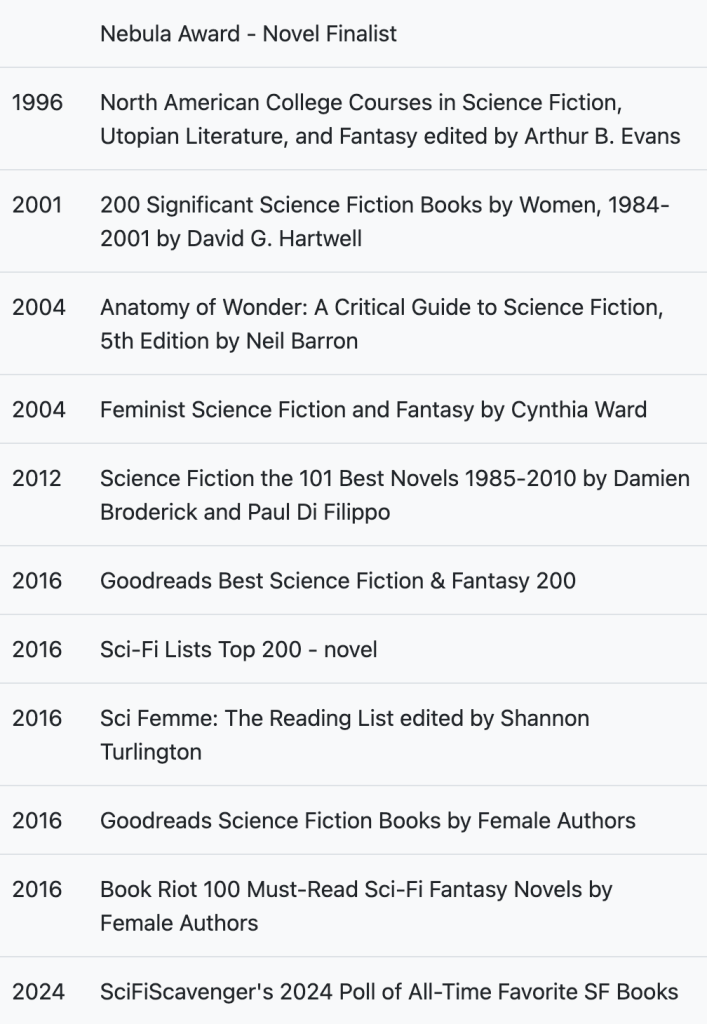
Parable of the Sower is on the Classics of Science Fiction List because of these 12 citations:
I do have one major disappointment with the novel. Lauren’s mother was a drug addict using one of many new designer drugs. As a byproduct of her addiction, Lauren is born with psychic empathy. That makes fighting to survive in a dog-eat-dog world difficult. This affliction jazzes up the plot but detracts from the realism Butler paints.
Octavia Butler spent an afternoon with our Clarion West class in 2002. At the time, I had not read anything by her, but I had read about her. I wish I had read the works I’ve since read so I could have asked her many questions. Just another regret on my giant pile of regrets.
James Wallace Harris, 2/6/25
 Classics of Science Fiction
One thought on “PARABLE OF THE SOWER by Octavia E. Butler”