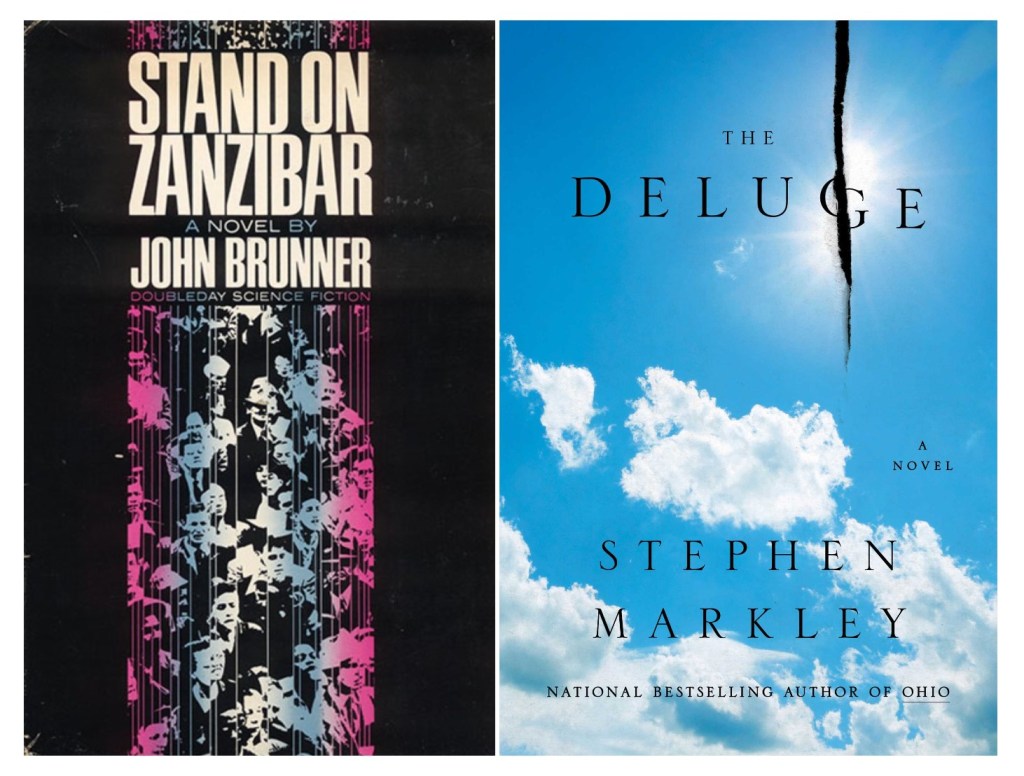
Out of the thousands of science fiction novels I’ve read, I thought Stand on Zanzibar by John Brunner took itself the most seriously. It addressed world problems John Brunner thought threatened humanity in 1968. I read Stand on Zanzibar in 1969 and it made me dread the future he depicted of 2010. It wasn’t the most thrilling SF novel I’ve ever read, nor was it easy to read, but it was most impressive stylistically and made me think about the future more than any other science fiction novel. The Deluge by Stephen Markley now follows in the footsteps of Stand on Zanzibar. Both books describe futures we should want to avoid at all costs. They are deadly serious science fiction.
There aren’t that many serious SF novels that intentionally warn us about the future. Other famous ones are Brave New World by Aldous Huxley, Nineteen Eighty-Four by George Orwell, The Handmaid’s Tale by Margaret Atwood, and The Ministry for the Future by Kim Stanley Robinson.
Everyone wants to predict the future, but that’s impossible, so science fiction writers sometimes extrapolate current trends, fictionalizing a possible near future. This is what both Stand on Zanzibar and The Deluge do. We can judge Brunner’s speculation since we’ve now lived past the time he imagined. He got a lot wrong, but he got other stuff right, especially how terrorism would spread across the world. Stephen Markley speculates about the politics of climate change will play out over the next sixteen years and five presidential elections.
Did Brunner and Markley hope we’d change our ways because we read their books? Markley warns his readers what will happen if we don’t act soon regarding climate change. His book asks: What will it take for humanity to give up fossil fuels? Kim Stanley Robinson does the same thing in The Ministry of the Future. Both novels spend a substantial number of words on terrorism. I really hope that isn’t the incentive that pushes us to change. Can we avoid these horrible futures because we read about them today?
My other review of The Deluge, intended for people who don’t read science fiction, I focused on the question: Can we change? For this review I want to focus on the question: Can science fiction influence society at large? If it can’t, why write such SF novels? Both The Deluge and Stand on Zanzibar are huge ambitious works that use a large cast of characters, shifting points of view, interspersed with chapters of pseudo journalism and pop culture, giving a multifaceted view of the near future. The Deluge is almost nine hundred pages in print and runs nearly forty-one hours on audio. It’s big and profoundly serious.
Serious science fiction often warns us we’re heading towards specific scary futures we could avoid if we make the effort. Do we ever heed such warnings? Scientists currently studying free will say it looks like humans are not in conscious control of our lives. I agree with them. If that’s true, can we change the way we act based on things we read? Maybe the authors of serious science fiction never hoped to change the course of history, but only wanted to appeal to certain individuals and influence their thinking. Are such novels part of an extended conversation about the future taking place in the genre of science fiction? Do they expect their readers to change the world, or just for other novelists in the future to reply? Are books about possible futures just an extended conversation that’s taken place in print?
Wasn’t Orwell’s Nineteen Eighty-Four a reply to Huxley’s Brave New World? Wasn’t John Brunner having his turn in the discussion when he wrote Stand on Zanzibar and his Club of Rome Quartet? And didn’t Margaret Atwood jump into the conversation with The Handmaid’s Tale? And aren’t such nonfiction books of futurism like The Limits of Growth and Future Shock also part of the conversation? I believe Robinson’s and Markley’s books are just the latest things said in a never-ending conversation about the future. Sure, many readers consider these books a genre of gloom and doom, but do they have a greater purpose and impact?
It’s interesting that all the books I’ve mentioned so far worry about issues that we continue to face. Is that because we’ll always face those issues? Or do their authors expect us readers to change the way we live and act and eventually solve these problems?
Science fiction writers and futurists know they can’t predict the future, but do they believe readers can divert the present away from possible futures they fear? Isn’t that a kind of free will? A kind of hope for the group mind? The reason scientists don’t believe individuals have free will is because they detect brain activity at the unconscious level before we think we claim to consciously make our decisions. Isn’t the world of intellectual speculation only a kind of unconscious group mind thought process?
People like to think we can become captains of our fate, so is it surprising that writers might hope that society can consciously choose what it will become? But does a meta-conversation about what human society could or should be really represent a kind of free will? I’m sure in their heart of hearts that Orwell, Brunner, Atwood, and Markley wanted to influence society and avoid the horrors they saw coming.
Self-help books are bestsellers because some people do change their habits, so isn’t that evidence that if enough people read serious science fiction it might influence the larger society? Scientists studying free will say no because the desire to change comes from our unconscious minds. But does that matter if science fiction influences us on a conscious or unconscious level? Isn’t the woken social movement mainly due to reading?
I do believe certain books about the future, both fiction and nonfiction, represent an ongoing conversation, but I don’t know if we change our lives because we listened to the conversation. I’m liberal, and have a lot of liberal friends, who claim to be very worried about climate change, but none of us have tried to significantly shrink our carbon footprint.
Back in 1969 when I read Stand on Zanzibar, I was frightened by Brunner’s vision of the future. Over the decades I’ve read and discussed its ideas on overpopulation and the limits of growth with my friends, but we’ve never acted on those fears. I’ve been talking with people about the dangers of climate change for over twenty years now, but we haven’t done anything significant either. That’s why in my other essay about The Deluge I titled it: “Will People Change vs. Can People Change?“
I don’t think we will change. So, why read science fiction that warns us about the future? Likely, we don’t have free will, but we might have an existential awareness of who we are, and I believe books speculating about the future expand that awareness.
Most science fiction is written to entertain. Most science fiction readers seldom read serious science fiction. John Brunner got some critical attention for his Club of Rome Quartet novels, but I’ve read he was depressed because they made no real impact on society. Few writers can achieve George Orwell’s and Margaret Atwood’s social impact.
The Deluge got a fair amount of good mainstream press, but I’m the only person I know who has read it. I doubt Stephen Markley intended it for science fiction readers. He’s a mainstream literary writer. However, because it attempts to do what Brunner did all those decades ago, I believe some science fiction writers will find it interesting.
Reviews of The Deluge:
- ‘The Deluge,’ an epic new climate novel, drowns us in catastrophes – Los Angeles Times
- The Enormity of It All: On Stephen Markley’s “The Deluge” – Los Angels Review of Books
- A New Novel Confronts the Scale and Gravity of Climate Change – New York Times
- The Deluge by Stephen Markley review – apocalypse in slow motion – The Guardian
- How will climate change destroy us? ‘The Deluge’ imagines the scenarios. – The Washington Post
by James Wallace Harris, 2/29/24
 Classics of Science Fiction
You’re not the first to ask this kind of question. Ever read “The Failure of the Science Fiction Novel as Social Criticism,” by C.M. Kornbluth, in THE SCIENCE FICTION NOVEL: IMAGINATION AND SOCIAL CRITICISM (Advent, 1959) (collecting papers by Heinlein, Bloch, Bester, and Kornbluth from a university symposium)?
LikeLike
John, I read that book back in the early seventies. I thought I had a copy but couldn’t find it. I just checked and it’s on Amazon for the Kindle for just $4.99, so I bought a copy. Thanks.
LikeLike
It’s always stimulating to follow your thoughts on science fiction. Keep it up.
LikeLike
Thanks.
LikeLike
Okay, lots to unpack I’m probably not the person to unpack all the points. Go talk to Peter Watts, he’s much better at this than me.
First, unconscious mind; hate that term, and its near cousin, subconscious mind. Both are at best shorthand for behavioural processes we don’t control consciously, and at worst illustrate the tendency of people to throw words around as if we understand something, where we clearly don’t e.g.: quantum ‘anything.’
Passive Frame Theory by Professor Ezequiel Morsella has an interesting lecture on YouTube (https://tinyurl.com/2y6hv8po), and of course there’s the excellent lecture series by Professor Robert Sapolsky too (https://tinyurl.com/q3zkvce).
Changing behaviours can be done, it was my profession back in the day, but the success rate is around 50% (not a fifty-fifty chance, but rather a measure of treatment outcomes). people only change when the alternative of not changing is misery, and even then, change is hard.
The reasons for this are down to multiple variables: attachment style; cognitive development; education; and sociocultural assumptions which include things like internal versus external locus of control.
As for free-will, it needs to be defined first, and science based definitions of free-will are really about degrees of freedom, not what the general public or philosophers think free-will is.
Okay, that’s all I’ve got.
LikeLike
Our words are crude pointers to vast complexities. Using the term unconscious mind is like referring to the control system of an ICBM as a black box.
I’ve been reading Sapolsky’s book DETERMINED. I’ve added those videos to my Watch Later tracking on YouTube.
I do think we can change some of our behaviors, but it’s hard, limited, and still might not be of free will.
I believe ChatGPT makes a marvelous model of the unconscious mind. Such AI programs can mimic a lot of what the unconscious mind produces. I think of the unconscious mind as the hardware and software that generates thoughts, dreams, visions ideas, intellectual abilities, physical abilities, etc. Our conscious mind is mostly a watcher, an observer. But it watches a recreation of reality in our heads. The conscious mind has the illusion it’s doing the thinking, deciding, feelings, and believing it’s observing reality directly. Of course, it’s also hard to separate our individual natures from society.
LikeLiked by 1 person
I didn’t find STAND ON ZANZIBAR depressing or frightening when I read it.
Of course, that’s me. But I thought Brunner’s book an interesting attempt to visualize the (then-) distant future of 2010 — a world Brunner was enough of an artist to depict as one that, when taken on its inhabitants’ own terms, was not necessarily hellish, and had its positives as well as its negatives.
It was a world I wouldn’t have minded living in. A world, too — based on the actual reality we’ve gotten — that Brunner wasn’t too far wrong in predicting. In SOZ, China is America’s new rival; Europe has united; there’s genetic engineering, Viagra, Detroit’s collapse, satellite TV, gay marriage, laser printing, electric cars, marijuana decriminalization, and much more.
https://themillions.com/2013/03/the-weird-1969-new-wave-sci-fi-novel-that-correctly-predicted-the-current-day.html
So, given its similarities to the world of SOZ, does the actual lived reality of 2010-24, now we’re walking around in it, *feel* like the dystopia of overpopulation Brunner wanted to depict?
Not so much for most of us, I don’t think. Maybe more so in the U.S. — but, arguably, living in the U.S. of SOZ would be an improvement over the real U.S. of 2024 with its diminishing life expectancies, corporate looting, etcetera. If you travel and go to places like China, however, then, no, 2024 doesn’t feel dystopian to the Chinese, who are mostly happy about their society’s technological advance and their higher standards of living. As are much of the humanity of 2024, who live in a real world of over 8 billion people, exceeding the ‘dystopian’ overpopulation at SOZ’s end by more than one billion
And I think that’s a large point about many dystopian novels. An Englishman of the 19th century might have written a dystopia novel of a future England that’s a dystopia because Christian believers are a small minority and the British empire is gone. But for people actually living in such a world in 2024, it’s not dystopian. It’s just the world as it is, and it has its problems, but most people aren’t worried by the things that 19th century Englishman thought were dystopian.
Novels like Brunner’s THE SHEEP LOOK UP or THE DELUGE, where the world is actually hitting the wall, are another matter, of course.
LikeLike