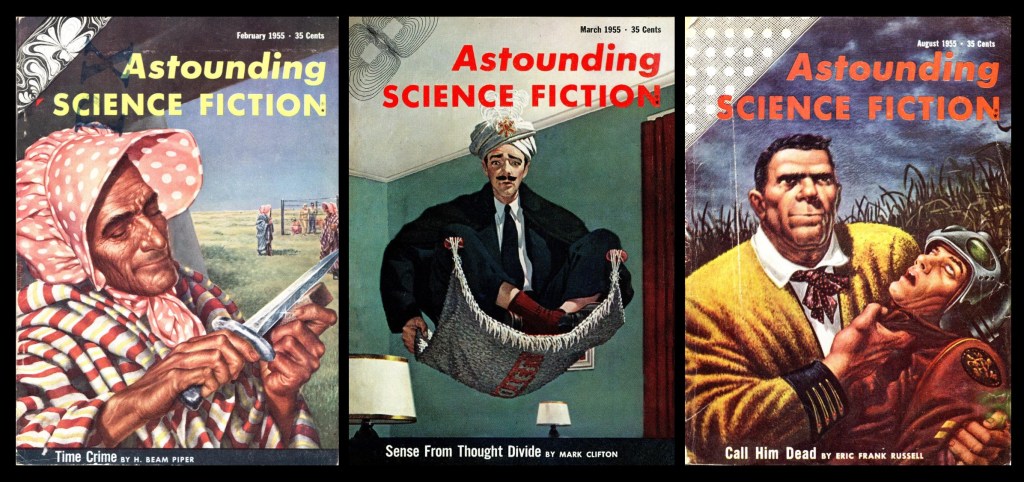
As I’ve described before, our reading group is covering the best science fiction short stories of 1955. To supplement the discussion, I’m creating .pdf files for each science fiction magazine that includes their cover, table of contents, and some departments such as book reviews, fanzine reviews, and letters to the editor. Sometimes I even include interesting ads or other artifacts that add to the discussion of science fiction in 1955. I just created “1955 Astounding Overview” to go with the ones for Amazing and IF. I’ll be doing more magazines in the future. You can download what I’ve done so far here:
The general belief was Astounding Science Fiction was in decline in the 1950s but looking through the 1955 issues I’m not so sure. Our group wondered why “Allamagoosa” by Eric Frank Russell won the Hugo for best short story in 1955 when there were so many other great short stories. It was in the May issue. I noticed when going through the issues of Astounding that Russell had four short stories in that magazine for 1955, and one 3-part serial, meaning he was in seven of the twelve issues. The guy was just popular and that might have gotten him votes. However, “Allamagoosa” is a fun story.
Astounding also published the Best Novelette winner too, for “The Darfsteller” by Walter M. Miller, Jr. in the January issue. Astounding also had the winning novel, They’d Rather Be Right, which was serialized in 1954. “The Darfsteller” is magnificent, but They’d Rather Be Right is considered by many to be the worst novel to win the Hugo Award. See “Hugo Nominees: 1955” by Jo Walton about that controversy. (You can get both the Mark Clifton novels discussed in that essay at Amazon for ninety-nine cents.)
Of the fourteen stories we’ll be reading for Group Read 63, five were from Astounding, three from Galaxy, and four from F&SF. The other two were from other sources. We have already read eight other stories from 1955 in other group reads, but I’ve forgotten their sources.
For me, the best thing about the “1955 Astounding Overview” that I created are the book reviews by P. Schuyler Miller. His column, “The Reference Library” is my favorite way to look back over science fiction in the 1950s. Not only did Miller review books, but often wrote about the state of science fiction and publishing. Some of the books he reviewed that I’ve read, or own and hope to read are:
- Science-Fiction Thinking Machines edited by Groff Conklin
- Born of Man and Woman by Richard Matheson
- One in Three Hundred by J. T. McIntosh
- Brain Wave by Poul Anderson
- The Immortal Story by Sam Moskowitz
- The Best Science-Fiction Stories: 1954 edited by Bleiler & Dikty
- The Stars Are Ours by Andre Norton
- The Forgotten Planet by Murray Leinster
- The Star Beast by Robert A. Heinlein
- Star Short Novels edited by Frederik Pohl
- The Best from Fantasy and Science Fiction: Fourth Series edited by Anthony Boucher
- Shadows in the Sun by Chad Oliver
- Earthlight by Arthur C. Clarke
- More Adventures in Time and Space edited by Healy & McComas
- Earthman, Come Home by James Blish
- The Mouse That Roared by Leonard Wibberley
- Northwest of Earth by C. L. Moore
- Assignment in Tomorrow edited by Frederik Pohl
- To Walk the Night by William Sloane
- The Exploration of the Moon by Arthur C. Clarke
- Of All Possible Worlds by William Tenn
- Hell’s Pavement by Damon Knight
- Who Goes There? by John W. Campbell
- The Body Snatchers by Jack Finney
- Re-Birth by John Wyndham
- The Edge of Running Water by William Sloane
- Solar Lottery by Philip K. Dick
- The Martian Way and Other Stories by Isaac Asimov
- The Fittest by J. T. McIntosh
Each of Miller’s columns begins with several pages on a generalized topic. This also conveys a lot about science fiction in 1955.
James Wallace Harris, 9/9/23


Thank you. This is a real public service. When I had a subscription to Analog in the 1960s, P. Schuyler Miller’s column was a gateway to the world.
LikeLiked by 1 person
I always enjoy reading your posts. They are absolutely full of great information and insights regarding SF and its history.
Has P. Schuyler Miller’s column ever been collected in book form? I find this kind of thing just as fascinating (if not more so) than the actual classic SF stories, many of which I have read again and again over the years. I have the complete “Benchmarks” series of books collecting Algis Budrys’ columns from Galaxy magazine, and I would thoroughly recommend them. As I would be more of a fan of Astounding than of Galaxy, I would most likely find a collection of Miller’s columns just as interesting, if not more so.
LikeLiked by 1 person
It’s often said that Astounding’s readers were offended that Galaxy performed so well and Astounding relatively weakly in the first Hugos (1953) so in 1955 they banded together to make sure Astounding got the awards.
I actually think “The Darfsteller” is a strong award. THEY’D RATHER BE RIGHT — not so much. “Allamagoosa” is fun but not really Hugo worthy. But they also published de Camp’s “Judgement Day” and Budrys’ “Nobody Bothers Gus”, Piper’s “Time Crime”, Vance’s “The Gift of Gab”, and Schmitz’s “Grandpa”, so all in all a decent year.
LikeLike