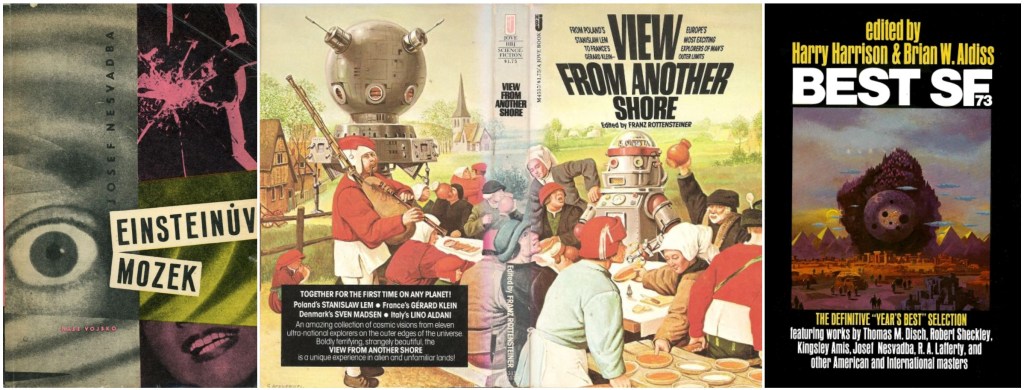
“Captain Nemo’s Last Adventure” by Josef Nesvadba is story #22 of 52 from The World Treasury of Science Fiction edited by David G. Hartwell (1989), an anthology my short story club is group reading. Stories are discussed on Tuesdays, Thursdays, and Saturdays. “Captain Nemo’s Last Adventure” first appeared in Nesvadba’s 1960 collection, Einsteinův Mozek. It was translated into English for the 1973 anthology edited by Franz Rottensteiner, View From Another Shore, and it was selected in 1974 for Best SF: 1973 edited by Harry Harrison and Brian Aldiss. (Follow the link to the story title to see where it’s been anthologized if you want to find a copy to read. However, The Treasury of World Science Fiction is widely available in used copies and is probably the cheapest way to get this story, along with 51 others.)
David G. Hartwell had so much to say about “Captain Nemo’s Last Adventure” in his introduction that I thought I’d just reprint it here.
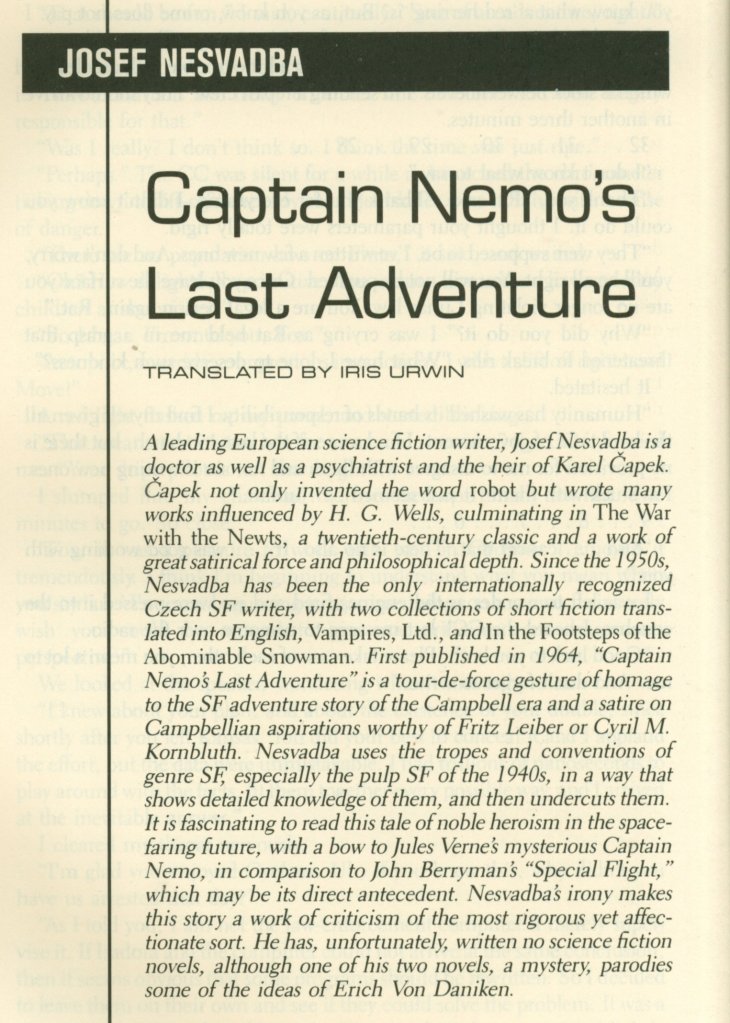
I don’t know if I agree with Hartwell when he says “Captain Nemo’s Last Adventure” is a satire on stories from John W. Campbell’s era, or that Nesvadba uses the tropes and conventions of 1940s science fiction. I’m not even sure “Captain Nemo’s Last Adventure” is even an ironic work of criticism. I’m not saying it’s not, but I want to propose an alternate theory.
What if science fiction evolved separately in Czechoslovakia? And what if its evolution sometimes paralleled American pulp science fiction? Evidently, “Captain Nemo’s Last Adventure” was written after Sputnik but before Gargarin’s famous ride. Would Josef Nesvadba have access to old American pulps or even 1950s anthologies that reprinted them?
The prose of “Captain Nemo’s Last Adventure” doesn’t come across like the prose in pulp fiction. Like many of the foreign language science fiction stories we’ve been reading, it’s mostly told and not shown. However, it is longer, and that lets it become a fuller story than the shorter works we’ve read. I wonder if Nesvadba wasn’t inspired by Soviet science fiction or the Polish Stanislaw Lem?
“Captain Nemo’s Last Adventure” is about the super-heroic Leonard Feather and chronicles his feats of always needing to save the day, and eventually the Earth. Yes, we could compare him to Kimball Kinnison and the Lensman series. But Feather could just as easily be compared to Homer’s Ulysses.
I do think Nesvadba was making fun of spacemen, and the kind of macho men who need to always be on an adventure. Feather is a womanizer who makes his wife unhappy, as well as his mistresses, and he can’t understand why his son isn’t like him. Nesvadba is satirizing a certain kind of man that has existed in all genres of literature.
Nesvadba also appears to be attacking the call of the high frontier, robotics, and the never-ending quest to conquer and engineer. When Captain Feather, aka, Captain Nemo meets another intelligent race, he can’t understand what they are after. When he returns to Earth and is forced to stay put, Feather begins to see the need for philosophy and art.
There are parallels to American science fiction in this story. Heinlein, Campbell, Hamilton, and others all wrote stories about meeting super-advanced aliens back in the 1940s. The robots in “Captain Nemo’s Last Adventure” remind me of Jack Williamson’s The Humanoids. This story even reminds me just slightly of Robert Sheckley in the 1950s.
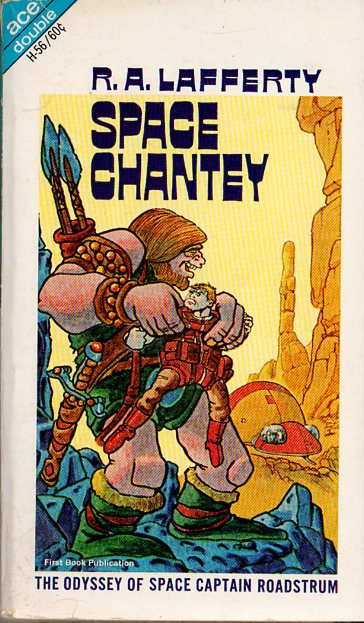
But, Captain Feather and his crew mostly remind me of Space Chantey by R. A. Lafferty, which is a science fiction parody modeled on Homer. My guess is that Nesvadba’s story was really inspired by Lem’s The Star Diaries, which came out in the 1950s?
Still, “Captain Nemo’s Last Adventure” is a good tale. It’s not told dramatically, which disappoints me, but its length allowed it to cover a number of interesting science-fictional topics that were enjoyable to me.
James Wallace Harris, 6/23/23


Jim, thanks for a great essay on “Captain Nemo’s Last Adventure”. While not a perfect story, I did like it and it did convince that I need to look harder for other fiction by Josef Nesvadba. Looking at ISFDB, the only English language collections of his they list are the 1964 collection “Vampires Ltd.” and the 1971 collection “The Lost Face”.
LikeLike
JWH: “What if science fiction evolved separately in Czechoslovakia? … Would Josef Nesvadba have access to old American pulps or even 1950s anthologies that reprinted them? … My guess is that Nesvadba’s story was really inspired by Lem’s The Star Diaries, which came out in the 1950s?”
Seems more likely than Hartwell’s theory to me. Stanislaw Lem himself had never seen any Western SF other than H.G. Wells and Stapledon before the later 1960s.
LikeLike
I’ve had another idea about this. Maybe Nesvadba wasn’t influenced by any other science fiction. Or do science fiction writers need to read science fiction to get started? Did H. G. Wells read science fiction? Or did he come up with all those concepts on his own?
LikeLike