
“The Green Hills of Earth” by Robert A. Heinlein is story #19 of 52 from The World Treasury of Science Fiction edited by David G. Hartwell (1989), an anthology my short story club is group reading. Stories are discussed on Tuesdays, Thursdays, and Saturdays. “The Green Hills of Earth” first appeared in The Saturday Evening Post, on February 8, 1947.
I don’t know how many times I’ve read “The Green Hills of Earth.” I believe every time before I ignored most of the story, responding and remembering the final part. Heinlein does a great deal of wordy tap dancing before he gets down to a rather simple story. This time I realized that all typewriting soft-shoeing is the real gold in the story, and the final emotional part that I’ve always remembered is pyrite that tricked my eye.
With this reading, I was bowled over by the high concentration of imaginative details in “The Green Hills of Earth.” Heinlein sets up a whole interplanetary space-faring society, alluding to the Harriman’s corporation which is chronicled in later stories. There are politics and laws – the Tri-Planet Treaty and The Space Precautionary Act. There are Venusians and Martians, which aren’t detailed, but I imagined in passing, that is fleshed out in later stories like Red Planet and other juveniles, Stranger in a Strange Land, and Double Star. Heinlein throws in rockets, their makes, and models. And more interestingly, Heinlein alludes to languages that don’t yet exist, and how they relate to our current languages. Plus he talks about pop culture, music, and poetry. He does all this in a faux academic style with hints of satire on how future history and sociology work.
Heinlein also sets up the solar system that’s been explored enough to allow for commercial trade. Heinlein’s spacemen are working-class men who seemed modeled on 1940s commercial shipping and merchant marines and are nothing like NASA’s astronauts. Heinlein had high hopes for the final frontier. Just read through these four paragraphs to see how Heinlein embeds details into his story.

I’d say the first two-thirds of “The Green Hills of Earth” is a kind of prologue that sets up one dramatic scene. Heinlein is experimenting with his writing, going beyond normal pulp fiction. When I think about it, science fiction went through several new waves that caused mutations in SF writing techniques. This story was published in a slick magazine, The Saturday Evening Post, something revolutionary for the genre and Heinlein. The term science fiction wasn’t widely known in 1947. It was just coming into vogue in the general public outside of fandom. Heinlein’s stories for the slicks were breakthroughs, helping the general public move away from thinking of science fiction as Saturday serials “Buck Rogers stuff.”
And we can’t ignore the poetry. This story is full of verse and is about a poet who has become mythic. I’m not big on poetry, so I’ve tended to skim over it in the past. I tried harder this time to read Heinlein’s lines of poetry. I have no idea if Heinlein’s verse is any good, but I did study it enough this reading to realize he put a lot of work into writing it. In “The Green Hills of Earth” Heinlein says about Rhysling, his Blind Singer of the Spaceways, “It mellowed his approach, changed his doggerel to verse, and sometimes to poetry.” I can’t tell verse from poetry, so I don’t know if Heinlein’s verse transcends into poetry.
I did notice Heinlein used some phrasing I thought was bumpy – “calm and couth” – and rhyming dearth with girth. Couth, dearth, and girth seem like archaic words now but might have been fine in the 1940s. Even still, “As they rove around the girth” doesn’t quite seem to work as an image or sound right coupled with “Of our lovely mother planet.” I would have thought, “As we rove around the girth / Of our lovely Earth” would sound better. However, he was saving the word “Earth” for the last line, “Of the cool green hills of Earth.” Of course, this was in a section where Rhysling was working out his song.

Like I said, I’m terrible with poetry, but I like the image Heinlein’s going for here. I’d try to work it as “Let sweet fresh breezes thrill me / As they blow round the Earth / From the planet that calls me / To green hills of my berth.” Can I get away with that pun and double meaning in the end? I know, I’m just as bad as Heinlein. My point here is reading and writing poetry is hard, so I’ve got to give Heinlein a lot of credit for trying.
Heinlein had a habit of killing characters to generate emotion in his readers. In this story, the actual bit of storytelling at the end has Rhysling sacrificing his life to save the ship. That’s rather maudlin and melodramatic, and even cheesy, but I think Heinlein gets away with it because it’s a fitting ending for an old spaceman. Did we want Rhysling to die in a nursing home?
Last year I started a project of reading and reviewing all of Heinlein’s stories in the order they were written. “The Green Hills of Earth” jumps five years ahead of where I left off. I need to get back to that project. But I can say “The Green Hills of Earth” appears to be a quantum leap in Heinlein’s writing skills. I was still writing about his stories written before WWII, and evidently, working for the war effort somehow matured Heinlein’s writing. This story is more sophisticated in its storytelling ambition.
I wish I had the energy and drive to write a comprehensive analysis of “The Green Hills of Earth.” There’s so much going on in this story I could write pages and pages. Looking at the fragment of Rhysling’s poem, “The Grand Canal” makes me wonder if it inspired Roger Zelazny and his story “A Rose for Ecclesiastes” – wasn’t Gallinger writing a madrigal too. Look at Heinlein’s poem. Doesn’t it at least remind you of Ray Bradbury and Planet Stories too?
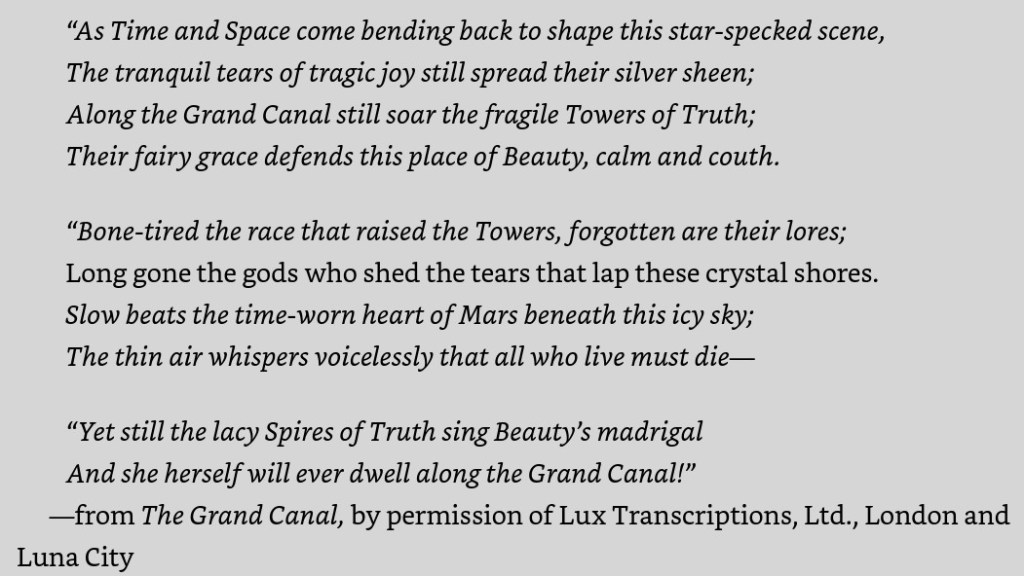
I could go paragraph by paragraph and find many things to say for each, but that would take too long for a blog post. I imagine each paragraph will remind you of all the science fiction you’ve read too. If you don’t own The Past Through Tomorrow or The Green Hills of Earth, you should be able to find “The Green Hills of Earth” in one of many anthologies.
James Wallace Harris, 6/17/23
 Classics of Science Fiction
That was in our literature book when I was in 6th or 7th grade, 1962-1963. Definitely mainstream. I’m grateful you’re taking the trouble to write objectively about these stories.
LikeLike
Really. I wasn’t so lucky. My 6th grade was 1962/63 and 7th was 1963/64. So Doug we are very similar in age.
Are you reading along in THE WORLD TREASURY OF SCIENCE FICTION?
LikeLike
Over the last year you’ve provided me with some good reading suggestions I would otherwise have overlooked. Most are stories that have been recently published, at least within the last ten to fifteen years. But I have a real soft spot for the golden age.
I haven’t read this one in years. I subscribe to the Saturday Evening Post, and so have access to their full archive. A nice two-page color illustration (the only one), opens the story.
I’m going to read it tonight, keeping in mind what you’ve rediscovered.
Thanks again, and keep ’em coming.
LikeLike
I thought about subscribing to Saturday Evening Post so I could copy the pages posting with this review.
Let’s us know what you think when you reread “The Green Hills of Earth.”
LikeLike
There’s some interesting history and biographical material in Alec Nevala-Lee’s book “Astounding” (2018)–he covers Asimov, Campbell, Heinlein and Hubbard during this time period.
LikeLiked by 1 person
I’ve read ASTOUNDING, and that’s a good recommendation. I also recommend covering the same time period, THE WORLD BEYOND THE HILL by Alexei and Cory Panshin, ROBERT A. HEINLEIN (2 volumes) by William H. Patterson, and THE PLEASANT PROFESSION OF ROBERT A. HEINLEIN by Farah Mendlesohn.
I keep meaning to reread all of them concurrently, so I can cover year-by-year of Heinlein’s development.
LikeLike
Many thanks for this review, Jim! However, I don’t think Heinlein’s emotional ending is mere “pyrite,” but is genuinely heartfelt. In some ways it reminds me of the equally moving ending to “Requiem.” I like the entire story just about from start to finish–poetry and all–in spite of a few bumpy passages, as you put it.
LikeLike
I finished re-reading Green Hills last night. I don’t remember when I read it prior to that, but in light of your comments I did find it more complete and complex than Heinlein’s earlier stories. And I have to agree with Carl — the ending got to me. I guess I’m getting sentimental in my older age (65). I get the sense that Heinlein enjoyed writing endings like that (Requiem), that he anticipated what the reader might feel — and when you really enjoy going through that kind of writing process, I think your writing is better because of it.
LikeLike
I meant pyrite in the way its shiny, looks like gold, and attracts our attention making us think we’ve found gold. If “The Green Hills of Earth” had only been about an old man who sacrifices himself to save a rocket ship it would have just been a sentimental story, and melodramatic. And it’s the part of the story that I’ve always reacted to before, and the part that I remembered. But this time, I realized that Heinlein was at his most creative in the part of the story that sets up the ending.
LikeLiked by 1 person
I see what you mean in your last sentence, but I also think the entire story–set-up, ending, and all–is genuine literary gold.
LikeLike