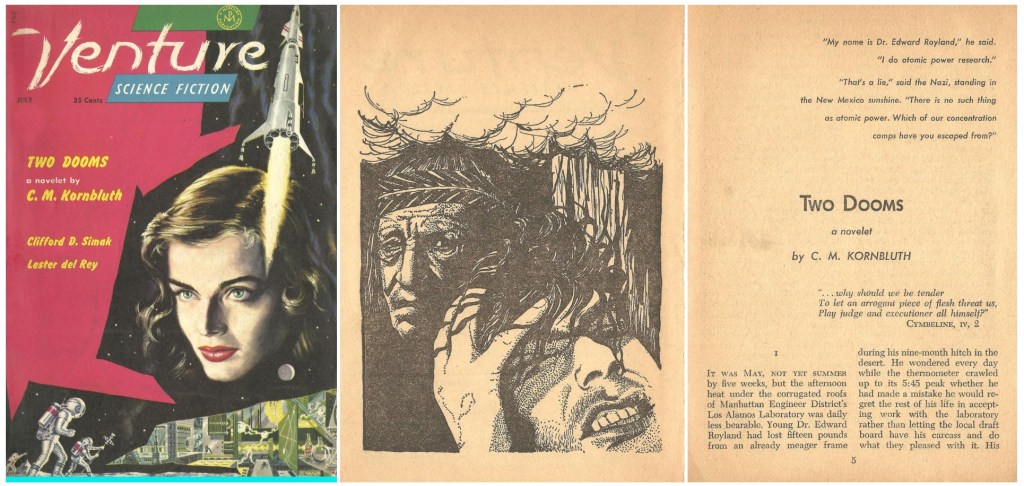
“Two Dooms” by C. M. Kornbluth is story #17 of 52 from The World Treasury of Science Fiction edited by David G. Hartwell (1989), an anthology my short story club is group reading. Stories are discussed on Tuesdays, Thursdays, and Saturdays. “Two Dooms” was first published in Venture Science Fiction (July 1958). “Two Dooms” was a posthumously published story since Kornbluth had died earlier that year in March. (By the way, “Two Dooms” is available in The Best of C. M. Kornbluth which is selling today at Amazon for 99 cents for the Kindle edition.)
I finally struck gold. I read these old anthologies hoping to find great science fiction stories I’ve missed, and “Two Dooms” is one such work. I can’t believe I missed it. My memory is faulty, so I could have read it. Decades ago I owned A Mile Beyond the Moon, Kornbluth’s collection that first put the story in book form. I’ve also owned, The Best of C. M. Kornbluth for decades, as well as both the hardback and audiobook of His Share of the Glory: The Complete Short Science Fiction of C. M. Kornbluth, and three anthologies in which “Two Dooms” has been anthologized. Kornbluth is one of those authors I’ve always meant to dive into and read all their stories but never have. “Two Dooms” makes me regret that.
The best way I can describe “Two Dooms” that will make you read it is to say: “Two Dooms” is probably the story that inspired Philip K. Dick to write The Man in the High Castle. I have no way of knowing if PKD read “Two Dooms” but it really feels like it. I’m not saying Dick copied Kornbluth, but like many science fiction stories, many writers read about a juicy idea and want to use it too, but in their own way.
And it’s not just that Dick’s novel and Kornbluth’s novella are alternative histories where Germany and Japan win WWII and occupy the United States — several writers have explored that idea, it’s that each writer chose a mystical philosophy to flavor their story. PKD uses the I Ching and Kornbluth uses Hopi Indians and psychedelic medicine. Both authors gave a low-level view of the occupation. Both authors were concerned with the little people at ground level rather than the big historical perspective. But finally, I think the stories feel similar because both writers were tortured souls.
Kornbluth’s POV character is Dr. Edward Royland, a young physicist working at Los Alamos, New Mexico on the Manhattan Project during WWII. It’s early on, and they aren’t even sure they can build a bomb. Royland isn’t happy with his job, especially working in the miserable heat. One day after work he drives into the desert to meet his friend Charles Miller Nahataspe, a Hopi Indian shaman. This part of the story reminds me tremendously of Carlos Castanada’s books. Kornbluth gives us a fair amount of information about how the Hopi see reality differently from us and even claims the Theory of Relativity is something Hopi understand as children because they have no concept of time like we do. I wonder what books Kornbluth read that inspired him to write this part?
Nahataspe gives Royland some dried, blacken mushrooms. He tells Royland because he doesn’t see reality clearly, they will be safe to experience — that Royland’s cloudy vision of reality will protect him. But Nahataspe was wrong, Royland’s vision isn’t cloudy, and the magic mushrooms take him into the future where the Axis powers rule America.
It’s interesting to compare Kornbluth’s and Dick’s methods of getting their characters into an alternate history. Kornbluth uses the old-fashion literary technique of putting his character to sleep and having them wake up in a new world. Dick begins his story in the alternate history, and one of the amusing aspects of his method, is his characters speculate about our reality.
In olden times, the first-person account was considered the gold standard of believability. That’s why so many old novels have a frame where we learn how the story came about. Modern storytelling has dropped the frame. But with “The Two Dooms” Kornbluth needs Royland to go and come back, and using mystical Native American magic works well as a frame.
Both stories tell what living under Germans and Japanese would be like, and that’s where the two stories differ. While under Japanese rule, Royland spends his time with Chinese peasants, but when he’s on the other side, he spends time with higher-ranking Germans. Kornbluth stereotypes his nationalistic characterizations, but it’s not done in a simple way. I did feel that Kornbluth did quite a lot of research on this story, especially the parts about Los Alamos and the Hopi Native Americans. Since I recently read a nonfiction book about the Manhattan Project, I thought Kornbluth captured some interesting historical details.
I especially like when Kornbluth described a roomful of women as the computer department and Royland wished he had an analog differentiator. All through “Two Dooms” Kornbluth mentions details that entertained me. For example, when Royland leaves his office at the end of the day, Kornbluth says, “Mechanically he locked his desk drawers and his files, turned his window lock, and set out his waster-paper basket in the corridor.” It’s the detail of the waste-paper basket and window that impressed me. Royland’s work is top secret, so it’s logical he would lock his files. But if everything is locked up, how can custodians empty the trash? And it’s 103 degrees at 5:45, so we know the windows are open, and it would be important to lock them too.
Here’s the scene where Royland first enters Nahataspe hut. Notice all the little details Kornbluth sticks in here. Also, notice the humor.

I’ve really got to read more Kornbluth. I’ve been thinking that since I watched Bookpilled’s review of The Best of C. M. Kornbluth. It impressed me that a young guy in his thirties found so much to admire in a mostly forgotten science fiction writer that died over sixty years ago. (Also reviewed are Hothouse, Blood Music, and Nova.)
James Wallace Harris, 6/13/23
 Classics of Science Fiction
Thanks. IMO Kornbluth is an underappreciated writer. Our public library had “Not This August” when I was a kid. Which is a similar alternate history and pretty powerful. https://en.wikipedia.org/wiki/Not_This_August
LikeLike
Reading the plot summary at Wikipedia makes me want to read Not This August. I need to finish my series about atomic war in science fiction. I never wrote about the 1960s.
LikeLike
You should absolutely read more Kornbluth. His short stories are better than his novels. Most outstanding to my taste: “The Mindworm,” “The Little Black Bag,” “The Luckiest Man in Denv,” “The Adventurer,” “The Cosmic Expense Account,” and “Theory of Rocketry.”
LikeLike
[1] ‘Gomez’ is good, too.
[2] Seconding John Boston. Kornbluth was the first short story writer out of American magazine SF to get within range of the greats — Kipling, Hemingway, and such — and, honestly, still one of a very few SF writers to achieve that.
Which is why younger people with an interest in literature are still finding their way to him. You noted the BookPilled guy, and I found myself having a passing conversation with a young man under 30 in a bookstore in Berkeley, CA, a couple of years ago during which he asked, “I don’t suppose you’ve heard of a writer called C.M. Kornbluth?” and I replied, “I have, actually.”
LikeLike
As for Kornbluth’s novels, those he wrote alone showed promise, never fulfilled because of his early death.
Those written with Fred Pohl are another matter and I think it’s hard to imagine 20th century American SF without them. Seriously: brilliant American SF novels in the 1950s can be pretty much defined as Bester’s two and those by Pohl and Kornbluth. Alongside THE SPACE MERCHANTS, I have great love for GLADIATOR-AT-LAW, while WOLFBANE is an early stab at the sort of themes that writers like Greg Bear would come to three decades later.
LikeLike
Re. Kornbluth’s novels, those he wrote alone showed promise, never fulfilled because of his early death.
Those written with Fred Pohl are another matter; I think it’s hard to imagine 20th century American SF without them. Seriously: brilliant American SF novels in the 1950s can be pretty much defined as Bester’s two and those by Pohl and Kornbluth.
Alongside THE SPACE MERCHANTS, I have great love for GLADIATOR-AT-LAW, while WOLFBANE is an early stab at the sort of themes that writers like Greg Bear would come to three decades later.
LikeLike
I thought about “Gomez” but it’s a little sentimental for my taste.
LikeLike
That’s pretty cool. I don’t get to meet young people much anymore.
I have all the time in the world since I’m retired, but it’s still not enough time to read everything I want. Still, I want to one day focus on C. M. Kornbluth.
LikeLike