Pantsers vs. Plotters

Can readers guess how a story was plotted as they are reading it? Was the writer a pantser or a  plotter? Did the writer just sit down and start writing by the seat of their pants, or did they carefully work out the whole plot ahead of time, maybe in an outline, software, or just in their heads? Would be writers often argue over whether its better to be a pantser or a plotter — to let a muse whisper in your ear or work out the details in advance with logical precision.

My guess is most science fiction writers come up with a science fictional idea first, and then invent characters, setting, plot to showcase that idea. Quite often it feels like some writers get an idea, sit down and start writing towards presenting the idea fictionally, inventing everything needed on the go to get to a situation the presents the idea. Unfortunately, this often shows as lame characters, speaking crappy dialog, following mundane events which gives an overall impression of haste. This is fine for a first draft. A final draft should feel like everything in the story was there for a creative purpose. Personally, if I spot the seams, I feel I’m reading something too close to the seat of the pants draft. If a story feels polished I assume everything was carefully thought out and sculpted. However, I don’t know if my reading sixth-sense is accurate.
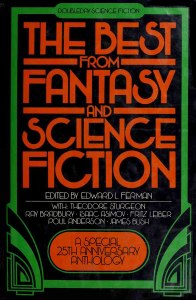
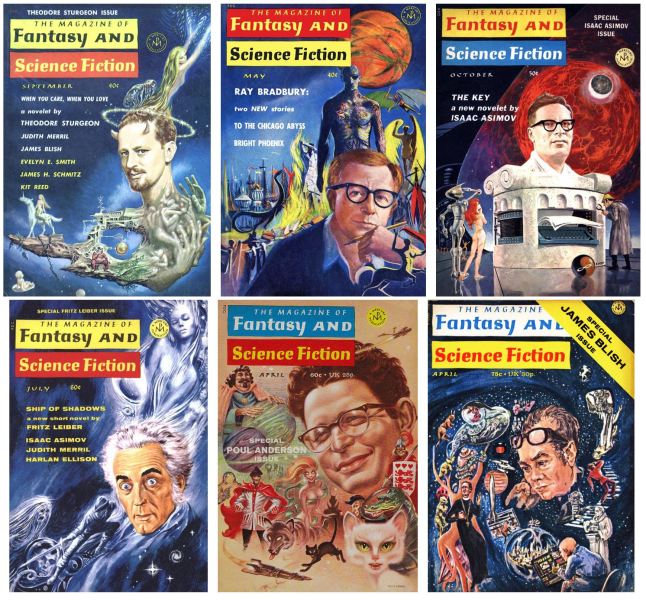
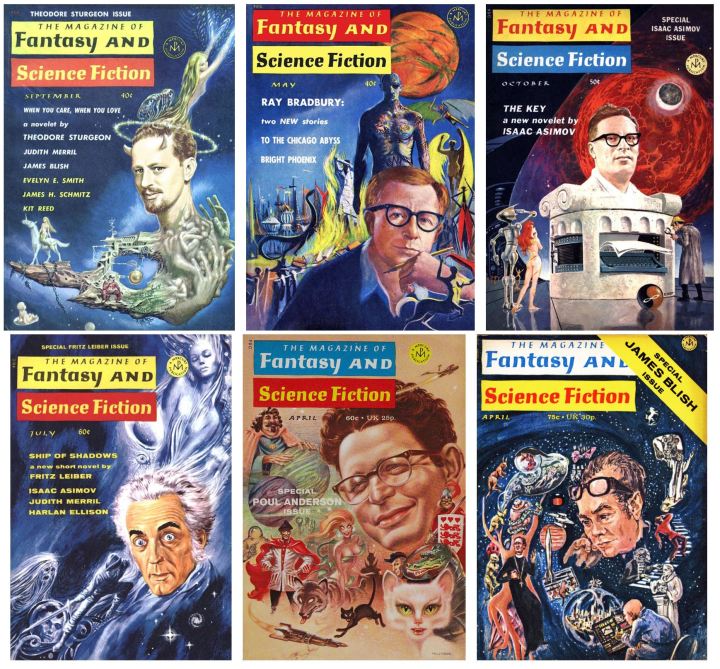
F&SF25An example of my thought tracks comes from just reading “Midsummer Century” by James Blish. The story  first appeared in the April 1972 issue of The Magazine of Fantasy and Science Fiction, but I read it in The Best From Fantasy and Science Fiction: A Special 25th Anniversary Anthology edited by Edward L. Ferman. This anthology had six stories from special issues devoted to Theodore Sturgeon, Ray Bradbury, Isaac Asimov, Fritz Leiber, Poul Anderson, and James Blish. Besides a story, each author was given a short biography and bibliography. With such special fuss, you’d think the stories would have been an exceptional work. “Ship of Shadows” by Lieber and “The Queen of Air and Darkness” by Anderson were award-winning stories, quite ambitious, and impressive. Four of them were not.

Those four had various problems, and as I read them, I wondered how they were conceived. The Sturgeon felt like the beginning of a novel that had been abandoned, and then hastily fixed up for the F&SF editors. The Asimov felt like it had started out as one kind of story, hit a wall, set aside, and then fixed up with a trick solution. The Bradbury felt like Bradbury hadn’t written any SF in a while and was riffing on one of his old standard science fiction melodies — but he was out of practice. I really liked the start of both the Sturgeon and Asimov. They had been chugging along fine on inspiration but then ran out of steam. All three felt like they had been plotted on the go. The Lieber felt like another seat of the pants creation, but it worked. However, Leiber didn’t stick the ending. The Anderson felt like it was holistically conceived, but who knows, he could have written it scene by scene out of his unconscious.
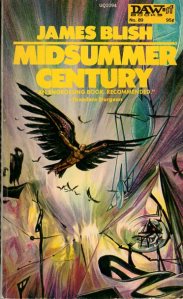
midsummer-century-dawThe last story, “Midsummer Century” is the most interesting in trying to figure out how and why Blish wrote it. It’s so episodic that it really feels like he was flying by whatever ignited his mind during five long writing sessions, each time feeling a different kind of inspiration, each fascinated by a different far-out idea.

The story begins with radio astronomer John Martels moving from England to the United States. Blish uses this part to natter about the class system in England and the lack of one in America, despite the fact that Americans do oppress certain ethnic groups. This section ends with Martels repairing a radio telescope and falling to his apparent death. What a reading shock because I was all prepared to enjoy a story about a British astronomer working in America. Evidently, Blish got bored with that.

Next, we find Martels 25,000 years in the future cohabiting a computer with an immortal being named Qvant. I know it was quite common in the 19th-century to come up with innovative ways of getting your character into the future, but did Blish really expect us to believe that dying inside a radio telescope dish would project a soul ahead in time? It definitely was an odd way to solve a cliffhanger, but I went with the flow.

Blish then spends some time describing what reincarnated life in a future computer is like, with no bodily senses other than a security camera monitoring a decaying room in a far future museum. It turns out Qvant was created by the third form of humanity, reminding me of Last and First Men by Olaf Stapledon. Qvant has become an oracle god to the fourth form of humanity, who appears as naked savages but are quite noble, leading clean and tidy lives within a hothouse jungle that has taken over the entire Earth.

In this portion of the story, Blish seems interested in exploring reincarnation, and Zen meditative states, as well as new forms of communication. Qvant advises the primitives to solve their problems with rituals and dances which he tells Martels really do work. Blish was well known in the SF genre as a polymath, and here he tries to imagine an advanced non-technological society. This section is the longest part of the story, allowing Blish to work out several science-fictional ideas, but I can’t help but believe, most were on the fantasy end of the spectrum.

When I started wondering where Blish was going next with his story, he evidently, was wondering the same thing. Martels’ mind jumps into a human named Tlam. By now, I’m starting to wonder if Blish isn’t writing a picaresque, rather than a modern plotted story. At this point, it felt like Blish had written himself into a corner used this turn of events as a quick way to escape. That writing day, he obviously felt more interested in the primitive people and their society. Martels rides along in Tlam’s head observing the ways of the fourth form of humanity.

Blish doesn’t stick with this story angle for long. By now, it felt like he had decided on an ending, and wanted to get Martels there. But first, he needed Martels to visit the kingdom of the birds. Evolved birds were brought up in the second section, and I assumed Blish wanted to play with that idea for a while.

We knew from the second section that fourth-stage humans were competing with birds for dominance of the planet. The birds wanted to wipe out humanity and were succeeding. In this portion of the story, I wanted to find out more about our avian rivals, but Blish presents few ideas about bird civilization, not nearly enough for me. Tlam/Martels is captured by birds and taken to a skyscraper of wood and leather built by the bird civilization. Martels/Tham gets to meet the bird king, but nothing really happens.

Almost abruptly Blish decides its time for Tlam/Martels to escape and comes up with another cliffhanger escape, one with a fair amount of action and wonder, but one that felt rushed and somewhat half-hearted.

Finally, we reach the last section of the story, set in Antarctica, where a few third stage humans cling to existence allied with another powerful computer, the one Qvant wants to use to regain power. We only learn late in the last section that Qvant has been traveling along with Martels inside Tlam’s head, but Martels makes it inside the computer first, frustrating Qvant. This final section gives Blish an opportunity to explore telepathy, which almost feels like it was his original goal for the story. Much of the story is about the transmigration of human and machine souls and telepathy. After he explores those ideas, Blish tacks on a happy ending and quits.

I don’t know if the novella “Midsummer Century” was expanded when published as a 106-page hardback book. ISFDB calls it a chapbook. I’m tempted to get it to see if Blish rewrote and expanded the story. However, I’m hesitant because I’m afraid he didn’t.

The science fiction in this story felt like something out of the 1930s or 1940s, maybe inspired by The Time Machine, or Campbell’s “Twilight” or even Stapledon’s stories. Blish wanted us to think about the far future and what we might evolve into. And that’s a cool SF theme I love. Getting Martels into this future is rather clunky. Does the story really need a man from the past? Couldn’t it just have been about the third and fourth stage humans and the birds?

“Midsummer Century” is full of fascinating concepts, but the plotting is haphazard. It makes me wonder how budding writers could even consider pantsing practical. I imagine any story written entirely from daily inspiration should be rewritten thoroughly after a careful analysis. Science fiction writers often have to make a living by pounding out the pages, and not every unconscious mind is working behind the conscious mind of the writer to guide the plot so every scene tightly integrates with the whole. I assume some writers might have such a superpower for plotting on the go, but doubt many.

I love science fiction for its ideas, but just throwing out a series of marvelous musings doesn’t make for storytelling. Thinking about it now, I’m not sure if I’ve ever read a science fiction novel set in the far future that was thematically holistic in its construction. I think the theme inclines writers to spit-ball the concepts. I need to reread Hothouse by Brian Aldiss, it might have been more artistic, but I can’t remember.

On the other hand, “The Queen of Air and Darkness” by Poul Anderson felt like it was designed like a three-dimensional wooden puzzle. And that might explain why it won the Hugo, Nebula, and Locus awards.

James Wallace Harris, 5/28/20
F&SF25 Special Issues


A Four Short Story Day

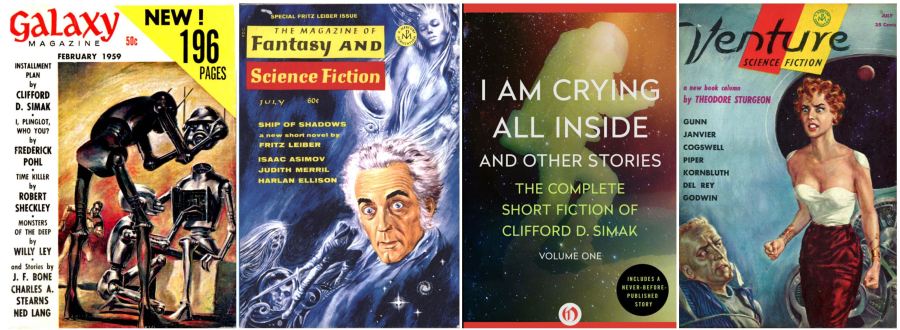
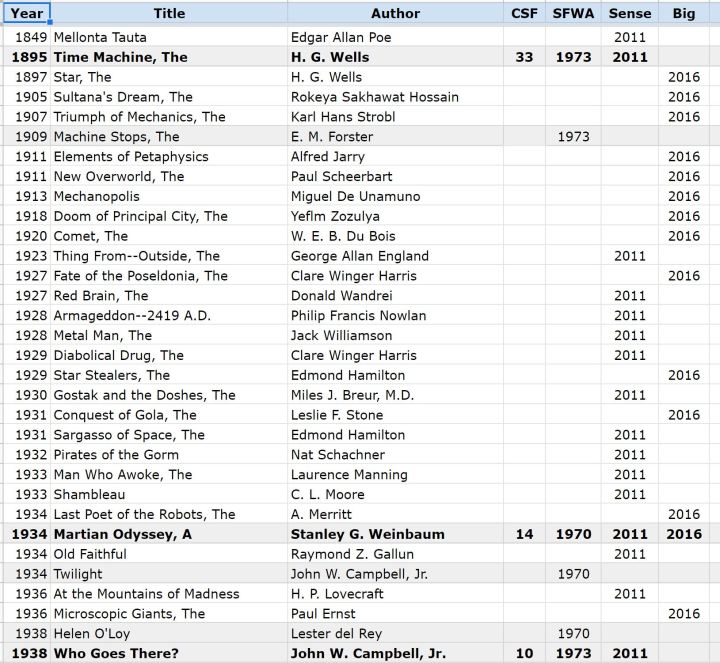
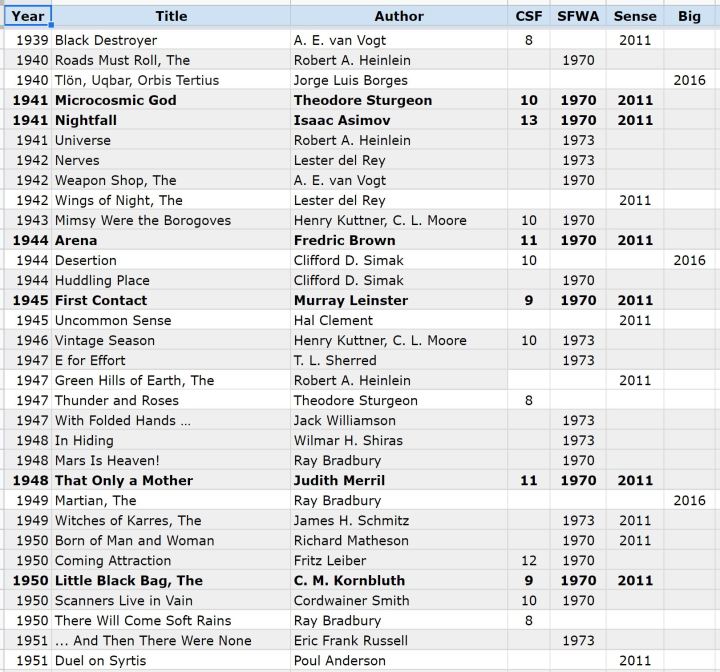
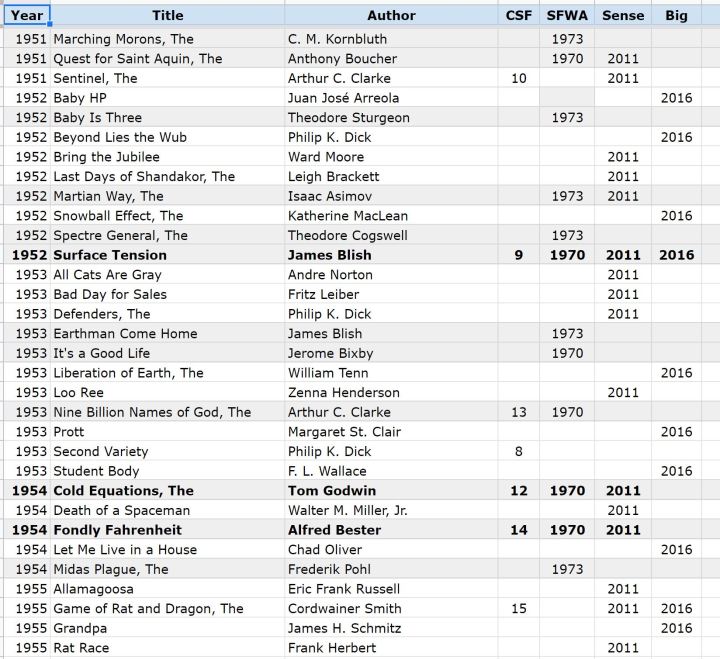
On most days I read one short story — for my Facebook short story discussion group. For some reason, I read four today — two on audio through my iPhone, one from a hardback, and one from a magazine scan on my iPad. The covers above are from their original publications and the stories were:

  • “Installment Plan” by Clifford D. Simak
  • “Ship of Shadows” by Fritz Leiber
  • “I Had No Head and My Eyes Were Floating Way Up in the Air” by Clifford D. Simak
  • “The Keeper” by H. Beam Piper

The two Simak stories came from the new audiobook edition of I Am Crying Inside and Other Stories: The Complete Stories of Clifford D. Simak Volume One. So far there have been twelve volumes of The Complete Stories of Clifford D. Simak, and Audible.com has recently released the first three volumes on audio. Currently, ten of the twelve volumes are on sale at Amazon for the Kindle priced at $1.99 or $2.99. I have all twelve. Audible will sell the audiobook editions for $7.49 if you own the Kindle edition. I’ve been really getting into Simak lately, so that’s why I listened to two of his stories today. The narration was excellent.

I was pushed to read the second Simak story, “I Had No Head and My Eyes Were Floating Way Up in the Air” because it was intended for the never-published anthology, The Last Dangerous Visions, edited by Harlan Ellison, and that was being discussed on two Facebook groups today. I squeezed it in. I wouldn’t say it was a dangerous vision, but it was very dark, about a man Charlie Tierney who has a personality similar to Donald Trump who intended to commercialize a planet by exploiting the inhabitants but the local intelligent life had other plans.

The first Simak story, “Installment Plan” was also about exploiting a planet and its natives, but it was much sunnier and funnier. Again, the local intelligent life has different plans. This story reminded me of Simak’s classic “The Big Front Yard” about an American farmer trying to do business with aliens whose world intersects his farm through some kind of dimension collision. Simak evidently had a thing for interstellar commerce. “Installment Plan” also has robots like those found in the City stories. Simak was also big on robots.

“Ship of Shadows” was a tour de force of weird space fiction, even winning a Hugo Award for Best Novella of 1970 (beating out “A Boy and His Dog” by Harlan Ellison). “Ship of Shadows” was worthy of that special F&SF issue devoted to Leiber. The story begins with Spar awakening from a drunk hallucinating, but after his head begins to clear, the world he perceives is very strange indeed. Cats talk, people fear vampires, others are addicted to moonmist but where the heck are we? The characters in this story float as if they are in free-fall, but the action is set in a bar called the Bat Rack. The story took work to read but paid off nicely.

My last read of the day was “The Keeper” by H. Beam Piper for another online short story group. It’s a rather straight forward adventure set on another planet. Good, but not as impressive as Piper’s “Omnilingual.”

All this short story reading is making me appreciate many new authors, especially Simak, Leiber, and Piper.

I’ve been reading a short story a day and discussing it online for a few weeks now, and it’s turned out to be very rewarding. Cramming four stories in one day is overindulging. I prefer listening to stories if I can find an audio version. Short stories usually run less than an hour, with novelettes running 1-2 hours, and novellas 2-4 hours. I can read them a great deal faster than that, but I enjoy them far more at the slow pace of speech. I can listen to stories when I do my physical therapy exercises, walk, cook, eat, wash dishes, or pursue other physical activities that don’t require thinking. Audiobook narration has been evolving as an art form, and productions from recent years have been outstanding.

I ached to hear “Ship of Shadows” today but could find no audio edition. My inner reading voice is just pitiful. Most bookworms prefer to read to themselves, but I feel I get way more out of fiction when I let a professional read to me. And when I do read with my eyes, I try to imagine how an audiobook narrator would perform the story. I can’t do what they do, but if I read slow enough, I can recall the kinds of techniques they use.

Tomorrow’s discussion story is “Arena” by Fredric Brown. I think it will be the fourth time I’ve read it over the last fifty years. That’s another thing I’m learning — stories improve significantly with rereading. Some stories I didn’t like or thought dull on first reading eventually become stunning works of art on the fourth reading.

All the stories I read today were first readings. I’ve learned something else by reading so many short stories. The highest rating or compliment I can give any story is to say I want to read it again. “Ship of Shadows” is a story I rate that highly.

James Wallace Harris, 5/22/2020

Remembering Helen O’Loy

Most short stories never get published. Of those that do, most are never reprinted. So, it is quite fascinating to study a story that does. My Facebook group is discussing “Helen O’Loy” by Lester del Rey that first appeared in print in the December 1938 issue of Astounding Science-Fiction. Using its record at the ISFDB.org we can track when it’s been reprinted over the years. It has also been translated into at least six languages. Here’s the timeline of major reprints:

  • 1948 – … And Some Were Human by Lester del Rey (collection)
  • 1952 – Beyond Human Ken edited by Judith Merril
  • 1954 – Assignment in Tomorrow edited by Frederik Pohl
  • 1960 – S-Fマガジン – v. 1 n. 1 (Japan)
  • 1963 – The Coming of the Robots edited by Sam Moskowitz
  • 1965 – Science-Fiction-Cocktail: Band I (German anthology)
  • 1966 – Master’s Choice edited by Laurence M. Janifer
  • 1970 – The Science Fiction Hall of Fame, Volume One edited by Robert Silverberg
  • 1971 – 18 Greatest Science Fiction Stories edited by Laurence M. Janifer
  • 1972 – 3000 Years of Fantasy and Science Fiction edited by L. Sprague and Catherine de Camp
  • 1974 – Modern Science Fiction edited by Norman Spinrad
  • 1974 – Histoires de robots (French anthology)
  • 1975 – In Dreams Awake edited by Leslie A. Fiedler
  • 1977 – Science Fiction and Fantasy edited by Fred Obrecht
  • 1977 – Souls in Metal edited by Mike Ashley
  • 1978 – Robots, Robots, Robots edited by Geduid and Gottesman
  • 1978 – The Best of Lester del Rey
  • 1981 – Science Fiction: Masters of Today edited by Arthur Liebman
  • 1982 – Analog: Reader’s Choice
  • 1983 – The Best of Omni Science Fiction No. 5
  • 1985 – Histoires de robots (French anthology)
  • 1990 – Friends, Robots, Countrymen edited by Asimov and Greenberg
  • 2010 – Robots and Magic by Lester del Rey
  • 2017 – The Robot Megapack ebook anthology

This leaves off the many reprint editions of the above volumes, plus some obscure anthologies, and other collections of Lester del Rey. For example, The Science Fiction Hall of Fame, Volume One seems to stay in print and is currently available in paper, ebook, and audiobook editions. It’s the volume my Facebook group is reading.

However, why wasn’t it collected in Adventures in Time and Space edited by Healy and McComas or The Best of Science Fiction edited by Groff Conklin? Those two giant anthologies from 1946 set the standard for science fiction anthologies for a generation. Nor has “Helen O’Loy” been anthologized in any of the recent super-giant retrospective anthologies like The Big Book of Science Fiction edited by Ann and Jeff VanderMeer  or one of the teaching anthologies like Sense of Wonder edited by Leigh Ronald Grossman

In truth, “Helen O’Loy” is a minor story, and problematic if you analyze it psychologically, especially with how it treats women. It hasn’t appeared in a significant SF anthology in over forty years. NESFA Press remembers Lester del Rey with Robots and Magic, but they are a fan press that remembers the old greats of the genre. The Science Fiction Hall of Fame stays in print because it does exactly what it was designed to do, remember the legendary shorter works of science fiction published before the creation of the Nebula Awards. “Helen O’Loy” was up for a Retro Hugo award but came in second, losing to “How We Went to Mars” by Arthur C. Clarke.

Anthologists who attempt to present a historical overview of the genre constantly shift through the past looking for older SF stories that are relevant to present-day readers. Each new anthology tends to forget more of the older stories. The Big Book of Science Fiction has 29 stories from 1934-1963 where The Science Fiction Hall of Fame has 26 in volume one, and another 22 in volumes 2A and 2B.  Sense of Wonder has 46 stories from 1934-1963, twelve of which were in the first volume of The Science Fiction Hall of Fame. There are only two stories – “A Martian Odyssey” by Stanley G. Weinbaum and “Surface Tension” by James Blish appearing in all three anthologies.

Of course, Sense of Wonder has an unfair advantage, it has over 200+ short stories, and is so big that it’s only practical to own as an ebook. However, among my friends, we’ve often wondered if members of the SFWA voted today for the best short stories from 1926-1963 what would they be? So I just paused writing this essay to write about that.

Would modern science fiction writers still pick “Helen O’Loy” as a classic science fiction short story from that era before 1964? I don’t think so. Surely, the current younger generations would see the story much differently than those writers who grew up reading science fiction in the 1930s, 1940s, and 1950s.

On a very simple level, “Helen O’Loy” tries to ask a very simple question: “Could a robot ever be considered human?” Science fiction stories, novels, television shows, and movies are still exploring this very simple question. And there is a growing industry seeking to actually build realistic sexbots. Why wouldn’t “Helen O’Loy” remain a classic? For any man lusting after a woman made to order, they’d probably not see anything wrong with the story.

Lester del Rey wrote “Helen O’Loy” before the world knew about digital computers and programming. The technology for imagining how a robot could work in 1938 would be clockwork mechanics, radio electronics, and wire recorders. They had little reason to assume we could build a machine that could see, hear, think, and talk. Del Rey had the myths of Pygmalion and the Golem, and stories about mechanical men for inspiration, but that’s about all. In 1938, on a technical level this story is a pure fantasy.

Then, how does the story hold up for psychological realism? Why would Phil and Dave in the story give up two real life girls, the unnamed twins, for a mechanical girl? One twin wanted to see a movie the boys didn’t so they dumped both girls? Are we really going to believe that biological humans will ever accept pseudo-humans as soulmates?

The main problem with “Helen O’Loy” today is how little respect it gives women. Basically, it says if a machine could be built that looks like a beautiful woman, and if that machine serves the man in all his needs and wishes, then that’s all men need from women. (Why didn’t femfans of the day howl back then?) “Helen O’Loy” assumes women have no wishes, desires, wants, ambitions of their own, that a woman’s only purpose is to fulfill a man’s needs. Are there men and women who would be satisfied with a visually appealing machine that serves their fantasies?

I say the heart of this story doesn’t beat — then or now. Sure, “Helen O’Loy” is an amusing little tale if you don’t think about it. So why has it been remembered and reprinted more than most other science fiction stories? I have to assume it resonates with adolescent male fantasies, or with people who feel challenged to build AI robots.

All along, science fiction has loved robots. And building a robot equal to a human has been the gold medal goal. But it’s here when I personally feel science fiction has always failed miserably with a total lack of logic and vision. Humans are emotional creatures, and emotions come from biology and chemistry. AI minds will be digital. The only emotion I can imagine a robot having might be curiosity. Why has science fiction failed to understand that no matter how much a robot might look like us it will never think or feel like us? And why has science fiction for so long wanted to see robots that are so like us that a Turing test would include physically passing for human?

To many science fiction fans, Isaac Asimov owns the robot story. He didn’t expect them to pass for human, or to think like us. But I don’t think Asimov ever extrapolated very far with the possibilities of intelligent machines. His stories certainly invalidated stories like “Helen O’Loy” but why haven’t other science fiction writers gone further?

I think we will forget “Helen O’Loy” partly because of its affront to feminism, but also it’s ideas about robotics are too primative and silly today. Of course, any anthology that tries to show the evolution of fictional thinking about robots will include it. And to be honest, I still enjoyed the story, and admired the way del Rey told it. I had to wince many places at the sexism, and groan at the idea of vacuum tube robots with memory coils, but ultimately I liked the story.

James Wallace Harris 5/10/20


What if SFWA Revoted on the Science Fiction Hall of Fame in 2020?

The original volume one of The Science Fiction Hall of Fame edited by Robert Silverberg came out in 1970 — 50 years ago. It contained 26 stories that the SFWA members voted on as the best short stories before the Nebula Awards were created in 1964. In 1973 The Science Fiction Hall of Fame Volumes 2A and 2B edited by Ben Bova added 22 additional novelettes and novellas.

Times have changed. New generations have replaced older generations. What would the current SFWA members pick as their favorite science fiction stories before 1964? Well, we won’t know unless they conduct a new poll and published the results, but that doesn’t keep me from trying to guess. I can’t help but think that the younger generations of writers discovered different old science fiction stories growing up in the last fifty years. How many old Hall of Fame classics are still considered classics? How many Hall of Fame classics are now problematic for some reason? Are there stories that past generations overlooked that younger generations have rediscovered?

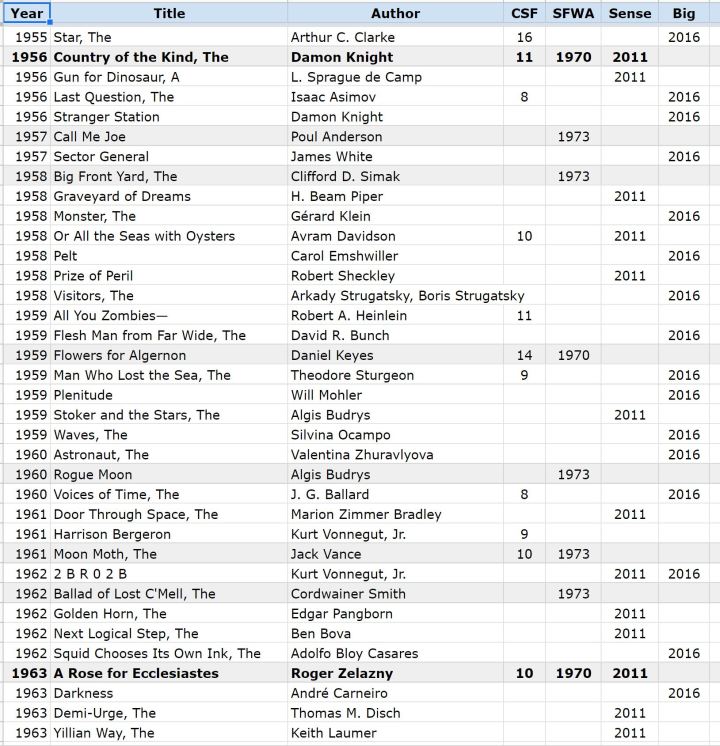
I’ve created a spreadsheet (see images below) that contains the original Science Fiction Hall of Fame stories highlighted in gray. I’ve added stories published before 1964 from our Classics of Science Fiction Short Stories that had eight or more citations (column labeled “CSF”). Our database system collects stories from best-of-year anthologies, retrospective anthologies, teaching anthologies, fan polls, award winners, and expert opinions. We call each source a citation. You can query our database here.

I’ve also added the stories in Sense of Wonder edited by Leigh Ronald Grossman that came out before 1964. This huge 2011 book was designed to be a textbook to teach science fiction (column labeled “Sense”). I also added the stories published before 1964 that were in The Big Book of Science Fiction edited by Ann and Jeff VanderMeer which came out in 2016 (column labeled “Big”). I felt these two were the latest retrospective anthologies of the genre that might reveal what younger generations are admiring from older times.

Finally, I bolded any story that was listed in at least three of the four columns. Only two stories were in all four columns, “A Martian Odyssey” by Stanley G. Weinbaum and “Surface Tension” by James Blish. This shows an agreement between the past and the present.

If you study the stories from the Grossman and VanderMeer books you can see how they have tried to find stories that haven’t been recognized as a classic before. It also feels like the VanderMeers made an extra effort to identify women and foreign writers that have gone unrecognized. Would modern members of SFWA vote for them in 2020? I don’t know, but I do believe there’s an effort to identify forgotten stories and writers who deserve new attention, or find writers whose creativity wasn’t recognized in their day but we can see with hindsight that should have been.

If you study the spreadsheet reproduced below in images, I think there are stories that were thought classics in 1970 that probably wouldn’t be in 2020. Two examples, “Twilight” by John W. Campbell and “Helen O’Loy” by Lester del Rey. I have to wonder if any story that only has a 1970 or 1973 in the SFWA column and nothing in the CSF, Sense, or Big columns might not be voted into 2020 Hall of Fame volumes.

Are the new stories introduced by the VanderMeers or Grossman worthy of being considered a classic now? Classic literature has always shifted with the times. Usually, it’s much easier to fall out of favor than to be rediscovered, but it happens. To a minor degree the Retro Hugo awards are reconsidering forgotten stories. And I’m surprised that Grossman and the VanderMeers ignored some then classic stories, especially “The Machine Stops” which has become so revelent and brilliant in our internet age.

Finally, Grossman and the VanderMeers were not setting out to pick classics. I believe Grossman was picking stories to show the evolution of the genre, and the VanderMeers were picking stories to show that the genre was wider and more diverse than we thought. The stories the newly formed SFWA members voted on were stories they loved reading growing up during the years 1926-1963. Current generations don’t have that connection with the past, so classics take on a whole new meaning. And there’s a good chance that younger generations of science fiction readers and writers have no reading experience with most of the stories listed here. To them, classic science fiction short stories came out in the 1980s or 1990s. That could mean the three-volume Science Fiction Hall of Fame could be reduced to two or even one volume today.

I got the idea to write this essay because this Facebook group is reading and discussing the stories in The Science Fiction Hall of Fame volumes.

1849-1938

1939-1951

1951-1955

1955-1963

JWH

Rereading “A Martian Odyssey” by Stanley G. Weinbaum 50 Years Later

I love “A Martian Odyssey” by Stanley G. Weinbaum. The first time I read it was when I bought The Science Fiction Hall of Fame, Volume One, 1929-1964 from the SFBC in the summer of 1970. I wish I had discovered it sooner, during that golden age of science fiction when we’re twelve. Instead, I was a college freshman. I was a bit older, a bit more knowledgable, a bit more cynical, but it still clinging to my dreams of finding a way to the red planet. Fifty years later, I know better, that Mars is not for me. Yet, I still daydream my science fictional fantasies, not just to forget the pandemic or economic collapse, or even to ignore the nagging pains of my aging body, but to recall something that made me happy a half-century ago. Something that inspired me.

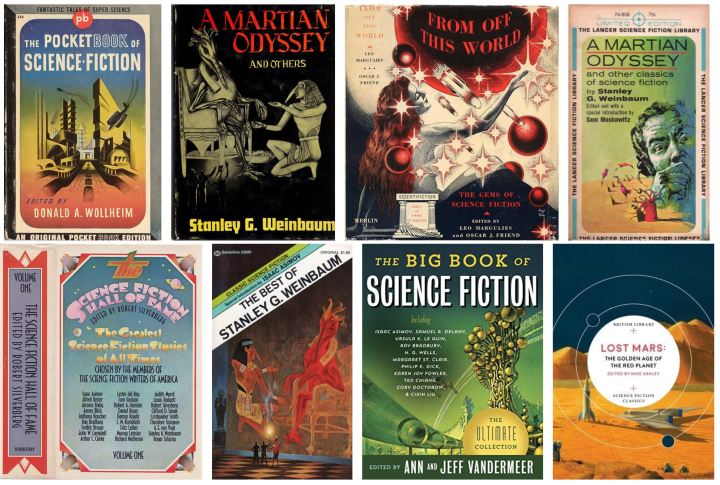
If Donald Wollheim had not snagged “A Martian Odyssey” for his 1943 groundbreaking paperback anthology, The Pocket Book of Science Fiction, I’m pretty sure I would have read “A Martian Odyssey” at twelve or thirteen. Obviously, Healy and McComas, or Groff Conklin would have grabbed it for Adventures in Time and Space or The Best of Science Fiction in 1946. Those two enduring hardback anthologies were still haunting libraries in my early teen years in the 1960s. Unfortunately, I never stumbled upon any Weinbaum collection or later anthology that contained “A Martian Odyssey” before I bought The Science Fiction Hall of Fame. Would 12-year-old kids today discovering this classic in the many anthologies that have published since then feel the kind of sense of wonder I could have felt if I had read “A Martian Odyssey” in 1963? And would my 1970 sense of wonder even be a fifth of what overwhelmed readers who discovered Weinbaum’s first story in the July 1934 issue of Wonder Stories? I can’t say my 2020 pleasure in rereading “A Martian Odyssey” is anything other than just wistful nostalgia. Yet, I did recognize several triggers in that story that made me love science fiction way back when.

A Martian Odyssey in 8 anthologies

I also wish I had read “A Martian Odyssey” before Mariner 4’s flyby of Mars in July 1965. Like I said, 1963 would have been the perfect year, especially if I could have read “A Martian Odyssey” one day and then “A Rose for Ecclesiastes” by Roger Zelazny the next. That’s the last story in The Science Fiction Hall of Fame, and it was first published in 1963. I consider those two stories perfect bookends for an era in science fiction.

When Mariner 4 flew by Mars in July of 1965 we discovered the planet was a cold cratered world much like the Moon. We had finally opened the lid on the Schrodinger’s Cat of Mars speculation. It was dead! We discovered Mars wasn’t like fiction at all. Before Mariner 4 I had a deep faith in our genre and loved Pre-NASA Science Fiction. I wanted Mars to be like Heinlein’s Mars of Red Planet, The Rolling Stones, Double Star, and Stranger in a Strange Land — and Heinlein wanted Mars to be like Edgar Rice Burroughs and Stanley G. Weinbaum’s stories.

I see “A Rose for Ecclesiastes” as a beautiful farewell salute to Pre-NASA Science Fiction. The Science Fiction Hall of Fame is probably the greatest single science fiction anthology of all time — at least the readers at Goodreads voted it so. We’ve decided to read and discuss the stories from The Science Fiction Hall of Fame at the Facegroup I’m in. You’re welcome to join. “A Martian Odyssey” is our first story. I’m hoping to hear from other Weinbaum fans and learn about how they first discovered “A Martian Odyssey” too.

I don’t know how many times I’ve read Weinbaum’s classic since 1970. I was overjoyed a couple years ago when The Science Fiction Hall of Fame came out on audiobook. Its audio production of “A Martian Odyssey” is pitch-perfect. My inner reading voice couldn’t compete with third-grade actors in a school play. I consider the narration to sound just like how men talked back in the 1930s when “A Martian Odyssey” first appeared in Wonder Stories.

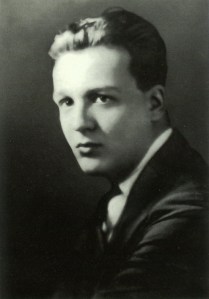
Stanley_G._WeinbaumStanley Weinbaum’s writing career was quite short — his first story came out in 1934 and he died at the end of 1935. Yet, in that short period, a dozen of his stories were published in Astounding Stories and Wonder Stories. A short biography and bibliography can be read at Wikipedia. He had been writing since the 1920s, finishing four works published as novels after his death. However, few people outside his hardcore fans ever read anything other than “A Martian Odyssey.” Even that story’s direct sequel, “Valley of Dreams” from the November issue of Wonder Stories has never been reprinted in a significant retrospective anthology.

If you love “A Martian Odyssey” do yourself a favor and read or listen to “Valley of Dreams.” It picks up where the first story left off and gives us more details about the exotic Martian life Weinbaum introduced in the first story.

Two Tweels

Here are the two stories in audio from YouTube. I’ll give you a chance to listen to them because I will talk about the details, and maybe spoil them for you.

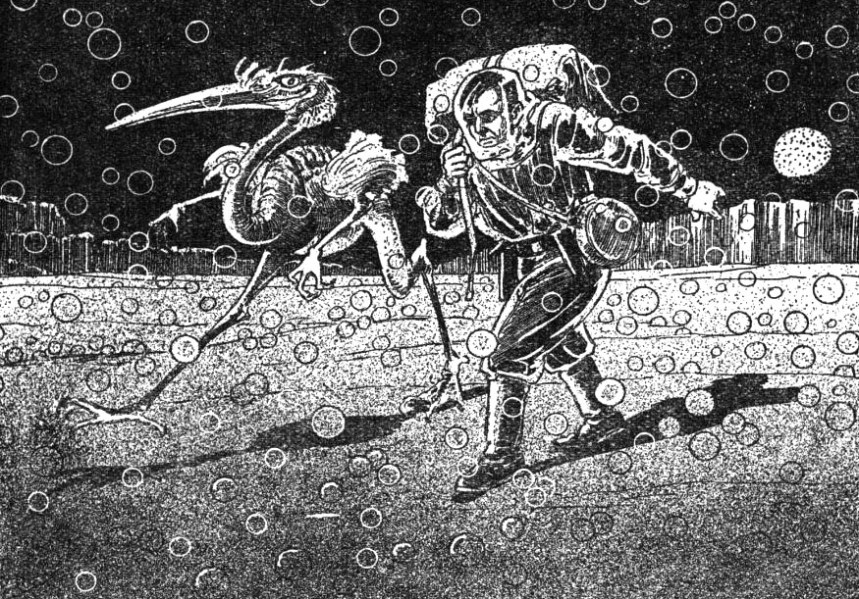
Weinbaum wrote science fiction before the general public even knew the term science fiction. Interplanetary tales have been around for a long time, but Weinbaum tried to imagine Mars with the science of his day. Dick Jarvis is part of a four-man mission to Mars when he is stranded in a crash of a survey flyer. Jarvis must cross hundreds of miles to get back to the rocket. Weinbaum tells us Mars has an extremely thin atmosphere in which the Earthmen can be trained to breathe. Humans are protected from eighty-degrees below zero temperature by special suits. Because the gravity is only one-third of Earth, Jarvis is able to make twenty miles a day crossing the Martian landscape. Along the way, he observes several bizarre life-forms and meets an intelligent being called Tweel. They travel together, saving each’s other’s life, becoming fast friends even though their ability to communicate in words is almost non-existent.

Modern readers might find Weinbaum’s prose a bit on the quaint side, and the plot rather simplistic by current-day standards. Jarvis tells the story to his human pals after he is rescued.  This framing device was common in stories from that era and earlier. Readers weren’t used to the immediacy of television reporting, so stories of true adventures were told after they happened. The same framing technique is also used in “Valley of Dreams” where Jarvis gets to meet Tweel again and visit an ancient Martian city.

One of the toughest things science fiction writers have to do is convey alienness. We’re used to movies and television shows where aliens are humans with make-up and costumes. Weinbaum wanted his readers to feel the alienness of aliens and he succeeds, both with non-intelligent lifeforms and a couple different types of intelligent beings. Tweel looks somewhat like an ostrich with arms and hands and can jump a hundred feet into the air and land on its beak. Tweel can mimic some Earth words, and with those few words convey some abstract concepts. Jarvis is unable to learn any of Tweel’s language.

Weinbaum gives us both a first contact story, and a story about alien anthropology and linguistics. I get one of my biggest sense of wonder rushes from stories about humans walking through dead alien cities, and that’s part of “Valley of Dreams.” I first discovered this rush from reading After Worlds Collide by Edwin Balmer and Philip Wylie when I was in the 7th grade. Weinbaum also throws in a lifeform based on silicon, maybe the earliest I’ve seen of this idea. And he comes up with the idea that some intelligent beings might not use the same logic/math we do.

Probably, all these exciting sense-of-wonder ideas have been discovered by most children today before they start school. I’m old enough to remember the world without all the standard science-fictional ideas that kids now get as soon as they can think. I doubt they can comprehend how delicious “A Martian Odyssey” was to minds before every exciting science-fictional idea was beaten into dullness by pop culture.

James Wallace Harris, 5/5/20


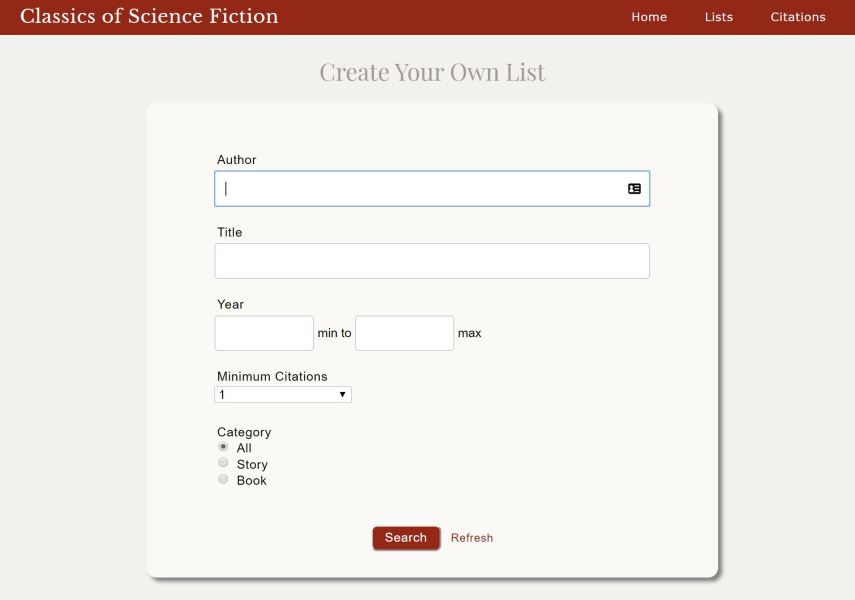
Create Your Own Reading Checklist

* * *

You can now download the results of any List Builder search. This is great if you want to create a custom reading list, or to copy our data for your own research.

Just configure the List Builder page by:

  • Picking an author or leave blank for all
  • Leave the title blank unless you want titles with certain keywords
  • Put in a date range, or same year for both for a single year, or leave blank for all
  • Pick the number of citations. A one gets all, higher numbers limited the results
  • Pick whether you want just short stories, novels, or both
  • Hit the Search button

Listbuilder2

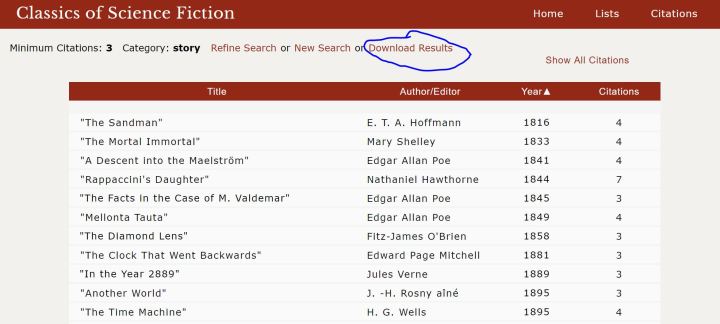
Then on your results page click on “Download Results” and you’ll get a comma-delimited file to save which you can load into a spreadsheet or database. I import my results into Google Sheets to have an online checklist to keep for handy reference.

James Wallace Harris, 5/2/20