What Are The Magic Ingredients That Make Me Love a Short Story?

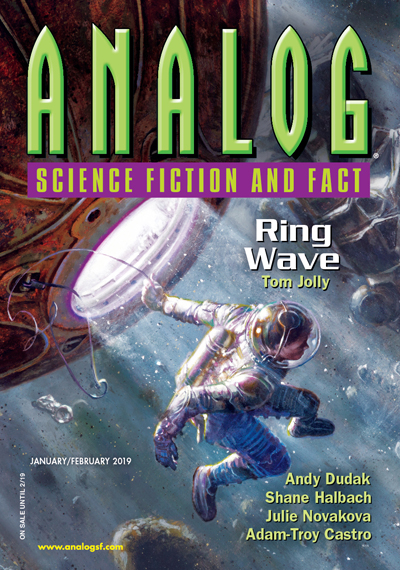
AFF_JanFeb2019_400x570

On Monday, my friend Mike told me to read “The Fading Pages of a Short Story” by Bud Sparhawk in the Jan-Feb 2019 issue of Analog. Three days later I’m still thinking about it. Mike warned me that Rocket Stack Rank (RSR) had not liked it. I read the story and found it moving. I assumed RSR had only given it 3-stars, but when I checked, “The Fading Pages of a Short Story” had just 1-star.

What were the magic ingredients in “The Fading Pages of a Short Story” that made Mike and I resonate with the story but were missed by Rocket Stack Rank? My routine way of selecting the latest short science fiction to read is to check RSR and go after the 5-star stories. This means I wouldn’t have read “The Fading Pages of a Short Story” on my own. I’m grateful to Mike recommended the story because the story worked on me and pushed my emotional buttons.

Several reviewers have dismissed this story as sentimental. Are Mike and I emotional saps who are suckers for stories that make our eyes water? I don’t know about Mike, but I am. Does that make “The Fading Pages of a Short Story” a 5-star story in my heart? Well, not quite.

I don’t want to rate stories, but I do want to promote them. Let’s face it, the short story is a dying art form, but one I admire. To be upfront and honest, I want you to buy science fiction magazines and read more short stories because I want the market to thrive and not go extinct. But what’s the best way to do this? Rocket Stack Rank has its system which I use and recommend, but it’s not perfect. If you learn their system I believe it’s reliable for rating stories by its standards.

However, if you don’t normally read science fiction short stories, you won’t become a fan if you try a couple and don’t like them. It helps to have a pusher to get you hooked. There are all kinds of stories for all kinds of readers. That makes it hard for us story pushers to get people to read a particular story.

If I review a story I have to carefully point out what works for me in a way that is understandable to you. If we can’t find a common wavelength to communicate on, there’s no reason for you to try the stories I push, or even read what I write.

So why exactly did I like “The Fading Pages of a Short Story” by Bud Sparhawk?

  1. The story is about an old man, David, losing his memory. I’m an old guy worried about losing my memory.
  2. The old guy is a science fiction writer who reads his own stories having forgotten he wrote them. I can already rewatch a Perry Mason I saw two months ago and not remember the plot.
  3. Sparhawk proposed a gadget he calls a memory-aid (think hearing aid) that helps with short-term and long-term memory. Great idea for SF short story.
  4. The story conflict deals with the old man’s children, Bill and Gwen, trying to decide if they should spend their own savings for a memory-aid for their aging father. Tough call.
  5. The story makes me wonder what would I do in the same situation, either for an older person or for myself.
  6. The story makes me fantasize how I would have told the same story differently.

Sparhawk’s story moved me, but I thought it had problems. Storytelling problems often make me stop reading. But sometimes they make me obsess over the story – like now. Often I like the idea but not the execution. I actually love stories I want to rewrite using my own personal insights because I believe the writer came up with a wonderful situation.

The main flaw of “The Fading Pages of a Short Story,” which could have been an editor’s tweaking, is making David 98. Who would consider spending the price of a house to get a memory-aid for a 98-year-old man? If he had been 68, then the decision would have been realistic and heartwrenching. It would have also fixed some secondary problems. If David is 98, Bill and Gwen should be in their 60s or 70s. They should be old enough to have their own memory problems. But in the story, Gwen still has kids at home. Clues suggest the story takes place in the 2030s, and David began writing at the beginning of the century, which would make him around 70. That doesn’t work. I can’t but wonder if 98 was a printing mistake.

But there were other little problems that made me pause my reading and think. David says he relies on speed-dialing. That’s an archaic phrase now and will be even more so in the 2030s. You just “call” people with smartphones, but we do rely on them to remember phone numbers. But this problem is an interesting writing problem to contemplate. I still call the refrigerator an “icebox” because that’s what my dad called it, and that was an old fashioned term when he learned it in the 1920s and 1930s. So an old man in the 2030s might still use the phrase “speed dial.” In other words, sometimes what I think of as flaws in the stories might be features.

There were a number of other aspects to the story that made me pause too, but they aren’t really important to why the story moved me. Being moved is the key ingredient. If I had not read the Rocket Stack Rank review I would never have thought about the flaws in this story. I would have finished it with a wonderful sense of existential suffering. A rewarding kind of pain that comes from good stories. Faulker said great fiction is about the heart in conflict with itself.

“The Fading Pages of a Short Story” is a slight story that made me feel something deeply in myself. That’s the magic ingredient to any short story. As someone who wants to write short stories, Sparhawk’s story gave me a lot to think about. But mostly, it made me fear for the future, tear up, and ache. My memories are slipping away and I know what that means, so I identified with David and I felt for him. When I was younger, this story would have meant nothing to me.

On The Astounding Analog Companion, Bud Sparhawk writes “The Bane and Pleasure of Writing” where he mentions having PSS (premature-submission-syndrome). I believe “The Fading Pages of a Short Story” would have gotten more stars with Rocket Stack Rank if he had baked it in the oven longer. Below that linked essay is a Q&A with Sparhawk where he talks about writing “The Fading Pages of a Short Story.” And below that is a bit of biography with his photo. Bud Sparhawk is 81, so he knows something about getting old. He’s also been a regular contributor to Analog for decades.

James Wallace Harris, February 20, 2019


The Winston Science Fiction Series

Winston-Science-Fiction-series

There are pleasures of the past you can buy — if you’re willing to pay the price. For some bookworms who got hooked on science fiction in the 1950s and 1960s, the Winston Science Fiction series aimed at children trigger an intense sense of nostalgia. However, I don’t believe it was the words in those 37 volumes that are burned into our memories, but the cover and endpaper art. Finding one of these stories reprinted without the art doesn’t set off those same intense emotions about the past, at least for me. I often wonder if nostalgia isn’t predominantly a visual thing. I’m in a number of Facebook groups where people are crazy about posting images of the past.

I never owned any of the Winston books as a kid, but got them from my school library, the Miami-Dade County Public Library, or from the Homestead Air Force Base library in the mid-1960s. There were three kinds of science fiction novels aimed at children that I remember from back then. The twelve Heinlein juveniles from Scribners, books by Andre Norton, and the Winston Science Fiction series. When I got my first job I ordered all the Heinlein books in hardback from the publisher. I wish I had ordered the Winston books at the time too. Those Winston books today in VG to Fine condition run hundreds of dollars each if they have the original dust jackets.

Mists of Dawn by Chad Oliver Another important visual bond with these books was the endpaper art that was part of most of the first editions by Alex Schomburg. In fact, this artwork can set off a flurry of comments on the Facebook groups Space Opera Pulp and Science Fiction Book Club. It seems to capture the essence of 1950s science fiction. And it’s a shame that all hardback books don’t all have endpaper art. The Heinlein juveniles did have beautiful endpapers, but just a star pattern, not like the sense-of-wonder artwork below.
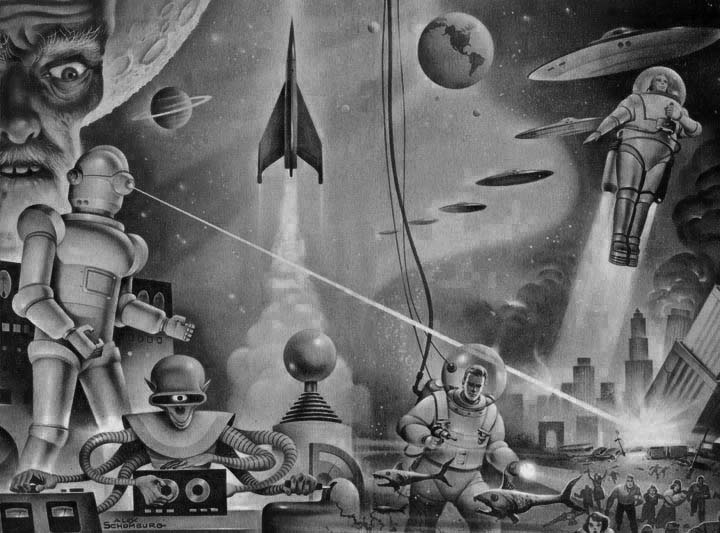
Winston_Endpaper For many years I’d keep an eye out for the Winston Science Fiction books when I shopped at used bookstores. I never saw any. I eventually assume they were all owned by collectors. A few years ago my friend Mike found The Ant Men by Eric North at a library book sale in good condition but without a dust jacket. I was envious of him for his luck. We then found WinstonSciFi that sells reproductions of the dust jackets at very reasonable prices. Now his copy of The Ant Men looks like this one:

The Ant Men by Eric North

The other day Mike and I were shopping at a used bookstore and found a Dover reprint of The Ant Men by Eric North. It had a stylised version of the cover that was okay, but what really shouted at me to buy the book was the original Schomburg endpaper art. I didn’t buy it because the book’s cover looked wrong. I’m still tempted to go back to get it because of the endpaper art.

Last year I discovered that many titles in the Winston Science Fiction series were being sold on Amazon as ebook and trade paperback reprints and they used the original cover art (but not the endpaper art). I ordered one just to check it out, Rockets to Nowhere by Lester del Rey. The publisher of these reprints is Dan Thompson of Thunderchild Publishing from Huntsville, Alabama. He also offers a reprint of The Ant Men with the original cover. You can read about how Dan got into reprinting vintage science fiction here. Like me, Dan also read the Heinlein and Andre Norton books growing up. He discovered that most of the Winston books were out-of-print and thought that was a shame, so he got into the publishing business. A few were in the public domain, but for most, he had to track down the copyright holders to arrange contracts for reprinting. He’s been able to reprint many but not all of the series in both ebook and trade paper editions.

Even though I’d love to own a mint condition original copy of Rockets to Nowhere, having Dan’s trade paperback reprint visually fulfills my nostalgic needs.

Rockets-to-Nowhere---both-editions

Of course, I would prefer to own the 1st-edition, but I don’t want to spend $200. $7.99 is a great compromise between my eyes and my bank account.

If you’d like to see what the other covers look like for the entire series, check out Worlds Without End. Publication history and other details can be found at ISFDB.org.

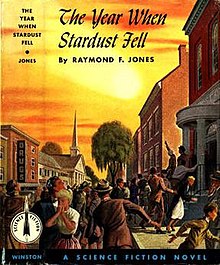
The-Year-When-Stardust-FellSome of these books have never been reprinted, and for some, Thunderchild is the first publisher since Winston to publish them. Which makes me wonder just how good are these stories? I decided to give one a read, but the one I picked wasn’t from Thunderchild. I’ve been wanting to read some Raymond F. Jones, but I now prefer to listen to books. The Year When Stardust Fell was the first one I could find on audio. I got it for $2.99 at Audible.com because I bought the 99 cent ebook edition at Amazon. Thunderchild also sells an ebook and trade paper of this title, and I might get it too because of the cover.

These stories were aimed at children, sometimes even targeted to elementary school kids, but mostly to junior and senior high. I found this story far more adult than I remembered. I don’t think I read The Year When Stardust Fell as a kid, but I had a couple of Deja vu experiences while listening to it. The story is about when Earth passes through a comet’s tail and its dust affects metals, so eventually, all machinery breaks down. Civilization slowly collapses. The story is told from the point of view of Ken Maddox who lives in Mayfield in an unspecified state. Ken’s father is a chemistry professor at a local university. Because of Mayfield being isolated, it’s citizens are able to survive with rationing while in larger cities millions die. As the story progresses the people of Mayfield must learn to live with less and less, and even deal with the moral problem of lifeboat ethics.

Ken and his science club buddies run a ham radio rig that stays in touch with other research sites who are trying to solve the problem of the dust affecting metals. Ken and his buddies also help his father in the lab. This allows the story to emphasize the workings of science. I found the tale thoroughly engaging. It’s not great, but it’s not bad either. To me, it holds up well with other 1950s science fiction stories. In fact, I was always anxious to get back to the story. But then, after-the-collapse stories are among my favorite kind of science fiction story.

Winston-Science-Fiction-at-eBay

To be honest, I can’t remember any of the details from the books I think I read. Of course, I read these stories 55 years ago. I’ll have to read several more to see if I think the series deserves to be remembered for its fiction. What I’m discovering is I want these books because of their physical artistic appeal that trigger my nostalgia. I saw a group of 8 of them on sale at eBay today for $300. The idea of holding those old books again is very tempting, even though $300 could probably get me “reading copies” of the entire series if I shopped carefully. A reading copy in used book terminology meaning its beat to hell but you can still read it. I could get most of them as ebooks for less than $100, and all of Thunderchild trade paper editions for under $300.

Dan says these books aren’t big sellers. It’s probably hard to market books for kids in the 1950s to kids or nostalgic adults in the 2010s. I wonder what will happen to these stories when the baby boomers all die off. I doubt any of them will ever be considered classics of the genre. It’s a shame that Thunderchild doesn’t have the right to publish the entire series again as one uniform set so they might have collector appeal.

Here the complete list of titles with cover artists. My favorites tend to be the ones with Alex Schomburg cover paintings. Links are to Thunderbird trade editions at Amazon.

  1. EarthboundMilton Lesser, cover by Peter Poulton (1952)
  2. Find the Feathered Serpent, Evan Hunter, cover Henry Sharp (1952)
  3. Five Against Venus, Philip Latham (Robert S. Richardson), cover Virgil Finlay (1952)
  4. Islands in the Sky, Arthur C. Clarke, cover Alex Schomburg (1952)
  5. Marooned on Mars, Lester del Rey, cover Paul Orban (1952)
  6. Mists of Dawn, Chad Oliver, cover Alex Schomburg (1952)
  7. Rocket Jockey, Philip St. John (Lester del Rey), cover Alex Schomburg (1952)
  8. Son of the Stars, Raymond F. Jones, cover Alex Schomburg (1952)
  9. Sons of the Ocean Deeps, Bryce Walton, cover Paul Orban (1952)
  10. Vault of the Ages, Poul Anderson, cover Paul Orban (1952)
  11. Attack from Atlantis, Lester del Rey, cover Kenneth S. Fagg (1953)
  12. Battle on Mercury, Erik Van Lhin (Lester del Rey), cover Kenneth S. Fagg (1953)
  13. Danger: Dinosaurs!, Richard Marsten (Evan Hunter), cover Alex Schomburg (1953)
  14. Missing Men of Saturn, Philip Latham, cover Alex Schomburg (1953)
  15. The Mysterious Planet, Kenneth Wright (Lester del Rey), cover Alex Schomburg (1953)
  16. Mystery of the Third Mine, Robert W. Lowndes, cover Kenneth S. Fagg (1953)
  17. Planet of Light, Raymond F. Jones, cover Alex Schomburg (1953)
  18. Rocket to Luna, Richard Marsten (Evan Hunter), cover by Alex Schomburg (1953)
  19. The Star Seekers, Milton Lesser, cover Paul Calle (1953)
  20. Vandals of the Void, Jack Vance, cover Alex Schomburg (1953)
  21. Rockets to Nowhere, Philip St. John (Lester Del Rey), cover Alex Schomburg (1954)
  22. The Secret of Saturn’s Rings, Donald A. Wollheim, cover Alex Schomburg (1954)
  23. Step to the Stars, Lester del Rey, cover Alex Schomburg (1954)
  24. Trouble on Titan, Alan E. Nourse, cover Alex Schomburg (1954)
  25. The World at Bay, Paul Capon, cover Alex Schomburg (1954)
  26. The Year After Tomorrow, eds. Lester del Rey, Cecile Matschat, and Carl Carmer cover and interior illus. Mel Hunter (1954) – an anthology of nine short stories
  27. The Ant Men, Eric North, cover Paul Blaisdell (1955)
  28. The Secret of the Martian Moons, Donald A. Wollheim, cover Alex Schomburg (1955)
  29. The Lost Planet, Paul Dallas, cover Alex Schomburg (1956)
  30. Mission to the Moon, Lester del Rey, cover Alex Schomburg (1956)
  31. Rockets Through Space, Lester del Rey, cover and interior illus. James Heugh (1957) – Special Companion Book (nonfiction)
  32. The Year When Stardust Fell, Raymond F. Jones, cover James Heugh (1958)
  33. The Secret of the Ninth Planet, Donald A. Wollheim, cover James Heugh (1959)
  34. The Star Conquerors, Ben Bova, cover Mel Hunter (1959)
  35. Stadium Beyond the Stars, Milton Lesser, cover Mel Hunter (1960)
  36. Moon of Mutiny, Lester del Rey, cover Ed Emshwiller (1961)
  37. Spacemen, Go Home, Milton Lesser, cover Ed Emshwiller (1961)

JWH

Fantastic Universe (1953-1960)

FANTUNIVAPR1955

I think it’s time we recognize some other science fiction magazines besides Astounding Science Fiction. So I’ve picked Fantastic Universe on a whim. Below, I’m going to list all the issues of Fantastic Universe available to read online at the Internet Archive, but before that, I thought I might explain why. If this column works out, I might do additional magazines.

I’ve recently read four books about Astounding Science Fiction and its editor John W. Campbell, Jr. (Requiem for Astounding by Alva Rogers, The World Beyond the Hill by Alexei and Cory Panshin, Astounding Days by Arthur C. Clarke, and Astounding by Alec Nevala-Lee). Quite often when I read the history of science fiction magazines Hugo Gernsback gets credit for starting Amazing Stories, and John W. Campbell seemingly gets credit for almost everything else. Of course, that’s not true. Time and time again, writers want to write about Campbell and Astounding. I’d like to know about the other editors and their magazines.

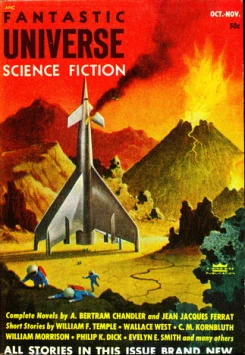
fantastic_universe_195310-11Most historians of the science fiction magazines do admit that Campbell’s influence waned in the 1950s as The Magazine of Fantasy and Science Fiction and Galaxy Science Fiction came on the scene. David L. Roshelm did write Galaxy Magazine: The Dark and the Light Years (1986), but as far as I know, no one has written a history of F&SF. There have been dozens of other science fiction magazines published in the 20th-century, and I have to wonder if their editors didn’t discover new writers, give new artists a gallery on their covers, provide letter columns for fans fighting their tempests in a teacup, and book reviewers a place to begin publishing.
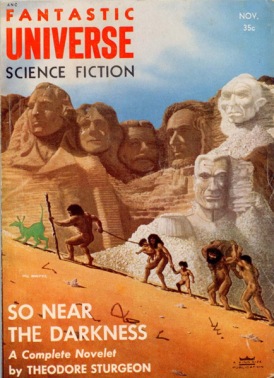
I collect anthologies of science fiction short stories. Most of the stories anthologized from the 1930s and 1940s have come from Astounding Science Fiction. And Astounding, F&SF, and Galaxy seem to dominate when looking at stories collected from the 1950s. Of course, these markets paid more, so their editors got the first look at work from the top writers. Yet, I’ve got to wonder about all those forgotten science fiction magazines, editors, and writers. Did their editors discover new writers? Have anthologists missed story gems from those forgotten magazines?

FANTUNIVNOV1955The four books about Astounding break into two kinds. Rogers and Clarke were fans from the start and go back and review old issues story-by-story they fondly remember. The Panshins and Nevala-Lee were too young to have read Astounding growing up. The Panshins focused on analyzing the impact of stories, while Nevala-Lee focused on the biographies Campbell and his famous writers: Heinlein, Asimov, and Hubbard.
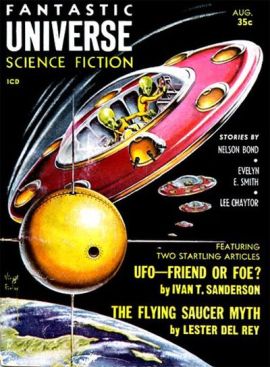
Thus, historians of magazines can choose to write about the stories, writers, or editors, an sometimes about the cover artists, interior illustrators, and book reviewers. Alva Rogers had a collection of Astounding to work with, and Clarke was given a microfilm set of Astounding. Nevala-Lee had digital scans. Having access to old magazines makes writing about them easier.

Because of sites like the Internet Archive, researchers can now read many more old science fiction magazines. It’s a great time for genre scholars to pour through long forgotten issues looking for undiscovered discoveries regarding SF in the 1950s. Fantastic Universe got the reputation for supporting the UFO craze. Whether it’s editor and writers believed in flying saucers, or were trying to make a buck of the craze, is another issue.  Ray Palmer at Amazing Stories and John W. Campbell, Jr. at Astounding both have piles of embarrassing editorials to defend too. And if you lived through the 1950s you’ll know people believed a lot of crazy ideas back then. Just read Confessions of a Crap Artist by Philip K. Dick, which I think is PKD’s best novel.

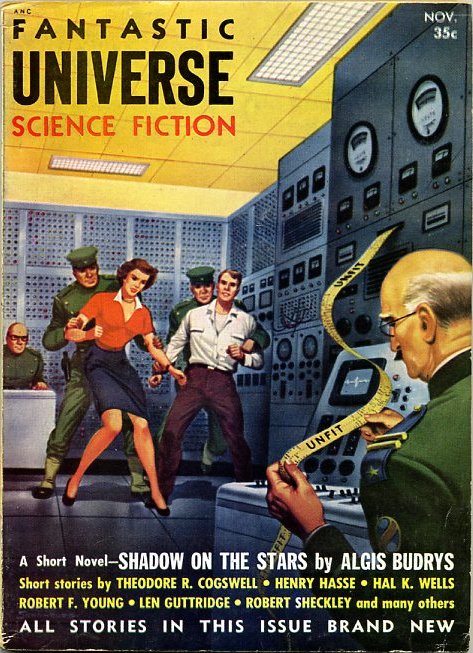
FANTUNIVAUG1957I thought it would be fun to research a lesser known science fiction magazine and picked Fantastic Universe, which ran from 1953-1960. I did find Leo Margulies: Giant of the Pulps (2017) by Philip Sherman. Supposedly, in the 1930s Leo Margulies edited 46 different pulp titles, but he’s most famous among SF fans for editing Startling Stories and Thrilling Wonder Stories. Sam Merwin, Jr. also worked on those two pulps and others, but I could not find a biography devoted to him. Hans Stefan Santesson seems to have gotten his start with Fantastic Universe and then went on to edit The Saint Mystery Magazine from 1959-1967.
Issue Lists (69)

Volume/Number links to ISFDB to see table of contents.

[IA] links to Internet Archive to read a scanned copy

1953Sam Merwin, Jr.

1954 – editor Beatrice Jones

1954 – editor Leo Margulies

1955 – editor Leo Margulies

1956 – editor Leo Margulies

1956 – editor Hans Stefan Santesson

1957 – editor Hans Stefan Santesson

1958 – editor Hans Stefan Santesson

1959 – editor Hans Stefan Santesson

1960 – editor Hans Stefan Santesson

The Internet Archive is becoming the Library of Congress for the web. It’s only missing 12 of the 69 issues of Fantastic Universe, and I’m pretty sure those issues will show up soon. I used to work in a periodicals department at a university and one of my jobs was tracking down and ordering missing issues. This was back in the 1980s and I had to snail-mail publishers all over the world. As our library ran out of space, we sometimes discarded whole runs of magazines, including a complete bound run of F&SF. That really killed my soul. I wanted them, but state law forbade the library from giving them to people, so they were shipped off to state surplus.

Now that libraries routinely discard items that seldom get used, it’s great that the Internet Archive is collecting everything it can as digital scans. Old pulp and digest magazines are aging badly, disintegrating and disappearing. So, scanning saves them for the future. And by being on the internet, people from all over the world can use them to write about the history of science fiction.

In the future, I’m hoping to see more books like Astounding by Alec Nevala-Lee about other areas of science fiction history. I was surprised by how many prominent general interest magazines reviewed it. I assume there are many more old fans like me who want to read about the evolution of science in magazines.

Additional Reading:

James Wallace Harris, 2/1/19

FantUnivNov54


Taxonomy of Science Fiction Themes

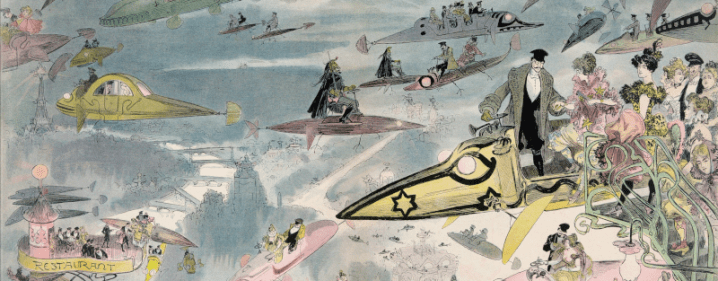
leaving the opera in the year 2000 by albert robida 800

When it comes to reading science fiction, I’ve reached an age where nothing new is under the sun. I feel like I’m approaching the weary wisdom of the author of Ecclesiastes when looking over our genre. And today I’m feeling more like Linnaeus and want to classify all the themes of science fiction. This will be a big undertaking that I won’t be finished soon. I’ve attempted this before with “Classifying Science Fictional Ideas.” What I want to do now is decide which approach should I start building the foundation of my tree?

During the past couple of years, I’ve suggested to other science fiction fans that science fiction might have a limited number of themes. Most have not liked the idea — they want our genre to be without limits. But I’m not so sure. It seems to me that science fiction covers specific territories it has claimed over the years. Reading more 19th-century science fiction has shown me we’ve been exploring the same lands for a very long time.

If we borrow from Linnaeus scheme of Life > Domain > Kingdom > Phylum > Class > Order > Family > Genus > Species and replace “Life” with “Science Fiction” what would be the Domains of our genre? I’m currently toying with:

  • Humans
  • Aliens
  • Artificial beings
  • Machines
  • Society
  • Earth
  • Space
  • Time
  • Dimensions

I’m thinking about the smallest to largest objects science fiction explores in speculation and extrapolation. I could also use point of view (POV) as my basic domains and have:

  • Humans
  • Aliens
  • Artificial beings

All stories depend on the human perspective even when imagining how aliens and robots think. Should the root domains of science fiction be:

  • Extrapolation (if this goes on)
  • Speculation (what if?)

Currently, we divide life into three domains, Bacteria, Archaea, and Eukaryota. Just a few decades ago we only had two domains. So starting science fiction with just two domains might be fine. We need to think about this. How do aliens and robots fit in, for example?

Wouldn’t robots come under extrapolation and aliens speculation? We’re building robots now that are getting smarter and smarter, so it’s no big deal to extrapolate they could eventually become smarter than us. Other than statistics, we have no reason to believe aliens are out there. We can only say, “What if intelligent beings exist on other worlds?”

But what if we ask, “What if robots were ten times smarter than people?” We now have robots under both extrapolation and speculations. Is that problematic? If Machines were a domain we could organize them this way:

  • Machines
    • Nonsentient
      • Computers
      • Matter transporters
      • Holodecks
      • Rockets
    • Sentient
      • Robots
      • AI Minds

But I don’t like that either. What if machines were only inventions and didn’t deal with sentient minds? What if we had a domain for Artificial Beings that included AI machines, as well as artificially created life like in the classic short story “Microcosmic God” by Theodore Sturgeon?

If we think about it, speculation and extrapolation are like mechanisms within nature, such as inheritance and evolution. Linnaeus was actually classifying objects. Science fiction is inspired by objects in the real world such as people, machines, aliens, robots, cities, Earth, moons, planets, stars, galaxies, and objects we assume could exist such as aliens, intelligent machines, artificial life, digital universes, as well as things that probably can’t exist like time machines and time travel.

We could divide science fiction into the domains:

  • What exists
  • What will exist soon
  • What theoretically could exist according to science we know
  • What theoretically can’t exist according to the science we know

But we’re back into splitting robots into different domains, maybe into all four. Once again, I’m thrown back to my object-oriented classification. For example, take Earth:

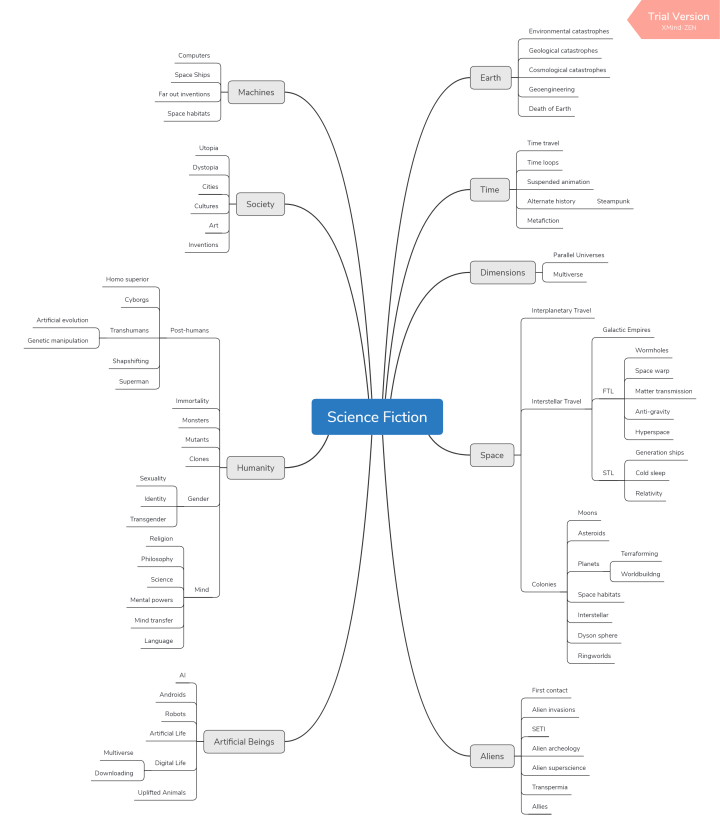
  • Earth
    • Environmental catastrophes
    • Geological catastrophes
    • Cosmological catastrophes
    • Geoengineering
    • Death of the Earth

I think this works nicely. Each of these could be speculation or extrapolation, or it could be stories based on things happening now or will happen soon, maybe could happen, or even wild speculation like Hothouse by Brian Aldiss that will never happen.

This is my current mindmap:

science fiction taxonomy mindmap

My plan is to read or review old science fiction to see how those stories would fit into the scheme, and grow this tree out with many more leaves.

If you have any ideas about classifying science fiction, please leave a comment below.

James Wallace Harris 1/15/19

What Were Heinlein’s Best Short Stories?

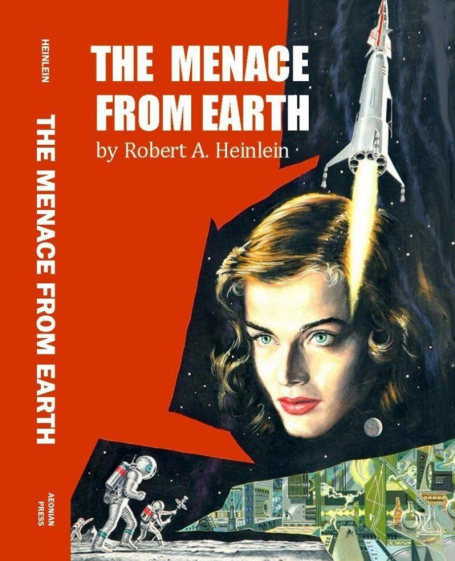
The Menace From Earth by Robert A. Heinlein

[You can use our Classics of Science Fiction Query Database to recreate this work, or test it with another author.]

We identify the best short stories by looking at which stories were most anthologized. Robert A. Heinlein was a prolific, well-loved writer, but one who might have hurt himself under our system because he charged so much to reprint his short stories that many anthologists couldn’t afford to include his work. Under our “citation” system, we include fan polls, awards, and even writer recommendation lists, as well as anthologies as our citation sources. Many Heinlein stories have multiple citations because of fan polls. Here’s our raw data – stories with at least 1 citation.

Heinlein Short Stories Citations 1

Heinlein had 59 short stories published in his lifetime, reprinted in 16 of his own collections. Which is probably one reason why he didn’t feel the need to have his stories anthologized by others. But the list above seems to include most of his famous stories. I’m surprised that “Jerry Was A Man” was never anthologized by a major retrospective anthology of the genre. (But it was made for a television anthology show.)

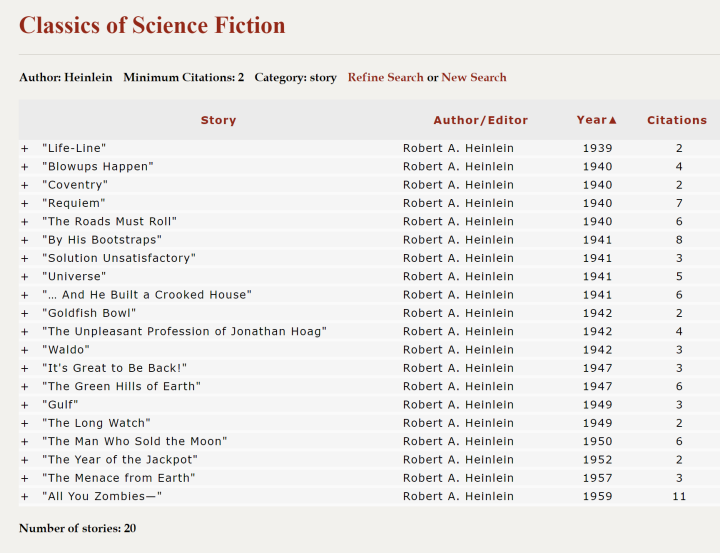
To get an idea which was his better stories, I’m going to show the stories that had at least 2 citations.

Heinlein Short Stories Citations 2

This list drops from 26 to 20 stories. That’s still a very long list of short stories. As we worked with our system, we saw we had to up the minimum citation cutoff to get a better idea which stories significantly stood out. By looking at the changes in the lists, we had to ask why about each story that fell out. For example, “Misfit” disappears here. It’s a fun story and might be considered Heinlein’s first juvenile, but ultimately, it is a weaker story. Look what happens when we up the cutoff to 3 citations.

Heinlein Short Stories Citations 3

This is a much better list. We lose five stories, such as the outrageous “The Year of the Jackpot,” which is one of my favorites. But is it really a standout story, or just one with a very neat idea? I personally rate it higher than “Gulf” and “It’s Great to Be Back.” If Heinlein had let it been anthologized more often I think it would be better remembered. Heinlein should have at least let Bleiler & Dikty include it in their annual best of the year collection. Or maybe those editors didn’t like it as much as I do. Terry Carr did include “The Year of the Jackpot” in Science Fiction for People Who Hate Science Fiction in 1966, and it did make it to Sci-Fi Lists Top 200 in 2018.

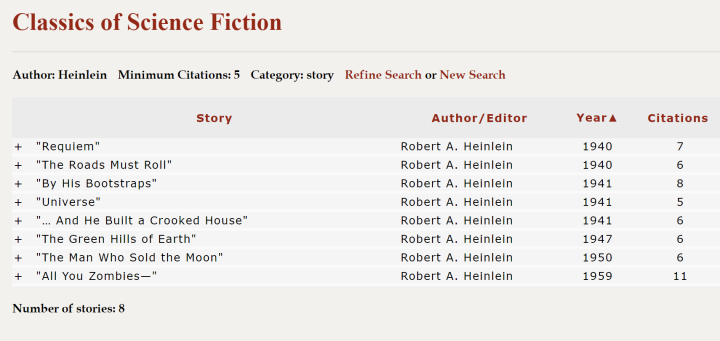
But let’s jump up the cutoff to 5, the one we used for our Classics of Science Fiction Short Stories list.

Heinlein Short Stories Citations 5

This list drops out my all-time favorite Heinlein short story, “The Menace From Earth.” I suppose I like that story so much because it came out in 1957 at the height of Heinlein’s career, was a young adult story, and I think Heinlein’s best novels were young adult novels, and it had a marvelous gimmick, human-powered flight on the Moon. Sadly, it doesn’t make the cut. Nor was it up for a Hugo. However, “The Menace from Earth” was eligible for Ted Dikty’s last annual collection, and Judith Merril’s third annual collection of best science fiction. Did Heinlein charge too much for it back in 1957, or did Dikty and Merril just not like the story? I can’t believe they wouldn’t have considered it one of the best short stories of the year. If they had anthologized “The Menace From Earth” it would have made our 5 citation cutoff.

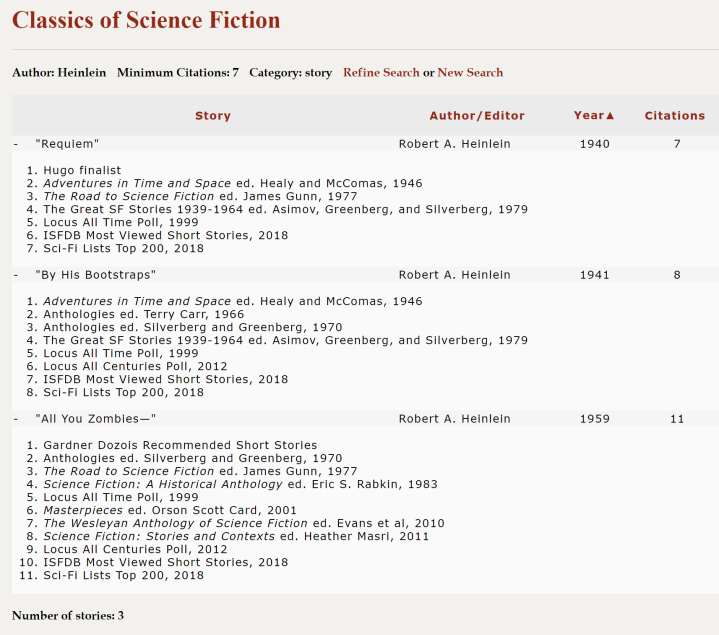
But let’s look at just one more cutoff, 7.  These are Heinlein’s most popular stories using our system. This time I’ve opened the citation source list for each story.

Heinlein Short Stories Citations 7

It’s the fan polls that put Heinlein over the top. Fans remember Heinlein, for example, “Requiem” was up for a Retro Hugo. Heinlein just wasn’t anthologized that much, at least by the major anthologies we included in our system. And the two citations from The Great SF Stories edited by Asimov and Greenberg are a kind of cheat. They leave a page for each story but say they couldn’t get the rights to include the actual stories. Probably meaning, Heinlein was charging too much. James Gunn did buy two Heinlein stories. And “All You Zombies–” got into three textbook anthologies. I guess they can afford to pay more.

“Requiem” is a beautiful story, and I consider a lovely tribute to our genre. “By His Bootstraps” is a razzle-dazzle plot story, but I’m not sure how much heart it contains. And “All You Zombies–” is another razzle-dazzle plotter, which is impressive, but on the other hand, is rather cynical. It’s very popular in the fan polls, and it’s one of few Heinlein stories that got made into a movie.

Ultimately, our system fails me. I love “The Menace from Earth.” It’s a positive story. It’s full of science fiction speculation. At its heart, it speaks to people who love science fiction. Maybe our system for identifying the best short stories works for telling me what the average reader thinks about Heinlein. No system is perfect. If you don’t agree with our statistical process, just assume your tastes run uniquely different from the average.

By the way, you can use our Classics of Science Fiction Query Database to analyze the popular stories for your favorite SF author.

James Wallace Harris, December 26, 2018

Not All Great Stories Are Remembered

A Logic Named Joe by Murray Leinster March 1946 Astounding.PNG

Our goal here at the Classics of Science Fiction is to discover analytical ways to remember science fiction. We describe our methods in “Remembering Science Fiction.” The trouble is, our methods don’t always work. For short stories, we collect annual anthologies, retrospective anthologies, textbook anthologies about science fiction, fan polls, awards, and a few recommendation lists from authors. We call each source of recognition a “citation” and we have over a 100 citation sources for short science fiction. To get on our final list of Classics of Science Fiction Short Stories a story had to have a minimum of 5 citations.

“A Logic Named Joe” by Murray Leinster from the March 1946 issue of Astounding Science Fiction is a definite classic in my mind, yet it only got 1 citation. It was collected in The Great SF Stories 8 (1946) edited by Isaac Asimov and Martina H. Greenberg. But if you look at the entry for “A Logic Named Joe” at ISFDB.org, you’ll see it’s never been collected in a major retrospective anthology of the science fiction genre. Yet, if you go read “A Logic Named Joe” online at Baen Book you’ll discover this 1946 story is very prescience about today’s computers, networking, and social media problems. For example, the illustration above shows kids looking at a film unsuitable for kids. In the story itself, kids are watching a film cannibals and their fertility dances. Leinster even imagined Nanny apps to keep kids from seeing what they shouldn’t, but in this case, Joe overrode that code.

The reason why people should read “A Logic Named Joe” today is for the same reason they should read “The Machine Stops” by E. M. Forster from 1909. Both are stories where the author has predicted our world and time to a fascinating degree. Science fiction was never meant to be a crystal ball, but sometimes it’s speculations about the future are eerily right. Both of these stories would just seem like nice stories if read before the internet era, but after that, we go, “Wait a minute! How could E. M. Forster in 1909 or Murray Leinster in 1946 imagine what’s happening now?”

“A Logic Named Joe” was written when the term “computer” meant a human that worked all day at a desk doing mathematics. Leinster used the word “logic” to mean what we call computers. I bet future retrospective anthologies will reprint “A Logic Named Joe.”

They will if the editors read it. How do keep short stories alive so readers will remember them? I’d say a majority of modern science fiction readers will never read even one of the anthologies we used to create our system for identifying the best short science fiction from the past. Sure, a few folks might take a science fiction course as an elective and have to read one of the textbook anthologies for their class. Or a small percentage might consume a current anthology like The Big Book Of Science Fiction (2016) edited by Jeff and Ann VanderMeer, but these readers are few and far between.

We’re hoping people will read our lists and track down the stories. We’ve even put all our research into a database that you can generate your own custom lists. But using our system you probably won’t notice “A Logic Named Joe.” Our system fails to recognize it. There have been no 1947 Retro Hugo Award for 1946 publications so far. This could happen in 2022. In 2018 the Retro Hugo Award voted for the 1943 Hugo awards that covered 1942 stories. In 2019 they’ll vote the 1944 awards. But even if “A Logic Named Joe” gets a Retro Hugo Award, will that be enough to make it into a classic story young readers will remember?

Murray Leinster is not very well remembered today, but he was once called the Dean of Science Fiction. Readers mostly remember him today for “First Contact” which was anthologized in The Science Fiction Hall of Fame.

If you use our database and set the min and max year to 1946, check the Story radio button, and put citations to 1, you’ll get all the stories our system found for 1946:

1946 Science Fiction Short Stories

The ones checked with a red mark are those collected by Asimov and Greenberg for The Great SF Stories 8 (1946). All the others came from other anthologies. 13 of the 22 stories are only remembered by one anthology. Using our cutoff of 5 citation minimum, these are the stories our system deems are the classics of 1946:

The Classics of Science Fiction Short Stories 1946

Few modern science fiction readers will even read these three stories, but because they’ve been anthologized so many times, their chances are better for being remembered as classics of the genre.

I believe “A Logic Named Joe” should be on that list, but how do we come up with a system that recognizes its worth? We could add Modern Masterpieces of Science Fiction (1965) edited by Sam Moskowitz. It’s a major retrospective anthology we missed. That would give “A Logic Named Joe” 2 citations. It would also reinforce the standing of the other stories in the anthology give giving them an additional citation.

We could also add the best theme anthologies. We aimed to pick major anthologies, either recognized as such or because they were large and definitive. Machines That Think (1984) edited by Asimov, Greenberg, and Warrick would be one such anthology. It collected 621 pages of great stories about thinking machines. That would bring “A Logic Named Joe” up to 3 citations. Of course, it’s given Asimov and Greenberg two votes.

I could assemble a committee of well-read specialists in short science fiction and give them each a vote. I’d give it my vote. That brings it up to 4 citations, still under the cutoff.

Are there any other sources of citations that recognize short science fiction? Being made into a television show or movie is a great form of recognition that helps keep a work of fiction in our pop culture memory. Unfortunately, “A Logic Named Joe” will never be filmed.

The gold standard for remembering short stories is being published in a major anthology. But how often do major anthologies get published? And when a large retrospective anthology is assembled, editors tend to look over the field and find exceptional stories that haven’t been well-anthologized before to now compete with the recognized classics. Would they now see “A Logic Named Joe” as one? The large genre remembering anthologies come out every few years, but they have page limits, and always more new stories to remember, and thus older stories that were once classics get left out.

Even among short stories, there’s a survival of the fittest. The question I always ask people, “How many short stories do you remember from the 19th-century?” The competition to become a classic is brutal.

“A Logic Named Joe” is a standout story because of how it anticipated the internet. But is that enough to make it a classic story worth remembering? It lacks the emotional depth to make it a literary classic. And it doesn’t have the beauty of “Vintage Season.” Maybe our system is working. Maybe “A Logic Named Joe” is a story I especially like, but not necessarily loved by others?

“A Logic Named Joe” by Will F. Jenkins (Murray Leinster’s real name because he had another story in the same issue) came in first place in The Analytical Laboratory. Readers liked it best, but it only got a 2.80 average rating, meaning it wasn’t that popular. A rating of 1.00 meant every reader picked it as their #1 story. A few rare stories back in the day managed that feat. So in 1946, “A Logic Named Joe” was only a slightly better than average story.

If you look at the list above of the 22 stories for 1946, only “Vintage Season” is a real classic. It had 10 citations. If we used a cutoff of 10, there are only 38 classic science fiction short stories that make the list. And even many of these are being forgotten. It’s hard to come up with a system that remembers everything that the average reader will encounter, or should read.

Classics of Science Fiction Short Stories 10 Citations

James Wallace Harris, December 25, 2018

New Feature: Build Your Own List


New feature

You can now build your own lists from our data. Be aware that our data is a very limited subset of science fiction books and short stories — just the most recommended and remembered stories.

You can always find this new feature under:

Home MenuBuild Your Own Classics of Science Fiction Lists

This landing page explains what you need to know and gives the link to the database system.

James Wallace Harris 12/18/18

Best of the Best Science Fiction 2018


Best 3 SF novels 2018

Wonder what great science fiction book you might have missed reading this year? Want to get ready to nominate books for the Hugo Awards next year?

I’m going to aggregate several Best-of-the-Year-2018 lists covering science fiction to see which books were mentioned the most often. Here are the lists I’m using:

Here are the results ordered by the number of lists they were on.

5 – Blackfish City by Sam J. Miller (B&N, BestSF, Chicago, Vulture, WP) *
4 – Severance by Ling Ma (B&N, Chicago, Goodreads, Vulture) *
4 – The Calculating Stars by Mary Robinette Kowal (B&N,  BestSF, Chicago, Goodreads)
3 – Rosewater by Tade Thompson (B&N, Chicago, Goodreads) *
3 – Semiosis by Sue Burke (BestSF, Chicago, Vulture) *
3 – Space Opera by Catherynne M. Valente (B&N, BestSF, Goodreads) *
3 – The Book of M by Peng Shepherd (B&N, BestSF, Chicago) *
3 – The Poppy War by R. F. Kuang (B&N, Vulture, WP) *
2 – Binti: The Night Masquerade by Nnedi Okorafor (BestSF, Goodreads) *
2 – Embers of War by Gareth L. Powell (B&N, BestSF)
2 – Empire of Silence by Christopher Ruocchio (B&N, BestSF)
2 – Foundryside by Robert Jackson Bennett (B&N, Vulture)
2 – Head On by John Scalzi (BestSF, Goodreads)
2 – Iron Gold by Pierce Brown (BestSF, Goodreads) *
2 – Medusa Uploaded by Emily Devenport (BestSF, Vulture) *
2 – Revenant Gun by Yoon Ha Lee (BestSF, Goodreads) *
2 – Senlin Ascends by Josiah Bancroft (B&N, WP) *
2 – Spinning Silver by Naomi Novik (B&N, Vulture) *
2 – State Tectonics by Malka Older (Chicago, BestSF) *
2 – Temper by Nicky Drayden (B&N, Vulture) *
2 – The Only Harmless Great Thing by Brooke Bolander (B&N, BestSF)
2 – The Oracle Year by Charles Soule (BestSF, Goodreads) *
2 – Vengeful by V. E. Schwab (B&N, Goodreads) *

* – Titles at Scribd.com

I’ve only read one title off this list, Semiosis by Sue Burke – it was quite impressive. That experience inspires me to try more of these titles.

James Wallace Harris, December 15, 2018

Audible Has A Fantastic Collection of Baby Boomer Science Fiction

The Fourth R by George O. Smith

For several years now (2017, 2016, 2015), I’ve created wish-lists of wanted audiobook editions of classic science fiction stories. My hope is publishers would see my lists and produce those titles on audio. I doubt they ever have, but every year a few more classic science fiction books show up at Audible.com. They have done a fantastic job. Almost any title I read as a kid is now available to read with my ears. Nearly every book on The Classics of Science Fiction and Worlds Without End Top-Listed Books of All-Time lists are available on audio. And I think that validates those stories.

Starting in 2002 when I joined Audible.com I’d scan the new releases daily always hoping to find my favorite science fiction stories from my Golden Age years, the books Baby Boomers now consider the classic of the genre.  Each year it gets harder to find titles that haven’t gotten the audiobook treatment. Here are some of the older science fiction titles that have shown up at Audible this past year:

  • Armageddon 2419 A.D. by Philip Francis Nowlan
  • Sleeping Planet (1965) by William R. Burkett, Jr.
  • The Troublemakers by George O. Smith
  • The Snail on the Slope by Arkady & Boris Strugatsky
  • Triplanetary (1934) by Edward E. Smith (magazine version)
  • This World is Taboo by Murray Leinster
  • The Sensitive Man by Poul Anderson
  • Masters of Space by Edward E. Smith & E. Everett Evans
  • The Silent Invaders by Robert Silverberg
  • Mercenary by Mack Reynolds
  • Catseye by Andre Norton
  • Storm by George R. Stewart
  • The Land of Always Night (Doc Savage) by Kenneth Robeson
  • The Golden Man (Doc Savage) by Kenneth Robeson
  • Planet Stories – March 1953 (magazine)
  • Planet Stories – Fall 1941 (magazine)
  • Rappaccini’s Daughter by Nathaniel Hawthorne
  • The Scarlett Plague by Jack London
  • With the Night Mail by Rudyard Kipling
  • As Easy as ABC by Rudyard Kipling
  • 2 B R 0 2 B by Kurt Vonnegut, Jr.
  • Sci-Fi Shorts volumes 1-6 (public domain)
  • Future Eves: Classic Science Fiction About Women by Women edited by Jean Marie Stine
  • Pink Winds, Green Cats, Radiant Rocks & Other Classics by the Forgotten Woman of Science Fiction’s Golden Age by Frances Deegan

As any diehard mid-century Sci-Fi fan knows, Audible is scraping the bottom of the barrel. They did (accidentally I’m sure) grant a few of my wishes from last year:

  • The Demolished Man by Alfred Bester
  • The Stars My Destination by Alfred Bester
  • Rogue Moon By Algis Budrys
  • The Einstein Intersection by Samuel R. Delany
  • Grass by Sherri Tepper

Not very many, but they were heavy hitters that were overlooked. I realize now that many of my wishes were unrealistic because reprinting old anthologies on audio probably involve significant copyright problems. And I’m starting to doubt there’s a market for short fiction SF on audio anyway, but even then, I got to listen to the three-volume The Science Fiction Hall of Fame. That made 2018 a great year for science fiction on audio. The first volume is probably the most popular science fiction anthology of all-time.

The Long Loud Silence by Wilson Tucker

I’ve decided to make this the last year for wishing for old science fiction on audio. I’m going to make one last roundup of what I’d love to hear and then go off to listen to all the great SF books already sitting in my Audible library. I’ve purchased more than I can listen to in my expected remaining lifetime. This year I’m going to mostly aim for books that publishers should have an easier time acquiring the rights, either novels or single author collections.

I love hearing science fiction read to me by great narrators. And because I study the history of science fiction, there are many rare titles on I want to hear. But I doubt many others do. Sure, there a bunch of us old SF fans rereading our favorite science fiction from our formative years by listening to their audiobook editions, but I don’t know how big that market is, and in any case, we’re a dying audience. I believe Audible and its allied publishers have found pretty much all the old science fiction that was once popular before the year 2000.

Still, there are books I want to hear, and there are science fiction authors from the past that never had anything reprinted in audio, such as Zenna Henderson or William Tenn, or other writers that have had little of their work represented. I still yearn to hear classic science fiction short stories, but I know copyright issues probably make them difficult to reprint. However, I still love to hear three SF anthologies that I believe would significantly cover the history of the science fiction short story if they were produced for audio: Adventures in Time and Space (1946) edited by Raymond J. Healy & J. Francis McComas, Dangerous Visions (1967) edited by Harlan Ellison, and The Big Book of Science Fiction (2016) edited by Jeff and Ann VanderMeer. Links are to ISFDB.org to show their table of contents. But I doubt they will ever get an audio production now.

67 Books I Want to Hear In My 67th Year

  1. A Voyage to Arcturus (1920) by David Lindsay
  2. The World of Null-A (1948) by A. E. Van Vogt
  3. The Voyage of the Space Beagle (1950) by A. E. Van Vogt
  4. The Legion of Time (1952) by Jack Williamson
  5. The Long Loud Silence (1952) by Wilson Tucker
  6. Marooned on Mars (1952) by Lester del Rey
  7. Bring the Jubilee (1953) by Ward Moore
  8. Children of the Atom (1953) Wilma H. Shiras
  9. A Mirror for Observers (1954) by Edgar Pangborn
  10. Mission of Gravity (1954) by Hal Clement
  11. Cities in Flight (1955) by James Blish
  12. Citizen in Space (1955) by Robert Sheckley
  13. Rocket to Limbo (1957) by Alan E. Nourse
  14. Wasp (1957) by Eric Frank Russell
  15. The Enemy Stars (1958) Poul Anderson
  16. The Lincoln Hunters (1958) by Wilson Tucker
  17. The Fourth “R” (1959) by George O. Smith
  18. The High Crusade (1960) by Poul Anderson
  19. Hothouse (1962) by Brian W. Aldiss
  20. Second Ending (1962) by James White
  21. Davy (1964) by Edgar Pangborn
  22. Simulacron-3 (1964) by Daniel Galouye
  23. Earthblood (1966) by Keith Laumer and Rosel George Brown
  24. Empire Star (1966)
  25. The Witches of Karres (1966) by James H. Schmitz
  26. Lords of the Starship (1967) by Mark S. Geston
  27. Camp Concentration (1968) by Thomas Disch
  28. Of Men and Monsters (1968) William Tenn
  29. Omnivore (1968) Piers Anthony
  30. Past Master (1968) by R. A. Lafferty
  31. Space Chanty (1968) by R. A. Lafferty
  32. The Last Starship from Earth (1968) by John Boyd
  33. The Still, Small Voice of Trumpets (1968) by Lloyd Biggle, Jr.
  34. Behold the Man (1969) by Michael Moorcock
  35. Bug Jack Barron (1969) by Norman Spinrad
  36. Macroscope (1969) by Piers Anthony
  37. And Chaos Died (1970) by Joanna Russ
  38. The Year of the Quiet Sun (1970) by Wilson Tucker
  39. The Doors of His Face, The Lamps of His Mouth (1971) by Roger Zelazny
  40. The Fifth Head of Cerberus (1972) by Gene Wolfe
  41. The Listeners (1972) by James Gunn
  42. The Continuous Katherine Mortenhoe (The Unsleeping Eye) (1973) by D. G. Compton
  43. The Centauri Device (1974) by M. John Harrison
  44. Orbitsville (1975) by Bob Shaw
  45. The Female Man (1975) by Joanna Russ
  46. The Shockwave Rider (1975) by John Brunner
  47. Trouble on Triton (1976) by Samuel R. Delany
  48. On Wings of a Song (1979) by Thomas M. Disch
  49. Ridley Walker (1980) by Russell Hoban
  50. No Enemy But Time (1982) by Michael Bishop
  51. Native Tongue (1984) by Suzette Haden Elgin
  52. Ancient of Days (1985) by Michael Bishop
  53. The Falling Woman (1986) by Pat Murphy
  54. Mindplayers (1988) by Pat Cadigan
  55. Her Smoke Rose Up Forever (1990) by James Tiptree, Jr.
  56. A Woman of the Iron People (1991) by Eleanor Arnason
  57. Sarah Canary (1991) – Karen Joy Fowler
  58. Synners (1991) by Pat Cadigan
  59. China Mountain Zhang (1992) by Maureen F. McHugh
  60. Ammonite (1993) by Nicola Griffith
  61. Galatea 2.2 (1995) by Richard Powers
  62. Ingathering: The Complete People Stories of Zenna Henderson (1995)
  63. Holy Fire (1996) by Bruce Sterling
  64. The Book of the Long Sun (1993-96) by Gene Wolfe
  65. Aye, and Gomorrah (2003) by Samuel R. Delany
  66. Store of the Worlds (2012) by Robert Sheckley
  67. The Future is Female (2018) edited by Lisa Yaszek

The Last Starship From Earth by John Boyd
— James Wallace Harris 11/15/18

In Praise of Mediocre Science Fiction

IF Magazine May 1954

The word “mediocre” usually presents a negative connotation. But the word can mean ordinary, average, middle-of-the-road which if you think about it, is true for most things in our lives. Not everything in life can be exceptional. Statistically, most aspects must be run-of-mill common. We don’t like to believe this, but most of us lead mediocre lives. We wish our time on Earth could be as important as a classic novel, but we’re goddamn lucky if we can say we’ve had a good average life.

This essay was originally going to be called “Favorite Science Fiction Stories Volumes 1-10 Table of Contents.” I love Audible.com, but it often annoys me by selling anthologies without listing their individual entries. I recently stumbled upon this series and thought I’d provide a public service by listing the contents of all ten volumes. I was hesitant to even try these audiobooks because the so few stories I saw listed were famous.

I couldn’t find much about the publisher, Jimcin. It’s web page merely states its products are for sale at Audible.com, although these anthologies are also listed at Amazon and iTunes. They appear to be collections of out-of-copyright stories, which means they are older than the 1920’s or the authors or author’s heirs never bothered to renew the original copyright. In other words, they might be the dregs of the genre. The ten volumes do contain a few big-name-authors, and a handful of classic science fiction stories like “The Machine Stops” by E. M. Forster, “The Martian Odyssey” by Stanley G. Weinbaum, and “Scanners Live in Vain” by Cordwainer Smith. Those three stories also appear in the legendary Science Fiction Hall of Fame anthology series which came out in audio this past year. But for the most part, these stories were the common, run-of-the-mill stories that filled the science fiction digests in the 1950’s and 1960’s.

There’s a certain fun quality to science fiction that doesn’t require literary greatness. In the middle of last century, hack writers churned out Sci-Fi tales to survive. Many of them could hammer out a story in a few days that could both excite geeky fans and pay the rent. All they had to do was come up with an idea that 12-year-old know-it-alls had never encountered. Hardcore science fiction lovers thought of themselves as Slans but often blowing their minds only took one hit on the science fiction bong.

I avoided buying these Jimcin anthologies for years because I thought they’d be crappy, but then four volumes went on sale and I took a chance. I’ve been pleasantly surprised. Yes, they are mediocre, but they also have a unique entertainment quality. Just my kind of fun. If you love episodes of the old Twilight Zone TV series, there’s a good chance you’ll enjoy these stories too.

I crave science fiction short stories on audio. Somehow, short stories come alive for me when I listen, especially when they’re read by a narrator who adds dramatic voices. Oh, I still love to read, but I admit I’m a poor reader compared to these hired guns. It’s the narrators who add the extra dimension. And these ten volumes are a time capsule of what it’s like to have been a kid back in the 1950’s and 1960’s who loved science fiction.

My goal here is to promote more audio productions of short science fiction. I need to get more people buying audiobook science fiction anthologies so publishers will feel the demand and publish more of them. Most of you will not rush out and buy one of these Favorite Science Fiction Stories anthologies, especially after I called them mediocre, but I wanted to be as honest as possible.

I’m going to list the table of contents to all ten volumes and provide links to some of the stories I’ve found on YouTube, so you can hear what I’m talking about. These are public domain stories you can find online for free, especially at places like Project Gutenberg and YouTube. I don’t think the audio versions below are the same as the ones in the anthologies, but I’ve only tested a handful of stories. I’m not trying to ruin Jimcin’s sales but promote them. It’s far more convenient to listen to them on your smartphone than to listen to them on YouTube. But try a few to see why you should buy a whole anthology.

There are many public domain science fiction stories in audio available on the web. Often, they are from LibriVox, which use volunteer readers. LibriVox readers are good and provide a great public service, but they don’t usually provide the kind of dramatic narration I’m talking about. The stories I link to below have at least a basic level of professionalism, and some of them are excellent. I don’t know if these recordings are from copyrighted productions or if they’re productions by would-be audiobook narrators hoping to prove they can be professional.

My goal is to promote audio productions of short science fiction by expanding the audience. I want to see more anthologies of older science fiction for sale. Try some of these audio short stories to see if you get hooked, and if you do, then try one of the anthologies. 1 credit or $7-$10 is not that much for 15-20 hours of entertainment.

If you want to know more about audio science fiction, check out SFFAudio.com. They track and review both print and audio productions of public domain genre stories, as well as review professional productions of new and old stories.

I’ve bought 5 of the 10 volumes so far – see *. I’m getting a big kick out of listening to these stories. Yes, they are mediocre, but they capture a certain science fictional flavor from mid-20th-century. Be sure and read “The History of Science Fiction, and Why it Matters” by Allen Steele in the Nov-Dec 2018 issue of Asimov’s Science Fiction which just came out. Steele wonderfully explains why it’s important to read old science fiction.

Prices listed are from Amazon. Audible members might get a discount. These Favorite Sci-Fi Stories have been around for a decade, but I don’t know if they get much attention. These anthologies are not listed in ISFDB.org as far as I can tell. I wish they were. I’ve published this list of contents because I had a hard time finding this information.

Favorite Science Fiction Stories

Volume 1 (2009)* – $10.95

  1. The Gifts of Asti“ by Andre Norton
  2. The Defenders” by Philip K. Dick
  3. “Earthmen Bearing Gifts” by Fredric Brown
  4. A Martian Odyssey” by Stanley G. Weinbaum
  5. This is Klon Calling” by Walter Sheldon
  6. Security” by Poul Anderson
  7. “The Perfectionists” by Arnold Castle
  8. “The Day Time Stopped Moving” by Bradner Buckner
  9. Image of the Gods” by Alan E. Nourse
  10. “Time and Time Again” by H. Beam Piper
  11. “The World Called Crimson” by Darius John Granger
  12. “Postmark Ganymede” by Robert Silverberg
  13. The Stars, My Brothers” by Edmond Hamilton
  14. 2 B R 0 2 B” by Kurt Vonnegut, Jr.
  15. “Belly Laugh” by Ivar Jorgensen
  16. Year of the Big Thaw” by Marion Zimmer Bradley
  17. The Machine Stops” by E. M. Forster
  18. “Pandemic” by J. F. Bone
  19. Bread Overhead” by Fritz Leiber
  20. “The Day of the Boomer Dukes” by Frederik Pohl
  21. Beyond Lies the Wub” by Philip K. Dick

Volume 2 (2010) – $10.95

  1. The Coffin Cure” by Alan Edward Nourse
  2. Cat and Mouse” by Ralph Williams
  3. The Blue Tower” by Evelyn E. Smith
  4. The Gift Bearer” by Charles Fontenay
  5. “History Repeats” by George Oliver Smith
  6. The Altar at Midnight” by C. M. Kornbluth
  7. Hall of Mirrors” by Fredric Brown
  8. The Answer” by H. Beam Piper
  9. “The Calm Man” by Frank Belknap Long
  10. The Next Logical Step” by Ben Bova
  11. Operation Haystack” by Frank Herbert
  12. Foundling on Venus” by John and Dorothy DeCourcy
  13. The Repairman” by Harry Harrison
  14. The Beast of Space” by F. E. Hardart
  15. The Big Trip Up Yonder” by Kurt Vonnegut, Jr.
  16. Where There’s Hope” by Jerome Bixby
  17. The Success Machine” by Henry Slesar
  18. Pythias” by Poul Anderson
  19. Two Plus Two Makes Crazy” by Walt Sheldon
  20. “Alien Offer” by Al Sevcik
  21. All Cats Are Gray” by Andre Norton
  22. Zen” by Jerome Bixby
  23. “The Unspecialist” by Murray Yaco
  24. The Sargasso of Space” by Edmond Hamilton
  25. “Flamedown” by H. B. Fyfe
  26. “Grove of the Unborn” by Lyn Vanable
  27. What Is He Doing in There?” by Fritz Leiber
  28. “The 4D Doodler” by Grapy Waldyte
  29. “Bad Medicine” by Robert Sheckley
  30. Dead Ringer” by Lester del Rey
  31. I’ll Kill You Tomorrow” by Helen Hubert

Volume 3 (2011) – $10.95

  1. “The Missing Link” by Frank Herbert
  2. Arm of the Law” by Harry Harrison
  3. No Moving Parts” by Murray F. Yaco
  4. The Hills of Home” by Alfred Coppell
  5. The Measure of a Man” by Gordon Randall Garrett
  6. The Hated” by Frederick Pohl
  7. “Salvage in Space” by Jack Williamson
  8. The Burning Bridge” by Poul Anderson
  9. The Crystal Crypt” by Philip K. Dick
  10. The Hour of Battle” by Robert Sheckley
  11. The Mathematicians” by Arthur Feldman
  12. Crossroads of Destiny” by H. Beam Piper
  13. Homesick” by Lynn Venable
  14. “The Eyes Have it” by James McKimmey, Jr.
  15. “They Twinkled Like Jewels” by Philip Jose Farmer
  16. Old Rambling House” by Frank Herbert
  17. Youth” by Isaac Asimov
  18. “Navy Day” by Harry Harrison
  19. “Service with a Smile” by Charles Louis Fontenay
  20. “The Cosmic Express” by John Stewart Williamson
  21. The Moon is Green” by Fritz Leiber
  22. “Stopover Planet” by Robert E. Gilbert
  23. “Watchbird” by Robert Sheckley
  24. “Probability” by Louis Trimble
  25. “The Doorway” by Evelyn E. Smith
  26. The Stroke of the Sun” by Arthur C. Clarke
  27. The Velvet Glove” by Harry Harrison
  28. “The House from Nowhere” by Arthur Stangland
  29. The Tunnel Under the World” – Frederik Pohl

Volume 4 (2012) – $10.95

  1. Arena” by Fredric Brown
  2. “Mate in Two Moves” by Winston Marks
  3. Love Story” by Irving E. Cox
  4. “The Golden Man” by Philip K. Dick
  5. Advanced Chemistry” by Jack G. Huekels
  6. The Dueling Machine” by Ben Bova
  7. Time Enough at Last” by Lyn Venable
  8. “Sorry, Wrong Dimension” by Ross Rocklynne
  9. Duel on Syrtis” by Poul Anderson
  10. “The Gostak and the Doshes” by Miles J. Breuer
  11. Keep Your Shape” by Robert Sheckley
  12. “Home Is Where You Left It” by Stephen Marlowe
  13. “Planet of Dreams” by James McKimmer, Jr.
  14. Blessed Are the Meek” by G. C. Edmonson
  15. Incident on Route 12” by James Schmitz
  16. The Invader” by Alfred Coppel
  17. “Monkey on His Back” by Charles DeVet
  18. “Robots of the World Arise” by Mari Wolf
  19. A Woman’s Place” by Mark Clifton
  20. The K-Factor” by Harry Harrison
  21. The Hanging Stranger” by Philip K. Dick.

Volume 5 (2012)* – $6.95

  1. The Skull” by Phlip K. Dick
  2. Sam, This Is You” by Murray Leinster
  3. “Manners of the Age” by Horace Brown Fyfe
  4. Omnilingual” by H. Beam Piper
  5. “Heist Job on Theiser” by Gordan Randall Jarrett
  6. The Yillian Way” by Keith Laumer
  7. “The Ultimate Vice” by A. Bertram Chandler
  8. “Backlash” by Winston Marks
  9. “Adolescents Only” by Irving Cox
  10. Project Mastodon” by Clifford Simak
  11. “Sargasso of Lost Starships” by Poul Anderson
  12. The Dictator” by Milton Lesser
  13. The Misplaced Battleship” by Harry Harrison
  14. A Pail of Air” by Fritz Leiber
  15. “The Vilbar Party” by Evelyn E. Smith
  16. “The Servant Problem” by Robert F. Young

Volume 6 (2012)* – $6.95

  1. Perchance to Dream” by Richard Stockham
  2. “Father Image” by Robert Silverberg
  3. Tree, Spare That Woodman” by Dave Dryfoos
  4. “Disaster Revisited” by Darius John Granger
  5. Subversive” by Mack Reynolds
  6. “The Stutterer” by R. R. Merliss
  7. Infinite Intruder” by Alan E. Nourse
  8. “A Bottle of Old Wine” by Richard O. Lewis
  9. “B12’s Moon Glow” by Charles A. Sterns
  10. A Logic Named Joe” by Murray Leinster
  11. No Strings Attached” by Lester del Rey
  12. The Street That Wasn’t There” by Clifford D. Simak
  13. “Regeneration” by Charley Dye
  14. “Wheels Within” by Charles V. Devett
  15. “The Lonely Ones”, by Edward W. Ludwig
  16. “The God in the Box” by Sewell Peaslee Wright
  17. “Scanners Live in Vain” by Cordwainer Smith
  18. “New Hire” by Dave Dryfoos
  19. “The Enormous Room” by H.L.Gold and Robert Kreps
  20. Turnover Point” by Alfred Coppel
  21. “Breeder Reaction” by Winston Marks

Volume 7 (2013)* – $5.95

  1. “The Ties That Bind” by Walter Miller, Jr.
  2. Toy Shop” by Harry Harrison
  3. Beyond the Walls of Sleep” by H. P. Lovecraft
  4. Victory” by Lester del Rey
  5. Accidental Death” by Peter Bailey
  6. The Color Out of Space” by H. P. Lovecraft
  7. “Cully” by Jack Eagan
  8. “The Statue” by Mari Wolf
  9. “Police Operation” by H. Beam Piper
  10. “See” by Edward G. Robles, Jr.
  11. “Thing of Beauty” by Damon Knight
  12. “A Scientist Rises” by Desmond Hall
  13. “The Small World of M-75” by Ed M. Clinton, Jr.
  14. “Two-Face” by Frank Belknap Long
  15. “Creature from Cleveland Depths” by Fritz Leiber

Volume 8 (2014)* – $6.95

  1. The Last Days of Earth” by George C. Wallis
  2. Contamination Crew” by Alan E. Nourse
  3. The Memory of Mars” by Raymond F. Jones
  4. A Traveler in Time” by August Derleth
  5. The Colonists” by Raymond F. Jones
  6. Doubletake” by Richard Wilson
  7. Stamped Caution” by Raymond Z. Gallon
  8. Success Story” by Robert Turner
  9. “Disqualified” by Charles L. Fauntenay
  10. Say Hello for Me” by Frank W. Coggins
  11. “Witch of the Demon Seas” by Poul Anderson
  12. “The Last Two Alive” by Alfred Coppell
  13. “The Old Die Rich” by H. L. Gold
  14. “Ministry of Disturbance” by H. Beam Piper

Volume 9 (2016) – $6.95

  1. The Concrete Mixer” by Ray Bradbury
  2. “Farewell to the Master” by Harry Bates
  3. “Bedside Manner” by William Morrison
  4. “The Inferiors” by Mari Wolf
  5. “The Aggravation of Elmer” by Robert Arthur
  6. Conquest Over Time” by Michael Shara
  7. The Virgin of Valkarion” by Poul Anderson
  8. “No Charge for Alterations” by H. L. Gold
  9. Greylorn” by Keith Laumer
  10. The Other Now” by Murray Leinster
  11. The Ambulance Made Two Trips” by Murray Leinster
  12. The Fun They Had” by Isaac Asimov
  13. “Fondly Fahrenheit” by Alfred Bester
  14. A Matter of Importance” by Murray Leinster

Volume 10 (2018) – $6.95

  1. Adjustment Team” by Philip K. Dick
  2. The Keeper” by H. Beam Piper
  3. The Amazing Mrs. Mimms” by David C. Knight
  4. The Girls from Earth” by Frank N. Robinson
  5. The Man the Martians Made” by Frank Long
  6. “Pet Farm” by Roger Dee
  7. “A World of Talent” by Philip K. Dick
  8. “Shock Treatment” by Stanley Mullen
  9. “The Variable Man” by Philip K. Dick
  10. “The Players” by Everett Cole
  11. “Common Denominator” by John D. MacDonald
  12. “Survey Team” by Philip K. Dick
  13. “Medal of Honor” by Dallas McCord Reynolds
  14. “The Highest Treason” by Randall Garrett

– – James Wallace Harris (11/8/18)