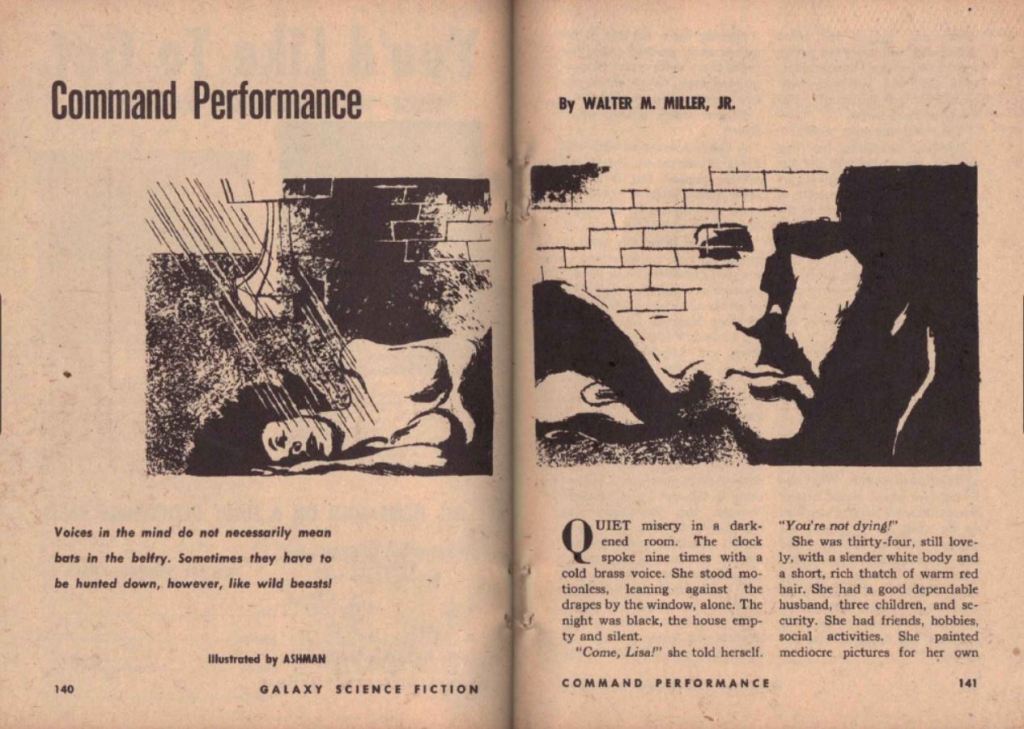
“Command Performance” by Walter M. Miller, Jr.

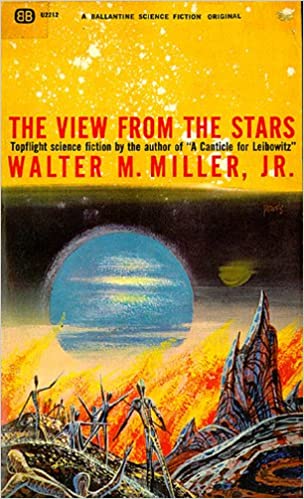
“Command Performance” by Walter M. Miller, Jr., was first published in Galaxy Science Fiction (November 1952) and was retitled in 1965 to “Anybody Else Like Me?” for Miller’s second collection The View from The Stars. This was my third reading of the story. Previously read in The Best Science-Fiction Stories: 1953 edited by Everett F. Bleiler and T. E. Dikty, and The Great Sf Stories 14 (1952) edited by Isaac Asimov and Martin H. Greenberg. I just listened to the story in The Best of Walter M. Miller, Jr. that was released on audio two weeks ago (June 2021).

Imagine you’re a science fiction writer and want to tell a story about a person who feels they are different from other people and one day they discover they’re a telepath when they finally meet someone like themselves. How would you plot such a story? I wouldn’t have done it like Walter M. Miller, Jr. did in “Command Performance,” and neither would you, but I was quite impressed with how he envisioned such an encounter playing out. Miller had an interesting take on how telepathy might work, and like many science fiction stories from the 1950s, it’s very psychological.

Most writers picture telepathy as people talking to each other without speaking aloud. Miller takes the concept much further. He has his characters, Lisa Waverly and Kenneth Grearly sharing thoughts, emotions, bodily sensations, fantasies, and inputs from all five senses. Much like that old saying about walking in someone else’s shoes.

I wish “Command Performance”/”Anybody Else Like Me?” was a novel instead of a short story, and Miller had worked out Lisa’s and Kenneth’s relationship at length. However, it appears Miller never finished a fully completed published novel. Miller’s most famous book, A Canticle for Leibowitz was a fix-up novel based on three previously published stories. ISFDB only lists one story in the novel section, “The Reluctant Traitor,” probably a novella, that appeared in the January 1952 issue of Amazing Stories. Saint Leibowitz and the Wild Horse Woman was a novel he almost completed before committing suicide, was finished by Terry Bisson, and published after his death.

According to ISFDB, Walter M. Miller, Jr. published 41 works of short fiction in the 1950s, and one in 1997, so evidently writing novels wasn’t his thing. I found this essay by Terry Bisson, “A CANTICLE FOR MILLER; or, How I Met Saint Leibowitz and the Wild Horse Woman but not Walter M. Miller, Jr.” to be quite interesting, revealing a few more tidbits about Miller. And now that I’m listening to The Best of Walter M. Miller, Jr. that just came out in audio, I’m finding each story makes me want to know more about Miller as a person. As Bisson points out, Miller did not want to meet people, and never even met his agent. That makes me even more curious about him.

I believe stories reveal details about their writers, even when writers desperately try to stay hidden. I’m only on the fourth story in this audiobook, and I’m guessing there will only be fourteen total if it’s based on the 1980 edition of the book of the same name. (Why haven’t his other stories been collected?)

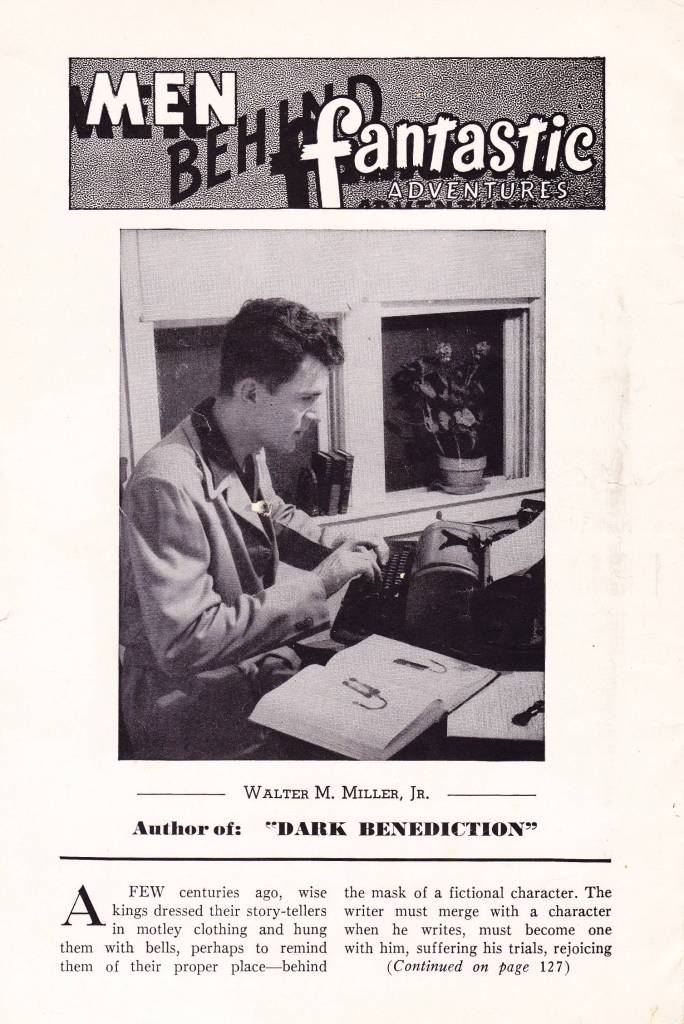
I can’t find much on Miller except his entries in Wikipedia and SF Encyclopedia. But at the beginning of his career, he wrote this profile about himself for the September 1951 issue of Fantastic Adventures:

I believe this provides us with a few additional clues. Miller became a recluse making himself enigmatic. I don’t think Miller was telepathic, but he might have felt himself different from other people. But as I listen to his stories I can’t help but wonder about the man who wrote them. They are a strange take on science fiction, focusing on humans, and less about aliens and spaceships. Miller seemed more interested in psychology, philosophy, religion and aspects about mundane life. One reason why I’m so fond of science fiction of the 1950s is because the characters were often ordinary, just ones who encountered the fantastic in strange little ways.

I’m really enjoying this collection and looking forward to hearing all 22 hours. I then hope to reread A Canticle for Leibowitz before trying Saint Leibowitz and the Wild Horse Woman.

James Wallace Harris, 7/8/21

Update:

A friend sent me a chapter from Better to Have Loved: The Life of Judith Merril by Judith Merril and Emily Pohl Weary where Merril recounts her affair with Walter M. Miller, Jr. while married to Frederik Pohl. It added many more puzzle pieces to my growing mental picture of Miller. I went to buy the book on Amazon and Amazon informed me I already had a copy. Now I need to read it.

Unfortunately, I don’t have a table of contents for the audiobook version of The Best of Walter M. Miller, Jr. but I’m hoping it’s the same as the 1980 hardback edition. That book seemed to combine the two previous paperback collections, Conditionally Human (1962) (3 novellas) and The View from the Future (1965) (9 stories and novelettes) and added two other stories for a total of 14. That leaves 27 stories uncollected. There were other collections of Miller’s stories, but they all seem to be reprinted from that same list of 14. Maybe they were all dogs, and not worth reprinting, but sometime I hope to read them too.

How The 21st Century Remembers Old Science Fiction Short Stories

I know the short story is an obscure art form on the wane, and the minority of readers who still enjoy reading short stories mostly read new ones as they come out in online periodicals, but I’m concerned with remembering the best science fiction short stories from the past. Old novels, movies, and television shows have massive support systems for being remembered and introduced to new potential fans. Have you ever seen a book 1,001 Short Stories to Read Before You Die? YouTube is overrun with YouTubers devoted to their favorite books, movies, albums, and television shows, but has YouTube every offered to show you one devoted to short stories? And how often do you see a Top 100 list of all-time best short stories on the web where they live and die by Top 100 lists? Or even the equivalent of the Billboard Hot 100 for current short fiction releases?

About the best a short story can hope for is getting anthologized, and even then, damn few anthologies stay in print. Anthologies that reprinted science fiction short stories were common on twirling book racks in the drugstores of the 1950s through the 1970s, but they’ve about disappeared today. Of course, the science fiction magazines that published the stories originally, have faded into obscurity only loved by the last 10,000 subscribers. The internet has brought about a renaissance of online publication of short stories, and that’s reflected in the annual awards which pretty much ignore the printed magazines nowadays.

Science fiction short stories published in periodicals go back at least two hundred years, and there are fans who still read them too, just not that many. And those fans are dying off. There’s barely enough storyworms to keep the memory of classic short SF alive. (Which probably explains why so few anthologies are for sale.)

Last night I read “The Country of the Kind” by Damon Knight for the fourth time this century. And it wasn’t because the mood struck me to read it again. I’m reading The Great SF Stories 18 (1956) (1988) edited by Isaac Asimov and Martin H. Greenberg and it’s included in that anthology. It was also included in The Science Fiction Hall of Fame Volume One (1970) edited by Robert Silverberg which I listened to when it came out on audio in 2017, and then listened to again when the book club I’m in read it last year. I first read The Science Fiction Hall of Fame anthology back in the 1970s when it came out. I also read “The Country of the Kind” recently in Science Fiction of the Fifties (1979) edited by Martin H. Greenberg and Joseph Orlander.

I have this self-imposed rule that I don’t skip short stories I’ve read before when reading anthologies. I’ve discovered it takes multiple readings to fully appreciate a short story. “The Country of the Kind” has gotten better on every rereading.

This got me to thinking. How do average science fiction fans stumbleupon old science fiction short stories to read? I figure it’s the same way I discover older SF short stories, by reading anthologies. But like I said, anthologies aren’t as common as they once were. How often do young science fiction fans buy a SF anthology? Or a collection? Do they even know the difference between an anthology and collection? Many people selling them on eBay don’t. The collection is a book of short stories by a single author, and I believe this is the most common way that bookworms still read short stories today. It’s when they decide to consume everything by their favorite author that they finally turn to the short story.

An anthology is a book of short stories by multiple authors. Most readers today see them as annual best-of-the-year volumes that collect the top short stories from the previous year. About every five years a large retrospective anthology comes out that presents the best of the genre’s past. I hardly ever see them anymore, but some theme anthologies reprint short stories with similar subjects are still being published. Baen used to do this, but I haven’t seen any in a while. One exciting new anthology that just came out is The Best of World SF: Volume 1 edited by Lavie Tidhar.

Yesterday I went looking for 21st-century anthologies that look back on science fiction of the 19th and 20th centuries. Here’s what I found currently in print. A few of these titles are aimed at the textbook market, reminding me that school reading is another way young readers encounter old SF stories.

Hyperlinks in the titles below are to the CSF database were you can see their table of contents by story in order by year published. That page also has additional links for more information about all the stories. If you don’t want to lose your place here, do a right-click and select Open in New Window, and then close that window after you’ve poked around.

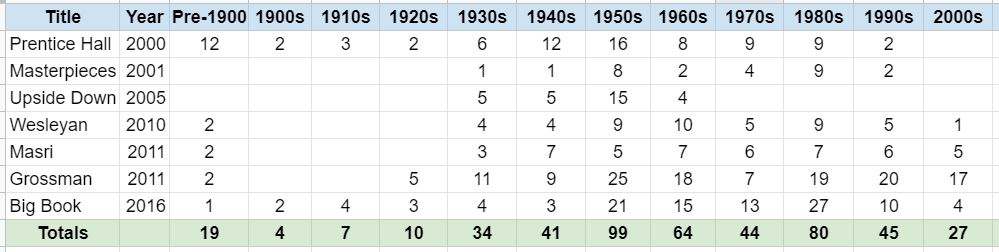
Here’s how these anthologies remember short stories by decades. Like I said, science fiction short stories have been around a very long time. But looking at the numbers below makes it look like something happened in the 1930s. Amazing Stories began in 1926, which some claim was the start of the genre, but others think it really began when John W. Campbell, Jr. became editor of Astounding Science-Fiction in the late 1930s. (See my essay “19th Century Science Fiction Short Stories” for an overview of a baker’s dozen of anthologies that remember that century.)

It’s interesting to see the distribution of stories by decades. Both The Prentice Hall Anthology of Science Fiction and The Big Book of Science Fiction have something from every decade. In terms of totals, the 1950s win, with the 1980s coming in second. The so-called Golden Age of the 1940s seems to be fading.

If you want to read some of the classics of SF anthologies, check out Mark R. Kelly’s Anthology page.

The Classics of Science Fiction Short Stories list, which is set to a minimum of 8 citations produces a list of 97 stories. It remembers stories from 1934-2010, which is a kind of a moving memory bubble. The entire database contains 4,554 stories from 1809-2010 with at least 1 citation. We currently believe that 7-8 citations represent a certain level of popularity or remembrance.

“The Country of the Kind” is reprinted in the Sense of Wonder (2011) anthology, so it’s still being remembered. Here’s the history of where it’s been anthologized since its original publication in 1956. The last major anthology it was in was The Very Best of Fantasy & Science Fiction, Volume 2 (2014) edited by Gordon Van Gelder.

If you’ve been paying attention, you’ll note “The Country of the Kind” gets reprinted every few years in an anthology. That’s how Damon Knight’s little classic stays alive. I doubt many young readers today read anthologies, so it’s probably just barely hanging on in our collective memory.

When I researched this story on Google, I did notice that several sites devoted to writing school papers offered an analysis of the story for a fee. Being taught in school is another way for a short story to survive. There are other ways. Getting made into a movie or TV show sometimes happens, but that mostly seems to happen to stories by Philip K. Dick. Several episodes of Love, Death & Robots were based on recently published SF stories. I’m also in a Facebook group that helps.

Speaking of reading science fiction short stories in school, I can tell from my stat pages that some are probably popular with teachers. I doubt that many Googlers would be searching on these stories unless they were forced to by a school assignment. Another indicator they are assigned reading is they get hits only during the school year.

It’s rather telling that “The Country of the Kind,” “The Veldt” by Ray Bradbury, and “The Ones Who Walk Away From Omelas” by Ursula K. Le Guin seem to be very popular in the classroom. And each of those stories deal with a particular incidence of violence. It’s almost as if controversial nastiness makes for teachability.

Finally, I’ve thought of one other new way that short stories are presented to help them be remembered: audiobooks. Both audiobook publishers and podcasters present audio productions short stories. For example, here’s one for “The Country of the Kind.” I noticed yesterday that Audible came out with The Best of Walter M. Miller, Jr. in June with over 20 hours of readings of Miller’s short stories. That made me very happy. Audible has some SF anthologies, but not many. The best way to find audio productions of short stories is to look for collections by your favorite author. For example, they have The Complete Short Stories by J. G. Ballard that runs over 63 hours, or five volumes of The Collected Short Stories of Philip K. Dick.

James Wallace Harris, 7/6/21

Why Did I Like This Story?

Have you ever spent time thinking about why you like a particular story, movie, television show, song, photograph, painting, etc.? I believe most of us assume the critical ingredient is in the artwork itself. What if that’s not altogether true? What if our admiration also depends on what’s inside ourselves too?

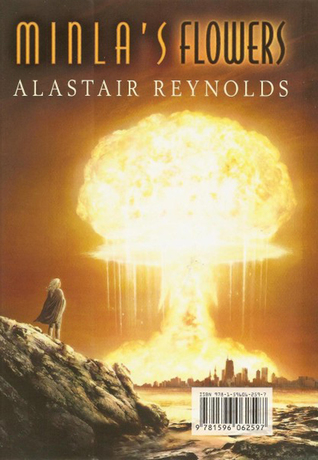
I just read “Minla’s Flowers” by Alastair Reynolds in The New Space Opera edited by Gardner Dozois and Jonathan Strahan. It was the eleventh story in the anthology and the first one that grabbed me. The other ten were well-told tales, but they just didn’t resonate with my Sci-Fi soul. And that’s a hint at what I’m talking about. “Minla’s Flowers” pushed my buttons, but which buttons, and where did they come from?

People turn to genealogy when they want to know how their body got here, but it doesn’t explain the programming that went into creating their personality. What if we use the Butterfly Effect to explain the lineage of our personality and show where all beliefs, opinions, likes, dislikes, prejudices, loves, hates, fears, etc. that went into making who we think we are. What if the Big Bang origin of all our traits can be traced back to specific triggers, whether huge emotional explosions or tiny seeds of inspiration? Can we ever trace specific emotions back to the first flutter of butterfly wings?

This theory started taking form a few years ago when I realized I didn’t enjoy modern science fiction short stories as much as I loved older SF stories. Had I changed, or science fiction? It’s been sixty years since I started reading SF. It seems obvious that both myself and the genre have changed, but have we? The macro aspects of my personality and the genre haven’t I don’t think. But how many micro details reveal any real change? Both are complex system not easily understood, so my Freudian-like analysis will only be guesswork.

One hypothesis I’ve considered deals with information density. I know a lot more in 2021 than I did in 1962, and so does science fiction. My mind reads with a greater density of relatable knowledge, and modern SF prose is often written with a greater density of information and science fictional speculation. Yet science fiction themes don’t seem to change over time. About the only new themes to emerge during my lifetime is digital worlds and brain downloading/uploading, and both probably had precursors if I researched it enough. Last night I watched the 2019 British miniseries of The War of the World, and then started rereading the novel. It only reminds me of how I’ve been seeing shadows of Wells my whole life.

When I grew up SF stories had basic plots that exposed ordinary humans to usually one far-out bit of speculation. Now SF stories are written with a Phil Spector-like Wall of Speculation approach, embedding the plot and far-from-ordinary-humans into narratives of greater information density, especially the New Space Opera stories about the far future.

First off, I didn’t feel “Minla’s Flowers” was a five-star story, but I did feel it deserved a solid four-stars, mainly because I knew I’d want to reread it someday. In fact, I’ve already reread parts of it to compose my comment for our reading group at Facebook. That’s when I realized something. I liked “Minla’s Flowers” because it reminded me of so many other science fiction stories. Here’s my comment to the group:

Alastair Reynolds begins "Minla's Flowers" with a lone adventurer, Merlin, and his AI spaceship, Tyrant, falling out of subspace, Waynet, to make repairs on a planet, Lecythus, only to discover it inhabited by humans who had colonized it thousands of years ago and are currently at war, where he befriends an old scientist, Malkoha, and his daughter Minla.

I have to say all this triggered memories of Flash Gordon/Buck Rogers, Dr. Zarkov/Dr. Huer, and Dale Arden/Wilma Deering. "Minla's Flowers" is the first story in this collection that feels like Old Space Opera, and it was a lot of fun.

I thought for sure Reynolds was going to arrange for Merlin and Minla to become lovers ala cold sleep (think THE DOOR INTO SUMMER), but that didn't happen. Minla became his rival, even the antagonist of the story. Eventually, the plot of "Minla's Flowers" turns into the plot of WHEN WORLDS COLLIDE, escaping a doomed planet by building a spacefaring nation in seventy years.

Since Merlin is needed for a future adventure by Reynolds, he undergoes a series of cold sleep timeouts, and only ages a few months during this story, while Minla reaches 80. That should remind me of several SF stories, but I can't recall any at the moment. (INTERSTELLAR?)

Reynolds extends this story time and again through philosophical and ethical issues of helping a civilization speed up its development. In this regard, Merlin's and Tyrant's roles remind me of Klaatu and Gort from the film THE DAY THE EARTH STOOD STILL.

Because Reynolds embeds so much of the science fiction mythos into his story it caused the science fiction region of my soul to resonate with it. I know I will reread this story in the future, and it might even resonate more, but for now...

Rating: ****

Science fiction speculates on a limited number of subjects. One of the reasons I didn’t enjoy many of the ten stories before this one in The New Space Opera is because they speculated about topics I either discount, or I believe are too overused. Many of the stories in this anthology assume in the far future humans will have colonized the galaxy, and we’ll share it with aliens, intelligent robots, androids that look like us, cyborgs, humans that have achieve immortality, posthumans, transhumans, and downloaded humans. Decades ago it was common to see one of these elements as the basis of a science fiction story, but now it seems science fiction writers assume they will all coexist in the future, and somehow they must all be mentioned whenever writing a story about the far future. Actually, I’d find it a reading thrill for a writer to challenge these assumptions. It’s why I loved Aurora by Kim Stanley Robinson.

New science fiction writers have to recycle old themes because developing new ones are next to impossible. And as a reader, at least for me, if I encounter too many stories using the same concepts, I get bored with them. I should probably avoid theme anthologies like The New Space Opera. Yet, I responded positively to “Minla’s Flowers” because it caused me to resonate with old SF I loved in adolescence. Freud was a big explorer of our subconscious mind, but did he ever suggest early sense of wonder experiences would create chimes in our personality that would ring in later years if we encounter similar wonders on the same wavelength?

Of course, I might need to be careful with line of self-analysis, or I might find out that everything I love and believe originated in old science fiction stories I first encountered in youth. I’ve often thought science fiction was my substitute for religion when it didn’t take when I was a kid.

“Minla’s Flowers” has one human, one AI spaceship, and an alien world populated by humans that colonized the planet so long ago they’ve forgotten how they got there. This simplicity of story elements reminds me of Old Space Opera. (Although Reynolds does keep trying to cram in even more science fictional elements I felt diluted the story.)

At the plot’s core, “Minla’s Flowers” is about a civilization that needs to flee its home planet to find a new world because their sun will be destroyed in seventy years. One of the first SF books I read with this theme was the omnibus When Worlds Collide and After Worlds Collide by by Edwin Balmer and Philip Wylie. Has that story I read at age twelve shaped my response to future fiction? All my life I’ve thought humanity should colonize space to protect itself from extinction. Did that too come from Balmer and Wylie? Thinking about it now, I’m not sure it’s a practical or realistic idea. We were evolved for living on Earth, and all our space exploring fantasies may just be that.

Merlin fits the archetype for the science fiction hero, as does his sidekick. Where Reynolds took his story in an anti-tradition was with Minla, and that also thrilled me too. Is the right mixture for entertaining new science fiction a good bit of the tried and true, with a touch of the contrary?

Fiction is still magical. I don’t know how it works its spells. But now that I’m much older, and have consumed vast quantities of the genre, I sense patterns that my unconscious mind likes. It’s almost as if my unconscious mind learns and evolves, and maybe even has its own logic. I’m old and tired, and have a difficult time finding stories I still love, but every once in a while, something clicks. It’s a weird unexplainable experience.

James Wallace Harris, 6/19/21

Is Science Fiction Just Fairy Tales?

When I first started reading science fiction, I thought it superior to ordinary fantasy because science fiction prepared readers for the future. I never believed science fiction predicted the future, but I did believe science fiction could seriously ponder future possibilities. To me, the best science fiction was philosophical, speculative, and extrapolated on current trends. Both the fixup novel The Dying Earth by Jack Vance and the anthology The New Space Opera edited by Gardner Dozois and Jonathan Strahan ponders the far future. But do their stories say anything serious about the future? Do any of their stories speak specifically to the adult mind? Or are they just fairy tales for grown up readers?

The Dying Earth is a collection of six related short works of fantasy that imagines life on Earth after the sun grows old, which is a wonderful science fictional concept. The stories are a cross between fantasies about magicians and science fiction about dying civilizations that barely remembers technology. In a vague way, its stories remind me of the stories in One Thousand and One Nights, but that’s because I just read “Ask Yourself Which Books You Truly Love” by Salman Rushdie in The New York Times. Rushdie was writing about our love of stories, especially the ones we first encounter as children. But I thought the Arabian Nights stories imagined when humanity and history were young, and the Jack Vance stories imagine humanity and history when old.

The Dying Earth contain these six stories:

  • “Turjan of Miir”
  • “Mazirian the Magician”
  • “T’sais”
  • “Liane the Wayfarer”
  • “Ulan Dhor”
  • “Guyal of Sfere”

The first three stories feel like Aesop, Homer or Grimm, simple fable or fairy tale in tone, while the later ones grow in sophistication feeling more like Dante or Chaucer. “Ulan Dhor” comes across the most like science fiction, but science fiction from the 1930s out of Weird Tales.

After “The Time Machine” by H. G. Wells, and The Night Land by William Hope Hodgson, other writers began expanding the end of time theme, but Vance got to name it with this book. Normally, I don’t like fantasy stories, but I did like The Dying Earth. This book was so successful that Vance wrote more stories about living under the dark red sun that were collected in three different volumes. I haven’t read them yet, but I bought Tales of the Dying Earth for the Kindle which puts all four into one book.

Normally, I avoid fantasy, preferring science fiction, but I started life as a bookworm with the Oz books by L. Frank Baum. If you only know Oz from the 1939 film, The Wizard of Oz, then you don’t know Oz. Not that the film isn’t wonderful, but it doesn’t convey the vastness of Baum’s fantasy worldbuilding. I’m not a scholar on children’s fantasy books, but is there any fictional world building before the 20th century that can compete with the Oz books?

I know pop culture has pretty much forgotten Baum’s fantasyland, but for children growing up in the early decades of the 1900s, the Oz books were as popular as the Harry Potter books are today. Many classic science fiction writers grew up reading Oz books, including Robert A. Heinlein, who referenced them in his later World as Myth novels.

I bring up the Oz books here because Baum’s basic plotting device is often used by fantasy and science fiction writers. It works like this. Introduce one or more normal characters, and maybe some exotic or magical characters. Give them a quest. Take the group from one strange location to the next, where they meet wonders and far out beings. Keep it up until you’ve filled a book’s worth of pages. Tie things up with a satisfying insight. Ringworld by Larry Niven is a great example of this, and so is some of the stories in The Dying Earth, especially “Ulan Dhor” and “Guyal of Sfere.” The later story even has an Oz like wizard that explains things at the end.

The Dying Earth theme is powerful because writers usually explore two visions: the end of man, and the end of Earth. Just to meditate on that idea generates a powerful sense of wonder. However, I don’t think Vance’s stories say any more about the future than One Thousand and One Nights says about the past. They are just fairy tales for grownups. Modern fantasy has vastly evolved past these stories in sophistication. I will keep reading in this series because I’ve been told Vance eventually gets more sophisticated too, but I wonder if he ever gets more adult.

I wonder if the 20th century trend of writing stories set in an ever-growing fantasyland might have begun with Baum? That kind of never-ending world building appeals to both children and adolescents, and has apparently seduced many an adult reader too, because it seems like all genre writers are churning out countless books in series. And doesn’t our hunger for story series and complex world building comes from our childhood love of fantasy series?

The Dying Earth as a theme keeps expanding with new writers and new readers. Science fiction writers and readers also love the Far Future as a similar setting for a theme, although the name for that theme seems to have become The New Space Opera. Fans of this theme don’t worry about the end of the Earth or humankind, because they believe humanity has plenty of places to go. And like Baum inventing endless fantasy beings for Oz, the New Space Opera writers have invented endless far out aliens, robots, AI, transhuman, and posthumans to populate stories using this theme.

But to be honest, I’m not that fond of the New Space Opera theme. Oh, the ideas they come up with have a wonderful sense of wonder, but these stories are often presented as hard science fiction, which imply their science fictional inventions could be possible, and I don’t believe that. The opening of “Glory” by Greg Egan is dazzling. It sounds so scientific yet I can’t believe it’s no more realistic than magic. It begins:

An ingot of metallic hydrogen gleamed in the starlight, a narrow cylinder half a meter long with a mass of about a kilogram. To the naked eye it was a dense, solid object, but its lattice of tiny nuclei immersed in an insubstantial fog of electrons was one part matter to two hundred trillion parts empty space. A short distance away was a second ingot, apparently identical to the first, but composed of antihydrogen.

A sequence of finely tuned gamma rays flooded into both cylinders. The protons that absorbed them in the first ingot spat out positrons and were transformed into neutrons, breaking their bonds to the electron cloud that glued them in place. In the second ingot, antiprotons became antineutrons.

A further sequence of pulses herded the neutrons together and forged them into clusters; the antineutrons were similarly rearranged. Both kinds of cluster were unstable, but in order to fall apart they first had to pass through a quantum state that would have strongly absorbed a component of the gamma rays constantly raining down on them.

Left to themselves, the probability of them being in this state would have increased rapidly, but each time they measurably failed to absorb the gamma rays, the probability fell back to zero. The quantum Zeno effect endlessly reset the clock, holding the decay in check.

The next series of pulses began shifting the clusters into the space that had separated the original ingots. First neutrons, then antineutrons, were sculpted together in alternating layers. Though the clusters were ultimately unstable, while they persisted they were inert, sequestering their constituents and preventing them from annihilating their counterparts. The end point of this process of nuclear sculpting was a sliver of compressed matter and antimatter, sandwiched together into a needle one micron wide.

The gamma ray lasers shut down, the Zeno effect withdrew its prohibitions. For the time it took a beam of light to cross a neutron, the needle sat motionless in space. Then it began to burn, and it began to move.

You can finish the whole story here.

The stories in The New Space Opera are exactly what I wanted to believe in growing up. I desperately wanted humanity to have all this potential. I knew I’d never live to see such successes in space, but I wanted to die confident that humanity would go on to achieve these wonders. Now that I’m approaching seventy, I realize my childhood dreams were wishful fantasies, no more realistic than the far-out promises of religion. Sure, we will explore space, but not like the epic super-science visions produced by the New Space Opera stories. We’re not going to transfer our minds into other bodies, whether biological or digital. We’re not going to build spaceships the size of Jupiter. We’re not going to have galaxy spanning civilizations. All those ideas are just fairy tales for adults.

However my problem with the New Space Opera stories is not that they imagine impossible futures, but how the stories are often told. Many of the stories in this anthology cram too many ideas into one plot. Their authors love to jam in so many speculative concepts that basic story gets crushed. Characterization and plotting take a back seat to worldbuilding. And it’s not that these writers are constantly infodumping ideas, but instead they throw out endless hints assuming readers can fill in the details mentally. Often those hints require cognitive decryption which for me distracts from the story. Sometimes stories combine a dozen science fictional concepts into one futuristic setting as if every science fictional speculation to date will come true. The cumulative effect is a goulash of cliché science fiction. That’s why when I got to Kage Baker’s “Maelstrom” it felt refreshingly different. Her speculation about colonizing Mars took a backseat to plot and character. That’s why I prefer Robert Reed’s “Good Mountain” to “Hatch,” his entry in the anthology.

I’m afraid too many of the stories in The New Space Opera depend too much on the big standard theories of current SF. I love science fiction for its ideas, but I also need a good story. Dense worldbuilding isn’t good enough for me. But hey, that might just be me. Maybe my aging brain can’t handle modern science fiction. Maybe that’s why I preferred Vance’s fantasy stories, even though I prefer science fiction over fantasy. Evidently, there’s something in how storytellers need to tell adult fairy tales that count.

Paul Fraser in our science fiction short story discussion group on Facebook makes a distinction between dense stories and story stories in modern SF fiction. I agree. I think the editor Gardner Dozois liked to promote dense stories, and we see that in The New Space Opera. Our group has seen dense stories popular in Asimov’s Science Fiction too. See their list of finalists for their 35th annual reader awards. One example of an overly dense story is Ray Nayler’s “Return to the Red Castle,” where he takes a simple plot of a woman wanting to help her old teacher, an android, recover her memory, by throwing in enough ideas for a half-dozen science fiction stories. I wanted the story to be more about Irem and Umut’s issues with memory, and less about the world building for the Istanbul Protectorate. But obviously, plenty of readers loved it just the way it is.

But whatever you prefer, dense or story, aren’t these stories still adult fairy tales? Isn’t the problem how the story is told rather than issues with the content? Is Little Red Riding Hood and her problems with the wolf any different in true age appeal than Irem’s problem with her android? I’m sure James Joyce and Proust’s novels are aimed at adult minds. But how much science fiction is truly adult in nature? And I’m not talking about X-rated content. If young children and young adults had the readings skills, wouldn’t they find most science fiction and fantasy fiction appealing? Can you name any science fiction novel that only appeals to a mature mind?

I wonder now if The Dying Earth and The New Space Opera stories aren’t aimed at the child in me. That I still read such stories because I never grew up. Or maybe, the wonders we imagined in childhood never leave us. As a ten year-old I wanted to live in Baum’s Oz. As a thirteen year-old I wanted to live on Heinlein’s Mars. It’s taking me sixty-nine years to accept the only place for humans is Earth, but I’m not sure if I will ever grow up and accept that. I have to wonder if I’ve never outgrown fairy tales.

James Wallace Harris, 6/3/21

Checklists for Reading Science Fiction Short Stories

We often see lists of best novels to read on the internet, but how many lists are there for reading short stories? Regarding science fiction, here are some of the major lists.

However, if you use our List Builder feature and click on Show Citations you can see which stories are on multiple lists. We haven’t added the sfadb list yet, but will. By using the year ranges, checking short story, and finding the right number of citations, you can easily see how these lists overlap. Unfortunately, you’ll also see the citations from other sources. Maybe we’ll program a way to limit by citation source type in the future. On the other hand, you’ll see how some stories are remembered by different kinds of citations: polls, awards, anthologies, scholars, etc.

Here is the List Builder set to 1939-2021 with 5 citations. That generates 863 stories. You can up the citation count to make the list shorter. Our v. 2 list uses 8 citations which reveals just 98 stories.

Reviewers of Short Science Fiction:

James Wallace Harris 3/21/21

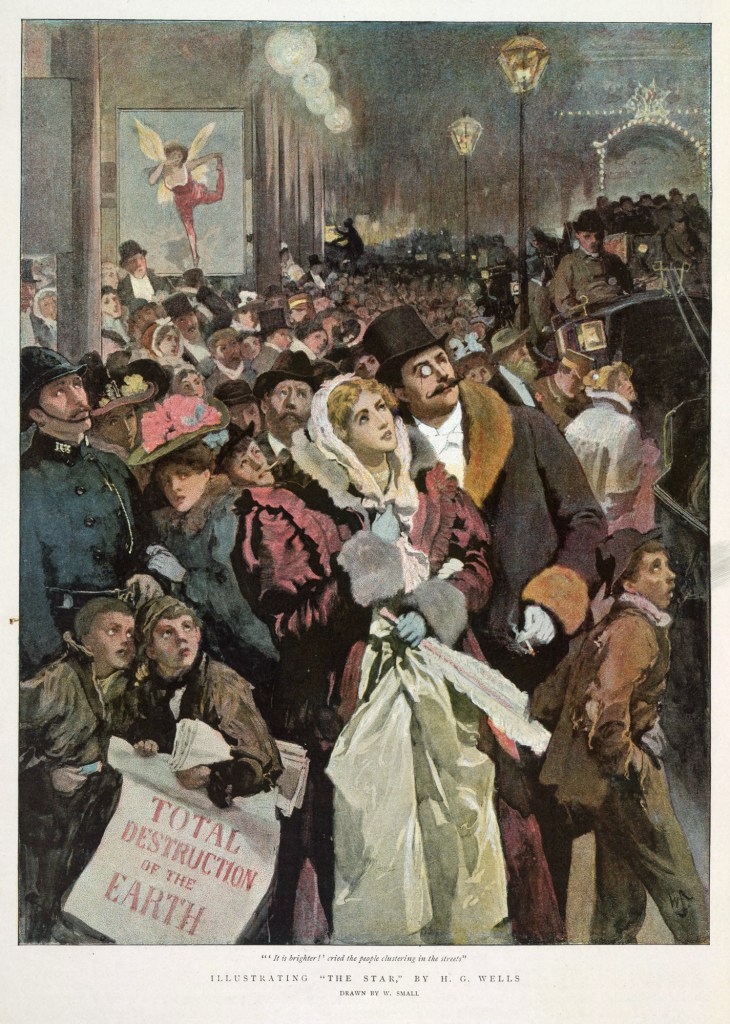
“The Star” by H. G. Wells

When I was young, reading science fiction thrilled me by giving me new ideas to ponder, ones I wasn’t getting from school. For example, when I was twelve, I read the When Worlds Collide/After Worlds Collide double decker by Edwin Balmer and Philip Wylie. It provided three new wonders to inflame my mind. First, planets from outside the solar system could fly through our interplanetary space and even collide with the Earth. Imagining the end of the world provides no end of chilling speculation. People have been entertaining that vision since the Great Flood. Second, I was introduced to the idea that people could escape the end of the world. Wow, what a concept! And third, what if we found a dead city that was once occupied by aliens? What would it be like to walk among their ruins and imagine their lives from the clues they left?

What’s remarkable about “The Star” by H. G. Wells, published in 1897, is its science fictional setup would work just as well today in 2021. The story describes people’s reactions from from around the world at that time, but the astronomical events and effects upon the Earth would be the same today. And I’m not sure people now would react much differently than they did then. What has changed is how the news is spread.

Nowadays I am fascinated by how science fiction short stories gain popularity and then fade from pop culture memory. They are usually remembered by anthologies. An editor of a good retrospective anthology knows the genre and tries to keep older stories alive. Every few years a new large retrospective anthology of short science fiction appears. Over time, the weakest older stories are left out of the latest anthology, and the best newer stories are added, revealing a kind of evolution.

Readers who buy genre retrospective anthologies are shown a kind of photograph of the history of short science fiction, with each new anthology trying capture the genre in a pose by how the editors want their readers to see its history. I’ve been dipping into The Big Book of Science Fiction edited by Jeff and Ann VanderMeer since it came out in 2016. Its oldest story is “The Star.” The Big Book of Science Fiction has nearly a hundred stories and I’ve read maybe a quarter of them. The VanderMeers worked to diversify the history of the genre by including more stories by women writers and translated stories by non-English speaking writers.

Their family portrait of science fiction looks somewhat different than Leigh Ronald Grossman’s group photo, Sense of Wonder, taken in 2011. Grossman’s oldest pick was “Mellonta Tauta” by Edgar Allan Poe from 1849. Grossman’s anthology is even larger than the VanderMeers’, but it includes a novel, novel extracts, and introductory essays. It’s meant to be a textbook for teaching the history of science fiction, but Grossman’s photo of the genre revealed a more traditional pose for the genre.

Right now, I’m less concerned the overall image of the genre’s legacy than I am with understanding the evolution of science fictional ideas. I’d love to create a taxonomy of science fictional ideas and themes. When Groff Conklin assembled his first retrospective anthology back in 1946, The Best of Science Fiction, he divided the stories into six theme sections. Over the decades many anthologists have created theme anthologies. But it’s impossible to grasp all the far-out ideas of science fiction in just one anthology, or even a shelf of them. So, I’m going to work my way through several large retrospective anthologies, take notes, and plot my findings. Maybe I can come up with some way of showing an evolutionary tree of science fictional ideas.

I’ve decided “The Star” was inspired by astronomy, so the first theme I’m going to work on is Astronomical Science Fiction. However, did H. G. Wells think up his idea? Had Wells read Omega: The Last Days of the World by French astronomer Camille Flammarion which came out in 1894? When did the English edition first appear? Wells could also have read Olga Romanoff or, The Syren of the Skies by George Griffith serialized in Pearson’s Weekly (12/30/1893 – 8/4/1894). Both these stories are impact event stories. And then we must ask where did Flammarion get his idea? Jules Verne wrote Off on a Comet in 1877 about a comet that gives the Earth a glancing blow. Wells was savvy enough to know his planet didn’t need to impact the Earth, but it’s gravitation influence coming near us could wreak havoc on our planet.

I want to develop a classification scheme, a taxonomy, or even a mind map of how science fiction ideas evolve. Earlier writers imagined a comet hitting the Earth. Wells imagined a planet from outside the solar system, which is a much newer idea if you think about it. People were aware of comets, but how many Earthlings imagined a planet visiting the solar system? Then in the 1930s Balmer and Wylie imagined two visiting planets. By the way, Wells interstellar visitor is called a star in the title, but referred to as a planet in the story. People see it as a star in the sky.

Once you start considering the theme, thinking about astronomy can inspire all kinds of science fictional ideas. Wells used astronomy again at the end of The Time Machine when he used the Sun expanding into a red giant, and the Earth slowing its rotation.

I wish I had a better memory than I do so I could recall all the science fiction stories that used astronomy as the inspiration of its science fiction. Fred Hoyle used it for The Black Cloud a story about a dust cloud blocking the sun. But sometimes its fanciful astronomy. Poul Anderson imagined the solar system orbiting the Milky Way in Brain Wave and wondered what if the solar system passes through different kinds of radiation fields. Now this is unbelievable but fun, but what if the solar system had been in a radiation field that retarded intelligence and it moved out of that field? In Brain Wave humans and all living things become a bit smarter. Even more fanciful is Robert Charles Wilson’s Spin, where he imagines the Earth encased in a spin membrane that slows time down. Of course, this moves outside the realm of Astronomical Science Fiction because the membrane was artificially created.

Getting back to real astronomy, consider the short story “Inconstant Moon” by Larry Niven from 1971. People notice the Moon is glowing strangely one night. Our narrator theorizes the Sun has gone nova and the world is about to be destroyed, but then figures a massive solar flare has occurred, which might be survivable. Notice how these Astronomical Science Fiction stories usually involve the destruction of the Earth.

Larry Niven and Jerry Pournelle returned to the comet impact in 1977 with Lucifer’s Hammer. Comet and asteroid strikes seem to be the most common inspiration on Astronomical Science Fiction. But here is a list created by Andrew Fraknoi in 2019 that lists more recent science fiction based on astronomy and physics. Wells or “The Star” wasn’t mentioned. That’s the problem with creating a SF theme taxonomy, it’s like the biological world there are millions of examples to be classified.

One interesting aspect of “The Star” (and When Worlds Collide) is it depends on astronomers to let the people of Earth know that something is about to happen. How often are astronomers the heroes of science fiction stories?

It was on the first day of the New Year that the announcement was made, almost simultaneously from three observatories, that the motion of the planet Neptune, the outermost of all the planets that wheel about the sun, had become very erratic. Ogilvy had already called attention to a suspected retardation in its velocity in December. Such a piece of news was scarcely calculated to interest a world the greater portion of whose inhabitants were unaware of the existence of the planet Neptune, nor outside the astronomical profession did the subsequent discovery of a faint remote speck of light in the region of the perturbed planet cause any very great excitement. Scientific people, however, found the intelligence remarkable enough, even before it became known that the new body was rapidly growing larger and brighter, that its motion was quite different from the orderly progress of the planets, and that the deflection of Neptune and its satellite was becoming now of an unprecedented kind.

Few people without a training in science can realise the huge isolation of the solar system. The sun with its specks of planets, its dust of planetoids, and its impalpable comets, swims in a vacant immensity that almost defeats the imagination. Beyond the orbit of Neptune there is space, vacant so far as human observation has penetrated, without warmth or light or sound, blank emptiness, for twenty million times a million miles. That is the smallest estimate of the distance to be traversed before the very nearest of the stars is attained. And, saving a few comets more unsubstantial than the thinnest flame, no matter had ever to human knowledge crossed this gulf of space, until early in the twentieth century this strange wanderer appeared. A vast mass of matter it was, bulky, heavy, rushing without warning out of the black mystery of the sky into the radiance of the sun. By the second day it was clearly visible to any decent instrument, as a speck with a barely sensible diameter, in the constellation Leo near Regulus. In a little while an opera glass could attain it.

At the end of the 19th century the common person did not have access to television or the internet. This news would have been spread by telegraph and newspapers. Also, I doubt many citizens of the world understood much about astronomy back then. Since we know so much about astronomy now, and science fictional concepts, so I would think a science fiction writer would have a hard time coming up with a good new concept to set off people’s sense of wonder.

H. G. Wells worked imagine in his story the discovery of the event on different minds around the world. I think that’s why new writers get to retell old stories. Many science fictional concepts are quite old, so it’s the current culture that changes in new stories, not the science fiction.

And when next it rose over Europe everywhere were crowds of watchers on hilly slopes, on house-roofs, in open spaces, staring eastward for the rising of the great new star. It rose with a white glow in front of it, like the glare of a white fire, and those who had seen it come into existence the night before cried out at the sight of it. "It is larger," they cried. "It is brighter!" And, indeed the moon a quarter full and sinking in the west was in its apparent size beyond comparison, but scarcely in all its breadth had it as much brightness now as the little circle of the strange new star.

"It is brighter!" cried the people clustering in the streets. But in the dim observatories the watchers held their breath and peered at one another it is nearer," they said. "Nearer!"

And voice after voice repeated, "It is nearer," and the clicking telegraph took that up, and it trembled along telephone wires, and in a thousand cities grimy compositors fingered the type. "It is nearer." Men writing in offices, struck with a strange realisation, flung down their pens, men talking in a thousand places suddenly came upon a grotesque possibility in those words, "It is nearer." It hurried along wakening streets, it was shouted down the frost-stilled ways of quiet villages; men who had read these things from the throbbing tape stood in yellow-lit doorways shouting the news to the passersby. "It is nearer." Pretty women, flushed and glittering, heard the news told jestingly between the dances, and feigned an intelligent interest they did not feel. "Nearer! Indeed. How curious! How very, very clever people must be to find out things like that!"

Lonely tramps faring through the wintry night murmured those words to comfort themselves--looking skyward. "It has need to be nearer, for the night's as cold as charity. Don't seem much warmth from it if it is nearer, all the same."

"What is a new star to me?" cried the weeping woman kneeling beside her dead.

The schoolboy, rising early for his examination work, puzzled it out for himself--with the great white star shining broad and bright through the frost-flowers of his window. "Centrifugal, centripetal," he said, with his chin on his fist. "Stop a planet in its flight, rob it of its centrifugal force, what then? Centripetal has it, and down it falls into the sun! And this--!

"Do we come in the way? I wonder--"

The light of that day went the way of its brethren, and with the later watches of the frosty darkness rose the strange star again. And it was now so bright that the waxing moon seemed but a pale yellow ghost of itself, hanging huge in the sunset. In a South African City a great man had married, and the streets were alight to welcome his return with his bride. "Even the skies have illuminated," said the flatterer. Under Capricorn, two negro lovers, daring the wild beasts and evil spirits, for love of one another, crouched together in a cane brake where the fire-flies hovered. "That is our star," they whispered, and felt strangely comforted by the sweet brilliance of its light.

The master mathematician sat in his private room and pushed the papers from him. His calculations were already finished. In a small white phial there still remained a little of the drug that had kept him awake and active for four long nights. Each day, serene, explicit, patient as ever, he had given his lecture to his students, and then had come back at once to this momentous calculation. His face was grave, a little drawn and hectic from his drugged activity. For some time he seemed lost in thought. Then he went to the window, and the blind went up with a click. Half way up the sky, over the clustering roofs, chimneys and steeples of the city, hung the star.

I would think in my taxonomy of science fiction for this theme I’d have to also classify the state of the world that received the story. Yet, isn’t the possibility of a roving body visiting out system still possible? Isn’t that why new SF writers in every generation can retell the story? Just research all the speculation the first known real interstellar visitor named Oumuamua caused? It reminded me of Clarke’s Rendezvous with Rama.

James Wallace Harris, 3/19/21
“The Man Who Lost the Sea” by Theodore Sturgeon

My job is to get you to read stories if you haven't. I'll try to make it easy for you by linking to a copy on the web if the story is available. I'll also tell you about anthologies where you can find the story. Then I'll start talking about the story. At first I'll be vague so as not to spoil the story, but hopefully intriguing enough to get to you to go read the story before continuing. As I progress I'll give more and more away.

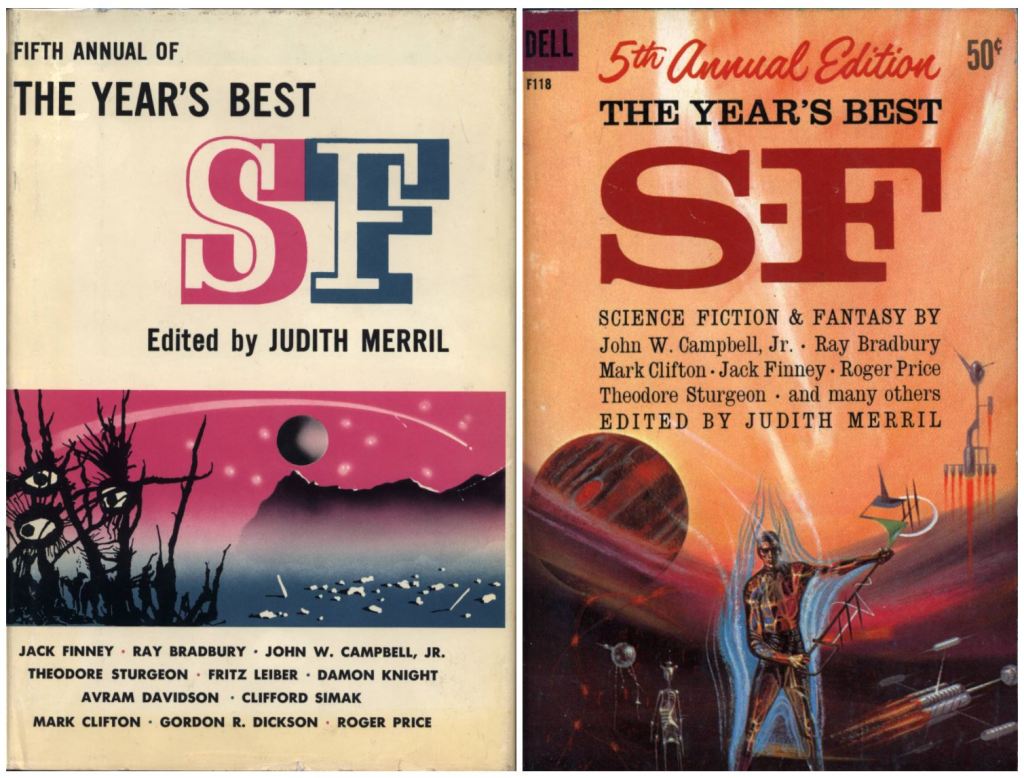
“The Man Who Lost the Sea” is a magnificent work of second person prose that is as confusing as a pile of jigsaw puzzle pieces without the box. As you read the story the picture is revealed with the placement of the last piece. “The Man Who Lost the Sea” was first published in October 1959 issue of The Magazine of Fantasy and Science Fiction. It was reprinted in Best American Short Stories 1960, The Best from Fantasy and Science Fiction (Ninth Series, 1960), and Judith Merril’s annual anthology,The Fifth Annual of the Year’s Best SF (1960) where I just read it. It was up for a Hugo in 1960 but lost to “Flowers for Algernon” by Daniel Keyes, but wouldn’t any story lose to that story? “The Man Who Lost the Sea” is currently available to read online at Strange Horizons. Or jump over to Escape Pod to listen to the story.

I’ll illustrate how admired this story is by showing you some of the retrospective anthologies it’s been reprinted in over the years:

  • 1968 – Towards Infinity edited by Damon Knight
  • 1969 – First Step Outward edited by Robert Hoskins
  • 1977 – Alpha 8 edited by Robert Silverberg
  • 1983 – The Arbor House Treasury of Science Fiction Masterpieces edited by Robert Silverberg and Martin H. Greenberg
  • 1989 – The World Treasury of Science Fiction edited by David G. Hartwell
  • 1990 – The Great SF Stories 21 (1959) edited by Isaac Asimov and Martin H. Greenberg
  • 1997 – A Century of Science Fiction (1950-1959) edited by Robert Silverberg
  • 2005 – My Favorite Science Fiction Story edited by Martin H. Greenberg
  • 2016 – The Big Book of Science Fiction edited by Ann and Jeff VanderMeer

I’m feeling guilty about not having read “The Men Who Lost the Sea” before now. How could I have missed it? To be honest, I’m not sure my younger self could have appreciated the story. The second person prose involving nonlinear events would have been difficult for my speed-reading younger self to comprehend. Just read the first paragraph:

Say you're a kid, and one dark night you're running along the cold sand with this helicopter in your hand, saying very fast witchy-witchy-witchy. You pass the sick man and he wants you to shove off with that thing. Maybe he thinks you're too old to play with toys. So you squat next to him in the sand and tell him it isn't a toy, it's a model. You tell him look here, here's something most people don't know about helicopters. You take a blade of the rotor in your fingers and show him how it can move in the hub, up and down a little, back and forth a little, and twist a little, to change pitch. You start to tell him how this flexibility does away with the gyroscopic effect, but he won't listen. He doesn't want to think about flying, about helicopters, or about you, and he most especially does not want explanations about anything by anybody. Not now. Now, he wants to think about the sea. So you go away.

What the hell is going on? Where are we? Who is the narrator? Sturgeon gives us the first clues in the second paragraph:

The sick man is buried in the cold sand with only his head and his left arm showing. He is dressed in a pressure suit and looks like a man from Mars. Built into his left sleeve is a combination time-piece and pressure gauge, the gauge with a luminous blue indicator which makes no sense, the clock hands luminous red. He can hear the pounding of surf and the soft swift pulse of his pumps. One time long ago when he was swimming he went too deep and stayed down too long and came up too fast, and when he came to it was like this: they said, "Don't move, boy. You've got the bends. Don't even try to move." He had tried anyway. It hurt. So now, this time, he lies in the sand without moving, without trying.

What can you say about this story so far? Later on when Sturgeon tries to give us more concrete clues can we really put them together yet?

Out and out the sick man forces his view, etching all he sees with a meticulous intensity, as if it might be his charge, one day, to duplicate all this. To his left is only starlit sea, windless. In front of him across the valley, rounded hills with dim white epaulettes of light. To his right, the jutting corner of the black wall against which his helmet rests. (He thinks the distant moundings of nausea becalmed, but he will not look yet.) So he scans the sky, black and bright, calling Sirius, calling Pleiades, Polaris, Ursa Minor, calling that . . . that . . . Why, it moves. Watch it: yes, it moves! It is a fleck of light, seeming to be wrinkled, fissured, rather like a chip of boiled cauliflower in the sky. (Of course, he knows better than to trust his own eyes just now.) But that movement . . .

Maybe it helps when Sturgeon lets us know the man is thinking about the past:

As a child he had stood on cold sand in a frosty Cape Cod evening, watching Sputnik's steady spark rise out of the haze (madly, dawning a little north of west); and after that he had sleeplessly wound special coils for his receiver, risked his life restringing high antennas, all for the brief capture of an unreadable tweetle-eep-tweetle in his earphones from Vanguard, Explorer, Lunik, Discoverer, Mercury. He knew them all (well, some people collect match-covers, stamps) and he knew especially that unmistakable steady sliding in the sky.

By now you should realize this story takes place in the guy’s head, but you still aren’t sure where the guy is or the identity of the annoying boy.

Have I gotten you interested? Have you gone back to the top of the page and followed the link to read the story? If not, let me give you a few more tantalizing clue. Have you read “An Occurrence at Owl Creek Bridge” by Ambrose Bierce – another often reprinted short story? “The Man Who Lost the Sea” belongs to very special tiny subgenre of fiction, one that has deeply personal significance to me, see my essay “Did The First Movie You Ever See Haunt You For The Rest Of Your Life?” about the novel High Barbaree by Charles Nordhoff and James Norman Hall. You probably don’t know these guys but they wrote The Mutiny on the Bounty. Or, have you ever seen the ending to the 1966 movie Seconds with Rock Hudson?

Jeez, if I haven’t hooked you by now I give up. I’ve always been fascinated about the nature of memory and consciousness. I love this Theodore Sturgeon because he explores those concepts in one impactful story.

James Wallace Harris, 3/16/21

Surviving Childhood By Reading Science Fiction

I love when I discover a short story that pushes all my buttons. I regret that I didn’t discover such wonderful tales when they were first published, but I do have the consolation as an old jaded reader of finding a story that still thrills me. “The Island of Doctor Death and Other Stories” by Gene Wolfe is one such story that I just read. It’s about a boy, Tackman Babcock, who survives a troubled “family life” by reading science fiction. Since I survived my bumpy upbringing by reading science fiction, I immediately bonded with Tackie.

I know, it has a confusing title. I’ve seen it collected in anthologies for years, and it always sounds like a collection of short stories by the author. When Gene Wolfe created his first short story collection the title became The Island of Doctor Death and Other Stories and Other Stories, as you can see above in the first edition, a 1980 paperback from Pocket Books. The 1997 edition is still available from Amazon. The original story, “The Island of Doctor Death and Other Stories” was first published in Orbit 7 (1970) edited by Damon Knight has been reprinted many times, so you might already own a copy. However, if you just want to quickly enjoy the story right now, it’s available online for free as an audio podcast from PodCastle, episode 171. Just click and take forty-five minutes to hear the story, it has wonderful narration.

Maybe now you’ll understand the confusing title, but you’re probably wondering what book Tackie was reading? If you’d like to read speculation about possible books read the entry for this story at a wiki devoted to Gene Wolfe. I tend to think Wolfe was trying to capture the feel of many novels, stories, and famous characters so readers would imagine the ones they have read. I definitely thought of The Island of Doctor Moreau by H. G. Wells, but I also thought of famous pulp stories, horror films, and cliff-hanging serials.

Wait, you didn’t go listen to the story? Or read it? Or remember reading it, and now you’re confused?

Tackie Babcock lives with his drug addicted mother in an old resort hotel. He isn’t supervised or well cared for, but his mother’s predatory boyfriend Jason, and a couple of aunts (May and Julie) keep an indifferent eye on him. We learn about Tackie’s inner life when Jason steals a paperback book that Tackie asked him to buy. The book has a lurid cover of a muscle bound man in rags battling a horrible half ape-half human creature. For the rest of the story, reality is interrupted by flashes from this novel. Captain Phillip Ransom adrift at sea for nine days arrives at a mysterious island and his captured by the mad Dr. Death, and his experimental creations. Eventually, we learn about other characters from Tackie’s real and imaginary world, including a beautiful native girl, Talar of the Long Eyes that Cpt. Ransom rescues from a fate worse than death. As the story progresses fiction and reality mix, so do who is good and who is bad.

If that doesn’t get you hooked, I don’t know what will. My parents were alcoholics, and we moved around a lot. From the time I started reading science fiction in the 5th grade until graduating, I attended nine different schools in three states. I forgot how many houses I lived in during that period, and I forgot how many times my parents split up. I’ve also forgotten how many drunken parental brawls I had to watch and hear, or how many times I was chauffeured around by drunk drivers. I survived all of that, and remember them as good times because I read science fiction. Without science fiction I’m not sure I would have had a happy childhood. I felt like Robert A. Heinlein was my father figure, Samuel R. Delany was my big brother, and Robert Sheckley was my crazy uncle.

I completely identified with Tackie Babcock. I wish I had read his story in 1970, but I’m thankful I finally found it in 2021.

James Wallace Harris, 3/5/21

p.s. Many of Gene Wolfe’s books including this one are available through Scribd.com, a subscription library. I mention it because I hope Scribd gets enough subscribers to survive. Think of it as Netflix for ebooks and audiobooks.

“The Colonists” by Raymond F. Jones

Raymond F. Jones has now hit two homers for me this week, with “The Colonists” flying out of the park. I was quite impressed with “The Memory of Mars” which I wrote about recently but I can’t decide if it’s a 4-star or 5-star story. I’d definitely give “The Colonists” a full 5-stars. The story is sophisticated in plot and science fictional speculation and is quite dramatic. I can’t understand why it isn’t a more famous science fiction story. Why didn’t Bleiler and Dikty or Asimov and Greenberg anthologize these stories in their best of the year annuals? Why haven’t they been anthologized is some of the big retrospective anthologies?

“The Colonists” was first published in the June 1954 issue of If. Follow the link to read it in a scan of the original magazine. Or you can read it various formats from Project Gutenberg. However, I highly recommend the excellent audio narrated version at YouTube.

I don’t want to say much about the story because I don’t want to spoil its surprises. The story examines the psychology of colonists immigrating to another world. Why would anyone give up everything on Earth to go live so far away? For a 1954 science fiction story, it considers the reality of space travel far more realistically than most of its peers.

Maybe this story impressed me because as a teenager I would have given anything to become a colonist on Mars. The idea of building a completely new society on the red planet was the most creative endeavor I could imagine for mankind. However, Jones suggests that most colonists in history were running away from something, and I have to admit that would have been true of my adolescent self.

I was also impressed with the complicated plotting in “The Colonists.” Jones does a great job, and I think this story would make an excellent film. It’s a novelette, and one hour and thirty-five minutes on audio, making it film length.

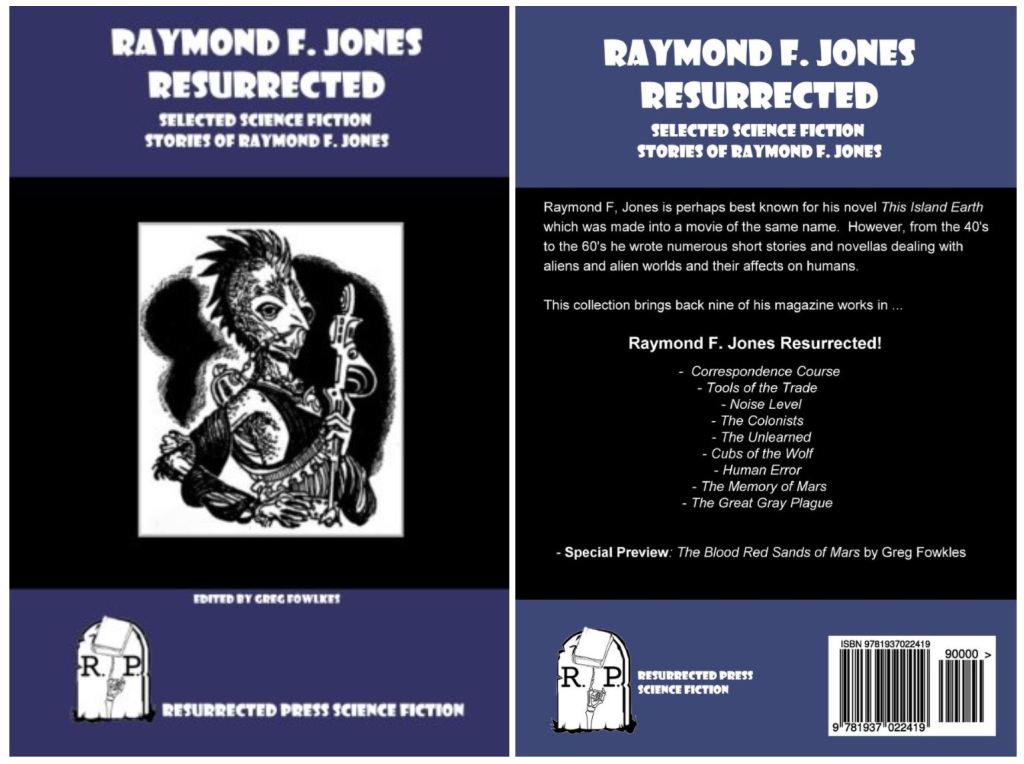
I wonder why Raymond F. Jones never made it big in the genre, or why he’s a mostly a forgotten SF writer? He gets a small write-up in Wikipedia that shows he was a prolific short story writer, but he did produce at least a dozen novels. I’m now anxious to read more of his work. I bought RAYMOND F. JONES RESURRECTED: SELECTED SCIENCE FICTION STORIES OF RAYMOND F. JONES after reading “The Memory of Mars.” (Kindle for $3.99 or paperback for $15.99)

ISFDB reveals I also need to track down two of his out-of-print collections, The Toymaker (1951), that collects stories from the 1940s, and The Non-Statistical Man (1964), that gathers stories from the 1950s. I have no idea if I’ll like those stories as much as the two I read this week.

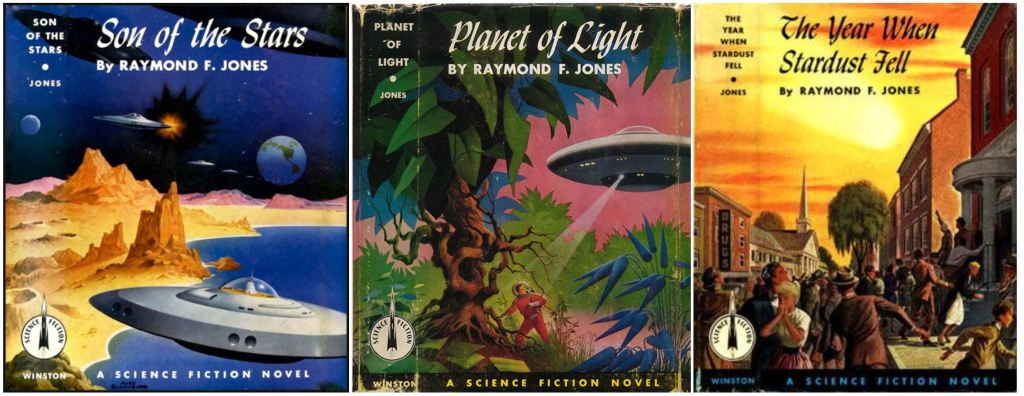
I do remember discovering Raymond F. Jones before, back in the 1960s when I was a young teenager reading all the Heinlein and Winston Science Fiction novels marketed for juveniles. Heinlein was tops, but Jones made a very good impression. I reread Son of the Stars and The Year When Stardust Fell last year. They were both fun, but not great. They didn’t jump out at me like “The Memory of Mars” and “The Colonists” did this week. I have no understanding of my critical judgement. Did I get excited about these stories because they’re actually good, the kind of good that other readers would recognize too, or was I just in the right mood for them at this moment in my life?

James Wallace Harris, 2/6/21

The Year’s Best S-F: 5th Annual Edition edited by Judith Merril

Our Facebook group is scheduled to read The Year’s Best S-F: 5th Annual Edition edited by Judith Merril in February and March. This presents a kind of scavenger hunt to find the stories because most of the members do not have a copy of this 1960 book. Probably out of the 400 members only a handful have a copy. Luckily we have ISFDB.org to tell us where these stories from 1959 and 1960 were originally published and reprinted (click on title).

It annoys me that Merril didn’t stay within the 1959 boundary and included four stories from 1960. That makes it hard to compare this best-of-the-year anthology against others – although in 1959-1960 Merril was the sole contemporary annual anthologist. But in 1990 Isaac Asimov and Martin H. Greenberg revisited 1959 in their anthology The Great SF Stories 21 (1959), which included these stories (I’ve bolded stories that Merril also picked):

I can’t believe Asimov and Greenberg left out “Flowers for Algernon.” In the 1960 volume Asimov and Green also chose Merril’s picks “Mariana” by Fritz Leiber and “The Handler” by Damon Knight. That means nine Merril stories overlap with Asimov/Greenberg out of nineteen in her 5th annual edition.

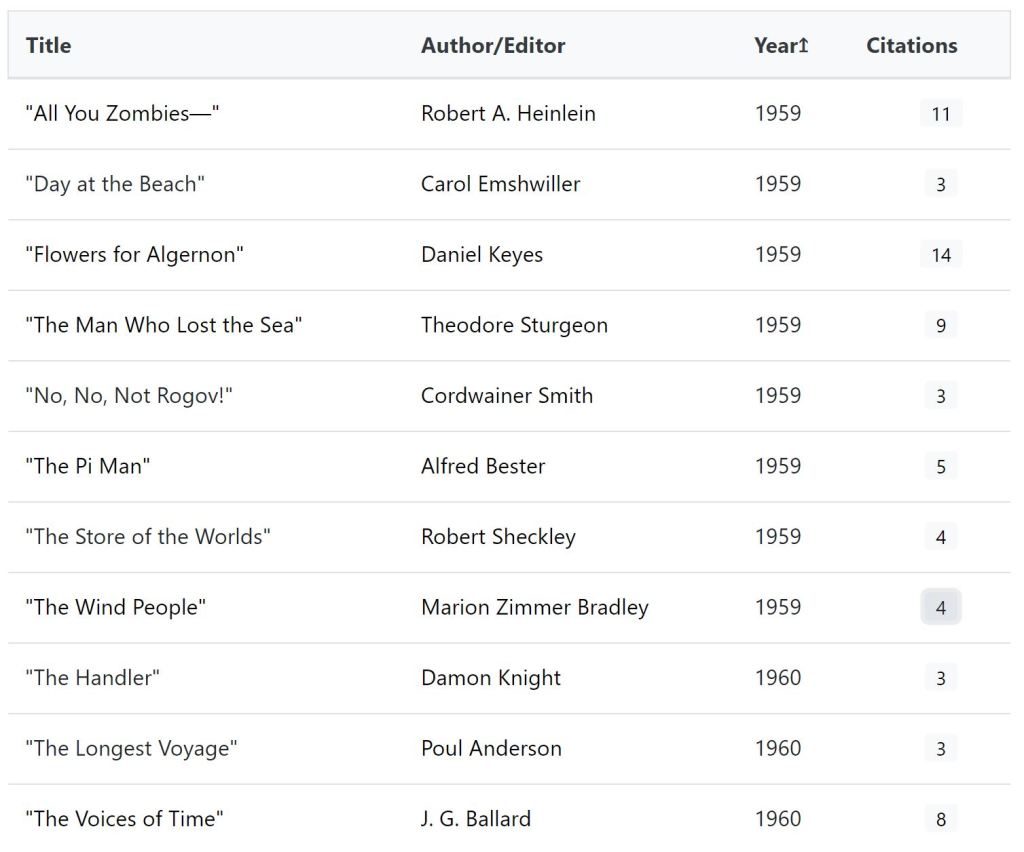
Our Classics of Science Fiction database showed these stories for 1959-1960 with three or more citations:

Both anthologies missed “All You Zombies—” but then Heinlein is notoriously absent in a lot of anthologies. I assume it was too expensive to reprint his stories.

The 1960 Hugo Award nominations for short fiction from 1959 were:

  • “Flowers for Algernon” by Daniel Keyes [F&SF Apr 1959] – winner
  • “The Alley Man” by Philip José Farmer [F&SF Jun 1959]
  • “The Pi Man” by Alfred Bester [F&SF Oct 1959]
  • “The Man Who Lost the Sea” by Theodore Sturgeon [F&SF Oct 1959]
  • “Cat and Mouse” by Ralph Williams [Astounding Jun 1959]

None of Merril’s 1960 stories were nominated for the Hugo, but Poul Anderson’s “The Longest Voyage” from 1960 was the winner in 1961. “Flowers for Algernon,” “All You Zombies—,” “The Man Who Lost the Sea,” and “The Pi Man” were in the The Best from Fantasy and Science Fiction: Ninth Series for 1959 stories, and it should be considered another good source of 1959 SF short stories.

James Wallace Harris, 2/6/21