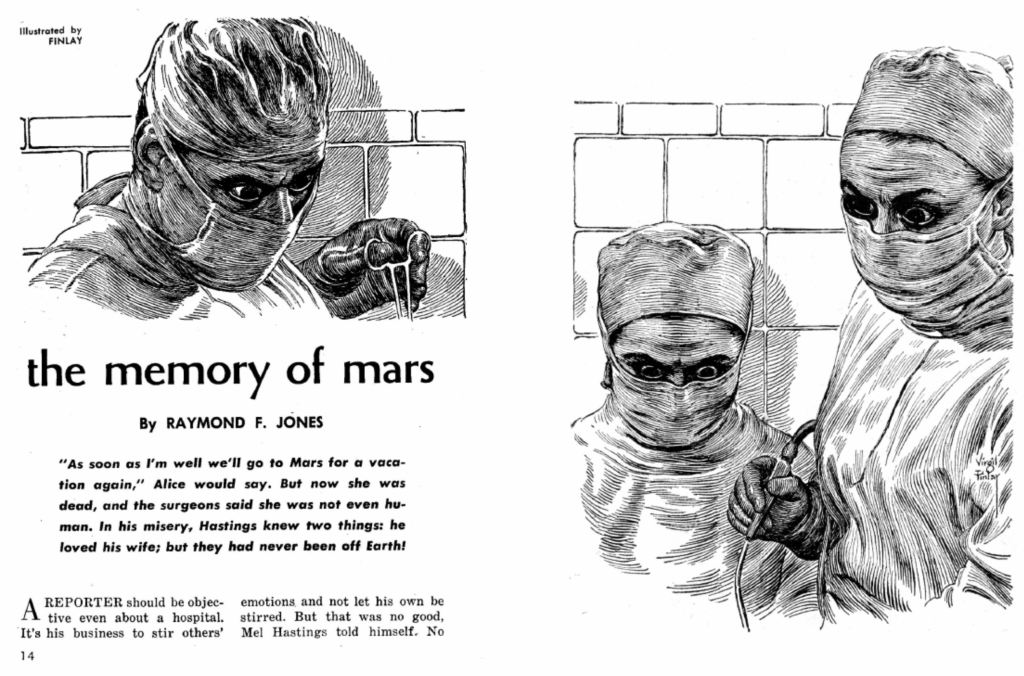
“The Memory of Mars” by Raymond F. Jones

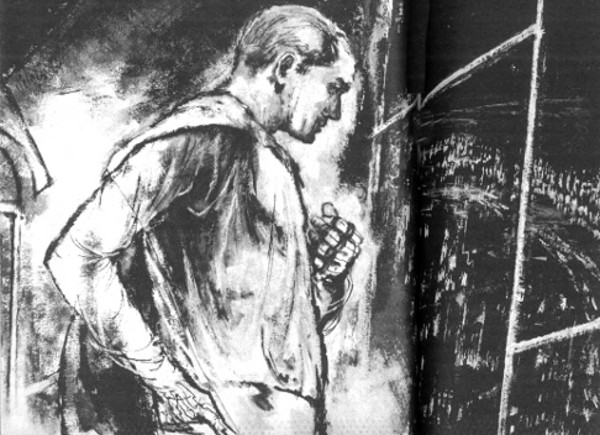
I love a gripping story that makes me anxious to find out what happens next. As soon as I started listening to “The Memory of Mars” by Raymond F. Jones I knew I was hooked. Mel Hastings, a reporter, is waiting to hear about his wife’s operation. But what was troubling him was what his wife Alice said before going into surgery: “As soon as I’m well again we’ll go to Mars for a vacation again, and then you’ll remember. It’s so beautiful there. We had so much fun—”

Mel Hastings knew they had never been to Mars. Mel’s mystery became my mystery, and I knew this story was going to be a ripping good yarn. But I also thought the story sounded like the beginning of “We Can Remember It For You Wholesale” by Philip K. Dick, a much more famous science fiction story from 1966, and known today by the title of the two movies that were based on it, Total Recall.

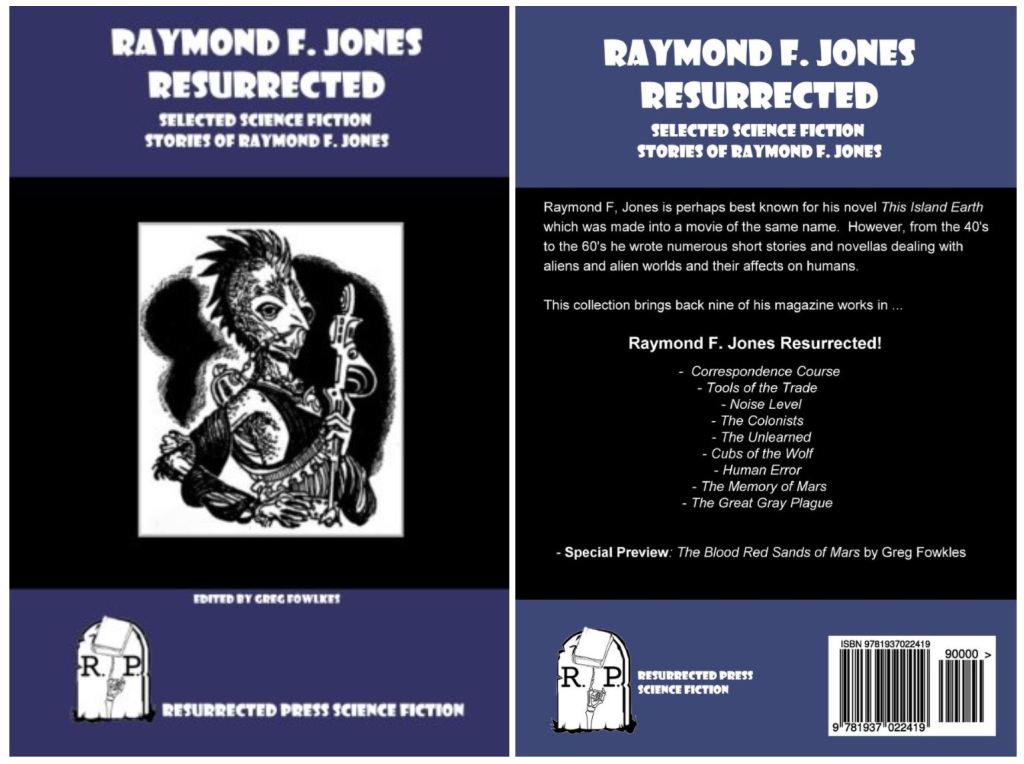
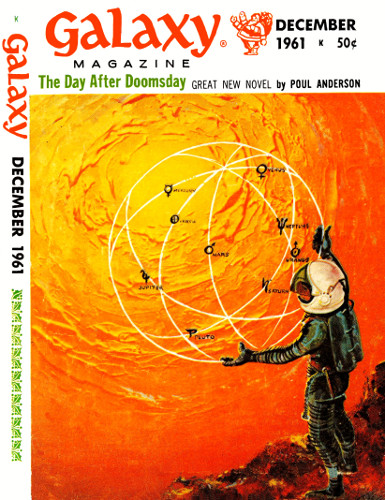
Before we go any further you might like to stop and read “The Memory of Mars.” It’s available in a scan of the original issue of Amazing Stories from December 1961. Or you can read it online at Project Gutenberg. But I recommend listening to this excellent audio production at YouTube. Or you can buy Raymond F. Jones Resurrected: Selected Science Fiction Stories of Raymond F. Jones for the Kindle for $3.99 or paperback for $15.99 which I did because I wanted to read more of his stories.

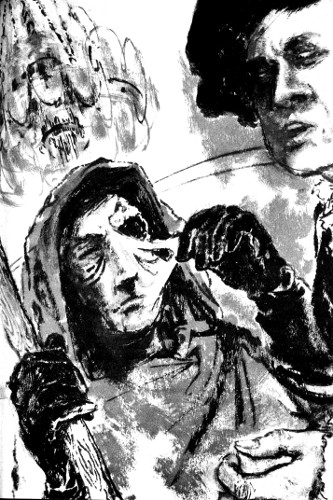
The mystery deepens when the surgeon tells Mel his wife has died and that she wasn’t human. Her internal organs were all different. Because Mel is a reporter he starts investigating his wife and was able to prove she was human until very recently with other medical records. Then he finds photos of Alice on Mars and souvenirs from a Martian vacation. Now, doesn’t that remind you of the PKD story? But it gets even more like “We Can Remember It For You Wholesale.”

Mel decides he must go to Mars to find out what happens but he has a deep phobia against space travel. He then goes to a medical specialist to erase that phobia and they discover Mel had gone on vacation to Mars with Alice. Now this is getting eerily like the PKD story. Could Dick have been inspired by “The Memory of Mars” to write his tale?

Mel Hastings has quite an adventure solving these mysteries with even more similarities to the PKD story. But I hope you’ll read “The Memory of Mars” to find out what happens.

I love finding old SF stories that are forgotten but still deserve to be read. “The Memory of Mars” was never reprinted in an anthology, and in only in one collection of stories by Raymond F. Jones mention above. You can see its reprint history here.

Raymond F. Jones had marginal success as a SF writer back in the 1940s, 1950s, and 1960s. His biggest claim to fame was the film This Island Earth based off his fix-up novel of the same title. I became acquainted with his work as a kid reading his young adult novels for the Winston Science Fiction series (Son of the Stars, Planet of Light, The Year When Stardust Fell). I definitely need to read more of his work.

James Wallace Harris, 2/6/21

Wishes Inspired After Reading 400+ Short Stories in 2020

Besides all the anthologies pictured above I read parts of several other anthologies, many short stories from old and new magazines, and many stories off the internet. But this is nothing compared to what professional editors and anthologists read each year.

This experience has transformed the way I perceive and understand short fiction. There seems to be endless ways to construct a short story and just as many ways to give voice to the narrator(s). And although there seems to be a finite number of themes that science fiction explores there seems to be infinite ways of expressing them.

I’m in a short story reading group on Facebook with over three hundred members, and there is no consistent reaction to stories. One reader can claim a story changed their life while another reader will tell us the story is unreadable. Are stories completely subjective, or do some achieve some kind of artistic objectiveness?

All my short story reading has inspired a number of wishes. I know, I’m always wishing for something. Even if I can’t have my wishes come true, I do love formulating them carefully.

  1. I wish I could remember my favorite stories. After reading over 400 stories this year, and a 1,000 in the past three years wouldn’t it be great if I could tell you which ones I loved best? I can’t. All following wishes stem from this first wish.
  2. I wish I had the discipline of keeping a log of everything I read with comments and annotations. It would be an external memory. I know a number of people who do this and it really seems to pays off. However, such effort does require more discipline than I can muster. Can you imagine logging and summarizing 1,000 stories?
  3. I wish I could assemble my own anthologies of favorite stories if I can’t remember them or keep track of them. Unloved stories really aren’t worth remembering, are they? I’ve thought of photocopying my favorite stories and keeping them in a binder, folder, or box. That way I could could reread them easily, or sort them into different orderings – by themes, chronologies, or types. I also imagine myself scanning stories and saving them in CBR/PDF/Kindle collections, but I believe I would prefer holding physical copies.
  4. I wish I could read and write about stories in such a way that I get more out of them. I believe one reading only gets me 20-25% of what the author intended. Multiple readings and writing essays gets me more of what’s there. I doubt I’ll ever achieve 100% reading efficiency, but I could become more proficient than I am now.
  5. I hope I don’t burn out on reading short stories. I’m developing a tolerance, and that worries me. While some good stories are even more dazzling as I learn how to read better, other stories seem even more trivial. And there is a growing middle ground. Stories that are good, but not quite really good. My enjoyment might improve if I put some effort into discovery their hidden qualities. Do I spend more time with such stories, or search for newer stories that are immediately dazzling? There is a downside to constantly seeking more powerful fixes, I burn out churning through mediocre reading.

There is a dynamic to growing old that I’m becoming all too aware. That’s becoming jaded. There’s a wonderful essay I read in the The Guardian this morning, “The joys of being an absolute beginner – for life” that applies to what I’m saying here. It’s about maintaining the mind of being young when learning something new and then maintaining that attitude as you get old. That’s hard to do when you’re body is wearing out, and it’s also hard to do when you’ve done something a zillion times. But what’s the alternative if I give up trying?

Not only must I work on my wishes, but I must also work on the advice of this article.

James Wallace Harris, 1/7/21

From Let’s Pretend Literature

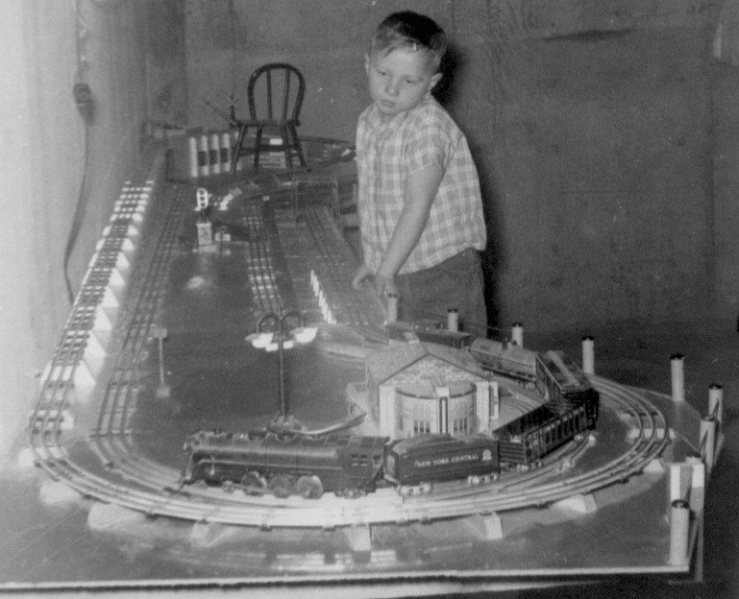
Why would a grown man write a short story for an adult science fiction magazine about toy people on a boy’s model railroad layout becoming alive and having their own thoughts? It’s one thing for Disney to create the Toy Story series for children that adults enjoy, but it’s really another thing to ask grownups to let’s pretend about toys having conscious minds. Or is it? Wasn’t The Twilight Zone in 1961 doing the same thing in its classic episode “Five Characters in Search of an Exit” about conscience toys hoping to escape an existential fate? And let’s not forget The Nutcracker or Babes in Toyland. The idea of toys having a secret life has been around a long time. Well, at least as long as kids have been playing let’s pretend, but why has the same theme survived for grownups in stories, novels, plays, operas, and ballets?

Chad Oliver, was an anthropologist who wrote “Transformer” for the November, 1954 issue of The Magazine of Fantasy & Science Fiction, a periodical that prided itself on having sophisticated adult readers. (Online copy here.) I read “Transformer” last night in The Great SF Stories 16 (1954) edited by Isaac Asimov and Martin H. Greenberg that was published in 1987. The story was reprinted again for Sci Fiction in 2005 (archived to read online). You can also listen an audio version at Radio Echos online. Finally, you can buy the Kindle edition of Far From This Earth: The Collection Short Stories of Chad Oliver Volume Two for $1.99 to get it and many other Chad Oliver short stories.

Chad Oliver is another dead science fiction writer whose work is slowly fading away. He barely gets a write-up in Wikipedia. A fair number of his books are still in print for the Kindle and most are only a $1.99. My only previous experience reading Oliver was his Mists of Dawn (1952) as a kid back in the middle 1960s, a title from the wonderful Winston Science Fiction series for young adults. I reread Mists of Dawn recently when I was fondly remembering those books.

“Transformer” is a strange little story. Isaac Asimov and Marty Greenberg didn’t want to use it for their anthology of science fiction stories because they didn’t consider it science fiction, but the story got to both of them so much that they had to include it. In my younger days I would have dismissed this story as fantasy because of my prejudice against fantasy fiction, but in my old age I’m more accepting of up front make believing. (That reminds me of a Bob Dylan line, “I’m younger than that now.”)

In “Transformer” an old woman is talking to a person named Clyde, but right at the beginning she also addresses us readers while talking to Clyde:

You might stick around for a minute and listen, you see—things might get interesting.

One more thing we might as well clear up while we're at it. I can hear you thinking, with that sophisticated mind of yours: "Who's she supposed to be telling the story to? That's the trouble with all these first-person narratives." Well, Clyde, that's a dumb question, if you ask me. Do you worry about where the music comes from when Pinza sings in a lifeboat? I feel sorry for you, I really do. I'll tell you the secret: the music comes from a studio orchestra that's hidden in the worm can just to the left of the Nazi spy. You follow me? The plain, unvarnished truth is that I get restless when the town's turned off for a long time. I can't sleep. I'm talking to myself. I'm bored stiff, and so would you be if you had to live here for your whole life. But I know you're there, Clyde, or this wouldn't be getting through to you. Don't worry about it, though.

This is strictly for kicks.

This is Chad Oliver way of saying he knows we’re adults and gives us a wink-wink. Knowing he’s an anthropologist makes me wonder if this story has some kind of subtext about primitive minds, but I don’t think so. I think Oliver is choosing to be an adult and saying, “Let’s pretend.” However, his story of ELM POINT, a crummy toy town on a cheap model train layout in Willy Roberts’ attic is neither fun nor playful, it’s more like an Edgar Allan Poe nightmare.

Here’s the thing, we adults, we grown-ups, we mature intellectual beings, play let’s pretend all the time. Just before I read “Transformer” I finished up watching Bridgerton on Netflix, an 8-part miniseries where adult viewers pretend Jane Austen wrote a story with sex and nudity. Our make believe train set town is a film recreation of Regency England, a favorite fantasyland for romance aficionados. That recreation is no more accurate to reality than Willy’s train layout on an old piece of plywood. But we still have fun, don’t we?

In other words, most adults never stop playing let’s pretend either. We just stop needing the toys to jump start our fantasies. That reminds of a Philip K. Dick novel, The Three Stigmatas of Palmer Eldritch, where colonists on Mars shift their let’s pretend from using Perky Pat dolls and layouts to enhance their hallucinations on the drug Can-D, to then use the new drug Chew-Z that doesn’t require toys to shape the hallucinations. I must reconsider what Dick’s novel is saying in regards to what I’ve learned from this Chad Oliver’s story.

Chad Oliver is asking us about our fantasy life being transformed.

Willy Roberts surveyed his model railroad without pleasure. He could remember the time when it had given him a real hoot, but after all he was thirteen years old now. He felt slightly ashamed that he should want to mess with it at all, but it was better than getting kicked around in football by all the big guys in the neighborhood. And Sally had said she was going to the show with Dave Toney, damn her.

I remember getting two train sets for Christmas in 1959, when I was eight. I loved those toy trains, but they were quickly forgotten by the time I was nine. It’s hard to believe Willy is still playing with his at thirteen, but then I watch YouTube videos about guys my age spending fortunes on their elaborate model train layouts.

At what age are we supposed to give up playing let’s pretend? How many people ever do?

I’ll let you read most of “Transformer” for yourself if you want to. This 1954 story reminds me so much of when I was a kid in the 1950s. But Chad Oliver also reminds us that there’s a troublesome side to reality that always intrudes on our pretending. ELM POINT if fake, and poorly made. It has rubber trees and cellophane rivers. Our narrator tells us:

It isn't much of a life, to my way of thinking. You do the best you can, and get up whenever some dumb kid hits a button, and then you get tossed in the wastebasket. It seems sort of pointless.

And later on says:

I don't want you to get the idea that I'm just a sour old woman, Clyde, a kind of juvenile delinquent with arthritis. I'm not, really. You know, a long time ago, when Willy was younger, even ELM POINT wasn't so bad.
...
I'll tell you, though—it's funny. Sometimes, a long time ago, I'd go and sit down by that silly cellophane river and I'd almost get to where I liked it here.

Our narrator and the other denizens of ELM POINT decide to rebel against the tyranny of Willy Roberts, but things don’t go according to plan. After the failed coup Willy decides to sell off his train, layout, and toy citizens. Our narrator ends up in the house of another boy for his train set, but things aren’t as good.

That's right. ELM POINT looks like Utopia from where I'm sitting. Mark Borden, the one that bought me, can't afford a real model railroad set-up, and his house doesn't even have an attic. So about once a week he takes us all out of his dirty closet, sets up his lousy circle of track, and starts up his wheezing four-car freight train. It isn't even a scale model. Big deal.

Things are relative in both reality and our make believe worlds. We hope for better times, and sometimes remember the bad times weren’t that bad after all. We all play let’s pretend when we watch TV or read novels or even just kick back in our La-Z-Boys and fantasize. Could Chad Oliver be asking us to compare our lives to living in a badly constructed model railroad layout?

I’m also reading a nonfiction book, Evil Geniuses by Kurt Andersen that’s about how our political economy was shaped by the fantasies of rich Milton Friedman worshipping libertarians over the last fifty years. I’m also reading The Ministry of the Future by Kim Stanley Robinson, a science fiction fantasy about the politics of the future after climate change starts killing people by the millions. Both books are deadly serious and ask us to stop playing let’s pretend and do something. But we don’t, do we? Why is playing let’s pretend so overwhelmingly alluring to us?

Am I reading too much into “Transformer?” Did you find something else? The story is haunting even though it’s a simply little fun tale for F&SF. More and more, I’m spending my let’s pretend time by reading old issues of F&SF. What does it say when I knowingly choose a cheap model railroad layout over reality?

Maybe the anthropologist in Chad Oliver is saying something in his story. Maybe it’s a neat little message in a bottle thrown on the ocean of fantasies.

James Wallace Harris, 1/5/21

Vintage SF Short Stories

Mark R. Kelly has come out with a new ranked list of well remembered science fiction short stories. You can view it here. I like to use the word remembered because some people get bent out of shape when seeing list titles with words like classics, great, best, in them. All of us who are in the business of creating lists try to come up with quantitative ways of recognizing which stories are remembered most, and that kind of implies the results are among the best or classics. Ultimately, it’s tracking reader memory. Kelly has an interesting system.

I love all these lists because I love reading old science fiction short stories. I thought I’d compare several just for the fun of it, and help remind people there are lists out there that help find old science fiction short stories to read. By the way, January is Vintage Science Fiction Not-a-Challenge month accord to the Little Red Reviewer blog, and reading short stories count. If you read and review old SF you might post links to their site.

Kelly has a nice feature for his list, a photo of a recent anthology and a link to Amazon where you can buy that anthology. See our “The SF Anthology Problem — Solved” essay for which anthologies have the most remembered stories.

Click on the heading link to see each site’s full list of stories.

Mark R. Kelly’s 10 Top SF Stories:

  1. “Bears Discover Fire” by Terry Bisson
  2. “Day Million” by Frederik Pohl
  3. “The Game of Rat and Dragon” by Cordwainer Smith
  4. “‘Repent, Harlequin!’ said the Ticktockman” by Harlan Ellison
  5. “The Star” by Arthur C. Clarke
  6. “The Nine Billion Names of God” by Arthur C. Clarke
  7. “Jeffty Is Five” by Harlan Ellison
  8. “Light of Other Days” by Bob Shaw
  9. “When It Changed” by Joanna Russ
  10. “I Have No Mouth, and I Must Scream” by Harlan Ellison

ISFDB Top 10 SF Stories:

  1. “Story of Your Life” by Ted Chiang
  2. “Flowers for Algernon” by Daniel Keyes
  3. “The Shadow Over Innsmouth” by H. P. Lovecraft
  4. “The Veldt” by Ray Bradbury
  5. “Dear Devil” by Eric Frank Russell
  6. “The Screwfly Solution” by James Tiptree, Jr.
  7. “Sandkings” by George R. R. Martin
  8. “Enemy Mind” by Barry B. Longyear
  9. “Jeffty Is Five” by Harlan Ellison
  10. “The Tell-Tale Heart” by Edgar Allan Poe

Sci-Fi Lists Top 10 SF Stories:

  1. “Flowers for Algernon” by Daniel Keyes
  2. “Nightfall” by Isaac Asimov
  3. “Story of Your Life” by Ted Chiang
  4. “The Nine Billion Names of God” by Arthur C. Clarke
  5. “The Ones Who Walk Away From Omelas” by Ursula K. Le Guin
  6. “Exhalation” by Ted Chiang
  7. “‘Repent, Harlequin!’ said the Ticktockman” by Harlan Ellison
  8. “Hell is the Absence of God” by Ted Chiang
  9. “A Rose for Ecclesiastes” by Roger Zelazny
  10. “I Have No Mouth and I Must Scream” by Harlan Ellison

The Classics of Science Fiction Short Stories Top 13 Stories (our list):

  1. “Bloodchild” by Octavia E Butler
  2. “The Star” by Arthur C. Clarke and “When It Changed” by Joanna Russ
  3. “Blood Music” by Greg Bear and “The Game of Rat and Dragon” by Cordwainer Smith

4th place ties made our list run longer than 10:

  • “Bears Discover Fire” by Terry Bisson
  • “Day Million” by Frederik Pohl
  • “Flowers for Algernon” by Daniel Keyes
  • “Fondly Fahrenheit” by Alfred Bester
  • “Light of Other Days” by Bob Shaw
  • “A Martian Odyssey” by Stanley G. Weinbaum
  • “‘Repent, Harlequin!’ said the Ticktockman” by Harlan Ellison
  • “The Story of Your Life” by Ted Chiang

Here is a list of all the lists we used to calculate our list, which include the ISFDB and Sci-Fi Top 100 lists.

So, consider reading some vintage SF short stories this month.

James Wallace Harris, 1/2/21

I’m Having a Problem With Science Fiction – And It’s Due to Getting Older

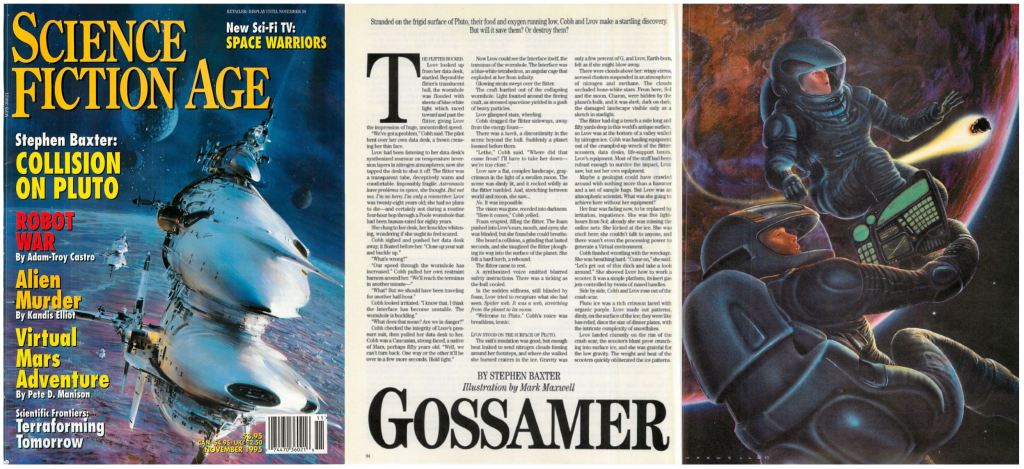
“Gossamer” by Stephen Baxter is about two women astronauts being marooned on Pluto. Back in 1964 I read Have Space Suit-Will Travel and my pre-adolescent self was thrilled by Kip’s adventures on Pluto. I desperately wanted to grow up and have such experiences too. Now, in 2020 at age 69, the thought of being an astronaut on Pluto seems bonkers. I didn’t really enjoy reading “Gossamer” even though it was a perfectly fine story. However, what’s weird, is I could reread Have Space Suit-Will Travel and thoroughly enjoy pretending to be Kip on Pluto again.

The younger unscientific me wanted science fiction to be real. The older scientific me and wants science fiction to be realistic. Do you grok the distinction? In 1964 I wanted my world to be science fictional. In 2020, I want my science fiction to be worldly. I’ve gotten half my wish, because the world has become very science fictional. However, science fiction has become more fantastic, more unbelievable, even the kind that claims to be based on hard science.

Our Facebook group, Best Science Fiction and Fantasy Short Fiction is discussing “Gossamer” because we’re reading through The Year’s Best SF 1 (1996) edited by David G. Hartwell. Hartwell also included “Gossamer” in his 2002 anthology The Hard SF Renaissance. He introduces the story in the The Year’s Best SF with:

Stephen Baxter writes in the hard science mode of Hal Clement and Robert L. Forward. This kind of SF is particularly valued by hard SF readers because it is comparatively scarce and requires intense effort by the writer to be accurate to known science. It produces innovative imagery that is peculiar to hard SF; that sparks that good old wow of wonderment. His novels began to appear in 1991 (Raft); the 1995 novel, The Time Ships, is his sequel, published 100 years later, to H.G. Wells's 1895 The Time Machine. Baxter's “Gossamer” appeared in Science Fiction Age, the most successful new SF magazine of the 1990s. His visions based on science are astonishingly precise and clear and that is what his fiction offers as foreground for our entertainment.

In his introduction to “Gossamer” in The Hard SF Renaissance, Hartwell quotes an interview with Baxter from Locus Magazine:

Looking back, things do change, in terms of influences. When I was young, I was influenced by the greats of the past, Wells and Clarke. When I was kind of cutting my teeth, writing a lot of stories and finally selling stories in the eighties, it was the people who were around at the time, the dominant figures: Benford and Bear in hard SF And now, my contemporaries, roughly: Paul McAuley, Peter Hamilton, Greg Egan. And I’ve met everybody else who s still alive, probably—not Egan, but Clarke and Benford, and Bear I’ve become quite friendly with.
 
With people like Bear and Benford, McAuley and Robinson, who are working off the same material as I’m working from—the new understanding of the planets, and so forth, the new understanding of cosmology (which is maybe more philosophy than science, because it’s untestable), we’re all coming from the same place. And you do have this dialogue, really, a conversation. 

Even though “Gossamer” is from a quarter-century ago, I consider it and Baxter, Bear, Benford, McAuley, Robinson – all the New Space Opera and British Space Opera authors part of a new movement of Hard SF. They’ve yet to become old since I don’t know of a newer movement that has replaced them yet.

The trouble is I don’t find their hard science fiction particularly hard. It’s more Super-Science Fantasy for me. For example, in “Gossamer” people scoot around the solar system via a subway system of wormholes. Yes, mathematicians have thrown out theories about wormholes, but I remember from an episode of Nova, them saying that to open a 1-meter wormhole for 1-second would require the energy of converting the mass of Jupiter into energy.

I believe we’re talking the practicality of counting angels on pinheads. Science fiction writers have latched onto space drives, warp drives, wormholes, and banter them about with a bit of physics mumbo-jumbo and expect us to believe it’s hard science. Come on, this is no more believable than portals in C. S. Lewis fantasies. There are other theoretical interstellar propulsion systems that science fiction writers use — light-sails, ramjets, anti-matter, etc. that are a little more believable, but only if we’re very damn lucky, and a zillion technical issues don’t get in the way, which I expect they will.

As of now, I’m skeptical of any story where the characters go anywhere near a fraction of lightspeed. And I consider any story with FTL as science fantasy. Star Trek and Star Wars are in the same category as The Lord of the Rings to my adult mind. And I don’t think I’m alone. I think there’s a paradigm shift in science fiction by some writers and readers to disavow interstellar travel. My younger self loved galactic empires but my older self has become an atheist to those faiths.

If I had read “Gossamer” as a teenager I would have embraced it thoroughly. But at 69, I’m just not drinking the Kool-Aid. Actually, my Sense of Wonder has switched to Sense of Nostalgia. I delight in old science fiction that was never scientific, but I now admire it for what science fiction once meant to me. I guess it’s easier to find pleasure in old hopes, than finding new hopes in old age.

But It’s Just a Fun Story

I believe there are two kinds of science fiction. 99% of science fiction stories are just for fun. You get your characters into a fix and then get them out. The reader is amused. If such tales need wormholes and space warps to create exciting make-believe adventures, far-out. And that’s cool. And if Baxter intended “Gossamer” to fall into this group, then it’s a fun story.

However, there is that 1% of science fiction where I believe the science fiction writer is speculating about real possibilities, and I can’t help but believe any writer or story that claims to be Hard SF is not in this 1% group. These are the stories I read growing up in the 1960s that imagined technologies and explorations that I expected might come true in my lifetime. Apollo 11 validated such stories. As a kid I believed science fiction promoted interplanetary travel. I also believe we had a real space program because older generations had grown up reading science fiction and wanted to make it true.

The difference between then and now is I used to believe we’d also invent interstellar travel. Growing up has made me doubt that. Growing up has made me doubt a lot of science fictional ideas. I can forgive old science fiction for their hopes, but I’m just ultra-skeptical about the hopes of current science fiction. I keep wondering when will science fiction grow up.

If Baxter is suggesting that leaping around the solar system via wormhole stations will come true in future generations then I just don’t buy it as a story, especially as hard SF. Does that make sense to you? I’m not picking on the story, I’m picking on the science fiction speculation. I guess I’ve just got too old for Santa Claus Science Fiction.

Other Logical Problems

Even if we ignore the wormholes, I have other problems with “Gossamer.” In the story, two women, Cobh and Lvov, crash onto Pluto after unexpectedly traveling too fast in a wormhole. Cobh assures Lvov they will be safe but will have to wait 20 days in their spacesuits to be rescued. That hit me harder than the wormhole as being completely unbelievable. There’s scientific realism, but there’s also practical realism too.

Now this is picking on the story. There just isn’t any explanations for how they could live in their spacesuits for so long. How do they go to the bathroom? How do they eat and drink? How many tons of supplies must they carry around to keep those suits going? Where is the fuel for their scooters? Once the two woman are on Pluto they have no logistical problems, or even any problems with the cryogenic cold. That’s too unworldly for me.

Also, they’re on a scientific mission to study Pluto’s atmosphere. All their work could have been done by robots. If their society can create wormholes, I imagine their robots must be pretty damn spectacular. The worldly way would not involve human exploration of extreme environments.

But there’s one last piece of logic that bugs me. I can’t believe people would really want to visit Pluto in person. It’s like wanting to lounge in a tank of liquid nitrogen wearing a spacesuit. Sure, Baxter speculates they might find life there, but there’s nothing there but extreme cold, gases in cryogenic liquid form, and rocks. My worldliness tells me once people realize what space travel really means, we’re not going to have that many volunteers. In the next few decades as we go back to the Moon and on to Mars, I believe a new reality will be revealed and romantic science fictional notions about space travel will disappear.

When I was young going into space seem so fantastic, but now that I’m older the reality is most of the solar system is bathed in horrible radiations and lethal temperatures. Even Mars, my favorite planet, would be a horrible vacation destination. Oh, there will always be masochistic thrill-seeking explorers, but the practically of indulging such adventures will wane.

When I was young, exploring outer space seemed so romantic, adventuresome, and exotic. I thought the best possible thing to do in life would be to leave Earth. Now, that seems so damn crazy. Everything that’s wonderful and beautiful is on Earth. Maybe getting closer to death has made me wise to the reality of science fiction. Now the beauty of science fiction is remembering what it was like to be young and having those wild crazy dreams.

James Wallace Harris, 12/19/20

The Cold Equations of Thinking Like a Dinosaur

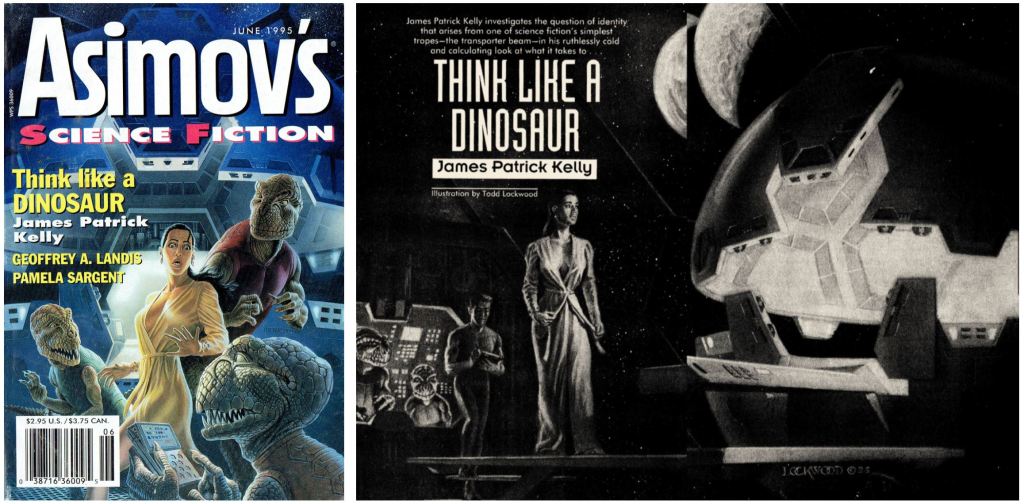
Spoiler Warning: This is not a review, but thoughts for my short story discussion group. We’re discussing The Year’s Best SF 1 edited by David Hartwell, which is currently just 99 cents at Amazon for the Kindle edition. “Think Like a Dinosaur” by James Patrick Kelly is the first story in the anthology, originally appearing in Asimov’s Science Fiction (June 1995). It won a Hugo for Best Novelette in 1996. If you haven’t read “Think Like a Dinosaur,” go find a copy and read it before reading my comments. It’s a wonderful story with plot elements you don’t want spoiled.

It’s hard not to think of “Think Like a Dinosaur” as a retelling of “The Cold Equations” by Tom Godwin. The plots are the same – nice girl must be spaced by nice guy because story logic dictates there is no other solution in the story’s reality. “The Cold Equations” is one of the most famous science fiction short stories in the genre. [You can read “The Cold Equations” online at Lightspeed Magazine.] Readers still argue for ways to save Marilyn even though the whole intent of writing the story is to kill her. Godwin’s point is the universe follows laws indifferent to human emotions and sometimes we just can’t save the girl. Kelly uses the same cold equations to kill Kamala. Instead of calling the logic the cold equations, Kelly calls it thinking like a dinosaur. Now this is not an insult to cold blooded reptiles. In the story, aliens that look like descendents from dinosaur type creatures offer to give Earth interstellar matter transmitter technology if they’re convinced humans can live up to the required rules of using it. They are called dinos in the story, and it’s implied they are far wiser than humans.

The main rule say the dinos is no duplicates. As soon as someone is transmitted to another stellar system the original must be destroyed. There’s a hint that the universe will balk at duplicates, but I didn’t find that clear. It might just be an arbitrary rule by the dinos. Maybe they’ve learned from experience that having multiples of the same being running around causes too much trouble. But this is the rule the dinos insist on for Earth to join the intergalactic community. By the way I’m reminded of Rogue Moon by Algis Budrys. It too applies the cold equations to matter transmitted travelers that seem to reinforce the dinos thinking.

Matter transmitters are rarely the subject of science fiction. The most famous use of them is Star Trek, where I always assumed travelers were disassembled and then reassembled using the same atoms. If you read the article on Teleportation at Wikipedia, that method is called beaming. There is another method called Quantum teleportation, which is the kind used in “Think Like a Dinosaur” and Rogue Moon. In that method, the subject is scanned and reproduced with atomic particles at the receiving site. This means two copies exist after the transmission.

The premise of “Think Like a Dinosaur” is the universe demands we eliminate one copy. Now you can argue with the logic of this, but for James Patrick Kelley’s story, it’s a required truth. And we need it to be true so Michael must kill Kamala, in the same way Barton must kill Marilyn. I’m amused by those readers who trying to find a way out of this problem within the story, or demand that the story should have been different.

Why are such stories created? It’s a horrible premise that disturbs some readers. Do these stories feed some kind of kink in some readers who secretly get off on killing young women? I doubt it. I believe cold equation stories are a tiny subgenre of science fiction where the writer sets up a situation that illustrates being forced to make an extreme decision. Lot in “Lot” by Ward Moore abandons his wife and sons to save his daughter and himself when he realizes not everyone in his family has the instinct to survive in a post-apocalyptic world. Lot knew his wife and boys could never let go over the old world, and thus wouldn’t make it in the new one. If you pay attention, you can spot other cold equation stories.

Of course, the real purpose of these stories is for the reader to put themselves in the situation and ask what would they do. Would you put Marilyn or Kamala in the air lock and punch the button that opens the outside door?

There is a TV version of “Think Like a Dinosaur” produced for the 1995 remake of The Outer Limits that perfectly illustrates how the writers and producers of that show couldn’t think like a dinosaur. That botched the ending by forcing additional motivations onto Michael. They also showed him being crushed by his decision. Either they didn’t understand the story, or they didn’t think television viewers could handle it.

I don’t know if Tom Godwin or James Patrick Kelly were offering lessons about reality, or just creating stories with tricked up plots. Robert A. Heinlein always wanted his readers to understand that exploring the galaxy would take guts, with explorers needing to make the tough choices that the universe requires in its cold equations.

On the other hand, I don’t think we’ll ever have matter transmitter technology that can send people, or even large inorganic objects. Like most readers who complain about “The Cold Equations” have shown, the situation where Marilyn could have stowed away should never have been possible. They wail at the unbelievability of the premise. As a person who has often moaned and groaned about unscientific and illogical science fiction I can understand these attacks. However, sometimes you just have to let a story be a story.

p.s.

There are stories where duplicates do happen and the stories reveal the problems of having duplicates. But I can’t remember any of them. If you do, please leave a comment.

James Wallace Harris, 12/9/20

“Death of a Spaceman” by Walter M. Miller, Jr.

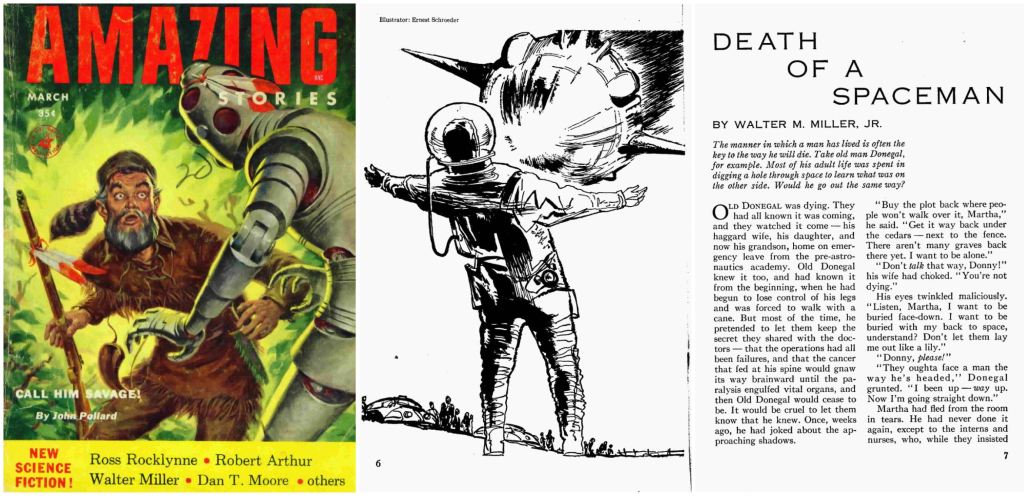
You can read "Death of a Spaceman" by Walter M. Miller, Jr. online at Project Gutenberg or listen to a rather good audio production at YouTube by NewThinkable.

When we love a story, do we love the words, or love what the words point to? With fiction, we’re drawn into some stories and repelled by others. What makes us care for a story? What aspects of the story resonate with our sense of self. (I wanted to say soul, but that’s too overblown, something a teenager would say. What part of the mind/body responds to art?) Most people never go beyond I love it or I hate when reacting to a story. But what is it about a story that we love or hate, what is it that we’re responding to and what is responding?

Joachim Boaz over at Science Fiction and Other Suspect Ruminations got me to read “Death of a Spaceman” by Walter M. Miller, Jr., a story that moved me. How did an old science fiction story affect me emotionally? What words and sentences in “Death of a Spaceman” triggered responses in my sensorium? How can staring at black marks on a white page set off emotions? Would any other series of words that set off the same series of emotions be considered equal to reading “Death of a Spaceman?” Could I reduce that short story to a series of statements that would read like a recipe for setting off those emotions? And if it’s possible to translate the story into a recipe/algorithm? Could I create a recipe that I could use as an outline for writing an emotional driven short story?

Here is a tally of my reactions to aspects of “Death of a Spaceman” that made me like it.

  • Old Donegal (Donny) is a 63-year old man. I’m 69. I seldom encounter old people like myself in stories.
  • Donegal is bedridden, dying of cancer that’s slowly paralyzing his body. It started with his legs and has now worked up to his arms. My body is wearing out too, and I think a lot about the progression of disease and what it will be like to die. In the past couple of decades I’ve known many people that ended up bedridden and dying. I have spinal stenosis and clogged arteries that makes my legs numb at times, and I can imagine it progressing.
  • Donegal’s dying is portrayed very realistic and gritty, and lately I’ve been loving gritty science fiction stories from the 1950s, stories that weren’t anything like stories I grew up reading as a kid in the 1960s, which nearly always featured young protagonists. One word jumped out at me that Miller used, enemas. Poor old Donegal is bedridden, and that’s very degrading and embarrassing, he would need someone to take care of all his bodily needs. And that’s something particular that’s always scared me about with getting old.
  • Donegal is a retired astronaut who regularly flew to the Moon. He worked on the engines, and his work is presented as a mundane job much like an engine room mechanic on ocean going cargo ships. I’m a lifelong science fiction fan and when I was young I wished I could have had a spaceman’s life like Donegal’s.
  • Donegal is doing everything within his limited powers to choreograph his own deathbed scene. My mother did that too. She desperately wanted to die at home and did. Seeing how Donegal tried to control things from his bed made me think about how much my mother must have work to maneuver her own ending. Will I do the same thing?
  • As Donegal connives to get his wife to do what he wants but confesses that the sick and dying must also take care of the caretakers and survivors. I thought that was particularly insightful, especially for an old man who was probably pretty selfish his whole life. Donegal realizes that his wife Martha is suffering too and tries to relieve her of some of her worries.
  • I admired how Miller presented Donegal and Martha pursuing their own goals in this dramatic situation. Martha also pictures how she wants Donegal to die and pushes him to see a priest. I always feel the best fiction presents every character with their own agenda. In the ballet between Donny and Martha we see each of them trying to lead the dance.
  • Donegal and Martha are poor, living in a rented flat, making ends meet off a spaceman’s pension. But they live next to the Keith’s mansion, a rich family that owns the spaceship company Donegal worked for. This reminds me of the movie Dead End (1937) where a mansion townhouse is built right down in the waterfront slums. I guess even back in the 1950s such socioeconomic juxtapositions were possible. In both “Death of a Spaceman” and Dead End, the rich have a party where the sight and sounds spread over the poor neighborhood. That’s quite effective artistic imagery. Donegal by the way, likes hearing the party and the music but worries that it will drown out the rocket blast he hopes to hear as he dies.
  • Donegal is also waiting for his daughter Nora and grandson Ken. He assumes Ken will follow in his footsteps and be a blastman on a rocket run. We learn that Ken is going to disappoint him. This reminds me of my father before he died. He was a sergeant in the Air Force and dreamed I’d take ROTC in college and become an officer in the Air Force. But this was the 1960s, and the last thing I wanted to do. Over the years I’ve slowly learned just how disappointed me must have been.
  • Only Nora shows up. We know that Ken can’t face Donegal. We see Donegal slowly come to grips with this lost hope.
  • We have a couple flashbacks of Donegal at work and home that flesh out his personality for the story. We also learn that the Keith’s have a son, and the party is his going away party because he’s joining the space academy. This sets us up for a very sentimental ending. All through the story Martha worries that the Keiths are disturbing Donny, but he actually enjoys hearing the party and thinking about them. His only worry is they won’t stop the noise in time for him to hear the last rocket take off. Near the end of the day the doctor shows up. I guess in the 1950s doctors still made house calls. The doctor’s role in the story is really to go tell the Keiths about Donegal dying and his last wish.
  • There is quite a lot of content that develops Donegal and Martha as an old loving couple, and I really enjoyed that. And it’s quite entertaining how the priest and Donegal get on in their honest man-to-man fashion when Martha leaves the room.
  • Up until the last moment the party keeps going full tilt noisy, and Donegal gets very worried. Then the music stops. A lone trumpet plays, and Donegal recognizes the trumpeter is playing the music for the lowering of the flag. He realizes the Keiths had this done it for him. Boy did this choke me up, bringing tears to my eyes. I had to go blow my nose.
  • Donegal dies wearing his old space suit boots, listening to the rocket launch. The rich man’s son, the one going off to be a spaceman has the orchestra play “Blastroom Man” after the sound of the rocket launches fades. Donegal died with a grin on his face. Sadly, just after he dies, Ken shows up.

Okay, this is really over-the-top sentimentality, but I bought it all. I don’t think I would have appreciated this story if I had read it in my youth. As I deconstructed the story for my list it’s quite obvious what made me like the story so much, personal connections, emotional connections. And it’s quite easy to look back and see why I haven’t liked other stories in the past. No connections. I have admired stories I thought were beautifully written, had thrilling plots, or contained endless clever ideas, but without generating emotions, those stories were dry and academic, just intellectual feats of prose.

Stand up comics have an understanding of how to trigger laughs. I suppose short story writers have a sense of how to trigger emotional reactions in readers. Did Walter M. Miller, Jr. consciously know what he was doing when he wrote “Death of a Spaceman?” Or is fiction writing mainly the work of the writer’s unconscious mind communicating with the unconscious mind of their readers? Did Miller intentionally contrive every trigger that generated the emotions I experienced?

Is this art, craft, or psychology? Or all three. Amazing Stories, where this story was first published, was mainly targeted to male adolescents back in the 1950s. How did they react to this story? I wonder if I can research that?

Today, Miller is mainly known for writing A Canticle for Leibowitz, which was a fix-up novel based on three short works. Most of his science fiction output was shorter works published in the 1950s in science fiction magazines, and none of those stories were ever very famous. He’s pretty much known as a one-hit-wonder with A Canticle for Leibowitz, which is quite brilliant, especially the first story, “A Canticle for Leibowitz” that originally appeared in F&SF in April, 1955. I’ve only read a handful of his standalone stories. I need to read more and study Miller more closely.

James Wallace Harris, 12/3/20

“With Flaming Swords” by Cleve Cartmill

Why read a third-rate story by a third-rate writer from a science fiction magazine published 78 years ago? In this case I can blame Paul Fraser who said in a Facebook comment “Cleve Cartmill was a pretty poor writer—I can think of only one story by him that I liked, ‘With Flaming Swords.'” Our group Best Science Fiction and Fantasy Short Fiction reads old science fiction anthologies. In this case we’re reading Fifty Short Science Fiction Tales edited by Isaac Asimov and Groff Conklin, and the story under discussion was “Oscar” by Cleve Cartmill from Unknown (Feb. 1941). It was that slight horror fantasy that inspired Paul’s comment.

I thought “Oscar” was barely okay. I also knew that Cleve Cartmill was famous for writing “Deadline” which caused FBI agents to visit the office of John W. Campbell, Jr. back during WWII. Those agents thought the story might reveal a leak to the Manhattan Project. I’ve read “Deadline” and thought it rather dull for all the attention it gets in science fiction history. Campbell always used “Deadline” to puff up Astounding Science-Fiction’s reputation, but it seemed like a lame claim to fame. I can’t believe FBI agents took it serious.

Again, I must ask myself, why read another story by a writer that has already had two strikes with me? Well, I was curious if Paul was right. Now Paul didn’t say the story was great, just one he liked. I followed the link he gave (included above) to read the story off my computer screen, however, after several pages I realized it was a rather long, so I loaded up that issue of Astounding on my iPad. (By the way, that issue also contained “Nerves” by Lester del Rey, a story that got into The Science Fiction Hall of Fame.)

“With Flaming Swords” is still a clunker but for some reason I kept reading. Why? My TBR pile is a whole wall of books and magazines. Well, this time Cartmill sucked me in. The story is about a theocracy ruled by men who claim to be saints. Their proof of sainthood is they glow in the dark, and people take that as proof of divinity. They aren’t. This future society came after an atomic war which caused a few males to carry a gene that makes them glow. Cartmill must have had atomic bombs on the brain back then. I kept reading because I wondered if the small cadre of unbelievers could overthrow the saints.

Hell, the idea of glowing blue people is stupid, even for 1942. I suppose Cartmill thought if radium lettering on his watch glowed, so might irradiated people. One thing about reading old science fiction from the 1940s and 1950s is folks back then had a lot of screwy ideas about radiation.

Robert A. Heinlein had published “If This Goes On—,” a short novel about a small band of freedom fighters trying to overthrow an American theocracy in Astounding in 1940. Did Cartmill get his idea from Heinlein. I kept reading “With Flaming Swords” to see how it compared. But then, that was one of my least favorite Heinlein stories from the 1940s. However, I did like the 1954 novel, The Stars Are Ours! by Andre Norton, also about a small group of scientists fleeing an American theocracy. Could it be that I just like science fiction stories about American theocracies being overthrown?

Cartmill’s writing in “With Flaming Swords” was readable, but it was basically just an adventure tale with several silly unscientific ideas. And it lacked any good science fictional ideas, although I thought it fascinating that Cartmill worked extremely hard to keep the violence down to one killing. And the real point of the story was about how people in power, even based on generations of lies, will not give up that power easily. Privilege hangs on with all its might, justifying their right with any logic it can grasp. We can see that today, and maybe that kept me reading too.

I can see why Paul liked this story if I don’t put too much weight on the word like. Would I recommend it? No — well, maybe. Here’s the thing, if you’re into reading old science fiction stories, and enjoy developing a sense of what it was like to read the old pulps and digests, maybe “With Flaming Swords” is worth reading. But that’s with some heavy qualifications.

Awhile back I decided I wanted to get a feel for the evolution of science fiction through reading short stories. I decided the heart and soul of real science fiction came from pulps and digest magazines. I wrote “The Best Science Fiction Short Stories” setting up the problem of how much to read. I decided there were three levels to approach the problem:

  • Read the original magazines (thousands of magazines)
  • Read the annual anthologies (100-200 volumes)
  • Read the very best retrospective anthologies (2-25 volumes)

I started out just reading the retrospective anthologies. Then I got into the annual anthologies, which is what our Facebook group mainly reads. But to really get down into my subject, I’ve started reading the magazines. Most of the stories aren’t that good, but that’s the reality of the situation. Reading science fiction short stories from just the best retrospective anthologies gives a false impression of the genre. Reading the annuals gives a different distorted view. Reading the magazines gets down to the bare metal.

“With Flaming Swords” has only been reprinted once in a retrospective anthology, and never collected for an annual. To its credit, it did make it to Groff Conklin’s 1948 anthology A Treasury of Science Fiction. Most of Cartmill’s 45 stories published from 1941-1956 were never reprinted in anthologies, and it appears he never had a collection of his stories published in his lifetime (1908-1964). Darkside Press put out Prelude of Armageddon in 2003, and this $40 hardback only contained eleven of his stories. “Deadline,” “Oscar,” and “With Flaming Swords” were among them.

I can’t decide if I wasted my time or not. I enjoyed learning about this microscopic bit of genre history. Reading a great story will stimulate my mind making the experience feel important. Reading crappy stories don’t give me such thrills, but I do feel like I’m learning something. I guess I feel more like a graduate student that has found a mildly interesting footnote.

James Wallace Harris, 11/30/20

Good Science Fiction Bad Science

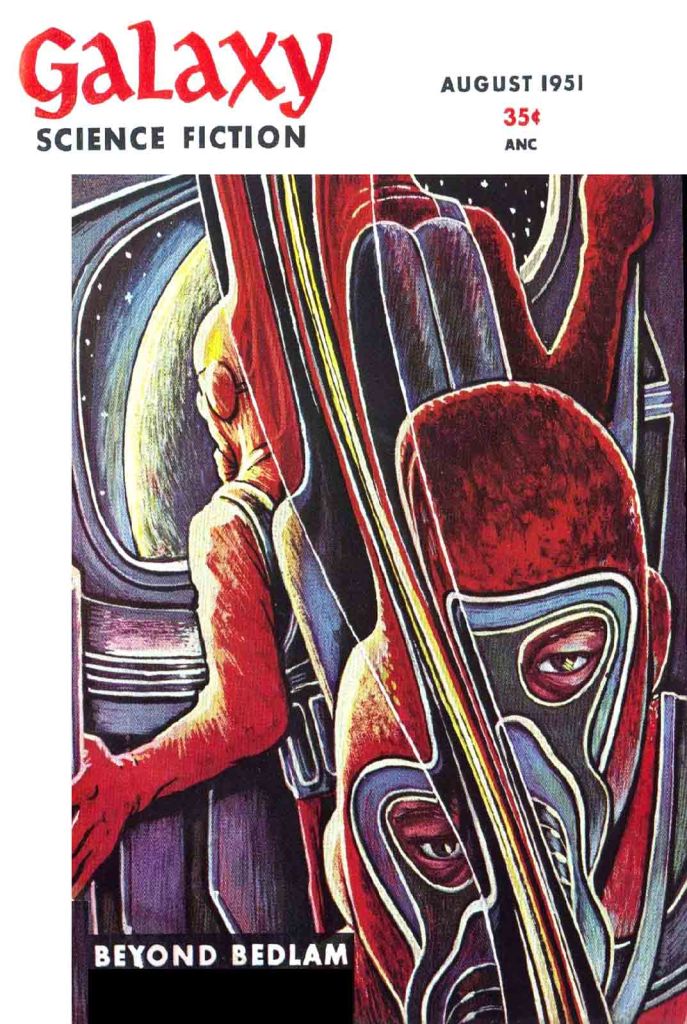
Do you stop reading science fiction when you encounter bad science, dated beliefs, or foolish concepts? I do if I’m warned ahead of time – but not if I’ve already gotten sucked into a the story. “Beyond Bedlam” by Wyman Guin is one such story that I kept reading once I realized it’s basic premise was ridiculous. It was first published in the August 1951 issue of Galaxy Science Fiction. I read it because of a friend recommending it and I read Robert Silverberg’s Reflections column about “Beyond Bedlam” being a one-hit wonder for Wyman Guin.

Maybe I shouldn’t tell you the premise for “Beyond Bedlam” because it might keep you from reading it. It’s available to read for free by following the link to the Galaxy magazine above, or by following this link to Project Gutenberg. The story is a short novella, about 20,000 words, so it will take you a bit of time to consume. Silverberg liked it well enough to anthologize it twice. Check to see if you have the classic 1980 SF anthology The Arbor House Treasury of Great Science Fiction Short Novels.

“Beyond Bedlam” is about a future utopian America that we would rebel against, but Wyman Guin presents as making sense to the citizens of that era. Guin didn’t write much science fiction because he worked in the pharmacological industry. His story presents the 29th-century America running smoothly because everyone is required by law to take psychiatric drugs. The characters in the story refer to our times as a dangerous failure because we let our emotions get the best of us. This by the way, isn’t the crazy premise of the story. Other science fiction stories have predicted people in the future controlled by drugs, and people do take a lot of drugs today for the mental health.

Guin takes one extra step that pushes the story into unbelievability territory – but I won’t give that away. Hopefully, you’ll start reading and get sucked in. Or maybe you will even think it a cool idea. Some science fiction fans love wild ideas no matter how silly they might be. I completely reject Guin’s speculation but enjoyed the story.

I understood why Guin wrote this story. I read lots of old books and watch lots of old movies, and the 1940s and 1950s was a time when people were fascinated with psychiatry and psychological mysteries. What’s particularly fascinating, and I’m giving a hint here that older readers might understand, is the 1951 “Beyond Bedlam” was written well before the 1957 bestseller, The Three Faces of Eve.

The reason why I found “Beyond Bedlam” compelling is Guin’s storytelling. Silverberg said Guin wrote 80,000 words of rough draft before distilling his story down to 20,000 words. It’s tightly plotted, with vivid characterization and great worldbuilding. It’s also filled with emotions derived from five characters’ unique movitations. Plus, “Beyond Bedlam” is quite adult, which wasn’t typical of science fiction in 1951.

Wyman Guin’s low output and his crazy premise will probably doom this nifty tale to obscurity. That’s a shame. “Beyond Bedlam” is not a literary classic. It’s a nostalgic tidbit from the dregs of decomposing pop culture that old fans fondly recall as they wait to die.

James Wallace Harris, 10/29/20

Realism in Science Fiction

Our Facebook group, Best Science Fiction and Fantasy Short Fiction recently read “Wall of Crystal, Eye of Night” by Algis Budrys, originally published in the December 1961 issue of Galaxy Magazine. We’re group reading Galaxy: Thirty Years of Innovative Science Fiction edited by Frederik Pohl, Martin H. Greenberg, and Joseph D. Olander. Because of this I’ve been thinking about the legacy of Galaxy Magazine, science fiction from the 1950s and how realistically did science fiction fans see the future.

So far “Wall of Crystal, Eye of Night” hasn’t found many admirers in our group, although the anthologist Rich Horton considers it one of his all-time favorite stories. My taste in SF often overlaps with Rich. I found the story to be compelling, thought provoking, not quite a classic, but unbelievably unrealistic.

I’ve read many books about science fiction of the 1940s, which older fans call The Golden Age of Science Fiction. John W. Campbell, Jr. was given most of the credit for this golden age because as editor he discovered and nurtured Heinlein, Asimov, Van Vogt, Hubbard, and many other SF writers that became famous in the genre when Baby Boomers were growing up. Many young SF writers and readers today are rebelling against that era of science fiction, but I think even by the end of the 1940s the writers and readers of the day were also ready to change, and that’s why F&SF (1949) and Galaxy (1950) quickly became popular magazines. And I’ve been told by many readers of my Baby Boom generation that they considered the 1950s to be the real Golden Age of Science Fiction. Did science fiction become more realistic in that decade?

Even though “Wall of Crystal, Eye of Night” came out at the end of 1961, I’m considering it a reflection of 1950s science fiction. Like the two classic stories from 1950, “Scanners Live in Vain” by Cordwainer Smith and “Coming Attraction” by Fritz Leiber, they mark a new beginning by reacting to the previous decade.

I have written elsewhere that I felt 1940s science fiction could be characterized by a yearning for transcendence. Campbell, Heinlein, and others expected mankind to evolve in the future, gaining mental and psychic powers that would help them conquer the galaxy. Reading “Wall of Crystal, Eye of Night” provided a kind of epiphany for me. It was wild, full of vitality, but ultimately discomforting because its lack of realism. Handling the fantastic in the same way superhero comic books handle reality. Is that the real legacy of 1950s SF?

Fiction has always had a strange relationship with reality and realism. I suppose we could say fiction has different levels of realism. By the way, I don’t mean to imply any artistic criticism to these various levels – at least for now.

  • Level 1 – Greek myths, superhero comic books, Bible stories, talking animal stories
  • Level 2 – Young adult or adult fantasy, science fiction
  • Level 3 – Science fiction that tries to be scientific
  • Level 4 – Most mundane genre fiction
  • Level 5 – Serious literature that’s mimetic

Unfortunately, much of science fiction swings the needle towards Level 1 rather than towards Level 5, even though science is in its label. “Wall of Crystal, Eye of Night” slams the needle over to 1 on the gauge. Is this good or bad? The story is fun. It’s a thrill ride. Should we even worry about it’s over-the-top fantastic elements?

I should warn you, I read “Wall of Crystal, Eye of Night” just after reading “The Boys Is the End of the Superhero As We Know It. And it’s about time.” That essay begins with “After two seasons of The Boys, I can say with roughly 85 percent confidence that Dr. Fredric Wertham was right.” I’ve got to admit that my confidence level is even higher, but then I’m prejudice against superhero comics. If you don’t know who Fredric Wertham is, read this. For most of my life I’ve had to accept the studies that say fiction, especially violent fiction, has no impact on the development of children, even though I find such results hard to believe. However, the years 2016-2020 makes me strongly wonder if Fredric Wertham wasn’t right all along. But I go further than Wertham, and wonder if science fiction and fantasy is dangerous too.

“Wall of Crystal, Eye of Night” opens in the skyscraper office of Rufus Sollenar, a entertainment business titan. He’s looking out a floor to ceiling window contemplating his success in life. He believes his new product, EmpaVid, will dominate the market and guarantee success and riches for the rest of his life. EmpaVid is a television system that manipulates the emotions of the viewers. Sollenar expects EmpaVid patents to allow him to dominate the entertainment industry.

Sollenar wears utilijem rings that allows him to operate everything in his office with a wave of his hand. Budrys describes the scene quite dramatically, with Sollenar conducting the machines of his office with simple hand gestures, like a magical superpower. Still, it’s technology, making the story science fiction. Sollenar is smug and feels like he dominates the world when looking out his window down on the city.

Eventually, a Mr. Ermine forces is way into Sollenar’s office. An ermine is a weasel, and even Mr. Ermine dresses in rust colored garments, the color of a weasel. This is rather obvious, too much like a comic book villain. Galaxy Magazine was aimed at adults, and from what Budrys says in his memoir of working there, Horace Gold wanted it to be read by a wider audience than just the average young science fiction fan. I feel this aspect of the story counters that goal. But maybe I’m being too harsh.

Mr. Ermine is from the IAB, the International Association of Broadcasters. At first you think of him as a toady but eventually we learn he’s far more powerful, like an enforcer for the mob. Over the course of the story the IAB becomes more sinister, and suggesting Budrys wants us to believe it’s a secret cabal that manipulates the entertainment business, and will go to any length to get what they want. Again, this is painting reality with comic book strokes. People who love conspiracies will love this aspect of the tale.

After some heavy-handed info-dumping we get down to the conflict of the story. Mr. Ermine tells Sollenar that Cortwright Burr, a competitor, has gone to Mars and had the Martian engineers make him a device. The implication being that the Sollenar corporation and IAB are threatened.

We next see Sollenar acting like Spiderman climbing on Cortwright Burr’s corporate skyscraper. We are given some razzle-dazzle about the machinery that allows Sollenar to do this, but once again the story falls into comic book mode. There were many SF stories in the 1950s and 1960s about titans of industry at war with one another. Alfred Bester aided his characters in The Demolished Man with psychic powers, and Philip K. Dick wrote many stories of business power figures battling with reality-bending drugs and technology. The most famous novel of this sub-type was The Space Merchants by Pohl and Kornbluth, first serialized in Galaxy.

In the early 1950s there were dozens of science fiction magazines on the market, and hordes of prolific writers to fill their pages. Business in America was booming, and like the ambitious said to one another, “The sky’s is the limit,” meaning nothing is impossible. Often it feels like these science fiction writers also felt there were no limits, and SF readers will believe anything. This is why critics of the genre claimed science fiction was for gullible young males. But on the other hand, the stories had an excitement and energy that fans loved.

Reading “Wall of Crystal, Eye of Night” both annoyed and excited me. I’m torn by admiring Budrys flamboyant imagination and insulted that he thinks so little of my intelligence.

Sollenar enters Burr’s office like Neo in a scene from The Matrix, diving through a window with his pistol aimed, hitting the ground, and popping up. Sollenar fires and hits Burr with a blast of energy from his gun, throwing Burr’s body against the wall. Burr had been holding a golden ball when shot and had yelled a command at it just before he was hit. Burr, now a sack of broken bloody bones holds the sphere up and Sollenar blasts him again. Burr drops the ball and Sollenar goes after it but sees that Burr is still animated even though his face is blown away. Sollenar shoots him again. He then gathers up the ball, but seeing Burr still moving fires all his remaining charges into the body. Sollenar is so freaked out he leaves the ball. He then climbs out the window and gets into his spiderman suit, but sees Burr still trying to come after him.

Why didn’t Burr die. How could his body be so destroyed yet still move? Later Sollenar is back at his building with his girlfriend on the balcony, and the body of Burr shows up climbing the outside of the building. WTF? Sollenar crushes the gripping hand on the rim of the outside wall, and the body falls down to crash below.

This is like some supernatural horror film, or an EC Comic. It reminds me of the Marvel films of today, and why I don’t like them. I hate films that show extreme violence with the reality of The Three Stooges or Wile E. Coyote. But I keep reading. How can Budrys explain this to me?

The next scene has Sollenar going to the TTV Executives’ Costume Ball. Guess what, Curt Burr is there, dressed as a gallows bird. Not only does Budrys go for obvious symbolism, but he just flat out tells us. And guess how Sollenar is costumed? As a Medici. Is this story supposed to be a comedy? Is this story supposed to be a mad parody of the genre like the first version of Casino Royale made fun of James Bond movies? Have I been taking it too seriously, when it was meant to be a gag all along?

One reason I can’t stand superhero comics and movies is I can’t buy into their reality, I can’t suspend my disbelief to accept their obviously unreal premises. Is Budrys trying to get his readers to believe his story or is he satirizing the genre? Galaxy Magazine was known for its satire and human. Am I taking things to literal? Sarcasm often flies over my head, and satire often just seems stupid. Is Budrys secretly sneering at his reader?

If “Wall of Crystal, Eye of Night” was filmed it would look a Marvel film. Do fans of such film see them as satire? What are they poking fun of?

Sollenar now accuses Burr of buying immortality from the Martians. But what a horrifying kind of immortality, becoming a walking bag of broken bones and torn up flesh that can’t die.

Ermine now returns, also in costume, one which no one would take him for a man. Ermine even proves how inhuman he is, by showing Sollenar he has no feelings from his nerves. He feels no pain.

Sollenar learns that he must succeed or IAB will kill him. He takes a rocket to Mars. The trip must have lasted no more than what jet plane takes to get to a nearby city. More unreality. More comic book realism. And I should say, the realism level of Star Wars.

Sollenar violently ditches Ermine on Mars and heads out to find the Martian engineers. I did like the whole description of Mars, both the human and Martian cities and the Martians. Maybe that’s because I’ve always been a sucker for stories about Mars.

Sollener bargains to buy immortality like Burr, but it turns out Martians don’t have immortality to sell. What the Martians are selling is an illusion machine. It can make the irrational rational.

Now this would be hilarious if Budrys intended all along to make this a recursive science fiction story, poking fun at the genre. Judith Merril did that “The Deep Down Dragon” another story in the Galaxy anthology. But am I seeing SF humor too often? I get the feeling Budrys does want us to believe this wild adventure story just like Philip K. Dick often used techniques in his serious stories by having his characters confused by reality. I think, but not sure, that Budrys is pulling a PKD here. In a way, Cort Burr prefigures Palmer Eldritch. So maybe PKD 1960’s work was inspired by Budrys?

If I read this story right, Cort Burr was never shot. Sollenar just believed he was. And to escape Ermine who is waiting to shoot him, he buys a Martian machine to give Ermine the illusion that his nerves function again, and that he killed and buried Sollenar.

Ultimately, this is a fun story, even though it mainly works at Level 1 reality. And as long as we accept it as creative fun there is no harm in playing make believe. But we still have to consider the article about the danger of superhero stories. Has generations absorbing anti-reality fiction from comics, science fiction, television, movies, video games affected them? Would society be saner and wiser if its citizens only consumed Level 4 and Level 5 fiction?

Contemplate all the news stories you’ve encountered in 2020. Too much of it feels like people are trying to live Level 1 reality as being real. Think about those men who planned to kidnap a governor believing they were freedom fighters. Think about Qanon believers. Think about all the crap stories people believe today. Did science fiction contribute to the current climate of anti-science? We aren’t living in a satire although it sure feels like one. And that’s painful!

Does consuming Level 1 fiction create a Level 1 society? We can claim Bible stories and Greek mythology proves we’ve been consuming such fiction for thousands of years. Would going cold turkey on such fiction help? Or do we consume Level 1 fiction because the average human can only comprehend reality with Level 1 thinking?

This is a lot of philosophical navel gazing to get from one minor SF story from 1961. But, I’ve got nothing better to do. It is 2020, you know.

Additional Reading

James Wallace Harris, 10/12/20