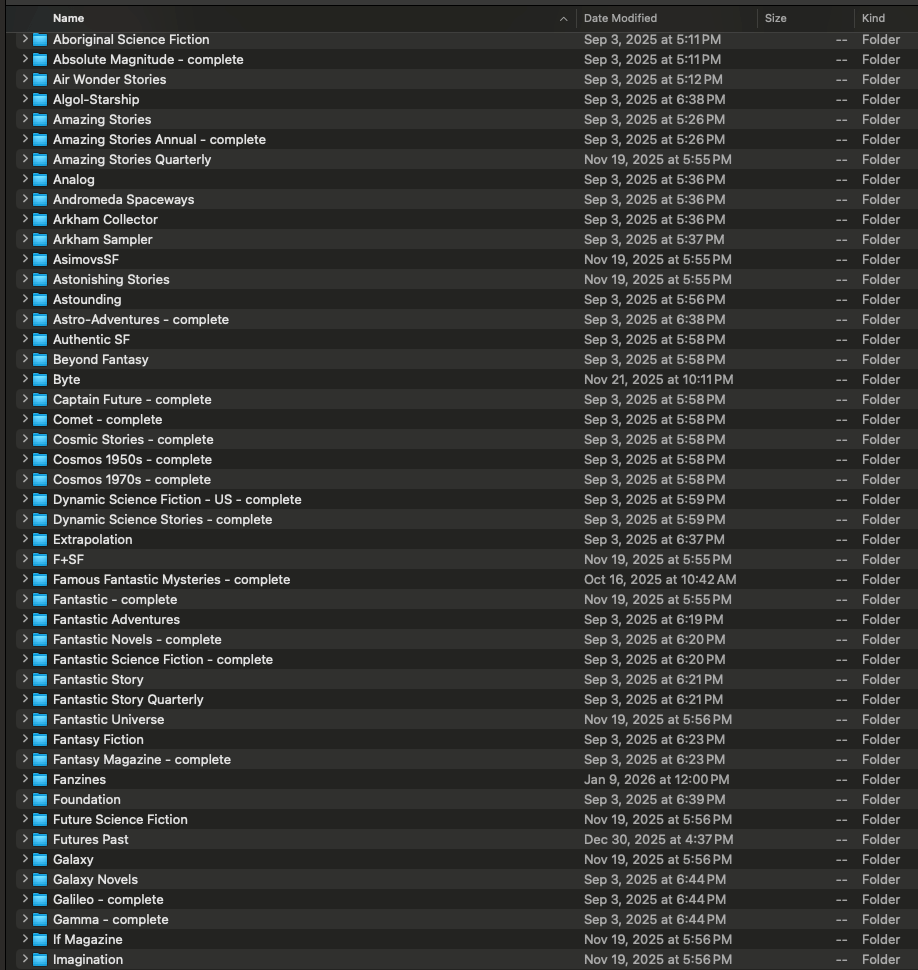
I accomplished a task last night that I’ve been hoping to finish for months. It made me exceedingly happy. My goal was to create a digital library of all my scanned pulp and digest science fiction magazines so they could be accessed from any of my computer devices. I have three computers (Windows, Mac, Linux), four tablets (two iOS, two Android), and an iPhone.
Last year, I bought a UGreen DXP2800 NAS. NAS stands for network-attached storage. Think of it as a big hard drive that all your computers can access. Over the years, I’ve collected scanned copies of nearly every science fiction magazine published in the 20th century. The Pulp Magazine Archive at the Internet Archive is a great place to search for them, but there are many others on the net. When I was young, I wanted to collect pulp magazines, but it’s not very practical unless you want to fill every room of your house with old magazines. I’ve known people who have. Even collecting digital copies is a pain because collecting them eventually overwhelms the latest big disk you’ve bought.
I have a librarian gene. I worked for six years in the periodicals department of a university library in my twenties. Pictured above is just the top portion of my magazine directory on the NAS. Here’s how I see the same directory with the YACReader Library:
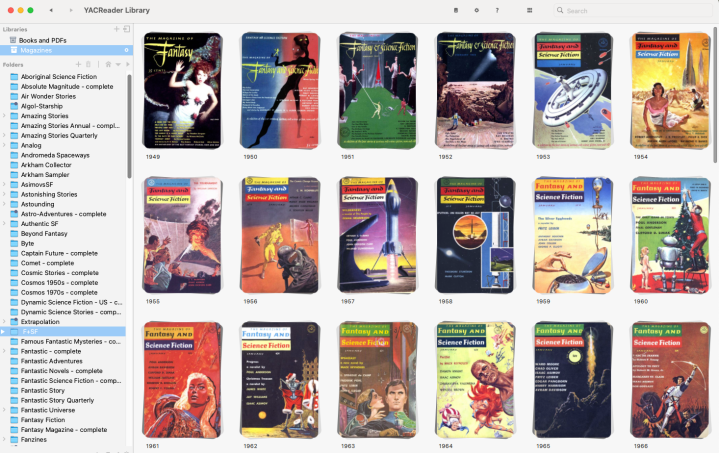
Here’s what it looks like when I select a year.
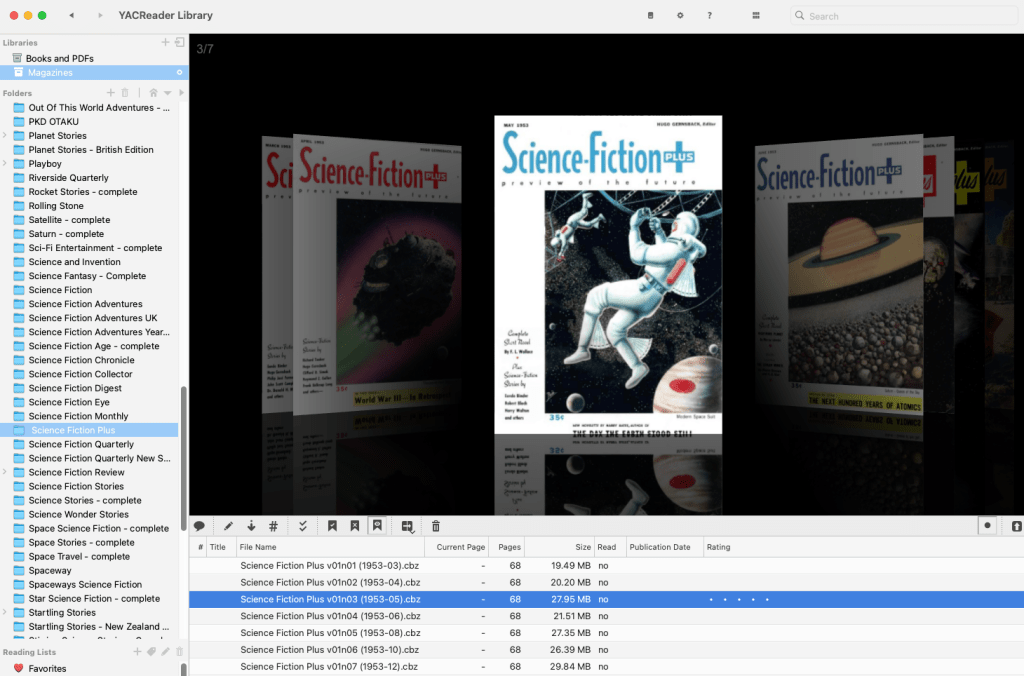
YACReader is by far the best CBR/CBZ/PDF reader I’ve found. And combining it with the YACReader Library is by far the easiest way to get pulp magazines on my tablets.
I can sit at any of my computers and, within seconds, look up any magazine. My previous ease-of-use success was putting all my magazines on a microSD card and loading it onto my Android tablet.
This new method is great when I’m researching an essay for this blog. I often use ISFDB.org or Wikipedia to look up a detail about an old story, and it will mention a magazine. Or I can be in my La-Z-Boy using a tablet and find a story to read. I can even be on my phone and look up a detail. YACReader runs on all my devices. YACReader users can access files via several networking methods or from several major cloud providers. However, there is also the YACReader Library. On a single-user machine, it’s just a nice graphical interface for looking at magazine covers. However, it offers a port for remote clients.
I wanted to put the YACReaderLibrary Server on my UGreen NAS, but after weeks of agonizing over how to set it up with Docker, I gave up. (I don’t know Docker or Linux well enough.) YACReader and the YACReader Library were a breeze to install on a Mac. Since I leave my Mac on all the time, I decided it was just simpler to install YACReaderLibrary on my Mac. Everything worked perfectly. I quickly went through all my devices, making sure they could access my magazine library — and I could.
You know that old saying, “Be careful what you wish for?” I woke up this morning anxious to play with my new system, and a revelation came to me. I had created the perfect system for reading, researching, and writing about 20th-century science fiction, but at 74, do I still need all that science fiction?
I could just pig out on sci-fi. The best analogy I can think of is to picture yourself in a beautiful bakery, looking at all the cases of cookies, cakes, and pies. You’d want to eat everything. And you might be willing to spend every bill in your wallet. But how many sweets should you actually take home? How many should you eat each day? I know my younger self could have spent 24/7 inside my new library.

This morning, I feel like Henry Bemis, when he was organizing piles of books he planned to read for each month of the rest of his life. I have enough science fiction for every minute I have left to live.
However, if we labeled reading science fiction on a pyramid diagram of healthy reading, where would it sit? Would it be an essential life-affirming activity shown as a large solid base, ot would it be an occasional sweet, illustrated as a tiny tip at the top of the pyramid?
When I watch the news, it makes me feel like withdrawing from the world to read science fiction and watch the old TV shows I’ve collected on my Jellyfin server. I confess, I’ve spent most of my life escaping into fiction — either by reading or watching. That troubles me. In old age, I wish I had been more active in my youth, when I had the energy. I wish I had created things, rather than consuming them. It’s too late to change my spots now.
Science fiction was my artificial reality.
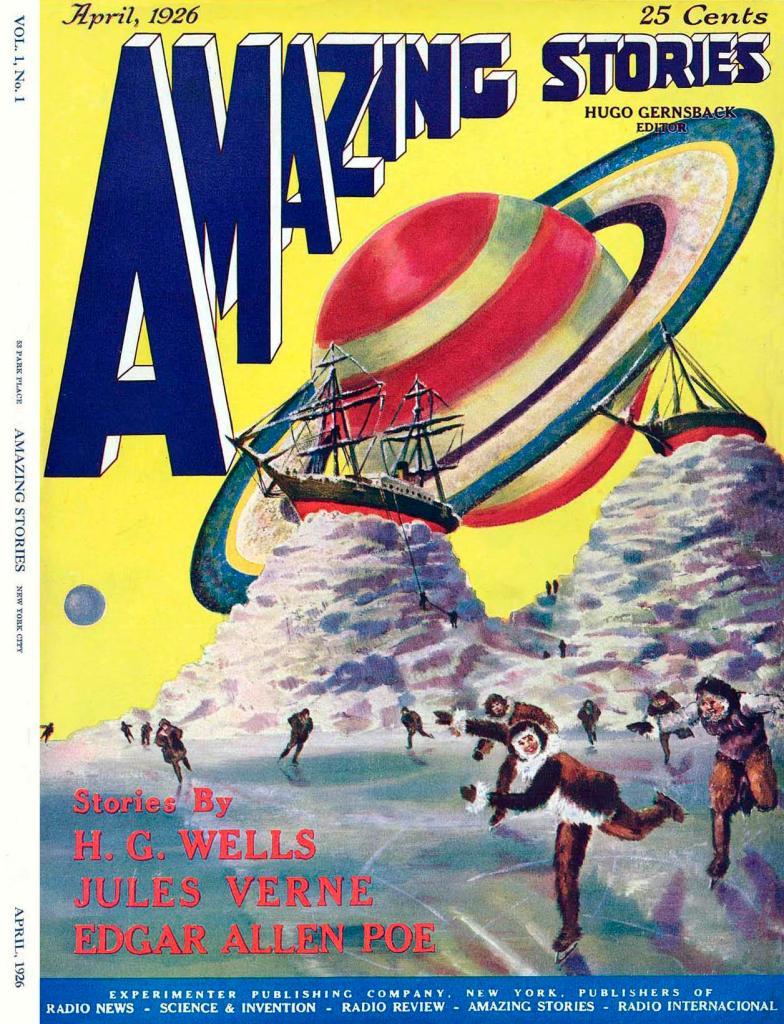
Science fiction, as a genre, began one hundred years ago when Hugo Gernsback published the April 1926 issue of Amazing Stories. There is an alternate reality in these magazines that I prefer over actual reality. I get a big kick out of having this reality at my fingertips. My computers are like a time machine; I can jump to any location in its space and time.
I’ve collected enough. Now that I’m old, and real reality presses in, I mostly read about here and now. My fiction addiction is wearing off. But I can’t give it up completely. It’s strange, but there are moments during the day when I just dip into an old science fiction magazine for a few minutes, and my science fiction craving is satiated.
James Wallace Harris, 1/11/26


The internet Archive is a treasure trove of material I never knew existed until I found the website.
LikeLiked by 1 person