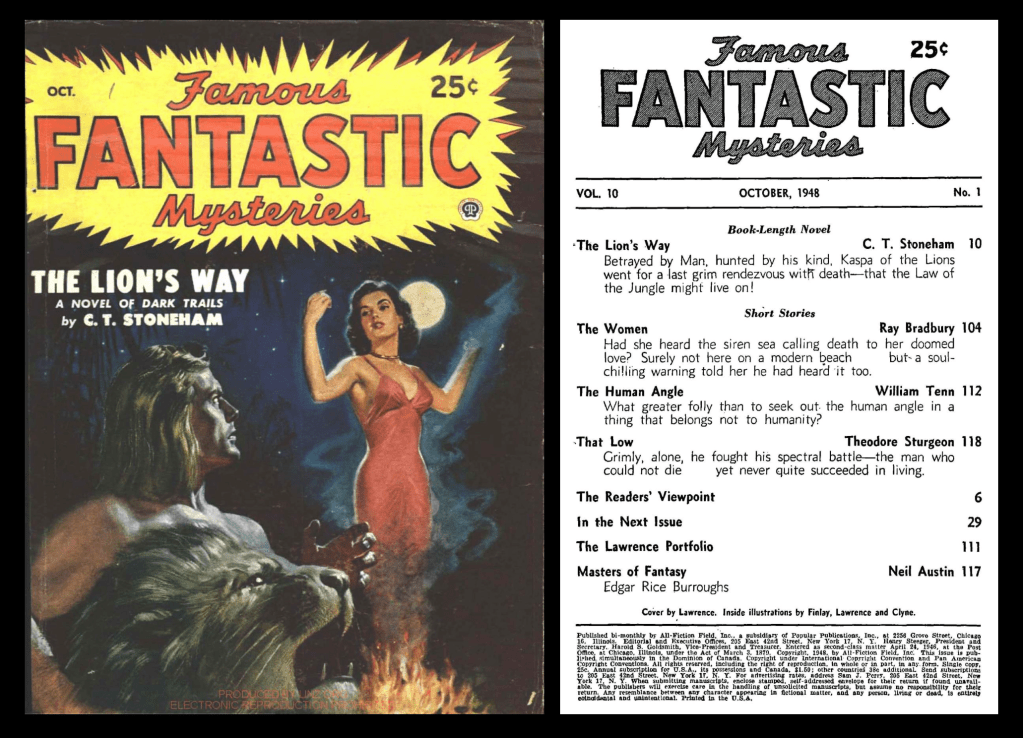
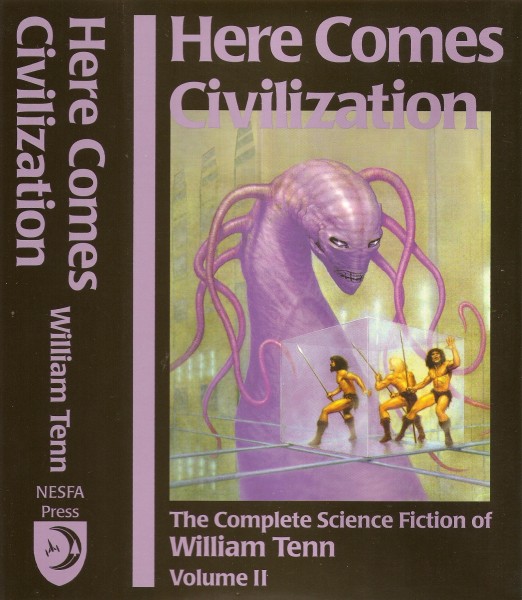
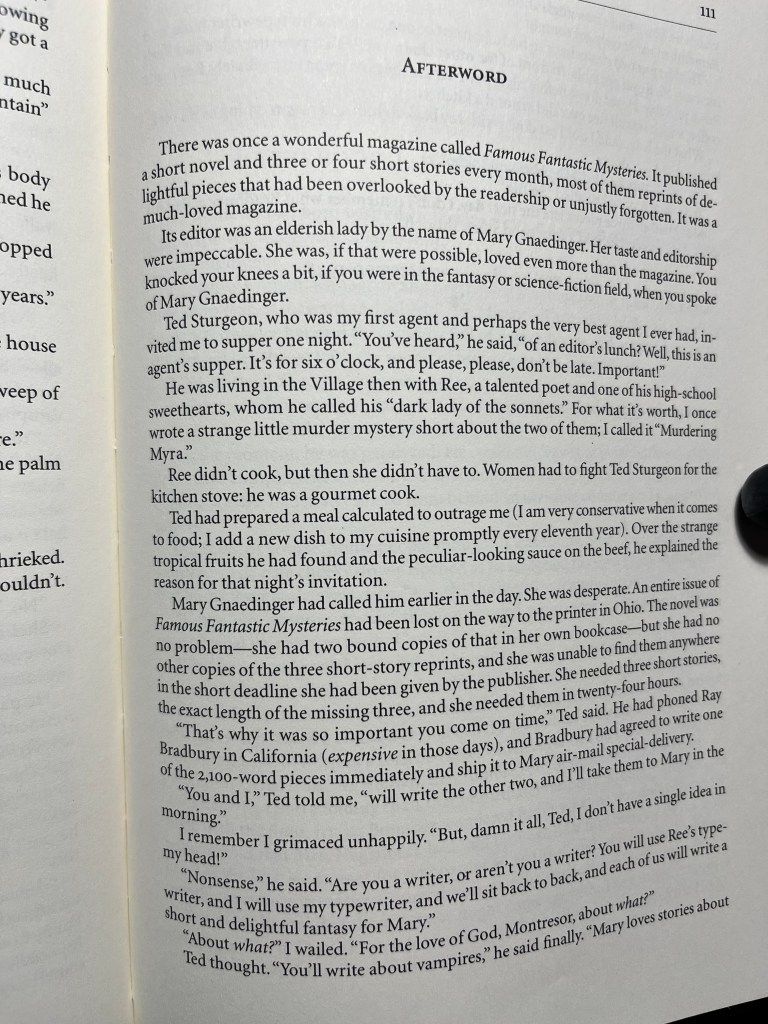
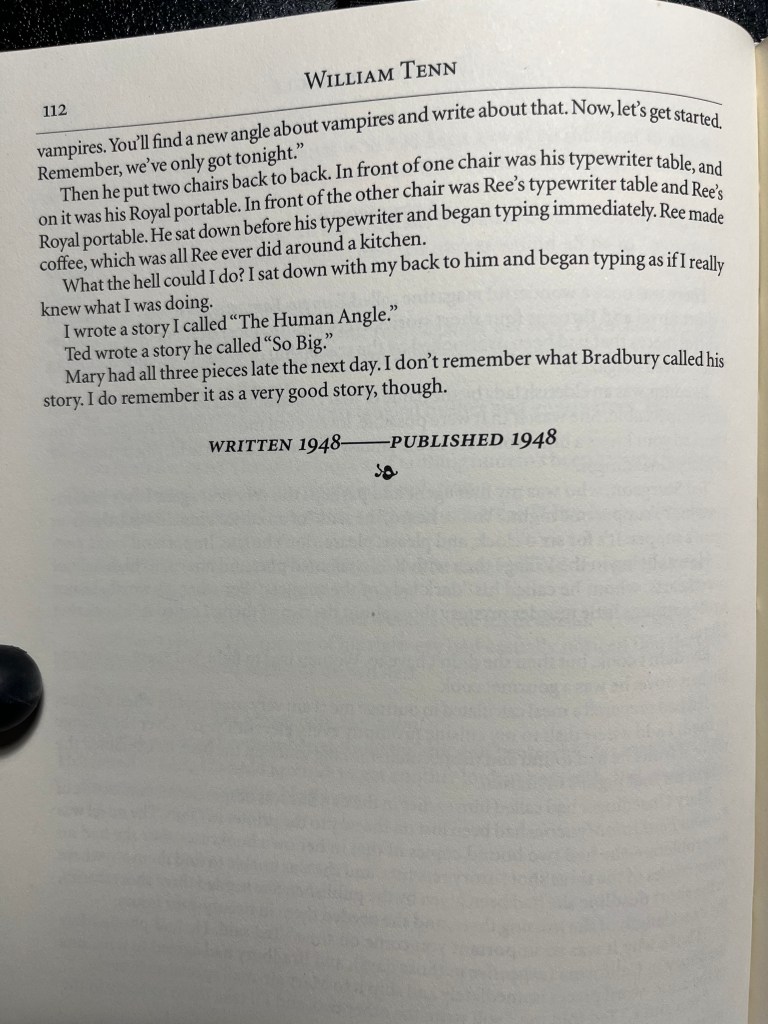
My friend Mike recently told me an anecdote from Here Comes Civilization: The Complete Science Fiction of William Tenn Volume 2. It was in the afterward to the story “The Human Angle.” It seems Ted Sturgeon invited William Tenn over for dinner with a hidden agenda. When Tennn arrived, Sturgeon told him that Mary Gnaedinger, the editor of Famous Fantastic Mysteries needed three short stories by tomorrow and they would write two of them that night. Ray Bradbury was going to write the third and air mail it special delivery to Mary from California. (See the “Afterward” below for the full tale.)
Tenn, Sturgeon, and Bradbury did come through in twenty-four hours and their stories were printed in the October 1948 issue of Famous Fantastic Mysteries. You can read that issue at Archive.org.
There were many legendary science fiction writers (and pulp writers) who bragged they could crank out a short story in a day, or a novel in a weekend. But is this hack writing any good? That’s hard to say. What is good? All three stories, “The Women,” “The Human Angle,” and “That Low” were readable stories and even entertaining. However, they are also quite forgettable. But not completely forgettable. Follow the links to view their reprint histories.
Men and women who wanted to make a living writing science fiction back in the 1930s, 1940s, and 1950s had to produce a lot of content. Many science fiction writers made a half-ass living churning out short stories for magazines. But are these speedy productions worth your time to read today? That depends.
Short stories can achieve several levels of quality and recognition. Getting published in a magazine is the first rung up in a ladder of publishing success. The next step up in recognition of quality is being nominated for an award or getting reprinted in an anthology, especially an annual best-of-the-year anthology. Winning an award is another step up. After that, recognition comes slowly. Having an author include a story in one of their short story collections at least says the author is proud of that story. But having a story reprinted in a retrospective or theme anthology means the story stands out over the other stories that came out in the year it was first published. Even greater recognition is when a short story is used in a textbook and taught in school or optioned for a film or television show.
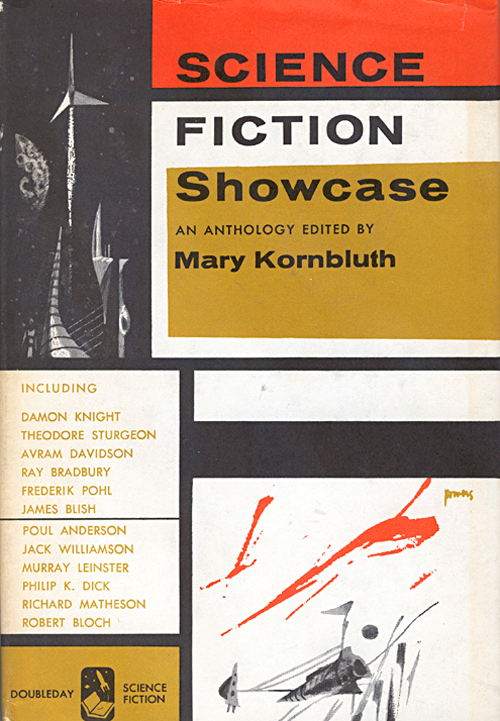
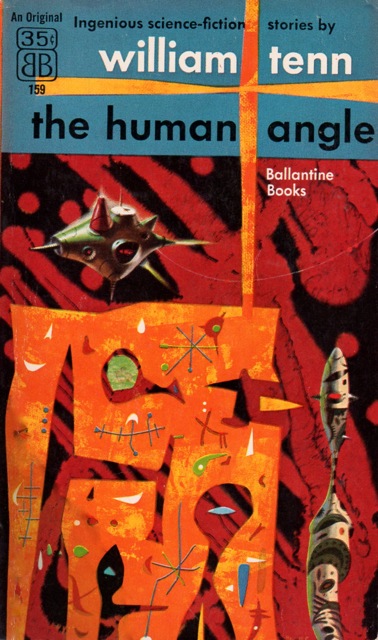
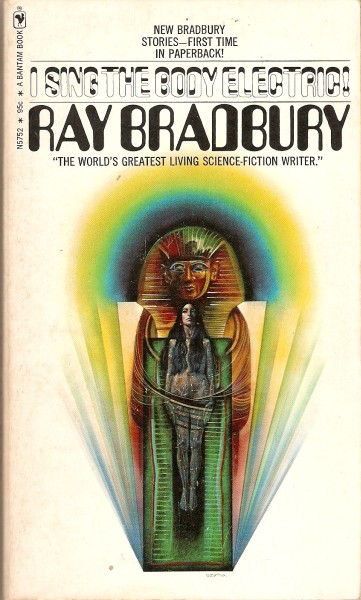
The Bradbury and Tenn were anthologized in a few minor theme anthologies as well as a few author collections. Bradbury included “The Women” in his famous I Sing the Body Electric collection. Tenn used “The Human Angle” for the title of a collection. Sturgeon’s story was reprinted in Mary Kornbluth’s Science Fiction Showcase, which was a special anthology probaby to help the widow of C. M. Kornbluth. “That Low” was only reprinted in Sturgeon’s complete stories series, suggesting that Sturgeon never liked it much. They were not major stories. However, these stories were sold several times, and they are in print today.
But back to my title question: How to judge hack writing. First, we must consider what kind of reader you are. Are you an indiscriminate reader, like someone who comes home from work and turns on the television and quickly finds something to watch by flipping through the channels? Or, are you the kind of person who Googles to find the critically admired shows that just came out this month? Maybe, you’re the person who looks at lists of the best TV series of all-time hoping to find something amazing to watch.
The Bradbury, Tenn, and Sturgeon stories are perfectly good stories if you’re capable of being entertained by an average episode of an average TV series. And that might be good enough for most people. But if you’re the kind of person who thinks in terms of the “Ten Best Episodes of The Twilight Zone,” these stories don’t even come close. And, if you compare them to “Fondly Fahrenheit” by Alfred Bester, or “The Story of Your Life” by Ted Chiang, or “The Ones Who Walked Away from Omelas” by Ursula K. Le Guin, then they aren’t even in the same galaxy.
I’ve developed a rating system I sometimes use in group discussions about short stories. One star is an amateur effort, and two stars is a story that still needs work and shouldn’t have been published. I seldom even mention these stories. Three stars to me is a professional story acceptable for magazine publishing. Four stars is a story that is good enough for me to look forward to rereading. Five stars is a story I’ve read many times and consider a classic.
Hack writers can routinely crank out three-star stories. The stories by Bradbury, Tenn, and Sturgeon are all three-star stories. I didn’t mind reading them, but at my age, they are a waste of my precious reading time – a commodity that’s dwindling. They were fun to look up and read because of Tenn’s anecdote about how and why they got written, but that’s about all.
When I’m restless, I still enjoy reading old science fiction anthologies. I have trouble watching TV, but I can still read for fun. I enjoy looking for gems. The trouble is I seldom find stories like “The Star Pit” by Samuel R. Delany or “Flowers for Algernon” by Daniel Keyes. But that’s what I’m really hoping to find, stories that work at that level.
I also want to know why and how stories work at the highest level of short story writing. I assume there must be definable qualities I can list, but I can’t list those qualities now. I plan to study my favorite 5-star stories and make a list in the future.
I will say the Bradbury story had the most writing qualities of the three stories. It had the most emotional tension. It had the most vivid details. It had the most poetic imagery. I cared for the wife in the black bathing suit. And it was the least predictable of the three stories.
The Tenn story was a vampire story. It has an unusual setting for a vampire story, which was a plus, and it had a different kind of vampire, another plus. But it was the most predictable of the three stories, and the least developed. Bradbury just had way more tension and conflict in his story. Sturgeon’s ending was the most surprising, but it wasn’t a very insightful surprise.
The obvious thing I can say about hack writing is it needs more drafts. Many hack stories could have been far better if they had baked longer in the oven. Writers who are proud of their first-draft writing might regularly sell their work, but it will never be considered great. A good example is Barry Malzberg. Some of his stories and novels are quite appealing, but none of them are books I want to reread. The absolute measure of great fiction is how often readers reread such work.
Robert Silverberg at the beginning of his career cranked out science fiction. Some of it was readable, but neither memorable nor something I’d want to reread. Then at the end of the sixties he changed. I assume he spent more time rewriting, although in some of those same years he cranked out four novels. But Downward to the Earth was different. I’ve read it twice and look forward to rereading it again.
I’m currently reading book 20 of The Great SF Stories 1-26 (1939-1964) edited by Isaac Asimov and Martin H. Greenberg with Robert Silverberg doing #26 with Greenberg after Asimov died. I’ve been reading them in order, along with the other best of the year anthologies that covered the same year. For any given year, I’d say there were less than five stories that I’d rate 5-stars. On average I’d say it’s two 5-star stories in each year. Most of the other stories are 3-stars and 4-stars.
I’m not sure if there are even three hundred 5-star stories in all the years of science fiction. Most would-be science fiction writers who achieve some success publish a handful of stories before starting on novels. I’m not sure if hack writers still exist. There are bestselling writers who crank out one or two novels a year who might be considered hack writers because of their productivity, but I don’t know if they are hack writers like Philip K. Dick, Ray Bradbury, Clifford Simak, Harlan Ellison, Robert Silverberg, and Theordore Sturgeon were early in their career when they could publish a dozen short stories and a couple of novels in a year. Ray Bradbury was quite proud of selling one short story a week pace, and he published in both the pulps and slicks.
Just because a story was written fast, doesn’t mean it’s bad. But the odds of it being great are low. I’m in a handful of online groups whose members love short fiction. There are many readers out there who appreciate good hack writing, especially those old readers who love pulp fiction. I don’t want to criticize such stories and their fans. I have often enjoyed a fun average story, but I’ve forgotten thousands of them.
James Wallace Harris, 4/9/25
 Classics of Science Fiction
My main concern is enjoyment. I make no attempt to systematically rank stories, but simply go from one story to the next, reading whatever looks interesting.
LikeLike
My impression is most of it is quite forgettable; but every once in a while an author gets inspired and writees a gem. “The Last Question” by Asimov is one of these? (Not sure about that.)
Silverberg stopped writing SF from 1960-64 for the most part, then became a “serious” SF writer in Feb. 1965 with the publishing of “The Sixth Palace”. Have you read this?
“Many science fiction writers made a half-ass living churning out short stories for magazines.”
I thought that almost all SF writers had a day job, and fSF-only ull-time writers were very much an exception. One name that comes to mind is Poul Anderson, who was that, and cranked out stories like hotcakes. As a result the quality of his fiction varies hugely. From hugo & nebula award-winning works all the way over to forgettable trash.
LikeLiked by 1 person
Heinlein and Philip K. Dick were full time writers from the start. I believe there were several other SF writers who lived off their writing. Some nearly starved like H. Beam Piper. Others like Henry Kuttner wrote for several genres including comics. I know Barry Malzberg also wrote porn to make ends meet.
LikeLiked by 1 person
Heinlein was not a full-time writer from the start and didn’t start writing until after 30. He was trained as a naval engineer and spent 5 years in the navy before being medically discharged. I’m guessing any benefits were his “day job” after leaving the navy. Yes he was one of maybe the only Spec-Fic-Only writers who made a living out of it. Very much the exception.
LikeLiked by 1 person
Heinlein was a full time writer from when he started writing. His naval career was long over and he failed at other careers before he started writing. He did have a small medical pension. But he always said he wrote to pay the mortgage and buy the groceries. He was selling so regularly to Campbell that he bought a new car and paid off the mortgage.
His biography mentions no jobs after he published his first story in 1939. He did quit writing during the war and worked for a military contractor I believe. He quit when the war ended and was a full time writer after that. That’s when he started selling to the slicks and then published in hardback. He also got some Hollywood and TV sales.
Heinlein was science fiction’s first big success.
Jim
LikeLiked by 1 person
Okay. But that’s Heinlein “the dean of SF writerrs”. Most, or almost all, spec-fic ONLY writers had day jobs. Either that or they were just eke-ing out a living.
LikeLike
Oh, you’re right that the majority of SF writers were only part timers. Philip K. Dick is probably better example. There were a small percentage of writers who barely made a living because they couldn’t do anything else.
Clifford Simak was a hack writer who had a day job but still banged out hundreds of stories across several genres.
LikeLike
Today’s e-books are the equivalent of pulp fiction and I say this: some are great, all follow a formula for the genre; some are terrible. But you know what, one learns write by writing, the same way, actors learn to act, but acting, and stand up comics, by finding a still existing comedy club which has an open mic night, and get up there to be funny to people are three sheets to the wind. Isn’t Sturgeon’s law that “90 per cent of everything is crud.” There is a lot of “crud” that I like. And love. However, you article was very and insightful. Sincerely, Ken Gardner, proud E-book writer and reader.
LikeLike