
Back in the 1960s when other teens fantasized about becoming rock stars, playing for the NFL, or being seen on the silver screen, I dreamed about becoming a science fiction writer. After reading the 1973 satire on science fiction writers, Herovit’s World by Barry N. Malzberg, I see that I was much better off working with computers at a university for thirty-five years and retiring with a pension. You can currently buy the Kindle edition for $1.99. But read my review carefully before you risk even that little money. It’s a good read for only certain kinds of science fiction fans.
Barry N. Malzberg died on December 19, 2024, at 85. Although prolific, he was never a famous science fiction writer. Malzberg’s most successful books were written in the 1970s, and Barry is mostly forgotten today. He is getting some attention on YouTube as a few reviewers rediscovering him. Malzberg has a reputation as being the curmudgeon of science fiction. Malzberg often relies on satire, but his stories were never fun like the satires of Kurt Vonnegut. Malzberg wrote dark, edgy, and psychological fiction like Philip K. Dick, but he never developed a cult following.
Recently, Bookpilled on YouTube declared that Malazberg was his new favorite science fiction writer. Bookpilled skews towards literary and dark SF, often from the 1970s. But to be honest, Malzberg is very hit-and-miss. Joachim Boaz, a true connoisseur of seventies science fiction, found little to love in The Many Worlds of Barry Malzberg. Boaz considered most stories good but rated “Death to the Keeper” brilliant. Boaz also called Malzberg’s most notable novel Beyond Apollo brilliant, giving it a 5 out of 5 rating.
Be sure to read MPorcius’ extensive review who believes Herovit’s World was overpromoted by Robert Silverberg and Harlan Ellison, but he did like it a lot.
And if you pay attention, Malzberg is mentioned occasionally on YouTube, print reviews, blogs, and podcasts. Three years ago, the biographer Alec Nevala-Lee interviewed Malzberg for two hours.
Herovit’s World is a short novel, 160 pages in paperback, and just under six hours on audio. Jonathan Herovit, our protagonist, has written 92 science fiction novels in the past but struggles to finish his latest book. It’s overdue. He only has thirty pages and his editor is hounding him. His wife is hounding him. He’s stuck in a small apartment with a new baby who cries endlessly. Herovit is approaching forty, well on the road to being an alcoholic, depressed, delusional, and coming apart mentally.
Herovit wants to be like Mack Miller, the fictional action hero of his endless Survey Team novels. Herovit wants to be like the decisive Kirk Poland, his alter-ego and pen name for his books. Jonathan Herovit has turned Kirk Polan into an imaginary friend, one that’s become an abusive second personality.
Malzberg uses this novel to satirize editors, publishers, authors, readers, fans, conventions, writer conferences, writer associations, and the science fiction genre. We never know if Herovit’s World is autobiographical. Herovit is self-loathing. Is this Malzberg confessing his own feelings, or just creating a character. But if you read Malzberg’s three books of essays, The Engines of the Night: Science Fiction in the Eighties (1982), Breakfast in the Ruins (2007), or The Bend at the End of the Road (2019) you’ll get the feeling that he did use his own life for inspiration.
Malzberg is confusing. He has stated that he loves science fiction and the genre. Listen to the podcast above. But science fiction also depressed him, even tormented the poor guy. Herovit’s World is recursive science fiction. That is science fiction about science fiction. Often recursive science fiction is fun, even zany, like What Mad Universe by Fredric Brown or God Bless You, Mr. Rosewater by Kurt Vonnegut. Herovit’s World is full of creative ideas and psychological observations, but they’re not fun. Malzberg feels more like Kafka.
Malzberg and Herovit are hack writers. They pride themselves on cranking out any style or type of fiction and getting paid for first drafts. However, Herovit’s World reads quite well. It has its literary aspects and is full of fun experimentation. I’m glad I read it even though it’s about an unhappy man going down the tubes. And it does make you think about science fiction.
Malzberg was several years younger than Herovit. Herovit’s writing career began in the 1950s, while Malzberg started publishing in the 1960s. Herovit remembers the science fiction magazine boom of 1953. Herovit was a disciple of John Steele, who I assume is based on John W. Campbell. So is Malzberg really making fun of 1950s science fiction? At one point in an argument with his wife Janice, she gives a bit of a speech which might be the key to the whole story:
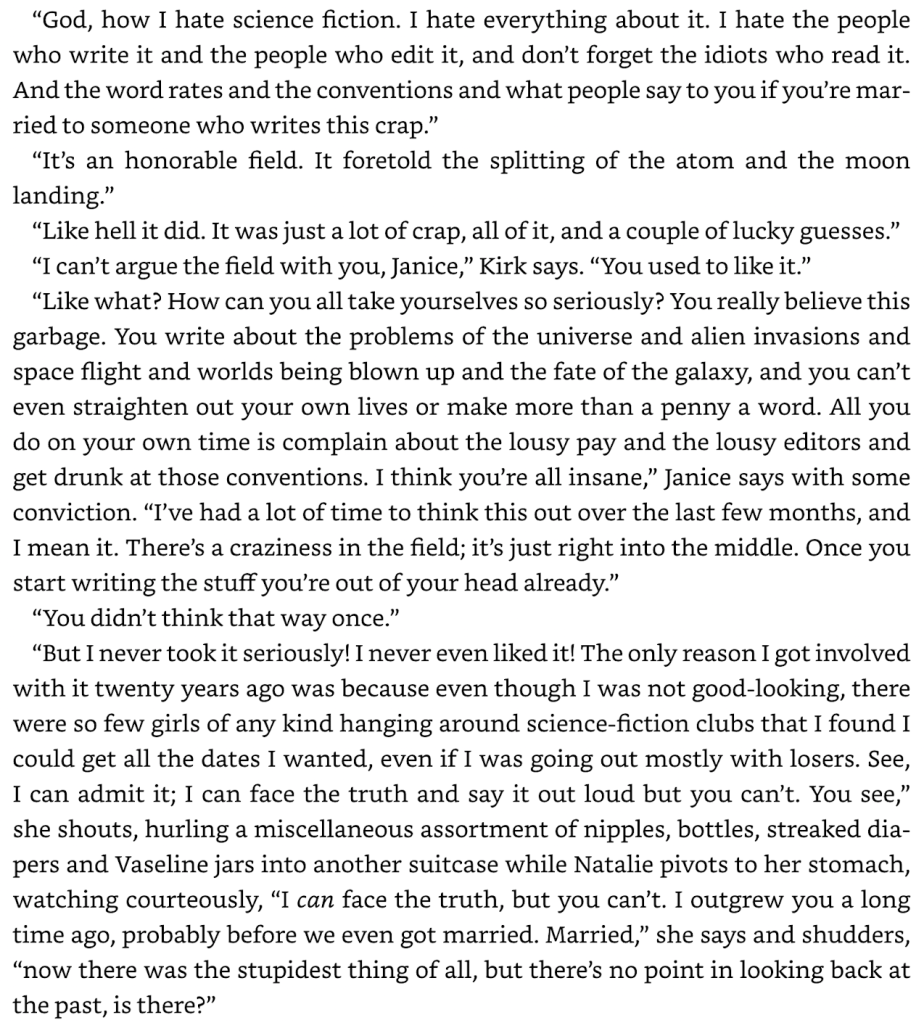
I also remember when there were very few females at science fiction clubs and conventions. Boy have things changed. We must acknowledge that Malzberg skewers SF of the 1950s or 1960s in Herovit’s World. But we should also ask: “How would a disgruntled SF writer skewer the genre today?”
There is a dream sequence late in the novel where Herovit is having tremendous sex with a college coed. He had been invited to a conference and the coed approached him telling Herovit that Kirk Poland was her favorite writer. It turns out she was paid by the university to seduce Herovit so he could be studied for academia. Science fiction was getting noticed by the academic world in the early 1970s. Many writers and fans felt vindicated. However, other writers claimed science fiction was better left in the gutter. Malzberg uses this scene to give his opinion:
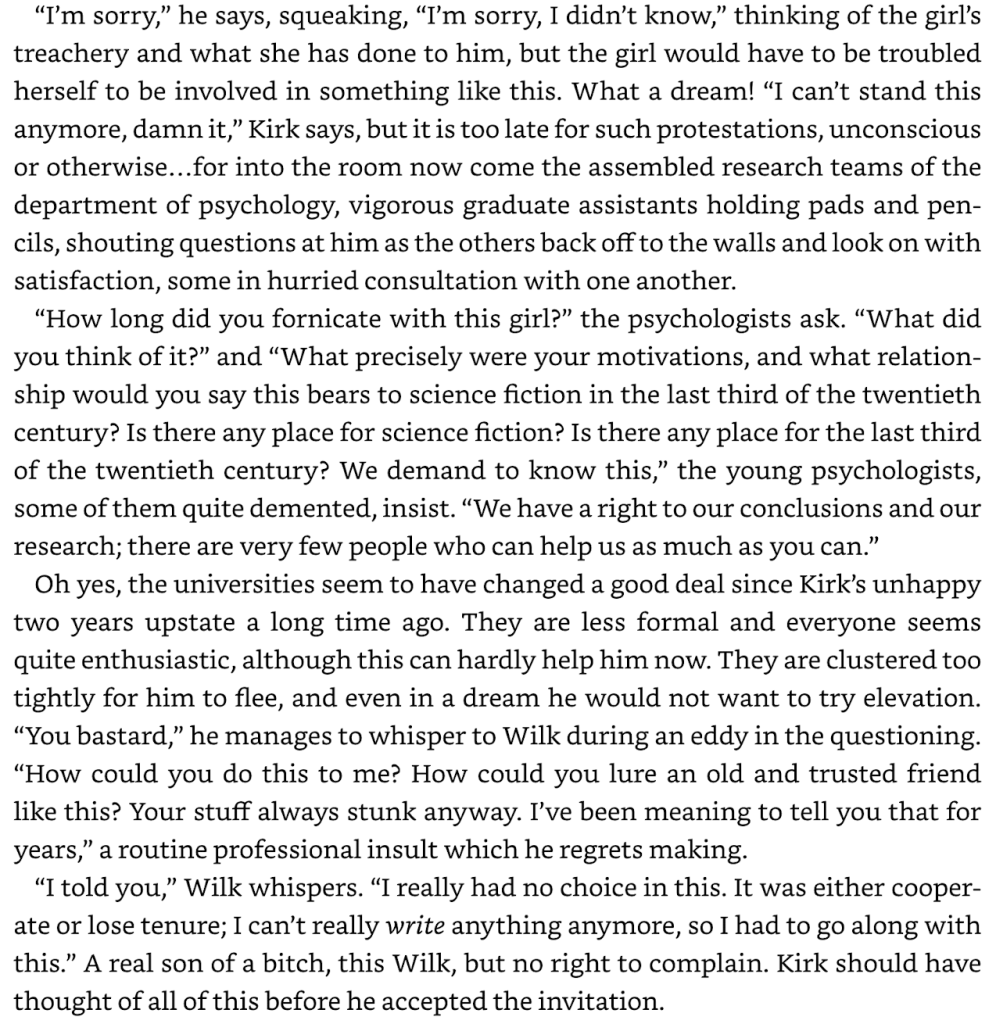
Herovit and Malzberg regretted giving so much of their creative effort to a genre that gets so little respect. They know they are writing escapism for adolescents. I think the genre has changed a lot since the 1970s. It does get more respect and it’s taken more seriously, probably because it deserves it. However, some of Malzberg’s criticisms might still be true, especially once you analyze why certain stories and themes are so popular with science fiction fans.
A good deal of Herovit’s World is about marriage. Herovit routinely cheats on his wife at science fiction conventions and neglects her at home. I’ve heard plenty of gossip about science fiction writers at conventions and conferences. But there is a non-SF connection here. There are many literary novels about blocked writers and failed marriages. I can’t tell if Malzberg is satirizing them too, or padding his SF novel. Both Herovit and Malzberg have bragged about being able to pad their fiction. My favorite novel on this theme is Wonder Boys by Michael Chabon, who writes in literary and SF genres.
Herovit’s World also contains a lot of sex. Malzberg got his start as a writer cranking out soft-core porn paperbacks. I don’t know if he’s saying that science fiction writers are sex obsessed, or sexually frustrated, or if he was merely padding his story because he didn’t have enough to say about science fiction to fill out the novel length. I do know that Portnoy’s Complaint by Philip Roth had come out a few years earlier and had become a bestseller dealing with sex honestly. As they say, “sex sells,” and Malzberg was hoping to break out of the science fiction ghetto.
Overall, Herovit’s World is mildly amusing. Most readers at Goodreads give it three stars, but a few love it giving it five stars. My rating would be ***+. I thought it was written well enough (***) and I liked it (+), but I wouldn’t ever reread it. That’s my main problem with Barry N. Malzberg. His books are interesting, but they never reach my next rating level. I give **** to books I know I’ll want to reread.
If Herovit’s World was less padded with sex scenes and had more satire about science fiction, it could have been a **** novel with me. If Malzberg had tried harder, gone beyond a first draft maybe, and really thought about the purpose of this novel, it could have been far better.
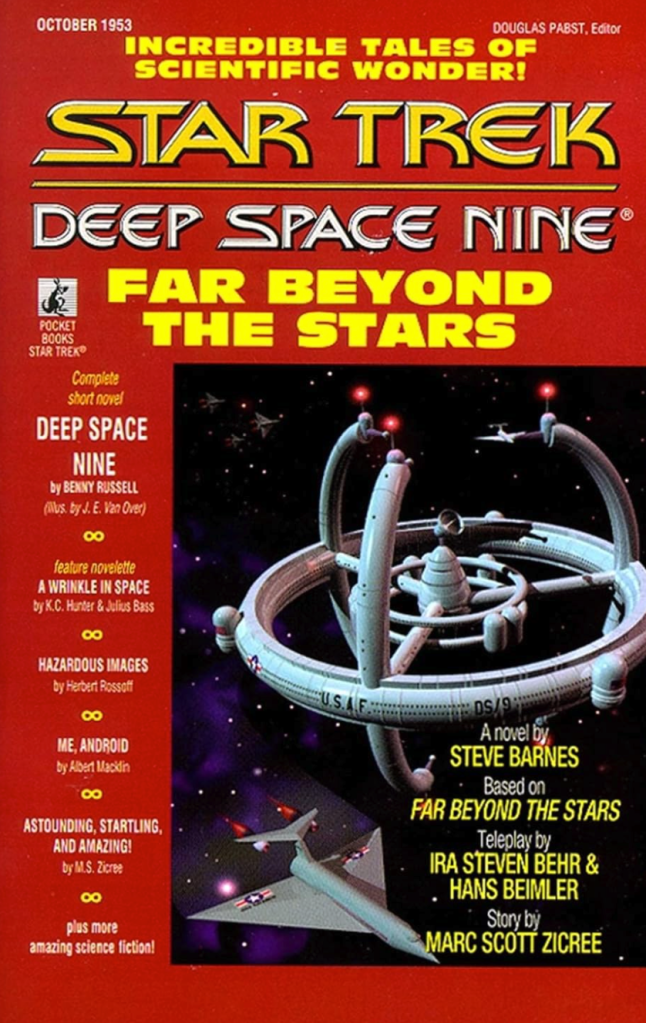
Malzberg focused on the pathetic without ever showing what we love about science fiction. His novel could have been elevated by showing Malzberg/Herovit’s passion for the genre. Far Beyond the Stars by Steven Barnes is a recursive science fiction novel that does just that. The story is a novelization of a Star Trek: Deep Space Nine episode where the DS9 crew are shown working at a 1950s science fiction magazine much like Galaxy Science Fiction. The story criticizes the racism in the genre back then yet still shows a love for science fiction.
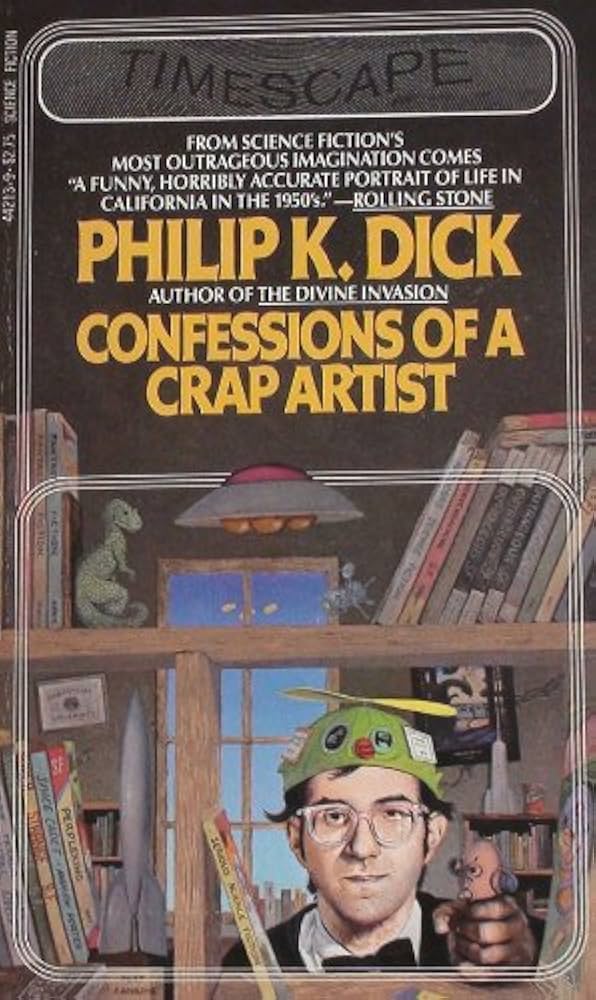
No matter how much I criticize science fiction, I can never forget how much Heinlein’s juveniles meant to me as a kid. I could write a satire on the genre, but I hope I wouldn’t do what Malzberg did in Herovit’s World, by making it all feel slimy and depressing. One reason why my favorite Philip K. Dick novel is Confessions of a Crap Artist is even though it criticizes science fiction fans, it does it with love. It’s a superior recursive science fiction novel.
James Wallace Harris, 2/11/25
 Classics of Science Fiction
Marvelous piece with some fine insights. Reading Malzberg — especially his nonfiction — requires an ability to digest a lot of grumpiness.
LikeLike
That’s a good way of putting it. Poor old Barry Malzberg was grumpy.
LikeLike